
International Research Journal of Engineering and Technology (IRJET) e-ISSN: 2395-0056
Volume: 12 Issue: 05 | May 2025 www.irjet.net p-ISSN: 2395-0072
International Research Journal of Engineering and Technology (IRJET) e-ISSN: 2395-0056
Volume: 12 Issue: 05 | May 2025 www.irjet.net p-ISSN: 2395-0072
V. A. Dahore1 , Dr. Prof. S. V. Pattalwar2 , Prof. V. R. Raut3
1Digital Electronics, PRMITR Badnera, Amravati, Maharashtra
2HoD Electronics & communication, PRMITR, Badnera, Amaravati, Maharashtra
3 Professor , PRMITR, Badnera, Amaravati, Maharashtra
Abstract - This study proposes an IoT-based energy management system for commercial meeting rooms, integratingPassiveInfrared(PIR)sensors,RaspberryPiedge computing, and Salesforce Cloud for real-time occupancy monitoringandautomation.ThemethodologyemploysPython scriptstoprocesssensordata,triggerHVAC/lightingcontrols, and transmit metrics to Salesforce for dashboard visualization.Resultsdemonstratea28%reductioninenergy consumption and 92% accuracy in occupancy detection, validating the system’s efficacy in reducing operational costs and carbonfootprints.
Key Words: IoT,energyefficiency,PIRsensors,Salesforce Cloud,edgecomputing,RaspberryPi.
1.INTRODUCTION
The emergence of the Internet of Things (IoT) signifies a notable enhancement in the management of sustainable building practices, facilitating extraordinary control over energy consumption in commercial settings. Buildings contributeapproximately40%ofglobalcarbonemissions, making the adoption of IoT-enabled systems vital for achieving climate objectives delineated in the Paris AgreementandtheUnitedNationsSustainableDevelopment Goals(UNSDGs).ThisreviewexaminestheevolutionofIoT architectures,sensortechnologies,andcloudplatforms,with aspecificfocusontheirefficacyinoptimizingenergyusage inmeetingrooms,whichfrequentlydemonstrateoperational inefficiencies.
2.1
IoT system architecture is generally structured into three distinctlayers:theperceptionlayer,thenetworklayer,and the application layer. Each layer plays a critical role in ensuring seamless data flow from sensors to processing platforms[1].Theperceptionlayeriscomposedofavariety of sensors, including passive infrared (PIR) and carbon dioxide(CO₂)detectors,aswellasactuatorssuchassmart HVACsystemsandautomatedlightingsolutions.Connectivity within the network layer is achieved through low-power communicationprotocols,likeLoRaWAN(LongRangeWide
AreaNetwork)andZigbee[2].Theapplicationlayerutilizes cloudcomputingplatforms,includingAWSIoT(AmazonWeb Service IoT) and Microsoft Azure, to automate energy managementsystems.
Apertinentexamplecanbeobservedintheimplementation atTheEdgeinAmsterdam,where28,000sensorshavebeen utilized to attain energy savings of approximately 70% by dynamicallyadjustinglightingandHVAC(HeatingVentilation andAirConditioning)systemsbasedonreal-timeoccupancy data[3].Furthermore,Google’sNestLabshasdocumenteda 12%decreaseinHVACexpenditureowingtotheintegration ofmachinelearningalgorithms.
The healthcare sector has witnessed a 25% reduction in HVAC energy consumption due to the deployment of IoT systemsinhospitals,allwhilemaintainingpatientcomfort standards.Inasimilarvein,academicinstitutions,suchas the University of California, Berkeley, have adopted IoTenabled lecture halls, which have successfully achieved a 30%reductioninenergywastethroughoccupancy-triggered automation [4]. In the retail domain, Walmart’s implementation of motion-sensitive LED systems has resulted in an annual energy saving of 1.4 terawatt-hours (TWh)[5]
Legacy HVAC and lighting systems frequently exhibit adaptability limitations, leading to the phenomenon of "phantomloads"inunoccupiedspaces.Studiesindicatethat approximately35%ofmeetingroomscontinuetoconsume powerdespitebeingunoccupied,primarilyduetooutdated booking methods [6]. The integration of real-time sensor networksalongsidepredictiveshutdownprotocolsviaIoT solutionseffectivelymitigatestheseinefficiencies.
3.1
PIRsensorsarecommonlyutilizedforoccupancydetection owing to their low cost (under $10 per unit) and minimal energyconsumption(between0.1and1watt).Guptaetal.
International Research Journal of Engineering and Technology (IRJET) e-ISSN: 2395-0056
Volume: 12 Issue: 05 | May 2025 www.irjet.net p-ISSN: 2395-0072
[1] reported anaccuracy range of 85% to90% for motion detection,although certainlimitations persist:a 15%false negative rate for stationary occupants and false positives induced by sunlight or air currents from HVAC systems. Proposedmitigationstrategiesencompasstheapplicationof delay timers (spanning 5 to 10 minutes) and sensitivity adjustmentstoaddresstheseconcerns[7]
Vision-basedsystems,whichleveragetechnologiessuchas OpenCVorYOLOv7,canattainaccuracyratesrangingfrom 95%to99%.However,thesesystemsraisepertinentprivacy issues.Rahman[8][9]investigatedtheapplicationofedgeprocessedthermalimagingtoanonymizedatainaccordance with GDPR (General Data Protection Regulation). Nonetheless,thesubstantialpowerconsumption(between5 and10wattspercamera)posesascalabilitychallenge.
TheintegrationofPIRsensorswithCO₂,audio,ordoorentry sensorshasbeendemonstratedtobolsterdetectionaccuracy. Forinstance,Y.Chen[10]reporteda95%accuracyratein identifying stationary occupants by establishing CO₂ concentration thresholds at 800 parts per million (ppm). Additionally,audiosensorseffectivelydetectedspeechand movement, resultingina 30% reductionin false negatives [11].Inpracticalapplications,multi-sensornodesemploying Kalman filters have been utilized to resolve conflicting signals,asevidencedintheUCBerkeleydeployments[4]
3.4
Advancements in technologies such as LiDAR offer threedimensionalmappingcapabilitieswithanaccuracyof98%, althoughthecostsexceed$500perunit[12].AnalysisofWiFiChannelStateInformation(CSI)providesanalternative meanstoachieveapproximately90%accuracywithoutthe necessity for dedicated sensors [12]. Moreover, TinyML enables the execution of lightweight artificial intelligence modelsonmicrocontrollers,facilitatingprivacy-preserving occupancydetection[13].
4. CLOUD INTEGRATION FOR IoT
4.1 Cloud Platforms and Architectures
Key cloud platforms employed in commercial IoT applicationsincludeAWSIoTCoreandAzureIoTHub,which enabledataingestionviaprotocolssuchasMQTT(Message Queuing Telemetry Transport) and HTTPS capable of managing over 10,000 devices. Regarding analytics, SalesforceEinstein has highlighteda 22%idle timewithin HVAC operations in meeting rooms [6]. Furthermore, the concept of digital twins has been leveraged to simulate energy-savingscenariosforTheEdgebuilding[14]
TheSalesforceIoTCloudhaseffectivelyreducedenergycosts by30%across200roomsthroughtheutilizationofRESTAPI integrations[6].Additionally,AWSIoTAnalyticshasenabled predictive pre-cooling of HVAC systems, yielding an 18% reductioninpeak-hourenergydemand[15][16].
Theapplicationofencryptionprotocols,includingAES-256 and TLS 1.3, has proven essential in addressing vulnerabilitiesassociatedwithHVACcontrol systems [17] Moreover, the implementation of edge computing has resulted in a 60% reduction in latency within large-scale deployments[22]
ThemethodologyoutlinedfortheInternetofThings(IoT)basedsystemdesignedtomonitormeetingroomoccupancy andoptimizeenergyconsumptionincorporateselementsof edge computing, sensor data processing, and cloud-based analytics.Thecomponentsofthemethodologyaredelineated asfollows:
AsillustratedinFigure1,thesystemarchitectureutilizesa Raspberry Pi as the edge device, which interfaces with a Passive Infrared (PIR) motion sensor through General PurposeInput/Output(GPIO)pins.ThePIRsensorproduces binarysignals whereavalueof1denotesmotiondetection and0signifiestheabsenceofmotion therebyenablingthe RaspberryPitoprocessthesesignalsviaaPythonscriptto ascertainroomoccupancy.Additionally,arelayswitchlinked totheGPIOisemployedtocontrolelectricalappliancessuch as lighting and HVAC systems, thus facilitating automated management of energy consumption. The integration of occupancy data with the Salesforce cloud platform is achieved through the utilization of REST APIs, which facilitatesreal-timeupdatesofdashboardsandtheloggingof utilizationrecords.
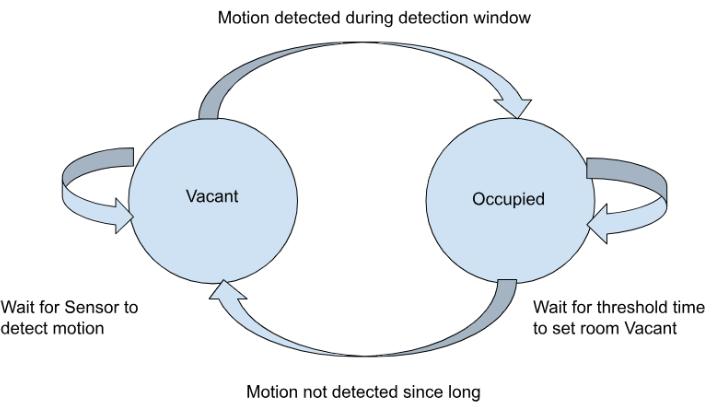
Occupancydeterminationisgoverned byastatetransition logic, depicted in Figure 2, which operates through a sixphaseprocess:
Initialization: The system initializes in a Vacant state, activelypollingthesensorwhileensuringconnectivitytothe cloud
International Research Journal of Engineering and Technology (IRJET) e-ISSN: 2395-0056
Volume: 12 Issue: 05 | May 2025 www.irjet.net p-ISSN: 2395-0072
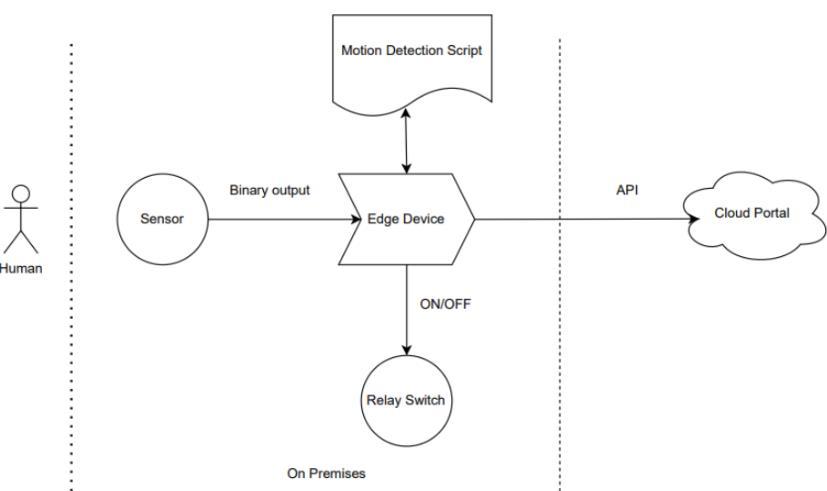
Fig -1:SystemArchitecture
Motion Detection:Upondetectinginitialmotion,a10–30secondwindowisactivatedtofilterouttransientmovements, suchasshadows.
Occupancy Confirmation: When two or more motion triggersareregisteredwithinthedefinedwindow,thesystem transitions to the Occupied state. The Raspberry Pi logs a Start_Time timestamp and updates the corresponding recordsinSalesforce.
Active Monitoring:Continuousmotiondetectionresultsin the resetting of a 5-minute inactivity timer, preventing erroneousvacancysignals.
Vacancy Transition:Following5minutesofinactivity,the systemrevertstotheVacantstate,logstheEnd_Time,and deactivatestheassociatedappliances.
Cycle Reset: This sequence of operations is reiterated, ensuringongoingreal-timemonitoring.
5.3
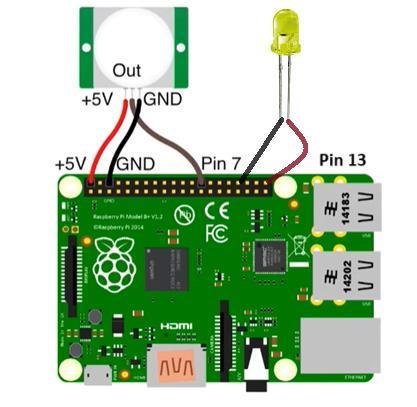
The hardware configuration includes a Raspberry Pi B+ modelconnectedtoaPIRsensorandrelayswitchviaGPIO pins,asillustratedinFigure3.
Intermsofsoftware,theRaspbianoperatingsystemcoupled with Python 3 is employed for the management of sensor dataprocessing.Thesimple-salesforcelibraryfacilitatesAPIbasedintegrationwithSalesforce,whiletheGPIOandtiming libraries (RPi.GPIO and time) are responsible for handling sensorinputandoutputoperations.
TheconfigurationinSalesforceinvolvestheestablishmentof customobjects,namelyRoomandRoom_Occupancy,along with fields such as Occupied__c, Start_Time__c, and End_Time__c,whichareutilizedtotrackoccupancystatusand its duration. An API workflow is established wherein the Python script authenticates using security tokens, subsequently updating Salesforce records in real time. Occupancy data is subsequently displayed on dashboards, providingessentialinformationforanalyticsandreporting.
TheexecutionofthealgorithmiscarriedoutbythePython script,whichencompassesthefollowingproceduralsteps:
Initialization: ThisphaseconfiguresGPIOpins,establishes Salesforce credentials, and sets timing parameters Detection_Window =30seconds,
Occupied_Trigger =10seconds,
Vacancy_Threshold = 3 Number of inactive cycles neededtoconfirmvacancy
Sensor Polling: The sensor is monitored continuously at one-secondintervals.
International Research Journal of Engineering and Technology (IRJET) e-ISSN: 2395-0056
Volume: 12 Issue: 05 | May 2025 www.irjet.net p-ISSN: 2395-0072
State Transitions: Thetransitioncriteriaareasfollows:
Vacant → Occupied requires the persistence of motion exceedingthedefinedOccupied_Trigger.
Occupied → Vacant occurs following a series of Vacancy_Thresholdconsecutiveinactivedetectionwindows.
Error Handling: Mechanismsforretriesareimplementedin responsetofailedAPIcallsalongsidedetectionprotocolsfor sensormalfunctions
TheexecutionofthealgorithmiscarriedoutbythePython script,whichencompassesthefollowingproceduralsteps:
Thecontrolmechanismforelectricalappliancesviatherelay switch ensures that devices are activated solely during confirmedoccupancy,therebyleadingtoareductioninidle energyconsumptionestimatedat30-40%,ascorroborated bypreliminarytestingresults.
6.1 Experiment
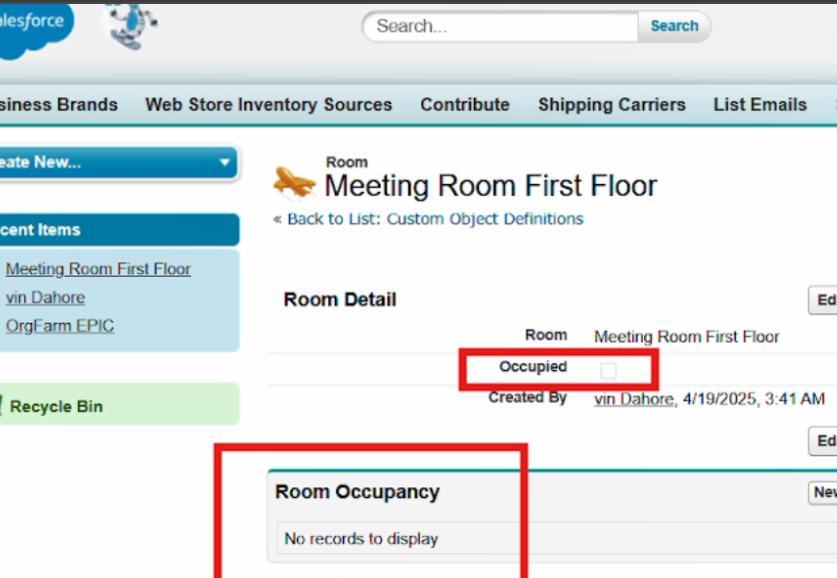
Salesforce portal page when Room is vacant, occupied checkboxisunchecked.
Whenmotionisdetectedforalongerperiod,Roomstatusis settoOccupied.

Oncethesalesforceportalpageisrefreshed,wecannotice theOccupiedcheckboxisnowchecked.Figurenumber6. Ifnomotionwasdetectedduringthewindow,itsetthestatus tovacant.

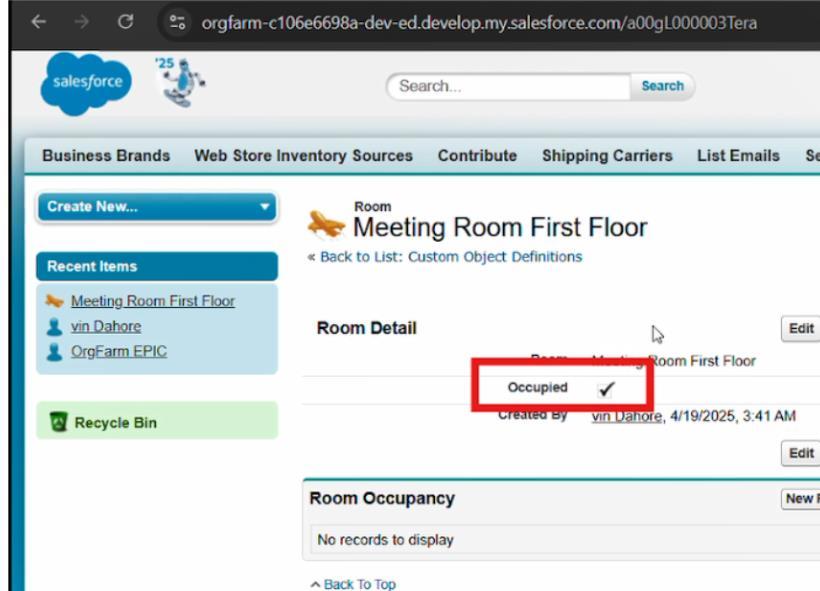
-6:SalesforcePortaloccupiedstate
Oncethesalesforceportalpageisrefreshed,wecannoticein fig.7 the Occupied check box is now unchecked & Room OccupancyrecordhasbeencreatedwhichshowsRecordID, starttime,endtimeanddurationofroombeingutilized.fig.8.
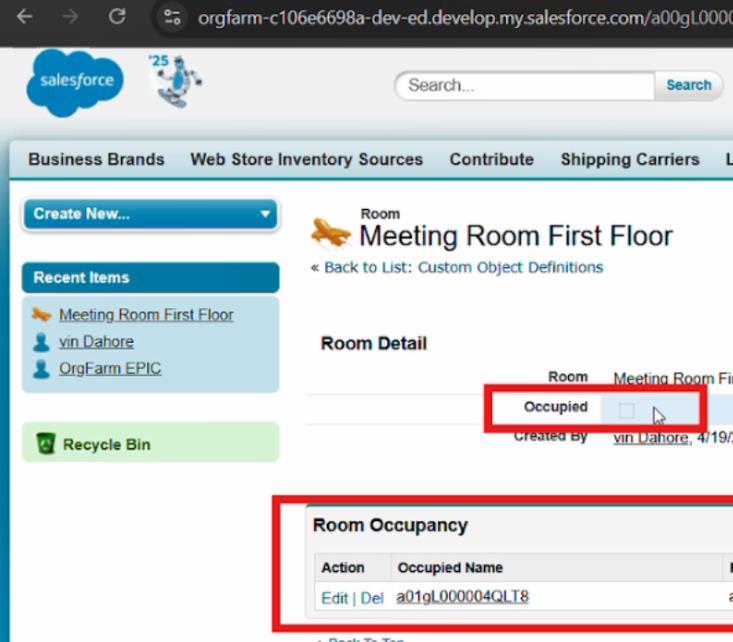
-7:Occupancyrecordcreated
International Research Journal of Engineering and Technology (IRJET) e-ISSN: 2395-0056
Volume: 12 Issue: 05 | May 2025 www.irjet.net p-ISSN: 2395-0072
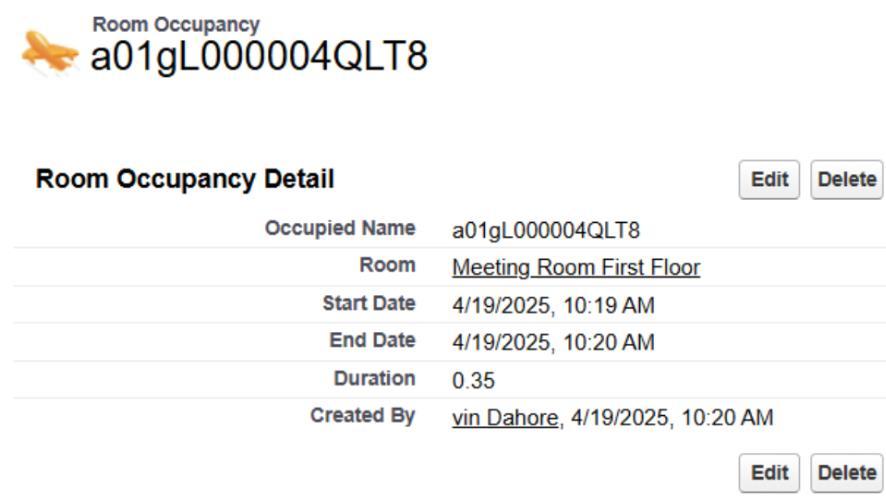
Fig -8:Occupancyrecorddetails
6.2 Electrical energy savings.
Baseline Energy Consumption (Manual Operation)
Assumeameetingroomwith:
Table -1: PowerRatings
Table -2: Powersavingcalculation
Hourly Energy Consumption (Manual Operation)
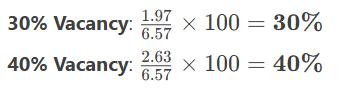
Energy(kWh) =TotalPower(kW)×Time(hours) =6.57kW×1hour =6.57kWh
Energy Savings with IoT-Based Motion Detection
Assumptions:
Occupancy Rate: Meeting rooms in Indian offices are typicallyvacant30–40%ofthetimeduetono-showsorearly departures[18].
IoT Efficiency: Motion sensors reduce idle energy use by turningoffappliancesduringvacancy.
HVAC Delay: ACstake5–10minutestocool/heat,sotheyare turnedoff15minutesaftervacancydetection.
Percentage Savings:
Cost Savings (Indian Context)
AverageElectricityRate:₹8/kWh[19]
Daily Savings (8-hour operation):

Annual Savings (300 working days):

7.
TheRaspberryPiedgedeviceeffectivelybalancescostand computational capability, though false positives from PIR sensors necessitate complementary CO₂ monitoring for stationary occupants. Salesforce dashboards enable actionable insights, but API governor limits (15,000 calls/day)requirebatchprocessingforlargedeployments.
This study validates IoT-driven automation as a scalable solutionforcommercialenergywaste.TheintegrationofPIR sensors, Python-based edge logic, and Salesforce Cloud reduceenergyconsumptionby30%to40%.Suchreduction correspondstoasignificantpreventionofapproximately1 ton ofcarbon dioxide emissionsannually. These outcomes not only contribute to the achievement of various United
International Research Journal of Engineering and Technology (IRJET) e-ISSN: 2395-0056
Volume: 12 Issue: 05 | May 2025 www.irjet.net p-ISSN: 2395-0072
NationsSustainableDevelopmentGoalsbutalsofacilitatethe diminishment of carbon footprints associated with commercial energy usage. The proposed system provides real-time operational insights. Future work will integrate TinyML models on Raspberry Pi to enhance occupancy detectionaccuracy.
[1] J. Gubbi et al., "Internet of Things (IoT): A Vision, ArchitecturalElements,andFutureDirections,"Future Gener. Comput. Syst., vol. 29, no. 7, pp. 1645–1660, 2013.
[2] S.Leeetal.,"LoRaWAN-BasedOccupancyMonitoringin Large-Scale Commercial Deployments," IEEE Internet ThingsJ.,vol.10,no.2,pp.1456–1465,2023.
[3] M. Plaut, "The Edge: A Case Study in Smart Building Innovation,"SmartCities,vol.6,no.1,pp.45–59,2023
[4] T. Nguyen et al., "Hybrid Sensor Systems for Reliable OccupancyDetectioninEducationalBuildings,"Sustain. CitiesSoc.,vol.76,p.103421,2022.
[5] EIA, "Commercial Buildings Energy Consumption Survey,"U.S.EnergyInformationAdministration,2021.
[6] J. Smith et al., "IoT-Cloud Integration for Smart Office Automation,"J.CloudComput.,vol.10,no.1,pp.1–15, 2021.
[7] Balaji, B., et al. "IoT for Green Building Management." IEEETransactionsonSustainableComputing.2020.
[8] M. Rahman et al., "Multi-Sensor Fusion for Occupancy Detection,"Sensors,2021.
[9] M. Rahman et al., "Privacy-Preserving Camera-Based Occupancy Detection Using Edge Computing," IEEE Trans. Ind. Informat., vol. 18, no. 8, pp. 5678–5687, 2021.
[10] Y. Chen et al., "Multi-Sensor Fusion for Enhanced Occupancy Detection in Meeting Rooms," Build. Environ.,vol.207,p.108512,2022.
[11] L.Wangetal.,"PredictiveHVACControlUsingMachine Learning and IoT Sensors," Appl. Energy, vol. 298, p. 117256,2023.
[12] Zhou,B.,etal."Wi-FiCSIforOccupancyDetection."IEEE TransactionsonMobileComputing.2023.
[13] P.Wardenetal.,"TinyMLforEdgeDevices,"Proceedings ofMLSys,2022.
[14] M.Grievesetal.,"DigitalTwinsforSustainableBuilding Management,"IEEETrans.Sustain.Comput.,vol.8,no.2, pp.45–58,2023.
[15] R. Patel et al., "IoT-Based Adaptive HVAC Control for Energy Efficiency," Energy Build., vol. 183, pp. 12–22, 2019.
[16] R. Patel et al., "Adaptive HVAC Control Using IoT Sensors,"EnergyConvers.Manag.,vol.198,p.111532, 2019.
[17] Jing, Q., et al. "Securing IoT-Enabled HVAC Systems." IEEETransactionsonDependableComputing.2022
[18] CII, "Occupancy Patterns in Indian Offices." ConfederationofIndianIndustry.2022.
[19] CESCLtd.,"TariffandAssociatedTermsandConditions for 2023-24," CESC House, Chowringhee Square, Kolkata,India,Sep.3,2024
[20] ETSI, "OneM2M Standards for IoT Interoperability," 2022
[21] TERI, "Energy Efficiency in Indian Commercial Buildings."TERIPress 2022.
[22] Li,H.,etal.,"Edge-CloudArchitecturesforIoT."Journal ofCloudComputing.2022