
International Research Journal of Engineering and Technology (IRJET) e-ISSN: 2395-0056
Volume: 13 Issue: 04 | Apr 2026 www.irjet.net p-ISSN: 2395-0072
IOT-BASED LOW-COST SMART WATER LEVEL MONITORING AND MOTOR CONTROL SYSTEM FOR DOMESTIC APPLICATION
Priyanshu Roy1, Sahil2, Sagar Jangra3 , Nitin Malik4
1, 2, 3
BCA student, School of Engineering and Technology, Sushant University, Gurugram, Haryana, India
4 Associate Professor and Dean, School of Engineering and Technology, Sushant University, Gurugram, Haryana, India
Abstract - This research paper presents the design and development of anIoT-basedprojectwhichfocusesonlow-cost smart water level monitoring along with a motor control system for domestic houses. The system that we have designed focuses on the digital approach of how we can implement a water monitoring and management system that uses our mobile device for monitoring and manage that system. In the research project we use a NodeMCU to establish system connection to user mobile through the Blynk application, through the application the user willbeabletoremotelycheck the water level , also the user can perform motor (ON/OFF) operation using the application. The application will also provide notification when the water level reaches critical stages i.e., “low or high” This research provides a lost cost water management and tracking solutionthatisboth efficient and low-cost that can be used to monitor water level for overhead tank and also remotely control motor operation in domestic households.
Key Words: Low Cost, Efficient, , NodeMCU, IoT, Water Monitoring, Motor Control
1. INTRODUCTION
Waterisoneofthemostimportantandvaluableresourcein theworldandisneededandwillbeneededalsolongaslife existsonearth. Weashumansused itinoureverydaylife from drinking it to washing our laundries from it in our everyday lives. It is estimated that about 71% of earth’s Surfaceiscoveredinwater andaround96.5%ofthatwater issaltwater. Whichcannot be directlyusedtodrink. This leavesonlyasmallfractionoffreshwateravailableforuse, makingefficientwatermanagementaveryimportanttopic.
Furthermore,inIndiathesituationismorechallenging the countrywiththehighestpopulationintheworldcurrently andgrowing everyyearrapidlysoinIndiathedemandfor water will naturally increase as well. With this huge populationneedforwaterandsustainingtheavailablewater becomes a significant concern We have already seen metropolitan cities with high population density like Bengaluru and areas in the capital of the country Delhi is alreadyfacingwatershortagesanddrywaterreserves.This highlightstheneedforminimizewaterwastageandawater managementsystemthattrackthewaterlevels.
Atthesametimethecountryhasseenrapidinternetgrowth with an estimate around 55 to 65% of India’s population uses internet which is around every 6 in 10 Indians use internetAroundofwhich95%accessinternetthroughtheir mobilephones.Butstill Indiandomestichouseholdsusetraditionalmanualsystem forthingssuchasmotoroperationsorwatermonitoring.
Overhead tanks in households at times might overflow at duetonegligence,whichresultinmotorbeingturnedonfor more time than it should which results in wastage of electricityandwateroverflowwhichiswaterwastage.
To address this issue this research proposes a low-cost InternetofThings(IoT)-basedwatermonitoringandmotor control system. This system allows a user to operate the water motor and get the current water level indications through remote access which will be the Blynk iot applicationthroughtheinternet.
It eliminates the use of physical operations of motor. The physicalwaterlevelmonitoringisnolongerneededitcanbe seen through the Blynk iot application, so the water monitoringisalsoautomated.Ifthewaterlevelgetscritical it either when the water is too high in tank or too low it sends a notification to the user and also the motor turns itself off.Currentresearchesinthisfieldfocusesonsimilar resultthat increasesthe efficiencyandreduceswater and powerwastagebutotherexistingresearchesbearahigher Cost to make a working model. The primary focus of this research is to provide a cost effective and efficient model that much lower in cost and can be easily adopted by householdscomparedtoothers..Whiletheproposedmodel offersaffordabilityandfunctionality,thereremainsscopefor furtherimprovementsandenhancements.
2. METHODOLOGY
Thisprojectinvolvesthefollowingcomponentsthatareused inimplementingit.
I. Esp8266 Node MCU microcontroller- It is a microcontrollerthatisusedtoexecutethegiventasks thatareprogrammedinit.Itcanbeconsideredasthe brainoftheproject.Esp8266withthehelpofArduino IDE and C++ programming language the instructions
International Research Journal of Engineering and Technology (IRJET) e-ISSN: 2395-0056
Volume: 13 Issue: 04 | Apr 2026 www.irjet.net p-ISSN: 2395-0072
that are to be given to it are prepared. Then a data transfercableisusedtotransferthewrittenprogramto themicrocontroller
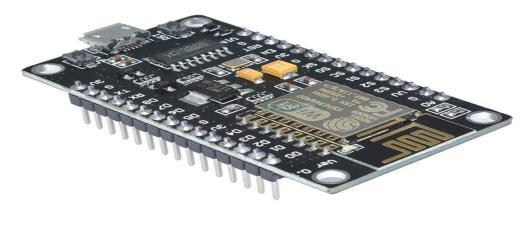
Fig-1:imageofesp8266NodeMCUusedinsystem
ii.HC-SR04 Ultrasonic Sensor-Itisa4pin ultrasonic sensor that is used to measure water levels. It emitssoundwavesandmeasuresthetimeittakesforecho toreturn,which isdirectlyproportionaltothedistanceto thewatersurface.Theequationforcalculatingthedistance is.


Fig2:Imageof HC-SR04ultrasonicsensorusedinsystem
iii.Relay module-The relay module acts as an electrical switchandcontrolsthemotor basedonthewaterlevel.

Fig-3:Imageofrelaymoduleusedinsystem
iv.Blynk App-Itisamobileapplicationthatactsasremoteto dooperationsofthemotorandseethecurrentwaterlevel throughtheapp.
3. RESULTS & DISCUSSIONS
Theprojectwassuccessfullyimplementedandtested.
Water motor was able to transfer water from its water source to the water tank and was operable throughBlynk
Waterlevelinthetankwasaccuratelydetectable
The ultrasonic sensor accurately measured the waterlevelandgaveoutputontheblynkapp
The Blynk application provided notification after waterlevelsarecritical
Motorturnedoffwhenwaterlevelreachescritical stages
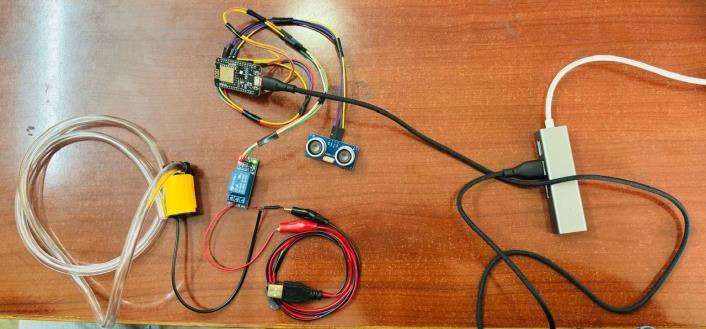
Fig-4:Experimental setup of system
Fig-4imageshowstheprototypeversionofimplementingthe system
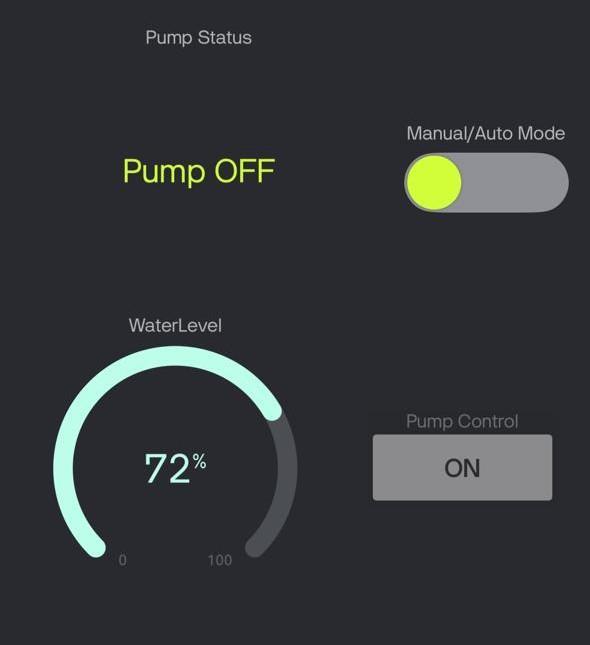
Fig-5:Current water level indication through Blynk app
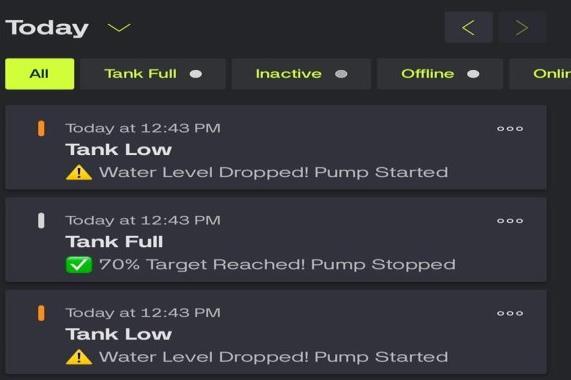
Fig-6:Notification of critical water levels in Blynk app
International Research Journal of Engineering and Technology (IRJET) e-ISSN: 2395-0056
Volume: 13 Issue: 04 | Apr 2026 www.irjet.net p-ISSN: 2395-0072
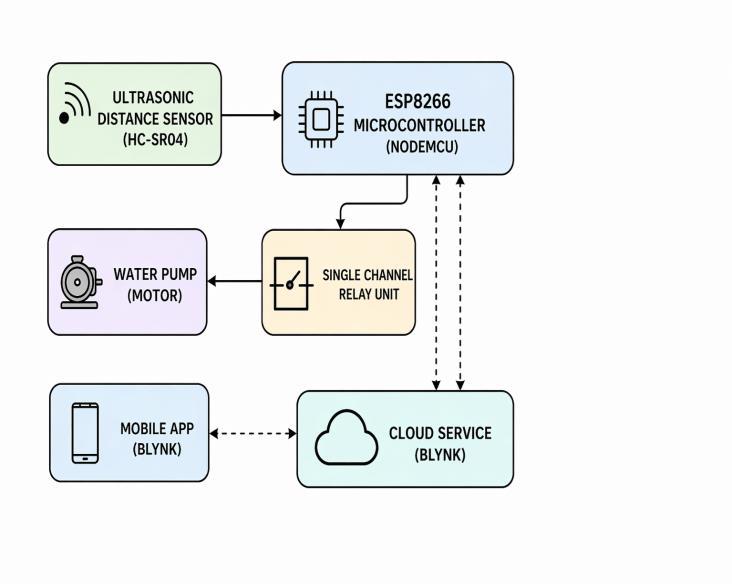
Fig-7:Ablockdiagramofthesystem(adaptedfrom[2])
Table-1: Status of water level based on the Blynk app(adaptedfrom[2])
Sl.no. Device status Motor pump status Water level Status of the water level in Blynk
1 Online On 0% to >70% Waterlevelstarts increasing
2 Online On <70 Water level stops increasing
3 Online Not working Thesame Notavailable
Table-1 demonstratestheworkingofthewaterpumpand itscorrespondingwaterlevelstatusfromtheblynkapp. Italsohighlightsthemotorstoppingandstarting atcriticallevels.
4. CONCLUSIONS
Thisprojecthassuccessfullydesignedandimplementedthe prototypeofasmart lowcostandefficient solutiontothe problemspresented.Theprototypeprovidesaccuratewater level monitoring and also provides remote water motor operating through blynk application improving user convenienceandreducemanualefforts
The prototype displayed a reliable and consistent performanceduringtesting,makingitsuitableforhousehold andsmall-scaleapplications.Itoffersapracticalsolutionto preventwateroverflowandwastage,contributingtobetter resourcemanagementandefficiency.
However, for large-scale implementation, further improvements are required, such as enhanced sensor durability,betternetworkstability,andmorerobustsystem integration.
Overall,theproposedsystempresentsacost-effectiveand scalableapproachtowardsmartwater managementusing IoTtechnology
REFERENCES
[1] I.G ABDULHAMID,A.I.BALARABE“Automatic level monitoring and control system” International ResearchJournal of Engineering,vol.6,issue 6,pp.710,2022.
[2] A.Banerjee, R.Paul, R.Saha Roy, D.Banik, S.K. Sinh, M.Maiti“Smartwatertanklevelmonitoringandmotor pumpcontrollingsystemusinginternetofthings(iot)for preventing water wastage” International Research Journal of Engineering and Technology (IRJET) ,vol.12,issue6,pp.1254-1260,2025.