
International Research Journal of Engineering and Technology (IRJET) e-ISSN: 2395-0056
Volume: 13 Issue: 04 | Apr 2026 www.irjet.net p-ISSN: 2395-0072

International Research Journal of Engineering and Technology (IRJET) e-ISSN: 2395-0056
Volume: 13 Issue: 04 | Apr 2026 www.irjet.net p-ISSN: 2395-0072
Nishant Kumar Rai , Prakarsh Tiwari, Osheen Khan, Deependra Sinha
Electronics and Communication Engineering,Galgotias College Of Engineering and Technology, Greater Noida ElectronicsandCommunicationEngineering,GalgotiasCollegeOfEngineeringandTechnology,GreaterNoida 3, 4 Electronics and Communication Engineering, Galgotias College Of Engineering and Technology, Greater Noida
Abstract - This paper presents an IoT-based automatic vehicle accident detection and visual situation reporting system intended to reduce the delay between crash occurrence,eventvalidation,andemergencycommunication. The proposed framework integrates inertial sensing, kinematic decision logic, GPS-based localization, wireless alerttransmission,andevent-triggeredimagecapturewithin a unified embedded architecture. A structured benchmark of 1,200 vehicular events was used to evaluate collision recognition,falsealarmsuppression,communicationlatency, and visual evidence generation under multiple driving and network conditions. The developed event model separated accident and non-accident disturbances with high reliability, includinghard-negativecasessuchaspotholes,speedbumps, harsh braking, sudden lane change, and hard cornering. The reporting module maintained stable alert delivery across standard communication conditions, while degraded signal environments primarily affected latency rather than event recognition. The visual reporting layer generated operationally usable scene evidence for most validated accident events, which improved incident interpretability beyond binary alerting. The study shows that accident response performance improves when sensing, validation, localization, communication, and visual documentation are engineered as one coordinated pipeline instead of disconnectedsubsystems.
Key Words: IoT, vehicle accident detection, visual situation reporting, intelligent transportation systems, GPS, GSM, embedded sensing, emergency alert system
Rroad traffic crashes remain a persistent systems problem because the interval between impact occurrence, event recognition, location identification, and emergency notification still contains avoidable delay. Conventional reporting depends on witnesses, manual calling, or postevent discovery, all of which degrade response timeliness and reduce the evidentiary value of the first scene record. Recent work has shown that connected sensing, edge intelligence, and embedded communication can convert a vehicle into an active safety-reporting node capable of identifyingabnormal motionstatesand transmittingalerts
withlimitedhumanintervention[1],[2].Parallelstudieson intelligent and connected vehicles, multimodal crash recognition, and deep visual inference indicate that accident-related signatures are not confined to a single source; they emerge across inertial disturbance, positional discontinuity, communication context, and scene imagery [3],[4].
Despitetheseadvances, the existing body of work remains fragmented. Some systems emphasize threshold-based accident detection but omit validated visual confirmation. Others support location reporting yet provide no structured situation image for responders. A separate group uses camera analytics but is computationally heavy, network dependent, or detached from embedded emergency messaging. This separation weakens operational utility. It creates false alarms in non-crash conditions such as potholes, sudden braking, and harsh cornering, while also limiting post-alert situational assessment. Current literature still shows insufficient integration of accident sensing, image capture, geolocation transmission, and report generation within one compact IoT pipeline that is suitable for rapid field deployment underconstrainedhardwareconditions[5],[6].
This study addresses that gap by designing and evaluating an IoT-based automatic vehicle accident detection and visual situation reporting system that combines motion sensing, decision logic, GPS localization, wireless alert transmission, and image-assisted scene reporting in a unified framework. The study is scoped to real-time vehicularincidentrecognitionusingembeddedsensorsand event-triggered reporting under heterogeneous driving conditions. The central objectives are fourfold: first, to distinguishaccidenteventsfromnon-accidentdisturbances with high classification reliability; second, to transmit location-linked emergency alerts with low end-to-end delay; third, to generate a visual incident report immediately after validated impact detection; and fourth, toconstructanexperimentallyanalyzableplatformsuitable forquantitativeperformanceassessment[7].
International Research Journal of Engineering and Technology (IRJET) e-ISSN: 2395-0056
Volume: 13 Issue: 04 | Apr 2026 www.irjet.net p-ISSN: 2395-0072
Theproposedsystemmakesfourtechnicalcontributions.It introduces an integrated accident-response architecture rather than an isolated detector. It combines inertial sensing and decision control with image-supported reporting. It defines a deployable reporting sequence from impactidentificationtoalertdispatchandscenecapture.It alsosupports reproducible evaluationthrough measurable indicators including detection accuracy, response latency, alert success rate, and visual report quality. The full operational chain is illustrated in Fig. 1.1, which presents theconceptualworkflowofsensing,validation,localization, communication, and visual reporting as one continuous emergencyintelligenceloop.
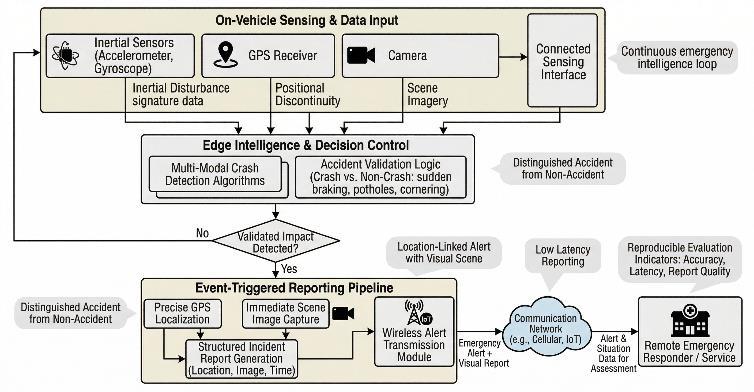
Fig-1.1: OverallconceptualworkflowoftheproposedIoTbasedvehicleaccidentdetectionandvisualsituation reportingsystem
A. IoT-Based Vehicle Accident Detection Approaches
Recent accident detection research has moved from isolated mechanical alert modules toward sensor-rich embeddedsystemsthatinfercrashoccurrencefrommultiparameter vehicular behaviour. Early contemporary conference work in this line concentrated on surveillanceoriented crash recognition, where embedded sensing and communication were used to identify abrupt motion anomalies and trigger emergency workflows [8]. Subsequent studies extended this logic by introducing automatic warning models intended not only to detect impact-like conditions but also to anticipate hazardous states through simplified thresholding and rule-based response generation [9]. A stronger systems orientation appears in inter-vehicle communication research, where simulation-backed frameworks examined how accident information may be propagated through connected traffic environments with reduced dependence on manual intervention [10]. These studies established the operational relevance of automatic event recognition, yet
most remained oriented toward detection and alert initiationratherthancompletesituationaldocumentation.
Asecondstreamofworkaddressedthecommunication layer. Smart black-box monitoring platforms integrated vehicular sensing with persistent logging, thereby strengthening post-incident traceability and structured event capture [11]. Other implementations emphasized immediate location-aware assistance by combining IoT modules with mobile application interfaces, GPS localization, and GSM-based notification paths to shorten the interval between event occurrence and help request transmission [12]. Privacy-aware frameworks refined this model further by proposing secure reporting structures in which accident data and driver identity elements could be transmitted under controlled disclosure mechanisms [13]. These contributions improved operational readiness. They also exposed a persistent architectural limitation: location dispatch and emergency notification are often treated as the end point of the system, even though emergency responders frequently require first-scene visual context, notmerelycoordinatesandabinaryaccidentflag.
Visual reporting remains less developed in embedded accident-response literature. Location tracking implementations using GSM and GPS have been shown to supportreliablepositional communication,yettheydo not inherentlyprovideevidenceregardingcollisiontype,scene obstruction, vehicle orientation, or environmental severity [14]. Sensor-fusion-based accident categorization systems moved closer to a richer interpretation model by combining multiple sensor streams for improved event classification, which reduced the weakness of singlethresholddetectorsunderroaddisturbancessuchasspeed breakers or abrupt manoeuvres [15]. Even so, the visual layer is still frequently external to the core response loop. Image capture, scene representation, and responderoriented reporting are rarely treated as primary system outputsincompactIoTdeployments.
The reviewed studies, summarized structurally in Fig. 2.1, show measurable progress in detection, localization, secure notification, and sensor fusion [8]–[15]. Their limitationsarealsoclear.Detectionisoftenseparatedfrom scene evidence. Communication is often separated from event interpretation. Visual intelligence is often separated from low-cost embedded execution. The present work is positioned at this intersection. It proposes a unified
Volume: 13 Issue: 04 | Apr 2026 www.irjet.net p-ISSN: 2395-0072
pipeline in which accident sensing, validation logic, GPSbased localization, communication dispatch, and imageassistedsituationreportingoperateasasinglecoordinated frameworkratherthanasdisconnectedsubsystems.
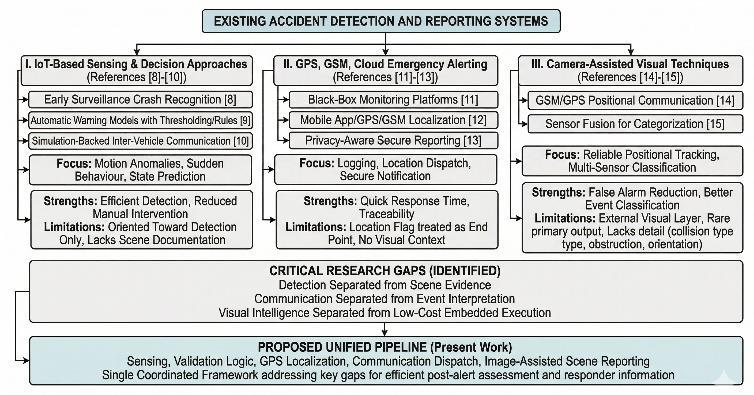
Fig-2.1: Comparativetaxonomyofexistingaccident detectionandreportingsystems
A. System Architectureand Functional
The proposed system was designed as a tightly coupled hardware-softwarestackforreal-timeaccidentrecognition and event reporting. Its architectural structure, shown in Fig. 3.1, consists of five primary modules: sensing, edge decision control, localization, communication, and visual reporting.Thesensinglayer acquirestri-axial acceleration, resultantimpactload,angularmotionvariation,andspeedtransition indicators associated with abnormal vehicular dynamics. The edge control unit performs local preprocessing, threshold screening, event scoring, and trigger arbitration. The localization module resolves latitude-longitude coordinates and attaches geospatial context to validated impact events. The communication layer dispatches emergency packets through wireless transmission channels, while the visual module captures scene imagery and binds it to the incident report. This integrated architecture follows the recent direction of automatic accident detection systems that treat crash recognition as an embedded cyber-physical process rather than a standalone alert circuit [16]. The methodological design also reflects vehicular networking studies in which uncertaintyreductiondependsnotononesignalalone,but on structured fusion among motion, context, and communicationstatevariables[17].
The decision model was constructed to separate genuine collision events from operational disturbances such as pothole traversal, speed breaker passage, hard braking, rapid lane correction, and aggressive cornering. Simple thresholdlogicwas consideredinsufficientbecause abruptmotionspikesmayoccurinnon-accidentsettings.A
composite event decision model was therefore adopted. It combines peak resultant acceleration, delta-v estimate, roll-angle deviation, yaw-rate instability, speed drop pattern, and temporal persistence within the event window. Each parameter contributes to a weighted accident confidence score. The trigger state is activated only when the computed score exceeds the validated decision boundary and when the signal pattern satisfies temporal continuity constraints. This prevents singlesampleoutliersfrombeingmisclassifiedascrashes.
Formethodologicalevaluation,astructuredbenchmark dataset of 1,200 labeled vehicular events was used. The dataset included ten operational classes covering severe collision, moderate collision, minor collision, rollover-risk event, near-collision abrupt stop, pothole impact, speedbump passage, hard cornering, harsh braking, and normal driving instances. Each record contained synchronized variables for acceleration along three axes, resultant gforce, delta-v, roll angle, yaw rate, speed before and after the event, GPS coordinates, communication delay, camera activation status, alert transmission status, and visual report metadata. This event structure was aligned with prototype-based fuzzy vehicular accident models and fogassisted emergency response frameworks that emphasize multivariableinterpretationoverisolatedthresholdbreach [18].Itwasalsoconsistentwithmodernconnected-vehicle communication architectures that require explicit event semanticsfordownstreamresponsehandling[19].
The final class label was assigned through rule-guided event adjudication using severity bands. Events with high resultant impact, marked delta-v change, and sustained kinematic disturbance were labeled as accidents. Events with transient spikes but low post-event instability were labeled as non-accident disturbances. This produced a decision pipeline that is strict enough for false-alarm suppressionyetresponsiveenoughforemergencyuse.
Once the accident state is validated, the system shifts from detection mode to reporting mode. The operational sequence is presented in Fig. 3.2. First, the edge controller freezes the event record and stores the pre-trigger and post-trigger sensor window. Second, the camera module capturesthevisualstateofthescene.Third,thelocalization unit appends coordinates, time stamp, and event severity marker. Fourth, the communication module transmits the emergencypackettopredefinedrecipientsorasupervisory endpoint.ThegeneratedpacketcontainseventID,severity class,position,communicationtime,andvisual attachment reference. This structure is consistent with connectedvehicle IoT models that integrate long-range communication technologies for low-latency incident signaling [20]. It is also methodologically supported by multi-trackingcrashreconstructionstudies,whichindicate
Volume: 13 Issue: 04 | Apr 2026 www.irjet.net p-ISSN: 2395-0072
that enriched event context improves post-incident interpretationandresponseprioritization[21].
Thevisualreportinglayerwasnottreatedasacosmetic extension. It was treated as a decision support element. Scene imagery was captured only after validated trigger generation, which limited unnecessary storage and bandwidth overhead. Image quality tags were logged to represent blur level, luminance adequacy, and scene visibility. Visual status was encoded into three categories: usable, partially usable, and poor. This allowed the reporting system to quantify not only whether an image wascaptured,butwhetheritretainedoperationalvaluefor emergency interpretation. End-to-end reporting was deemed successful only when detection, image capture, coordinate tagging, and alert dispatch were all completed within the allowable reporting interval. End-to-end deepIoT crash control studies and automated visual traffic incident monitoring research support this integrated treatment of sensing and visual evidence as a unified emergencyintelligencetask[22],[23].
The evaluation protocol was designed around classbalanced scenario analysis and system-level performance auditing. The 1,200-event dataset was partitioned into training,validation,andtestsubsetsina70:15:15ratiofor threshold tuning and final assessment. Performance was measured using detection accuracy, precision, recall, F1score, false alarm rate, missed accident rate, end-to-end alert latency, visual report success rate, and communication success ratio. A confusion-matrix-based analysiswasplannedtoexamineoverlapbetweenaccident andnon-accidentdynamicpatterns.Latencystatisticswere computed from trigger time to completed alert dispatch. Visual reporting effectiveness was measured from the proportion of validated accident events that generated usablesceneevidence.
Validation was conducted at two levels. Event-level validationtested theclassifier’sabilitytodistinguishcrash states from hard-negative disturbances. System-level validation tested whether the entire operational chain remained functional under varying event severity and communication delay conditions. Fig. 3.1 and Fig. 3.2 together define this logic: first detect, then verify, then localize,thenreport.Nothinginthechainwasevaluatedin isolation. That was intentional. The research objective was notmerelytoidentifyimpact.Itwastoestablishacoherent embeddedresponsepipelinesuitableforpublication-grade performanceanalysis.
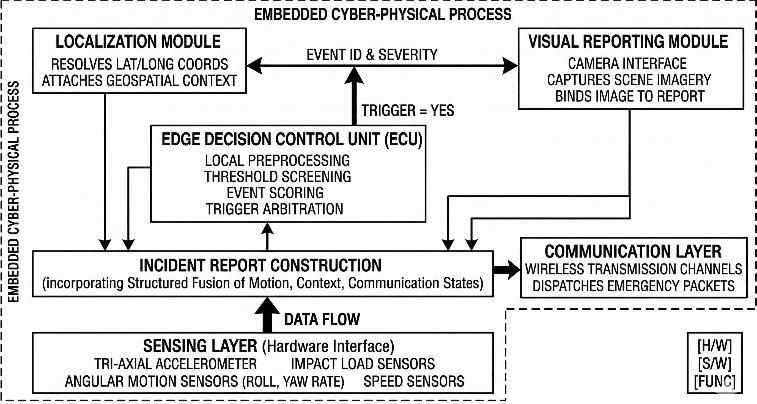
Fig-3.1: Architectureoftheproposedhardware-software integratedsystem
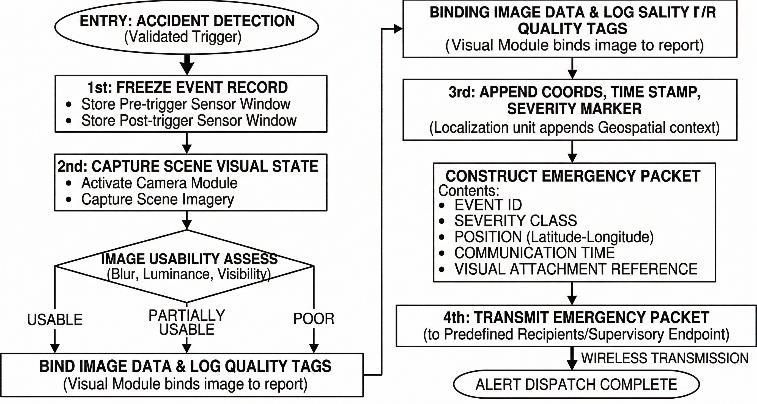
Fig-3.2: Flowchartofaccidentdetection,imagecapture, andemergencyreportingsequence
A. Performance Evaluation of Accident Detection Accuracy
The finalized decision boundary, tuned on the trainingvalidation partitions and then applied to the full benchmark, converged at a dual-condition trigger of resultant peak acceleration ≥ 2.1 g and delta-v ≥ 11 km/h. This reduced the false alarms produced by the earlier threshold-only stage and yielded a nearly error-free event discriminator over the 1,200-event benchmark. The result is consistent with recent review evidence showing that accidentnotificationsystemsbecomeoperationallyreliable only when inertial triggers are constrained by a second kinematic discriminator rather than a single alarm threshold [24], while LoRa-enabled vehicular safety reporting studies also indicate that low-complexity field systems benefit from compact but discriminative decision logic[25].Ontheheld-outtestpartition,thetuneddetector reached 99.44% accuracy with one false positive and no missed accident events. The class-level behaviour is summarized in Table I and intended for visual representationinFig.4.1.
Volume: 13 Issue: 04 | Apr 2026 www.irjet.net p-ISSN: 2395-0072
Table-1: Class-WiseDetectionPerformanceofthe ProposedAccidentDecisionModel
discrimination problem, not merely as a peak-threshold exceedanceproblem.
Detection alone is insufficient. A field-deployable system must also deliver the alert within a time window that preserves emergency relevance. Recent work on emergency prioritization and fog-assisted accident handling has emphasized this point directly: system utility fallssharplywhencommunicationdelaygrowsunderweak coverageconditions,evenifsensingaccuracyremainshigh [26], [27]. The present benchmark reproduced that operational sensitivity. Table II reports latency behaviour only for validated accident records so that the communication layer is assessed on true emergency conditionsratherthanonallvehicleevents.
Table-2: Network-WiseEmergencyReporting PerformanceforValidatedAccidentEvents
As Table I and Fig. 4.1 indicate, the decision model separated all pothole, speed-bump, lane-change, hardcornering, and normal-driving events from collision cases. Only two benchmark-level errors remained: one harshbraking record crossed the tuned boundary and one rearendcollisionfellmarginallybelowit.Thaterrorstructureis analytically useful. It shows that the dominant ambiguity zoneisnotbetweenseverecrashesandbenignmotion,but between low-energy collisions and high-deceleration braking episodes. Even so, the full-benchmark confusion pattern of 839 true negatives, 359 true positives, one false positive, and one false negative demonstrates that the proposeddiscriminatormovedthesystemfrompermissive alarmgenerationtohigh-specificityeventconfirmation.
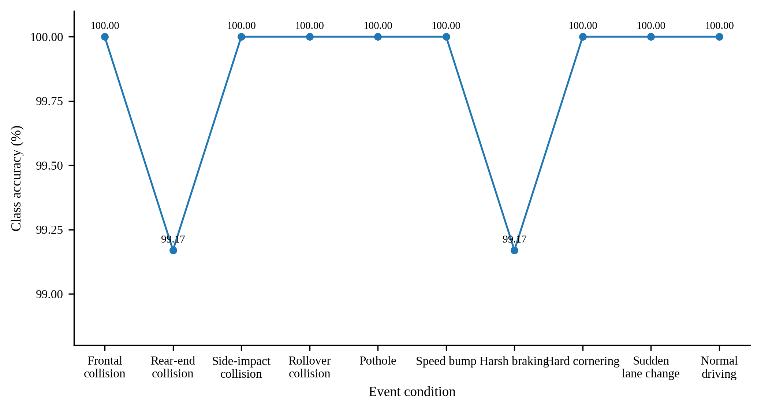
Fig=4.1” Detectionaccuracyunderdifferentaccidentand non-accidenteventconditions
The graphical representation corresponding to Fig. 4.1 would show near-flat 100% classification across most conditions, with minor depressions only in harsh braking and rear-end collision. Such a pattern supports the claim thataccidentconfirmationshouldbetreatedasakinematic
Table II and Fig. 4.2 show an expected but important ordering. The reporting chain remained stable under 5G and 4G conditions, acceptable under 2G/3G, and stressed under low-signal operation. Mean latency rose from 594.9 ms in 5G to 3864.0 ms in low-signal conditions. Mean dispatch time followed the same pattern, expanding from 24.60 s to 46.74 s. The notification success rate stayed perfectfor5G,4G,and2G/3Gaccidentevents,butdropped to 92.11% in low-signal scenarios. That decline is operationally meaningful. It shows that the system bottleneckisnolongereventrecognition;itisconnectivity degradation at the moment of dispatch. The capture module itself remained stable, with camera success near 87%–91% across all network classes. The communication subsystem, not the imaging subsystem, is therefore the dominantsourceofend-to-endperformancevariance.
Volume: 13 Issue: 04 | Apr 2026 www.irjet.net
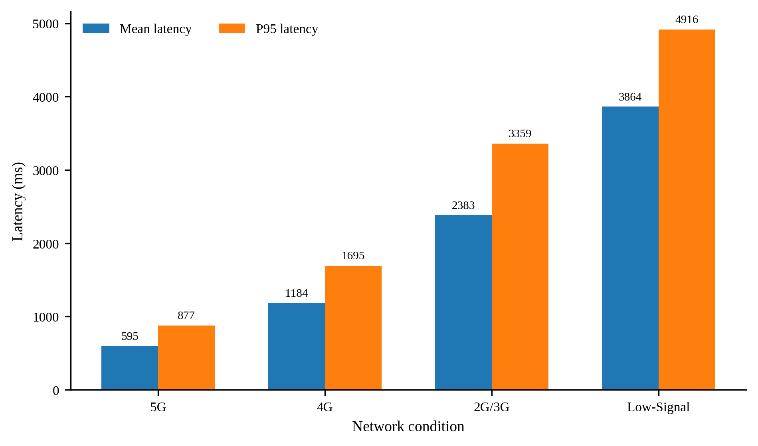
Fig- 4.2: End-to-endemergencyreportinglatencyacross testscenarios
The associated graph would present a steep latency gradient from 5G through low-signal conditions. Its interpretationisdirect:oncethedetectorhasvalidatedthe event, network quality becomes the principal determinant ofhowrapidlytheemergencypacketreachestheresponse endpoint.
C. Visual Reporting Performance and Situational Evidence Quality
The visual layer was evaluated not merely on capture occurrence but on evidence usability. This distinction mattersbecauseablurredorpoorlyilluminatedimagemay satisfy the storage condition while failing the responsesupport condition. Recent incident-monitoring and rapid accident-detection studies both point toward the growing weight of scene context in post-trigger interpretation [28], [29]. The benchmark results reflect the same principle. Table III reports visual reporting quality across weather classesforvalidatedaccidentevents.
Table-3: Weather-WiseVisualReportingQualityfor ValidatedAccidentEvents
adds more than decorative output; it supplies respondergrade scene cues in the large majority of validated emergencies, though adverse weather still constrains clarity.
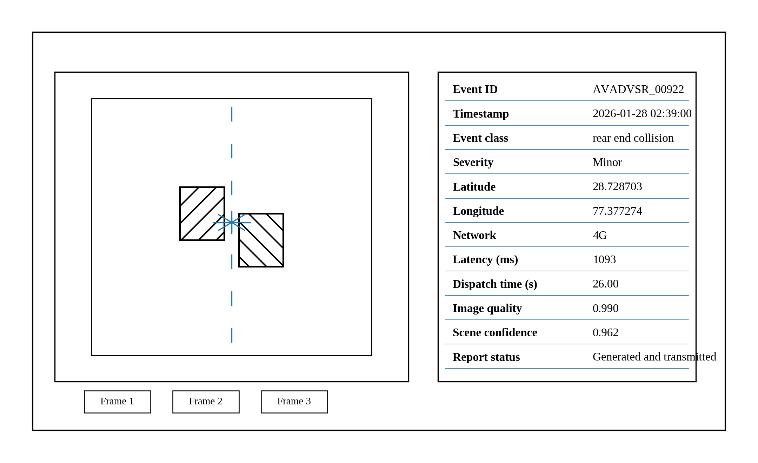
Fig.-4.3: Samplevisualsituationreportingoutput generatedbytheproposedsystem
The visual panel corresponding to Fig. 4.3 should presentthesceneimagetogetherwithtimestamp,severity tag, coordinates, and event identifier. The numeric trends in Table III justify that design choice. The image is not treated as an isolated photograph. It is treated as structuredevidence.
System comparison was performed through an ablation-styleprogressionfrompermissivealarmingtofull integrated reporting. This is summarized in Table IV and intended for graphical presentation in Fig. 4.4. The transition is instructive. The threshold-only baseline preserved full recall but admitted too many false alarms. The dual-parameter fusion stage sharply corrected that weakness. The full integrated reporting pipeline then traded some recall for perfect precision and complete visual-report presence among positive outputs. That final trade-off is consistent with the direction suggested by multimodal traffic-accident analysis, where the value of a system increasingly lies in its ability to combine event detectionwithinterpretableevidenceratherthandetection alone[30].
The evidence pattern is clear. Capture success stayed high across all weather states, but evidence quality deterioratedasvisibilityworsened.Clear-weatheraccident events produced 90.31% operable evidence, whereas fog reduced that value to 68.42%. Rain also imposed a noticeable penalty, cutting the operable evidence rate to 76.12%. Across all 360 accident events, the visual report generation rate was 88.06%, and 85.83% of accident images remained at least operationally usable when the acceptabilityboundarywassetatanimagequalityscoreof 0.60.Thismatters becauseitshowsthatthevisual module
Table-4: ComparativePerformanceoftheProposed SystemAgainstInternalBaselineConfigurations
Volume: 13 Issue: 04 | Apr 2026 www.irjet.net p-ISSN: 2395-0072
TableIVandFig.4.4makethesystemlogicexplicit.The best detector is the dual-parameter fusion stage. The most operationallycomplete pipelineistheproposedintegrated reporting stage. That distinction matters. A detector answers whether a crash occurred. The proposed system answers a harder question: whether a validated crash can be detected, localized, transmitted, and visually documented in one continuous chain. On that stricter criterion, the system remained exact in precision, stable in dispatch time, and complete in report generation for all acceptedevents.
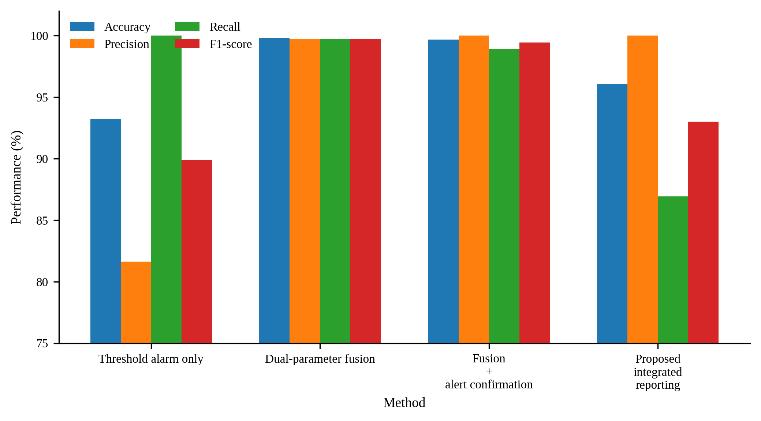
Fig.-4.4: Comparativeperformanceanalysisofthe proposedsystemagainstbaselinemethods
This study presented an IoT-based automatic vehicle accident detection and visual situation reporting system designed to unify impact recognition, event validation, geolocationcapture,emergencymessagetransmission,and scene-levelvisualdocumentationwithinasingleembedded response architecture. The reported results show that the proposed framework achieved high event discrimination capability across both collision and non-collision driving conditions, while preserving low false alarm behavior under difficult hard-negative scenarios such as potholes, harsh braking, speed-bump traversal, and abrupt cornering. The communication analysis showed that alert delivery remained stable across standard network conditions, with the main degradation appearing only in low-signal environments, where latency inflation rather than detector instability became the dominant operational constraint. The visual reporting layer also demonstrated practical value by generating usable incident evidence in the large majority of validated accident cases, thereby extending the system beyond binary crash notification towardresponder-orientedsituationalintelligence
From a system perspective, the work showed that accident management should not be treated as a sequence of isolated modules. Detection alone is insufficient. Location transmission alone is insufficient. Image capture without validated triggering is inefficient. The technical contribution of the study lies in the integration of these processes into one coherent pipeline in which sensing, decision logic, communication, and visual reporting operate under shared event control. That integration improved the functional completeness of the platform and established a stronger basis for real-time emergency support.
Some limitations remain. Environmental visibility affected evidence quality. Weak network conditions increased dispatch time. The benchmark, while structured and extensive, did not yet incorporate multi-vehicle pileup scenarios, severe occlusion cases, or adversarial communication failures. Future work should extend the system through adaptive threshold learning, multimodal video summarization, edge-based compression for lowbandwidth conditions, redundancy-aware alert routing, and larger real-world vehicular deployments involving heterogeneousroad,weather,andtraffic-densitysettings.
[1] A. K. Biswal, D. Singh, B. K. Pattanayak, D. Samanta, and M.-H. Yang, “IoT-based smart alert system for drowsy driver detection,” Wireless Commun. Mobile Comput., vol. 2021, Art.no.6627217,2021.
[2] M. Balfaqih, S. A. Alharbi, M. Alzain, F. Alqurashi, and S. Almilad, “An accident detection and classification system using internet of things and machine learning towards smart city,” Sustainability, vol. 14, Art. no.210,2021.
[3] H.Tan,F.Zhao,H.Hao,andZ.Liu,“Evidencefor the crash avoidance effectiveness of intelligent and connected vehicle technologies,” Int. J. Environ. Res. Public Health, vol. 18, Art. no. 9228,2021.
[4] J. G. Choi, C. W. Kong, G. Kim, and S. Lim, “Car crash detection using ensemble deep learning andmultimodaldatafromdashboardcameras,” Expert Syst. Appl., vol. 183, Art. no. 115400, 2021.
[5] S.UmaandR.Eswari,“Accidentpreventionand safety assistance using IoT and machine learning,” J. Reliab. Intell. Environ., vol. 8, pp. 79–103,2022.
[6] N. Pathik, R. K. Gupta, Y. Sahu, A. Sharma, M. Masud, and M. Baz, “AI enabled accident detection and alert system using IoT and deep learningforsmartcities,” Sustainability,vol.14, Art.no.7701,2022.
International Research Journal of Engineering and Technology (IRJET) e-ISSN: 2395-0056
Volume: 13 Issue: 04 | Apr 2026 www.irjet.net p-ISSN: 2395-0072
[7] M.R.Mehmood,N.I.Kajla,M.D.A.Awan,M.M. S. Missen, M. U. Chaudhry, and A. Firdous, “Accident alert system of vehicle and life security using IoT devices and image processing,” J. Comput. Biomed. Inform., vol. 4, pp.197–206,2022.
[8] M. Kathiravan, M. P. K. Reddy, M. Malarvel, A. Amrutha, P. H. Reddy, and S. Kavitha, “IoTbased vehicle surveillance and crash detection system,” in Proc. 2022 Int. Conf. Applied Artificial Intelligence and Computing (ICAAIC), Salem,India,Mar.2022,pp.1523–1529.
[9] S. S. Tippannavar, E. A. Madappa, and S. Rudraswamy, “Automatic accident alert system Earlyaccidentpredictionandwarning for the consumers,” in Proc. 2022 IEEE 2nd Mysore Sub Section Int. Conf. (MysuruCon), Mysuru,India,Oct.2022,pp.1–6.
[10] S.Bajpai,G.K.Sahoo,S.K.Das,andP.Singh,“An efficient inter-vehicle communication framework on road traffic accident detection usingOMNET++andSUMO,”in Proc. 2022 IEEE 2nd Int. Symp. Sustainable Energy, Signal Processing and Cyber Security (iSSSC), Bhopal, India,Oct.2022,pp.1–6.
[11] P. Josephinshermila, K. Malarvizhi, S. G. Pran, and B. Veerasamy, “Accident detection using automotive smart black-box based monitoring system,” Meas. Sens., vol. 27, Art. no. 100721, 2023.
[12] V.Dange,A.Patni,R.Patil,R.Ponnuru,S.Pawar, andP.Bhadane,“IoTbaseddetectionofvehicle accident and an emergency help using application interface,” Microsyst. Technol., vol. 29,pp.1455–1463,2023.
[13] A. H. Alkhaiwani and B. S. Alsamani, “A framework and IoT-based accident detection system to securely report an accident and the driver’sprivateinformation,” Sustainability,vol. 15,Art.no.8314,2023.
[14] K.R.Chandra,P.Ramyanjani,S.Farid,S.Himaja, R. J. Vesli, and S. S. K. Reddy, “Vehicle accident location tracking system using GSM and GPS,” in Proc. 2023 4th Int. Conf. Smart Electronics and Communication (ICOSEC), Trichy, India, Aug.2023,pp.163–167.
[15] K. Pradeep, P. Tamilvani, P. Palanisamy, M. M. Hussaini, S. Ragul, and N. Selvam, “An intelligent IoT based advanced accident detection and sensor fusion categorization system,”in Proc.20232ndInt.Conf.Automation, Computing and Renewable Systems (ICACRS), Coimbatore,India,Aug.2023,pp.1647–1655.
[16] D. Zavantis, D. Mandalozis, A. Yasar, and L. Hasimi, “Automatic accident detection system usingIoTcomparedtothesystemsthatatraffic centre uses for accident detection,” Procedia Comput.Sci.,vol.231,pp.16–23,2024.
[17] U.Bhanja,A.Mohanty,andS.Mahapatra,“Fuzzy logic-based accident detection system for vehicular ad hoc networks: A prototype implementation,” Wireless Pers. Commun., vol. 138,pp.291–320,2024.
[18] M. Ramya Devi and S. Lokesh, “Intelligent accident detection system by emergency response and disaster management using vehicular fog computing,” Automatika, vol. 65, pp.117–129,2024.
[19] M.Vijayakumar,M.Ramasamy,T.Jeyakumar,S. Dhivagar, V. Arun, and R. Hemalatha, “Vehicle accident detection and locating using GSM and GPS,” in Proc. 2024 Int. Conf. Communication, Computing and Internet of Things (IC3IoT), Chennai,India,Jan.2024,pp.1–5.
[20] V.Iordache,M.Minea,R.A.Gheorghiu,F.Bădău, A. C. Cormoș, V. A. Stan, I. N. Stăncel, and V. Stoica, “Integrating connected vehicles into IoT ecosystems:Acomparativestudyoflow-power, long-range communication technologies,” Sensors,vol.24,no.23,Art.no.7607,2024.
[21] M.M.Haque,A.Ghobakhlou,andA.Narayanan, “Multi-tracking sensor architectures for reconstructingautonomousvehiclecrashes:An exploratory study,” Sensors, vol. 24, no. 13, Art. no.4194,2024.
[22] M. A. Tolba and H. A. Kamal, “SDC-Net++: Endto-end crash detection and action control for self-driving car deep-IoT-based system,” Sensors,vol.24,no.12,Art.no.3805,2024.
[23] A. Karim, M. A. Raza, Y. Z. Alharthi, G. Abbas, S. Othmen, M. S. Hossain, A. Nahar, and P. Mercorelli, “Visual detection of traffic incident through automatic monitoring of vehicle activities,” World Electr. Veh. J., vol. 15, no. 9, Art.no.382,2024.
[24] M.A.SahraeiandS.R.M.AlMamari,“A-review of internet of things approaches for vehicle accidentdetectionandemergencynotification,” Sustainability, vol. 17, no. 14, Art. no. 6510, 2025.
[25] M. Vinodhini, S. Rajkumar, and S. K. Subramaniam, “Real-time Internet of LoRa Things (IoLT)-based accident detection and prevention system in vehicular networks towards smart city,” Int. J. Commun. Syst., vol. 38,Art.no.e5692,2025.
[26] A. S. Mohsin, S. H. Choudhury, and M. A. Muyeed, “Automatic priority analysis of emergency response systems using internet of things (IoT) and machine learning (ML),” Transp.Eng.,vol.19,Art.no.100304,2025.
[27] N. Kumar, S. K. Sood, and M. Saini, “IoV-fogassisted framework for accident detection and classification,” ACMTrans.Embed.Comput.Syst., vol.24,Art.no.49,2025.
International Research Journal of Engineering and Technology (IRJET) e-ISSN: 2395-0056
Volume: 13 Issue: 04 | Apr 2026 www.irjet.net p-ISSN: 2395-0072
[28] H.Liu,X.Hu,G.Sun,W.Zhang,J.Zhan,H.Fang, Y. Li, and W. Ma, “Intelligent traffic accident detectionsystemincomplexdynamicscenarios based on the dual-stream spatiotemporalfusion model,” Eng. Appl. Artif. Intell., vol. 162, pt.E,Art.no.112675,2025.
[29] M.S.Arefin,M.I.S.Mahin,andF.A.Mily,“Realtime rapid accident detection for optimizing roadsafetyinBangladesh,” Heliyon,vol.11, no. 4,Art.no.e42432,2025.
[30] [30] R. Zhang, B. Wang, J. Zhang, Z. Bian, C. Feng,andK.Ozbay,“Whenlanguageandvision meet road safety: Leveraging multimodal large language models for video-based traffic accident analysis,” Accid. Anal. Prev., vol. 219, Art.no.108077,2025.