
International Research Journal of Engineering and Technology (IRJET) e-ISSN: 2395-0056
Volume: 12 Issue: 10 | Oct 2025 www.irjet.net p-ISSN: 2395-0072
International Research Journal of Engineering and Technology (IRJET) e-ISSN: 2395-0056
Volume: 12 Issue: 10 | Oct 2025 www.irjet.net p-ISSN: 2395-0072
Supriya Rajput 1 Alfiya Mulla2 , Rabiya Kazi3 , Suzain Bargir4, Tasbiya Chikkodi5
1Assistant Professor, Maratha Mandal’s Engineering College, Belagavi, Karnataka, India
2Student, Maratha Mandal’s Engineering College, Belagavi, Karnataka, India
3Student, Maratha Mandal’s Engineering College, Belagavi, Karnataka, India
4Student, Maratha Mandal’s Engineering College, Belagavi, Karnataka, India
5Student, Maratha Mandal’s Engineering College, Belagavi, Karnataka, India
Abstract - This research presents the development of an intelligent air quality management system that leverages InternetofThingstechnology tomonitorandimproveindoor atmospheric conditions. The proposed solution addresses growing concerns about airborne pollutants in enclosed spaces by implementing real-time detection and automated purification. At the core of the system is an ESP32 microcontroller that processes data from multiple environmental sensors, including a GP2Y1010 particulate matter detector and an MQ135 multi-gas sensor. These components work in tandem to identify harmful substances such as dust particles, carbon dioxide, carbon monoxide, and benzenederivatives.Thearchitectureincorporatesdual-mode operation, allowing either manual control through a mobile applicationorautomaticadjustmentofpurificationintensity basedoncontaminantconcentration.Experimentalvalidation demonstrates the system's capability to maintain air quality within safe parameters by dynamically modulating fan velocity in response to pollutant levels. This approach representsasignificantsteptowardcreatinghealthierindoor environments through accessible smart technology.
Keywords: IoT, Blynk, real-time monitoring, air purification, indoor air quality
The degradation of atmospheric quality in urban environments has emerged as a critical public health challenge, with scientific studies establishing clear correlations between pollutant exposure and respiratory complications [1]. While substantial attention has been directed toward outdoor air quality, the indoor environmentswhereindividualsspendapproximately90% oftheirtimefrequentlyharborcontaminantconcentrations two to five times higher than external settings [2]. This paradox creates an urgent need for accessible monitoring technologies that can provide immediate awareness and interventioncapabilities.
Traditional air quality assessment typically relies on expensive laboratory equipment or sparse government monitoringstations,offeringlimitedutilityforpersonalized environmentalmanagement.TheemergenceofInternetof
Things architectures has created new possibilities for distributed,cost-effectiveairqualityassessmentsystems.By integratingsensornetworkswithcloud-baseddataanalytics andmobileinterfaces,thesesystemsempowerindividualsto trackandmanagetheirimmediatebreathingenvironment withunprecedentedprecision[3].
Thisinvestigationaddressestheidentifiedgapthroughthe development of a comprehensive air quality management platform that combines real-time monitoring with responsive purification. Unlike conventional air purifiers that operate on fixed schedules or manual controls, the implemented system establishes a closed-loop control mechanismwherepurificationintensitydirectlycorrelates with detected pollutant levels. The integration of multiple sensor modalities enables the detection of diverse contaminant types, while the IoT connectivity facilitates remote monitoring and control through consumer mobile devices.
The subsequent sections of this paper detail the system architecture, component selection criteria, operational methodology, and performance evaluation. Particular emphasis is placed on the sensor calibration procedures, control algorithm development, and validation under realisticusagescenarios.
The primary objectives of this investigation include: designing a multi-sensor air quality monitoring platform, developinganintuitiveuserinterfaceforlocalandremote interaction,implementinganadaptivecontrolalgorithmfor automaticpurification,andvalidatingsystemperformance undercontrolledenvironmentalconditions.
A significant feature of this system is its dual-mode operation.InManualMode,theuserhasdirectcontrolover the fan speed via a slider in the Blynk app. In Automatic Mode, the system intelligently calculates the required fan speedbasedonthehighestdemandfromeitherthedustor gas sensor readings, ensuring a dynamic and responsive purificationprocess.
International Research Journal of Engineering and Technology (IRJET) e-ISSN: 2395-0056
Volume: 12 Issue: 10 | Oct 2025 www.irjet.net p-ISSN: 2395-0072
The implemented system employs a modular architecture comprising sensing, processing, communication, and actuation components. This hierarchical design ensures robust operation while maintaining flexibility for future enhancementsandmodifications.
2.1
Thehardwareselectionprioritizedreliability,accessibility, and performance characteristics appropriate for indoor environmentalmonitoringapplications.
CentralProcessingUnit:TheESP32microcontroller was selected for its integrated Wi-Fi capabilities, sufficient analog-to-digital conversion resolution, and support for peripheral communication protocols,includingI²C.
ParticulateMatterDetection:TheGP2Y1010AU0F optical dust sensor employs an infrared emitting diode and phototransistor configuration to detect light scattering caused by airborne particles. This component provides an analog voltage output proportionaltodustdensity.
Gas Concentration Sensing: The MQ135 semiconductorsensordemonstratessensitivityto multipleatmosphericcontaminantsincludingCO₂, CO, NH₃, and benzene. Resistance variations correspondingtogasconcentrationareconverted tovoltagereadingsthroughasimplevoltagedivider circuit.
UserInterfaceComponents:A16x2characterLCD withI²Cinterfaceprovideslocalreadouts,whilethe BlynkIoTplatformenablesremotemonitoringand controlthroughsmartphoneapplications.
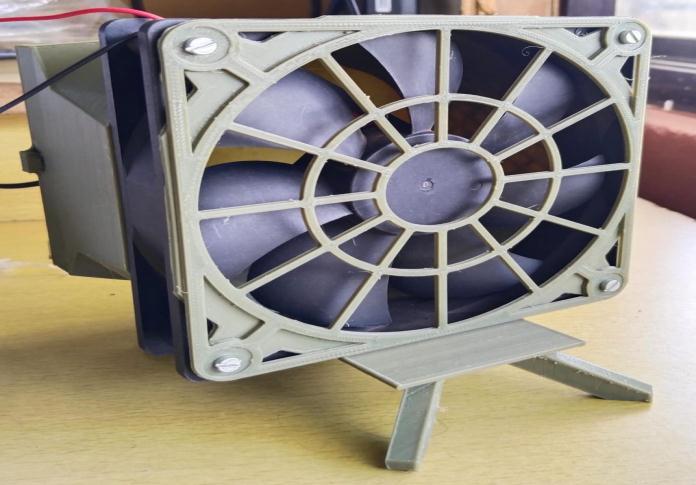
ActuationSystem:A12VDCbrushlessfancoupled withaMOSFET-basedpulse-widthmodulation circuitenablesvariable-speedairpurification.The fanassemblyincorporatesastandardparticulate filterforcontaminantremoval.
Systemoperationinitiateswithcontinuousenvironmental samplingthroughthesensorarray.Thedustsensorrequires precise timing control, with the internal infrared LED activated for 280 microseconds before analog voltage measurement. The recorded voltage values undergo conversiontomassconcentrationunits(mg/m³)usingthe manufacturer-specifiedtransferfunction.
Simultaneously, the MQ135 sensor output voltage is processedtodeterminegasconcentrationlevels.Thesystem calculatessensorresistanceinthetargetgasenvironment usingtheloadresistorvalueandsupplyvoltage.Theratio
between baseline resistance in clean air and current resistance provides the foundation for concentration estimationthroughempiricalrelationships[4].
The ESP32 microcontroller executes the core control algorithm, which supports dual operational modes. In manualmode,fanspeedisdirectlydeterminedbyuserinput throughthemobileapplicationinterface.Automaticmode implements a demand-based control strategy where fan velocity is continuously adjusted according to the highest calculated demand from either particulate or gas sensors. This approach ensures the system responds to the most criticalairqualityparameteratanygivenmoment.
Thefirmwarearchitectureincorporatesmultiplefunctional modules, including sensor data acquisition, signal processing, control logic execution, and communication management.TheBlynkIoTplatformfacilitatesbidirectional dataexchangebetweenthehardwareandmobileinterface, enabling real-time parameter visualization and remote controlcapability.Thesystemimplementsadisplaycycling routine that sequentially presents different parameter combinations on the local LCD, maximizing information deliverywithinthelimiteddisplayarea.
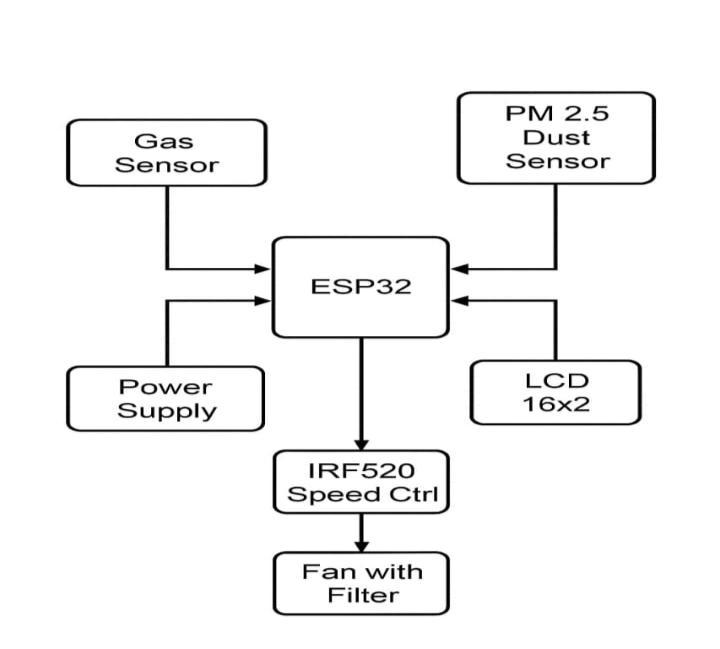
Fig -1:blockdiagram
International Research Journal of Engineering and Technology (IRJET) e-ISSN: 2395-0056
Volume: 12 Issue: 10 | Oct 2025 www.irjet.net p-ISSN: 2395-0072
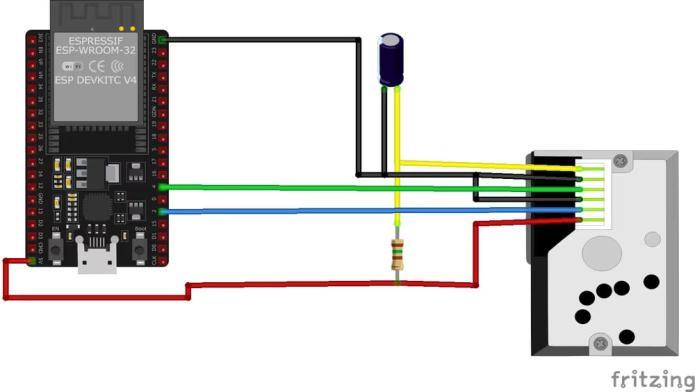
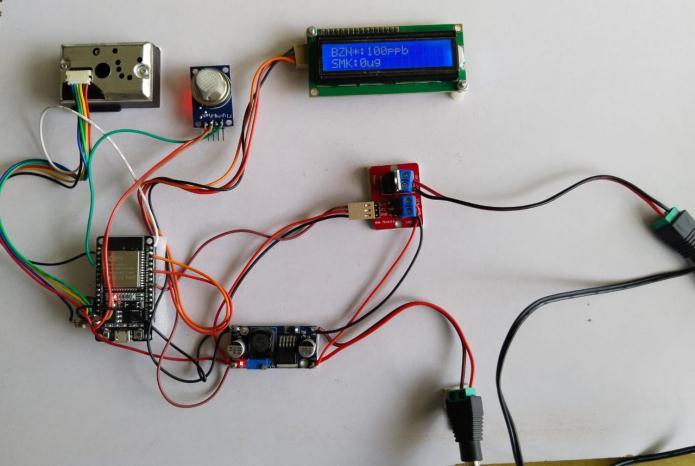
Theprototypesystemunderwentcomprehensivetestingina controlledlaboratoryenvironmentandsimulatedresidential settings to evaluate performance characteristics under variedconditions.
The implemented sensors demonstrated appropriate responsiveness to introduced contaminants. During particulate testing, combustion sources such as incense sticksgenerateddetectablesignalswithin3-5seconds,with thedustsensoroutputincreasingproportionallytosource proximity and intensity. The gas sensor exhibited similar responsiveness to carbon dioxide sources, with measured concentrationsrisingrapidlyinenclosedspaceswithlimited ventilation.
Theautomaticcontrolalgorithmsuccessfullymodulatedfan speedinresponsetochangingairqualityconditions.Atlow contamination levels (below 30% of maximum scale), the system maintained minimal fan operation to conserve energy. As pollutant concentrations increased, fan speed escalatedproportionally,reachingmaximumvelocitywhen contaminationlevelsapproachedthe predefinedfull-scale values.
Thetransitionbetweenoperationalmodesprovedseamless, with manual control inputs immediately overriding automaticoperationwhenselected.Themobileapplication provided consistent remote access with negligible communication latency, typically below two seconds for controlcommandexecution.
International Research Journal of Engineering and Technology (IRJET) e-ISSN: 2395-0056
Volume: 12 Issue: 10 | Oct 2025 www.irjet.net p-ISSN: 2395-0072
Whencomparedtoconventionalairpurificationsystems,the implementedsolutiondemonstratesdistinctadvantagesin responsivenessanduserengagement.Traditionalpurifiers typically operate on fixed timers or manual settings regardlessofactualairquality,whiletheproposedsystem dynamically adjusts operation based on real-time environmental conditions. The integration of remote monitoring capabilities further differentiates the system fromconventionalalternatives.
The concepts and methodologies presented in this work establish a foundation for next-generation environmental managementsystemsthatprioritizebotheffectivenessand accessibility
This project successfully designed and validated an IoTbased air monitoring system that detects pollutants using sensors,processesdatawithanESP32microcontroller,and automatically purifies air through a smart fan control system. The system was rigorously tested, demonstrating reliablereal-timemonitoringviaamobileappandeffective automaticpurificationtriggeredbypollutionlevels, which confirmeditspracticalfunctionalityformaintainingindoor airquality.
[1]. World Health Organization. (2021). WHO global air quality guidelines: particulate matter (PM2.5 and PM10), ozone, nitrogen dioxide, sulfur dioxide, and carbon monoxide.Geneva:WorldHealthOrganization.
[2].Klepeis,N.E.,Nelson,W.C.,Ott,W.R.,etal.(2001).The National Human Activity Pattern Survey (NHAPS): a resourceforassessingexposuretoenvironmentalpollutants. Journal of Exposure Analysis and Environmental Epidemiology,11(3),231-252.
[3]. Gubbi, J., Buyya, R., Marusic, S., & Palaniswami, M. (2013). Internet of Things (IoT): A vision, architectural elements, and future directions. Future Generation ComputerSystems,29(7),1645-1660.
[4].Wang,C.,Yin,L.,Zhang, L.,Xiang,D., &Gao,R.(2010). MetalOxideGasSensors:SensitivityandInfluencingFactors. Sensors,10(3),2088-2106.
[5]. Sharp Corporation. (2006). GP2Y1010AU0F Compact Optical Dust Sensor Datasheet. Osaka, Japan: Sharp Corporation




Alfiya Mulla is a final-year Electronics and Communication student.Sheiscurrentlypursuing her degree at Maratha Mandal’s EngineeringCollege.
Rabiya Kazi is a final-year Electronics and Communication student.Sheiscurrentlypursuing her degree at Maratha Mandal’s EngineeringCollege.
Suzain Bargir is a final-year Electronics and Communication student.Sheiscurrentlypursuing her degree at Maratha Mandal’s EngineeringCollege.
Tasbiya Chikkodi is a final-year Electronics and Communication student.Sheiscurrentlypursuing her degree at Maratha Mandal’s EngineeringCollege.