
International Research Journal of Engineering and Technology (IRJET) e-ISSN: 2395-0056
Volume: 12 Issue: 09 | Sep 2025 www.irjet.net p-ISSN: 2395-0072
International Research Journal of Engineering and Technology (IRJET) e-ISSN: 2395-0056
Volume: 12 Issue: 09 | Sep 2025 www.irjet.net p-ISSN: 2395-0072
Rahul Gowda B Y1 , Dr.S Kavitha2
1PG Student (MTech) in Structural Engineering, Dr Ambedkar Institute of Technology, Bangalore, Karnataka, India
2Professor, Department of Civil Engineering, Dr Ambedkar Institute of Technology, Bangalore, Karnataka, India
Abstract - Concrete, one of the most widely used construction materials, is susceptible to cracking, which compromises its durability and load-bearing capacity. Selfhealing concrete provides a sustainable and cost-effective solution to mitigate crack propagation and restore structural integrity. This study investigates the potential of methyl methacrylate (MMA), combined with 15% Dr. Fixit Integral Bond (a waterproofing admixture), encapsulated withinglasscapsulesandvasculartubes,toenhancehealing performance in M30 grade concrete. The experimental program involved casting concrete cubes and beams embedded with MMA-filled capsules and vascular tubes. Healing performance was assessed by introducing cracks and monitoring recovery over a 9-hour period at 1-hour intervals, followed by compressive and flexural strength evaluations. The results highlight the efficiency of the systeminsealingcracks,improvingdurability,andrestoring strength, indicating its applicability for real-world infrastructure.
Concrete is an indispensable construction material due to its high compressive strength, durability, and costeffectiveness.However,itsbrittlenaturemakesitproneto cracking, which reduces service life and leads to costly repairs. Traditional repair methods are inefficient, particularly for inaccessible structures. Self-healing concrete, inspired by biological systems, offers an innovative solution by autonomously sealing cracks using encapsulated healing agents. Among these, methyl methacrylate (MMA) has demonstrated considerable promiseduetoitslowviscosity,rapidpolymerization,and strongbondingability.ThisstudyintegratesMMAwithDr. FixitIntegralBondandevaluatesitsperformancethrough encapsulation in capsules and vascular tubes within M30 concretespecimens.
Danish et al. (2020) [1] This paper provides a critical review of self-healing techniques, highlighting their applications and performance. It notes that the geometry and size of cracks are crucial in selecting a self-healing method. Encapsulation of chemical healing agents sought considered more effective due to enhanced reaction
between un-hydrated cement particles and the healing agents
Qureshi et al. (2016) [2] This study focuses on using encapsulated expansive minerals (magnesium oxide, bentonite,andquicklime)forself-healingincement-based mortars. Here they used concentric glass capsules to containthemineralsandwater Itwasfoundthatsamples put in water showed the highest healing efficiency, with approximately 95% crack sealing and 25% strength recovered in 28 days The research also found that this systemwasabletoeffectivelyheallargecracks,upto400 µm The self-healing process involved the hydration of expansivemineralsinitially,followedbyslowcarbonation overtime
Taheri and Clark (2021) [3] This article describes the preparationofPMMAnanocapsulesforuseasself-healing additives in concrete via a miniemulsion polymerization technique The healing components (resin and hardener) were separately encapsulated in PMMA shells The study found that these nanocapsules survived the mixing and hardening processes When cracks occurred, the stress fields brokethe brittle shells,releasing the healingagents to bridge early-stage fractures (<10 µm) Long-term healingwasachievedthroughtheformationofpolymorph calcite crystals in the presence of moisture and carbon dioxide
Gilabert et al. (2017) [4] This paper investigates the strength and debonding energy of a glass-concrete interface, which is crucial for encapsulation-based selfhealing concrete The study found that samples exhibited cleandebondingbetweentheglassandconcrete
Khaliq and Ehsan (2016) [5]Thisarticlediscussescrack healing using bio-influenced self-healing techniques It explores different bacterial incorporation methods to achieve crack healing The study found that graphite nanoplatelets were a good carrier compound for shortterm healing, while lightweight aggregates were effective for long-term healing. It also notes that incorporating lightweight aggregate improved the concrete's compressivestrength
International Research Journal of Engineering and Technology (IRJET) e-ISSN: 2395-0056
Volume: 12 Issue: 09 | Sep 2025 www.irjet.net p-ISSN: 2395-0072
Theprimaryhealingagentselectedforthisstudyismethyl methacrylate (MMA), chosen for its low viscosity and rapid polymerization. To ensure longevity and stability, 15%Dr.FixitIntegralBondwasadded.Encapsulationwas carried out using two approaches: (1) cylindrical glass capsules of 2 cm length and 7 mm diameter, and (2) vascular tubes of 7.5 cm length and 7 mm diameter. The base concrete mix was designed for M30 grade, using Ordinary Portland Cement (OPC), fine aggregates, coarse aggregates, and water in accordance with IS 10262-2019 guidelines.
4.1 Objectives:
Evaluate Healing Efficiency – Quantify the healing efficiency of methyl methacrylate (MMA)-based selfhealing concrete by measuring the percentage of crack closureandstrengthrecoverythroughmechanicaltesting.
Identify the ideal percentage of MMA in the vascular tube system to balance self-healing performance and structural integrity.Measurethe number of times theselfhealing system can autonomously repair cracks before depletionofthehealingagent.
4.2 Methodology:
1.Literaturereview
2.Selectionofmaterials&m30mixdesign
3.Casting&curingofconcretespecimens
4.Assessmentofspecimens
5.Introductionofcracks&healingevaluation
6.Evaluationafterhealing
7.Results&validation
8.Conclusion
5.CASTING
5.1Mix Design of M30 Concrete:
SpecificationofMaterials:
a)GradeDesignation:M30
b)TypeofCement:OPC53Grade
c)MaxNominalSizeofAggregate:20mmdown
d)MinimumCementContent:320kg/m³
e)Water-CementRatio:0.45
f)Workability:100mmslump
g)ExposureCondition:Severe(R.C.C.)
h)MethodofConcretePlacing:Manual
i)MaximumCementContent:480kg/m³
j)SpecificGravityofCement:2.857
k)SpecificGravityofcourseaggregate:2.75
l)SpecificGravityoffineaggregate:2.6
Table -1: M30Mixdesigncalculation
Description Value / Result
Target Mean Strength (F′ck) 38.25MPa
Adopted Water–Cement Ratio 0.42(OK,<0.45)
Water Content (for 100 mmslump) 191.5litres
CementContent 456kg/m³
AggregateProportions CA=0.606,FA=0.394
Mix Proportions (Volumes)
Cement=0.160 m³,Water= 0.192 m³, Aggregates = 0.648m³
CorrespondingMasses CA≈1080kg,FA≈638kg
Adjustmentfor Moisture are CA = 1068 kg, FA = 603 kg, Water=238.5litres
Final Quantities
Cement = 456 kg, FA = 603 kg, CA = 1068 kg, Water = 238.5litres
Final Mix Proportion (by weight) 1 : 1.32 : 2.34 : 0.52
Table -2: Finalmixquantityper50kgcementbag
Aggregate(FA)
CoarseAggregate(CA) 117.1 kg
Concrete specimens were prepared as per the M30 mix design. For cube specimens, 150×150×150 mm molds wereusedwithembeddedglasscapsules.Beamspecimens of 150×150×700 mm were prepared with vascular tubes strategicallyplacedalongthetensilezone.Thespecimen’s were demolded after 24 hours of casting and put in pond forcuringitinwaterfor28daysbeforetesting.
Slumpof114mmisobtainedduringcasting(whichhad agoodworkability).
International Research Journal of Engineering and Technology (IRJET) e-ISSN: 2395-0056
Volume: 12 Issue: 09 | Sep 2025 www.irjet.net p-ISSN: 2395-0072
Table -3: CompressiveStrengthTestResultsofM30 Concrete
Age of Concrete Compressive Strength (MPa)
7 Days 22.07
14 Days 28.87
28 Days 34.50
Table -4: FlexuralStrengthTestResultsofM30Concrete
Age of Concrete Flexural Strength (MPa)
14 Days 2.78
28 Days 4.43
5.2 Now casting done with the capsules & vascular tubes
Due to uneven Distribution of capsules in the concrete & most capsules as observed were located below the neutralaxisofthecube,andtherearemorevitalchancesof capsules damage during the casting this glass encapsulation method can be avoided. Due to the various disadvantages now by continuing the test with vascular tubesinthereinforcedbeam.
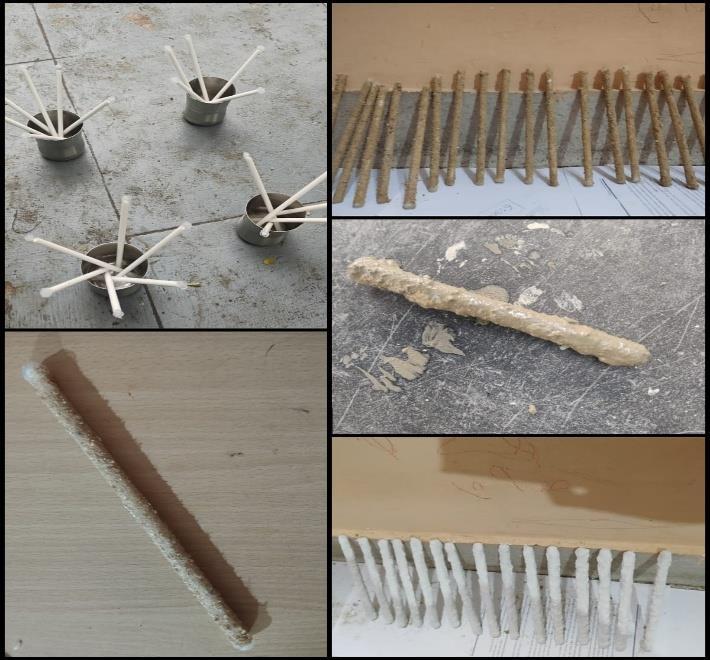
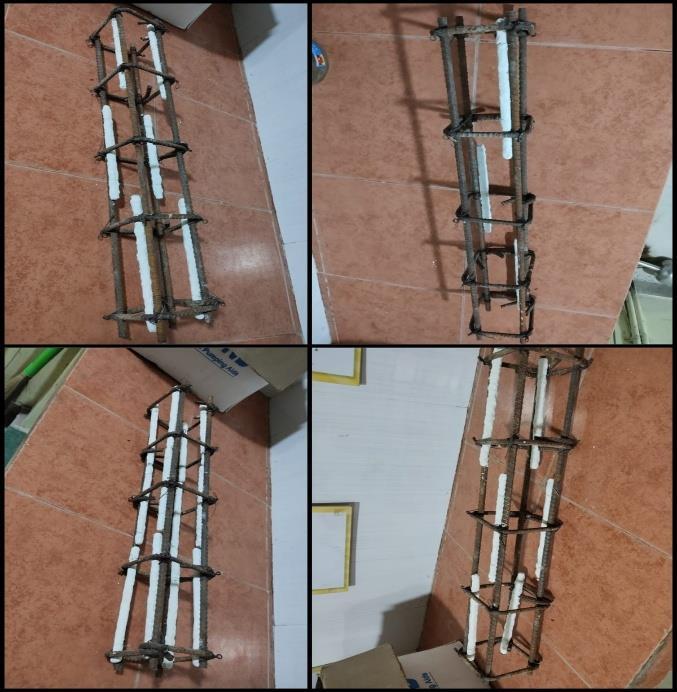
Above specimen each of 3 set casted & cured for 28 days. Then later subjected to maximum crack width till 2.2mmwasmadebyapplyingexternalloads.
6.TEST RESULTS
Crack Healing in mm when adopted 1.35% of Vascular tube in Cross Section
Chart -1:Plotfor1.35%
International Research Journal of Engineering and Technology (IRJET) e-ISSN: 2395-0056
Volume: 12 Issue: 09 | Sep 2025 www.irjet.net p-ISSN: 2395-0072
Crack Healing in mm when adopted 2.7% of Vascular tube in Cross Section
Chart -2:Plotfor2.7%
Crack Healing in mm when adopted 4.05% of Vascular
Crack Healing in mm when adopted 5.4% of Vascular tube in Cross Section
Chart -3:Plotfor4.05%
Chart -4:Plotfor5.4%
The healing efficiency was assessed by monitoring crack width reduction, compressive strength recovery, flexural strength,andload-deflectionbehavior.Observationswere recorded every hour for 9 hours after crack induction. Graphs illustrating crack closure percentage, compressive strength gain, and flexural performance will be included here.
Onanaverage(0.9+0.82+1.02+1.2)÷4 =0.985mm
Since MMA is applicable only till 2mm crack width, in this investigation it filled maximum of (0.985÷2)x100=49.25%.Thereby49.25%healingofcracks wassuccessfulthroughthisapplicationofvasculartubesin reinforcedconcrete.
Whereas the limitation of this is during the early failureslikewithin12yearsitworksmoreeffectively.Only one time the self-healing system can autonomously repair cracksbeforedepletionofthehealingagent
Strengthevaluationreportafterhealingofcracksuponthe cracklinesobservedinitially.Byusing“ReboundHammer Method”
Table -5: ReboundHammerTestResultforStrength
International Research Journal of Engineering and Technology (IRJET) e-ISSN: 2395-0056
Volume: 12 Issue: 09 | Sep 2025 www.irjet.net p-ISSN: 2395-0072
Bymeasuringthepercentageofcrackclosureandstrength recovery through mechanical testing using 2.70% would bemoreeconomicalandadoptedforbestresult.
The study confirms that MMA combined with Dr. Fixit IntegralBondencapsulatedincapsulesandvasculartubes provides significant potential for crack healing in M30 grade concrete. Rapid polymerization of MMA ensures immediate sealing, while waterproofing admixture prolongs its active state. This system demonstrated strength recovery and durability improvement, making it suitable for long-term infrastructure applications such as bridges, tunnels, and marine structures. Future work may explore large-scale field applications and optimization of vasculartubedistribution.
Thiscanbeapplicableincaseofspecializedstructures,off shore construction which will help in longer life & risk of early repairs required in the structure can be minimized by using this advanced technique in construction practices.
Danish,A.,Mosaberpanah,M.A.,&Salim,M.U.(2020). Past and present techniques of self-healing in cementitiousmaterials.JMRT,9(3),6883-6899.
Taheri, S., & Clark, S. M. (2021). Preparation of selfhealing additives for concrete via miniemulsion polymerization.IntJConcrStructMater,15:8.
Qureshi, T. S., Kanellopoulos, A., & Al-Tabbaa, A. (2016). Encapsulation of expansive powder minerals withinaconcentricglasscapsulesystem.ConstrBuild Mater,121,629–643.
Gilabert, F. A., Van Tittelboom, K., et al. (2017). Strength and debonding energy of glass-concrete interface.CemConcrCompos,77,49-61.
Araújo, M., Chatrabhuti, S., et al. (2018). Poly(methyl methacrylate) capsules as alternative to glass capsules.CemConcrCompos,92,210-222.
Khaliq, W., & Ehsan, M. B. (2016). Crack healing in concreteusingbio-influencedtechniques.ConstrBuild Mater,102,349–357.
Li,W.,Zhu,X.,Zhao,N.,&Jiang,Z.(2016).Preparation and Properties of Melamine Urea-Formaldehyde Microcapsules for Self-Healing of Cementitious Materials.Materials,9(152).
Hilloulin,B.,VanTittelboom,K.,Gruyaert,E.,DeBelie, N., & Loukili, A. (2014). Design of polymeric capsules for self-healing concrete. Cement and Concrete Composites.
Maes, M., Van Tittelboom, K., & De Belie, N. (2014). The efficiency of self-healing cementitious materials by means of encapsulated polyurethane in chloride
containing environments. Construction and Building Materials,71,528–537.
VanTittelboom, K., DeBelie,N.,VanLoo, D.,& Jacobs, P. (2011). Self-healing efficiency of cementitious materials containing tubular capsules filled with healing agent. Cement and Concrete Composites, 33, 497–505