
International Research Journal of Engineering and Technology (IRJET) e-ISSN: 2395-0056
Volume: 12 Issue: 09 | Sep 2025 www.irjet.net p-ISSN: 2395-0072
International Research Journal of Engineering and Technology (IRJET) e-ISSN: 2395-0056
Volume: 12 Issue: 09 | Sep 2025 www.irjet.net p-ISSN: 2395-0072
Ramesh.A1 , Karthikraja.S2 , Ravichandran.P3
1-2Lecturer, Department of mechanical Engineering, Annai JKK Sampoorani Ammal Polytechnic College, Tamil nadu, India
3 Head of the department, Department of mechanical Engineering, Annai JKK Sampoorani Ammal Polytechnic College, Tamil nadu, India ***
Abstract
Thisprojectinvestigatesthethermo-mechanicalbehaviourof hybrid composites made from Banana and Kenaf fibers, two natural reinforcements recognized for their lightweight, biodegradable,andstrongproperties.Thesefiberspresent an eco-friendly alternative to synthetic fibers in composite materials.Compositesamples weremade usingdifferentfiber combinations and tested for thermal stability, strength, and heat resistance. The performance of the composite materials was evaluated through tensile, compressive, impact, and dynamic mechanical analysis (DMA) tests. These findings suggest that with careful optimization, Banana and Kenaf fiber-based composites can provide sustainable, highperformance materials suitable for applications in industries such as automotive, and electronics, contributing to ecofriendly manufacturing practices.
Key Words: Banana fiber,Kenaf fiber, natural fibers, impact resistance, environmental sustainability, thermo - mechanical behaviour,thermal stability, strength and heat resistance, fiberreinforced composites, mechanical properties.
In recent years, there has been a growing emphasis on developingsustainableandeco-friendlymaterialsthatalign withglobalenvironmentalinitiatives.Onepromisingavenue inthispursuitistheuseofnaturalfiberssuchasBananaand Kenafincompositematerials.Thesefibersarerenewable, biodegradable, and possess unique mechanical properties that make them attractive as reinforcement materials in composites.Byincorporatingthesenaturalfibers,industries canreducetheirrelianceonsyntheticfibers,whichareoften non-biodegradable, resource-intensive to produce, and contributesignificantlytoenvironmentalpollution.
BananaandKenaffibershaveshownimmensepotentialin reinforcingcompositematerials.Kenaf,abestfiberextracted from the Hibiscus cannabinus plant, is well known for its remarkable mechanical properties such as high tensile strength, excellentdurability,andimpressivedimensional stability. Kenaf fiber offers outstanding thermal stability, which enhances the composite's resistance to heat and environmental factors. The Kenaf fiber-reinforced
composites exhibit improved mechanical and thermal propertieswhencombinedwithappropriateresinsystems, making them ideal for automotive parts and construction materials. These attributes make Kenaf fiber suitable for applicationsrequiringstrengthandlightweightproperties. Bananafiber,obtainedfromthepseudo-stemofthebanana plant,isvaluedforitsimpressivetensilestrength,resilience, and ability to absorb energy effectively. Banana fiberreinforced composites show notable improvements in mechanicalperformance,particularlyinimpactresistance andenergyabsorption,duetotheirinherentflexibilityand toughness.Thecombination ofthesetwo natural fibers in hybrid composites has gained attention due to their complementarymechanicalcharacteristics,whichenhance overall performance in applications such as automotive, aerospace,construction,andpackagingindustries.
The adoption of Banana and Kenaf fibers in composite materials offers substantial environmental benefits. Since theseplantsarefast-growingandrequireminimalresources forcultivation,theirusecontributestoreducingthecarbon footprint associated with composite manufacturing. Furthermore, Banana and Kenaf fibers are biodegradable, which minimizes waste accumulation and supports the circulareconomy.Comparedtosyntheticfibersderivedfrom petrochemicals, the production of these natural fibers demandslessenergyandgeneratesfeweremissions,making themamoreenvironmentallysustainablealternative.Kenaf fibers' cultivation consumes less water and energy than traditionalsyntheticfiberproduction,reinforcingtheirecofriendly advantages. This project aims to investigate the thermo-mechanical behaviour of Kenaf and Banana fiberreinforced hybrid composites by examining various influencingfactorssuchasfibertreatment,fiberorientation, and fiber volume fraction. These factors are crucial in determiningthemechanicalperformanceofthecomposite, particularlyinareasliketensilestrength,flexuralstrength, impact resistance, and hardness. A comprehensive evaluation of these mechanical properties will provide insights into the composite's ability to withstand stress, deformation,andenvironmentalconditions.
Additionally, this study will assess the thermal stability, thermalconductivity,andheatresistancecharacteristicsof thesehybridcomposites,whichareessentialforapplications exposedtofluctuatingtemperaturesandthermalstress.The
International Research Journal of Engineering and Technology (IRJET) e-ISSN: 2395-0056
Volume: 12 Issue: 09 | Sep 2025 www.irjet.net p-ISSN: 2395-0072
hybridcompositesreinforcedwithBananaandKenaffibers demonstrate excellent thermal insulation and improved dimensionalstability,makingthemidealcandidatesforheatresistantapplications.Moreover,thisprojectwillexplorethe environmental and economic implications of integrating BananaandKenaffibersintocompositematerials.
On the environmental front, the study will examine how thesefiberscontributetoloweringthecarbonfootprintof composite production and their potential to replace nonrenewablesyntheticreinforcements.
Economically,thestudywillevaluatethecost-effectiveness of these fibers, considering factors such as material availability,processingrequirements,andpotentialsavings inmanufacturing.Thenaturalfibercompositescanachieve cost savings of up to 30% compared to synthetic alternatives,furtherhighlightingtheeconomicadvantagesof usingKenafandBananafibers.
By carefully analysing these variables, the study aims to demonstratethatnaturalfiberslikeBananaandKenafcan beeffectivelyusedtoproducecompositematerialsthatare not only strong and mechanically durable but also environmentally friendly. Fiber treatment plays a crucial role in enhancing the bonding between the fiber and the matrix,whichimprovesstrengthandload-bearingcapacity. Orientationaffectsthewaystressisdistributedacrossthe material,andoptimalfiberalignmentcansignificantlyboost performance. Additionally, controlling the fiber volume ensures a balance between mechanical properties and weight, which is essential for practical applications. The outcomesofthisresearchareexpectedtomakeameaningful contributiontothefieldofsustainablematerialsscienceby providing insights and data that industries can use to developgreeneralternativestosyntheticcomposites.
This aligns with the growing demand for eco-conscious engineering solutions in sectors such as automotive, construction, packaging, and consumer goods, where performance must be maintained without compromising environmentalresponsibility.Thisinvestigationalignswith theon-goingeffortstopromotesustainablemanufacturing practices and addresses the need for environmentally consciousengineeringsolutions.
2.1 SELECTION OF MATERIALS
In this paper I choose Banana and Kenaf fibers. These are natural fibers widely recognized for their outstanding mechanical properties, eco-friendliness, and costeffectiveness,makingthemidealforcompositeapplications. Thesefibersareincreasinglygainingattentionassustainable alternatives to synthetic reinforcements due to their renewablenatureandminimalenvironmentalimpact.
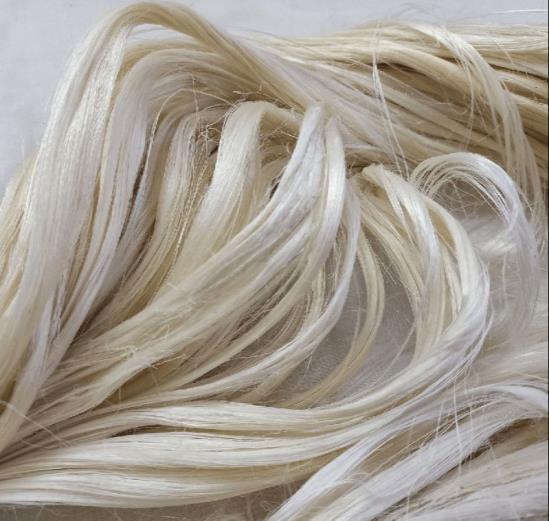
From Fig 1 the Banana fibers are extracted from the pseudostemofthebananaplantandareprimarilycomposed ofcellulose(60-65%),hemicellulose(6-8%),andlignin(510%). This composition contributes to their remarkable tensile strength, flexibility, and lightweight characteristics. Bananafibersareknownfortheirgoodthermalinsulation, sound absorption, and biodegradability, making them suitable for various eco-friendly applications. However, banana fibers are hydrophilic by nature, which can compromise their performance in composite materials by reducingadhesionwithpolymermatrices.
Toaddressthis,surfacetreatmentssuchasalkalitreatment, silanetreatment,oracetylationarecommonlyemployedto enhance fiber-matrix bonding and improve moisture resistance. In composite applications, banana fibers have demonstratedsignificantimprovementsintensilestrength, impactresistance,andflexuralproperties.Theirlightweight naturefurthercontributestoreducingtheoverallweightof composite materials, making themsuitableforautomotive parts,furniture,andbiodegradablepackagingmaterials.
International Research Journal of Engineering and Technology (IRJET) e-ISSN: 2395-0056
Volume: 12 Issue: 09 | Sep 2025 www.irjet.net p-ISSN: 2395-0072
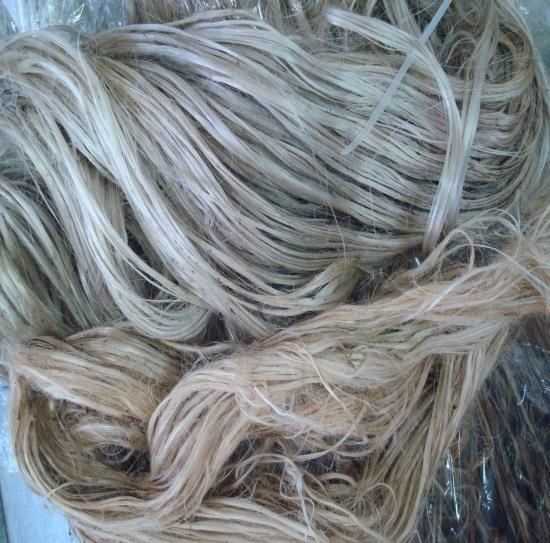
Fig2showsKenaffiberanditobtainedfromthestalkofthe plantandarewidelyrecognizedfortheirhighstrength-toweightratio,thermalstability,andlowdensity.Kenaffiberis composedmainlyofcellulose(60-65%)andlignin(8-13%), giving it excellent mechanical properties for composite reinforcement. Due to its superior durability and natural resistance to microbial attack, kenaf fiber has been extensivelyappliedinautomotivecomponents,construction materials, and biodegradable composites. Kenaf fiber is particularlyvaluedforitsthermalstability,whichallowsitto withstand higher temperatures without significant degradation.Additionally,kenaf-reinforcedcompositeshave shown remarkable results in enhancing flexural strength, tensilestrength,andimpactresistancewhencombinedwith othernaturalfibers.
Hybridcompositescombiningbananaandkenaffibershave shown enhanced mechanical properties due to the complementary characteristics of both fibers. Kenaf fibers improve structural strength and heat resistance, while banana fibers contribute flexibility and lightweight properties. Research has demonstrated that hybrid composites reinforced with banana and kenaf fibers show improved tensile strength, flexural strength, and impact resistance compared to composites reinforced with individual fibers alone.To enhance the bonding strength between fibers and matrices, chemical treatments such as alkalitreatment,benzoylation,and peroxidetreatmentare frequently employed. These treatments improve surface roughnessandincreasethefiber-matrixinterfacialadhesion, significantly boosting the overall mechanical and thermal performanceofthecomposite.
InthisprojectIfollowedasystematicapproachtoprepare, test,andevaluatethemechanicalpropertiesofBananaand Kenaffiber-reinforcedcomposites.Theprocessbeganwith material selection, where Banana and Kenaf fibers were chosenfortheirstrength,lightweightnature,andeco-friendly properties.
To improve bonding with the polymer matrix, the fibers underwent alkali treatment, which effectively removed impuritiesandenhancedtheirsurfaceroughnessforbetter adhesion.Aftertreatment,thefiberswerearrangedinlayers and combined with the polymer using the hand lay-up method,ensuringproperalignmenttoenhancemechanical strength.
The fabricated composite was then subjected to a curing processundercontrolledtemperatureandpressure,ensuring the matrix hardened properly to improve its stability and strength. Finally, mechanical tests suchas tensile, flexural, andimpactstrengthtestswereconductedfollowingASTM standards to ensure accurate and reliable results. The followingfigure3.3showsthemethodologyflowchart.
Flow chart:
Selection of Material
Processing of Composite Specimens
Composite fabrication
Experimental setup&Testing Standards
Result and Analysis
Chart-1:Methodologyflowchart
2.3.1Fiber Treatment
RawBananaandKenaffibersweretreatedtoimprovetheir adhesiontothematrix.Thefiberswerefirstimmersedinan alkali solution, such as sodium hydroxide (NaOH), which helped remove natural impurities like lignin and hemicellulose. This treatment also increased the surface roughnessofthefibers,promotingbetterbondingwiththe epoxyresin.
Aftertreatment,thefiberswerethoroughlyrinsedwithwater to remove any residual alkali, then air-dried at room temperatureuntilfullydehydrated.Alkalitreatmenthasbeen showntoenhancefiberstrength,increasesurfaceroughness, andimprovecompatibilitywithpolymermatrices,resulting in composites with superior mechanical and thermal properties.
By carefully managing fiber treatment conditions, such as alkaliconcentration,soakingtime,anddryingtemperature, the resultingcomposite materials demonstrated improved tensilestrength,flexuralstrength,andthermalstability.
2.3.2Fiber Alignment and Distribution
Following treatment, the fibers were cut into appropriate lengthsandcarefullyalignedwithinthecompositetoachieve uniformdistribution.Thealignmentoffiberscansignificantly affect the mechanical properties of the composite, particularlyitstensilestrengthandflexibility. Studies have shown that proper fiber alignment improves stress transfer between the matrix and fibers, resulting in enhanced mechanical strength and thermal stability. Ensuringconsistentfiberorientationduringthecomposite lay-upprocessiscrucialforachievingreproducibleresultsin mechanicaltesting.
Itiscrucialasnaturalfiberscontainnon-cellulosicmaterials suchaslignin,hemicellulose,waxes,andoilsthatreducetheir bondingabilitywiththepolymermatrix.
International Research Journal of Engineering and Technology (IRJET) e-ISSN: 2395-0056
Volume: 12 Issue: 09 | Sep 2025 www.irjet.net p-ISSN: 2395-0072
Removing these impurities enhances fiber roughness, increasessurfacearea,andexposesmorehydroxylgroupson the fiber surface, resulting in improved mechanical interlockingandchemicalbondingwiththepolymerInthis study, Banana and Kenaf fibers were soaked in a sodium hydroxide(NaOH)solutionfor2–4hours.
TheconcentrationofNaOH,typicallybetween2%to10%, plays a significant role in modifying the fiber’s surface morphology and crystalline structure.Additionally, the process enhances the fiber’s degree of crystallinity by disrupting the hydrogen bonds in the cellulose structure, therebyimprovingitsstiffnessandtensilestrength.Rinsing thefibersthoroughlyaftersoakingisessentialtoeliminate any remaining alkali, as residual NaOH may cause fiber degradationorpoorcompositeperformance. Theimproperrinsingcanleadtobrittlefibers,reducingtheir flexibilityandstrength.Afterrinsing,thefibersweredriedat roomtemperaturefor24hourstoremovemoisturecontent. Removing moisture is crucial as water molecules can interfere with fiber-matrix bonding, resulting in weak interfacesandreducedmechanicalstrength.
Thefibers exhibit improved surface roughness and fiber fibrillation,whichenhancesmechanicalinterlockingwiththe matrix. This improved bonding increases tensile strength, flexural strength, and impact resistance in natural fiberreinforcedcomposites.
2.3.3Composite
Thefiberswerecutintospecificlengthsrangingfrom10to 20 cm, depending on the design requirements of the composite. The length of the fiber plays a critical role in determiningthemechanicalperformanceofthecomposite material. Longer fibers are generally more effective at transferring stress throughout the composite, which helps enhancetensilestrengthandresistancetoimpactforces. However, if the fibers are too long, they can hinder the properpenetrationofresinduringthefabricationprocess, leadingtoweakerbondingbetweenthefibersandthematrix.
To evaluate the impact of fiber orientation on mechanical behaviour, the treated fibers were arranged in different patterns parallel,random,andwoven.Theresultsindicate thatparallelalignmentoffiberssignificantlyimprovestensile strengthduetoefficientstresstransferalongthelengthof eachfiber.
In contrast, random and woven orientations tend to offer betterimpactresistanceandmoreeffectiveloaddistribution, making them ideal for applications where durability and toughnessarecritical.Moreover,theorientationofthefibers stronglyinfluencestheflexuralstrengthandstiffnessofthe composite.Whileparallel-alignedfiberscontributetogreater stiffness along the fiber direction, woven configurations enhanceenergyabsorptionandensuremoreuniformload handlingduringmechanicalstress,especiallyindynamicor impact-proneenvironments.
2.4.1Matrix material
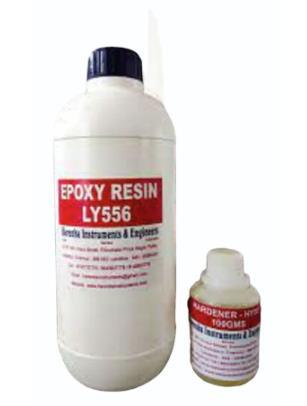
InthisprojectIhaveusedepoxyresinLY556showninfigure 3, becauseEpoxyresinisa widelyused polymer matrixin composite materials, recognized for its exceptional mechanical properties, superior adhesion, and chemical resistance.
Whencombinedwithnaturalfiberslikebananaandkenaf, epoxyresineffectivelyenhancesthestructuralintegrityand performanceofthecomposite.Theselectionofepoxyresinas the matrix material is driven by its remarkable characteristics, ensuring optimal bonding, durability, and reinforcementforsustainablecompositedevelopment.Epoxy resinisathermosettingpolymerthatexhibitshighstrength, low shrinkage during curing, and excellent dimensional stability. Its notable characteristics include high adhesive strength, which forms strong chemical bonds with natural fibers,improvingloadtransferefficiencybetweenthematrix andreinforcement.Thecuredresinresistsmoisture,solvents, andvariouschemicals,ensuringlong-termdurability.Epoxy matrices maintain structural integrity under elevated temperatures, crucial for enhancing the heat resistance of bananaandkenaffibercomposites.
Theminimal volumetricchangeduringcuringhelpsretain the composite's shape and size, essential for precise engineeringapplications.Epoxyresinoffersexcellenttensile, compressive, and flexural strength, enhancing the composite'sabilitytowithstandexternalloads.Inbananaand kenaf natural fiber composites, epoxy resin acts as the bondingmediumthatholdsthefiberstogether.Thestrong adhesion properties of epoxy enable effective stress distribution across the composite structure, improving mechanical performance. This bonding reduces the risk of fiberpull-outanddelamination,ensuringenhanceddurability andstability.
International Research Journal of Engineering and Technology (IRJET) e-ISSN: 2395-0056
Volume: 12 Issue: 09 | Sep 2025 www.irjet.net p-ISSN: 2395-0072
In the preparation and development of the kenaf-banana natural composite,specific chemicalsandequipmentwere employedtoensurethequality,durability,andaccuracyof the resulting material. These included solvents, molds, fixtures,andsurfaceagents,eachplayingacrucialroleinthe compositefabricationprocessshowninfigure4
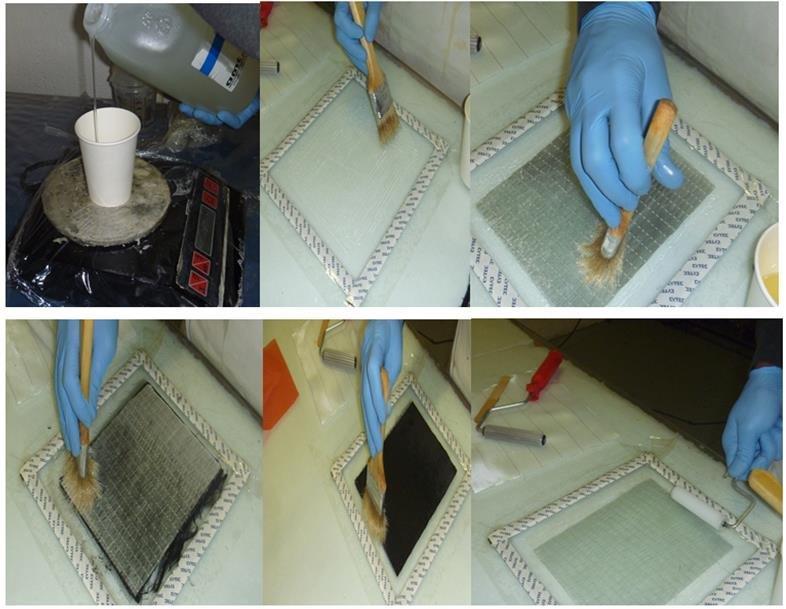
Fig-4:Fabricationwithequipment
(i) Solvents
Solventssuchasethanol,acetone,orisopropylalcoholwere utilizedtocleanandpreparethekenafandbananafibers. Thisstepwasessentialtoeliminatecontaminantslikedirt, oils, and surface impurities that could otherwise hinder bondingwiththepolymermatrix.Cleaningthefibersensured improvedadhesion,enhancingthemechanicalandthermal properties of the composite. For example, immersing the fibersinacetoneforaspecificdurationfollowedbythorough dryinghelpedinachievingoptimalsurfacecleanlinessand improvedfiber-matrixbondingstrength.Studieshaveshown thatfiberpre-treatmentusingsolventssignificantlyimproves the tensile strength and thermal stability of natural fiber composites.
Custom-designedmoldsandfixtureswereemployedtoshape thecompositespecimensaccordingtostandarddimensions for mechanical and thermal testing. These molds were constructed from durable materials such as aluminium or steeltowithstandthecuringprocessandmaintainprecise geometry.
Ensuring consistent specimen dimensions was critical to achievingreliableandrepeatableresultsduringtesting.For thekenaf-banana natural composite,molddesignplayeda pivotal role in controlling the thickness, uniformity, and alignment of fiber layers, which directly impacted the material'smechanicalbehaviour.
Releaseagents,suchassilicone-basedspraysorwaxcoatings, were applied to the mold surfaces before introducing the compositemixture.Thispreventedthecuredkenaf-banana composite from adhering to the mold walls, allowing for smooth and undamaged specimen removal. Proper applicationoftheseagentsreducedsurfacedefects,ensureda cleaner finish, and minimized the risk of fiber detachment duringdemolding.Thisstepwasespeciallyvitalinpreserving thecomposite'sstructuralintegrityandachievingaccurate testresults.
Thecleanedandtreatedfiberswerearrangedinlayerswithin a mold, ensuring uniform fiber orientation for improved mechanicalproperties.Thepreparedpolymerresinmixture wasthenpouredoverthefibers,ensuringcompletewetting of the fiber surface shown in figure 3.6.Care was taken to remove air bubbles through vibration or manual rolling techniques.
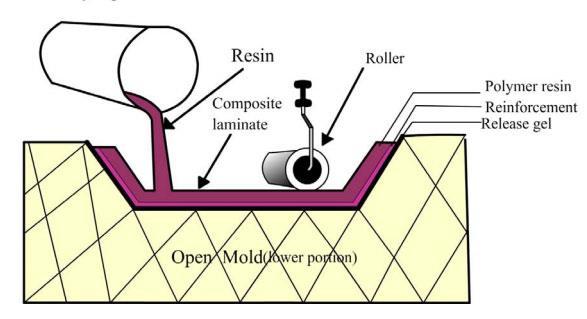
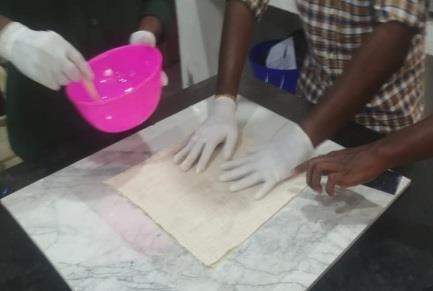
The fabrication of Banana and Kenaf fiber-reinforced composites employed the hand lay-up method, a common and effective technique formanufacturing fiber-reinforced compositesThismethodiswidelypreferredforitssimplicity, cost-effectiveness, and suitability for producing composite sheets with controlled fiber alignment and uniform resin distribution.
International Research Journal of Engineering and Technology (IRJET) e-ISSN: 2395-0056
Volume: 12 Issue: 09 | Sep 2025 www.irjet.net p-ISSN: 2395-0072
Ipreparedfourdistinctcompositesamplestoevaluatetheir propertiesshowninfigure3.7.Thefirstsampleconsistedofa Kenaf-Banana-Kenaffibercombination,designedtobalance thestrengthcharacteristicsofbothfibers.
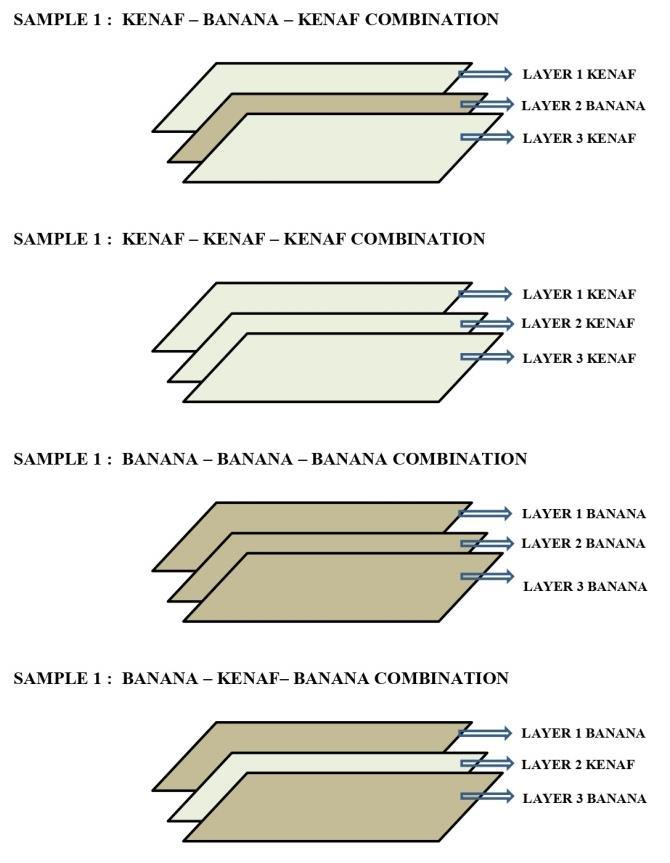
The second sample featured a Kenaf-Kenaf-Kenaf combination, intended to highlight the pure mechanical performance of Kenaf fibers. The third sample utilized a Banana-Banana-Bananacombination,focusingonthespecific propertiesofBananafibers.
Lastly, the fourth sample combined Banana-Kenaf-Banana layers, aiming to explore the synergistic effects of these natural fibers. Each composite was designed to assess variations in mechanical, thermal, and structural performance.Duringthefabricationprocess,custommolds were designed to secure the fiber layers and resin during curing.
Themoldswerecoatedwithareleaseagenttopreventthe compositefromadheringtothemoldsurface,ensuringeasy removalaftercuring.Theusingmoldreleaseagentnotonly simplifiesdemoldingbutalsoimprovesthesurfacefinishof thecompositespecimens.
Thefiberswerecarefullyplacedintothemold,followedby thegradualpouringofepoxyresinoverthefibers.Ensuring uniformresindistributioniscrucialforavoidingdryspotsor air voids, which can significantly weaken the composite structure.
Properresinimpregnationcombinedwithpressingduring the lay-up process effectively minimizes air pockets and ensuresstrongfiber-matrixadhesion.Eachfiberlayerwas
pressedmanuallytopromotebondingandensureuniform thickness.
Thecuringprocesswasconductedintwophasestoensure thecomposite’smechanicalstrengthandstability.First,the compositewascuredatroomtemperaturefor24hoursto allowtheresintobegincross-linkingwiththefiberstructure. The curing process conducted by the help of hot air oven shown in figure 7, the initial curing phase allows the compositetogainsufficientstrengthtoholditsshapebefore post-curing.
Post-curingwascarriedoutatelevatedtemperatures(80–100°C) for 4 hours to enhance polymerization, improve thermalstability,andensurecompletehardening.Thepostcuring at elevated temperatures reduces internal stresses, enhances cross-link density in the polymer matrix, and improvesthecomposite'sdimensionalstability.Additionally, post-curing ensures the removal of residual solvents and unreacted monomers, which could otherwise compromise thecomposite'sstrengthanddurability.
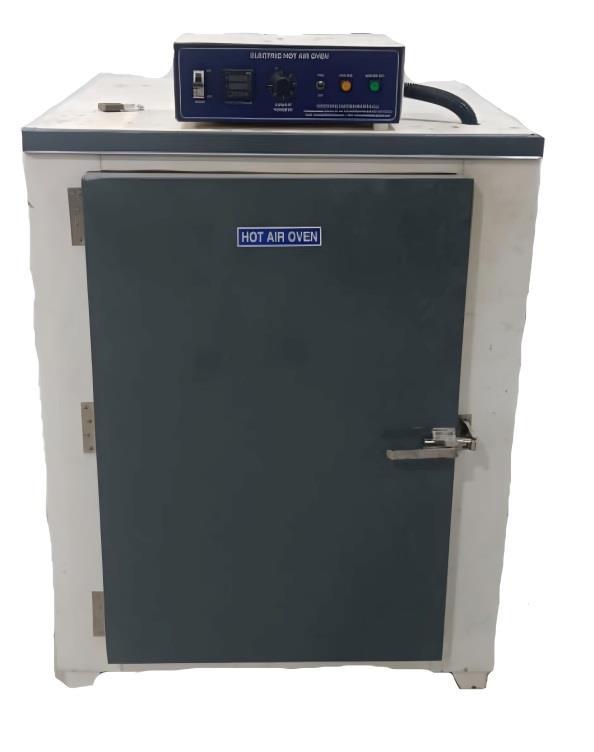
Oncethecuringprocesswascompleted,thespecimenswere removedfromthemolds,andexcessmaterialwascarefully trimmedtoachievetherequiredtestingdimensions.Proper trimmingensuresuniformspecimensize,whichisessential for obtaining accurate and reproducible results during mechanicaltestingandthermaltesting.
3.EXPERIMENTAL
ThemechanicalperformanceoftheBananaandKenaffiber composites was evaluated using several standard tests to assess their strength, flexibility, toughness, and impact resistance. Testing standards such as ASTM D3039, ASTM D790,ASTMD256,andASTMD7028werefollowedtoensure accurateandreliableresults.
International Research Journal of Engineering and Technology (IRJET) e-ISSN: 2395-0056
Volume: 12 Issue: 09 | Sep 2025 www.irjet.net p-ISSN: 2395-0072
Tensile testing was conducted to measure the tensile strength,elongationatbreak,andmodulusofelasticityofthe composites. Specimens were prepared according to ASTM D3039 guidelines, ensuring consistent dimensions for accuratetesting.Thepreparedspecimensweremountedina UniversalTestingMachine(UTM)showninfigure8,which appliedagraduallyincreasingtensileloaduntilthesample fractured.
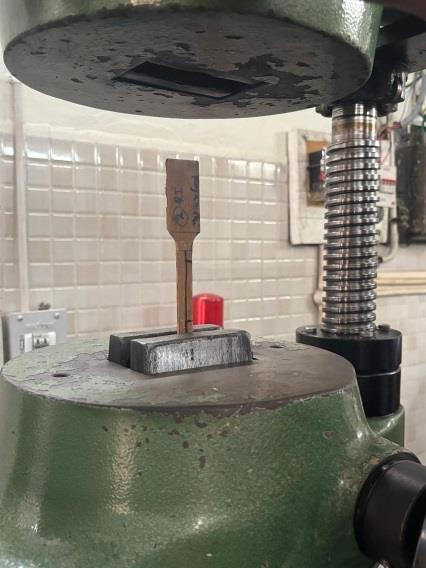
Duringthetest,thefollowingkeyparameterswererecorded:
Maximum tensile stress: The highest stress the materialcanwithstandbeforefailure.
Strain at failure: Theextenttowhichthematerial stretchesbeforebreaking.
Young's modulus (tensilemodulus): Ameasureof the material's stiffness or resistance to elastic deformation.
The tensile properties are highly influenced by fiber alignment, fiber treatment, and the quality of fiber-matrix bonding.Alkali-treatedfibersoftendemonstrateimproved tensilestrengthduetoenhancedinterfacialadhesion.
Flexuralstrengthandmodulusweremeasuredusingathreepoint bending test, which is widely employed to assess a composite's resistance to bending loads. Specimens were preparedfollowingASTMD790standardstoensureuniform sizeandshape.Thepreparedspecimensweremountedina threepointbendingmachineshowninfigure9 Duringthe test, applied a concentrated load at the centre of the compositebeamwhilethebeamwassupportedatbothends.
Thefollowingparameterswereevaluated:
Flexural strength: Themaximumstressamaterial canendurebeforebreakingduringbending.
Flexural modulus: A measure of the material's stiffnessinresponsetobendingforces.
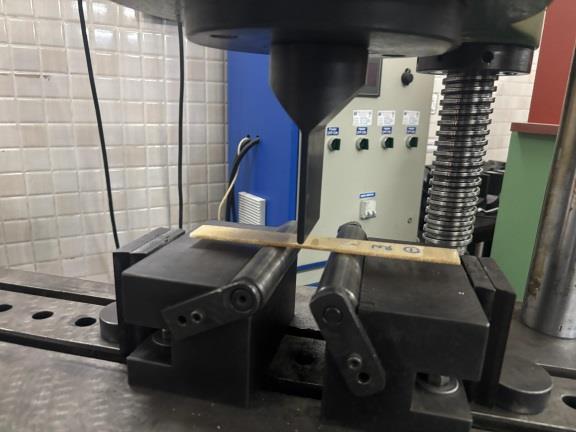
Thecompositesreinforcedwithalkali-treatedfibersexhibit higher flexural strength due to improved fiber-matrix bonding.Additionally,fiberorientationplaysacrucialrolein flexural performance, with parallel-aligned fibers showing superiorresultscomparedtorandomlyorientedones.
Impact resistance was evaluated using an Impact Testing MachinefollowingASTMD256standards.
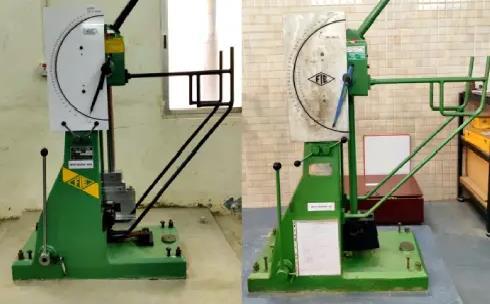
The figure10 shows the charpy impact test machine. The Specimens were notched to create a stress concentration point,whichhelpsinassessingtheirabilitytoabsorbsudden impactforces.Theimpactenergyabsorbedbyeachspecimen wascalculatedbasedonthedifferenceintheheightofthe pendulumbeforeandafterstrikingthesample.
Keyparametermeasured:
Impact energy: Thetotal energyabsorbedbythe specimenduringfracture,indicatingthematerial's toughness.
International Research Journal of Engineering and Technology (IRJET) e-ISSN: 2395-0056
Volume: 12 Issue: 09 | Sep 2025 www.irjet.net p-ISSN: 2395-0072
The alkali-treated fibers demonstrate enhanced impact resistanceduetoimprovedenergydissipationmechanisms. Moreover, fiber orientation and fiber length significantly affect impact toughness, with woven fiber patterns often outperforming random or parallel orientations in impact energyabsorption.
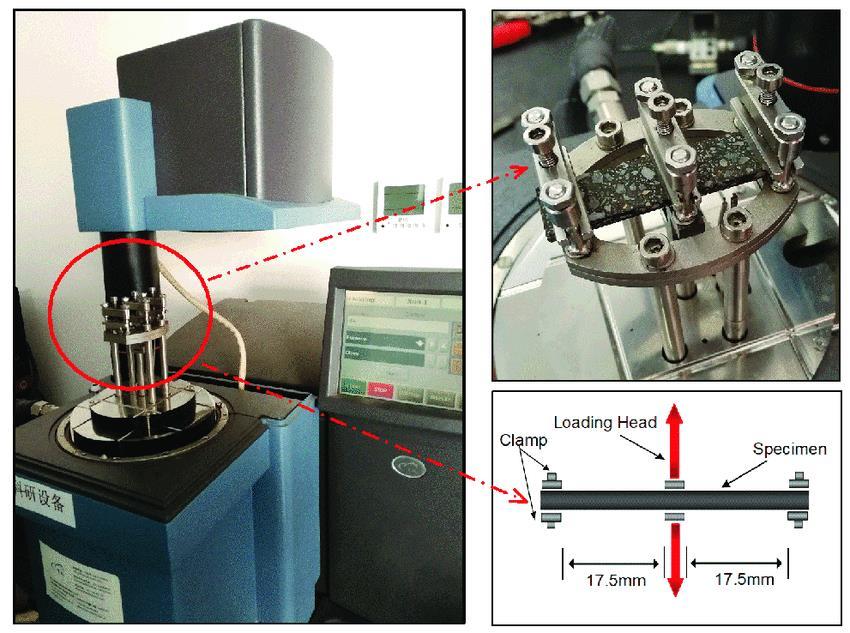
Dynamic Mechanical Analysis (DMA) was conducted followingASTMD7028standardsbyusingdualcantilever bending machine shown in figure 11. To evaluate the composite’s viscoelastic properties, including storage modulus, loss modulus, and damping factor (tan δ). DMA provides insights into the material's behavior under cyclic loading,temperaturevariations,andmechanicalvibrations.
KeyparametersanalyzedinDMAinclude:
Storage modulus (E'): Represents the material's elasticresponseandstiffness.
Loss modulus (E''): Represents the material's energydissipationasheatunderdeformation.
Damping factor (tan δ): Indicates the material's abilitytoabsorbvibrationsanddissipateenergy. DMA is essential for understanding the thermal stability, glasstransitiontemperature(Tg),andviscoelasticbehavior of natural fiber-reinforced composites. The alkali-treated fibers improve storage modulus values, enhancing the composite’s structural performance under dynamic conditions.
These standardized testing methods ensure the reliability and accuracy of mechanical performance data, providing valuableinsightsintothestrengthanddurabilityofBanana andKenaffiber-reinforcedcomposites.
3.5 Morphological Analysis
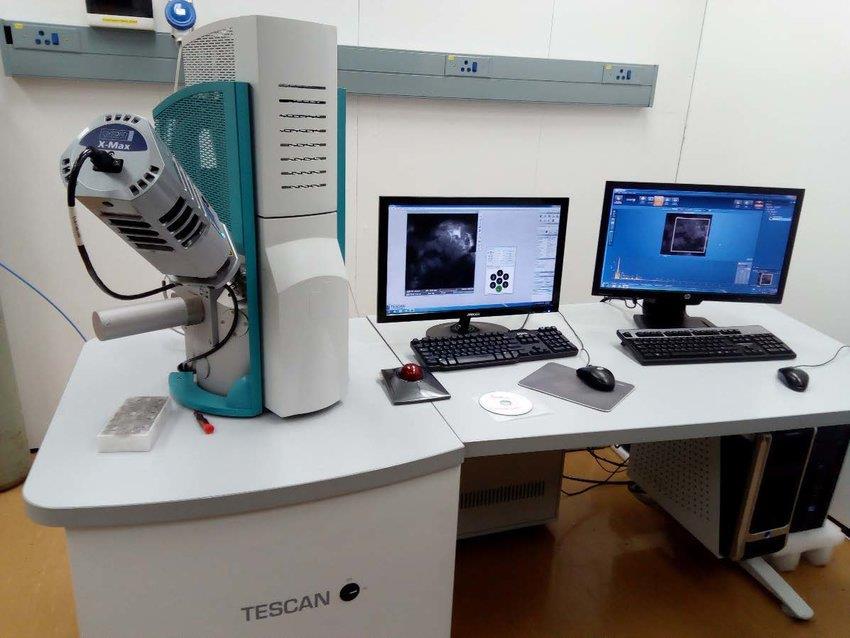
Morphologicalanalysiswasconductedtostudythesurface characteristics,fiber-matrixinterface,andfracturebehavior ofbananaandkenaffiber-reinforcedcomposites.Scanning Electron Microscopy (SEM) Shown in figure 12, it was employed to capture high-resolution images, providing detailedinsightsintothecomposite'smicrostructure.
KeyObservationsinMorphologicalAnalysis:
Fiber-Matrix Adhesion: SEMimagesrevealedthat alkali-treated fibers demonstrated improved bonding with the matrix, reducing voids and enhancingloadtransferefficiency.
Surface Roughness: Thetreatedfibersexhibiteda smoother surface with reduced impurities, contributingtobettermechanicalinterlocking.
Fracture Behavior: SEManalysisindicatedfewer fiberpull-outsandimprovedfiberbreakagepatterns in alkali-treated composites, signifying enhanced mechanicalintegrity.
Morphologicalanalysisisessentialforunderstandingfiber dispersion,voidformation,andmicrostructuraldefectsthat influencecompositeperformance.
4.1 TESILE TEST ANALYSIS:
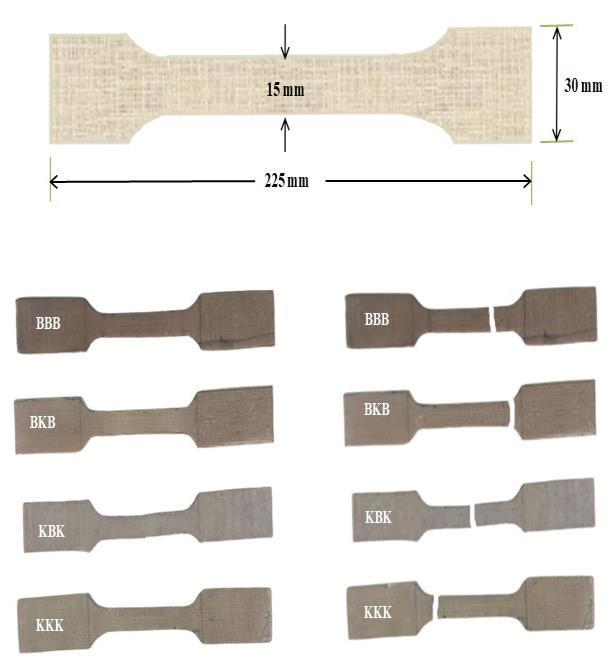
ThetestspecimenswerepreparedfollowingASTMD3039 guidelines, with dimensions of 250 mm x 25 mm x 3 mm showninfigure4.1.Thislength-to-widthratiowaschosento ensureaccuratestressdistributionduringtesting.Tapered tabswerebondedatbothendsofthespecimenstominimize stress concentrations and ensure proper grip alignment. Tensile testing was conducted using a Servo-Controlled UniversalTestingMachine(UTM)withaloadcapacityof400 kN. The test was performed at a crosshead speed of 2 mm/min in accordance with ASTM D3039 standards. Environmental conditions were maintained at 23°C ± 2°C with50%±5%relativehumiditytoensureconsistentand reliableresults.
International Research Journal of Engineering and Technology (IRJET) e-ISSN: 2395-0056
Volume: 12 Issue: 09 | Sep 2025 www.irjet.net p-ISSN: 2395-0072
Specimen Preparation
Analysis of Tensile Strength:
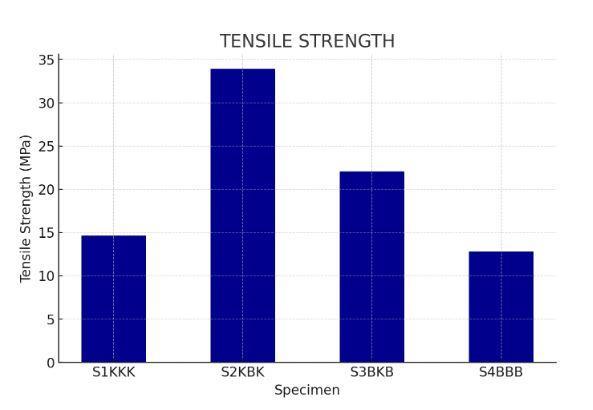
The table 1 represents tensile test analysis. The analysis reveals a significant influence of fiber combination and orientationonthecomposite'stensilestrength.
a) Highest Tensile Strength - S2KBK (33.92 MPa)
TheKenaf-Banana-Kenafcombinationexhibitedthehighest tensile strength. This can be attributed to the strong mechanical properties of kenaf fibers combined with the flexibility and toughness provided by banana fibers. The outerlayersofkenaflikelyimprovedloaddistribution,while the inner banana fiber layer enhanced bonding and crack resistance.
b) Moderate Tensile Strength - S3BKB (22.07 MPa)
TheBanana-Kenaf-Bananacompositeachievedamoderate tensile strength, lower than S2KBK. The reduced strength mayresultfrombananafibers'relativelylowermechanical properties compared to kenaf. However, the presence of kenafinthecoreprovidedstructuralstability.
c) Lower Tensile Strength - S1KKK (14.63 MPa)
TheKenaf-Kenaf-Kenafconfigurationshowedlowertensile strengththanthehybridcombinations.Whilekenaffibersare strong,theabsenceofbananafibersmayhaveledtoreduced flexibility and lower crack resistance, resulting in poorer performanceundertensilestress.
d) Lowest Tensile Strength - S4BBB (12.82 MPa)
The Banana-Banana-Banana composite displayed the weakesttensilestrength.Bananafibersarelessrobustthan kenaf,andtheabsenceofstrongerreinforcementlayerslike kenaf reduced the composite's ability to withstand tensile forces. The following graph 1 shows the Graphical RepresentationofTensileTest Graphical Representation
Table-1:TensileTestAnalysis
(Sample1,Kenaf-Kenaf–Kenaf Sample2,Kenaf-Banana–KenafSample 3, Banana - Kenaf- Kenaf Sample 4, BananaBanana–Banana
IRJET | Impact Factor value: 8.315 |
International Research Journal of Engineering and Technology (IRJET) e-ISSN: 2395-0056
Volume: 12 Issue: 09 | Sep 2025 www.irjet.net p-ISSN: 2395-0072
Hybrid composites combining kenaf and banana fibers (S2KBK and S3BKB) performed better than single-fiber combinations. The inclusion of kenaf as the outer layer improvedtensilestrengthsignificantly,indicatingthatkenaf's rigidity and load-bearing capacity enhance the overall compositestructure.Purebananafiberconfigurationsproved less effective for tensile strength, suggesting their better suitability for applications requiring flexibility rather than hightensileloads.
TheresultshighlightthattheKenaf-Banana-Kenaf(S2KBK) configuration offers the best balance of strength and flexibility, making it an ideal candidate for applications demanding superior tensile performance. For improved mechanical properties, hybrid configurations are recommendedoversingle-fibercomposites.ReasonforHigh TensileStrength,Accordingtostudiesonhybridnaturalfiber composites, kenaf fibers possess high tensile strength (approximately 800 MPa) that enhances the load-bearing capacity.Meanwhile,bananafibersprovideimprovedenergy absorptionandcrackresistance.
4.2
The impact resistance of the composite material was evaluatedusingaCharpyImpactTestingMachinefollowing theASTMD256standard.Thetestspecimenswereprepared withdimensionsof55mminlength,12.5mminwidth,anda thickness of 3 mm, as specified by the standard shown in figure 14. Each specimen was machined with a V-notch featuringa45°angle,adepthof2.5mm.Duringtesting,the specimensweremountedhorizontallyonthesupportswith thenotchedsidefacingawayfromthestriker.
Specimen Preparation
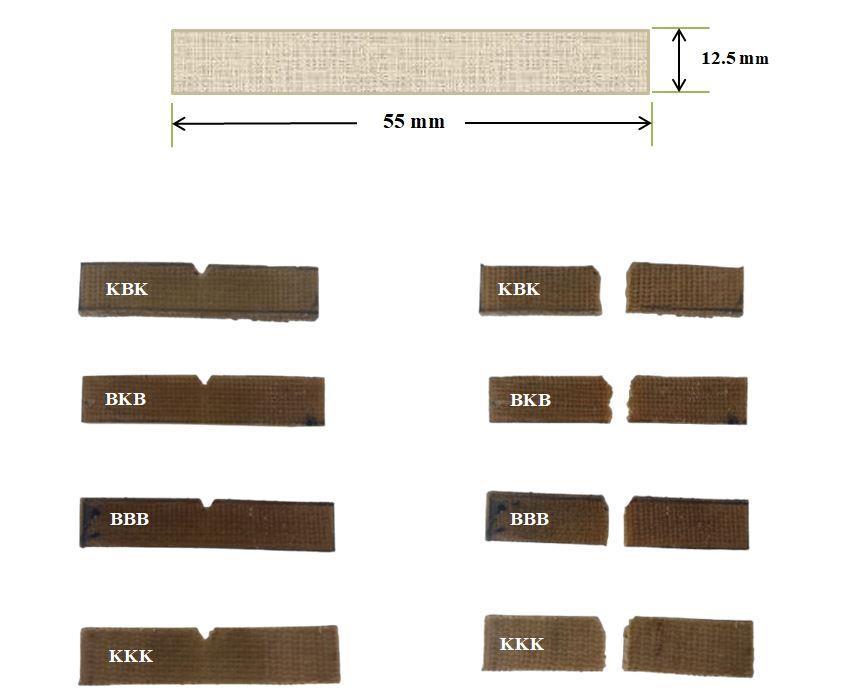
Before Testing After Testing
The pendulum-type impact testing machine had a calibratedenergyrangeofuptoto50J.Thissetupeffectively assessedthematerial'stoughnessbymeasuringtheenergy absorbedduringfractureundersuddenimpactconditions.
Table-2:ImpactTestAnalysis
Theresultsindicatenoticeablevariationsinimpactenergy absorptionacrossthedifferentcompositeconfigurations.The table 2 shows the results. TheKenaf-KenafKenafcombinationsdemonstratedthehighestaverageimpact energy values, 1.68 J. The Banana-BananaBananacombinations demonstrated the second highest average impact energy values, 1.67 J. This higher impact energy is attributed to the uniform fiber arrangement in thesecombinations,whichfacilitatesbetterloaddistribution andenhancesenergydissipationduringimpactconditions. The uniformity in fiber type within these configurations enables a more consistent stress transfer mechanism, reducing weak points in the composite structure and ultimatelyimprovingimpactresistance.Ontheotherhand, theBanana-Kenaf-Bananacombinationexhibitedthelowest impact energy at 1.00 J, while the Kenaf-Banana-Kenaf combinationrecordedslightlyhigheraverageimpactenergy of 1.33 J. These lower values may be attributed to the alternating fiber pattern, which introduces interfaces betweendifferentfibertypes.
International Research Journal of Engineering and Technology (IRJET) e-ISSN: 2395-0056
Volume: 12 Issue: 09 | Sep 2025 www.irjet.net p-ISSN: 2395-0072
TheincreasedimpactenergyintheBanana-Banana-Banana andKenaf-Kenaf-Kenafcombinationscanbeattributedtothe uniformfiberorientationandconsistentfiber-matrixbonding throughoutthecompositestructure.Intheseconfigurations, thehomogeneousdistributionoffibersresultsinbetterload transfer and energy dissipation when subjected to impact forces.Additionally,thebananafiber'snaturalflexibilityand the kenaf fiber's toughness contribute to their improved ability to absorb impact energy.Conversely, combinations withalternatingfiberlayers,suchasBanana-Kenaf-Banana and Kenaf-Banana-Kenaf, exhibited lower average impact energy values. This decrease may be due to differences in fiber-matrix adhesion between the distinct fiber types, potentially creating weak interfacial bonding zones that reduceoverallimpactresistance.
Representation
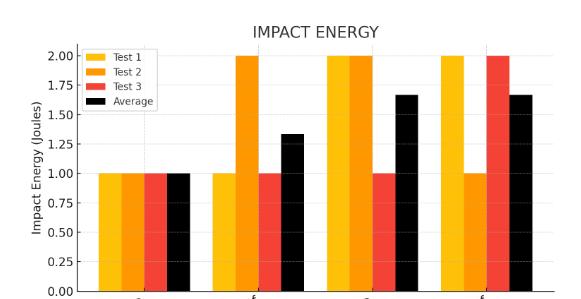
Graph-2 : Graphical representation of impact energy
Fromthegraph2.Thebargraphillustratestheimpactenergy valuesacrossvariousfibercombinationsforeachtest,along withthecalculatedaverage.Thecolor-codedbars - yellow (Test1),orange(Test2),red(Test3),andblack(Average) provide a clear visual representation of the impact performance. Banana-Kenaf-Banana consistently recorded 1.00Jinalltests,showingstablebutlowimpactresistance. Kenaf-Banana-Kenafdisplayedinconsistentresultswith1J,2 J,and1J,leadingtoanaverageof1.33J.Theincreasedimpact energyinTest2suggestspotentialvariabilityinbondingor fiber orientation.Banana-Banana-Banana demonstrated relativelyhighervalueswith2JinTests1and2butdropped to 1 Jin Test3. This fluctuation may indicatevariations in fiber-matrix bonding under different impact conditions.Kenaf-Kenaf-Kenaf maintained strong performancewithvaluesof2J,1J,and2J,averaging1.67J
TheflexuraltestspecimenswerepreparedfollowingASTM D790guidelines,withdimensionsof220mm×30mm×3 mm shown in figure15. This size was selected to ensure accurate stress distribution and effective evaluation of flexuralproperties.Thespecimenswereplacedonathree-
pointbendingfixturewithaspan-to-depthratioof16:1as specifiedinthestandard.
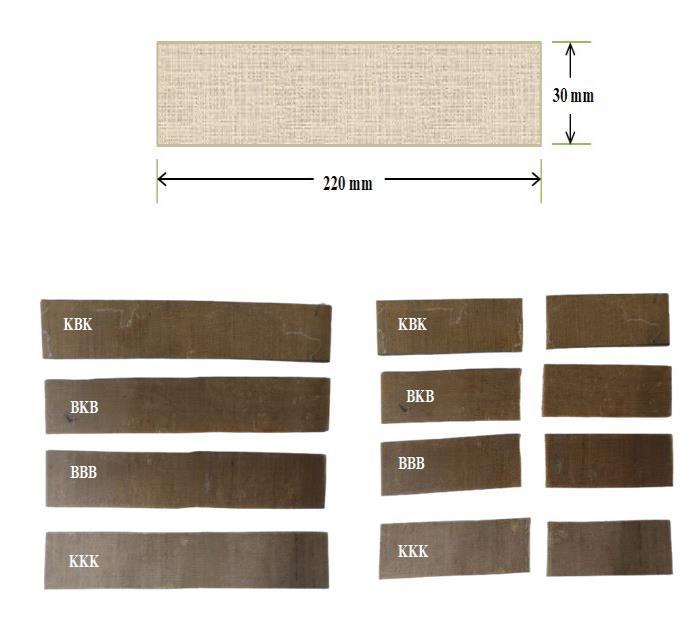
Flexural testing was carried out using a Servo-Controlled UniversalTestingMachine(UTM)withaloadcapacityof400 kN.Thetestwasconductedundercontrolledconditionsto ensureaccurateresults,withtheenvironmentmaintainedat roomtemperatureunderstandardlaboratoryconditions.
Fromthetable3,Sample4(Kenaf-Kenaf-Kenaf),composed entirelyofKenaffibers,showedthehighestflexuralstrength withamaximumforceof260N,displacementatmaximum force of 6.53 mm, and total displacement of 12.98mm, resultinginacompressivestrengthof2.6MPa.Kenaf'sstrong tensilestrengthandstiffnessimproveditsabilitytohandle high loads. The uniform Kenaf fiber arrangement ensured better stress distribution, reducing weak points and enhancingstability.StrongbondingbetweentheKenaffibers andthematrixmaterialfurtherimprovedloadresistance.
Sample2(Banana-Kenaf-Banana),combiningBananaand Kenaffibers,recordedamaximumforceof140N,minimal
International Research Journal of Engineering and Technology (IRJET) e-ISSN: 2395-0056
Volume: 12 Issue: 09 | Sep 2025 www.irjet.net p-ISSN: 2395-0072
displacementatmaximumforce,andtotal displacementof 6.11mm,resultinginacompressivestrengthof1.4MPa.The two Kenaf layers added strength, while the Banana layer improved flexibility. This combination enhanced energy absorption during loading and improved stress transfer, giving Sample 2 better stability than samples with fewer Kenaflayers.
Sample 1 (Kenaf - Banana - Kenaf) showed moderate performancewithamaximumforceof40N,displacementat maximumforceof0.94mm,andtotaldisplacementof6.16 mm, achieving a compressive strength of 0.4 MPa. The alternatingKenafandBananafiberlayersresultedinweaker bondingpoints,reducingstresstransferefficiency.Although theKenaflayersaddedsomestrength,thesofterBananafiber layer limited the sample's ability to resist bending forces effectively.
Sample 3 (Banana - Banana - Banana), made entirely of Banana fibers, exhibited the lowest performance with a maximumforceof60N,displacementatmaximumforceof 1.8 mm, and total displacement of 3.92 mm, resulting in a compressive strength of 0.6 MPa. Banana fibers' lower stiffness and weaker bonding contributed to poor flexural strength. The sample's reduced ability to resist bending forces and possible internal voids further weakened its stability.
Sample 4 (KKK) performed the best, proving that Kenaf fibers significantly improve strength and stability.
Sample2(BKK)showedbetterresultsthansamples withfewerKenaflayers,confirmingKenaf'spositive impactonstrength.
Sample 1 (KBK) offered moderate performance, suggestingabalancebetweenflexibilityandstrength inmixedfibercomposites.
Sample 3 (BBB) had the weakest performance, indicating that Banana fibers alone lack sufficient rigidityforstrongcomposites.
The results highlight that Kenaf fibers play a key role in enhancing composite strength and stiffness. Using more Kenaf layers or combining Kenaf with Banana fibers can effectively improve mechanical performance. Meanwhile, relyingsolelyonBananafibersoralternatingKenaf-Banana layers may reduce structural stability. Optimizing fiber composition is essential for achieving durable and highperformancenaturalfibercomposites.
The graph presents a comparison of compression test parametersforfourcompositesampleswithdifferentfiber compositions shown in graph3. The parameters measured includeMaxForce(N)(blue),MaxDisplacement(mm)(red), andCompressiveStrength(MPa)(green).
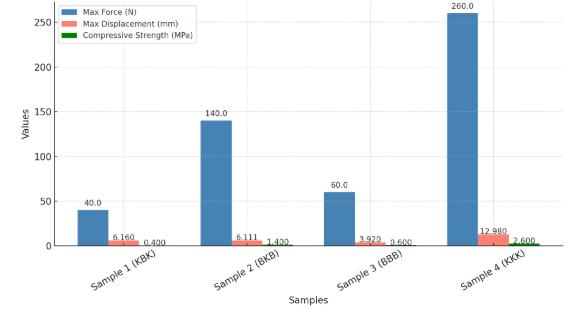
Graph-3:Graphicalrepresentationofflexuraltest
Sample4(KKK)achievedthehighestvaluesacross all parameters, with a Max Force of 260 N and Compressive Strength of 2.6 MPa, highlighting Kenaf'ssuperiorstructuralstability.
Sample 2 (BKK) showed the second-best performance with a MaxForce of 140 N and Compressive Strength of 1.4 MPa, indicating improvedstrengthduetothepresenceoftwoKenaf layers.
Sample 3 (BBB) exhibited moderate performance withaMaxForceof60NandCompressiveStrength of0.6MPa,suggestingthatBananafibersaloneoffer limitedmechanicalstrength.
Sample1(KBK)recordedthelowestvalues,witha MaxForceof40NandCompressiveStrengthof0.4 MPa,indicatingweakerbondingandreducedload resistance.
The Dynamic Mechanical Analysis (DMA) test follows the ASTM D7028 standard, which is used to evaluate the mechanical properties of composite materials. The test sampleispreparedwithdimensionsof127mm×12.7mm ×3 mm shown in figure16. A dual cantilever fixture is commonlyusedforthistest,wherethesampleisclampedat bothendswhilethecentralsectionissubjectedtooscillating forces.
The testing environment is maintained under controlled temperature conditions to study the material’s behavior acrossdifferenttemperatureranges.Thistesthelpsmeasure keypropertiessuchasstiffness,damping,andthematerial’s abilitytoresistdeformationunderdynamicloads.
International Research Journal of Engineering and Technology (IRJET) e-ISSN: 2395-0056
Volume: 12 Issue: 09 | Sep 2025 www.irjet.net p-ISSN: 2395-0072
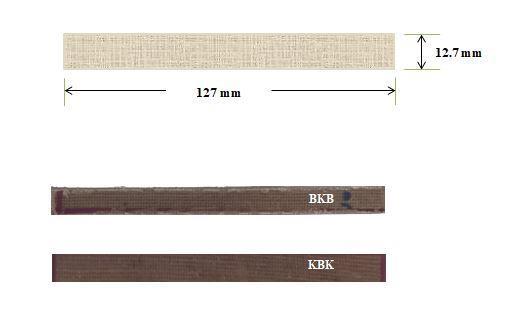
Fig16:SpecimenpreparationofDMA
Table-4:dynamicmechanicalanalysisofbananakenaf bananacombination
GRAPH:
Axes and Curves
The graph4 shows the DMA Graphical representation of banana kenaf banana composite.X-axis (Temperature, °C): The material is heated, and its viscoelastic properties are measuredacrossthistemperaturerange.
LeftY-axis(Modulus,MPa):ThisaxisshowsboththeStorage Modulus (blue/green curve) and the Loss Modulus (red curve)inMPa.
Right Y-axis (Tan δ): This axis (in black or green in some graphs)representsthedimensionlessratioofLossModulus toStorageModulus.
Storage Modulus (E′)
The Storage Modulus represents the elastic (or ‘stiffness’) portion of the material’s viscoelastic response. Atlow temperatures, the composite is in a ‘glassy’ or more rigid state,sotheStorageModulusisrelativelyhigh(hereitisin therangeofthousandsofMPa).Astemperatureincreases,the polymeric matrix begins to soften, causing the Storage Modulustodrop.Thisdecreaseindicatesthetransitionfrom theglassyregiontowardtherubberyregion.
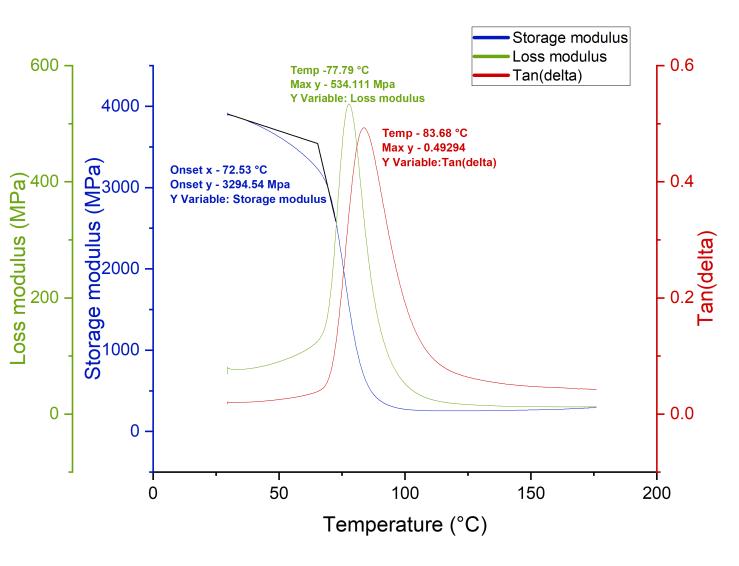
Graph-4:dynamicmechanicalanalysisofbananakenaf bananacombination
Loss Modulus (E″)
The Loss Modulus indicates the viscous or energydissipatingportionofthematerial’sresponse.Typically,the LossModuluswillhaveapeakatorneartheglasstransition region because that is where internal molecular motions (chainmobility)andenergydissipationaregreatest.Inthe provided graph, the peak of the Loss Modulus is around 71.93 °Cwithavalueof~558 MPa.Thissuggestssignificant molecular mobility and damping behavior around this temperature.
Tan δ(DampingFactor)
Tan δ=E″/E′, ItistheratioofLossModulustoStorageModulus.Thiscurve oftenpeaksatorneartheglasstransitiontemperature(Tg) becauseitindicatesthepointwherethematerialtransitions from a predominantly glassy (elastic) behavior to a more rubbery(viscous)behavior.
Inthegraph,Tan δpeaksatabout78.59 °C,withamaximum valueofabout0.59368.ThisiscommonlytakenastheTgof thecomposite.
International Research Journal of Engineering and Technology (IRJET) e-ISSN: 2395-0056
Volume: 12 Issue: 09 | Sep 2025 www.irjet.net p-ISSN: 2395-0072
Observations
Fromthegraph4theOnsetTemperature(~67 °C):Thismay represent the beginning of the significant drop in Storage Modulus(theonsetoftheglass-to-rubbertransition).
Peak in Loss Modulus (~71.93 °C): Indicates maximum energydissipation.
Peak in Tan δ (~78.59 °C): Commonly used as the glass transition temperature (Tg).The difference between the temperature of the peak in Loss Modulus and the peak in Tan δ is not unusual different methods define Tg slightly differently(onset,peakofE″,peakofTan δ,etc.).
Discussion
Stiffness at Lower Temperatures: At lower temperatures (below ~60 °C), the high Storage Modulusindicatesthecompositeisquiterigid.This is typical of polymer composites in their glassy region.
Transition Region (~60–80 °C): As temperature increases past 60 °C, the polymer matrix softens, leadingtoarapiddropinStorageModulusandan increaseinLossModulus.
Glass Transition (70–80 °C range): The glass transitionisconfirmedby:
AnoticeabledropinStorageModulus.
ApeakinLossModulusaround71.93 °C.
ATan δ maximumnear78.59 °C,whichis oftencitedastheTg.
GRAPH:
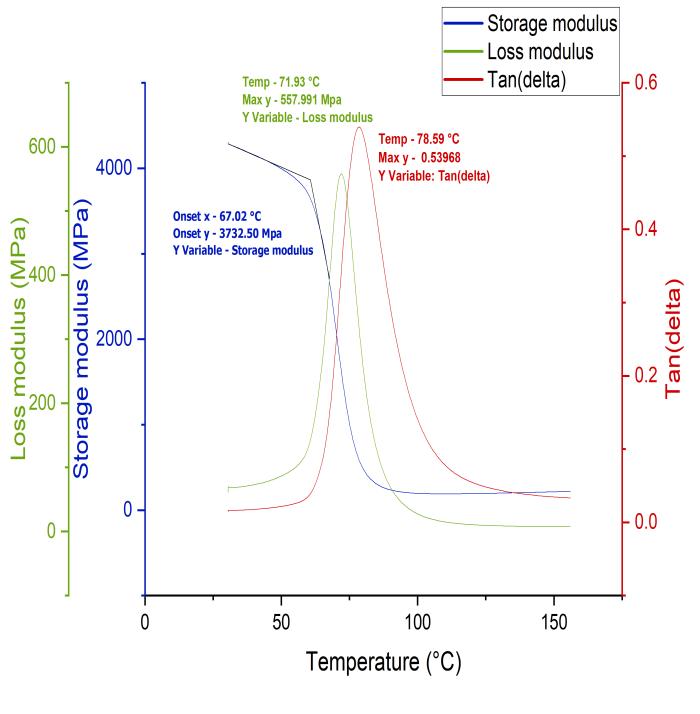
Graph-5:DynamicMechanicalPropertiesofKenaf-BananaKenafComposite
1. Storage Modulus (E′) – Blue Curve
Storagemodulus(E′)representstheelastic(energy-storing) behaviorofthematerial.Ahigherstoragemodulussignifies betterstiffnessandmechanicalstrength.
Observed Value:
Fromthegraph5shows,initialhighmodulus:~3732.50MPa at67.02°CSharpdropbeyond~70°Cindicatestheonsetof theglasstransitionregion.Intheglassyregion(below67°C), thecompositebehavesasastiff,brittlesolidwithminimal chainmovement.ThedropinE′post-transitionsuggeststhe material enters a rubbery phase, where chain mobility increasessignificantly,andreducingstiffness.
Implication:
HighinitialmodulusconfirmsthatKBKlaminatesaresuitable forload-bearingapplicationsundermoderatetemperatures. ComparedtotheBanana-Kenaf-Bananalaminate(3294MPa), KBKshowsabout13.2%higherstiffness,likelyduetokenaf’s superiorfiberrigiditywhenplacedasouterlayers.
2. Loss Modulus (E″)– Green Curve
Lossmodulus(E″)indicatestheenergydissipatedasheatdue to internal friction during cyclic loading. The Peak Value is557.991MPaat71.93°C
Behaviour:
E″increaseswithtemperatureasmolecularchainsbeginto move more freely. The peak corresponds to maximum molecularmobility,whereviscousdampingisatitshighest.
International Research Journal of Engineering and Technology (IRJET) e-ISSN: 2395-0056
Volume: 12 Issue: 09 | Sep 2025 www.irjet.net p-ISSN: 2395-0072
Implication:
A high loss modulus means the composite can dissipate vibrationalenergyeffectively,makingitusefulinapplications wheredampingiscritical(e.g.,automotivepanels,machine housings).
Comparedtotheotherconfiguration(~534MPa),thishigher valueindicatesenhancedenergyabsorption,likelyattributed to improved interfacial bonding between the kenaf and matrixontheoutersides.
3. Tan δ (Damping Factor) – Red Curve
Tanδ=E″/E′,representingtheratioofviscoustoelastic behaviour.It’sameasureofdampingorinternalfriction.The PeakValueis0.53968at78.59°C
Glass Transition Temperature (Tg)
TanδpeakcorrespondstoTgofthecomposite.Beyond this,themateriallosesrigidityandbehavesmorelikerubber.
Interpretation:
High Tan δ means better damping but lower mechanical stiffness. The KBK laminate has a higher Tan δ than BKB (0.49294),suggestingbettervibrationalenergydissipation However,abalanceisneeded:toohighaTanδcouldmeana trade-offinload-bearingcapacity.
Conclusion:
KBK's damping capability makes it ideal for dynamic applications, while still maintaining structural integrity at servicetemperaturesbelow70°C
Property
KenafBanana (BKB)
Kenaf (KBK)
Fromthetable6showsthefollowingobservations,
ThermalStability:TheKBKconfigurationhashigher peaktemperaturesacrossallvariables,suggesting enhancedthermalresistanceduetokenaf’shigher lignincontentandthermalresistance.
Stiffness: BKB exhibits a higher storage modulus, indicating greater rigidity, likely from the outer bananafibersprovidinginitialload-bearingsupport.
Damping: BKB shows slightly better damping performance(higherTanδ),makingitmoresuitable wherevibrationabsorptionisessential.
Transition Behavior: KBK shows a broader transition range, which may contribute to maintaining structural integrity over varying temperatureranges.
The Banana-Kenaf-Banana (BKB) hybrid composite demonstrates higher initial stiffness and greater damping ability, making it more suitable for applications requiring shock absorption and mechanical rigidity at moderate temperatures.
Ontheotherhand,theKenaf-Banana-Kenaf(KBK)composite exhibits superior thermal resistance and slightly wider transition behavior, making it favourable for applications exposed to higher temperatures or requiring long-term thermalstability.
Thus, material selection should depend on specific applicationneeds:
ChooseBKBfordynamicapplicationsrequiringhigh dampingandstiffness.
ChooseKBKforthermallydemandingenvironments requiringdimensionalandmechanicalstability.
The SEM machine in the image is a TESCAN Scanning ElectronMicroscope,equippedwithanOxfordInstruments X-Max detector for energy-dispersive X-ray spectroscopy (EDS)analysis.Thetestsampleispreparedwithdimensions of10mm×10mm×3mmshowninfigure17
Resolution: High-resolution imaging capabilities withnanometerprecision.
Magnification Range: Up to 1,00,000x, allowing detailedsurfaceexamination.
Accelerating Voltage: Variable range for optimal imaging(commonly200Vto30kV).
Table-6:ComparativeDiscussionofDMA
StageMovement:Motorized5-axisstageforprecise samplepositioning.
International Research Journal of Engineering and Technology (IRJET) e-ISSN: 2395-0056
Volume: 12 Issue: 09 | Sep 2025 www.irjet.net p-ISSN: 2395-0072
SoftwareInterface:Advancedimageprocessingand dataanalysistoolsforenhancedvisualization.
This SEM setup ensures accurate characterization of the composite'ssurfacemorphology,fiberdispersion,andmatrix bonding,crucialforevaluatingthecomposite'smechanical andthermalperformance.
Specimenpreparation
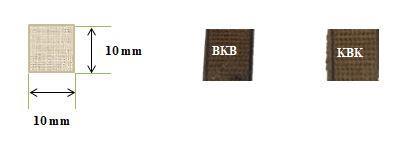
1. Surface Morphology Overview
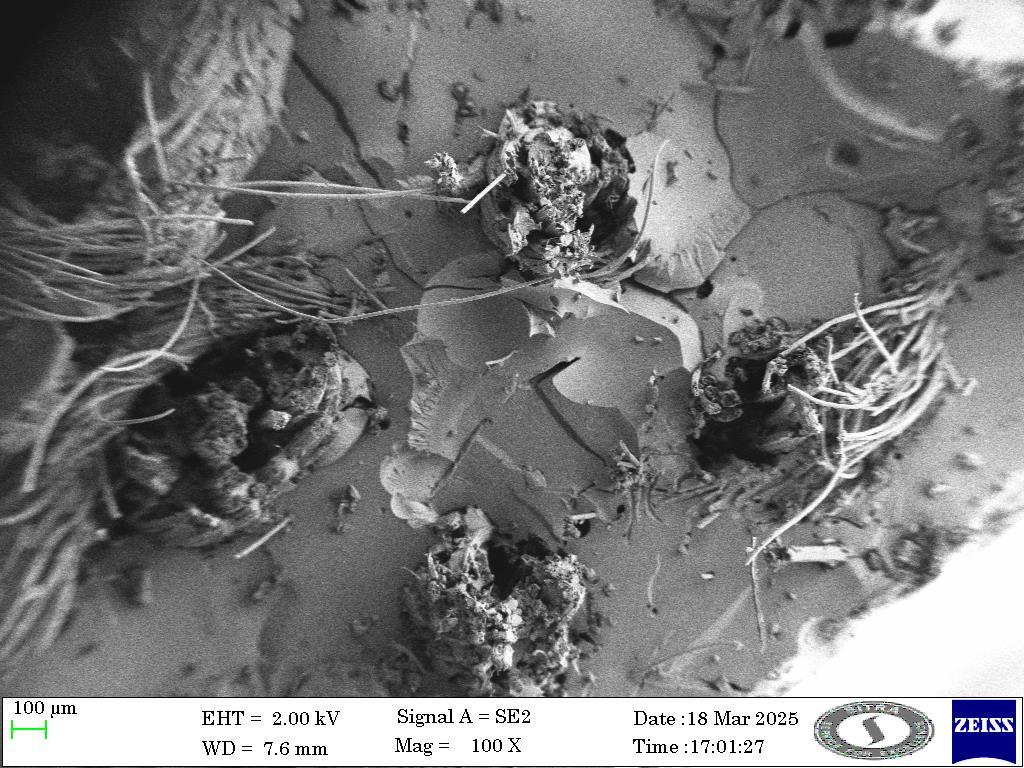
The SEM image of the BKB composite sample reveals the heterogeneoussurfacestructureofthehybridnatural fiber composite.The figure 18 showsdistinct fibrous regions, wherebanana and kenaf fibers are embeddedwithin the polymermatrix(likelyepoxyorpolyesterresin).
The interface between fiber and matrix is a key factor in composite performance, and this SEM image helps in assessing bonding quality, fiber dispersion, and structural integrity.
2. Fiber-Matrix Adhesion
Acloserlookindicatesmoderatetogoodinterfacialbonding between the fibers and the surrounding matrix. There are regions where fibers appear well-embedded, indicating effective load transfer, which contributes to mechanical strength.However,somesmallpull-outsandmicro-voidscan
beseenatcertainpoints,suggestinglocalizeddeboningor incompletewettingoffibersduringfabrication.
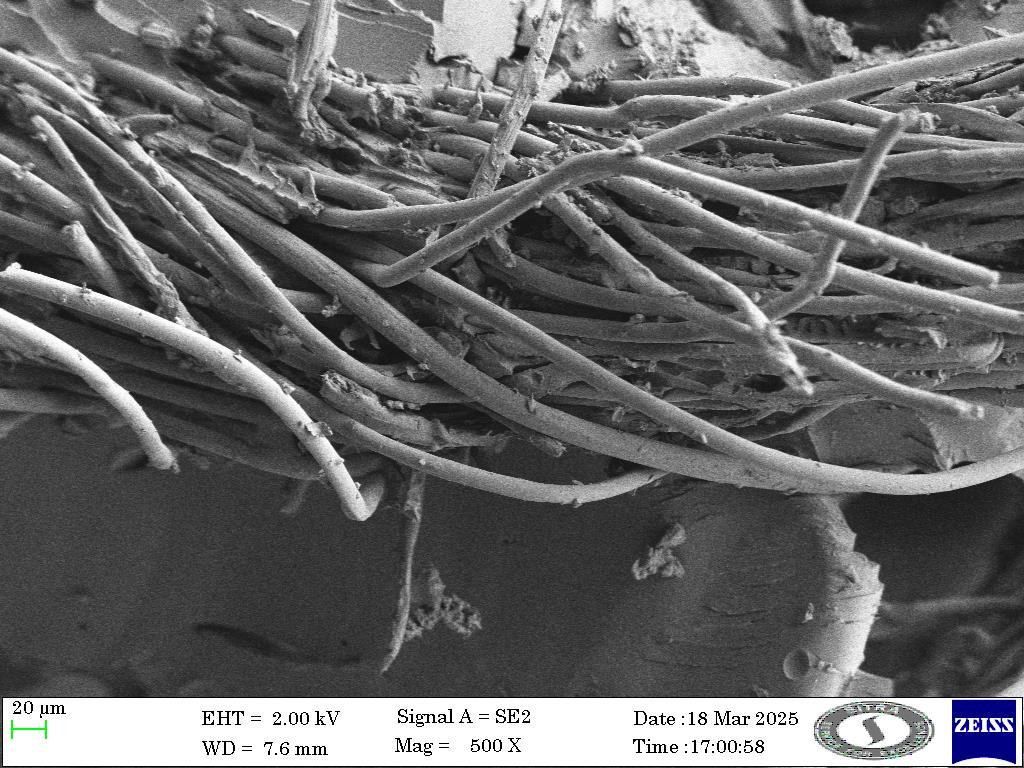
Banana fibers, due to their high cellulose content, appearaslongandcoarsestrands.
Kenaffibers,beingfinerandmorealigned,showa moreuniformdistribution.
3. Fiber Fracture and Pull-Out Mechanism
TheSEMimagedisplaysevidenceoffiberbreakageandpullout, which are two primary failure mechanisms in fiberreinforcedcomposites.Thefracturedfiberendsexhibitrough, unevenedges,indicatingbrittlefracturebehavior.Incontrast, the pulled-out fibers leave behind voids or tunnels in the matrix, suggesting weak interfacial bonding at specific regions.
4. Void Formation and Porosity
Themicrographrevealsalimitednumberofmicro-voidsand poresacrossthesurface.Thesevoidsmayresultfrom:
Airentrapmentduringfabrication
Inadequateresininfiltration
Volatilereleaseduringcuring
Excessiveporositynegativelyaffectsmechanicalproperties such as strength and modulus. The controlled presence of voids here indicates a reasonably optimized fabrication process,thoughslightimprovementsinvacuumdegassingor pressurecuringcouldenhancequality.
5.Fiber Orientation and Distribution
Thebananaandkenaffibersappeartoberandomlyoriented with slight preferential alignment. This non-uniform distributionaffectstheanisotropicbehaviorofthecomposite, meaningitsstrengthandstiffnessvariesdependingonthe direction of applied stress. Thekenaf fibersseem more
International Research Journal of Engineering and Technology (IRJET) e-ISSN: 2395-0056
Volume: 12 Issue: 09 | Sep 2025 www.irjet.net p-ISSN: 2395-0072
continuous and aligned, offering tensile strength.Banana fibers contribute bulk and energy absorption due to their structure.
6. Microstructural Integrity
Overall,theSEMimageindicatesafairlydenseandintegrated microstructure, which is essential for effective stress transferandmechanicaldurabilityshowninfigure20.
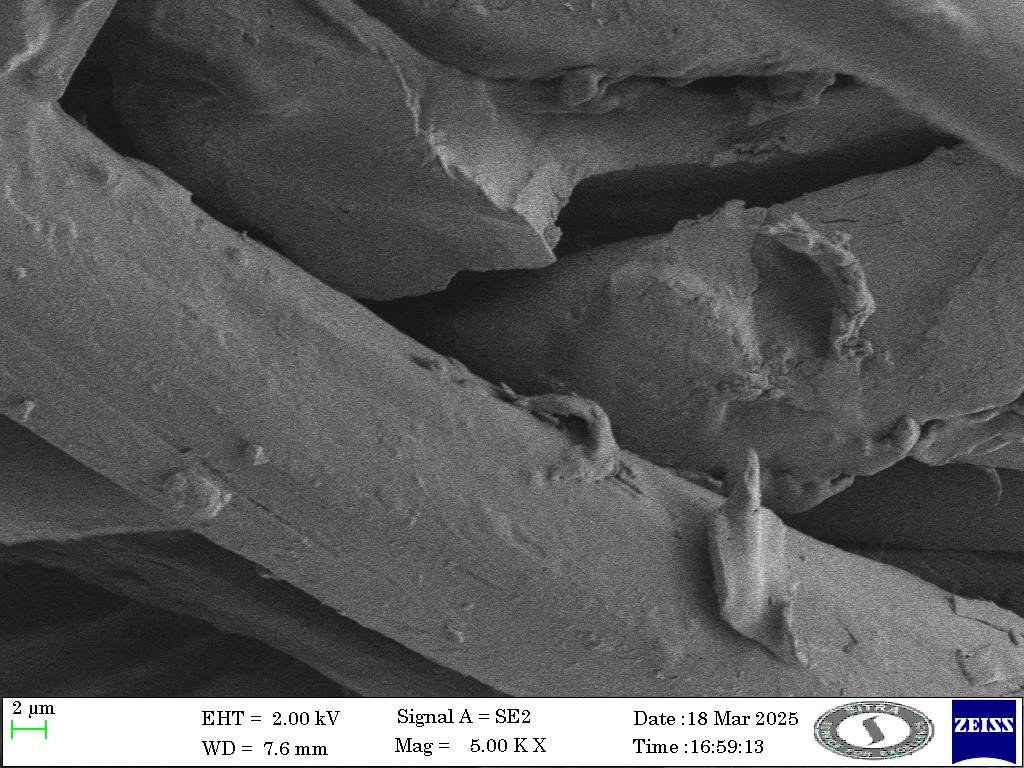
Fig-20:Microstructuralviewwith5.00kx magnification
Theminorflawsobserved(likefiberpull-outsandvoids)are typical innatural fibercompositesanddonotsignificantly compromise the composite's performance if controlled withinacceptablelimits.
The SEM image analysis of the Banana-Kenaf-Banana hybridcompositeconfirms:
Adequatefiber-matrixadhesion
Presenceofmixed-modefailuremechanisms
Controlledporosity
Balancedfiberdistribution
1. Overview of Microstructural Features
:
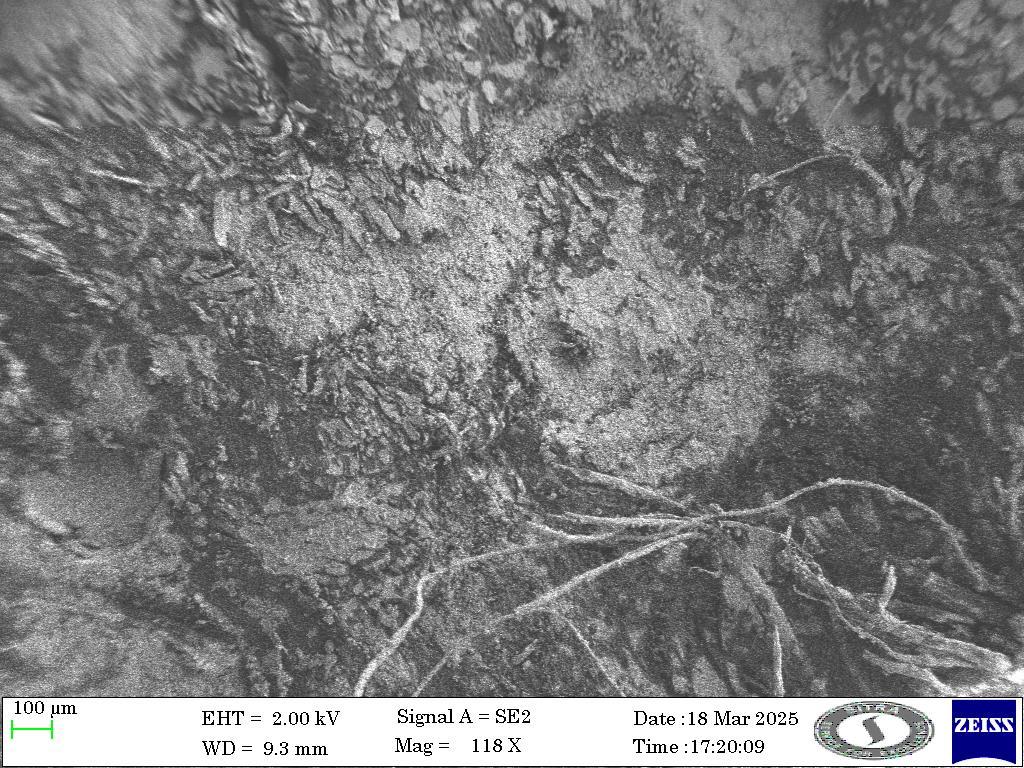
TheScanningElectronMicroscope(SEM)imageoftheKBK composite reveals a heterogeneous yet relatively compact structure,characteristicofnaturalfiber-reinforcedpolymer composites. The figure 21 shows a mixture of kenaf and bananafibersembeddedwithinapolymermatrix,mostlikely epoxyorpolyester.Thelayeredarrangement(Kenaf-BananaKenaf) is evident in the changing texture and fiber appearanceacrossdifferentregions.
2. Fiber-Matrix Adhesion
TheSEMmicrographshowsstrongfiber-matrixadhesionin most regions. The polymer matrix appears to have penetrated and encapsulated the kenaf and banana fibers adequately, which is critical for effective stress transfer betweenthematrixandreinforcement.
Kenaf fibers display a smoother, more aligned morphology with better surface contact with the matrix.
Bananafibers,withtheirroughertextureandporous nature, exhibit a good mechanical interlock but slightlymoreresin-richzones.
3. Evidence of Fiber Pull-Out and Fracture
The image also shows microstructural signs of failure mechanisms,suchas:
Fiber pull-out, especially at the interface between thebananafiberlayerandthematrix.Thiscouldbe due to incomplete wetting or interfacial deboning understress.
Fiberfracturezonesexhibitcleanandjaggedends, indicatingbrittlefractureinsomefibersandductile elongationinothers.
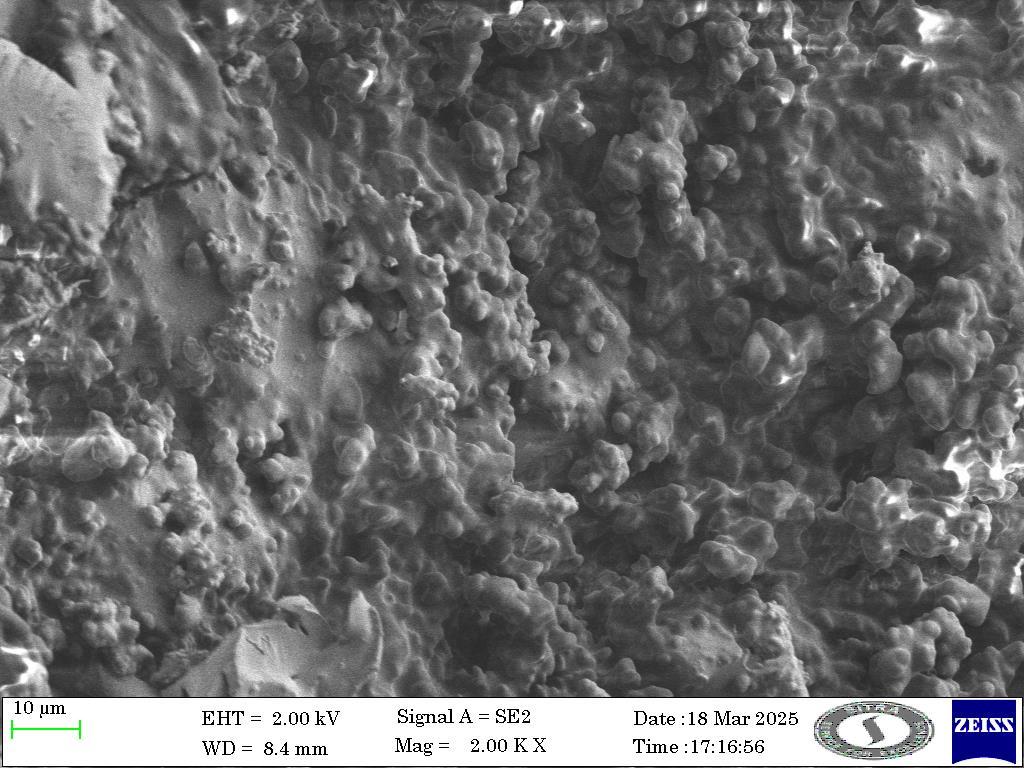
Fig-22:MicrostructuralviewofKenaf-Banana-Kenaf
4.Void Formation and Porosity
Fromthefigure22showstheSmallmicro-voidsandairgaps, areobservedinisolatedareas.Thesevoidscouldresultfrom:
Entrappedairduringresininfusion
Moistureinnaturalfibers
Incompletedegassingduringfabrication
International Research Journal of Engineering and Technology (IRJET) e-ISSN: 2395-0056
Volume: 12 Issue: 09 | Sep 2025 www.irjet.net p-ISSN: 2395-0072
Though minimal, these defects could act as stress concentrators, slightly reducing mechanical properties. However, their low frequency and size suggest a wellcontrolledmanufacturingprocessoverall.
5. Fiber Orientation and Layer Uniformity
Thecompositeexhibitslayeredorientation:
Kenaf fibers (outer layers): Appear straighter and more uniformly distributed. Their alignment suggests they are intended to provide structural stiffnessandtensilestrength
Banana fibers (core layer): Show more irregular orientation and bulkiness, offering vibration dampingandimpactresistance
Reasons:
1. Superior Interfacial Bonding:
The KBK sample exhibits stronger matrix-fiber adhesion, especially with kenaf in the outer layers, which ensures effectiveloadtransferandminimizesfiberpull-out.
2. Lower Porosity:
SEM imaging of KBK shows fewer voids and defects, indicating a better resin flow and fiber wetting during fabrication.Thisimprovesmechanicalconsistencyandlongtermdurability.
3. Better Fiber Alignment:
The kenaf fibers in the outer layers are more uniformly distributedandaligned,providingbetterstiffnessandtensile strength.
4. Overall Structural Integrity:
The layered arrangement in KBK enhances both stiffness (from kenaf) and toughness (from banana), leading to a composite with optimized mechanical and morphological performance.
Table 7: Comparative Discussion of SEM: Banana-KenafBanana(BKB)VsKenaf-Banana-Kenaf(KBK)Composite
BasedontheSEManalysis,theKenaf-Banana-Kenaf(KBK) composite demonstratesa more optimized microstructure comparedtotheBanana-Kenaf-Banana (BKB) variant.The KBK configuration, with kenaf fibers on the exterior, promotes stronger interfacial bonding, minimal void formation.
abstract.AbbreviationssuchasIEEE,SI,MKS,CGS,sc,dc,and rmsdonothavetobedefined.Donotuseabbreviationsin thetitleorheadsunlesstheyareunavoidable. Afterthetextedithasbeencompleted,thepaperisreadyfor thetemplate.DuplicatethetemplatefilebyusingtheSaveAs command,andusethenamingconventionprescribedbyyour conferenceforthenameofyourpaper.Inthisnewlycreated file,highlightall ofthecontentsandimportyourprepared textfile.Youarenowreadytostyleyourpaper.
Parameter
Fiber Arrangement
Surface Morphology
Fiber-Matrix
Adhesion
VoidContent
Porosity
Failure Mechanisms
Fiber Orientation
Structural Integrity
Mechanical Implications
Banana-KenafBanana (BKB)
Kenaf-BananaKenaf (KBK)
Banana (outer) –Kenaf(core) Kenaf (outer) –Banana(core)
Slightly rough, more fibrous due to banana outerlayers
Moderate to good; few fiber pull-outsseen
Few voids, slightly more due to bananarich outer surface
Fiber pull-out + fracture (some delamination areas)
Random orientation, especially bananafibers
Fairly good, someinterfacial issues
Good energy absorption, damping due to banana fiber bulkiness
Smoother, more aligned due to kenaf outer layers
Good to excellent; minimal pullouts and strong bonding
Minimal voids, indicatingbetter resininfiltration
Clean fracture + limited pull-out (strong interface)
More uniform and aligned kenaf outer layers
High integrity, well-formed microstructure
Better tensile strength, stiffness, and reliability
The Kenaf-Banana-Kenaf(KBK)hybridcomposite stands out as the best-performing configuration amongnaturalfibercomposites,offeringsuperior mechanicalstrength,stiffness,thermalstability,and structuralintegrity.
Thisperformanceisduetothestrategicplacement of high-strength kenaf fibers on the outer layers, which enhances load-bearing capacity and resistancetodeformation.
As a result, KBK composites are ideal for semistructuralapplicationsinautomotivecomponents, consumer products, and construction materials, wherereliabilityandsustainabilityareimportant.
In contrast, the Banana-Kenaf-Banana (BKB) configuration, while slightly lower in tensile strength, excels in impact resistance due to the ductilebananafibersontheouterlayers.
International Research Journal of Engineering and Technology (IRJET) e-ISSN: 2395-0056
Volume: 12 Issue: 09 | Sep 2025 www.irjet.net p-ISSN: 2395-0072
ThismakesBKBcompositesperfectforapplications requiring energy absorption, such as packaging materials,automotiveinteriorparts,andvibrationdampeningcomponents.
Overall, this project highlights the importance of optimizingthestackingsequenceofnaturalfibers to enhance composite performance, tailoring materialpropertiestospecificneeds.
Additionally, the use of renewable, biodegradable fibers like kenaf and banana offers significant environmental benefits, reducing the reliance on synthetic materials and supporting a more sustainable future in engineering and manufacturing.
These hybrid composites, therefore, present a viablealternativetosyntheticmaterials,combining highperformancewithenvironmentalsustainability
[1] Abdul Khalil, H. P. S., & Bakar, A. A. (2011). Mechanical performance of oil palm empty fruit bunches/jute fibres reinforced epoxy hybrid composites MaterialsScienceandEngineering:A, 528(29-30),7644-7650.
[2] Ahmed,K.S.,Vijayarangan,S.,&RajendraBoopathy, S. (2019). Studies on the Effect of Mould Release Agents in the Processing of Natural Fiber Composites Journal of Materials Research and Technology, 8(4), 3797-3805. https://doi.org/10.1016/j.jmrt.2019.06.028
[3] Alavudeen, A., Rajini, N., Karthikeyan, S., Thiruchitrambalam, M., &Venkateshwaren, N. (2015) - Mechanical properties of banana/kenaf fiber-reinforcedhybridpolyestercomposites:Effect ofwovenfabricandrandomorientation Materials &Design,66,246-257.
[4] Ali, M., Jawaid, M., Abdul Khalil, H. P. S., Khan, A., Alothman, S., & Nasir, N. M. (2016). Hydrophobic treatmentofnaturalfibersandtheircomposites A review Composites Science and Technology, 125, 45-57.
[5] Al-Oqla,F.M.,&Sapuan,S.M.(2020).Naturalfiber reinforced polymer composites in industrial applications: Feasibility of date palm fibers for sustainableautomotiveindustry.JournalofCleaner Production,66,347–354.
[6] Bledzki, A. K., Mamun, A. A., &Lucka-Gabor, M. (2010).Theeffectsofacetylationonpropertiesof flaxfibreanditspolypropylenecomposites Express PolymerLetters,4(6),395-403.
[7] Carrasco,F.,Pages,P.,Gamez-Perez,J.,Santana,O. O.,&Maspoch,M.L.(2010).ProcessingofPolymeric MatrixCompositesbyThermoforming:Influenceof Reinforcement on Thermal and Mechanical Properties JournalofCompositeMaterials,44(11), 1395-1415
[8] Das,S.,Gupta,M.K.,&Jindal,P.(2020).TheEffectof Alkali Treatment on Mechanical and Thermal PropertiesofNaturalFiberComposites.Journalof PolymerResearch,27,45-58.
[9] Faruk,O.,Bledzki,A.K.,Fink,H.P.,&Sain,M.(2012) - Biocomposites reinforced with natural fibers: 2000–2010 Progress in Polymer Science, 37(11), 1552-1596.
[10] Gassan,J.,&Bledzki,A.K.(2010). Possibilitiesfor improvingthemechanicalpropertiesofjute/epoxy compositesbyalkalitreatment.CompositesScience andTechnology,59(9),1303-1309.
[11] Gopinath,A.,Kumar,M.,&Elayaperumal,A.(2018). Experimental Investigations on Mechanical PropertiesofJuteFiber-ReinforcedCompositeswith Polyester and Epoxy Resin Matrices. Procedia Engineering,97,2052-2063.
[12] Goud, G., & Rao, R. N. (2011). Effect of alkali treatment on flexural properties of natural fiberreinforcedcomposites JournalofAppliedPolymer Science,123(3),1495-1504.
[13] Holbery, J., & Houston, D. (2006) - Natural-fiberreinforced polymer composites in automotive applications JournalofMaterials,58(11).
[14] Islam,M.S.,Pickering,K.L.,&Foreman,N.J.(2012). Influenceofalkalitreatmentontheinterfacialand physicochemicalpropertiesofindustrialhempfiber reinforced polylactic acid composites.Composites PartA:AppliedScienceandManufacturing,42(2), 210-219.
[15] Ismail,A.E.,Ariffin,A.M.T.,Mustapha,F.,&Sultan, M.T.H.(2019).AReviewonthePropertiesofEpoxy Resin and Its Composites Journal of Mechanical EngineeringandSciences,13(3),5523-5538.


MrA.Ramesh M.E., is currently workingasaLectureratAnnaiJKK Sampoorani Ammal Polytechnic College,TamilNadu,India Hehas completedaMasterofEngineering in Thermal Engineering. His research interests include heat transfer, renewable energy systems, and thermal analysis of engineeringmaterials
Mr.S.KarthikrajaM.E.,iscurrently workingasaLectureratAnnaiJKK Sampoorani Ammal Polytechnic College,TamilNadu,India.Hehas completedaMasterofEngineering in Mechatronics. His research interests include natural fiber composites, machine design, and automationsystems.
International Research Journal of Engineering and Technology (IRJET) e-ISSN: 2395-0056
Volume: 12 Issue: 09 | Sep 2025 www.irjet.net p-ISSN: 2395-0072 © 2025, IRJET | Impact Factor value: 8.315 | ISO 9001:2008

Mr.P. Ravichandran B.E., is currently working as the Head of the Department of Mechanical Engineering at Annai JKK Sampoorani Ammal Polytechnic College,TamilNadu,India Hisarea of interest includes composite materialsandtheirapplicationsin engineering.