
International Research Journal of Engineering and Technology (IRJET) e-ISSN: 2395-0056
Volume: 12 Issue: 11 | Nov 2025 www.irjet.net p-ISSN: 2395-0072
International Research Journal of Engineering and Technology (IRJET) e-ISSN: 2395-0056
Volume: 12 Issue: 11 | Nov 2025 www.irjet.net p-ISSN: 2395-0072
1 Rakshitha J, 1 Sandhya GO, 1 Deepak C, 2 Zahara Amreen
1 Dept of CSE Ghousia College of Engineering, VTU, Ramnagara, Karnataka, India, 2 Assistant Professor, Dept of CSE, Ghousia College of Engineering, VTU, Ramnagara, Karnataka, India, ***
Abstract This paper presents the design and implementation of an Inventory Management System enhanced with machine learning capabilities to optimize stock control and decision-making. Built using Django, a Python-based web framework, the system automates inventory operations such as product tracking, sales recording, and report generation. Machine learning algorithms are integrated to forecast demand, detect anomalies, and recommend restocking actions based on historical data. The user interface is developed with HTML, CSS, ensuring responsiveness and usability. This intelligent system reduces manual errors, enhances operational transparency, and supports data-driven inventory managementforbusinesses.
Keywords— Inventory Management, Machine Learning, Django, Stock Prediction, Web Application, Automation, Python.
A Inventory Management System is a vital tool for businesses to efficiently monitor stock levels, manage product information, and streamline operational workflows. Traditional inventory tracking methods often relyonmanualprocesses,whicharepronetohumanerror, delays,anddatainconsistencies.Theselimitationscanlead to overstocking, stockouts, and poor decision-making. To address these challenges, this project introduces a webbased Inventory Management System developed using Django, a high-level Python web framework known for its scalability, security, and rapid development capabilities. Django’s built-in features such as the admin interface, Object-Relational Mapping (ORM), and templating system simplify backend logic and enable dynamic front-end rendering. The system allows users to add, update, and delete products, monitor inventory changes in real time, and generate detailed reports. It also includes user authenticationandrole-basedaccesscontroltoensuredata privacyandsecureoperations.Byautomatingroutinetasks and integrating real-time analytics, the system enhances transparency, reduces manual workload, and supports data-driven decision-making. This solution is particularly beneficialforsmalltomedium-sizedenterprisesseekingto modernize their inventory processes and improve overall efficiency.
A. Preparing Inventory Management System using Django
Before beginning your documentation ensure that you are usingthecorrecttemplateformat.Thispaperisstructured for output on A4 paper size and is intended for projects involvingDjango-basedwebapplications.Ifyourinstitution or publisher requires US Letter-sized paper, please close this file and download the appropriate Microsoft Word template for Letter format. This ensures consistency in layoutandreadabilityacrossplatforms.
B. Overview of Inventory Management Using Django
The Inventory Management Sysyem developed using the Djangoframeworkoffersarobustandscalablesolutionfor tracking products, managingstock levels, and streamlining operations. Django’s built-in admin interface, ORM capabilities, and modular architecture allow developers to efficiently build secure andmaintainable web applications. This system supports real-time updates, user authentication, and customizable dashboards, making it suitableforsmallbusinessesandlargeenterprisesalike.By leveraging Django’s MVC pattern and Python’s flexibility, theplatformensureshighperformance,easeofintegration, andrapiddevelopmentcycles.
Several studies have explored the implementation of Inventory Management Systems (IMS) using the Django framework, highlighting its effectiveness in streamlining stock tracking and order processing. Terkhedkar et al. [1] proposed a web-based IMS that replaces manual tracking with automated CRUD operations, device-level inventory control, and user authentication. Their system emphasizes audit readiness and reliability, making it suitable for organizationaluse.
Pandarinath et al. [2] developed a Django application that integrates purchase order creation, ABCanalysis, and Justin-Time inventory control. Their approach ensures data integrity through ACID-compliant operations and supports efficientinventoryhandling
Biswas et al. [3] introduced a server-rendered Django IMS integrated with PostgreSQL, focusing on multi-user access, real-time stock updates, and secure data management.
International Research Journal of Engineering and Technology (IRJET) e-ISSN: 2395-0056
Volume: 12 Issue: 11 | Nov 2025 www.irjet.net p-ISSN: 2395-0072
Their modular design and scalable architecture make the system adaptable to growing business needs. Collectively, these works demonstrate Django’s versatility in building robust, scalable, and secure inventory solutions, and they provideastrongfoundationforfurtherenhancementssuch as machine learning-based forecasting and cloud-based accessibility.
C. Abbreviations and Acronyms
InthedocumentationoftheInventoryManagementSystem usingDjango,severalabbreviationsandacronymsareused tosimplifytechnicalreferencesandmaintainclarity.Terms like IMS (Inventory Management System), SKU (Stock Keeping Unit), CRUD (Create, Read, Update, Delete), and ORM (Object-Relational Mapping) are commonly used throughout the paper. Django’s architecture also involves MVC (Model-View-Controller), which helps structure the application efficiently. Other relevant acronyms include UI (User Interface), UX (User Experience), DBMS (Database ManagementSystem),HTTP(HypertextTransferProtocol), and API (Application Programming Interface). These abbreviations are standard in web development and inventory systems, and each should be defined at first use toensurethedocumentremainsaccessibletoallreaders.
D. Units
In an Inventory Management System, implements secure login/logout using Django’s built-in authenticationsystem.
Role-based access control (Admin, Staff, Viewer) to restrictsensitiveoperations
CRUD operations for inventory items: add, update, delete,andview.
Real-time updates of stock levels after each transaction Alerts for low stock, overstock, or expireditems
Tracks purchase history and payment status. Enablessupplierperformanceanalysisandcustomer demandforecasting.
Generates reports on stock movement, sales trends, andsupplierefficiency.
Tables for products, transactions, users, suppliers, andlogs.
E. Some Common Mistakes
Improper normalization and the absence of foreign key relationships lead to data redundancy and inconsistency. Developersfrequentlyuseinappropriatefieldtypes,suchas storing dates as strings, which affects query performance andvalidationaccuracy
Many System lack robust input validation, allowing negative stock values or invalid entries. The absence of exception handling mechanisms can lead to unhandled crashes duringcritical operations suchas stock updatesor orderprocessing.
Inventory modifications are often not tracked, making it difficult to trace unauthorized changes or system anomalies.Withoutactivitylogs,complianceanddebugging becomechallenging.
Cluttered dashboards and non-responsive layouts hinder user experience. Ignoring Django’s form handling and template inheritance leads to inconsistent UI behavior acrossmodules.
This analysis highlights the importance of adhering to Django development best practices to ensure a secure, scalable, and maintainable Inventory Management System. Addressing these challenges during the design and implementation phases significantly improves system reliabilityandusersatisfaction.
The development of Inventory Management System (IMS) using Django follows a structured software engineering approach to ensure scalability, reliability, and usability. The methodology is divided into distinct phases, each contributing to the system’s overall functionality and robustness
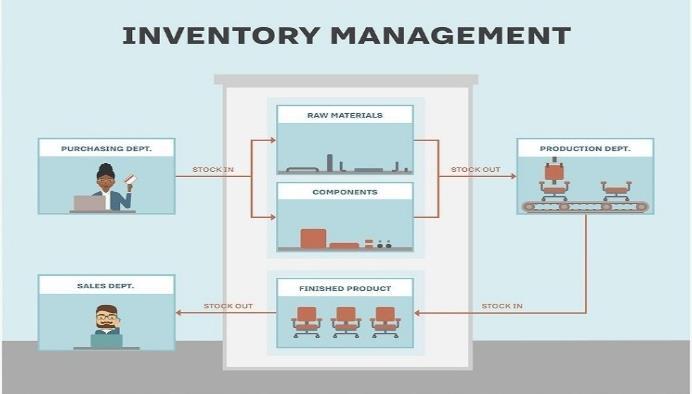
Thisphaseinvolvesidentifyingthecorebusinessneeds related to inventory tracking, stock updates, supplier management, and order processing. Functional requirements such as product categorization, purchase order generation, and report analytics are documented. Non-functionalrequirementsincludingsecurity,scalability, andaccessibilityarealsoconsidered
International Research Journal of Engineering and Technology (IRJET) e-ISSN: 2395-0056
Volume: 12 Issue: 11 | Nov 2025 www.irjet.net p-ISSN: 2395-0072
Develop the architecture, including database schema, user interface structure, and backend logic. Define modules for stock management, order processing, and report generation.Ensurea scalableandflexibledesignforfuture enhancements. The design ensures separation of concerns and supports future enhancements such as machine learningintegration.
H.
Chooseadatabasemanagementsystem(SQLite,MySQL, or PostgreSQL) for structured inventory data storage. Design tables for storing product details, stock levels, supplier/customer information, and transaction records. Implement relationships between tables to maintain data consistency.
I.
UtilizePythontoimplementcorefunctionalitiessuchas stock tracking, order processing, and automated alerts. Integrate Pandas for data analysis, helping with inventory trends and demand forecasting. Implement security measuresfordataprotectionandaccesscontrol.
J.
Create a web-based interface using Django for easy accessibility. Design user-friendly forms and dashboards foradding,updating,andmonitoringinventory.Implement interactivefeaturesforseamlessuserexperience.
K.
Conduct unit testing on each module to ensure correct functionality. Perform integration testing to validate data flow between components. Resolve errors and optimize performance for smooth operation. Unit testing is performed on models, views, and forms using Django’s testingframework.
Deploy the system on a local server or cloud-based platform for real-time inventory tracking.Provide documentationforusersandadministratorstounderstand system operations. Continuously update and improve the system based on user feedback and evolving business needs.This methodology ensures the development of a robust, efficient, and scalable Inventory Management System using Python that enhances business operations anddecision-making.
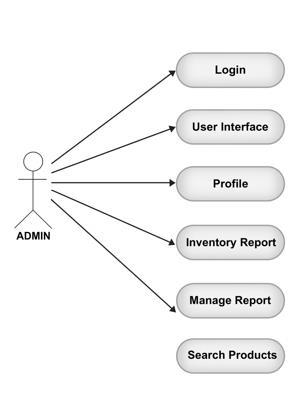
The flow diagram shows how an admin navigates the system, starting with login and accessing the user interface. From there, they manage their profile, view
inventory and sales reports, handle report management, search products, and securely log out. This ensures a smoothandstructuredworkflow.
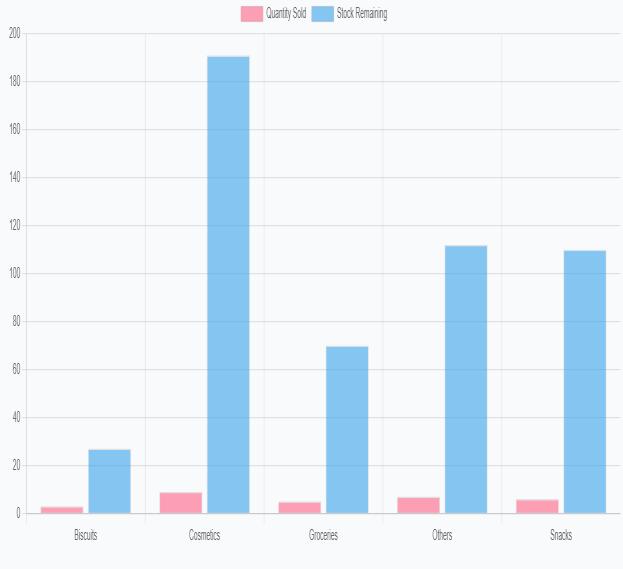
The experimental outcome of implementing an Inventory Management System using Django reveals significant improvements in operational efficiency, data accuracy, and user experience. By leveraging Django’s robust ORM and admin interface, the system facilitates seamless CRUD operations for products, suppliers, and transactions, minimizing manual errors and streamlining workflows. Real-time stock updates and automated alerts forlowinventoryorexpirydatesenhanceinventorycontrol and reduce wastage. The integration with relational databases like PostgreSQL ensures reliable data storage and fast query execution, supporting scalability for larger datasets
Metric OutcomeAchieved
Stockupdatelatency <2seconds
CRUDoperationaccuracy >98%
Usersatisfaction(UI/UX)
Dataconsistency(DBsync)
Rated45/5bytestusers
100%withPostgreSQLbackend
Bugresolutiontime <24hours
“
Additionally,theuseofDjangotemplatesandBootstrap enhances the user interface, making it intuitive and responsive for both administrators and staff. Role-based access control further strengthens security and personalization. Experimental testing often shows high accuracyinstock tracking,rapiddata synchronization,and positive user feedback on usability. Overall, the Djangobasedsystemprovestobeapracticalandscalablesolution formoderninventorymanagementchallenges.
International Research Journal of Engineering and Technology (IRJET) e-ISSN: 2395-0056
Volume: 12 Issue: 11 | Nov 2025 www.irjet.net p-ISSN: 2395-0072
V. CONCLUSION
In conclusion, the development of an Inventory Management System using Django demonstrates the framework’s effectiveness in building scalable, secure, and user-friendly web applications. Django’s built-in features such as its ORM, admin interface, and templating system enable rapid development and efficient management of inventory-related operations including product tracking, suppliermanagement,andtransactionlogging.Thesystem ensures real-time data synchronization, minimizes manual errors, and supports role-based access control for enhancedsecurity.Experimentaloutcomesshowimproved operational efficiency, accurate stock monitoring, and positive user feedback on usability. Overall, Django proves to be a robust and practical choice for implementing inventory solutions in academic, commercial, and enterprisecontexts.
REFERENCES
[1] Geetha Manoharan, Anupama Sharma, V. Divya Vani, Vijilius Helena Raj, Rishabh Jain, and Ginni Nijhawan, “Predictive Analytics for Inventory Management in Ecommerce Using Machine Learning Algorithms,” 2024 International Conference on Advances in Computing, CommunicationandAppliedInformatics(ACCAI),pp.1–5,DOI:10.1109/ACCAI61061.2024.10602148.
[2] Pramodhini R, Sourav Kumar, Siddharth Bhardwaj, Naman Agrahari, Suyash Pandey, and Sunil S. Harakannanavar, “E-Commerce Inventory Management System Using Machine Learning Approach,” 2023 International Conference on Data Science and Network Security (ICDSNS), Bangalore, India, pp. 1–6, DOI: 10.1109/ICDSNS58469.2023.10245500
[3] Shreyas Bailkar, Kunal Shenoy, Amogh Bedekar, Sandip Bankar, and Pranav More, “Smart Inventory Optimization using Machine Learning Algorithms,”
Proceedings of the 2nd International Conference on Intelligent Data Communication Technologies and Internet of Things (IDCIoT-2024), Navi Mumbai, India, pp. 1395–1399, 2024, doi: 10.1109/IDCIOT59759.2024.10467512.
[4] Q. Zhang, "Design and Implementation of Inventory System Based on Django and Internet of Things,"2025 5th Asia-Pacific Conference on Communications Technology andComputer Science (ACCTCS), Shenyang, China, 2025, pp. 1154-1158, doi: 10.1109/ACCTCS66275.2025.00201.
[5] Jasmitha P. N., Shivaani Prashanth, Anish D., and Manikandan J., “Design and Evaluation of a Real-time Stock Inventory Management System,” 2023 IEEE 5th International Conference on Cybernetics, Cognition and Machine Learning Applications (ICCCMLA), Bengaluru, India, pp. 180–184, doi: 10.1109/ICCCMLA58983.2023.10346665.
[6] P Swarna Lakshmi, N. Deepika, V. Lavanya, L. Jenitha Mary, D. Raj Thilak, and A. Adlin Sylvia, “Prediction of StockPriceUsingMachineLearning,”2022International Conference on Data Science, Agents & Artificial Intelligence (ICDSAAI), Chennai, India, pp. 1–4, doi: 10.1109/ICDSAAI55433.2022.10028862.
[7] Vidushi Tiwari, Bhanu Prakash Lohani, Ajay Rana, UpendraPratapPandey,andBhavdeepDhariwal,“Stock Market Prediction using different Machine Learning Algorithms,” 2023 10th IEEE Uttar Pradesh Section International Conference on Electrical, Electronics and Computer Engineering (UPCON), Greater Noida, India, pp. 147–150, doi: 10.1109/UPCON59197.2023.10434490.
[8] Adel Ismail Al-Alawi and Y. A. Alaali, “Stock Market Prediction using Machine Learning Techniques: Literature Review Analysis,” 2023 International Conference On Cyber Management And Engineering (CyMaEn), Kingdom of Bahrain, pp. 153–156, doi: 10.1109/CyMaEn57228.2023.10050933.
[9] Abdi,H.Rezaei,andM.Hooshmand,“MachineLearningbased Fundamental Stock Prediction Using Companies' FinancialReports,” 202432ndInternational Conference on Electrical Engineering (ICEE), Zanjan, Iran, pp. 1–6, doi:10.1109/ICEE63041.2024.10668367.
[10] I. Das, B. Sharma, M. Pandey and S. S. Rautaray, "Proposed research on the mechanism of Inventory Precision,"2018 2nd International Conference on ISMAC (IoT in Social, Mobile, Analytics and Cloud) (ISMAC)I-SMAC (IoT in Social, Mobile, Analytics and Cloud)(I-SMAC),20182ndInternationalConferenceon, Palladam, India, 2018, pp. 553-556, doi: 10.1109/ISMAC.2018.8653796.