
Volume: 12 Issue: 04 | Apr 2025 www.irjet.net p-ISSN:2395-0072
Volume: 12 Issue: 04 | Apr 2025 www.irjet.net p-ISSN:2395-0072
Aravinda Shilpa Konathala1 , Jhansi Sanapala2, Lokeswari Boddeti3, Yakshitha Reddi4
1Assistant Professor, Department of Electrical Engineering, Andhra University College of Engineering for Women, Andhra Pradesh, India.
2-4Students, Department of Electrical Engineering, Andhra University College of Engineering for Women, Andhra Pradesh, India.
Abstract - Augmented Reality (AR) redefines educational methodologies by integrating interactive 3D visualizations into learning environments. This study explores the role of AR in enhancing conceptual understanding, utilizing Unity 3D and Vuforia SDK to develop an interactive learning system focused on the humanheart.ThroughAR technology, a dynamic3D heart model is presented, allowing users to interact with its structure via rotation and exploration. An integrated information system further enhances the learning process by displaying functional details upon selecting specific heart components. Additionally, an embedded multimedia element illustrates the circulatory system, providing a comprehensiveeducationalexperience.Theimmersiveand interactive nature of AR fosters deeper engagement and knowledge retention, addressing traditional learning limitations. By leveraging Unity 3D and Vuforia SDK, this paper demonstrates the potential of AR to simplify complex subjects, enhance student interaction, and transform traditional learning into a more engaging and intuitiveprocess.
KeyWords: Interactive Learning, Augmented Reality, Unity3D,VuforiaSDK,HumanHeartModel
The rapid development of digital technologies hasdrasticallyreshapedtheeducationindustry,bringing novel approaches to augmented learning experiences. Among such developments, Augmented Reality (AR) stands out as a valuable tool, providing engaging and interactive learning environments. The AR technology was initially used for military, industrial, and medical applications,butwassoonappliedinthecommercialand entertainment domains [1]. Walpaw et al. were the first to attempt to implement an AR-based home automation system [2].AugmentedRealityhasgainedpopularityfor use in education owing to its advantages, opportunities, and positive impact on the achievement of learning outcomes [3] In contrast to conventional teaching methodsthatusetextbooks,diagrams,andfixedmodels, AR enhances learning by projecting digital content over the real world, where users can interact with intricate
ideas dynamically. The 3-D visualization of AR objects andinteractivecontentcanhelpengagelearnersactively during the learning process. This can result in better memory retention by linking previous knowledge of learners with new skills and knowledge, provide authentic and active learning opportunities [4] There is aneedtodevelop educationalframeworks withthehelp ofteachersandresearchersforARapplicationstoensure effective design of applications that will be successful in increasinglearningoutcomesandhelpteachers,parents, and students to exploit the benefits of AR for education [5]. AR can be used in diverse learning situations to provide auditory and visual support for different learning styles of learners having difficulties or disabilities[6].
Anatomy learning, especially, demands a thoroughunderstandingofthree-dimensionalformsand their functional interactions. Traditional materials, including books and 2D drawings, tend to lack an accurate spatial depiction of organs such as the human heart, complicating it for students to understand complex details. Students likely to have difficulty in visualizinginternalstructures,theirassociations,andthe physiologicalprocessestheyenable.
Vuforia is a Software Development Kit (SDK) that integrates and enables applications with AR capabilities. Vuforia supports native development for both iOS and Android. It enables the development of AR applications in Unity [7]. Through the use of AR technologies like Unity 3D and Vuforia SDK, an interactive and immersive learning process can be achieved,increasingcomprehensionaswellasretention, like the localization of typical tissues or organs that cannot be seen easily by the naked eye [8]. Educational tools based on AR offer life-like 3D visualizations, allowing anatomical structures to be manipulated by users, accessed for exploration, and an increased intuitivegraspofintricatebiologicalideas.
Traditional methods of teaching anatomy present several limitations that hinder effective learning and International Research Journal of
International Research Journal of Engineering and Technology (IRJET) e-ISSN:2395-0056
Volume: 12 Issue: 04 | Apr 2025 www.irjet.net p-ISSN:2395-0072
engagement. The keychallengesaddressedinthis paper includes:
Textbooks and 2D diagrams fail to offer a comprehensive three-dimensional view of anatomical structures, making it difficult for learnerstovisualizespatialrelationships.
Conventional teaching relies on static illustrations or physical models, which do not allow real-time manipulation or exploration of organstructures.
Anatomicalmodelsareexpensiveandnotalways accessible to every student, limiting opportunitiesforhands-onlearning.
Without interactive elements, it becomes difficult for learners to correlate structural detailswiththeirphysiologicalfunctions.
Traditional learning methods may not be engaging enough, leading to reduced student interestandlowerretentionofinformation.
By integrating AR with interactive 3D visualization, the limitations of traditional approaches can be addressed, offering a more effective and engaging learning experience.
Theprimaryobjectivesofthispaperare:
Todevelopaninteractive3Dvisualizationofthe humanheartusingARtechnology.
To enhance the learning process by allowing users to rotate and explore the 3D model dynamically.
Tointegrateaninformationsystemthatprovides real-timefunctionaldetailsofheartcomponents.
To incorporate multimedia elements for a comprehensiveunderstandingof thecirculatory system.
To demonstrate how AR can improve engagement, comprehension, and knowledge retentioninanatomyeducation.
The focus of this paper is on utilizing Unity 3D and Vuforia SDK to develop an AR-based learning tool for anatomy education, specifically targeting the human heart. The interactive system is designed to benefit students, educators, and medical professionals by offering an intuitive and immersive way to explore cardiac anatomy. While the discussion is centred on the human heart, the approach can be extended to other anatomical structures, demonstrating AR's broader application in medical and biological education. By integrating AR into learning environments, this paper highlights the potential of digital technology in revolutionizing education and enhancing conceptual understanding.
Vanin et al. (2018) explored the application of Augmented Reality (AR) in education, particularly utilizing 3D models and real-time interaction. In their work, they aimed at investigating the applicability of AR in industries in terms of being able to know machines more intuitively. From their investigation, they learned that students can grasp difficult concepts more easily through AR than in any other method, particularly in studyingthingsthatdemandspatialunderstanding.This paper is unique in the sense that it integrates gesture controlwith3Dheartmodelstomakelearningaboutthe heartmoreinteractiveandefficient[9]
ChangYuan Li et al. (2018) also ventured into the application of AR in learning. They discovered that AR enhances student engagement, enhances memory, and enables students to learn more efficiently using interactive 3D images. The research showed that AR is superior to conventional methods of learning in making abstract concepts more real and comprehensible. Nevertheless, it also identified some limitations such as high expense, a requirement of special equipment, and lessuserflexibility[10]
Scavarelli et al. (2021) surveyed how AR and Virtual Reality (VR) are being applied in social learning spaces suchasclassroomsandmuseums.Theycoveredlearning theories like constructivism and social cognitive theory to describe how AR/VR can facilitate collaborative learning. The article also surveyed various AR/VR tools andpinpointedareasrequiringfutureresearch[11].
Debnath et al. (2021) created an AR application based onUnity3DandVuforiatoassisthighschoolstudentsin learning human anatomy. The application displayed 3D images of six human organs and enabled students to interact with them. This made learning more enjoyable andeasier tocomprehend. Theirresearchdemonstrated that AR can enhance conventional teaching by enabling students to view and comprehend body parts more clearly[12].
Rodriguez-Pardo et al. (2015) developed an AR learning anatomy app and established that conventional 2D photographs in textbooks are not effective for demonstrating depth and spatial relationships. They compared AR app users and textbook users among students. Students who used the AR app scored higher on understanding and memory for the subject material. ThisworkvalidatedtheapplicationofARforsimplifying learningofcomplexbodystructures[13].
Hartanto et al. (2018) developed a mobile AR application to educate human anatomy. Because smartphones and tablets are widely used by students, they designed a system that displays 3D images of
International Research Journal of Engineering and Technology (IRJET) e-ISSN:2395-0056
Volume: 12 Issue: 04 | Apr 2025 www.irjet.net p-ISSN:2395-0072
human body parts on them. Learning became more engaging with the application and enabled students to learn independently, anywhere and at any time. Their research indicated that mobile device-based AR increases motivation and facilitates easier review of difficultconceptsbystudents[14].
Augmented Reality (AR) is transforming the educational process by encouraging interactive learning andengagement.TheuseofARineducationalprograms allows students to view intricate information in a more interactive way. The system uses Unity and Vuforia to create an interactive learning interface in which users canview3Dmodelsofeducationalmaterialsusingtarget image recognition. Through interaction with these models, users are able to better comprehend the topics thatarehardtounderstandfromtextbooksalone.
Thesystemunderproposalhasasystematicarchitecture withthreemainlayers:
User Interface Layer – This involves the mobile application interface, where users can engage withtheARcontentviaasmartphonecamera.
Processing Layer – Unity and Vuforia manage target image recognition, 3D model visualization,anduserinteractionprocessing.
ContentManagementLayer – Ratherthanrelying on cloud storage, the 3D models and assets are preloaded in Unity's asset library, providing instantaccessandsmootherprocessing.
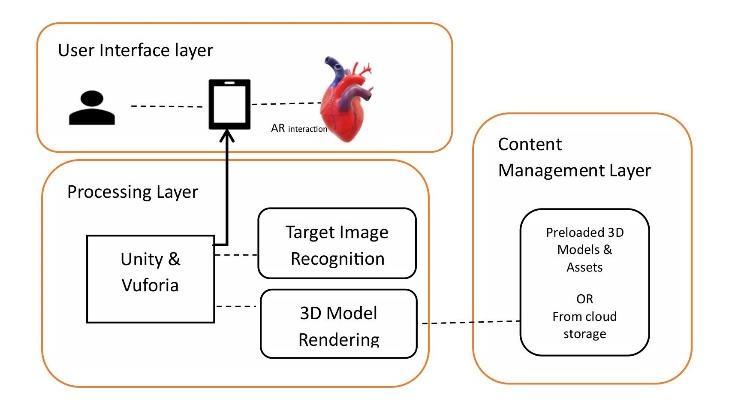
Fig1:LayeredArchitectureofARfor3Dheart
The Fig.1, as illustrated, provides a structured representation of the system’s architecture The interaction between layers ensures a streamlined process Whenever a user scans an image target, Vuforia captures it and assigns it to its corresponding 3D model. Unity renders
themodelinrealtime,andtheusercanmanipulateitby touchgestures.BecauseallassetsresideinsidetheUnity project, the system avoids the retrieval of external models, and it operates smoothly even without an internetconnection.
The AR learning system has a sequential workflow as shown in Fig.2 Below is the stepwise process describing theAR learning workflow:
1. Thecamerasweepsoverpredefinedimageslinked toARcontent.
2. Vuforia identifies the image and matches it to the related3DmodellocatedinUnity'sassetlibrary.
3. Unity loads the 3D model immediately and imposesitonthereal-worldenvironment,andlets usersmanipulateitviatouchgestures.
4. The model can be controlled by gestures such as zooming, rotating, and moving for a more interactive experience, for which a C# script is needed. This offers an interactive means of exploringandcomprehendingcomplexstructures.
5. The other method is through an interactive UI canvashaving buttons for thevarious parts ofthe model. When a button is tapped by a user, a C# script opens up an info panel with detailed data abouttheportiontapped.
6. Aninfopanelisrenderedtoshowthecontent.
7. The info panel has a close button, tapping which closes up the panel and enables users to navigate smoothly.
8. This blend of gesture-based interaction with 3D models and UI-driven structured content access guaranteesafunandintuitivelearningprocess.
9. Asalltheassetsarepreloaded,modelrenderingis neverdelayed,makingtheexperienceseamless.
Volume: 12 Issue: 04 | Apr 2025 www.irjet.net
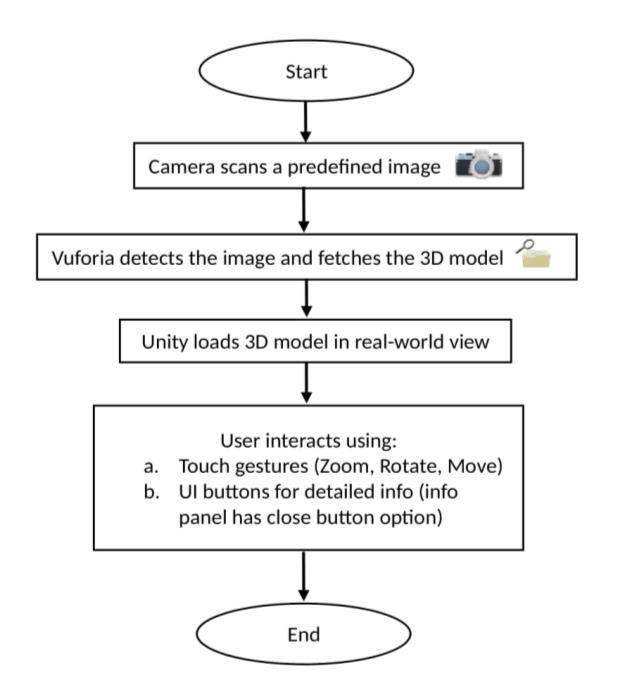
FlowDiagramoftheProposedSystem
3.3. Key Implementation Details
3.3.1.ARModelIntegration
Unity’sbuilt-inassetsystemisusedtostoreand manage 3D models, ensuring quick access and smooth rendering. The models are optimized to maintain high quality while minimizing performance overhead. Vuforia’s image recognition capabilities allow accurate tracking of target images, ensuring that 3D models stay anchoredtotheirdesignatedpositions.
3.3.2.UserInteraction
A major feature of the system is real-time interaction with the AR content. Unity’s input system enables multi-touch gestures for rotating, scaling, and moving 3D models. This feature allows users to explore educationalconceptsfromdifferentperspectives,making learningmoreengagingandeffective.
3.3.3.OptimizedContentManagement
Since all assets are embedded within the Unity project, the application runs efficiently without relying on external servers. This approach improves offline accessibility, ensuring users can access AR-based educational content anytime, without the need for an internetconnection.
4. RESULTS
Augmented Reality (AR) effectively facilitates interactive and immersive learning to know the human heart. The proposed system considered three different
-0056
-0072
target images to understand the concept of the heart in detail. Scanning target images allows 3D models, crosssectional structures, and an animated video describing bloodcirculationtobevisualized.
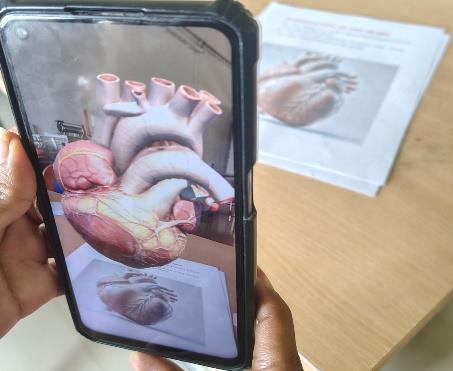
Fig.3:FirstTargetImage–3DHeartModel
As shown in Fig.3, scanning the image shows a 3Dheartmodel withinteractivecontrols. Themodelcan be rotated, zoomed in, and zoomed out, allowing for detailedexplorationofitsstructure.
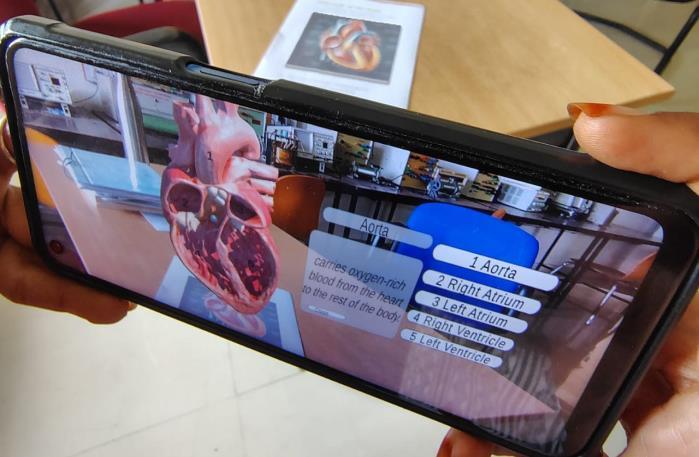
Fig.4:SecondTargetImage–Cross-sectionalViewofthe Heart
A cross-sectional 3D heart model, as illustrated in Fig4, is displayed with its internal structures labeled for easy reference Five UI buttons (aorta, left atrium, right atrium, left ventricle, right ventricle) offer detailed information on each structure. An information panel shows appropriate content when a button is pressed, withaclosebuttontodismissitwhennecessary.
International Research Journal of Engineering and Technology (IRJET) e-ISSN:2395-0056
Volume: 12 Issue: 04 | Apr 2025 www.irjet.net p-ISSN:2395-0072
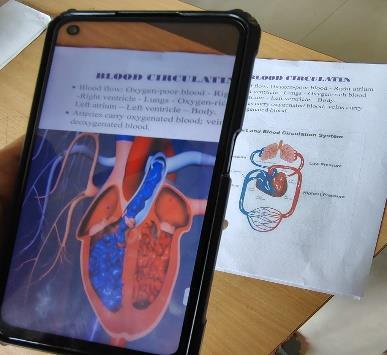
Fig.5:ThirdTargetImage–BloodCirculationVideo
A blood circulation video, as shown in Fig.5, operates by scanning the image. The visual representation aids in comprehending how blood circulates through various chambers and vessels. The system reacts in real time, provides smooth interaction, and makes complicated biological phenomena straightforwardthroughAR-basedvisualization.
5. CONCLUSION
Augmented Reality (AR) is a useful medium for interactive learning, and it increases the interest and accessibility of learning about the human heart. Combining 3D models, UI-based presentation of information, and animated videos increases the clarity, retention,andinterestinconcepts.
Interactive elements such as model manipulation, controlled access to content through UI buttons, and incontext embedding of multimedia address varying learning styles. This approach fills the gap between learning theory and hands-on visualization to make the intricaciesofanatomicaltheoryeasiertovisualize.
Features like voiceover, AR-based quiz functionality, and in-context interactive simulation can enhance learning further,leadingtofurtherusesofARineducation.
[1] Pokric, B., Karco, S., Drajic, D., Pokric, M., Rajs, V., Mihajlovic, Z., Knezevic, P., Jovanovic, D., “Augmented Reality Enabled IoT Services for Environmental Monitoring Utilizing Serious Gaming Concept”, ResearchGate,Jan2015.
[2] Wolpaw, J. R., Ramoser H., McFarland, D. J., Pfurtscheller, G., ‘‘EEG-based communication: Improved accuracy by response verification,’’ IEEE Trans. Rehabil. Eng.,vol.6,no.3.
[3] Mirza, T., Dutta, R., Tuli, N., Mantri, A., "Leveraging augmented reality in education involving new pedagogies with emerging societal relevance", International Journal of Engineering and Technology, 2025.
[4] Santos, M. E., Chen, A., Terawaki, M., Yamamoto, G., Taketoml,T.,Miyazakl,J., Kato,H., “Augmented RealityXRay Interaction in K-12 Education: Theory, Student PerceptionandTeacherEvaluation”,ResearchGate,ICALT, 2013.
[5] Garzon, J., Pavon, J., Baldiris, S., "Systematic Review and Meta-Analysis of Augmented Reality in Educational Settings".VirtualReal.2019.
[6] Duenser, A., Steinbugl, K., Kaufmann, H., Gluck J, ”Virtual andaugmented realityasspatial ability training tools”,ResearchGate.
[7] El-Moursy, A., Sibai, F. N., Rehman, J., Gouda, O. M., Gaber, A. T., Khedr, A. M., “Home Automation using Augmented Reality (HAAR)”, International Journal of EnvironmentalEngineering,Jan2021.
[8]Lee,D.,Yi,J.W.,Hong,J.,Chai,Y.J.,Kim,H.C.,Kong,H. J., “Augmented Reality to Localize Individual Organ in Surgical Procedure”, Healthcare Informatics Research, Oct2018.
[9] Vanin, P. A., Nesterov, A. S., Kholodilin, I. Y., “Integration of IIoT and AR Technologies to Educational Process Through Laboratory Complex”, Global Smart IndustryConference,IEEE,2018.
[10]Li, C. Y., Tang, B. H., “Researchon the Application of AR Technology Based on Unity3D in Education”, Journal ofPhysics,2018.
[11] Scavarelli, A., Arya, A., Teather, R. J., “Virtual reality and Augmented reality in social Learning spaces: a literaturereview”,Springer,May2020.
[12] Debnath, A., Pathak, U., Badoni, P., “An Augmented Reality Application to Teach Human Anatomy to SecondarySchoolStudents”,April2021.
[13] Rodriguez-Pardo, C., Hernandez, S., Patricio, M. A., Berlanga, A., Molina, J. M., “1. An Augmented Reality Application for Learning Anatomy” International WorkConference on the Interplay Between Natural and ArtificialComputation(IWINAC),2015.
[14] Hartanto, D., Cahyadi, A. I., Sari, R. F., “Human Anatomy Learning Systems Using Augmented Reality on MobileApplications”ProcediaComputerScience,2018.