
International Research Journal of Engineering and Technology (IRJET) e-ISSN: 2395-0056
Volume: 13 Issue: 04 | Apr 2026 www.irjet.net p-ISSN: 2395-0072
International Research Journal of Engineering and Technology (IRJET) e-ISSN: 2395-0056
Volume: 13 Issue: 04 | Apr 2026 www.irjet.net p-ISSN: 2395-0072
Rayasam Nirupama Sanjana1 , Vantakula Lakshmi2
1 MCA Student, Gayatri Vidya Parishad College of Engineering(A), Visakhapatnam – 530048, Andhra Pradesh, India
2 Assistant Professor, Department of Computer Applications, Gayatri Vidya Parishad College of Engineering(A), Visakhapatnam – 530048, Andhra Pradesh, India ***
Abstract - Climate data generated by meteorological organizations is growing rapidly due to advances in environmentalmonitoringsystemsandsatelliteobservations. Large volumes of temperature, rainfall, and cyclone datasets are released every year by agencies such as the India Meteorological Department (IMD), the National Oceanic and Atmospheric Administration (NOAA), and the ERA5 climate reanalysis dataset. However, most of this data is available in complex tabular formats that are difficult for users to interpret without specialized analytical tools. This research presentsthedevelopmentofanInteractiveClimateDashboard using Tableau to visualize long-term climate patterns across India.Theproposedsystemintegrateshistoricaltemperature and rainfall records from 1950 to 2025 along with cyclone track data from 1842 to 2025. The dashboard converts large climate datasets into interactive visualizations including geographicheatmaps,time-seriescharts,districtcomparison graphs, seasonal trend analysis, and animated cyclone tracking. The system allows users to explore climate information through dynamic filters such as year, district, region,andcyclone name,enablinginteractiveexplorationof climate trends and regional weather variations. By transforming raw climate datasets into clear visual insights, the proposed dashboard simplifies climate analysis and improves accessibility.
Key Words: Climate Data, Tableau Dashboard, Data Visualization, Climate Analysis, Cyclone Tracking, Interactive Dashboard
Climate plays a vital role in shaping environmental conditions, agriculture, disaster management, and economicplanning.Indiaexperiencesdiverseclimatic conditions due to its vast geographical diversity, including coastal regions, deserts, plateaus, and Himalayan Mountain ranges. These geographical features influence rainfall patterns, temperature distribution, and cyclone formation across different regions.
Meteorological organizations such as the India Meteorological Department (IMD), NOAA, and ERA5 climatedatasetscontinuouslycollectlargevolumesof weather data. These datasets include temperature
measurements, precipitation records, atmospheric pressurereadings,andcyclonetrackinformationover long time periods. Although such datasets provide valuableinsightsforclimate research, theyareoften distributedinrawformatssuchasCSVfilesorNetCDF datasets, which are difficult to analyze without technicaltools.
Traditional climate analysis methods rely heavily on statisticalsoftwareandmanualdataprocessing.This makes it challenging for many users to quickly understand climate patterns or explore regional variationsinweatherbehaviour.Withtheincreasing availabilityofclimatedata,thereisagrowingneedfor tools that can present complex datasets in a more accessibleandinteractiveformat.
Data visualization techniques provide an effective solutionforthischallenge.Visualizationtoolsconvert complexdatasetsintographicalrepresentationssuch as charts, maps, and dashboards that allow users to explore patterns and relationships more easily. Interactive dashboards enable users to filter data, compareregions,andobservelong-termclimatetrends dynamically.
This research proposes an Interactive Climate Dashboard using Tableau that integrates long-term climatedatasetsandcyclonetrackinginformation.The dashboardallowsuserstoanalyzetemperaturetrends, rainfall patterns, district comparisons, and extreme weathereventsthroughinteractivevisualizations.By transforminglargeclimatedatasetsintointuitivevisual insights, the system improves understanding of regional climate behaviour and supports climate researchandenvironmentalstudies.
A. Climate Data Visualization in Environmental Research
Visualization techniques have become essential for analyzingandinterpretinglarge-scaleenvironmental datasets. Kendall-Bar et al. introduced EcoViz, a
International Research Journal of Engineering and Technology (IRJET) e-ISSN: 2395-0056
collaborative visualization framework that enables interactive exploration of ecosystem data through visual interfaces [1]. Their study demonstrated that interactive visualizations significantly improve the understanding of complex environmental patterns comparedtotraditionalstaticrepresentations.
Tominski et al. explored the importance of information visualization in climate research, highlighting that climate datasets are highly multidimensional and difficult to interpret without visual tools [2]. Their work emphasized that visualization techniques help researchers identify trends, anomalies, and relationships among climate variables.
Nocke et al. further reviewed various visual exploration techniques for climate data, demonstratingthatvisualanalyticsplaysacrucialrole inunderstandinglong-termenvironmentalchanges[4].
Severalstudies have focused on analyzing long-term climate patterns using statistical and visualization techniques.Sharmaetal.conductedanextensivestudy on rainfall and temperature trend analysis, revealingsignificantvariabilityinclimaticconditions overtime[3].
Ahrens et al. proposed methods for large-scale climate data visualization usingadvancedgraphical techniques such as parallel coordinates, enabling efficienthandlingofhigh-dimensionaldatasets[5].
TheIntergovernmentalPanelonClimateChange(IPCC) reports have also highlighted the importance of analyzinghistoricalclimatedatatounderstandglobal climate change patterns and support environmental decision-making[10].
Visual analytics combines data visualization with analyticalreasoningtosupportdecision-making.Keim et al. introduced the concept of visual analytics, emphasizing its importance in handling large and complex datasets such as climate data [6]. Their research highlighted challenges such as scalability, interactivity,andusabilityinvisualizationsystems.
Heeretal.presentedvarious interactivevisualization techniques thatenableuserstoexplorelargedatasets
dynamically [8]. Similarly, Munzner provided a comprehensive framework for visualization design and analysis, which is widely used in developing moderndatavisualizationsystems[9].
Thesestudiesdemonstratethatinteractivedashboards significantly enhance user engagement and data interpretation compared to static visualization methods.
Despite significant advancements in climate data visualization, existing systems still exhibit several limitations. Many platforms primarily focus on realtime weather forecasting and do not provide comprehensivetoolsforlong-termclimateanalysis[2], [4]. Additionally, most systems lack features such as district-level comparison, seasonal analysis, and historical cyclone tracking.
Furthermore,manyvisualizationapproachesareeither staticorlimitedininteractivity,makingitdifficultfor userstoperformdynamicexplorationofclimatedata [6]. This limits the ability to analyze patterns across differentregionsandtimeperiodseffectively.
Toaddresstheselimitations,thisresearchproposesan Interactive Climate Dashboard using Tableau, which integrates multiple climate datasets and providesdynamicfiltering,visualization,andanalysis capabilities. The proposed system enhances accessibility and enables users to explore climate patternsinteractively.
The dataset used in this research is collected from reliable meteorological sources such as the India Meteorological Department (IMD), National Oceanic and Atmospheric Administration (NOAA), and ERA5 climatereanalysisdatasets.
The dataset consists of multiple types of climate information,whicharedescribedbelow:
Temperature Data: Contains daily and monthly temperature records from the year 1950to2025.Thisdataisusedtoanalyzelongterm temperature trends across different regions.
Volume: 13 Issue: 04 | Apr 2026 www.irjet.net p-ISSN: 2395-0072 © 2026, IRJET | Impact Factor value: 8.315 | ISO 9001:2008 Certified Journal | Page3958
International Research Journal of Engineering and Technology (IRJET) e-ISSN: 2395-0056
Volume: 13 Issue: 04 | Apr 2026 www.irjet.net p-ISSN: 2395-0072
Rainfall Data: Includes district-wise rainfall measurementscollectedoverseveralyears.It helps in studying rainfall distribution and seasonalvariations.
Cyclone Data: Contains historical cyclone trackrecordsfrom1842to2025.Thisdataset is used to visualize cyclone movement and analyzecyclonebehaviorovertime.
Geographic Data: Includes latitude and longitudecoordinatesofdistrictheadquarters. This data is used for mapping and spatial visualizationinTableau.
The ERA5 dataset is originally available in NetCDF format,whichisnotdirectlysuitableforvisualization. Therefore, it is converted into CSV format for easier processingandintegrationwithTableau
Before visualization, the datasets undergo preprocessingstepssuchas:
Removingmissingandduplicatevalues
Standardizingdateandtimeformats
Organizingdataintostructuredformat
Thesesteps ensure that the dataisclean,consistent, andreadyforaccuratevisualizationandanalysis
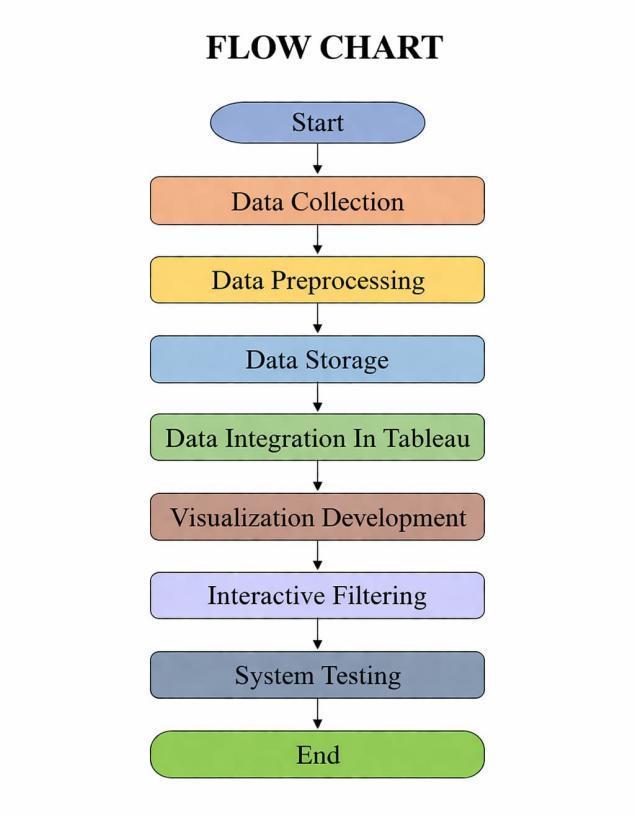
The proposed Interactive Climate Dashboard is developedusingastructuredmethodologyconsisting of three major phases: Data Collection and Preprocessing, Data Integration and Visualization Development and Interactive Dashboard Implementation.
Eachphaseofthemethodologyisexplainedindetail below.
The overall workflow of the proposed system is illustratedinFig.1.
PHASE1:DATACOLLECTIONANDPREPROCESSING
Dataset Collection:
Thedatasetsusedinthisresearchwerecollectedfrom publiclyavailablemeteorologicalsourcesincludingthe India Meteorological Department (IMD), National OceanicandAtmosphericAdministration(NOAA),and ERA5 climate reanalysis datasets. These datasets contain historical climate records including temperature,rainfall,andcyclonetrackdata.
Thecollecteddatasetsinclude:
Dailytemperaturedata
Monthlyrainfalldata
Districtgeographiccoordinates
Cyclonetrackrecords
The climate datasets cover the period 1950 to 2025, whilecyclonerecordsspanfrom1842to2025.
Data Preprocessing:
Raw climate datasets often contain missing values, duplicate records, and inconsistent date formats. Therefore, preprocessing is performed to clean and preparethedatasetsforanalysis.
International Research Journal of Engineering and Technology (IRJET) e-ISSN: 2395-0056
Volume: 13 Issue: 04 | Apr 2026 www.irjet.net p-ISSN: 2395-0072
Thepreprocessingstepsinclude:
Standardizingdateandtimeformats
Removingduplicateandnullrecords
Sortingdatasetschronologically
Mappinglatitudeandlongitudecoordinatesto districts
Creating derived attributes such as month, year,andseasonalcategories
Python libraries such as Pandas, NumPy, andXarray areusedtoperformdatacleaningandtransformation. After preprocessing, the datasets are stored in CSV formatforefficientprocessingandvisualization.
PHASE2:DATAINTEGRATIONANDVISUALIZATION DEVELOPMENT
Inthisphase,theprocesseddatasetsareimportedinto Tableau Desktop for visualization and dashboard development.
Data Integration:
Multipledatasetsincludingtemperaturedata,rainfall records,andcyclonetrackdataareintegratedwithin Tableau.Relationshipsbetweentablesareestablished toallowcombinedanalysisacrossdatasets.
Geographicrolesareassignedtolatitudeandlongitude attributessothatTableaucanautomaticallygenerate map-basedvisualizations.
Calculated Fields:
Several calculated fields are created in Tableau to supportclimateanalysis.Theseinclude:
Monthlyaveragetemperaturecalculations
Seasonalgrouping(Winter,Summer,Monsoon, Post-Monsoon)
District ranking based on temperature and rainfall
Abnormal year detection using statistical deviation
Time index values for cyclone movement animation
Visualization Techniques:
Variousvisualizationtechniquesareusedtorepresent climatedataeffectively.Theseinclude:
Geographicheatmapsfordistrict-levelclimate distribution
Linechartsfortemperatureandrainfalltrends
Barchartsforseasonalcomparisons
Rankingchartsforidentifyingextremeweather regions
Animated maps for cyclone movement visualization
The final phase involves developing an interactive dashboard that allows users to explore climate data dynamically.
Dashboard Development:
Several dashboards are created to analyze different climateaspects,including:
DailyTemperatureDashboard
DailyRainfallDashboard
MonthlyClimateTrendDashboard
DistrictComparisonDashboard
SeasonalClimateDashboard
ExtremeWeatherDashboard
CycloneTrackingDashboard
Interactive Filtering:
Interactivefiltersallowuserstocustomizetheanalysis. Userscanselectparameterssuchas:
Year
District
Region
Season
Cyclonename
Whenfiltersareapplied,Tableaudynamicallyupdates thevisualizationstodisplayrelevantdata.
International Research Journal of Engineering and Technology (IRJET) e-ISSN: 2395-0056
Volume: 13 Issue: 04 | Apr 2026 www.irjet.net p-ISSN: 2395-0072
Cyclone Movement Animation:
Cyclonemovementvisualizationisimplementedusing Tableau’s Pages Shelf feature, which enables timebased animation. The system plots cyclone positions based on latitude, longitude, and date values and connectsthemsequentiallytoformcyclonepaths.This animationallowsuserstoobservecyclonemovement acrossgeographicregionsovertime.
The developed climate dashboard successfully transforms large historical datasets into interactive visualinsights.
TheDailyTemperatureDashboardandDailyRainfall Dashboarddisplaydistrict-wiseweatherdistribution usinggeographicheatmaps.Thesevisualizationsallow userstoquicklyidentifyregionsexperiencinghighor lowtemperatureandrainfalllevels.
TheMonthlyClimateTrendDashboardspresentlongterm variations in temperature and rainfall through linecharts.Thesechartshelpidentifyseasonalpatterns andlong-termclimatechanges.
The system also includes dashboards highlighting extremeweatherconditions,suchas:
Tophottestdistricts
Topcoolestdistricts
Highestrainfalldistricts
Drought-proneareas
Flood-proneregions
One of the most significant features is the Cyclone Tracking Dashboard, which visualizes cyclone movement using animated geographic paths. The animationallowsuserstoobservecyclonetrajectories and understand how cyclones move across regions overtime.
Overall,thedashboardprovidesanintuitiveplatform for analyzing climate data and exploring weather patternsinteractively.
The interactive climate dashboard developed in this research is published on Tableau Public and can be accessedusingthefollowinglink:
https://public.tableau.com/app/profile/nirupama.sanj ana.rayasam3395/viz/INTERACTIVECLIMATEDASHBO ARDFORINDIA_17743353296380/MAINDASHBOARD
This research presented the development of an Interactive Climate Dashboard using Tableau for visualizinglong-termclimatepatternsacrossIndia.The systemintegrateshistoricaltemperatureandrainfall datasets along with cyclone track data to provide a comprehensiveclimateanalysisplatform.
By transforming raw climate datasets into maps, charts, and interactive dashboards, the system simplifiesclimateanalysisandimprovesaccessibility for users. The dashboard enables district-wise comparisons,seasonaltrendanalysis,extremeweather detection,andcyclonetracking.
The results demonstrate that modern data visualization tools such as Tableau can significantly enhancetheinterpretationofcomplexclimatedatasets. The proposed system can support climate research, environmentalmonitoring,andeducationalanalysisby providing clear and interactive visual insights into climatebehaviour.
Futureworkmayincludeintegratingreal-timeweather data, predictive climate modelling, and machine learningtechniquesforadvancedclimateforecasting
[1]J.Thompson,L.ChenandM.Rogers,“EcoViz:Co-designed Environmental Data Visualizations to Communicate EcosystemImpacts,”IEEEVISWorkshoponVisualizationfor ClimateandSustainability,2021,pp.1–6.
[2] C. Tominski, J. F. Donges, and T. Nocke, “Information VisualizationinClimateResearch,”Proceedingsofthe15th International Conference on Information Visualization, London,UK,2011,pp.298–305.
[3]A.Sharma,K.Agrawal,andN.Vasudevan,“ClimateTrend Analysis of Rainfall and Temperature,” Proceedings of the International Conference on Engineering Innovations and Technologies(ICoEIT),Bhopal,India,2025,pp.1348–1352.
[4]T.Nocke,M.Flechsig,andU.Böhm,“VisualExploration andAnalysisofClimateData,”EnvironmentalModelling& Software,vol.26,no.5,pp.599–613,2011.
[5]J.Ahrens,K.Brislawn,K.Martin,B.Geveci,C.Law,andM. Papka, “Large-Scale Data Visualization for Climate Data
International Research Journal of Engineering and Technology (IRJET) e-ISSN: 2395-0056
Volume: 13 Issue: 04 | Apr 2026 www.irjet.net p-ISSN: 2395-0072
Analysis,”IEEEComputerGraphicsandApplications,vol.31, no.4,pp.34–42,2011.
[6]D.A.Keim,F.Mansmann,J.Schneidewind,H.Ziegler,and T. Thomas, “Visual Analytics: Scope and Challenges,” IEEE TransactionsonVisualizationandComputerGraphics,vol. 14,no.1,pp.76–90,2008.
[7] M. Friendly, “A Brief History of Data Visualization,” in HandbookofDataVisualization,Springer,2008,pp.15–56.
[8]J.Heer,M.Bostock,andV.Ogievetsky,“ATourthrough theVisualizationZoo,”CommunicationsoftheACM,vol.53, no.6,pp.59–67,2010.
[9] T. Munzner, Visualization Analysis and Design. Boca Raton,FL,USA:CRCPress,2014.
[10] R. K. Pachauri et al., Climate Change 2014: Synthesis Report.Geneva,Switzerland:IPCC,2014.
2026, IRJET | Impact Factor value: 8.315 | ISO 9001:2008