
International Research Journal of Engineering and Technology (IRJET) e-ISSN: 2395-0056
Volume: 13 Issue: 03 | Mar 2026 www.irjet.net p-ISSN: 2395-0072
INTELLIGENT PROCTORING SYSTEM USING REAL-TIME FACE RECOGNITION ANDEYE-TRACKING
Sunitha Chakali1 , Kaveri Mamidi2 , Kirthi Nalam3 , Srikar Ramagoni4, Mrs.M.Keerthi5
1-4
Undergraduate Students, Department of Information Technology, Vidya Jyothi Institute of Technology, Hyderabad, Telangana, India
5 Assistant Professor, Department of Information Technology, Vidya Jyothi Institute of Technology, Hyderabad, Telangana, India
Abstract - Nowadays, online exams are common, but it is not easy to monitor students properly. our paper presents an Intelligent Proctoring System that monitors candidates inreal time using a webcam. In our project, the system checks whether a face is present and also tracks head movement and eye direction to identify events such as absence, multiple faces, and abnormal viewing behavior.
Based on these observations, a risk score is calculated to indicate the level of suspicious activity during the exam. The system is simple and can run using a normal webcam without extra setup. The results show that it can effectively identify abnormal behavior and support fair online examination processes.
1. INTRODUCTION
Today, many exams are conducted online, but monitoring studentsisstilldifficult.Althoughstudentsareaskedtokeep their webcamon,simplyrecordingvideoisnot enough to identifysuspiciousactivitiessuchaslookingaway,leaving thescreen,orthepresenceofmultiplepersons.
For this problem , we developed an Intelligent Proctoring System that monitors candidates in real time using a webcam.Thewebcamvideoistakenandcheckedframeby frame in our system to detect face presence, head movements,andeyegazedirection.Themainfocusofthe system is on head movement detection, along with gaze trackingundersuitablelightingconditions.
The system identifies events such as no face detected, multiplefacesdetected,andgazedirectionslikeleft,right, and center. Based on these observations, a risk score is calculatedtoindicatethelevelofsuspiciousbehaviorduring theexamination.Eventslike absence ofthecandidateand multiplefacedetectioncontributetoahigherriskscore.
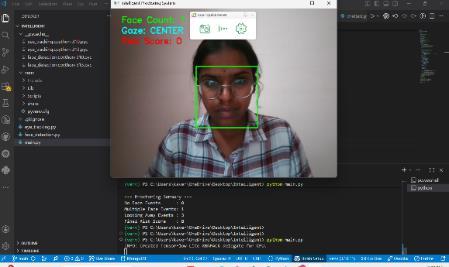
Thesystemdisplaysfacecount,gazedirection,andriskscore onthescreen.whichhelpsinanalyzingcandidatebehavior effectively. The system is simple, works with a standard webcam,anddoesnotrequireanyadditionalhardware.
Overall, this approach provides a practical solution for monitoringonlineexamsandhelpsinidentifyingabnormal behavior more effectively than basic video-based monitoring.
2. LITERATURE SURVEY
ManyresearchpapersareavailableinthisareaofAI-based onlineproctoringsystems,focusingonmonitoringcandidate behaviorusingcomputervisiontechniques.
T. Singh et al.(2024) proposed a multi-modal proctoring system that combines facial recognition, head pose estimation, mouth tracking, and audio analysis to detect suspicious activities.[3]The system shows improved accuracybyusingmultipleinputssuchasvideoandaudio. However, the inclusion of multiple modalities increases systemcomplexityandmay require higher computational resources,makingitlesssuitableforlightweightand realtimeapplications.
Vishal Molawade et al.(2023) developed an AI-based online exam proctoring system thatusesfacerecognition and object detection techniques like YOLO to identify activitiessuchasmobilephoneusageandmultiplepersons intheframe.[1]Whilethesystemimprovesautomationin monitoring,itmainlyfocusesonobjectdetectionanddoes notgivedetailedattentiontogazedirectionorcontinuous behaviortracking.
S. Essahraoui et al. (2025) presentedadeeplearning-based approach that integrates facial recognition, gaze tracking, and object detection to detect cheating behavior. [4]The system achieves better accuracy by combining multiple features.However,suchapproachescanbecomputationally expensive and may not perform efficiently in real-time environmentswithstandardhardware.
From the existing literature, it is observed that many systemseitherfocusoncomplexmulti-modalapproachesor require high computational resources. In contrast, our proposed system focuses on a lightweight and practical solutionusingastandardwebcam.[2]Itemphasizeshead movement detection along with gaze direction and introducesariskscoremechanismbasedoneventssuchas noface,multiplefaces,andgazedeviations.Thismakesthe system more suitable for real-time usage while still effectively identifying suspicious behavior during online examinations.
Volume: 13 Issue: 03 | Mar 2026 www.irjet.net p-ISSN: 2395-0072
3. PROPOSED MODEL
In this project, we developed an Intelligent Proctoring System to monitor students during online exams using a webcam. The system works in real time and checks the candidate’sbehaviorthroughouttheexam. The system captures video continuously and processes it framebyframe.First,itdetectswhetherthecandidate’sface is present. If no face is detected or if more than one face appears,thesystemconsidersitassuspiciousbehavior. Next,thesystemcheckswherethecandidateislooking. It usesfaciallandmarkstoestimatethedirectionoftheeyes.If thecandidatelooksawayfromthescreenforalongertime,it ismarkedasapossibleviolation.
Toavoidfalsealerts,thesystemdoesnotreactimmediately. It uses simple time rules. For example, the face must be missingforafewsecondsbeforeitiscounted,andlooking awayisonlyconsideredifitcontinuesforsometime. Finally,alltheseactivitiesarecombinedtocalculatearisk score. This score gives an overall idea of the candidate’s behaviorduringtheexam.
Thesystemissimple,workswithanormalwebcam,andcan be used easily for real-time monitoring in online examinations.
4.METHODOLOGY
Our Project Intelligent Proctoring System is designed to monitor candidate behavior in real time using a webcam. Thesystemprocesseslivevideocontinuouslyandanalyzesit todetectfacepresence,headmovement,andgazedirection. Theoverallworkflowconsistsofthefollowingsteps.
1. Video Acquisition
The system captures live video using a webcam through OpenCV.Thevideostreamisprocessedframebyframeto enablereal-timeanalysisofcandidatebehavior.
2. Face Detection
Face detection is performed using MediaPipe Face Detection[5]. Each frame is converted from BGR to RGB format and passed to the detection model. The system identifiesthenumberoffacespresentanddrawsbounding boxes around detected faces. The face count is used to determinewhetheravalidcandidateispresent,absent,orif multiplepersonsaredetected.
3. Facial Landmark Detection and Eye tracking
InourprojectspeciallyForgazeestimation,MediaPipeFace Mesh is used to extract facial landmarks. Key landmark pointsaroundtheeyesareidentified,andthecenterposition oftheeyesiscalculated.Thispositioniscomparedwiththe center of the frame to determine gaze direction as LEFT, RIGHT,or CENTER.If no facelandmarksare detected, the systemidentifiesitas“NOFACE”.
4. Event Detection Logic
The system defines specific rules to identify suspicious behavior:
NoFaceDetection:Ifnofaceisdetectedcontinuouslyfor more than 5 seconds, it is recorded as a suspicious event.
Multiple Faces Detection: If more than one face is detectedintheframe,itisimmediatelyrecordedasan event.
LookingAwayDetection:If thecandidatelooksleftor right continuously for more than 3 seconds, it is consideredaslookingaway.
Timersandflagsareusedtoensurethateventsarecounted onlyonceperoccurrence.
5. Risk Score Calculation
At the end ,A risk score is calculated based on detected eventsusingaweightedapproach:
NoFaceEvent→Weight=3
MultipleFaceEvent→Weight=5
LookingAwayEvent→Weight=1
Thefinalriskscoreiscomputedas:
Risk Score = (No Face Count × 3) + (Multiple Face Count × 5) + (Looking Away Count × 1)
Thisscorerepresentsthelevelofsuspiciousbehaviorduring theexamination.
6. Real-Time Output Display
Thesystemdisplaysimportantinformationonthescreen, includingfacecount,gazedirection,andriskscore.This helpsincontinuousmonitoringofcandidatebehavior duringtheexam.
7. Summary Generation
Atthe endofthesession,thesystemprovides a summary includingtotalcountsofnofaceevents,multiplefaceevents, lookingawayevents,andthefinalriskscore.
The proposed methodology is lightweight, efficient, and suitableforreal-time
5. RESULT AND DISCUSSION
The proposed Intelligent Proctoring System was tested in real-time using a standard webcam under different conditions to evaluate its ability to monitor candidate behavior. The system was able to process video frames continuously and detect events such as face presence, multiplefaces,andgazedirection.
International Research Journal of Engineering and Technology (IRJET) e-ISSN: 2395-0056
Volume: 13 Issue: 03 | Mar 2026 www.irjet.net p-ISSN: 2395-0072
A. Test Case Analysis
To evaluate the system, different scenarios were created manually, including absence of the candidate, presence of multiple persons, and gaze deviations. The system successfully identified these events based on predefined conditions.
Test Case Condition
NoFace Candidate leaves frame(>5sec)
System Output
Detected and recorded
Multiple Faces More than one faceinframe Detected immediately
Looking Left/Right Gazedeviation(>3 sec) Detected and recorded
Normal Behavior Facepresent,gaze centered No event detected
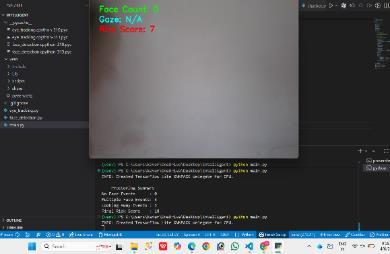
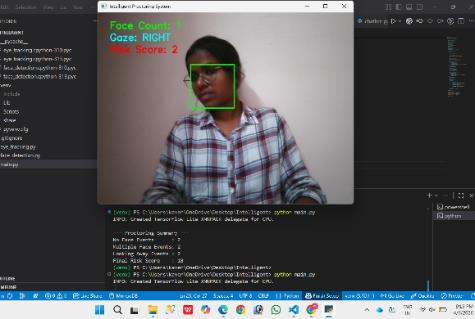
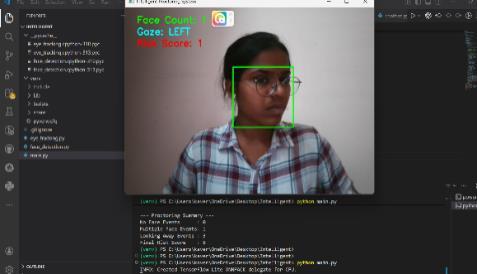
Theresultsshowthatthesystemwasabletocorrectlydetect alldefinedtestcasesduringexecution.
B. Risk Score Behaviour
Thesystemcalculatesariskscorebasedondetectedevents. Itwasobservedthateventssuchasmultiplefacedetection andabsence fromtheframe contributed more tothefinal score,whilegazedeviationscontributedless.Thishelpsin distinguishing between critical and minor suspicious behaviors.
C.
System Performance
Thesystemperformedsmoothlyinreal-timewithminimal delay.FacedetectionusingMediaPipewasstableinnormal lightingconditionsandaccuratelyidentifiedthenumberof facespresent.Gazedetectionworkedeffectivelywhenthe face was clearly visible, but its performance was slightly affected in low lighting or when the face was partially occluded.
D. Observations
Thewebcamisconsistentlydetectedfacepresenceand multiplefaces.
International Research Journal of Engineering and Technology (IRJET) e-ISSN: 2395-0056
Volume: 13 Issue: 03 | Mar 2026 www.irjet.net p-ISSN: 2395-0072
Gaze direction (left, right, center) was identified correctlyinmostcases.
Theuseoftime-basedconditions(5secondsfornoface and3secondsfor gazedeviation)helped reducefalse detections.
Continuousframeprocessingallowedbettertrackingof behaviorovertime.
6. CONCLUSION
Inthiswork,wedevelopedanIntelligentProctoringSystem tomonitorcandidatebehaviorduringonlineexaminations usingawebcam.Thewebcam videoinrealtimetodetect face presence, head movements, and gaze direction, and identifieseventssuchasnoface,multiplefaces,andlooking away.
Akeyfeatureofthesystemistheuseofariskscore,which representsthelevelofsuspiciousactivitybasedondetected events.Thismakesiteasiertoanalyzecandidatebehaviorin astructuredwayinsteadofrelyingonlyonrecordedvideo.
Weteamtestedindifferentscenariosandwasabletodetect thedefinedeventsandgeneratemeaningfulriskscores. It runs in real time and works with a standard webcam, makingitpracticalforreal-worlduse.
However,theperformanceofgazedetectioncanbeaffected underpoorlightingconditionsorwhenthefaceisnotclearly visible. These issues can be improved in future work by enhancingtherobustnessofthesystem.
Overall,theproposedsystemprovidesasimpleandeffective approach for improving the reliability of online examinations.
7. REFERENCES
[1] V. Molawade, S. Joshi, and P. Kulkarni, “Online Exam Proctoring System Based on Artificial Intelligence,” International Journal of Engineering Research & Technology(IJERT),vol.12,no.5,pp.1–6,2023.
[2] Y. S. Shih, C. H. Lee, and M. C. Chen, “AI-Assisted Gaze DetectionforProctoringOnlineExams,”IEEEAccess,vol. 12,pp.1–10,2024.
[3]T.Singh,R.Kumar,andA.Sharma,“Multi-ModalOnline Proctoring System Using Deep Learning Techniques,” ProcediaComputerScience,vol.233,pp.450–457,2024.
[4] S. Essahraoui, H. El Ghazi, and M. El Bekkali, “Deep Learning-Based Cheating Detection in Online Examinations,” Journal of Network and Computer Applications,vol.225,pp.103–115,2025.
[5]Google,“MediaPipe:Cross-PlatformMLSolutionsforLive and Streaming Media,” 2023. [Online]. Available: https://mediapipe.dev/
[6] R. K. Sharma and P. Verma, “Real-Time Online Exam ProctoringSystemUsingComputerVisionTechniques,” InternationalJournalofComputerApplications,vol.185, no.12,pp.25–30,2024.
[7]S.GuptaandA.Mehta,“Vision-BasedStudentMonitoring SystemforOnlineExaminations,”InternationalJournalof AdvancedComputerScienceandApplications(IJACSA), vol.15,no.3,pp.45–52,2025.
[8]M.A.Hossain,S.Rahman,andM.Hasan,“AI-BasedSmart OnlineExam Proctoring SystemUsing Deep Learning,” IEEEAccess,vol.12,pp.1–12,2024.
[9] A. K. Mishra and S. R. Das, “Automated Online Exam ProctoringSystemUsingComputerVisionandMachine Learning,”2025.
[10]N.PatelandR.Shah,“StudentMonitoringSystemUsing AI,”2024.