
INTELLIGENT LOAD BALANCING IN CLOUD ENVIRONMENTS
Santhosh C 1 , Sangeeths A 2
1PG student, Department Of Computer Applications, Jaya College Of Arts and Science, Thiruninravur, Tamilnadu, India
2Assistant Professor, Department Of Computer Applications, Jaya College Of Arts and Science , Thiruninravur, Tamilnadu, India
Abstract – Beloglazov et al. (2012) proposed an energy- Cloud computing has revolutionized the IT industry by providing scalable and on-demand resources over the internet. However, with the increasing number of users and dynamic workloads, load balancing has become critical challenge in ensuring system performance, resource utilization, and service reliability. Intelligent load balancing techniques use artificial intelligence (AI), machine learning (ML), and optimization algorithms to dynamically allocate resources across servers or virtual machines to handle workloads efficiently. This paper explores the concept of intelligent load balancing in cloud environments, focusing on algorithms, techniques, and strategies used to distribute workloads effectively. It discusses traditional and modern AI-based load balancing approaches, evaluates their performance, and highlights their role in improving scalability, response time, and fault tolerance in cloud infrastructure. The paper concludes by emphasizing the future potential of intelligent systems in achieving fully autonomous and energy-efficient cloud environments.
Key Words: Cloud Computing, Load Balancing, Artificial Intelligence, Resource Management, Optimization
I.INTRODUCTION
(Size 11 cambria font) Cloud computing has revolutionized the way computing resources are delivered and utilized by offering on-demand access to shared pools of configurable resources such as servers, storage, and applications. It enables users to deploy, manage, and scale applications efficiently without worrying about the underlying infrastructure. However, withthecontinuousgrowthofdataandincreasingnumberofusers,effectiveresourcemanagementandtaskdistributionhave becomecriticalchallengesincloudenvironments.
1.LITERATURE-REREVIEW
Numerous researchers have proposed intelligent methods for load balancing in cloud environments: Efficient resource allocation method for cloud data centers using adaptive threshold-based techniques to minimize energy consumption whilemaintainingperformance.
Gawali and Shined (2018) introduced aload balancing algorithm using artificial bee colony optimization that improved taskschedulingefficiencyandreducedprocessingtime.
Mishra et al. (2019) designed a hybrid approach combining genetic algorithms with particleswarmoptimization(PSO) fordynamicworkloaddistribution.
Sharma and Kumar (2020) exploreddeeplearning-basedloadpredictionmodelsto improvedecision-makingaccuracyin cloudsystems.
Patel et al. (2021) proposed a reinforcement learning-based system that autonomously adjusts resource allocation to handlefluctuatinguserdemands.
2.COMMON TECHNIQUES AND ARCHITECTURES
Machinelearning modelssuchasregression, decision trees, and neural networks predict workloadtrendsand automatically allocateresourcesbasedonperformancemetricslikeCPUusage,memoryconsumption,andnetworklatency. Intelligentload
International Research Journal of Engineering and Technology (IRJET) e-ISSN: 2395-0056
Volume: 12 Issue: 11 | Nov 2025 www.irjet.net p-ISSN: 2395-0072
balancing relies on a combination of machine learning, heuristic optimization, and dynamic scheduling algorithms. Common techniquesinclude:
Machine Learning-Based Techniques: Afterconvolution,non-linearactivationfunctionssuchasReLU (RectifiedLinear Unit)areappliedtointroducenon-linearity,allowing the model to learn complex relationships
Metaheuristic Algorithms: Optimizationalgorithmssuchas Genetic Algorithm (GA), Particle Swarm Optimization PSO), and Ant Colony Optimization (ACO) are widely used to find optimal resource distribution patterns. These algorithmsmimicnaturalprocessestoexploremultiplesolutions and minimize system overload.
Reinforcement Learning: These layers combine the extracted features to perform the final classification. They operate similarlytotraditionalneuralnetworks.
Regularization Techniques:Inthisapproach,theloadbalancerlearnsoptimalpoliciesthroughtrialanderror.Thesystem receives feedback (reward or penalty) based on resource utilization and task completion time, enabling adaptive and autonomousschedulingdecisions.
Dynamic Resource Allocation
Cloudsystemsusepredictiveanalyticstoadjustcomputingresourcesdynamically.Virtualmachinesarecreatedor terminatedbasedonworkloadintensity,ensuringscalabilityandcost-effectiveness.
InceptionNet –Combinesmultiplefiltersizesinparallel.
3.METHODOLOGY-EXISTING AND PROPOSED
Existing System
Intheexistingcloudcomputingenvironments,traditionalloadbalancingtechniquesareprimarily static or rule- based, suchas Round Robin, First Come First Serve (FCFS),and Least Connection algorithms.Thesemethodsdistributeuser requestssequentiallyorbasedonpredefinedruleswithoutconsideringthecurrentloadstatusofeachvirtualmachine (VM).
Working Principle:
Whenanewrequestarrives,itisassignedtothenextavailableserverinacyclicorfixedpattern.Theloadbalancerdoes notcheckthereal-timeresourceutilization(CPU,memory,bandwidth).Oncearequestisassigned,itremainsonthat nodeuntilcompletion.
Limitations:
Lackof adaptabilitytodynamicchangesinworkload.Possibility of somenodesbeingoverloadedwhileothersremain underutilized. Higher response time and reduced throughput during peak loads. Nolearning mechanism or intelligent decision-makingcapability.
Inefficientresourceutilizationleadingtopoorsystemperformance.
International Research Journal of Engineering and Technology (IRJET) e-ISSN: 2395-0056
Volume: 12 Issue: 11 | Nov 2025 www.irjet.net p-ISSN: 2395-0072
4.IMPLEMENTATION
1. Intelligentloadbalancingsystemssignificantlyimproveperformancemetricscomparedtotraditionalstaticmethods. SimulationtoolslikeClouds,OpenStack,andiFogSimarecommonlyusedtotestthesealgorithmsundervaryingload conditions.TrainingProcess
2. Data Preprocessing: Images are resized, normalized, and augmented (rotations, flips, color adjustments) to improve robustness.
3. Feature Extraction: Convolution and pooling layers automatically detect low-level (edges) and high- level (shapes, objects)features.
4. ModelTraining: Thenetworkminimizeslossfunction(e.g.,cross-entropy)usingoptimizationalgorithmslikeAdam orSGD.
5. Evaluation:Modelperformanceisaassessedusingmetricslikeaccuracy,precision,recall,andF1-score.
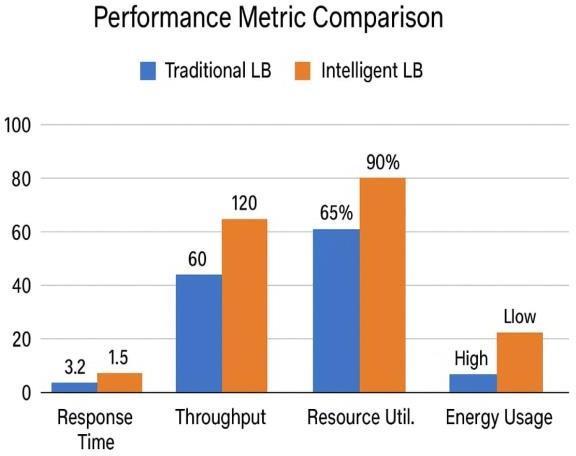
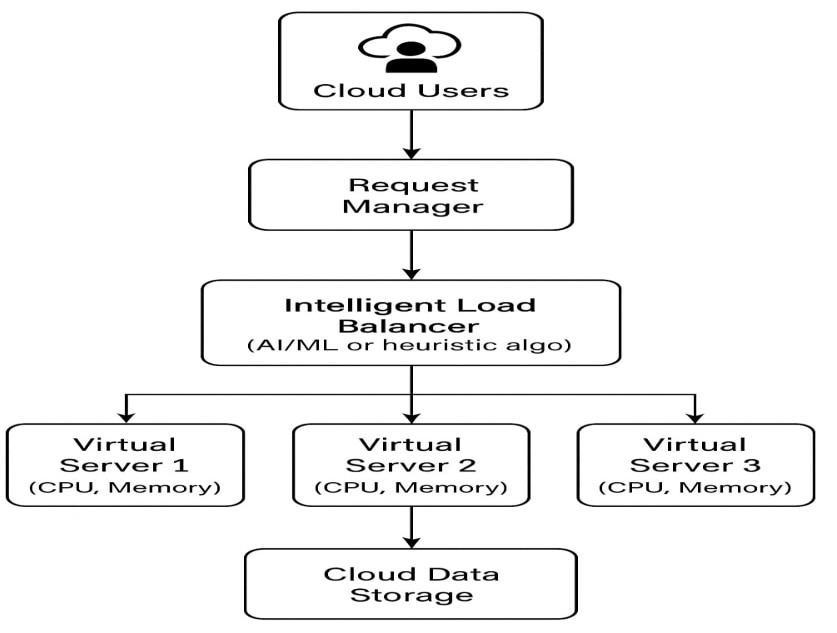
Figure 1: ArchitectureDiagramofIntelligentLoadBalancinginCloudEnvironment
Figure 2: ResultDiagram–PerformanceComparison
Volume: 12 Issue: 11 | Nov 2025 www.irjet.net p-ISSN: 2395-0072
5. MODULES
1. User Request Module
o Handlesincomingusertasksandsendsthemtotheloadbalancer.
o Collectsrequestparameterssuchaspriority,size,andexecutiontime.
2. Load Monitoring Module
o Tracksreal-timemetricsfromcloudservers(CPU,RAM,disk,andbandwidthusage).
o Sendsdatatothedecision-makingmodule.
3. Intelligent Decision Module
o Coreofthesystem;usesAI/MLtechniquestodetermineoptimaltaskallocation.
o ImplementsalgorithmssuchasGeneticAlgorithm,AntColonyOptimization,orNeuralNetworks.
5. Load Migration Module
o Detectsoverloadedserversand migratestaskstoidleorlightlyloadedones.
o Ensures zero downtime during Migration
6. Performance Evaluation Module
o Evaluatesperformancemetricslikeresponsetime,throughput,andresourceutilization.
o Compares results withtraditionalloadbalancingtechniques.
6.
CONCLUSIONS
Intelligent load balancing is an essential component of modern cloud computing infrastructure. It ensures efficient resource utilization,minimizessystembottlenecks,andimprovesuserexperiencebyleveragingAI,machinelearning,andoptimization algorithms. Future advancements in edge computing, federated learning, and quantum- inspired algorithms are expected to further optimize cloud performance, paving the way for fully intelligent, self-managed cloud ecosystems that balance efficiency,scalability, and sustainability.
7.FUTURE-SCOPE
Integration with Edge and Fog Computing environments to extend performance beyond centralized clouds. Use of Deep Reinforcement Learning (DRL) for more accurate and autonomous decision-making. Incorporation of Energy-Aware Load Balance in got reduce power consumption in datacenters Implementation of Block chain based monitoring for transparent and secure load distribution. Deployment in multi-cloud and hybrid cloud systems to handle cross- platform workloads effectively
8.REFERENCES
1.Krizhevsky, A., Sutskever, I., & Hinton, G. E. (2012). ImageNet Classification with Deep Convolutional NeuralNetworks.AdvancesinNeuralInformation ProcessingSystems.
2. Simonyan,K.,&Zisserman, A. (2014).Very Deep Convolutional Networks for Large- Scale Image Recognition. arXiv:1409.1556.
3. He,K.,Zhang,X.,Ren,S.,&Sun,J.(2016). DeepResidualLearningforImageRecognition.IEEECVPR.
4 . Szegedy,C.,Liu,W.,Jia, Y.,etal.(2015).GoingDeeperwithConvolutions.IEEECVPR.