
International Research Journal of Engineering and Technology (IRJET) e-ISSN:2395-0056
Volume:12Issue:06|Jun2025 www.irjet.net p-ISSN:2395-0072
INTELLIGENT INFORMATION AGGREGATION AND CONDENSATION SYSTEM
JVR Vinayak1 , K Sai Varshith2 , L Lokesh Nayak3 , B Sushmitha4
123Student(B.Tech), Department of Computer Science and Engineering, AVN Institute of Engineering and Technology, Hyderabad, India
4Assistant Professor, Department of Computer Science and Engineering, AVN Institute of Engineering and Technology, Hyderabad, India ***
Abstract - This paper introduces an Intelligent Information Aggregation and Condensation System developedtogenerate high-qualitysummaries fromlarge volumes of unstructured text using a hybrid summarization strategy. The system integrates extractive and abstractive techniques, where key sentences are first identifiedthroughsyntacticparsingusingSpaCy,andthen refinedviatransformer-basedmodelssuchas DistilBART, BART Large, and T5 Base from Hugging Face Transformers for fluent and coherent output. The application accepts multiple document formats, including PDF, DOCX, and TXT, and employs automatic chunking for processing content that exceeds model token limits. It also features TF-IDF-based keyword extraction and provides download options in TXT, DOCX, and PDF formats. Built using Python and deployed via Streamlit, the system offers a responsive web interface with integrated CSS for enhanced usability. Designed with modularityand extensibility in mind, this solution applies to fields requiring efficient text comprehension such as healthcare,law,academia,andmedia,andaimstoreduce cognitive load while improving access to essential information.
Keywords: Natural Language Processing (NLP); Text Summarization; Extractive Summarization; Abstractive Summarization; Bidirectional Encoder Representations from Transformers (BERT); TextTo-Text Transfer Transformer (T5); Generative Pretrained Transformer (GPT); BART (Bidirectional and Auto-Regressive Transformers); SpaCy NLP Library; Hugging Face Transformers; Term Frequency–Inverse Document Frequency (TF-IDF); Keyword Extraction; Document Processing; Streamlit Web Framework; Human-Centered ArtificialIntelligence(AI).
1. INTRODUCTION
In the digital age, the volume of textual data generated across domains such as healthcare, law, journalism, and scientific research is expanding at an unprecedented rate. The increasing demand for rapid assimilationoflarge-scaledocumentshasintensifiedthe need for intelligent systems capable of automating
content summarization. Traditional summarization methods, including rule-based and statistical approaches, often fall short of capturing semantic depth and linguistic nuance. With advancements in deep learning and natural language understanding, transformer-based architectures have emerged as stateof-the-artinvariousnaturallanguageprocessingtasks.
This paper presents an integrated framework designed not only to summarize lengthy and unstructured textual content but also to enhance usability through a real-time, web-accessible interface. The system is architected to support real-world use cases,enablingbothtechnicalandnon-technicalusersto derive concise and meaningful summaries with minimal computational overhead. Notably, the framework is extensible, capable of supporting additional language models or preprocessing layers and designed for portabilityacrossoperatingenvironments.
The system leverages tokenization, sentence boundary detection, semantic filtering, and modelagnostic preprocessing pipelines to ensure both precision and contextual preservation during summarization.Furthermore,theinterfaceisdesignedto maintain accessibility and scalability, promoting adaptabilityinenterpriseandresearch-gradeworkflows.
2. LITERATURE REVIEW
2.1EvolutionofSummarizationTechniques
The field of text summarization has undergone a significant transformation, beginning with early rulebased systems that used handcrafted linguistic rules to identify sentence importance. These methods, while transparent, lacked scalability and adaptability. The introduction of statistical techniques such as term frequency-inverse document frequency (TF-IDF) enabled content selection based on word distribution but often failed to capture contextual relationships. The advent of machine learning models improved summary relevance by learning patterns from annotated corpora, yet they were constrained by domain-specific dependencies and limited language comprehension. The progression to neural network-based approaches
International Research Journal of Engineering and Technology (IRJET) e-ISSN:2395-0056
Volume:12Issue:06|Jun2025 www.irjet.net p-ISSN:2395-0072
introducedmechanismslikeattention,enablingdynamic weighting of input components and thereby enhancing relevance detection and phrase restructuring capabilities.Thishistoricaltransitionrevealsacontinual trend towards more autonomous, data-driven models that can process unstructured information with greater linguisticcoherenceandcontextualawareness.
2.2ComparativeAnalysisofExistingSystems
Modern summarization frameworks typically adopt oneofthreestrategies:extractive,abstractive,orhybrid. Extractivemodelsleveragesentenceimportancemetrics, using methods such as centrality scoring and clustering to identify key passages. Despite generating grammatically sound summaries, they frequently lack semantic integration and may retain irrelevant redundancy. Conversely, abstractive models attempt to reconstruct new text based on learned language patterns. Architectures such as encoder-decoder transformers enable contextual reasoning and lexical variation but are vulnerable to inconsistencies and hallucinations.Hybrid systemscombine the strengths of both paradigms, pre-filtering content using extractive components before generating paraphrased outputs. Whilehybridsystemsexhibithigheroutputquality,they require precise orchestration between modules and are oftendifficulttointerpretordebug.Comparativestudies reveal that no single paradigm fully resolves the tradeoffs between coherence, computational efficiency, and linguisticdiversity.
2.3CriticalSurveyofResearchContributions
Recent academic efforts have focused on refining architectural frameworks and improving output fidelity. The study titled "Context-Aware Neural Summarization with Attention Dynamics" proposed using memoryaugmented attention layers to preserve discourse flow, yet faced challenges in maintaining summary compactness. Another paper, "Cross-Encoder and BiEncoder Fusion for Document Compression", demonstratedgainsinsemanticalignmentbutexhibited increased latency. A third work explored the utility of pre-trained encoder-decoder stacks fine-tuned on news datasets, but results degraded when applied to legal or medical content. Additionally, cross-lingual summarization efforts remain underrepresented, limiting global applicability. Collectively, these works highlight persistent gaps in model generalizability, inference performance, and handling of low-resource languagesorspecializedjargon.
2.4ProposedArchitectureOverview
The system presented in this work distinguishes itself through a layered design integrating modular processing units for content ingestion, analysis, and
generation. A dynamic preprocessing unit parses useruploaded documents and applies adaptive chunking based on token constraints. This is followed by a twostage summarization pipeline first performing content distillationusingsyntacticparsing,andthengeneratinga refined summary using a transformer-based language generator. Summarization models are accessed through HuggingFace'sTransformerAPI,enablingplug-and-play model switching. A keyword extraction unit augments interpretabilitybyhighlightingtopicrelevance.Theuser interface is built using Streamlit with embedded CSS to facilitate usability, while export options in TXT, DOCX, and PDF formats ensure versatility. This modularity not only enhances system maintainability but also allows seamless adaptation to emerging model advancements ornewinputformats.
2.5HardwareandSoftwareEnvironment
The infrastructure requirements of transformerbased models vary significantly. While lightweight modelslikeDistilBARTcanoperateonsystemswith4–8 GB RAM, larger architectures such as BART Large or T5 demand 16 GB or more, especially during batch processing. The implementation stack uses Python 3.9, and the solution is optimized for compatibility with Windows, Linux, and macOS platforms. To support document parsing, libraries like PyPDF2 and pythondocx are employed, while real-time interface rendering and interaction are managed through Streamlit. Integration with GPU accelerators (if available) is optional but recommended for reducing inference latency. Dependency management is handled through pip and requirements.txt, ensuring reproducible installations. This cross-platform operability is intended to democratize access across both individual users and organizationalsetups.
2.6IdentifiedTechnicalConstraints
Despite its advantages, the proposed system encounters several technical limitations. One challenge stems from the token boundaries enforced by transformer models, which can truncate semantically important information during chunking. Additionally, model response time varies widely depending on input size and hardware configuration, limiting suitability for real-time applications in low-resource environments. The inability to process embedded tables, graphs, or multi-column layouts in documents may reduce summarizationfidelityforacademicortechnicalreports. Furthermore, since models are pre-trained on generalpurpose datasets, summarization quality may deteriorate on domain-specific texts unless further finetuning is undertaken. Finally, language support remains predominantlymonolingual,withminimalinfrastructure
International Research Journal of Engineering and Technology (IRJET) e-ISSN:2395-0056
Volume:12Issue:06|Jun2025 www.irjet.net p-ISSN:2395-0072
for handling code-mixed or multilingual content a majorbarriertoglobalaccessibilityandscalability.
3. IMPLEMENTATION
The proposed system is designed as a modular, scalable, and user-centric text summarization platform, developed using Python and Streamlit. The architecture adopts a layered design approach that integrates both extractive and abstractive techniques while supporting seamless user interaction and multi-format document input.
3.1SystemArchitecture
The architecture comprises four core components: Input Handling, Preprocessing, Summarization Core, and Output Rendering. The Input Handling layer enables both manual text entry and file uploads, accommodatingformatssuchasPDF,DOCX,andTXT.In thePreprocessingphase,thesystemextractsnormalizes, and tokenizes the content using SpaCy and other NLP tools.TheSummarizationCoreutilizesahybridpipeline, combining extractive filtering and transformer-based abstractive modelssuchasDistilBART,BARTLarge,and T5. The Output Rendering module manages the display andexportofthesummarizedcontentwithanemphasis onuserexperienceandaccessibility.
3.2ModelIntegration
TransformermodelsareloadedusingHuggingFace’s pipeline interface and cached using Streamlit’s resource caching, ensuring efficient performance. Model-specific parameters such as maximum and minimum summary lengths,andsamplingoptionslikebeamsearch,arefinetunedtogeneratehigh-qualityoutputs.Toaccommodate the token limit (~1024 tokens) of transformer architectures, longer documents are intelligently split into chunks, each processed individually before recombination. The extractive layer pre-selects highrelevance sentences from each chunk, enhancing summarycoherenceandrelevance.
3.3WebInterfaceandUserFlow
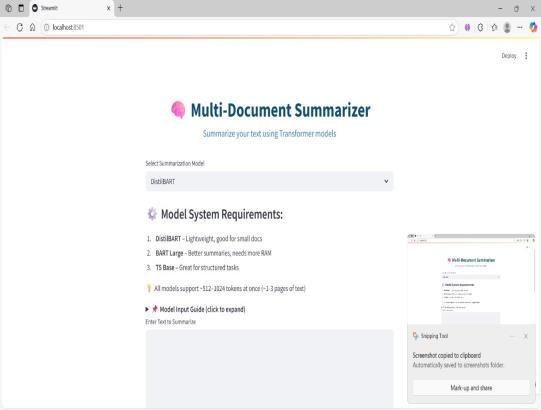
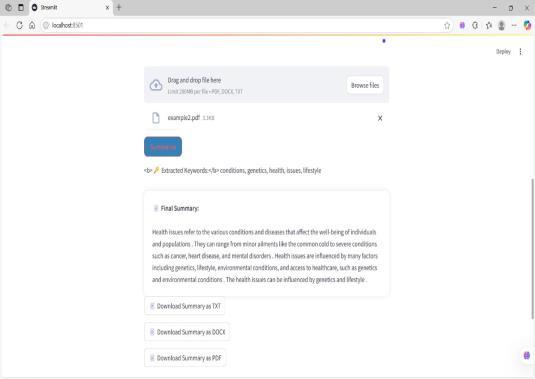
TheinterfaceisbuiltonStreamlitandenhancedwith custom CSS to provide a clean, responsive, and interactiveuser experience. Userscanuploadsupported document types or enter text manually, select a summarization model based on their system's capabilities, and generate summaries in real-time. Additional features include a model guide, keyword extraction via TF-IDF, and a stylized summary display panel.Theintuitivedesignensuresaccessibilityforusers withvaryinglevelsoftechnicalexpertise.
3.4FileHandlingandFormatSupport
The system is engineered to handle diverse input formats, ensuring flexibility and broad usability. PDF documents are parsed using the PyPDF2 library to extract content across all pages. DOCX files are processed using python-docx, where each paragraph is retrieved and concatenated. Plain text files are decoded directly from bytes. Preprocessing involves formatspecific adjustments such as whitespace removal, line merging, and token normalization. These transformations ensure that the input is clean and consistent, thereby improving summarization accuracy andreducingnoiseintroducedbydocumentformatting.
3.5ChunkingStrategy
Due to the input size limitations of transformer models,thesystemusesadynamicchunkingmechanism. Thetextissplitintosegmentsbasedon wordcountand semantic boundaries to maintain continuity and avoid context loss. Each chunk is processed separately, with extractive summarization applied to distill essential information before forwarding it to the abstractive model. The final summaryissynthesized byaggregating theoutputsofallchunks,ensuringreadabilityandlogical flow.
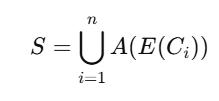
Toformalizethisprocess,thesummarizationflowcanbe representedas:
where,
C₁...Cₙaretheinputchunks,
E(Cᵢ)=extractivesummaryofchunki,
A(E(Cᵢ)) = abstractive summary of that extractive result, and S is the final synthesized summary.
Thisequationsignifiesthat thefinal summarySSSisthe union of abstractive summaries of extractive outputs from eachchunk, preservingcoherence andinformation relevance.
3.6SummaryExportOptions
Once the summarization is complete, the user can download the output in multiple formats tailored to differentusecases.Thesummarycanbesavedasaplain
Volume:12Issue:06|Jun2025 www.irjet.net
text file for quick reference, a DOCX file for documentation purposes, or a PDF file for professional sharing. These formats are generated using respective libraries python-docx for Word documents and FPDF for PDFs with formatting options such as headings, paragraph spacing, and font configuration. This multiformat export capability enhances the usability of the systemacrossacademic,business,andpersonalcontexts.
4. METHODOLOGY
ThemethodologyadoptedintheproposedIntelligent Summarization System involves a structured and modular sequence of operations encompassing data ingestion, preprocessing, hybrid summarization, and result presentation. Each component is designed with flexibility, efficiency, and clarity in mind, ensuring compatibility with various document types and system environments.
4.1DataFlowOverview
The system initiates with user input, either through manual text entry or file upload (PDF, DOCX, TXT). Uploaded files are parsed to extract raw text using format-specific libraries (PyPDF2, python-docx). Once the input text is extracted, it is passed into the preprocessing module where cleaning, normalization, andsentencesegmentationareperformedusingSpaCy’s en_core_web_smNLPmodel.
The summarization process begins as soon as the user provides input either by typing text manually or by uploading a document in formats like PDF, DOCX, or plain text. Once a file is uploaded, the system uses specific toolstopull thetextfromit: PyPDF2isused for reading PDF files, while python-docx is used to extract textfromWorddocuments.Afterretrievingtherawtext, the system sends it into a preprocessing stage. Here, unnecessary white spaces, line breaks, and irregular formatting are cleaned up to ensure the text is neat and readable. Then, using SpaCy’s pre-trained language model (en_core_web_sm), the content is broken down intosentences.
p-ISSN:2395-0072
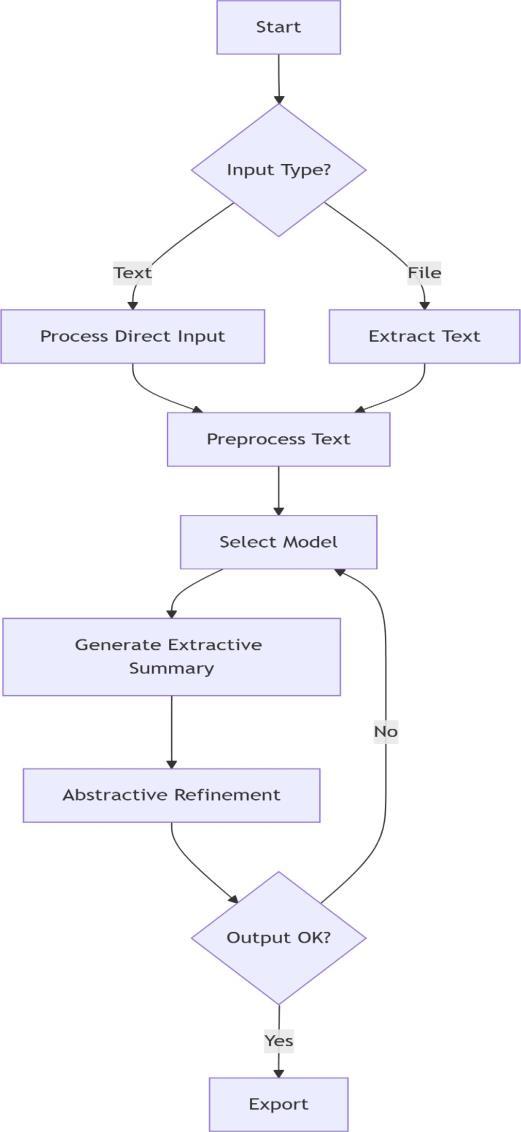
Fig4.1Activitydiagram
4.2HybridSummarizationPipeline
The hybrid summarization pipeline begins with the preprocessingstage,wheretheinputtextisanalyzedfor length. If the document exceeds the token threshold (typically around 1024 tokens), it is automatically divided into semantically coherent chunks to comply with transformer model limitations. This chunking process ensures that important contextual relationships aremaintainedacrosssections.
Followingthis,theextractivesummarizationphaseis initiated using SpaCy’s sentence segmentation capabilities. Key sentences are selected based on heuristics such as sentence position, relevance, and linguistic weight, preserving grammatical structure while filtering less informative content. The resulting extractive summaryserves asa condensed input for the nextphase. International Research Journal of Engineering and Technology (IRJET) e-ISSN:2395-0056
International Research Journal of Engineering and Technology (IRJET) e-ISSN:2395-0056
Volume:12Issue:06|Jun2025 www.irjet.net p-ISSN:2395-0072
The abstractive summarization phase utilizes transformer-based models such as DistilBART, BART Large, or T5 integrated through the Hugging Face pipelineAPI.Thesemodelsgeneratefluent,paraphrased versions of the input, dynamically restructuring and condensing information to enhance readability and coherence. Specific parameters like maximum length, minimum length, and sampling strategy are tuned to balancesummarybrevityanddepth.
Once the abstractive summary is generated, a postprocessing step refines the text to ensure smooth flow and consistency across chunked outputs. This cleaned, unified summary is then used for further keyword extractionandoutputformatting.
4.3KeywordExtraction
Toenrichtheoutputandassistintopicidentification, a keyword extraction module is applied postsummarization. The TF-IDF (Term Frequency–Inverse DocumentFrequency)vectorizationtechniqueisusedto identifythemostrelevantanddistinctivetermsfromthe summary.Thesekeywordsprovidequickinsightintothe centralthemesofthedocumentandaredisplayedtothe userforreference.
4.4UserInteractionandModelSelection
An interactive user interface developed with Streamlit allows seamless navigation through the summarizationprocess.Userscanchoosetheirpreferred model (DistilBART, BART Large, T5 Base) based on available system resources. The interface also displays memoryrequirementsandmodelspecificationstoguide user decisions effectively. Real-time feedback and result renderingensureusabilityandaccessibility.
4.5OutputGenerationandExport
Afterthefinalsummaryisgeneratedandrefined,the userisprovidedwithoptionstodownloadtheoutputin three formats TXT, DOCX, and PDF. The formatting includes headers, font styling, and layout structuring to enhance readability. This export functionality ensures that the summary can be integrated into downstream workflows such as reports, academic references, or presentations.
4.6MethodValidation
To validate the effectiveness of the proposed methodology, test cases across various domains including legal, academic, and technical documents were conducted. Each input was evaluated based on summary quality, coherence, coverage, and processing time.Feedbackfromthesetestsguidedrefinements
© 2025, IRJET | Impact Factor value: 8.315 |
5. EXPERIMENTAL
6. CONCLUSION
In an era characterized by information overload, the need for automated, accurate, and scalable text summarization solutions has become increasingly critical. The Intelligent Information Aggregation and Condensation System presented in this work addresses this need by integrating advanced transformer-based architectures into a hybrid summarization framework. By combining extractive techniques for structural filtering with abstractive models for semantic compression, the system generates concise, coherent, and contextually rich summaries across diverse input formatssuchasPDF,DOCX,andTXT.
The implementation leverages state-of-the-art pretrained models like DistilBART, BART Large, and T5, providing users with multiple summarization strategies depending on system capabilities and document complexity. Additionally, the use of a Streamlit-based web interface ensures accessibility, responsiveness, and real-time interaction, making the tool suitable for domainssuchasresearch,healthcare,legalanalysis,and journalism.
International Research Journal of Engineering and Technology (IRJET) e-ISSN:2395-0056
Volume:12Issue:06|Jun2025 www.irjet.net p-ISSN:2395-0072
Despite its effectiveness, the system still encounters challenges, particularly with memory-intensive models, inputlengthconstraints,anddomain-specificfine-tuning needs. However, its modular design opens avenues for future improvements such as multilingual support, realtime batch processing, and integration with domainadapted models. Overall, this work demonstrates the practical feasibility and value of intelligent summarizationsystems
7. FUTURE WORK
While the proposed system demonstrates strong performance in multi-format document summarization using transformer-based models, several enhancements are envisioned for future development. One key area involves improving support for multilingual and crosssummarization, which would expand the system's applicability to non-English texts and global users. Incorporating models like mBART and XLM-R could facilitate this expansion. Additionally, domain-specific fine-tuning particularly for legal, biomedical, and financial texts can significantly improve summarization accuracy and contextual relevance. Another promising direction is the development of adaptivechunkingalgorithmsthatdynamicallypreserve semantic continuity across longer documents without rigidtokenlimits,therebyimprovingsummarycohesion.
Future iterations may also explore integration with knowledge graphs and ontologies to enhance factual consistency and reduce hallucinations common in generative models. From a usability perspective, realtime multi-document summarization, batch processing, andamobile-friendlyversionoftheplatformcanfurther increase accessibility. Enhanced visualization tools for keyword mapping and semantic clustering may also enrichuserinteraction.
Finally, adopting model quantization and optimization techniques like ONNX, Intel OpenVINO, or TensorRT could significantly reduce inference time, making the solution more scalable and efficient for deployment in low-resource environments and edge devices.
REFERENCES
[1] H. Shakil, A. Farooq, and J. Kalita, “Abstractive Text Summarization,” International Journal of Advanced Computer Science and Applications, vol. 15, no. 3, pp. 103–110,2024.
[2] Streamlit Inc., “Streamlit: The fastest way to build data apps,” Streamlit Documentation, 2023. [Online]. Available:https://docs.streamlit.io
[3] Hugging Face, “Transformers: State-of-the-art Natural Language Processing for PyTorch and TensorFlow 2.0,” Hugging Face Documentation, 2023. [Online].Available:https://huggingface.co/docs
[4]A. Lewis, Y. Liu,and T. Wolf, “Fine-tuning Pretrained Transformers for Abstractive Text Summarization,” Transactions of the Association for Computational Linguistics,vol.11,pp.117–132,2023.
[5] L. Dong, S. Liu, Z. Yang, et al., “Unified Language Model Pre-training for Natural Language Understanding and Generation,” Proceedings of NeurIPS, pp. 13063–13075,2020.
[6] J.Devlin, M.Chang, K.Lee,and K. Toutanova, “BERT: Pre-training of Deep Bidirectional Transformers for Language Understanding,” in Proc. NAACL-HLT, pp. 4171–4186,2019.
[7] Y. Liu and M. Lapata, “Text Summarization with Pretrained Encoders,” in Proc.EMNLP-IJCNLP,pp. 3730–3740,2019.