
Volume: 13 Issue: 03 | Mar 2026 www.irjet.net
International Research Journal of Engineering and Technology (IRJET) e-ISSN: 2395-0056 p-ISSN: 2395-0072


Volume: 13 Issue: 03 | Mar 2026 www.irjet.net
International Research Journal of Engineering and Technology (IRJET) e-ISSN: 2395-0056 p-ISSN: 2395-0072

Atif Khan1 , Saad Nadaf2 , Husain Kharbe3 , Mohammad Dhorajiwala4
#Atif-Saad-Husain-Mohammad Department of Information Technology
Project Guide & HOD I/C HOD IF, Lecturer IF, MHSSP Department of Information Technology M. H. Saboo Siddik Polytechnic, India
Abstract - Driverfatigueisoneofthemajorcausesofroad accidents, especially during long-distance and night-time driving. When drivers travel alone, the chances of falling asleepatthewheelincreasesignificantly.Thispaperpresents an Intelligent Driving Assistant (IDA), a driver monitoring system designed to detect signs of drowsiness and provide timelyalerts.ThesystemusesOpenCVandalaptopcamerato monitorthe driver’s eyemovementsinrealtime.Ifthe driver’s eyesremainclosedforacertainduration,thesystemactivates warningalertsusingaPiezoBuzzerand5mmRedLED.Ifthe condition persists, an emergency message is sent to a registered contact. The system also uses Supabase for authentication and data storage, improving driver safety throughautomatedmonitoringandalert mechanisms.
Key Words: Driver Drowsiness Detection, Intelligent Driving Assistant, Computer Vision, OpenCV, Driver Safety Monitoring, Real-Time Alert System, Accident Prevention
A. Definition
Road safety has become an important concern in moderntransportation,especiallyduringnight-timeorlongdistance driving where driver fatigue is common. Drowsinessreducesadriver'sattention,reactiontime,and decision-makingability,whichcansignificantlyincreasethe chancesofroadaccidents.Inmanycases,driverstraveling alonemayfallasleepwithoutrealizingtheirleveloffatigue, leadingtodangeroussituations.
Traditional methods of preventing drowsy driving mainly depend on the driver's self-awareness or periodic rest breaks.However,theseapproachesarenotalwaysreliable, as drivers may ignore early signs of tiredness. Therefore, intelligentmonitoringsystemsarerequiredtoautomatically detectdriverfatigueandprovidetimelyalerts.
Toaddressthisissue,theIntelligentDrivingAssistant(IDA) isproposedasadrivermonitoringsystemthatobservesthe driver's eye movements using a camera. The system uses OpenCV to detect eye closure and analyze signs of drowsinessinrealtime.Whenthesystemdetectsthatthe driver’seyesremainclosedforaspecificduration,ittriggers
alertmechanisms including a PiezoBuzzeranda 5mm Red LED to wake the driver. If the condition persists, an emergencyalertmessageissenttoaregisteredcontact.The system also uses Supabase to manage user authentication andstoremonitoringdata.
The proposed system aims to enhance road safety by providingreal-timedrivermonitoringandautomatedalerts toreduceaccidentscausedbydriverfatigue.
ThecoreconceptoftheIntelligentDrivingAssistant(IDA)is basedonreal-timedrivermonitoringusingcomputervision to detect signs of fatigue and prevent potential accidents The system continuously analyzes the driver’s eye movementsthroughacameraandappliesautomatedalert mechanisms when drowsiness is detected. By combining artificialintelligencewithhardware-basedwarningsystems, the solution aims to improve driver awareness and road safety.
Theprimaryfunctionalityofthesystemisdetectingdriver drowsiness by monitoring eye movements. The camera captureslivevideoofthedriver’sface,andthe framesare processedusingOpenCV.Thesystemanalyzeswhetherthe driver’seyesremainclosedforaprolongedperiodoftime, whichindicatespossiblefatigue.
If the system detects that the driver’s eyes remain closed beyondapredefinedthreshold,ittriggersaseriesofalerts. This detection process allows the system to identify early signs of drowsiness and respond before a dangerous situationoccurs.
Toensurethedriver'ssafety,thesystemincludesa multistagealertmechanism.Whenthedriver'seyesremainclosed for a few seconds, the system first generates a warning notification. If the condition continues, a louder alert is activated using a Piezo Buzzer along with a visual alert througha5mmRedLED.
Volume: 13 Issue: 03 | Mar 2026 www.irjet.net
International Research Journal of Engineering and Technology (IRJET) e-ISSN: 2395-0056 p-ISSN: 2395-0072
If the driver does not respond to these alerts within a defined time period, the system automatically sends an emergency notification to a registered contact using a messaging service. Additionally, the system records monitoringdataandalerthistoryusingSupabase,allowing reports and safety analysis to be generated for future reference.
The development of the Intelligent Driving Assistant (IDA) originates from the increasing number of road accidents caused by driver fatigue and drowsiness. Longdistance travel, night driving, and monotonous road conditionsoftenreducedriveralertness,whichcanresultin delayedreactionsorevenfallingasleepwhiledriving.These situationsposeseriousrisksnotonlytothedriverbutalsoto passengersandotherroadusers.
Theideabehindthisprojectistocreateasmartmonitoring system that can automatically detect early signs of driver fatigue and provide immediate alerts before an accident occurs. By combining computer vision techniques with simple hardware alert mechanisms, the system aims to improvedriversafetyandreducethelikelihoodoffatiguerelatedaccidents.
Driverdrowsinessisamajorfactorcontributingtoroad accidentsaroundtheworld.Manyexistingsafetymeasures rely primarily on the driver’s self-awareness or manual reminderstotakebreaks,whichmaynotalwaysbeeffective. Someofthecommonproblemsassociatedwithtraditional approachesinclude:
Lackofcontinuousdrivermonitoring
Delayedrecognitionofdriverfatigue
Absenceofautomaticalertsystems
Noemergencynotificationwhenthedriverbecomes unresponsive
Without a reliable monitoring mechanism, it becomes difficulttodetectfatigueinrealtimeandpreventpotential accidents.
With advancements in artificial intelligence and computer vision, it has become possible to monitor driver behavior using camera-based systems. Technologies such as OpenCV allow real-time facial and
eye detection, making it easier to identify signs of drowsiness.
TheIntelligentDrivingAssistantusesthesetechnologiesto analyze the driver’s eye activity through a camera. If the systemdetectsprolongedeyeclosure,itactivateswarning alertsusingaPiezoBuzzerand5mmRedLED.Additionally, the system records monitoring data and manages user authenticationthroughSupabase,enablingalerttrackingand safetyreporting.
TheprimaryaimoftheIntelligentDrivingAssistantis to improve road safety by detecting driver fatigue and providingtimelyalerts.
Thekeyobjectivesinclude:
Monitoringthedriver’seyemovementsinrealtime usingacamera.
Detecting signs of drowsiness using computer visiontechniques.
Providingimmediatewarningalertsthroughsound andvisualindicators.
Sending emergency notifications to a registered contactwhennecessary.
Recordingmonitoringdataforsafetyanalysisand reporting.
This section describes the architectural design and workflowoftheDriverDrowsinessDetectionSystem.The systemisdesignedusingamodulararchitectureconsisting ofafrontendinterface,backendprocessingmodules,anda clouddatabaseforauthenticationandlogmanagement.Data FlowDiagrams(DFDs)areusedtorepresenttheinteraction betweensystemcomponentsandexternalentities.
The Data Flow Diagram (Level 0) provides a high-level representationoftheDriverDrowsinessDetectionSystem anditsinteractionwithexternalentities.
e-ISSN: 2395-0056 p-ISSN: 2395-0072 Volume: 13 Issue: 03 | Mar 2026 www.irjet.net
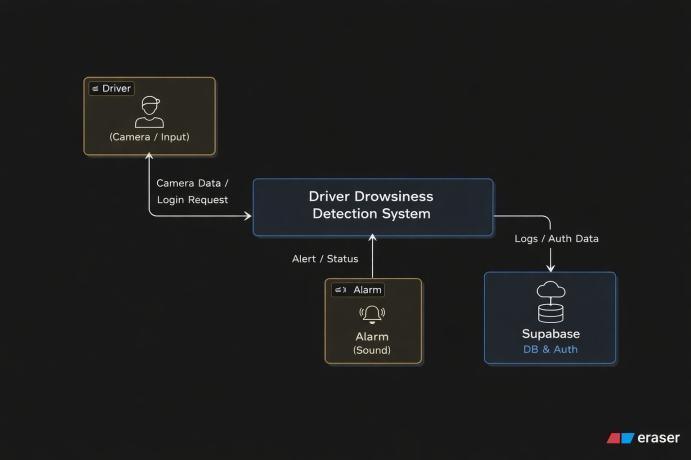
Inthisdiagram,theentiresystemisrepresentedasasingle process (1.0 Driver Drowsiness Detection System). The primaryexternalentitiesinteractingwiththesystemarethe DriverandtheSupabasecloudservice.Thedriverprovides inputtothesystemthroughthewebinterfaceintheformof camera data and authentication requests. The system processestheincomingdatatomonitordriveralertnessand detectsignsofdrowsiness.Whenfatigueisdetected,analert in the form of an alarm sound is generated to notify the driver.Additionally,authenticationinformationandactivity logsarestoredintheSupabasedatabaseformonitoringand record management. This diagram illustrates the overall input–process–outputstructureofthesystem.
TheDataFlowDiagram(Level1)presentsamoredetailed view of the internal processes involved in the Driver DrowsinessDetectionSystem.
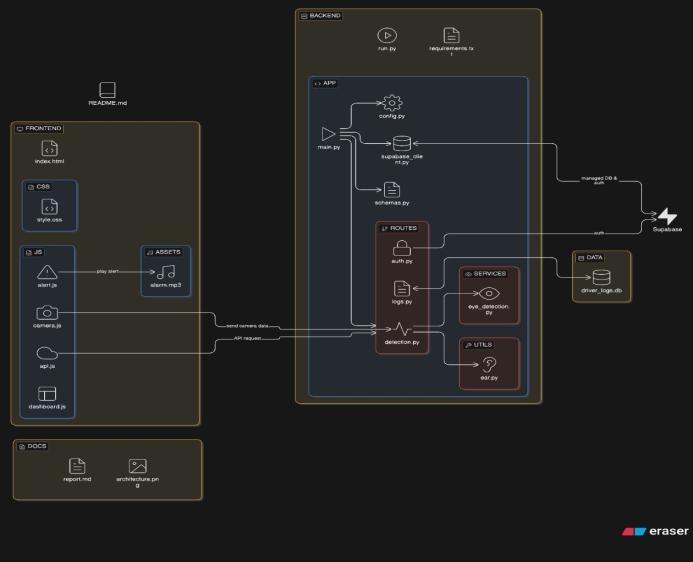
TheworkflowbeginswiththeAuthenticationModule(1.1) where the driver logs into the system and credentials are verified using Supabase authentication services. After successful authentication, the system captures real-time camerainputthroughtheCameraProcessingModule(1.2)in thefrontendinterface.
Thecapturedframesaretransmittedtothebackendwhere theDrowsinessDetectionModule(1.3)processesthedata usingeyedetectionalgorithmstoanalyzedriveralertness.If the system identifies signs of drowsiness, the Alert GenerationModule(1.4)activatesanaudiblealarmtowarn the driver. At the same time,relevant activity information anddetectionresultsarestoredintheDriverLogsDatabase (D1)forrecordkeepingandanalysis.
This layered workflow ensures efficient data processing, real-timemonitoring,andtimelyalertgenerationtoenhance driversafety.
ThissectiondescribestheimplementationoftheCCMS systemandthetechnologiesusedtodeveloptheplatform.
The The system was implemented using a combination of software and hardware technologies to ensure effective drivermonitoringandalertmechanisms.
FrontendTechnologies:
HTML5
CSS3
JavaScript
React
These technologies are used to design interactive dashboards for drivers and emergency contacts, enabling userstomonitorsystemalertsandviewsafetyreports.
BackendTechnologies:
Python3.x
OpenCV
Python handles the main processing logic of the system,
Fig 2: DataFlowDiagram–Level1 while OpenCV is used to capture video frames from the
Volume: 13 Issue: 03 | Mar 2026 www.irjet.net
International Research Journal of Engineering and Technology (IRJET) e-ISSN: 2395-0056 p-ISSN: 2395-0072
laptopcameraandanalyzethedriver’seyemovementsto detectsignsofdrowsiness.
DatabaseSystem:
•Supabase
Supabaseisusedtomanageuserauthenticationandstore monitoring data, alert history, and system records. This allowsthesystemtomaintaindriversafetyreportsandtrack drowsinesseventsovertime.
HardwareComponents:
•ArduinoUno
•PiezoBuzzer
•5mmRedLED
TheArduinoboardisconnectedtothelaptoptocontrolthe buzzer and LED indicators, which are activated when the systemdetectsdriverfatigue.
The system operates through a structured workflow that continuouslymonitorsthedriver’salertness.Themainsteps ofthesysteminclude:
The driver logs into the system through the dashboardinterface.
Thelaptopcamerastartscapturingreal-timevideo ofthedriver’sface.
ThesystemprocessesvideoframesusingOpenCVto detecteyemovements.
If the driver’s eyes remain closed for a certain duration,thesystemtriggersawarningalert.
Afterprolongedeyeclosure,thebuzzerandLEDare activatedtoalertthedriver.
Ifthedriverdoesnotrespondwithinapredefined time,anemergencymessageissenttoaregistered contact.
All alert events are stored in the database for monitoringandreporting.
This workflow ensures continuous driver monitoring and enables the systemto respond quickly tosigns of fatigue,
While the current implementation of the Intelligent DrivingAssistant(IDA)providesessentialfunctionalityfor detecting driver drowsiness and generating alert notifications, the system architecture is designed in a modular way that allows further improvements and scalability.Thesefutureenhancementscanimprovesystem accuracy,accessibility,andoveralldriversafety.
One potential enhancement is the development of a dedicated mobile application that allows drivers and emergencycontactstomonitordriverstatusdirectlyfrom their smartphones. A mobile application could provide featuressuchasreal-timealertnotifications,driveractivity monitoring, and access to safety reports. Integrating a mobile platform would increase accessibility and make it easier for emergency contacts to receive and respond to alertsgeneratedbythesystem.
Another possible enhancement is the integration of GPSbased location tracking. If the system detects prolonged driverinactivityorunresponsiveness,itcouldautomatically share the driver's real-time location with the registered emergency contact. This feature would help emergency responders quickly locate the vehicle in case of an emergencysituation.
Thesystemcanalsobeenhancedbyincorporatingadvanced dataanalyticstoolsthatanalyzedriverbehaviorovertime. ByexamininghistoricalmonitoringdatastoredinSupabase, the system could generate useful insights such as the frequencyofdrowsiness events, averagedrivingduration, and alert history. These reports could help drivers better understand their driving habits and improve their safety awareness.
In the future, the Intelligent Driving Assistant could be integrated with vehicle control systems to provide automated safety responses. For example, if the system detectsseveredriverdrowsiness,itcouldactivateadditional safety mechanisms such as reducing vehicle speed or triggering emergency signals.Combining thesystem with
Volume: 13 Issue: 03 | Mar 2026 www.irjet.net
International Research Journal of Engineering and Technology (IRJET) e-ISSN: 2395-0056 p-ISSN: 2395-0072
Since the Intelligent Driving Assistant (IDA) system processes user information and continuously monitors the driver through a camera, ensuring data privacy and system security is extremely important. The system incorporates several mechanisms to protect user data and maintain responsibleuseofmonitoringtechnology.
Driver information and monitoring records must be protected from unauthorized access. The system stores user credentials and alert records securely in the database managed by Supabase. Passwords are stored using secure hashingmethodsinsteadofplaintextstorage.Thisapproach helpsprotectsensitiveuserinformationandreducestherisk ofunauthorizedaccessincaseofadatabasebreach.
Thesystem follows a role-basedaccess model to ensurethat differentusers have appropriate levels ofaccess. Drivers are abletolog in, start monitoring, andview their alerthistory, while emergency contacts only receive alert notifications when necessary. Administrative access to system configuration and monitoring records is restricted to authorized users only. This access control mechanism preventsmisuseofthesystemandmaintainsdataprivacy.
Maintaining the integrity of stored monitoring data is important for reliable driver safety analysis. The system records alert events and monitoring results in a structured format to prevent data corruption or unauthorized modification. Additionally, the system ensures transparency by informing users that camera monitoring is active during operation. The driver has control over starting or stopping the monitoring process, ensuring ethical use of camerabaseddetectiontechnologies.
The The User Interface (UI) of the Intelligent Driving Assistant (IDA) system is designed to provide a simple and
efficient interaction environment for drivers and guardians. Theprimaryobjectiveoftheinterfaceistoensurethatusers caneasilyaccessthemonitoringsystem, receivealerts, and view system activity without requiring advanced technical knowledge. The interface focuses on clarity, minimal distractions,andquickaccessibilitytocriticalfeatures.
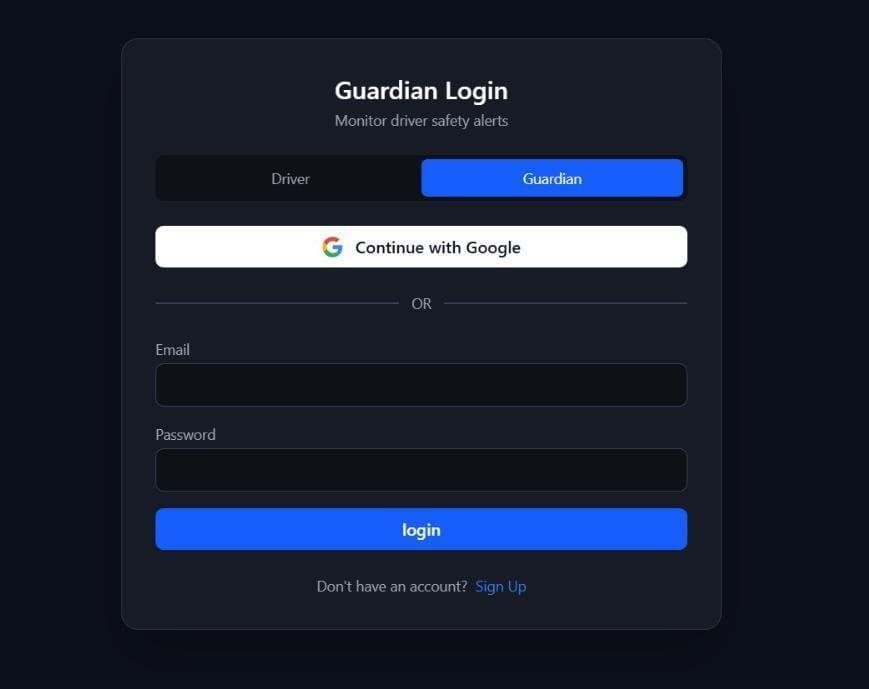
Thesystembeginswithaloginpagethatallowstwotypesof userstoaccesstheplatform:DriverandGuardian.Thedriver can log into the system to activate the driver monitoring feature,whiletheguardiancanlogintomonitoralertsand eventhistoryrelatedtothedriver.
Thislogininterfaceensuressecureaccesstothesystemand providesrole-basedfunctionalitydependingonwhetherthe userisadriveroraguardian.
After logging in as a driver, the user is directed to the AI Driver Assistance Dashboard. This interface activates the laptopwebcamanddisplaysthereal-timevideofeedused fordrivermonitoring.
ThesystemusesOpenCV-basedcomputervisionalgorithms to detect eye movements and determine whether the driver's eyes remain closed for a specific duration. If drowsinessisdetected,thesystemtriggerswarningalerts suchasabuzzersoundandLEDindicatortoalertthedriver.
Thedashboardprovidesacleardisplayofthecamerafeed
Volume: 13 Issue: 03 | Mar 2026 www.irjet.net
International Research Journal of Engineering and Technology (IRJET) e-ISSN: 2395-0056 p-ISSN: 2395-0072
and detection status, allowing the system to operate continuouslywhilethedriverisactive.
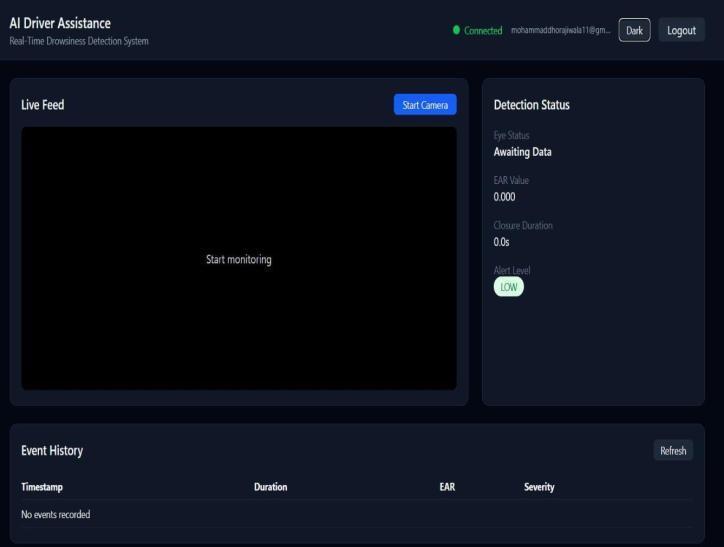
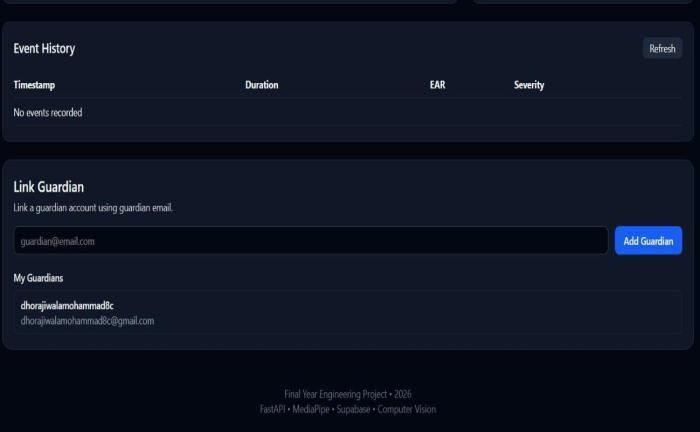
The system also includes an Event History module, which recordsallalerteventsgeneratedduringdrivermonitoring. These records are stored in the database and can be accessedthroughthedashboardforreviewandmonitoring purposes.
Additionally,thesystemallowsthedrivertoaddaguardian usinganemail address.Whencriticalalertsoccurandthe driverdoesnotrespondtowarnings,thesystemcannotify the registered guardian. This feature helps ensure that someoneclosetothedrivercanbeinformedinemergency situations. The event history provides transparency and allowsguardianstomonitorthedriver'salertrecordsover time.
The Intelligent Driving Assistant (IDA) presents a practical technological solution for reducing accidents caused by driver fatigue and drowsiness. By combining computer vision techniques with hardware-based alert mechanisms, the system provides real-time monitoring of the driver's eye activity and detects signs of drowsiness effectively.
The proposed system utilizes OpenCV to analyze eye movements through a camera and trigger alerts when prolonged eye closure is detected. The alert mechanism includes both sound and visual indicators using a Piezo Buzzerand5mmRedLED,ensuringthatthedriverreceives immediate warnings. Additionally, the system sends emergencynotificationstoaregisteredcontactifthedriver does not respond to alerts. User authentication and monitoringrecordsaremanagedthroughSupabase,allowing alerteventstobestoredandanalyzed.
Overall,thesystemdemonstrateshowartificialintelligence andsimplehardwareintegrationcanimprovedriversafety byprovidingearlydetectionoffatigueandtimelyalerts.The Intelligent Driving Assistant has the potential to enhance roadsafetyandreducetheriskofaccidentscausedbydriver drowsiness.
[1] T. Soukupová and J. Čech, “Real-Time Eye Blink Detection Using Facial Landmarks,” 21st Computer Vision Winter Workshop, Rimske Toplice, Slovenia, 2016.
[2] R.R.Garg,S.Singh,andP.Sharma,“DriverDrowsiness Detection System Using Computer Vision,” International Journal of Engineering Research and Technology,vol.9,no.5,pp.456–460,2020.
[3] A.Dasgupta,S.George,andA.Routray,“AVision-Based SystemforMonitoringtheVigilanceofDrivers,” IEEE Transactions on Intelligent Transportation Systems, vol. 14,no.4,pp.1827–1837,2013.
[4] *OpenCV Documentation. [Online]. Available: https://docs.opencv.org/
[5] Supabase Documentation. [Online]. Available: https://supabase.com/docs