
International Research Journal of Engineering and Technology (IRJET) e-ISSN: 2395-0056
Volume: 13 Issue: 03 | Mar 2026 www.irjet.net p-ISSN: 2395-0072
International Research Journal of Engineering and Technology (IRJET) e-ISSN: 2395-0056
Volume: 13 Issue: 03 | Mar 2026 www.irjet.net p-ISSN: 2395-0072
Atif Khan1 , Saad Nadaf2 , Husain Kharbe3 , Mohammad Dhorajiwala4
Atif-Saad-Husain-Mohammad Department of Information Technology
Project Guide & HOD I/C HOD IF, Lecturer IF, MHSSP Department of Information Technology
M. H. Saboo Siddik Polytechnic, India
Abstract - Driver fatigue is one of the major causes of road accidents, especially during long-distance and night-time driving. When drivers travel alone, the chances of falling asleep at the wheel increase significantly. This paper presents an Intelligent Driving Assistant (IDA), a driver monitoring system designed to detect signs of drowsiness and provide timely alerts. The system uses OpenCV and a laptop camera to monitor the driver’s eye movements in real time. If the driver’s eyes remain closed for a certain duration, the system activates warning alerts using a Piezo Buzzer and 5mm Red LED. If the condition persists, an emergency message is sent to a registered contact. The system also uses Supabase for authentication and data storage, improving driver safety through automated monitoring and alert mechanisms.
Key Words: Driver Drowsiness Detection, Intelligent Driving Assistant, Computer Vision, OpenCV, Driver Safety Monitoring, Real-Time Alert System, Accident Prevention
1.
Road safety has become an important concern in modern transportation, especially during night-time or long- distance driving where driver fatigue is common. Drowsiness reduces a driver's attention, reaction time, and decision-making ability,whichcansignificantlyincreasethechancesofroadaccidents.Inmanycases,driverstravelingalonemayfallasleep withoutrealizingtheirleveloffatigue,leadingtodangeroussituations.
Traditional methods of preventing drowsy driving mainly depend on the driver's self-awareness or periodic rest breaks. However, these approaches are not always reliable, as drivers may ignore early signs of tiredness. Therefore, intelligent monitoringsystemsarerequiredtoautomaticallydetectdriverfatigueandprovidetimelyalerts.
Toaddress this issue, the Intelligent Driving Assistant (IDA) is proposed as a driver monitoring system that observes the driver's eye movements using a camera. The system uses OpenCV to detect eye closure and analyze signs ofdrowsiness in real time. When the system detects that the driver’seyes remainclosedfora specific duration,ittriggers alertmechanismsincludingaPiezoBuzzeranda5mmRedLEDtowakethedriver.Iftheconditionpersists,anemergency alert message is sent to a registered contact. The system also uses Supabase to manage user authentication and store monitoringdata.Theproposedsystemaimstoenhanceroadsafetybyprovidingreal-timedrivermonitoringandautomated alertstoreduceaccidentscausedbydriverfatigue.
ThecoreconceptoftheIntelligentDrivingAssistant(IDA)isbasedonreal-timedrivermonitoringusingcomputervisionto detect signs of fatigue and prevent potential accidents. The system continuously analyzes the driver’s eye movements through a camera and applies automated alert mechanisms when drowsiness is detected. By combining artificial intelligencewithhardware-basedwarningsystems,thesolutionaimstoimprovedriverawarenessandroadsafety.
The primary functionality of the system is detecting driver drowsiness by monitoring eye movements. The camera captures live video of the driver’s face, and the frames are processed using OpenCV. The system analyzes whether the driver’s eyesremainclosed fora prolongedperiodof time,whichindicatespossiblefatigue.Ifthesystemdetectsthatthe driver’seyesremainclosedbeyondapredefinedthreshold,ittriggersaseriesofalerts.Thisdetectionprocessallowsthe systemtoidentifyearlysignsofdrowsinessandrespondbeforeadangeroussituationoccurs.
International Research Journal of Engineering and Technology (IRJET) e-ISSN: 2395-0056
Volume: 13 Issue: 03 | Mar 2026 www.irjet.net p-ISSN: 2395-0072
Toensurethedriver'ssafety,thesystemincludesamulti-stagealertmechanism.Whenthedriver'seyesremainclosedfora few seconds, the system first generates a warning notification. If the condition continues, a louder alert isactivated usingaPiezoBuzzeralongwithavisualalertthrougha5mmRedLED.
Ifthedriverdoesnotrespondtothesealertswithinadefinedtimeperiod,thesystemautomaticallysendsanemergency notificationtoa registered contactusing a messagingservice.Additionally,thesystemrecords monitoringdataandalert historyusingSupabase,allowingreportsandsafetyanalysistobegeneratedforfuturereference.
ThedevelopmentoftheIntelligentDrivingAssistant(IDA)originatesfromtheincreasingnumberofroadaccidentscaused bydriverfatigueanddrowsiness.Long-distancetravel,nightdriving,andmonotonousroadconditionsoftenreducedriver alertness,whichcan resultindelayedreactionsorevenfallingasleepwhiledriving. Thesesituationsposeseriousrisksnot onlytothedriverbutalsotopassengersandotherroadusers.
The idea behind this project is to create a smart monitoring system that can automatically detect early signs of driver fatigue and provide immediate alerts before an accident occurs. By combining computer vision techniques with simple hardware alert mechanisms, the system aims to improve driver safety and reduce the likelihood of fatigue- related accidents.
Driver drowsiness is a major factor contributing to road accidents around the world. Many existing safety measures rely primarilyonthedriver’sself-awarenessormanualreminderstotakebreaks,whichmaynotalwaysbeeffective.Someofthe commonproblemsassociatedwithtraditionalapproachesinclude:
Lackofcontinuousdrivermonitoring
Delayedrecognitionofdriverfatigue
Absenceofautomaticalertsystems
Noemergencynotificationwhenthedriverbecomesunresponsive
Withoutareliablemonitoringmechanism,itbecomesdifficulttodetectfatigueinrealtimeandpreventpotentialaccidents.
Withadvancementsinartificialintelligenceandcomputervision,ithasbecomepossibletomonitordriverbehaviorusing camera-basedsystems.TechnologiessuchasOpenCVallowreal-timefacialandeyedetection,makingiteasiertoidentify signsofdrowsiness.TheIntelligentDrivingAssistantusesthesetechnologiestoanalyzethedriver’seyeactivitythrougha camera. If the system detects prolonged eye closure, it activates warning alerts usinga Piezo Buzzerand5mmRedLED. Additionally,thesystemrecordsmonitoringdataandmanagesuserauthenticationthroughSupabase,enablingalerttracking andsafetyreporting.
TheprimaryaimoftheIntelligentDrivingAssistantisto improveroadsafetyby detecting driverfatigueandproviding timelyalerts.
The key objectives include:
Monitoringthedriver’seyemovementsinrealtimeusingacamera.
Detecting signs of drowsiness using computervisiontechniques.
Providingimmediatewarningalertsthroughsoundandvisualindicators.
Sending emergency notifications to a registeredcontactwhennecessary.
Recordingmonitoringdataforsafetyanalysisandreporting.
International Research Journal of Engineering and Technology (IRJET) e-ISSN: 2395-0056
Volume: 13 Issue: 03 | Mar 2026 www.irjet.net p-ISSN: 2395-0072
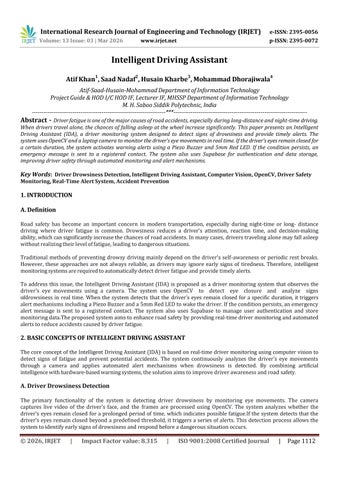
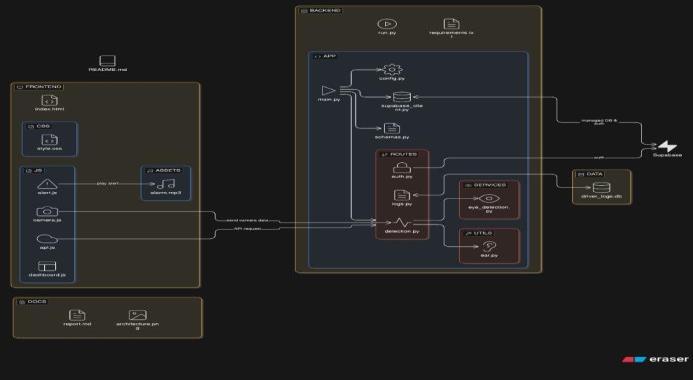
This section describes the architectural design and workflow of the Driver Drowsiness Detection System. The system is designedusingamodulararchitectureconsistingofafrontendinterface,backendprocessingmodules,andaclouddatabase forauthenticationandlogmanagement.Data FlowDiagrams(DFDs)areusedtorepresenttheinteractionbetween system componentsandexternalentities.
TheDataFlowDiagram(Level0)providesahigh-level representationoftheDriverDrowsinessDetectionSystemandits interactionwithexternalentities.
Inthisdiagram,theentiresystemisrepresentedasasingleprocess(1.0DriverDrowsinessDetectionSystem).Theprimary externalentitiesinteractingwiththesystemaretheDriverandtheSupabasecloudservice.Thedriverprovidesinputtothe system through the web interface in the form of camera data and authentication requests. The system processes the incomingdatatomonitordriveralertnessanddetectsignsofdrowsiness.Whenfatigueisdetected,analertintheformofan alarm sound is generated to notify the driver. Additionally, authentication information and activity logs are stored in the Supabase database for monitoring and record management. This diagram illustrates the overall input–process–output structureofthesystem.
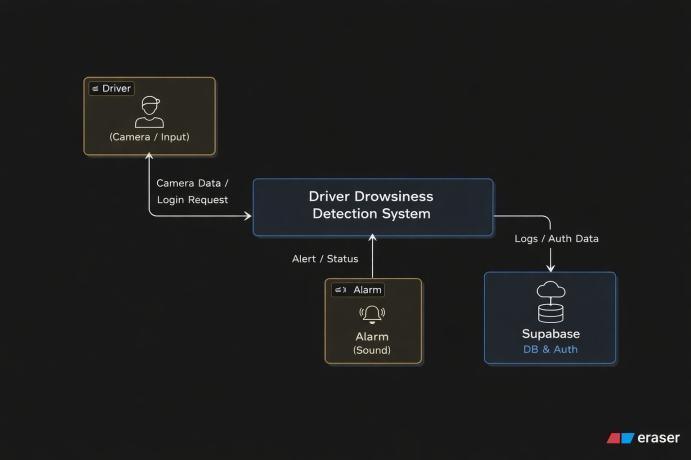
The Data Flow Diagram (Level 1) presents a more detailed view of the internal processes involved in the Driver DrowsinessDetectionSystem.
2:DataFlow Diagram–Level 1
International Research Journal of Engineering and Technology (IRJET) e-ISSN: 2395-0056
The workflow begins with the Authentication Module (1.1) where the driver logs into the system and credentials are verified using Supabase authentication services. After successful authentication, the system captures real-time camera inputthroughtheCameraProcessingModule(1.2)inthefrontendinterface.
The captured frames are transmitted to the backend where the Drowsiness Detection Module (1.3) processes the data usingeyedetectionalgorithmstoanalyzedriveralertness.Ifthesystemidentifiessignsofdrowsiness,theAlertGeneration Module(1.4)activatesanaudiblealarmtowarn the driver. Atthe same time, relevantactivity information and detection resultsarestoredintheDriverLogsDatabase(D1)forrecordkeepingandanalysis.
Thislayeredworkflowensuresefficientdataprocessing,real-timemonitoring,andtimelyalertgenerationtoenhancedriver safety.
ThissectiondescribestheimplementationoftheCCMSsystemandthetechnologiesusedtodeveloptheplatform.
The The system wasimplementedusinga combinationofsoftware andhardware technologies to ensure effectivedriver monitoringandalertmechanisms.
Frontend Technologies:
HTML5
CSS3
JavaScript
React
These technologies are used to design interactive dashboards for drivers and emergency contacts, enabling users to monitorsystemalertsandviewsafetyreports.
Backend Technologies:
Python3.x
OpenCV
Python handles the main processing logic of the system,laptopcameraandanalyzethedriver’seyemovementsto detectsignsofdrowsiness.DatabaseSystem:
•Supabase
Supabaseisusedtomanageuserauthenticationandstoremonitoringdata,alerthistory,andsystemrecords.This allows thesystemtomaintaindriversafetyreportsandtrackdrowsinesseventsovertime.
HardwareComponents:
•ArduinoUno
•PiezoBuzzer
•5mmRedLED
The Arduino board is connected to the laptop to control the buzzer and LED indicators, which are activated when the systemdetectsdriverfatigue.
Volume: 13 Issue: 03 | Mar 2026 www.irjet.net p-ISSN: 2395-0072 © 2026, IRJET | Impact Factor value: 8.315 | ISO 9001:2008 Certified Journal | Page1115
International Research Journal of Engineering and Technology (IRJET) e-ISSN: 2395-0056
Volume: 13 Issue: 03 | Mar 2026 www.irjet.net p-ISSN: 2395-0072
Thesystemoperatesthroughastructuredworkflowthatcontinuouslymonitorsthedriver’salertness.Themainstepsofthe systeminclude:
Thedriverlogsintothesystemthroughthedashboardinterface.
Thelaptopcamerastartscapturingreal-timevideoofthedriver’sface.
ThesystemprocessesvideoframesusingOpenCVtodetecteyemovements.
If the driver’s eyes remain closed for certainduration,thesystemtriggersawarningalert.
Afterprolongedeyeclosure,thebuzzerandLEDareactivatedtoalertthedriver.
Ifthedriverdoesnotrespondwithinapredefinedtime,anemergencymessageissenttoaregisteredcontact.
Allalerteventsarestoredinthedatabaseformonitoringandreporting.
Thisworkflowensurescontinuousdrivermonitoringandenables thesystem to respond quickly tosigns of fatigue,
While the current implementation of the Intelligent Driving Assistant (IDA) provides essential functionality for detecting driver drowsiness and generating alert notifications, the system architecture is designed in a modular way that allows further improvements and scalability. Thesefuture enhancementscanimprovesystem accuracy, accessibility, and overall driversafety.
One potential enhancement is the development of a dedicated mobile application that allows drivers and emergency contacts to monitor driver status directly from their smartphones. A mobile application could provide features such as real-timealertnotifications,driveractivity monitoring, andaccesstosafety reports.Integrating a mobile platform would increaseaccessibilityandmakeiteasierforemergencycontactstoreceiveandrespondtoalertsgeneratedbythesystem.
Another possible enhancement is the integration of GPS- based location tracking. If the system detects prolonged driver inactivity or unresponsiveness,itcould automatically share the driver's real-time location with the registered emergency contact.Thisfeaturewouldhelpemergencyrespondersquicklylocatethevehicleincaseofanemergencysituation.
Thesystemcanalsobeenhancedbyincorporatingadvanceddataanalyticstoolsthatanalyzedriverbehaviorovertime.By examininghistoricalmonitoringdatastoredinSupabase,thesystemcouldgenerateusefulinsightssuchasthefrequencyof drowsiness events, average driving duration, and alert history. These reports could help drivers better understand their drivinghabitsandimprovetheirsafetyawareness.
In the future, the Intelligent Driving Assistant could be integrated with vehicle control systems to provide automated safetyresponses.Forexample,ifthesystemdetectsseveredriverdrowsiness,itcouldactivateadditionalsafetymechanisms such as reducing vehicle speed or triggering emergency signals. Combining the system withadvanced driver assistance technologieswouldsignificantlyenhanceroadsafetyandaccidentprevention.
Volume: 13 Issue: 03 | Mar 2026 www.irjet.net p-ISSN: 2395-0072
Since the Intelligent Driving Assistant (IDA) system processes user information and continuously monitors the driver through a camera, ensuring data privacy and system security is extremely important. The system incorporates several mechanismstoprotectuserdataandmaintainresponsibleuseofmonitoringtechnology.
Driverinformationandmonitoringrecordsmustbeprotectedfromunauthorizedaccess.Thesystemstoresusercredentials and alert records securely in the database managed by Supabase. Passwords are stored using secure hashing methods instead of plain text storage. This approach helps protect sensitive user information and reduces the risk of unauthorized accessincaseofadatabasebreach.
Thesystemfollowsarole-basedaccessmodeltoensurethatdifferentusershaveappropriatelevelsofaccess.Driversareable to log in, start monitoring, and view their alert history, while emergency contacts only receive alert notifications when necessary. Administrative access to system configuration and monitoring records is restricted to authorized users only. Thisaccesscontrolmechanismpreventsmisuseofthesystemandmaintainsdataprivacy.
Maintaining the integrity of stored monitoring data is important for reliable driver safety analysis. The system records alert events and monitoring results in a structured format to prevent data corruption or unauthorized modification. Additionally, thesystemensurestransparency by informing users thatcamera monitoring is active during operation. The driver has control over starting or stopping the monitoring process, ensuring ethical use of camera- based detection technologies.
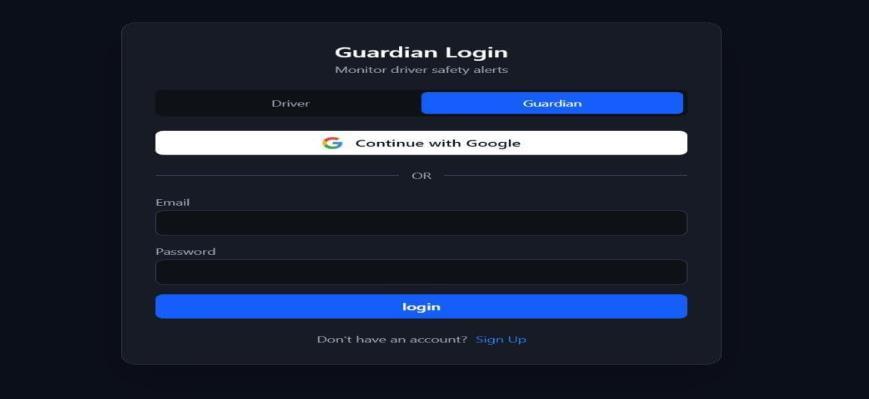
TheTheUserInterface(UI)oftheIntelligentDrivingAssistant (IDA) systemisdesignedtoprovideasimpleandefficient interaction environment for drivers and guardians. The primaryobjective of the interfaceis to ensure thatuserscan easily access the monitoring system, receive alerts, and view system activity without requiring advanced technical knowledge. Theinterfacefocusesonclarity,minimaldistractions,andquickaccessibilitytocriticalfeatures.
Thesystembeginswithaloginpagethatallowstwotypesofuserstoaccesstheplatform:DriverandGuardian.Thedrivercan log into the system to activate the driver monitoring feature, while the guardian can log in to monitor alerts and event historyrelatedtothedriver.
Thislogininterfaceensuressecureaccesstothesystemandprovidesrole-basedfunctionalitydependingonwhethertheuser isadriveroraguardian.
International Research Journal of Engineering and Technology (IRJET) e-ISSN: 2395-0056
Volume: 13 Issue: 03 | Mar 2026 www.irjet.net p-ISSN: 2395-0072
Afterlogginginasadriver,theuserisdirectedtotheAIDriverAssistanceDashboard.Thisinterfaceactivatesthelaptop webcamanddisplaysthereal-timevideofeedusedfordrivermonitoring.
ThesystemusesOpenCV-basedcomputervisionalgorithmsto detect eyemovementsanddetermine whetherthedriver's eyes remain closed for a specific duration. If drowsiness is detected, the system triggers warning alerts suchasa buzzer soundandLEDindicatortoalertthedriver.
The dashboard provides a clear display of the camera feed and detection status, allowing the system to operate continuouslywhilethedriverisactive.
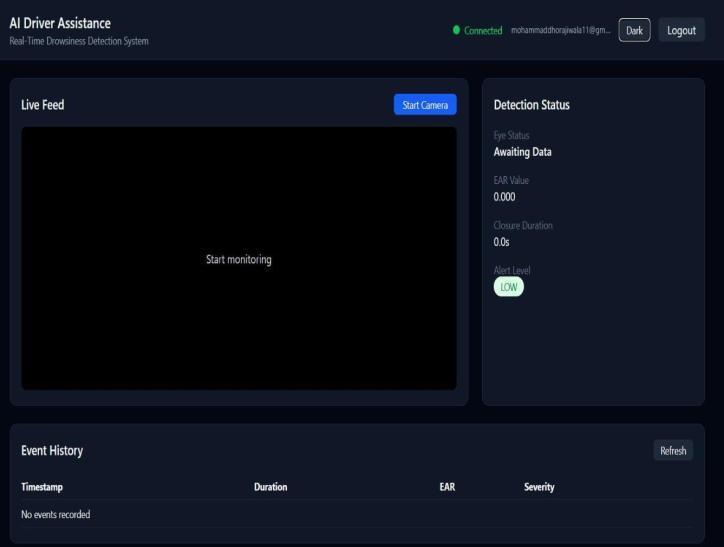
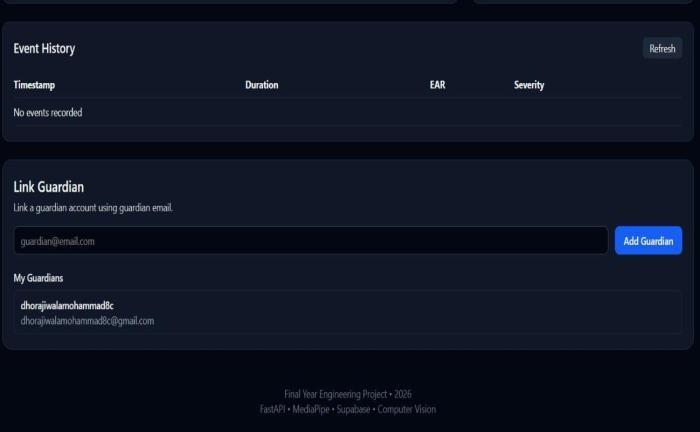
ThesystemalsoincludesanEventHistorymodule,whichrecordsallalerteventsgeneratedduringdrivermonitoring.These recordsarestoredinthedatabaseandcanbeaccessedthroughthedashboardforreviewandmonitoringpurposes.
Additionally, the system allows the driver to add a guardian using an email address. When critical alerts occur and the driver does not respond to warnings, the system can notify the registered guardian. This feature helps ensure that someoneclosetothedrivercanbeinformedinemergencysituations.
Theeventhistoryprovidestransparencyandallowsguardianstomonitorthedriver'salertrecordsovertime.
International Research Journal of Engineering and Technology (IRJET) e-ISSN: 2395-0056
Volume: 13 Issue: 03 | Mar 2026 www.irjet.net p-ISSN: 2395-0072
TheIntelligentDrivingAssistant(IDA)presentsapracticaltechnologicalsolutionforreducingaccidentscausedbydriver fatigue and drowsiness. By combining computer vision techniques with hardware-based alert mechanisms, the system providesreal-timemonitoringofthedriver'seyeactivityanddetectssignsofdrowsinesseffectively.
TheproposedsystemutilizesOpenCVtoanalyzeeyemovementsthroughacameraandtriggeralertswhenprolongedeye closure is detected. The alert mechanism includes both sound and visual indicators using a Piezo Buzzer and 5mm Red LED, ensuring that the driver receives immediate warnings. Additionally, the system sends emergency notifications to a registeredcontactifthedriverdoesnotrespondtoalerts.Userauthenticationandmonitoringrecordsaremanagedthrough Supabase,allowingalerteventstobestoredandanalyzed.
Overall,thesystemdemonstrateshowartificialintelligenceandsimplehardwareintegrationcanimprovedriversafetyby providing early detection of fatigue and timely alerts. The Intelligent Driving Assistant has the potential to enhance road safetyandreducetheriskofaccidentscausedbydriverdrowsiness.
[1] T. Soukupová and J. Čech, “Real-Time Eye Blink Detection Using Facial Landmarks,” 21st Computer Vision Winter Workshop,RimskeToplice,Slovenia,2016.
[2] R. R. Garg, S. Singh, and P. Sharma, “Driver Drowsiness Detection System Using Computer Vision,” International JournalofEngineeringResearchandTechnology,vol.9,no.5,pp.456–460,2020.
[3] A. Dasgupta, S. George, and A. Routray, “A Vision-Based System for Monitoring the Vigilance of Drivers,” IEEE TransactionsonIntelligentTransportationSystems,vol.14,no.4,pp.1827–1837,2013.
[4] OpenCVDocumentation.[Online].Available:https://docs.opencv.org/
[5] SupabaseDocumentation.[Online].Available:https://supabase.com/docs