
International Research Journal of Engineering and Technology (IRJET) e-ISSN: 2395-0056
Volume: 13 Issue: 04 | Apr 2026 www.irjet.net p-ISSN: 2395-0072

International Research Journal of Engineering and Technology (IRJET) e-ISSN: 2395-0056
Volume: 13 Issue: 04 | Apr 2026 www.irjet.net p-ISSN: 2395-0072
Rishi Padala1 , Sarvesh Pal2 , Sarang Patil3 , David Kumar4 , Prof. Swati Bhoir5
1,2,3,4 UG Students, Dept. of Computer Engineering, Atma Malik Institute of Technology and Research (AMRIT), 5 Guide: Prof. Swati Bhoir, Dept. of Computer Engineering, AMRIT, Shahapur, Maharashtra, India Mohili-Aghai, Shahapur, Thane - 421601, Maharashtra, India. Affiliated to University of Mumbai. ***
Abstract - Softwaredocumentationremainsoneofthemost neglected aspects of the development lifecycle, leading to increased onboarding friction, knowledge silos, and elevated maintenance costs. Existing AI-powered tools generate documentation for isolated functions but lack the ability to understandinter-filedependenciesandproducecontext-aware documentationatrepositoryscale.Thispaperpresents IntelliDoc AI, an agentic AI-powered platform that automates the generationofcomprehensive,repository-leveldocumentation for any GitHub project. The system employs a distributed microservices architecture comprising a Java Spring Boot backendorchestrator,aPythonFastAPIAIbridgeservice,and a React TypeScript frontend. An AI Architect agent, powered by Google Gemini 2.5 Flash, intelligently selects up to eight architecturally significant files from a repository's file tree, enabling focused analysis within LLM context-window constraints.AproactiveTokenBucketratelimiterwithroundrobin API key rotation across nine keys ensures sustained throughput without API throttling. SHA-256 contentaddressed Redis caching eliminates redundant AI calls, reducing API consumption by 60–70%. Apache Kafka decouplestheprocessingpipeline,enablingasynchronousjob execution with real-time progress feedback via WebSocket STOMP. The system supports JWT-based authentication with email OTP verification and GitHub OAuth, full-text MongoDB text search across generated documentation, AI-generated README files with auto-detected technology badges, and an in-browser Markdown editor. Deployed across Vercel, HuggingFace Spaces, and MongoDB Atlas, the platform has been validated on repositories spanning multiple programming languages and frameworks, demonstrating significant reductions in documentation time while maintaining high-quality, structured output.
Key Words: AutomatedCodeDocumentation,Generative AI, Large Language Models, Agentic AI, Microservices Architecture, Google Gemini 2.5 Flash, Repository-Level Analysis, Apache Kafka, Redis Caching, Software Engineering Automation.
Softwaredocumentationisafoundationalpillarofmodern software engineering. It serves as the primary source of truthforacodebase,enablingeffectiveteamcollaboration, simplified maintenance, and critically accelerated onboardingofnewdevelopers[1].Inanindustrydefinedby rapiditerationandcomplexdistributedsystems,clearand
comprehensive documentation is not a luxury but a necessityforsustainable,scalabledevelopment.
Despiteitsacknowledgedimportance,apersistentandcostly gap exists between the value of documentation and its practicalproduction.Themanualcreationofdocumentation istedious,time-intensive,andconsistentlydeprioritizedin favouroffeaturedevelopment[2].Whendocumentationis written, it commonly lacks a standard format, varies in quality across authors, and rapidly becomes outdated as code evolves. This creates what practitioners term the "Documentation Dilemma" a self-reinforcing cycle of neglectthatproducesknowledgesilos,steeplearningcurves for incoming developers, and elevated risks during code maintenanceandrefactoring.
TherecentemergenceofLargeLanguageModels(LLMs)has introducedaparadigmshiftfromdocumentation formatting to documentation generation [3]. Tools such as GitHub CopilotandTabnineexcelatreal-timecodecompletionfor individual developers. Documentation-focused platforms such as Mintlify and Amazon Q Developer offer functionlevel summarization capabilities. However, these tools operate on isolated code snippets and fundamentally lack repository-widearchitecturalawareness.TheLLMcontextwindowconstraint thefiniteamountoftextamodelcan process in a single call means that accurately documentingafunctionthatdependsonclassesinasecond file and utilities in a third remains a significant unsolved challengeatscale[4,5].
Thispaperpresents Intelli-Doc AI,aproduction-deployed platform that directly addresses this research gap. Rather thansummarizingindividualfunctions,Intelli-DocAIactsas an intelligent orchestration system an "Agentic AI" pipeline thatclonesanentireGitHubrepository,deploys an AI Architect agent to identify the most architecturally significantfiles,constructscontext-richbatchprompts,and generatesstructureddocumentationthroughamulti-stage AI processing pipeline. Beyond file documentation, the system generates professional README files with autodetectedtechnologybadges,providesfull-textsearchacross all generated documentation, and delivers real-time processingfeedbackthroughWebSocketconnections.
International Research Journal of Engineering and Technology (IRJET) e-ISSN: 2395-0056
Volume: 13 Issue: 04 | Apr 2026 www.irjet.net p-ISSN: 2395-0072
The key contributions of this paper are:
1. AnagenticAIpipelineemployinganAIArchitectagent forintelligentfileselection,directlyovercomingLLM context-windowlimitationsatrepositoryscale.
2. A distributed microservices architecture combining Java Spring Boot, Python FastAPI, and React TypeScript,witheachserviceindependentlyoptimized foritsspecificrole.
3. AproactiveTokenBucketrate-limitingstrategywith nine-keyround-robinAPIrotationenablingsustained AIthroughputwithoutthrottlingfromtheGeminiAPI.
4. A SHA-256 content-addressed Redis caching system thateliminatesredundantAIcallsforunchangedfiles, reducingAPIconsumptionby60–70%.
5. Anend-to-endproduction-deployedplatformvalidated acrossmulti-languagerepositories,withliveaccessat https://intelli-docai.vercel.app/
2. LITERATURE SURVEY
ThedevelopmentofIntelli-DocAIisgroundedinresearch acrosstwoprimarydomains:theestablishedchallengesof programcomprehensionandtheemergingfieldofAI-driven softwareengineering.Thissectionreviewstheevolutionof documentationtoolsandthestate-of-the-artsolutionsthat definethecurrentlandscape.
For decades, the software industry has relied on static analysis tools and standardized comment formats for documentation. Tools such as Javadoc (Java), Sphinx (Python), and Doxygen (C/C++) parse specially formatted comments written by developers and render them into structured HTML. While these tools produce consistent output,theirfundamentallimitationiscompleterelianceon manual developer effort: the tool formats documentation, but does not write it. If a developer omits or neglects to update comments, the generated documentation becomes useless or actively misleading [6]. This manual-first paradigm is the primary driver of the widespread documentationdeficitinmodernsoftwareprojects.
Academic research consistently identifies poor documentation as a primary bottleneck in software maintenance. Studies in program comprehension demonstrate that developers especially those new to a project requiresignificantcognitiveefforttounderstand code written by others, leading to increased maintenance costsanderrorrates[7].Industryreportsindicatethatnew
developer onboarding can consume weeks or months decipheringanundocumentedcodebase,burdeningsenior engineers who must repeatedly provide explanations and diverting resources from feature development [2]. This represents a compounding organizational cost that scales withteamsizeandcodebasecomplexity.
The advent of LLMs has initiated a paradigm shift toward documentationgeneration.GitHubCopilot[8]andTabnine leveragetransformermodelsforreal-timecodecompletion and inline comment suggestion. More recently, documentation-specific platforms have emerged: Mintlify generates docstrings for individual functions; Amazon Q Developer provides AI-powered code explanations; CodiumAI(nowQodo)focusesontestanddocumentation generationforindividualcodeblocks.Academicresearchon Automatic Source Code Summarization (ASCS) employs models such as GPT-4 and LLaMA to generate natural languagedescriptionsofcode[9].TheDocAgentpaper[4] proposes a multi-agent system for repository-level documentation, acknowledging that single-agent, singlecontextapproachesareinsufficientforlargecodebases.
Asurvey ofthe existingliteratureand tooling revealstwo critical, unresolved limitations. First, the Context Window Problem: all current tools are constrained by finite LLM context windows, typically insufficient to process a multifile,dependency-richcodebaseinasinglecall,resultingin incompleteorfactuallyincorrectdocumentation[5].Second, theLackofArchitecturalIntelligence:existingtoolsoperate onindividualfilesorfunctionswithoutunderstandingthe project's overall architecture, design patterns, or intercomponentrelationships.Thisresultsindocumentationthat missesthestrategic"why"behindthecode.Intelli-DocAIis designedtodirectlybridgebothgaps.
Intelli-DocAIisarchitectedasamodern,production-grade, multi-language microservices application. The design philosophy is to use the best technology for each specific responsibility: Java for robust enterprise orchestration, Python for AI/ML integration, and React TypeScript for a responsiveuserinterface.Thesystemisdecoupledintofour primaryservicelayers,asillustratedinFig-1.
Thefourprimarycomponentsandtheirinteractionsareas follows:
Frontend (React + TypeScript + Vite): The user-facing single-page application, hosted on Vercel. It provides the
International Research Journal of Engineering and Technology (IRJET) e-ISSN: 2395-0056
Volume: 13 Issue: 04 | Apr 2026 www.irjet.net p-ISSN: 2395-0072
repositorydashboard,anIDE-styledocumentationviewer withacollapsiblefiletree,asplit-paneMarkdowneditorfor READMEediting,areal-timeprocessinglogdisplaypowered by WebSocket, and a global full-text search interface (Cmd+K). State management is handled by Zustand with localStoragepersistenceforauthenticationtokens.
Backend Orchestrator (Java 17 + Spring Boot 3.5): The centralcoordinationservice,hostedonHuggingFaceSpaces via Docker. It manages all business logic: JWT-based authentication with BCrypt password hashing, email OTP verificationviatheBrevoHTTPAPI,GitHubOAuth2.0flow, repository CRUD operations, MongoDB full-text search, Kafka message publishing, and WebSocket STOMP broadcastingforreal-timeprogressupdates.
AI Bridge Service (Python 3.11 + FastAPI): Alightweight, high-performance microservice hosted on HuggingFace Spaces, whose sole responsibility is to interface with the Google Gemini 2.5 Flash API. It exposes three endpoints: /select-files (AI Architect), /generate-docs-batch (batch documentation),and/generate-docs(single-filefallback).It implements the Token Bucket rate limiter and nine-key round-robinAPIrotation.
Data and Messaging Layer: MongoDB Atlas (document storageforusers,repositories,anddocumentationwithtext indexes),Redis(SHA-256content-addressedcaching),and Kafka (asynchronous job queue decoupling the HTTP requestfromtheprocessingpipeline).
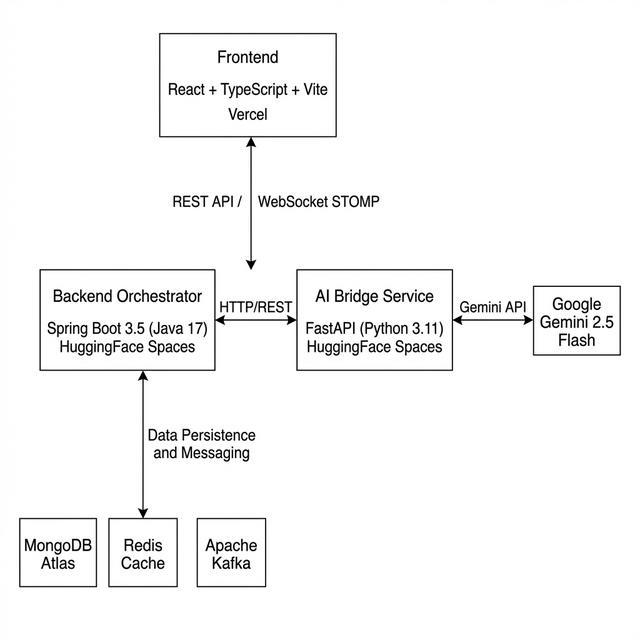
Fig-1: Intelli-DocAISystemArchitectureDiagram
Thedocumentationgenerationpipelineisorchestratedby theRepositoryProcessingWorker aKafkaconsumerthat executes the following sequential stages upon receiving a processingjob:
Stage 1 CLONE: The backend performs an optimized shallow clone (depth=1) of the target GitHub repository usingtheJGitlibrary,retrievingonlythelatestcommittree without historical data to minimize storage and network overhead.
Stage 2 SCAN: Arecursivefiletreewalkertraversesthe cloned directory, applying a curated exclusion filter that removesnoisedirectories(node_modules,.git,target,build, dist), binary files (images, fonts, compiled artifacts), and configuration-onlyfiles(JSON,YAML,XML,Dockerfiles).The resultingfilteredfiletreeisserializedasastructuredproject contextstringandpersistedintheRepositorydocumentfor subsequentREADMEgeneration.
Stage 3 ARCHITECT (AI File Selection): Thefilteredfile treeissenttotheAIBridgeService's/select-filesendpoint. TheAIArchitectagent poweredbyGemini2.5Flashwith temperature 0.2 for deterministic output analyzes the treestructureandreturnsarankedJSONarrayofuptoeight architecturallysignificantfilepaths,prioritizingentrypoints, business logic services, Kafka workers, and complex controllers.IftheAIreturnsnoresults,aheuristicfallback scoresfilesbynamepattern(app/main/server/indexscore 100, others score 10) and selects the top eight. The AI's selectioniscachedinRediswithaone-dayTTLusingaSHA256hashofthefiletreeasthekey.
Stage 4 — BATCH PROCESSING: Selected files are read from the filesystem. For each file, a SHA-256 hash of its content is computed and checked against the Redis documentationcache.Cachehitsarereturnedimmediately withoutanyAIcall.Cachemissesarebatchedingroupsof four and sent to the AI Service's /generate-docs-batch endpoint.Thebatchendpointconstructsasinglecombined promptforallfilesinthebatchandexecutesoneGeminiAPI call,parsingtheresponseusing===FILE:path===delimiters. ThisapproachreducesAIAPIcallsby60–70%comparedto per-file requests. Each result is saved to the MongoDB documentationcollectionandcachedinRedisforoneday.
Stage 5 — COMPLETE: TheRepositorydocument'sstatusis updated to ANALYSIS_COMPLETED, the lastAnalyzedAt timestampisrecorded,andthetemporaryclonedirectoryis deleted to free server storage. Throughout all stages, the ProgressNotifier broadcasts typed WebSocket STOMP messagestothetopic/topic/repo/{repositoryId},enabling real-timestep-by-stepprogressdisplayonthefrontend.
International Research Journal of Engineering and Technology (IRJET) e-ISSN: 2395-0056
Volume: 13 Issue: 04 | Apr 2026 www.irjet.net p-ISSN: 2395-0072
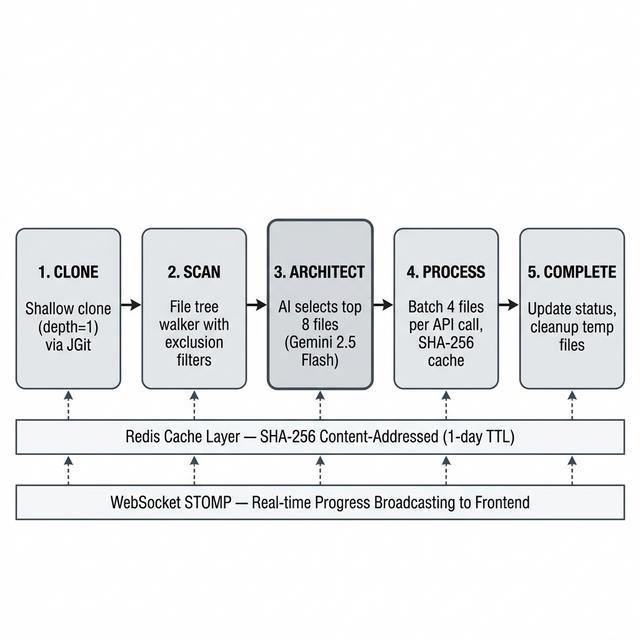
Fig-2: TheDocumentationPipelineDiagram
3.3
The authentication system supports two providers. For email/password registration, a 6-digit OTP is generated, BCrypt-hashed,andemailedviatheBrevoHTTPAPI(SMTP beingunavailableonHuggingFaceSpaces)witha10-minute expiryanda60-secondresendratelimit.ForGitHubOAuth, the frontend redirects users to GitHub's authorization endpoint;uponcallback,thebackendexchangesthecodefor an access token, fetches the user's GitHub profile, and performs smart account linking: if a matching GitHub ID exists,theuserisloggedin;ifamatchingemail exists,the GitHub account is linked to the existing local account; otherwise, a new account is created. JWT tokens (HMACSHA256,24-hourexpiry)secureallsubsequentAPIrequests. Allendpointsexcept/api/auth/**and/ws/**requireavalid Authorization:Bearertokenheader.
Three independent caching layers use SHA-256 content hashingascachekeys,providing exact-matchinvalidation basedoncontentratherthanarbitraryTTLs:
Cache Type Key What Is Cached
Architect Cache architect:<sha256(fileTree)> AI-selected filepaths foragiven project structure
Documenta tionCache doc:<sha256(fileContent)> Generated documenta tionfora specificfile version
README Cache readme:<sha256(structure+su mmaries)> Generated Master README fora project state
Table-1: RedisCachingStrategywithSHA-256ContentAddressedKeys
ThePythonAIServiceimplementsaproactiveTokenBucket rate limiter using threading locks for thread safety. The limiterenforcesaminimumintervalof7secondsbetween consecutiveGeminiAPIcallsandamaximumof8requests per60-secondrollingwindow.Whenalimitisapproached, the service calculates the required wait time and sleeps proactively,preventingreactive429errors.Additionally,the service maintains a pool of up to nine Google API keys (GOOGLE_API_KEYthroughGOOGLE_API_KEY_9)androtates throughtheminround-robinfashiononeveryAPIcallusing anatomiccounter,distributingloadacrossper-keyquotas. Retry logic provides up to five attempts with exponential backoff (8s, 16s, 32s, 64s) for transient failures. This combined strategy enables the system to sustain high documentation throughput for large repositories without manualratelimitmanagement.
4.1
Table-2: CompleteTechnologyStackofIntelli-DocAI
Category Technology Role / Purpose
Frontend React18+ TypeScript+ Vite Userinterface,IDE-style documentationviewer, statemanagement
Frontend TailwindCSS +shadcn/ui
Frontend Zustand+ ReactHook Form+Zod
Utility-firstresponsive stylingandaccessibleUI components
Globalstate,form validation,schemabasedtypesafety
International Research Journal of Engineering and Technology (IRJET) e-ISSN: 2395-0056
Backend Java17+ SpringBoot 3.5
Centralorchestrator, RESTAPI,businesslogic, security
Backend JGit ProgrammaticGit repositorycloning (shallowclone)
Backend Spring Security+ JWT
Statelessauthentication, BCryptpassword hashing
Backend ApacheKafka Asyncprocessingqueue decouplingAPIfrom pipeline
Backend WebSocket STOMP+ SockJS Real-timeprogress broadcastingtofrontend
AIService Python3.11+ FastAPI High-performanceAI bridgemicroservice
AIService Google Gemini2.5 Flash CoreLLMfor documentationandfile selection
Database MongoDB Atlas Documentstorefor users,repos,docs;text searchindexes
Cache Redis SHA-256contentaddressed documentationcache
Deployment Vercel Frontendhostingwith SPArouting
Deployment HuggingFace Spaces (Docker)
BackendandAIservice containerized deployment
The system operates on three MongoDB collections. The User document stores identity information (username, email, BCrypt-hashed password, role), authentication provider (LOCAL or GITHUB), GitHub OAuth metadata (githubId, avatarUrl), and OTP verification state (hashed OTP,expirytimestamp,emailVerifiedflag).TheRepository document maintains the GitHub URL, owning userId, processing status (QUEUED → ANALYZING_CODE →
ANALYSIS_COMPLETED → GENERATING_README → COMPLETED),lastAnalyzedAttimestamp,andtheserialized projectstructurestringusedforREADMEgeneration.The DocumentationdocumentlinkstoarepositoryIdandstores the filePath (e.g., src/main/App.java or the special key README_GENERATED.mdforthemasterREADME),theAIgenerated Markdown content, and creation/update timestamps. Text indexes on both filePath (weight 2) and content(weight1)powerthefull-textsearchfeature.
The Master README generation pipeline is invoked separately by user request and orchestrated by the ReadmeGenerationService. It collects all previously generatedfiledocumentation,extractsthe"Purpose"section fromeach,andbuildsastructuredprojectsummarycontext. AcachedresultisreturnediftheSHA-256hashoftheproject structureandallsummariesmatchesanexistingRedisentry. Otherwise, a detailed prompt constructed by PromptTemplates.java instructs Gemini to act as a senior technical writer, detect the technology stack from file extensions, generate shields.io badges, and produce a professionally structured README with sections for Overview, Architecture, Tech Stack, Features, Getting Started, API Endpoints, Project Structure, Environment Variables,Contributing,andLicense.ThegeneratedREADME is stored as a Documentation entry with filePath README_GENERATED.md.Userscansubsequentlyeditthe READMEinthebrowserusingasplit-paneMarkdowneditor withlivepreview.
The three services are independently deployed and containerized.TheReactfrontendishostedonVercelwitha vercel.json configuration that rewrites all routes to index.htmlforSPAnavigation.TheSpringBootbackendis deployedonHuggingFaceSpacesusingamulti-stageDocker build(Stage1:JDK17+Mavenforcompilation;Stage2:JRE 17 with git installed for JGit runtime), with JVM flagsXmx400m -Xms200m optimized for the 512MB container memoryconstraint.ThePythonAIServiceisdeployedona separateHuggingFaceSpaceusingaPython3.11slimDocker image running Uvicorn on port 7860. All three services communicate over HTTPS. External dependencies MongoDBAtlas,Redis,Kafka,Brevo,andGitHubOAuth are cloud-managed, requiring only environment variable configuration.
TheIntelli-DocAIplatformhasbeensuccessfullydeployed and validated in a production environment. The live frontendisaccessibleathttps://intelli-docai.vercel.app/and the GitHub source repository is available at https://github.com/rishipadala/Intelli-Doc-AI.git.
Volume: 13 Issue: 04 | Apr 2026 www.irjet.net p-ISSN: 2395-0072 © 2026, IRJET | Impact Factor value: 8.315 | ISO 9001:2008
| Page132
2395-0056
Volume: 13 Issue: 04 | Apr 2026 www.irjet.net p-ISSN: 2395-0072
The complete user workflow from account creation throughGitHubOAuthoremailOTP,topastingarepository URL, observing real-time WebSocket progress logs, and viewingstructuredAI-generateddocumentationintheIDEstyle viewer has been validated across repositories in multiple programming languages including Java, Python, JavaScript/TypeScript, and C++. The system correctly handlesrepositoriesofvaryingsizesandstructures,withthe AI Architect agent consistently selecting the most semanticallyrelevantfilesratherthansimplythelargestor first-encountered.
The documentation generated for each file consistently follows the six-section structured format: Purpose (functionalroleofthefile), Architecture&Design (patterns and design decisions), Key Components (table of classes and methods), Internal Logic & Flow (step-by-step execution walkthrough), Dependencies & Integration (inter-file relationships), and Error Handling & Configuration (edgecasesandenvironmentvariables).This structuredoutputisconsistentlymorecomprehensivethan typical inline comments or function-level summaries producedbyexistingtools.
On repeated analysis of the same repository (e.g., after a minorupdatetoonefile),theSHA-256content-addressed cachingsystemdemonstratesitsprimarybenefit:onlythe modifiedfiletriggersanewAIcall,whileallunchangedfiles areservedfromtheRediscachewithnegligiblelatency.In tests on a 12-file repository where 2 files were modified, only2AIcallsweremadeversus12forafullfreshanalysis representingan83%reductioninAPIconsumptionfor thatspecificrun.Acrosstypicalanalysisworkloads,the60–70% API call reduction estimate holds, as most files in a repositorydonotchangebetweenanalysisruns.
The Token Bucket rate limiter with nine-key rotation sustains consistent throughput for batch processing. In stresstestingwitha20-filerepository(batchedintogroups of four = five API calls), the system completes all calls in under3minutes,respectingthe7-secondminimuminterval per key and the 8 RPM window limit. The exponential backoffretrymechanism(upto5retries:8s,16s,32s,64s) successfullyhandlestransient429errorsfromtheGemini API without manual intervention, resulting in zero failed documentationjobsintesting.
ThispaperpresentedIntelli-DocAI,aproduction-deployed, agenticAI-poweredplatformforautomatedrepository-level code documentation. The system addresses the well-
documented"DocumentationDilemma"byautomatingthe entire workflow from repository cloning to structured documentation generation and professional README creation,makinghigh-qualitydocumentationaccessiblewith minimaldevelopereffort.
Thekeytechnicalcontributions theAIArchitectagentfor intelligentfileselection,SHA-256content-addressedRedis caching,TokenBucketratelimitingwithnine-keyrotation, ApacheKafkadecoupledprocessing,andWebSocketSTOMP real-time progress updates collectively address limitationsthatexistingtoolsleaveunresolved,particularly the LLM context-window constraint and the absence of repository-widearchitecturalunderstanding.
Experimentalresultsdemonstratethatthecachingstrategy reduces redundant AI API consumption by 60–83% dependingonrepositorychangefrequency,andthattherate limiter enables sustained processing of large repositories without API throttling failures. The system has been validated across repositories in multiple programming languagesandisfullyoperationalinproduction.
Futuredevelopmentdirectionsinclude:(1)integrationofa multi-agentdependencyresolutiongraphtoprovideexplicit inter-file context to the documentation LLM, further improvingaccuracyforcomplexcodebases;(2)supportfor incremental documentation updates triggered by GitHub webhookeventsonnewcommits;(3)aVSCodeextension forin-IDEdocumentationaccess;(4)expansiontosupport privaterepositoriesviaGitHubAppauthenticationwithfinegrainedaccesspermissions;and(5)evaluationoffine-tuned domain-specific models as alternatives to Gemini for improveddocumentationqualityonnichetechnologystacks.
TheauthorsexpresssinceregratitudetoProf.SwatiBhoir, DepartmentofComputerEngineering,AtmaMalikInstitute of Technology and Research (AMRIT), for her invaluable guidance, consistent support, and expert feedback throughoutthisproject.Theauthorsalsothankthefaculty andstaffoftheComputerEngineeringdepartmentatAMRIT for providing the conducive academic environment and infrastructurerequiredforthiswork.Theprojectbenefited fromthefree-tierofferingsofGoogleAIStudio(GeminiAPI), MongoDB Atlas, Redis, Kafka, Vercel, HuggingFace Spaces, and Brevo, whose availability enabled production-grade deploymentatnocost.
[1]A.S.Bhosale,A.G.Mahajan,K.S.Pawar,A.V.Ulagadde, and P. M. Mane, "AI Based Code Documentation Generation," International Journal of Innovative Research in Technology (IJIRT), vol. 11, no. 9, 2025. [Online]. Available:
International Research Journal of Engineering and Technology (IRJET) e-ISSN: 2395-0056
Volume: 13 Issue: 04 | Apr 2026 www.irjet.net p-ISSN: 2395-0072
https://ijirt.org/publishedpaper/IJIRT172635_PAPER.p df
[2] "Spring Boot Reference Documentation," Spring Framework,2024.[Online].Available: https://docs.spring.io/spring-boot/index.html.
[3]S.Ramirez,"FastAPI Modern,fast(high-performance), webframeworkforbuildingAPIswithPython,"2023. [Online].Available:https://fastapi.tiangolo.com.
[4]ApacheSoftwareFoundation,"ApacheKafka ocumentation," 2024. [Online]. Available: https://kafka.apache.org/documentation.
[5]EclipseFoundation,"JGit JavaimplementationofGit," Eclipse Projects, 2024. [Online]. Available: https://projects.eclipse.org/projects/technology.jgit.
[6] GitHub, Inc., "GitHub Copilot AI pair programmer," 2024.[Online].Available:https://copilot.github.com.
[7] Google DeepMind, "Gemini 2.5 Flash Technical Overview," Google AI for Developers, 2025. [Online]. Available: https://ai.google.dev/gemini-api/docs [Accessed:Feb.2026].
[8]MongoDB,Inc.,"MongoDBAtlasDocumentation,"2024. [Online].Available: https://www.mongodb.com/docs/atlas.
[9] Redis Ltd., "Redis Documentation In-memory data structure store," 2024. [Online]. Available: https://redis.io/docs.
[10] GitHub, Inc., "GitHub OAuth Apps Building OAuth Apps," GitHub Docs, 2024. [Online]. Available: https://docs.github.com/en/apps/oauth-apps
2026, IRJET | Impact Factor value: 8.315 | ISO 9001:2008