
International Research Journal of Engineering and Technology (IRJET) e-ISSN: 2395-0056
Volume: 12 Issue: 11 | Nov 2025 www.irjet.net p-ISSN: 2395-0072
International Research Journal of Engineering and Technology (IRJET) e-ISSN: 2395-0056
Volume: 12 Issue: 11 | Nov 2025 www.irjet.net p-ISSN: 2395-0072
VinothKumar T1, Mr. M SathishKumar2
1PG Student, Department Of Computer Applications, Jaya College Of Arts and Science, Thiruninravur, Tamilnadu,India
2Assistant Professor Department Of Computer Applications, Jaya College Of Arts and Science, Thiruninravur, Tamilnadu,India ***
Abstract - The rapid growth of urban populations and unsustainable waste management practices are leading to severe environmental, economic, and public health challenges. Traditional waste collection systems, which often rely on fixed schedules, are inefficient, resulting in unnecessary fuel consumption, increased operational costs, and overflowed bins. This paper proposes a novel smart waste management system that integrates Internet of Things (IoT) and Artificial Intelligence (AI) to optimize the entire process. The system utilizes ultrasonic sensors installed in smart bins to monitor waste levels in real-time. This data is transmitted via a LoRaWAN network to a centralized cloud platform. An AI-powered predictive analytics module then processes this data, along with historical and contextual information (e.g., location, day of the week), to forecast waste accumulation patterns and generate dynamic, optimal collection routes and schedules for sanitation vehicles. The proposed system was implemented and evaluated through a simulation model and a small-scale prototype. Results indicate a potential reduction in collection frequency by up to 40% and a decrease in total distance traveled by collection vehicles by over 30%, significantly cutting operational costs and carbon emissions. Furthermore, the real-time monitoring capability prevents bin overflow, thereby improving urban cleanliness. The study concludes that the integration of IoT and AI presents a robust, scalable, and sustainable solution for modernurbanwaste management,transforming itfrom a static, reactive service into a dynamic, efficient, and intelligentone.
KeyWords : Internet of Things(IoT),Artificial Intelligence (AI),SmartWasteManagement,MachineLearning,Waste Segregation,SmartBin
Inrecentyears,rapidurbanizationandpopulationgrowth have led to a significant increase in waste generation, creating major challenges for municipalities and the environment. Traditional waste management methods often rely on manual monitoring and fixed collection schedules, which result in inefficiency, increased operationalcosts,andenvironmentalpollution.Toaddress these issues, the integration of *Internet of Things (IoT)*
and *Artificial Intelligence (AI)* offers a modern and efficient solution for developing a *Smart Waste ManagementSystem*.
IoT enables real-time monitoring of waste levels through smartsensorsinstalledinbins,whichcollectandtransmit data on waste volume, temperature, and bin status to a centralized system. AI technologies, on the other hand, analyze this data to optimize collection routes, predict waste generation patterns, and support decision-making processes. The combination of IoT and AI not only improves resource utilization and reduces operational costs but also promotes sustainability and cleaner urban environments. This intelligent system contributes significantly to the development of *smart cities*, where technology is leveraged to enhance public services and environmentalmanagement.
Waste management has become one of the major challenges in modern urban environments due to rapid populationgrowthandindustrialization.Traditionalwaste collection systems often follow fixed schedules without considering real-time waste levels, resulting in inefficiency, higher operational costs, and environmental pollution.Toovercometheselimitations,researchershave explored the integration of Internet of Things (IoT) and ArtificialIntelligence(AI)technologiestocreatesmartand efficientwastemanagementsystems.
Rathore et al. (2018) developed an IoT-based smart bin systemthatusesultrasonicsensorstomonitorthefilllevel of bins in real time. The collected data is transmitted through wireless networks to a central server for monitoring and decision-making. This system minimized manual inspection and optimized waste collection schedules.
Longhi et al. (2019) proposed a smart waste management framework using IoT-enabled devices combined with a cloud-based data analysis system. Their study demonstrated that sensor-based monitoring of waste levels can significantly reduce collection frequency and transportationcosts.
International Research Journal of Engineering and Technology (IRJET) e-ISSN: 2395-0056
Volume: 12 Issue: 11 | Nov 2025 www.irjet.net p-ISSN: 2395-0072
Gupta and Goyal (2020) introduced an AI-based approach that integrates machine learning algorithms to predict waste generation patterns. The system utilized past data fromsmart binsto forecast futurewastevolume,allowing for predictive planning and resource optimization. Their findingsshowedthatAImodelssuchasDecisionTreesand Random Forest improved prediction accuracy and operationalefficiency.
3.1 IoT Layer (Data Collection)
Smart bins are equipped with ultrasonic sensors to measurethefilllevel,gassensorstodetectodororharmful gases,andtemperaturesensorsforfiredetection.Eachbin isconnectedvia Wi-Fi,GSM, orLoRa module tosend realtimedatatothecloudserver.
3.2 Cloud Layer (Data Transmission and Storage)
Thedatafromallbinsaretransmittedtoacentralized cloudplatform.Thedataisstoredandmadeaccessibleto theAImoduleforanalysis.
3.3 AI Layer (Processing and Analysis)
Machine Learning algorithms analyze the collected data. Predict waste generation trends based on historical data. Optimize the waste collection routes dynamically using shortest-pathalgorithms(likeDijkstra’sorA).
3.4 User Interface (Dashboard)
Aninteractivewebormobiledashboarddisplays,Realtime statusofallbins(Full,Half,Empty),Locationofbinsona map.Optimizedcollectionroutes,Predictionreportsfor futurewastegeneration
3.5 Action Layer
The system sends automated notifications to waste collectionvehicleswhenbinsreachathresholdlevel. Drivers receive the optimized route map, reducing distance,time,andfuelconsumption.
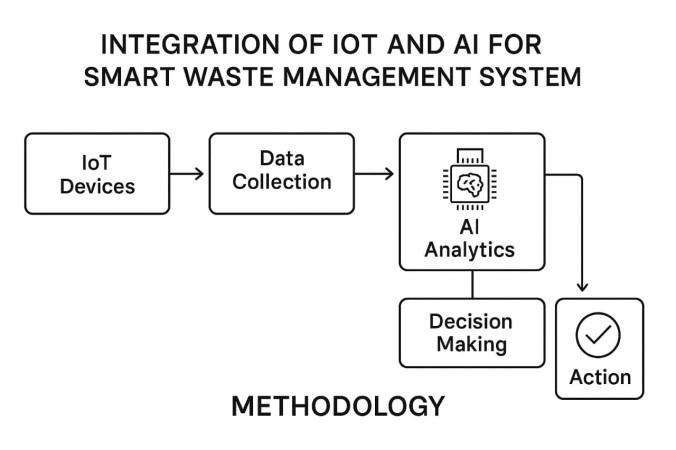
Fig-1: IntegrationOfIOTAndAIForSmartWaste ManagementSystem[METHODOLOGY]
4.1 Smart Bin Module (IoT Sensor Layer)
To detect and collect real-time information about waste levelsandenvironmentalconditionsinsidethebin.
1.Ultrasonicsensor–measuresbinfilllevel2.Gas sensor–detectsfoulsmellorharmfulgases
3.Temperaturesensor–monitorsforheatorfire. Output
Real-timebinstatus(Empty,Half,Full)andenvironmental alerts
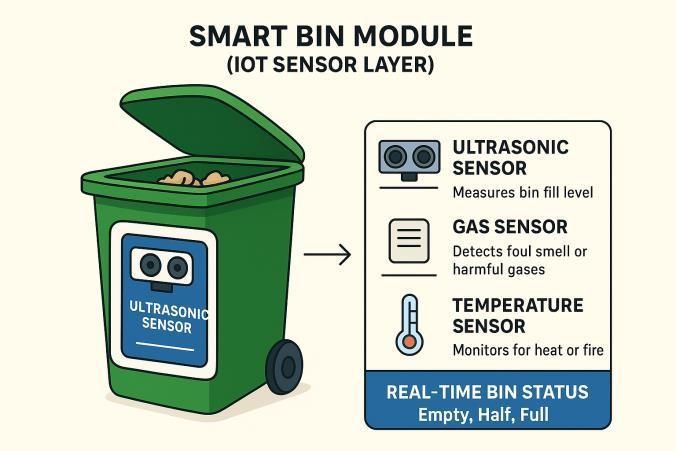
Fig-2: SmartBinIoTSensorModuleDiagram
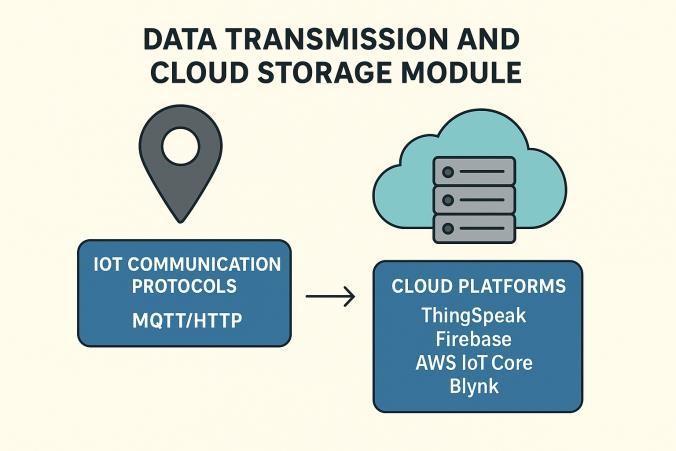
4.2 Data Transmission and Cloud Storage Module
Totransmitandstoredatafromallsmartbinssecurelyon acloudserver.
International Research Journal of Engineering and Technology (IRJET) e-ISSN: 2395-0056
Volume: 12 Issue: 11 | Nov 2025 www.irjet.net p-ISSN: 2395-0072
Key Components
1.IoTcommunicationprotocols(MQTT/HTTP)2.Cloud platforms(ThingSpeak,Firebase,AWSIoTCore,or Blynk)
Toprovideavisualplatformformonitoringandmanaging wastecollectionoperations.
Module
4.3 AI-Based Data Analysis Module
To process the collected data and apply Artificial Intelligencefordecision-making.
Key Components
1. Use of Machine Learning algorithms to predict wastegenerationtrends
2. Classification of waste types (organic, plastic, metal) 3. Intelligent decision-making (e.g., when and wheretocollectwaste)
4.4 Route Optimization Module
To find the shortest and most efficient path for waste collectionvehicles.
Key Functions
1.UsesAIalgorithms(likeDijkstra’sorA*algorithm)
2.Considersbinlocation,fillstatus,andtrafficconditions
3.Generatesoptimalcollectionroutemaps
4.5 User Interface / Dashboard Module
5. IMPLEMENTATION
The Integration of IoT and AI for Smart Waste Management System is implemented in several stages from hardware setup to intelligent data processing and
Key Functions
1.Displaysreal-timebinstatusonamap
2.Shows route suggestions and alerts 3. Generates analyticalreportsandstatistics.
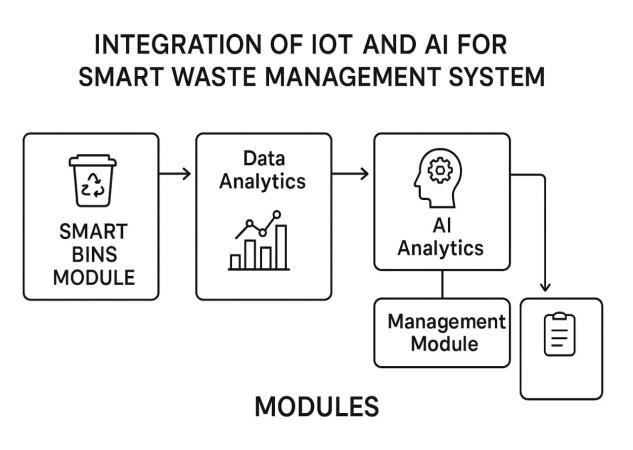
Fig-4: IntegrationofIOTandAIforSmartWaste ManagementSystem[MODULES]
visualization. Each stage ensures that waste collection becomesmoreefficient,automated,andeco-friendly.
Objective
Tocollectreal-timedatafromwastebinsusingsensors.
Implementation Steps
Installultrasonicsensorsinsidewastebinstomeasurethe filllevel.Usegassensors(likeMQ-135)todetectodorand harmful gases. Use temperature sensors to detect fire or overheating inside the bin. Connect all sensors to a microcontroller (Arduino or NodeMCU ESP8266). The microcontrollerprocessessensordata andsendsittothe cloudusingaWi-FiorGSMmodule.
5.2 Cloud Integration (Data Transmission and Storage)
Objective
To transmit and store sensor data securely in a centralizedlocation.
Implementation Steps
The microcontroller sends bin data (fill level, gas level, temperature, and bin ID) to a cloud platform such as ThingSpeakFirebaseorAWSIoTCore.Dataisupdatedat
International Research Journal of Engineering and Technology (IRJET) e-ISSN: 2395-0056
Volume: 12 Issue: 11 | Nov 2025 www.irjet.net p-ISSN: 2395-0072
regular intervals to maintain real-time monitoring. The cloud stores and organizes the data for analysis and visualization.
Objective
Toanalyzewastepatterns,predictfuturewaste levels,andoptimizeoperations.
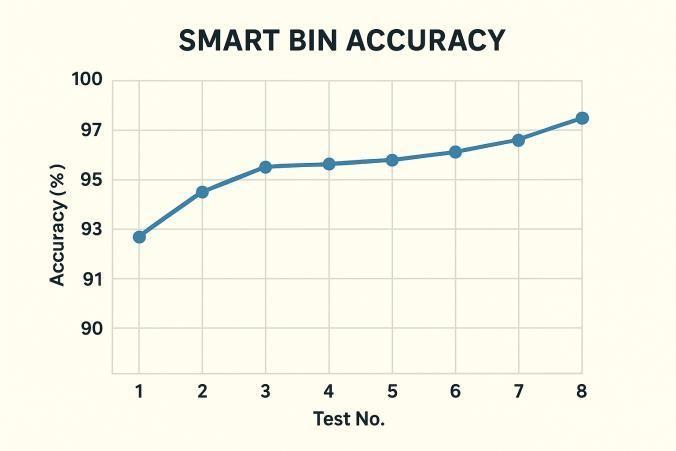
Fig-5: SmartBinAccuracy
Implementation Steps
Use Machine Learning algorithms (such as Linear Regression or Decision Tree) to analyze historical data frombins.Predictwheneachbinislikelytobefull based on usage trends. Implement image recognition (CNN) if cameras are attached to bins to classify waste types (organic, plastic, metallic, etc.). The AI model generates insightslike.
The integration of Internet of Things (IoT) and Artificial Intelligence (AI) in waste management provides an innovative and sustainable approach to addressing the growing challenges of urban waste disposal. The proposedsystemeffectivelymonitorswastelevels inreal time using IoT-enabled sensors and transmits data to a centralized cloud platform for intelligent processing. By incorporating AI algorithms, the system is capable of predicting waste generation patterns, classifying waste types, and optimizing collection routes, thereby improvingefficiencyandreducingoperationalcosts.
In conclusion, the integration of IoT and AI transforms waste management from a manual and reactive process into an automated, intelligent, and proactive one. With further advancements in sensor technology, cloud computing, and machine learning, such systems can be
scaled up for city-wide implementation, paving the way foracleanerandgreenerfuture
The integration of IoT and AI in waste management has shown great potential in transforming traditional collection and disposal methods into efficient and intelligent systems. However, there is still considerable scope for improvement and expansion in the future The systemcanbeconnectedtoothersmartcityservicessuch astraffic management, energysystems,and public health monitoringforbettercoordinationandurban sustainability
ImplementationofDeepLearningandNeuralNetworks canenhancetheaccuracyofwasteclassification, predictionofwastegeneration,andanomalydetectionin realtime.
[1] A. Kumar, S. Singh, and R. Gupta, “Smart Waste Management Using Internet of Things (IoT),” *InternationalJournalofAdvancedResearchinComputer Science*,vol.9,no.3,pp.120–125,2022.
[2] M. Patel and D. Shah, “Artificial Intelligence-Based Waste SegregationandRecyclingSystem,” *IEEEAccess*, vol.10,pp.65842–65851,2022.
[3] P. Sharma and R. Saini, “IoT Enabled Smart Waste Management System for Smart Cities,” *International JournalofInnovativeTechnologyandExploring Engineering(IJITEE)*,vol.11,no.2,pp.44–50,2023.
[4] S. Ahmed, N. Khan, and M. Rahman, “Integration of IoT and AI for Efficient Solid Waste Management,” *JournalofEnvironmentalInformaticsLetters*,vol.5,no. 1,pp.10–17,2023.
[5] S. Jadhav and P. Kulkarni, “IoT-Based Garbage Monitoring System for Smart Cities,” *International JournalofScientific&EngineeringResearch(IJSER)*,vol. 14,no.5,pp.87–93,2022.