International Research Journal of Engineering and Technology (IRJET)
e-ISSN: 2395-0056
Volume: 13 Issue: 06 | Jun 2026
p-ISSN: 2395-0072
www.irjet.net
Integrated Smart Vehicle Fire Detection and Suppression System for Enhanced Passenger Safety Gaurav Jamdar1, Rakshit Iyengar2, Vivek Kawale3, Romit Kanse4, Karthik Moolya5 1,2,3,4,5Department of Automobile Engineering, Ajeenkya DY Patil School of Engineering, Pune, India Corresponding
-----------------------------------------------------------------------------------------------------------------------------------------------
Abstract-Vehicle fire incidents continue to pose a
suppression, electrical isolation, door unlocking, and remote emergency notification in a single integrated platform.
significant risk to human safety and property. Conventional vehicle fire protection methods mainly depend on manual intervention, which may delay response during emergency conditions. This paper presents an automated vehicle fire detection and suppression system intended to reduce fire escalation at an early stage. The proposed system integrates a microcontroller-based control unit with multiple sensing elements temperature, smoke, and flame sensors to improve detection reliability through multi-sensor confirmation logic. Once a fire condition is validated, the system activates a fire suppression module, isolates selected electrical loads, unlocks vehicle doors, and transmits an emergency alert with location information through a GSM/GPS communication module. A conditional window ventilation strategy is proposed as an additional safety feature. The architecture is applicable to both internal combustion engine vehicles and electric vehicles with suitable sensor and nozzle placement. Prototype-level evaluation indicates rapid detection and response performance, demonstrating the potential of the system as a cost-effective enhancement to vehicle safety.
2. LITERATURE REVIEW Several studies have investigated fire safety systems for automobiles. Sensor-based vehicle fire detection platforms using temperature and gas sensors have been proposed for early warning applications [6][7]. IoTenabled systems using GSM and GPS modules have been developed to transmit emergency alerts and location data [8]. Real-time fire and smoke monitoring frameworks combining sensor arrays with automated safety responses have similarly been demonstrated for passenger vehicles [11]. Other studies have focused on automatic suppression mechanisms, including extinguisher actuation modules and relay-controlled shutdown systems [2][9]. In electric vehicles, increasing attention has been given to battery thermal runaway detection and cooling-based mitigation strategies [1]. Cost-effective automatic extinguishing architectures targeting EV battery fires triggered on combined flame/smoke sensing have also been reported [10].
Key Words: Vehicle fire safety, automatic fire suppression, multi-sensor detection, GSM alert, automotive safety, electric vehicle fire protection.
Although prior research has demonstrated individual functions such as detection, alerting, or suppression, fewer systems integrate these into a unified low-cost architecture. The present work addresses this gap through a coordinated multi-sensor control approach.
1. INTRODUCTION Vehicle fires remain a critical safety concern despite advances in automotive engineering. Common causes include electrical short circuits, overheating, fuel leakage, mechanical failures, and battery-related faults in electric vehicles [1][2]. Once ignition occurs, the confined geometry of a vehicle and the presence of combustible materials can accelerate flame spread and smoke accumulation [3].
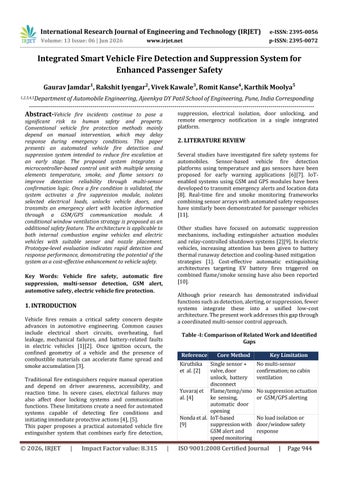
Table -I: Comparison of Related Work and Identified Gaps Reference
|
Impact Factor value: 8.315
Key Limitation
Single sensor + valve, door unlock, battery disconnect Yuvaraj et Flame/temp/smo al. [4] ke sensing, automatic door opening Nonda et al. IoT-based [9] suppression with GSM alert and speed monitoring
No multi-sensor confirmation; no cabin ventilation
Kiruthika et al. [2]
Traditional fire extinguishers require manual operation and depend on driver awareness, accessibility, and reaction time. In severe cases, electrical failures may also affect door locking systems and communication functions. These limitations create a need for automated systems capable of detecting fire conditions and initiating immediate protective actions [4], [5]. This paper proposes a practical automated vehicle fire extinguisher system that combines early fire detection,
© 2026, IRJET
Core Method
|
No suppression actuation or GSM/GPS alerting No load isolation or door/window safety response
ISO 9001:2008 Certified Journal
|
Page 944