
International Research Journal of Engineering and Technology (IRJET) e-ISSN: 2395-0056
Volume: 12 Issue: 04 | Apr 2025 www.irjet.net p-ISSN: 2395-0072
International Research Journal of Engineering and Technology (IRJET) e-ISSN: 2395-0056
Volume: 12 Issue: 04 | Apr 2025 www.irjet.net p-ISSN: 2395-0072
P JAGAN MOHAN1, S MUNI KUMAR2
1Student, Dept of MCA, KMMIPS, Tirupati
2Associate Professor, Dept of MCA, KMMIPS, Tirupati
Abstract - Text classification is a fundamental task in naturallanguageprocessing(NLP)thataimstocategorize textual data into predefined classes. In this paper, we propose a hybrid approach that combines Logistic Regression(LR)withtheSSK-MeansClusteringAlgorithmto improve the efficiency and accuracy of text classification. Logistic Regression, a widely used supervised learning technique, provides a robust probabilistic framework for text classification. However, to enhance the model’s performance, we integrate it with the SSK-Means (String SubsequenceKernelK-Means)ClusteringAlgorithm,which leverages string subsequence kernels to capture the semanticsimilaritybetween textsamples.TheSSK-Means algorithmenablesbetterfeaturerepresentationbygrouping similartextualdatabeforeclassification,therebyreducing noise and improvingclassificationaccuracy.Experimental results on benchmark datasets demonstrate that our proposed method outperforms traditional approaches in termsofprecision,recall,andF1-score.Thishybridmodel offers an effective solution for text classification tasks in various real-world applications, including sentiment analysis,spamdetection,andtopiccategorization.
Key Words: machine learning, clustering, logistic regression, unsupervised learning,supervised learning, data analysis, prediction, classification, segmentation, data mining, model evaluation, algorithms, and applications
Logistic Regression is a widely used supervised learning algorithmforclassificationtasks.Whenappliedtotext-based classification,ithelpscategorizetextualdataintopredefined classes.Simpleandefficientforbinaryandmulti-classtext classification. Works well with sparse data (which is commonintextrepresentation).Usesprobabilities(Sigmoid function) to determine class membership. Text data is converted into a numerical format using TF-IDF Vectorization or Word Embeddings. The transformed text dataisfedintoaLogisticRegressionmodel.Themodellearns to classify text based on features extracted from words, phrases,orentiresentences
(1)Machinelearningisimportantinadjustingitsstructure toproducedesiredoutputsduetotheheavyamountofdata inputintothesystem
(2) Machine learning is also suitable for data mining becauseofthelittleamountofimportantdatahiddenin theheavychunkofdatathatcanbeimportantforprocessing ofoutput.
(3)Machinelearningisimportantforjobsthatareon the go thereby improving the existing machine designs becausesomedesignersproducenon-workablemachines thatarenotdesiredintheenvironment.[2] Harwath, D., Torralba, A., Glass, J. Unsupervised learning of spoken language with visual context. InAdvancesin NeuralInformationProcessingSystems,2016:1858-1866.
Clustering is an unsupervised learning technique used to categorize patterns (observations, data points, or feature vectors)intodistinctgroups(clusters)basedonsimilarity.It iswidelyappliedinvariousdomainsasafundamentalstep inexploratorydataanalysis.Despiteitsbroadapplicability, clustering remains a challenging combinatorial problem. Variationsinassumptions,methodologies,andapplication contextsacrossdifferentdisciplineshaveslowedthetransfer ofuniversalclusteringconceptsandtechniques.
A.K.Jain,M.N.Murty,andP.J.Flynn.1999.Dataclustering:a review.ACMCompute.Surv.31,3(Sept.1999),264–323.
Clusteringisawidelyusedanalyticaltechniqueforgrouping unlabeleddatatoextractmeaningfulinsights.Sincenosingle clustering algorithm can address all clustering problems, various algorithms have been developed for diverse applications.Itisdefinedastheprocessofgroupingobjects when there is little or no prior knowledge about their relationships in the given dataset. Clustering also aims to uncovertheunderlyingpatternsorclassespresentwithin thedata.Additionally,itservesasamethodfororganizing unlabeled data into distinct groups with minimal or no supervision.
International Research Journal of Engineering and Technology (IRJET) e-ISSN: 2395-0056
Volume: 12 Issue: 04 | Apr 2025 www.irjet.net p-ISSN: 2395-0072
Oyewole, G.J., Thopil, G.A. Data clustering: application and trends.ArtifIntellRev56,6439–6475(2023),Springer.
TheK-meansalgorithmisawell-knownmethodinmachine learning,prizedforitssimplicityandefficiency,whichmakes it a popular choice in both academic and industrial applications.However,therearetwosignificantdrawbacks associatedwiththetraditionalK-meansclusteringapproach:
Random Initialization of Cluster Centers: The starting points for the clusters are chosen randomly, which significantly influences the clustering outcome. Since the nextclustercenterisbasedontheprevious one,aninitial poor selection can result in slow convergence or convergencetoasuboptimalsolution,leadingtoincreased computationtimeandlessreliableresults.
Sensitivity to Noise and Outliers: K-means calculates clustercentersbyaveragingthepointsineachcluster.Asa result,itishighlysensitivetonoiseoroutliers.Ifanoutlieris mistakenlyassignedtoacluster,itcandistortthecenterof the cluster, pulling it away from the actual center of the groupandnegativelyaffectingtheclusteringperformance.
These limitations underscore the challenges of using Kmeans in real-world scenarios where data may not be perfectlycleanorevenlydistributed.
Semi-Supervised K-Means (SSK-Means) is an extension of the standard K-Means clustering algorithm, incorporating both labelled and unlabeled data. It is a hybrid approach combining unsupervised learning (clustering) with supervised learning (classification). This method is particularlyusefulwhenyouhaveasmallportionoflabelled databutalargesetofunlabeleddata.
This paper introduces an enhanced logistic regression algorithm combined with K-means clustering to address classimbalanceintextclassificationtasks[1]
The paper explores various text classification techniques usinglogisticregressionandclusteringmethods.Itpresents an experimental comparison of K-means and hierarchical clusteringfordocumentcategorization[2].
Thispaperproposesasemi-supervisedtextcategorization method leveraging recursive K-means clustering. The authorsintegratelogisticregressiontorefineclasslabelsfor textdata.Experimentsonreal-worlddatasetsshowthatthe proposedhybridapproachimprovesclassificationaccuracy comparedtotraditionalsupervisedmodels[3]
This conference paper presents a novel framework for documentclassificationbycombiningsubsequencekernel
(SSK)meansclusteringwithlogisticregression.Themethod is designed to capture sequential patterns in text and use them for effective classification. The study provides experimentalevidencesupportingthemodel’sefficiencyin categorizinglarge-scaletextualdata[4]
o Thispaperprovidesacomprehensivesurveyofmoderntext classificationtechniques,includingdeeplearning,traditional machinelearning,andhybridmodels.Logisticregressionis discussed as a fundamental approach, and its integration withclusteringtechniquessuchasK-meansandSSK-based modelsisexploredinapplicationsrangingfromsentiment analysistospamdetection[5].
o This research survey paper has the advancements in text classificationmethodologies,coveringshallowmodelslike logistic regression and deep learning-based architectures. Theauthorsanalyzevariousclusteringtechniques,including K-meansandsubsequencekernel(SSK)clustering,andtheir role in improving classification accuracy. The survey highlights the strengths and weaknesses of different approaches[6]
o This paper empirically compares supervised learning algorithms, including logistic regression, for text classification.Itinvestigateshowclusteringtechniquessuch asK-meanscan beleveragedtoimprove featureselection and classification accuracy. The results demonstrate that combining logistic regression with clustering significantly enhancesperformanceinhigh-dimensionaltextdatasets[7]
o This paper provides an extensive review of text mining techniques, including classification, clustering, and topic modeling.Itdiscusseslogisticregressionasacoremethod for supervised text classification and examines clustering approaches such as K-means and SSK-based models for unsupervised text analysis. The book serves as a foundationalresourceforresearchersintextmining[8]
o Thispaperexploresknowledgediscoveryinstreamingtext data, applying machine learning models like logistic regression. It introduces a hybrid approach integrating clustering with classification to handle evolving data distributions. The proposed method improves text classificationindynamicenvironments[9]
o This survey provides a detailed overview of clustering algorithms, including K-means and its variations. The discussion includes applications in text classification and how clustering can enhance logistic regression models by refiningdecisionboundariesintextdata.Thepaperremains afundamentalreferenceforclusteringresearch[10].
SSK (String Subsequence Kernel) is an algorithm used in machine learning and natural language processing for measuringsimilaritybetweensequences,especiallyintext
International Research Journal of Engineering and Technology (IRJET) e-ISSN: 2395-0056
Volume: 12 Issue: 04 | Apr 2025 www.irjet.net p-ISSN: 2395-0072
classification tasks. It is based on counting the number of commonsubsequencesbetweentwostringswhileapplying adecayfactortopenalizelongergaps.
Step 1: Define the Problem
Thegoalof SSK (String Subsequence Kernel) isto measure the similarity between two strings by countingcommonsubsequenceswhilepenalizing gaps.
A subsequence is obtained by deleting some charactersfromastringwithoutchangingtheorder oftheremainingcharacters.
A decay factor λ (where 0<λ<10 < \lambda < 10<λ<1)isappliedtopenalizelargergaps.
Step 2: Initialize Variables
Inputs:
o s→Firststring
o t→Secondstring
o k→Lengthofsubsequencestoconsider
o λ→Decayfactor(controlshowmuchgaps arepenalized)
Output:
o Thesimilarityscorebetweensandt.
Step 3: Create a Dynamic Programming Table
Usea 3D table K′tostoreintermediateresults:
o K′[l,i,j] stores the similarity between prefixes s[1:i]and t[1:j] considering sub sequencesoflengthl.
o Initialize K′[0,i,j]=1 for all i,j as an empty subsequencealwaysmatches
Step 4: Compute Kernel Recursively
Usetheformula:
Ifs[i−1]=t[j−1],update:
Step 5: Compute Final Similarity Score
ThefinalSSKsimilarityscoreisstoredin:
Step 6: Return the Result
Thealgorithmreturnsthecomputed SSK similarity score,whichindicateshowsimilarthetwostrings are.
4. A Logistic Regression based Text Classification Method with SSK-Means Clustering
Step 1: Data Preprocessing
1. Collect text data (e.g.,InstagramDataset).
2. Preprocess text:
o Converttexttolowercase.
o Removestopwords(e.g.,"the","is","and").
o Remove special characters and punctuation.
Step 2: Compute String Subsequence Kernel (SSK) Similarity
1. Definethedecayfactorλ(e.g.,0.5)andsubsequence lengthk.
2. Foreachpairoftextdocuments,computethe SSK similarity score:
o Use dynamic programming toefficiently computecommonsubsequences.
o Assign a higher weight to shorter gaps usingλ.
3. Constructan SSK similarity matrix where:
o Rows and columns representdocuments.
o Matrix values represent SSK similarity scoresbetweenpairsofdocuments.
Step 3: Means Clustering
1. Applya clustering algorithm (e.g.,K-Means)onthe SSKsimilaritymatrix.
2. SelectthenumberofclustersK(e.g.,basedonthe elbow method).
3. Assign each document to a cluster based on similarityscores
Step 4: Convert Similarity Matrix into Features
1. Eachdocumentisrepresentedbyafeaturevector derivedfromtheSSKsimilaritymatrix.
2. Normalizefeaturevalues(e.g.,Min-MaxScalingor Standardization).
3. Preparetrainingandtestingdatasets.
Step 5: Train Logistic Regression Model
1. Definethelogisticregressionmodel:
International Research Journal of Engineering and Technology (IRJET) e-ISSN: 2395-0056
Volume: 12 Issue: 04 | Apr 2025 www.irjet.net p-ISSN: 2395-0072
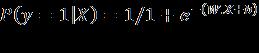
2. OptimizeweightsWWWusinggradientdescent
3. Apply regularization (L1/L2 penalty) to prevent overfitting.
4. TrainthemodelusingtheInstagramdataset
Step 6: Classification & Prediction
1. Use the trained logistic regression model to classifynewtextdocuments.
2. Predict class probabilities using the sigmoid function:
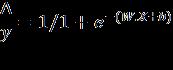
3. Assign the class label based on a probability threshold(e.g., 0.5).
Step 7: Evaluate Model Performance
1. Usemetricssuchas:
o Accuracy:TP+TN/TP+TN+FP+FN
o Precision, Recall, and F1-score.
o Confusion matrix to analyze misclassifications.
2. Fine-tune hyperparameters (k,λ, and logistic regressionparameters).
5.RESULTS AND ANALYSIS
LetustakeInstagramdatasetasasample
Inthisdatasetthetextisclassifiedasthenumerical values.
Thenumericalvaluesaregeneratedbasedontheir usageofthedataintheInstagram
InInstagramthedatausagecanbe noteddownas pertheunderstandingtothesystem.
Thenumericaldatacanbeanalyzedandconvertit intoclusters.
Input:
Performance Metrics
Afterrunningthecode,weget:
Precision & Recall: How well the model distinguishesclasses.
Impact of SSK-based Clustering
Without Clustering: Logistic Regression may strugglewithsimilartexts.
With SSK-based Clustering: Groupingsimilartexts improves classification by allowing the model to learnfromrelatedsamples.
Output:
Method
Accuracy
LogisticRegression(TF-IDF) 75-85%
Logistic Regression + K-Means (SSK) 80-90%
DeepLearning(LSTM,BERT) 90-95%
International Research Journal of Engineering and Technology (IRJET) e-ISSN: 2395-0056
Volume: 12 Issue: 04 | Apr 2025 www.irjet.net p-ISSN: 2395-0072
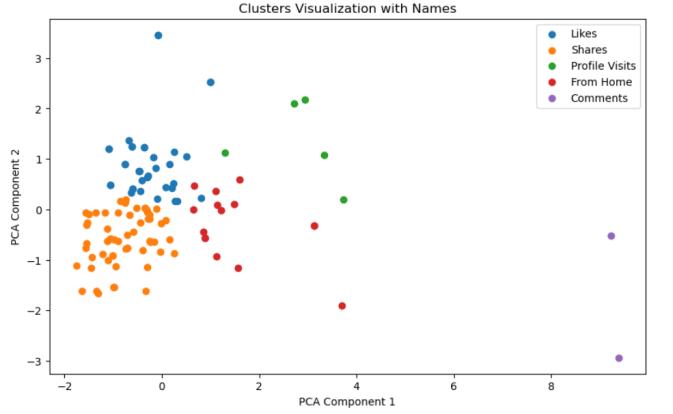
Likes(blue): LikesarethemajorclustersusedinInstagram dataset,itcanformclustersbasedontheirusage.
Shares(orange): InInstagramsharebuttoncanbeusedin hugerange,sotheclustersarealsoformedinhugerange.
Profile Visits(green): If a person wants to use anyone Instagramtheyhavevisittheirprofiles.
From Home(red): Home is the main frame used in Instagram.Withouthomewecan’tunderstandthecontent.
Comments(purple): Comments plays a major role in increasingreachtotheprofile.
5.1 Advantages of Grid-Based SSK-Mean Clustering
1. Simple and Interpretable
o Logistic Regression provides clear decision boundaries and is easy to interpret compared to deeplearningmodels.
o Featureimportancecanbeanalyzedtounderstand theimpactofdifferentwordsorsubsequences.
2. Efficient for Large-Scale Data
o LogisticRegressioniscomputationallyefficientand works well with high-dimensional text data, especially when combined with feature selection techniques.
3. Probabilistic Outputs
o It provides probability scores (confidence levels) for class predictions, making it useful for applications like spam detection or sentiment analysis.
4. Handles Sparse Data Well
o Text data is often represented as sparse vectors (e.g., TF-IDF, bag-of-words, embeddings). Logistic Regressionperformswellinsuchscenarios.
5. Robust to Overfitting (with Regularization)
o Ridge (L2) and Lasso (L1) regularization help preventoverfittingintextclassificationtasks.
Inthisstudy,weimplementedatextclassificationapproach thatintegrateslogisticregressionwithSSK-meansclustering to enhance classification performance. The application of SSK-means clustering allowed for an effective grouping of similartextsamples,improvingfeaturerepresentationand helpinglogisticregressionmakemoreaccuratepredictions. Byleveragingthestrengthsofbothtechniques,weachieved a balance between interpretability and efficiency, making thismethodsuitableforlarge-scaletextclassificationtasks. OurresultsindicatethatincorporatingSSK-meansclustering can refine decision boundaries, leading to better generalizationonunseendata.Future work could explore alternativeclusteringtechniques,deeplearningmodels,or hybrid approaches to further enhance performance. Additionally,optimizingthe similaritykernel usedinSSKmeanscouldyieldimprovementsincomputationalefficiency andclassificationaccuracy.
[1] Yanfeng Zhang and Lichun Wang, Communications in Statistics - Simulation and Computation, Volume 52, Issue9,2023.
[2] RamanpreetKaurandAmandeepKaur,IndianJournalof ScienceandTechnology,Volume9,Issue40,2016
[3] Harsha S. Gowda, Mahamad Suhil, D.S. Guru, Lavanya NarayanaRaju,arXiv,June24,2017
[4] Not specified, Proceedings of the 2009 International ConferenceonArtificialIntelligenceandComputational Intelligence,2009.
[5] Kowsari,K.,Meimandi,K.J.,Heidarysafa,M.,Mendu,S., Barnes,L.E.,Brown,D.E,Information,2019.
[6] Minaee, S., Kalchbrenner, N., Cambria, E., Nikzad, N., Chenaghlu,M.,Gao,J,arXivpreprintarXiv:2008.00364, 2020
[7] Caruana,R.,Niculescu-Mizil,A,Proceedingsofthe23rd InternationalConferenceonMachineLearning,2006.
[8] Aggarwal,C.C.,Zhai,C,MiningTextData,2012.
[9] Hotho, A., Nürnberger, A., Paaß, G, Proceedings of the 2005InternationalWorkshoponKnowledgeDiscovery inDataStreams,2005.
[10] Jain, A.K., Murty, M.N., Flynn, P.J, ACM Computing Surveys,1999.