
International Research Journal of Engineering and Technology (IRJET) e-ISSN: 2395-0056
Volume: 13 Issue: 03 | Mar 2026 www.irjet.net p-ISSN: 2395-0072

International Research Journal of Engineering and Technology (IRJET) e-ISSN: 2395-0056
Volume: 13 Issue: 03 | Mar 2026 www.irjet.net p-ISSN: 2395-0072
Jeel Doshi1 , Vatsal Kotha2
1Department of Computer Engineering, Dwarkadas J. Sanghvi College of Engineering, Maharashtra, India. ***
Abstract - Startupevaluation is an essentialcomponent in determining the feasibility and success of early-stage businesses. Because traditional approaches rely on human opinion and scattered, unstructured data, they may lead to inconsistent results. This paper presents, Innovise, an AIpowered platform available as both a web and mobile applicationthatoffersanapproachtostartupevaluationand strategic help. Innovise makes it easier to evaluate along important dimensions, including viability, market demand, scalability and sustainability. The platform’s several interconnected components include investor matching, competition analysis and chatbot-based advising support. Each feature of the application utilizes understanding from bothstructuredandunstructureddatasourcestoincreasethe reliability of strategic decisions. By integrating models from innovation management, entrepreneurial strategy, and artificial intelligence, Innovise serves as a holistic decisionsupportsystem.Thisstudylooksattheplatform’sconceptual framework, underlying methodology, and prospective effects in order to position it as a helpful tool for entrepreneurs, investors and ecosystem participants seeking data-driven evaluation and guidance
Key Words: Startup Evaluation, Artificial Intelligence, Investor Matching, Market Analysis, Idea Validation
Globally, the startup ecosystem has become an important forcebehindtechnologicaldisruption,economicgrowth,and innovation. Startups are renowned for going beyond the norm,challengingestablishedmarkets,andcomingupwith novel approaches for critical problems. Despite this, the majority of firms fail in their early phases, despite their increasingpotentialandreputation.Accordingtoresearch, morethan90%ofbusinessesfailwithinthefirstfiveyears, mostly as a result of avoidable issues like insufficient business models, a lack of product-market fit, a lack of competitiveknowledge,and limitedaccesstofundingand mentorship
Evaluating and validating the business idea is one of the mainobstaclesinthestartupprocess.Foundersfrequently lackorganizedresourcestoevaluatetheviability,scalability and sustainability of their ideas. Instead of data-driven insights, decisions are often dependent on personal experienceorintuition.Conventionalevaluationtechniques suchasinvestorpitchdecksandcompanyplanereviewsare time-consuming, subjective and fragmented. Also, in developing markets or underdeveloped areas, aspiring
businessownersmightnothaveaccesstoinvestors,market analysisormentors.
Atthesametime,thereisachancetorevolutionizestartup evaluationthroughthedevelopmentofdigitaltechnologies, particularly in the areas of artificial intelligence (AI), machine learning (ML), and business intelligence. Large amountsofbothorganized andunstructured data may be analyzed by intelligent systems, which can also identify trends,assesshazards,andofferusefulinsights.However, the existing set of digital tools for entrepreneurs is inadequate and fragmented. Existing platforms frequently focus on certain aspects, such as pitch deck preparation, financial modeling, or investor directories, rather than providingacomprehensive,end-to-endsolutionforstartup assessmentandadvice.
Toaddresstheseimportantgaps,thispaperoffersInnovise, anAI-poweredplatformthatreimagineshowstartupsare evaluated and supported in their early phases of development.Innoviseisacomprehensive,data-driven,and intelligent system that helps entrepreneurs validate their business ideas, analyse competition, identify market gaps, matchwithsuitableinvestors,andplanstrategicexecution usinganintegratedwebandmobileinterface.
The Innovise platform, built with a powerful technology stack that includes Next.js, Flutter, MongoDB, Machine Learning, Selenium, and python microservices comprises multiple interconnected modules, each addressing an importantproblemofstartupevaluation.
TheIdeaValidatorDashboardproducesathorough SuccessScoreforeachcompanyideabasedonfour key dimensions: market demand, feasibility, scalability, and sustainability. Each indicator is supported by machine learning models and thoroughly explained, allowing entrepreneurs to identifytheirstrengths and placesforprogress.A comprehensive SWOT (Strengths, Weaknesses, Opportunities, and Threats) analysis is also performed.
Competitor Analysis Engine: By scraping and collectingdatafromsuccessfulandfailingstartups (e.g.,Crunchbase,SharkTank),thismoduleallows startupstocomparetheirideastoexistingmarket participants. It identifies direct and indirect competitorsandfocusesontheirstrategicstrengths andweaknesses.[1]
MarketGapAnalyzer:Thisfeatureallowsusersto choose a domain of interest and then receive an
2395-0056
Volume: 13 Issue: 03 | Mar 2026 www.irjet.net p-ISSN: 2395-0072
analysisofcurrentgapsorunmetdemandsinthat industry. Thisenablesstartupstofindwhite-space possibilitiesandstrategicallyplacetheirsolutions.
Business Pathway Generator: This module generates a personalized, step-by-step execution roadmap based on the startup's profile, which includes industry, stage, location, and revenue model. Thepathwayincludesproductcreation,goto-marketstrategies,operations,teambuilding,and scaling.
Investor Matching System: Innovise has a robust matching engine that connects startups with relevant investors based on sector focus, funding history, and geographic proximity. A confidence score is generated to reflect the likelihood of investorinterest,allowingentrepreneurstobetter prioritizeoutreachefforts.
AI Chatbot Assistant: To improve customer assistanceandengagement,theplatformincludes an AI-powered chatbot that delivers immediate help, explains platform capabilities, answers startup-related questions, and makes strategic recommendations.
Byunitingallthesefunctionswithinoneintelligentplatform, Innoviseminimizesthefragmentationthatbesetsexisting solutions,creatingaunified,intelligent,andscalablesolution forearly-stagebusinessgrowth. Itbringstogetherbusiness theory,machinelearning,andreal-worlddata togenerate focused,actionablefindingsthatenhancethelikelihoodof firmsuccess.Thisresearchpapersharestheinspirationthat drove Innovise, its system architecture, its fundamental algorithmsdrivingitsinsights,andtheimplicationsofthe platform for changing the startup support space. Innovise hopes to be more than an instrument for future entrepreneurs,bridgingacademicconceptwithreal-world application.
Giventheincreasedinterestinusingartificialintelligenceto ecosystemsforentrepreneurs,Innovisemakesanimportant contribution to the interdisciplinary field that combines technology, business strategy, and decision sciences. It represents a practical application of AI-powered decision support systems (DSS) in the startup area, providing a scalable model for real-time evaluation and strategy creation. From an academic standpoint, this platform providesopportunitiestoinvestigatehowmachinelearning algorithmsmayreplicateorcomplementexpertevaluations, aswellashowdata-drivenmodelsinfluenceentrepreneurial behaviourandsuccessrates.Practicallyspeaking,Innovise hastheabilitytolowercompanyfailureratesbyproviding intelligent, accessible tools to non-technical founders and early-stageteams.Themethodologydescribedinthisstudy has the potential for broader application in startup incubators, accelerators, investment platforms, and academic institutions, all of which strive to stimulate
innovation and entrepreneurial success. By utilizing organized, data-driven evaluation and guidance systems, these organizations can improve their ability to nurture high-potential initiatives and encourage innovation in a scalable,evidence-basedmanner.
Maarouf,Feuerriegel,andProllochsintroduceafusedlarge languagemodel(LLM)thatforecastsbusinessperformance byanalyzingbothstructured(likestartupageandfounder count) and unstructured (like textual descriptions from Crunchbaseprofiles)data. Thealgorithmdemonstratedhow forecast accuracy is significantly increased by textual selfdescription,highlightingthesignificanceofunstructureddata in evaluating startup potential. The primary findings indicatethattextualdescriptionsareaveryreliablepredictor of startup success and that combining structured and unstructured data improves model performance. The potentialdeletionofcrucialprivateinformationbecausethis article relies on publicly available data and the untested model's applicability to startups other than Crunchbase profilesareamongitsdrawbacks.[2]
Potanin,Mark,etal.assertthattheresearchemploysdeep learningmodelsalongwithfundraisingmetricsandfounder traitstopredictfirmperformanceatSeriesBandCroundsof investment. The practicality of the idea is illustrated by applyingabacktestingmethodthatreplicatesventurecapital investmentprotocols.Thesimulatedventurecapitalportfolio oftheresearchincreasedinvalue14times.Itidentifiedearlystagehigh-potentialcompaniessuchasGitHubandRevolut earlyon.[3]Itsuseforearly-stageassessmentisrestrictedas itfocusesonlater-stagecompanies.Theperformanceofthe modelmayvaryindifferentindustriesandgeographies.
Yin Dafei, Jing Li, and Gaosheng Wu addressed a typical challengeforearly-stagestartups therewasnotenough reliable, structured data to make decisions with. In their research,theyusedmachinelearningalgorithms,LightGBM andXGBoostspecifically,totestwhetherthemachinescould actually predict startup success. But instead of simply trusting the raw output, the researchers considered why thesemodelsmadethosechoices.Throughinvestigationinto which conditions weighted most in their predictions, they sought to uncover actionable insight for founders and investors.Whattheyfoundwasinteresting:attributessuchas thestartup'sbusinessmodel,foundingteambackground,and earlyfundinginformationweremajordriversofoutcomes. Butthemodelsonlymarginallysucceededatprediction,with F1scoresjustabove52%.[4]Whilethatindicatespromise,it also highlights a key limitation the models had trouble with sparse data, a characteristic problem in early-stage analysiswherestartupsjustdon'thavealotofhistory.The mostimportantlessonfromtheirresearchisthatalthough machinelearningcanprovideexcellentadvice,howwellit
International Research Journal of Engineering and Technology (IRJET) e-ISSN: 2395-0056
Volume: 13 Issue: 03 | Mar 2026 www.irjet.net p-ISSN: 2395-0072
candosodependsontheamountandqualityofinputdata. Nevertheless, the research is a significant step in the directionofmakingstartupappraisalsmoresystematicand fact-based,anditprovidessomeinsightintothepotentialfor technologytoaugmenthumanjudgmentinearly,high-stakes businesschoices.
The Dellermann, Dominik, et al paper suggests design principlesforaHybridIntelligenceDecisionSupportSystem (HI-DSS)thatintegrateshumanandmachineintelligenceto verifybusinessmodelsinuncertainsituations.Theresearch highlightsthecomplementarycapabilitiesofhumansandAI in decision-making. HI-DSS improves decision-making in uncertainandcomplexstartupsituations.Integratinghuman intuitionwithAIanalyticsresultsinstrongerassessments. Implementationcomplexitycaninhibitadoptioninstartups. Needstobeproperlycalibratedtooptimallybalancehuman andmachineinputs.[5]
CapitalIVXisamachinelearningmodelthathasbeencreated toforecaststartupsuccess,likeIPOsoracquisitions,basedon largeCrunchbasedata.[6]Themodelhadgoodout-of-sample accuracy, implying its potential for use in venture capital screeningactivities.Accuracyforpredictingstartupsuccess rangesfrom80-89%.Ensemblemodelsworkwellindealing withvariousfeaturessetsofstartupdata.Modelperformance tendstodecreasewhenusedforstartupswithsparsepublic data.Itdoesnotincorporatemacroeconomicforcesaffecting startupsuccess.
ThestudyusesGenerativeAdversarialNetworks(GANs)to balancedatasetsinordertoaddressbiasesinstartupsuccess predictionmodels.Themethodincreasespredictionfairness and accuracy, especially for startup policies that are underrepresented.GANssuccessfullyaddresstheproblemof dataimbalanceintrainingdatasets.improvedmodelequity across various startup groups. GANs demand a significant amountofcomputingpowerandknowledge.Modelreliability maybe impactedbyartifacts introduced bysynthetic data production.[7]
ExploringdeterminantsoffundingsuccessingenerativeAI startups, the study reveals investor networks' dominance overtechnologyprogress.Powerfulinvestorconnectionsplay a crucial role in obtaining funding, according to the study. Investor power substantially increases funding success among generative AI startups. [8] Technology progress cannot, byitself, ensure theacquisitionof funding.Results cannotbegeneralizedacrossothernon-AIstartupindustries. Basedoninformationfromoneperiod,withthepossibilityof reducedtemporalapplicability.
Usingsentiment,engagement,andemotionexpressions,the studyexplorestheuseofAItoevaluatestartupvideopitches for efficacy. The methodology helps entrepreneurs make theirpitchesbetterbyprovidingfeedbackonpitchquality. TheassessmentofAIconfirmsitsevaluationpotentialandis
consistentwithfinancingsuccess.Itprovidesusefuladvice forimprovingpitchquality.Theperformanceofthemodel mayvary depending on thecultural andlinguistic context. For analysis to be effective, high-quality video data is required.[9]
The research uses tree-based models such as XGBoost to makepredictionsofstartupsuccessusingCrunchbasedata.It seekstoexplorehowmachinelearningcanbeusedtoassess the viability of startups through determining key success factors.TheXGBoostmodelhadastrongaccuracyof88.1% beating other models. [10] Key features for making predictions were previous funding, size of employees and typeofbusiness.Thedatacanbeskewedtowardsfundedor U.S.-based startups. Generalizability to emerging market startupsisuncertain.
ThestudybySamudra,V.C.,andSatya,D.P.aimstoincrease the effectiveness of startup investment choice through predictive modeling to assess probable business success early in the startup's life. [11] Predictive modeling helps investorstochoosehigh-valuestartups.Thereisamethodical assessmentstructurethatcanlimitinvestmentrisk.Models need superior data, usually not available to early-stage startups. External information such as market volatility is alsonotentirelyencapsulated.
The Bhattacharya, Dishan paper uses several models (e.g., CatBoost, LightGBM) to find out which features most significantly impact startup outcomes. Market sector, founding team experience and total funding have a major impactonoutcomes.CatBoostwasslightlybetterthanothers because it can better handle categorical variables. Feature engineering was constrained by publicly available data. Complicatedrelationshipssuchasteamdynamicsandtiming werenotcaptured.[12]
Thepapersuggestsacompletemachinelearningprocessto drivethestartupevaluationprocessfromdatagatheringto model validation. An explicit machine learning pipeline enhances transparency and reproducibility. [13] StakeholderssuchasVCsandincubatorscanutilizethisfor decision-making. The process is general and might not capture sector-specific idiosyncrasies. Manual features labelingpresentspossibilityofbias.
Hu,Junfeng,XiaosaLi,YuruXu,ShaowuWu,andBinZheng's study assesses the investment value of companies with LightGBM,XGBoostandanensemble(stacking)modelwith high feature set. LightGBM had RMSE of 3.059, and the stacked model brought it down to 3.047. [14] Tree-based models are suitable for feature importance analysis and dimensionality reduction. Risk of overfitting due to high featuredimensionality.Dependsheavilyonstructureddata; unstructuredorqualitativefactorsarenotconsidered.
International Research Journal of Engineering and Technology (IRJET) e-ISSN: 2395-0056
Volume: 13 Issue: 03 | Mar 2026 www.irjet.net p-ISSN: 2395-0072
The thesis provided by Sharchilev, Boris, Michael Roizner, Andrey Rumyantsev, Denis Ozornin, Pavel Serdyukov, and Maarten de Rijke utilize domain adaptation methods to enhance startup valuation prediction in fundraising. [15] Modelsadaptedbetterincertainfieldssuchastechstartups. Adding causal discovery assisted in determining which factorsinfluencefundingresults.Concentratedonvaluation ratherthanlong-termachievement.Web-deriveddatacould beoutdatedorincomplete,impactingreliability.
The paper proposed by Razaghzadeh Bidgoli, Mona, Iman Raeesi Vanani, and Mehdi Goodarzi introduce a machine learningapproachthatseekstoforecasttheviabilityofearlystagestartups.FromCrunchbasedataandsocialmedia,the authors created clustering and classification models to determine startup viability. The model is focused on interpretability by using SHAP (SHapley Additive exPlanations) and permutation feature importance techniques, offering insights into the drivers of startup success. The highest accuracies of 82% and 80% were obtainedfortheclassifyingalgorithmsusedusingRandom ForestandGradientBoosting,respectively.Theseperformed betterthanotheralgorithmssuchasMultilayerPerceptron, LogisticRegression,andSupportVectorMachine.Someofthe keyfeaturesaffectingstartupsuccessweredeterminedwith the analysis conducted utilizing SHAP values: Number of LinkedInfollowers,NumberofLinkedInemployees,Number of Twitter followers,Last funding size, Time from the fifth year. The research also utilized clustering algorithms (Kmeans, hierarchical, and DBSCAN) to cluster startups in termsofanalogousfeatures.K-meansclusteringperformed bestatasilhouettemeasureof72%,aidingtheseparationof differentstartupprofiles.Thedatasetwasmadeupmainlyof Y Combinator-backed companies between 2014 and 2018 and therefore may be subject to constraints of external validity across other incubators or years. Using available public data on social media and Crunchbase may capture other informative features not covered by these data sets. Themodelscanpotentiallymissthetemporal dynamicsof startup formation and changing market over time, with potentialeffectsonpredictionperformanceonmorerecent ventures.[16]
Inthevibrantentrepreneurialenvironmentoftoday,earlystage startup evaluation is a challenging and subjective endeavour. Although there are numerous platforms for investors and incubators to evaluate startups, these platforms often fail to provide comprehensive, clear, and data-driveninformation.Themajorityoftoolsarebasedon isolatedmetrics,arenotexplainableintheirresults,andare confinedtoonlywebormobileplatformslimitingexposure and use by a wider community. In addition, the lack of confidence scoring and real-time data integration reduces the credibility and efficiency of such tools even more. Existingsolutionsoftensufferfromthefollowinglimitations:
BrokenEvaluationParameters:Themajorityofthe toolsevaluatestartupsonlimitedparameters(such asfundingormarketsize),disregardingimportant factorslikefounderstrength,innovation,scalability, andcompetitiveedge.
TransparencyandExplainabilityShortfall:Existing systems tend to be black boxes, making recommendations without transparent reasons. They don't provide confidence scores or explanations for their ratings, making it hard for userstobelieveoractontheinsightspresented.
Limited Availability Across Platforms: Few if any solutionsexistasbothweband mobileplatforms, restraining accessibility for a variety of users like early-stageentrepreneurs,investors,andanalysts whomightneedtouseinsightson-the-move.
Inadequate Real-Time Intelligence: There is a significant lack of platforms that use real-time aggregation of data from places like GitHub, Crunchbase,patentdatabases,sharktankorsocial signalsinordertomakeinformedassessments.
Limited AI Utilization for Multi-Factor Decision Making:Thoughnumeroustoolsapplyrudimentary analytics,sophisticatedAI/ML-drivenmulti-criteria decision support systems analyzing early-stage startupsinacomprehensivemannerareyettobe foundinpractice.
No Personalization in Investor-Startup Matching: Existing platforms hardly employ smart matchmakingenginesapplyingstartupparameters andinvestorprofilestosuggestperfectmatches. Through filling these gaps, Innovise offers an AI-driven, explainable, and cross-platform solution based on a confidencescoretoopenlyjustifystartupassessments,and offersthesystemasbotha webandmobileapplication to enhanceaccessibility,engagement,anddecision-making.
In the current fast-paced business world, innovators and entrepreneursfinditdifficulttotesttheirideasefficiently becauseoftheconstraintsofconventionaltestingmethods. Thesemethodstendtobebasedonsubjectivejudgmentand piecemealdata,resultinginpoorpredictionsregardingthe viability of a startup. Furthermore, the growing focus on ethical and sustainable business practices introduces another level of complexity since most innovators do not havethetoolstointegratetheirideaswiththesechanging standards.Withoutasystematic,data-drivenapproach,there are high failure rates, wasted resources, and lost opportunitiesforfoundersandinvestorsalike.Tosupport thesechallenges,thereisacompellingnecessityforanAIbasedvalidationplatformthatcansystematicallyevaluate startup viability, recognize market gaps, and make actionablerecommendationstosharpenbusinessstrategies whileincorporatingethicalandsustainableconsiderations intotheevaluationprocess.
Volume: 13 Issue: 03 | Mar 2026 www.irjet.net p-ISSN: 2395-0072
The AI Startup Validator is an integrated platform that is intended to scientifically analyze and hone startup ideas usingsophisticateddataanalyticsandartificialintelligence. Twocoredatasetsunderpinthesystem:amethodicallywebscraped proprietary startup dataset certified by Shri Bhagubhai Mafatlal Polytechnic's Incubation Center, with extended parameters on business models, value propositions,andteamstructure;andanexhaustiveinvestor dataset from Kaggle that reflects investment trends and industry preferences. These datasets drive six integrated modules that function together to offer holistic startup validation.TheIdeaValidationDashboardutilizesensemble machinelearningmethodstoevaluateventurepotential,and the Competitor Analysis module determines market positioning via similarity algorithms. Actionable Business PathwaysaregeneratedbythesystemusinggenerativeAI, comprehensive Market Gap Analysis is performed to determineopportunities,andoptimalInvestorMatchingis achieved via intelligent recommendation systems. An AIdrivenChatbotwithretrieval-augmentedgenerationoffers contextual assistance throughout validation. This twodataset design guarantees all analysis is rooted in entrepreneurial traits as well as investment conditions, formingastrongmethodologyforstartupassessmentthat fills the gap between new ideas and marketplace success. Ethical data management is prioritized in the platform's construction,withinstitutionalregulationguaranteeingthe integrity and applicability of its analytical foundations. A breakdownofeachofthecomponentsisasfollows:
TheIdeaValidationDashboardisthecoremoduleinwhich usersprovideimportantinformationregardingtheirstartup throughaguidedquestionnaire.Thequestionnairerecords important parameters like Startup Name, Problem/Need, UniqueSellingProposition(USP),TargetSegment,Industry, Location,TeamSize,TeamBackground,Stage,andRevenue Model.Whensubmitted,thesystemprocessestheseinputs throughamulti-criteriascoringalgorithmthatanalyzesfour importantdimensions:
Feasibility(technicalandoperationalfeasibility)
Market Demand (customer need and growth potential)
Scalability(expansioncapabilityacrossmarkets)
Sustainability (environmental, social, and governancealignment)
The algorithmic system gives an immediate quantitative valuation of a Success Score (0-100). The system further createsaqualitativeSWOTanalysis(Strengths,Weaknesses, Opportunities, Threats) by correlating the startup's characteristicsagainstindustrystandardsandpastsuccess trends.ThisSWOTanalysisisdrivenbyanNLPmodelthat hasbeenfine-tunedtounderstandqualitativeinputs(such as problem statements, USPs) and align them with understoodindustrytrends.
The Competitor Analysis module recognizes and ranks similar competitive startups or ventures on similarity measurements. The software compares the startup of the userwithaprivatedatabaseoffirmsalreadyexistingwithin three major criteria using cosine similarity and semantic embeddings:
Industry(sectormatching)
TargetSegment(customersimilarity)
USP(strengthofdifferentiation)
Everycompetitorisgivena similarityscore(0-1),andthe results are given in a ranked list with detailed profiles, includingtheirbusinessmodel,fundinghistory,andmarket positioning.Thismoduleassistsentrepreneursinidentifying directandindirectcompetitorsaswellasfindinggapsinthe competitivespace.
The Business Pathway feature allows users to create personalized strategic roadmaps for their startups. Users givea quick overview of their businessandchooseone of fourstrategicmodels:
Financial Projections (revenue projections, cost structures,break-evenanalysis).
Marketing Strategies (customer acquisition, branding,digitalcampaigns).
Operational Plans (logistics, team structuring, workflowautomation).
Industry Insights (trends, regulatory considerations,emergingtechnologies).
This input is processed in the system utilizing Gemini 2.0 Flash, a strong but light-weight generative AI model, to generate a step-by-step action plan as a visual interactive React Flow diagram. Every step presents actionable suggestions, estimated time requirements, and the key performanceindicators(KPIs)withwhichprogresswould bemeasured.
This module assists entrepreneurs in finding unexploited opportunitiesbyexaminingtrendsacrosstheindustryand past startup success. When users enter their desired industry, the platform works with structured and unstructured data sources (e.g., patent databases, Crunchbase,newsarticles)toprovideinsightslike:
Potential Unmet Needs and Market Gaps (unaddressedcustomerpains)
PromisingMarketSegmentswithGrowthPotential (high-demandniches)
Areas Where Current Solutions Are Inadequate (weaknessesincurrentofferings)
Patterns in Successful and Failed Startups (key successdifferentiators)
The Investor Matching module provides the matching between startups and would-be investors through compatibility.Itanalyses:
IndustryMatch(preferencesectorsforinvestors)
FundingHistory(priorrounds,sizeofrounds)
International Research Journal of Engineering and Technology (IRJET) e-ISSN: 2395-0056
Volume: 13 Issue: 03 | Mar 2026 www.irjet.net p-ISSN: 2395-0072
Confidence Score (probabilities of funding using startupsignals)
Applyingcollaborativefilteringandrankingtechniques,the site creates a top 5 investor list, showing their profiles, highest investment ranges, andconfidence scores.Results arepresentedonaninteractiveMapbox-basedworldmap, enablinguserstosearchinvestorlocationsandgeographic fundingpatterns.
An AI chatbot, paired with a properly calibrated LLM providesreal-timeresponsesto:
BusinessValidationQuestions(refiningideas,risk assessment)
Funding Advice (pitching investors, grant opportunities)
MarketTrends(emergingtechnologies,competitor activity)
Thechatbotusesretrieval-augmentedgeneration(RAG)to lookupdetailsfromtheknowledgebaseoftheplatformto deliver correct and up-to-date responses. It also provides user-specific recommendations depending on the startup profileandtheuser'sinteractionhistory.
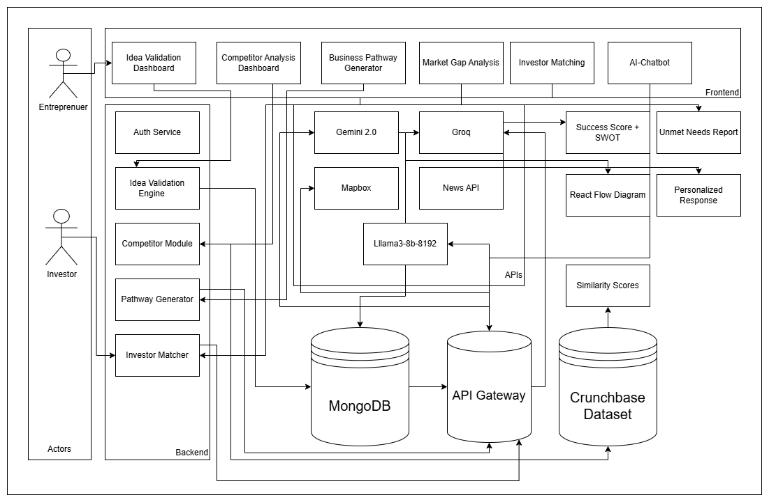
System architecture as shown in Fig. 1. is organized in a modularandscalablemannerinvolvingacombinationofAI and data processing units. In the front end, there is a GUI createdwithReact.jsthroughwhicheasyaccessisprovided toeveryfeature,whereasthebackendmakesuseofPythonbasedmicroservicesforprocessingandanalysispurposes. Idea Validation and Competitor Analysis modules incorporate NLP and similarity functions for comparing startupinputsagainstaprofessionallycurateddatabase of industrystandardsandcompetitorprofiles.FortheBusiness Pathway and Market Gap Analysis, generative AI models (Gemini 2.0 Flash) produce structured strategies from unstructured input, aided by an industry trends and
historicalstartupknowledgegraph.TheInvestorMatching systemisbasedonarecommendationenginecross-checking startup profile with investor databases using geospatial mappingvisualization.
Table -1: Evaluationmetrics
(KNN, NaïveBayesand Logistic Regression)
The AI-powered Startup Validator has consistent performance in all modules. The ensemble model (KNN, Naïve Bayes, and Logistic Regression) has 93% balanced accuracyinbothsuccessandfailurepredictionfortheIdea ValidationDashboard,with92-93%precisionand92%recall, showing correct identification of promising startups with minimal false positives as shown in Table 1. In Investor Matching, the same model has 92% recall in top-5 recommendations,correctlymatchingstartupswithsuitable investors. In parallel, the AI chatbot also boosts customer care through the integration of LLM logic with retrievalaugmentedgeneration(RAG)togivespreciseanswersand customer satisfaction by context-sensitive and evidencebased responses. Collectively, these results support the capability of the system in entrepreneurial risk reduction throughinformation-knowledgebasedwithRAGarchitecture forensuringaccuracyaswellasendorsementofpre-existing factsinitsresponses.Subsequentimplementationscanadd specializedtrainingbyindustryandextendtheRAGbodyof knowledge even more specifically tailored to specialist markets.
International Research Journal of Engineering and Technology (IRJET) e-ISSN: 2395-0056
Volume: 13 Issue: 03 | Mar 2026 www.irjet.net p-ISSN: 2395-0072
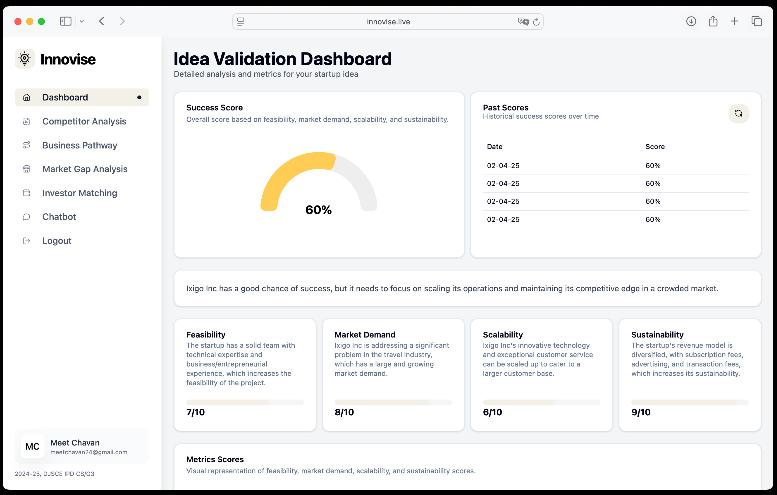
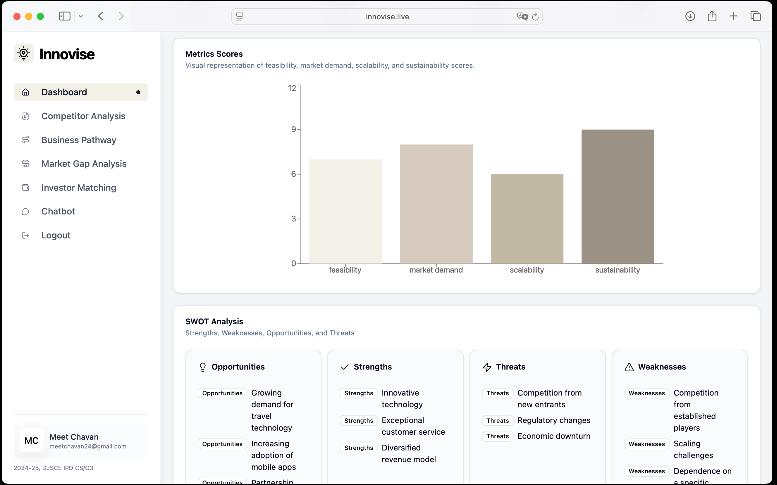
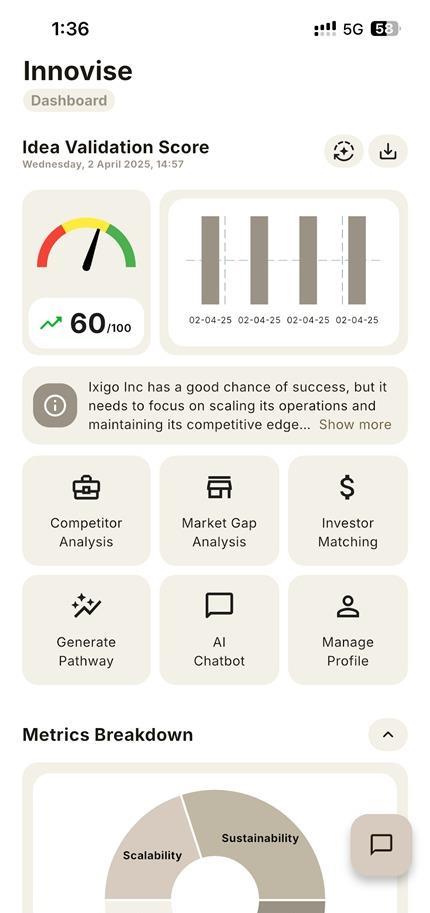
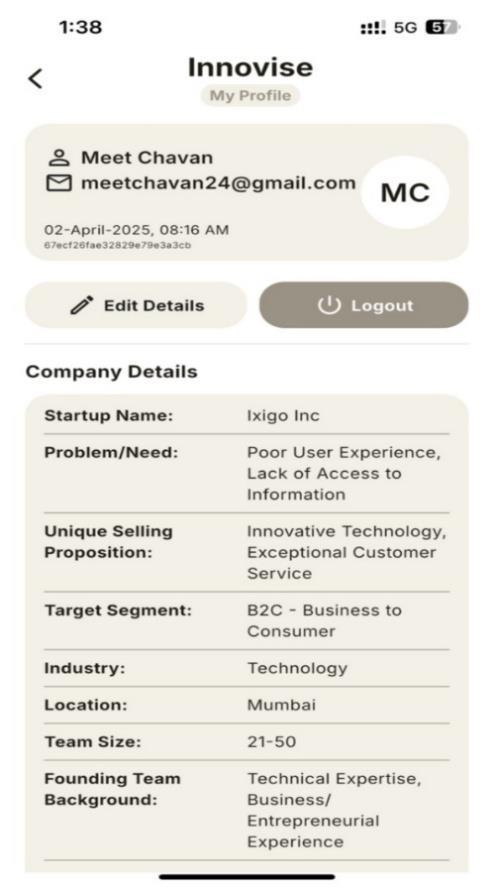
The Idea Validator Dashboard in Innovise provides a comprehensiveanalysisofastartup'spotentialthroughboth webandmobileappinterfaces.AsshowninFigures2and3 (web)andFigures4and5(app),itdisplaysadynamicidea validationscoreandvisualmetrics
The AI Startup Validator has a great potential for further improvements to be scaled up in terms of capability and impact in the future. Maybe one of the areas to improve furtherisapplyingtime-seriesforecastpredictiveanalytics methodstoassistinlookingintoupcomingindustrytrends and providing forward-looking advice to startups. The systemwouldbeenhancedifitincorporatedtheaspectof support for multiple languages along with region-based market-specificintegrationstointeractwithdifferentglobal entrepreneurial ecosystems. Expanding the dataset with real-time businessperformancedata fromAPIintegration with websites like Crunchbase or PitchBook would significantlyraisethecredibilityofvalidationtests.Afurther beneficialextensionwouldbedevelopingmentormatching functionality that matches founders with experienced advisorsbasedonindustryexpertiseandstartupstage.The platformcouldincorporatemoresophisticatedcollaboration features, including allowing teams to interactively collaborateontheirbusinessplanningandvalidationreports via the platform. Further, integrating explainable AI (XAI)
Volume: 13 Issue: 03 | Mar 2026 www.irjet.net p-ISSN: 2395-0072
functionality would also bring more transparency to the validationprocessbyclearlypresentinghowthescoresand recommendationsarebeingcreated.Theseadditionswould make the platform an even more comprehensive, worldwideinnovationhubthatsupportsentrepreneurseverystep alongtheirjourneywhilemaintainingthehighestlevelsof dataintegrityandanalyticaldiscipline.
Although the AI-driven Startup Validator is useful for entrepreneurs,itdoeshavesomelimitationsthatneedtobe recognized. One of the major limitations is the use of proprietaryandthird-partydata,sincecompletestartupand investor data is not always publicly or freely accessible, whichcanrestrictthescopeofanalysisincertainindustry sectors.Geographicreachmightbebiased,sinceparticular regional startup networks may not have the same prominence in the training set. Currently, the system has limitations with respect to dealing with unstructured sources such as video pitches or social media opinion, preventing it from accepting various validation signals as alternatives. The investor matching algorithm cannot necessarily keep pace with latest changes in investment thesisbyventurefirms,asthesetendtohappenquickerthan datasetrefreshescancapturethesystemdeliversuniform assessments, it cannot always substitute the fine-grained viewpoint of industry-specialist domain experts when evaluating highly technical or specialized ventures. These constraintsarisefromintrinsictechnicaltrade-offsbetween scalabilityandaccuracyincomputerizedvalidationsystems.
TheStartupValidatorprojectwithAIsuccessfullycreatedan end-to-end entrepreneurial decision support system by detailed research and implementation. The project built a responsivewebapplicationwithNext.js,aswellasPython microservices, and also a cross-platform mobile app developed with Flutter to make it accessible on various devices.Thecoreinnovationofthesystemisitssixcoupled modulesdrivenbyensemblemachinelearningmodelsand retrieval-augmented generation, underpinned by a strong dual-datasetbasisintegratingproprietarystartupdatawith full investor data. The initiative provides important contributionsbothtoacademicscholarshipandreal-world applicationsinstartupassessment,showcasinghowartificial intelligence can revolutionize entrepreneurial decisionmaking. Though the existing implementation delivers significant value through capabilities such as dynamic investor matching and generative business planning features, it also recognizes significant areas for future improvement, most notably in sector-specific implementationsandreal-timedataconsolidation.Thestudy setsanewstandardforstartupvalidationtoolsthatareable toclosethegapbetweendata-drivenanalyticsandhuman
insight, providing entrepreneurs globally with a powerful platformtoevaluateandimprovetheirbusinessideas.The creationofwebandmobileapplicationsguaranteesthatthis innovative tool has the possibility of reaching maximum potential across a variety of usage contexts, ranging from thorough desktop analysis to mobile consultations on the move.Thisprojectnotonlyprovidesinstantutilitarianvalue but also sets significant foundations for potential future innovationinAI-drivenentrepreneurialsupporttools.
[1] https://asana.com/resources/competitive-analysisexample
[2] Maarouf,A.,Feuerriegel,S.,andPröllochs,N.(2025).A fused large language model for predicting startup success. European Journal of Operational Research, 322(1),198-214.
[3] Potanin,M.,Chertok,A.,Zorin,K.,andShtabtsovsky,C. (2023). Startup success prediction and VC portfolio simulation using CrunchBase data. arXiv preprint arXiv:2309.15552.
[4] Yin,D.,Li,J.,andWu,G.(2021).Solvingthedatasparsity probleminpredictingthesuccessofthestartupswith machine learning methods. arXiv preprint arXiv:2112.07985.
[5] Dellermann,D.,Lipusch,N.,Ebel,P.,andLeimeister,J.M. (2019). Design principles for a hybrid intelligence decisionsupportsystemforbusinessmodelvalidation. Electronicmarkets,29,423-441.
[6] Ross,G.,Das,S.,Sciro,D.,andRaza,H.(2021).CapitalVX: Amachinelearningmodelforstartupselectionandexit prediction.TheJournalofFinanceandDataScience,7, 94-114.
[7] Park,J.,Choi,S.,andFeng,Y.(2024).Predictingstartup successusingtwobias-freemachinelearning:resolving dataimbalanceusinggenerativeadversarialnetworks. JournalofBigData,11(1),122.
[8] Siddik, A. B., Li, Y., and Du, A. M. (2024). Unlocking fundingsuccessforgenerativeAIstartups:Thecrucial roleofinvestorinfluence.FinanceResearchLetters,69, 106203.
[9] Giuggioli,G.,Pellegrini,M.M.,andGiannone,G.(2024). Artificialintelligenceasanenablerforentrepreneurial finance: a practical guide to AI-driven video pitch
International Research Journal of Engineering and Technology (IRJET) e-ISSN: 2395-0056
Volume: 13 Issue: 03 | Mar 2026 www.irjet.net p-ISSN: 2395-0072
evaluation for entrepreneurs and investors. ManagementDecision.
[10] Cholil,S.R.,Gernowo,R.,Widodo,C.E.,Wibowo,A., Warsito,B.,andHirzan,A.M.(2024).Predictingstartup successusingtree-basedmachinelearningalgorithms. RevistadeInformáticaTeóricaeAplicada,31(1),50-59.
[11] Samudra,V.C.,andSatya,D.P.(2024,September). Application of Startup Success Prediction Models and Business Document Extraction Using Large Language Models to Enhance Due Diligence Efficiency. In 2024 11thInternationalConferenceonAdvancedInformatics: Concept, Theory and Application (ICAICTA) (pp. 1-6). IEEE.
[12] Bhattacharya, D. (2024, January). Utilizing Base MachineLearningModelstoDetermineKeyFactorsof SuccessonanIndianTechStartup.
[13] Kalbande,S.,andKarmore,R.(2024,May).Startup SuccessPredictionUsingMachineLearning.InDoctoral Symposium on Computational Intelligence (pp. 309319).Singapore:SpringerNatureSingapore.
[14] Hu, J., Li, X., Xu, Y., Wu, S., and Zheng, B. (2020). Evaluation of company investment value based on machinelearning.arXivpreprintarXiv:2010.01996.
[15] Sharchilev,B.,Roizner,M.,Rumyantsev,A.,Ozornin, D.,Serdyukov,P.,anddeRijke,M.(2018,October).Webbasedstartupsuccessprediction.InProceedingsofthe 27thACMinternationalconferenceoninformationand knowledgemanagement(pp.2283-2291).
[16] Razaghzadeh Bidgoli, M., Raeesi Vanani, I., and Goodarzi,M.(2024).Predictingthesuccessofstartups using a machine learning approach. Journal of InnovationandEntrepreneurship,13(1),80.