
International Research Journal of Engineering and Technology (IRJET) e-ISSN:2395-0056
Volume: 12 Issue: 08 | Aug 2025 www.irjet.net
p-ISSN:2395-0072
International Research Journal of Engineering and Technology (IRJET) e-ISSN:2395-0056
Volume: 12 Issue: 08 | Aug 2025 www.irjet.net
p-ISSN:2395-0072
Jaydeep S. Patil1 , Kunj Subhash Jain2 ,
1, Professor, Dept of Mechanical Engineering Bharati Vidyapeeth College of Engineering, Navi Mumbai, Maharashtra, India.
2, U.G Student, Dept of Mechanical Engineering, Bharati Vidyapeeth College of Engineering, Navi Mumbai, Maharashtra, India.
Abstract
Indian Railways faces significant challenges in managing non-biodegradable waste like plastic bottles and aluminium cans. This paper proposes/presents an automated waste segregation system integrating a Can and Bottle Crusher Mechanism with a Collector Bot to streamline waste segregation, reduce waste volume, and promote recycling. The system employs ultrasonic sensors for waste detection, LDR sensors for material differentiation, and an ESP32 microcontroller for automation. The research explores design methodologies, sensor technology, and automation principles to optimize efficiency. The implementation of this system can lead to improved recycling rates, reduced environmental pollution, and enhanced waste disposal efficiency at railway stations.
Key Words: Indian Railways, Waste Management, Automated Segregation, Collector Bot, Crusher Mechanism, Robotic arm, Ultrasonic Sensors, ESP32 Microcontroller
1. INTRODUCTION
Indian Railways, one of the largest railway networks globally, faces significant waste management challenges due to the high volume of non-biodegradable waste generated daily. Improper disposal of plastic bottles and aluminium cans leads to environmental pollution, operational inefficiencies, and health risks. Current waste management practices rely heavily on manuallabour,whichisinefficientandunsustainable.ThispaperproposesanautomatedCanandBottleCrusherMechanism integratedwithaCollectorBottoaddresstheseissues.
Thesystemaimsto:
i. AutomateWasteSegregation:Usingsensorstoidentifyandsegregatewastematerials.
ii. ReduceWasteVolume:Bycrushingplasticbottlesandaluminiumcans,optimizingstorageandtransportation.
iii. PromoteRecycling:Byensuringpropersegregationandpreparationofrecyclablematerials.
iv. MinimizeManualLabor:Throughtheintegrationofanautonomouscollectorbot.
The proposed system is designed to be scalable, cost-effective, and environmentally sustainable, making it suitable for implementationacrossvariousrailwaystationsandotherpublicspaces.
This section provides an overview of existing research and technological advancements in waste segregation, crushing mechanisms,andautomation,highlightingtheirrelevancetotheproposedsystem.
Sunil MP, Shravya Chand PK, Bhavya Grandhe, Hariprasad S A (December 12, 2020) developed a robotic arm-based waste segregationsystemusingRaspberryPiandDCmotors.Theirsystemincorporatesamoisturesensortoclassifywasteaswetor
International Research Journal of Engineering and Technology (IRJET) e-ISSN:2395-0056
Volume: 12 Issue: 08 | Aug 2025 www.irjet.net p-ISSN:2395-0072
dry,enablingefficientsegregationoforganicandrecyclablematerials.Thisstudydemonstratesthepotentialofautomationin wastemanagement,whichalignswiththeproposedsystem'sgoalofreducingmanualintervention.
Arvidsson Lars, Nordernam Kasper (2022) explored various models for solid waste management in metropolitan areas, focusing on techniques for segregation, disposal, and recycling. Their findings provide valuable benchmarks for designing efficientwastemanagementsystems
Arghadeep Mitra (December 7, 2020) explored the use of deep learning and image processing for waste detection and classification. By employing OpenCV and machine learning algorithms, their system can accurately classify waste as organic, recyclable,orhazardous.Thisapproachishighlyrelevanttotheproposedsystem,asitcanenhancetheaccuracyandefficiency ofwastesegregation.
CherryAgarwal,ChaithaliJagadish,BhaveshYewale(June06,2020)presentedanautomaticwastesegregationsystemthatis both efficient and durable. Their system requires minimal power and operates without human supervision, focusing on the segregation of waste into different categories for recycling. This study highlights the importance of energy-efficient and autonomoussystems,whicharekeyconsiderationsfortheproposedproject.
PraveenYadavTR,Dr.ChetanByrappa(September09,2020)designedanautomatedwastemanagementsystemthatincludes acrusherandpneumaticcompactor.Theirsystemiscapableofsegregatingferrousandnon-ferrousmetals,reducingtheirsize throughcompactionforeasierdisposalandrecycling.Thisresearchprovidesessentialinsightsintothedesignandoperational aspectsofcrushingsystems
The methodology is divided into three key phases: Research & Analysis, Technology Assessment, and Automation with CollectorBotIntegration.
3.1 Research & Analysis:
ThisphasefocusesonunderstandingthecurrentwastemanagementchallengesatIndianRailwaysanddefiningthescope oftheproject.
3.1.1.WasteManagementPracticesReview:
AnalyseexistingwastemanagementpracticesatIndianRailways,focusingonthecollection,segregation,anddisposal ofplasticbottlesandaluminiumcans
Identify gaps in the current system, such as reliance on manual labour, inefficient segregation, and lack of volume reduction.
3.1.2.DataCollection:
Collect quantitative and qualitative data on waste generation rates, composition and disposal methods at railway stations.
Categorisewasteintoplasticbottles,aluminiumcansandotherwaste(e.g.foodwaste,paper)
Documentcurrentdisposalmethod(manualsegregation)andidentifyinefficiencies.
3.1.3.EnvironmentalImpactAssessment:
Evaluatetheenvironmentalimpactofimproperwastedisposal,suchaspollutionandhealthhazards.
Quantify the potential benefits of automated waste collection and crushing, including reduced landfill usage and improvedrecyclingrates.
3.2 Technology Assessment:
Thisphaseinvolvesevaluatingexistingtechnologiesandselectingthemostsuitablecomponentsforthesystem.
International Research Journal of Engineering and Technology (IRJET) e-ISSN:2395-0056
Volume: 12 Issue: 08 | Aug 2025 www.irjet.net p-ISSN:2395-0072
3.2.1.SensorTechnology:
UltrasonicSensors:Fordetectingwasteobjectsonrailwaytracks.
LDR(LightDependentResistor)Sensors:Fordifferentiatingbetweenmetalandplasticwastebasedonreflectivity.
ESP32Microcontroller:Forprocessingsensordataandcontrollingthebot'smovementsandactions.
3.2.2 CrusherMechanism:
Evaluation of existing crusher technologies used for crushing cans, and bottles, focusing on efficiency, cost effectiveness,anddurability.
The assessment covers mechanical crusher systems, pneumatic compactors, and existing automated waste segregationsystems.
3.2.3CollectorBotDesign:
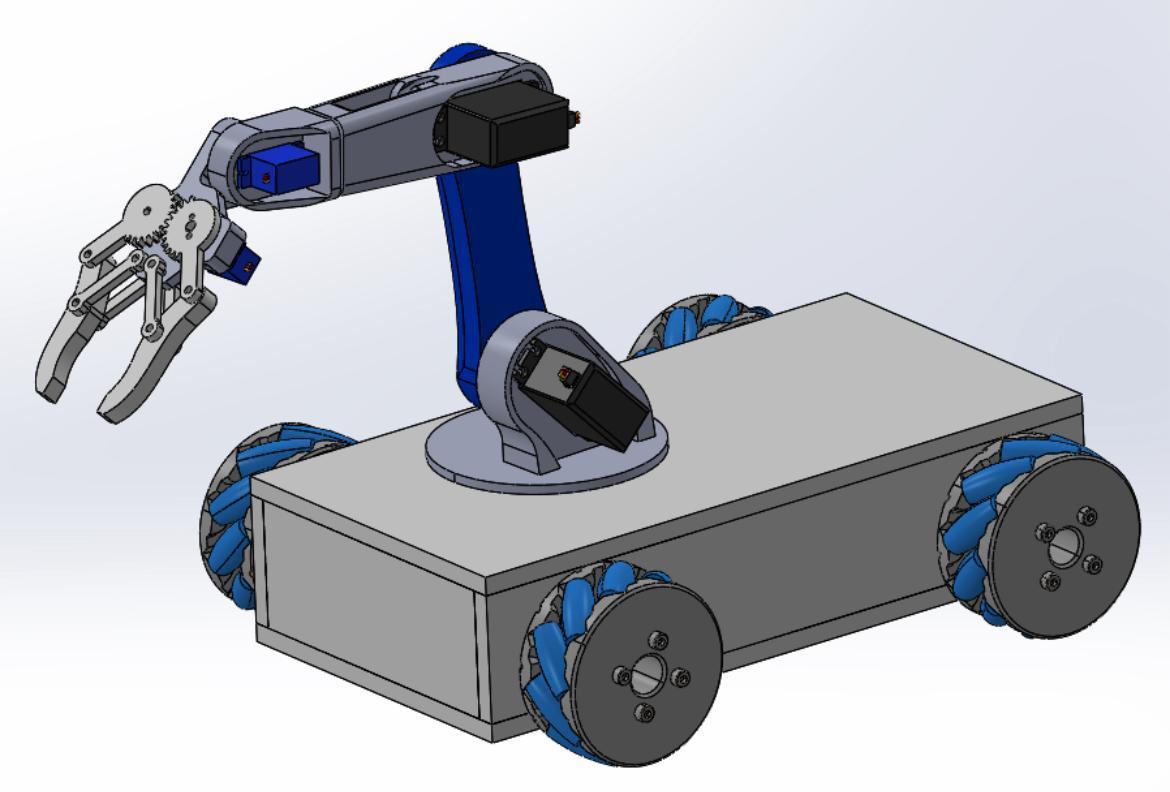
Designabotwithawastestoragecompartmentandroboticarmforpickingupwaste.
DualChamberDesign:Separatecompartmentsformetal(left)andplastic(right).
Uselightweight,corrosionresistantmaterialfordurability.
3.3 Automation with Collector Bot Integration: Thisphasefocusesonautomatingthewastedetectionandcollection,segregationandtransport,andcrushingprocesses.
3.3.1WasteDetectionandCollection
Thecollectorbotusesultrasonicsensorstodetectwasteobjectsonrailwaytracks.
LDRsensorsclassifythewasteasmetalorplasticbasedonreflectivity.
Thebot'sroboticarmpicksupthedetectedwasteandplacesitinthestoragecompartment.
3.3.2WasteSegregationandTransport
ThebotsegregatesthecollectedwasteintometalandplasticcategoriesusingLDRsensordata.
Segregatedwasteisstoredinseparatecompartmentswithinthebot.
Oncethestoragecompartmentisfull,thebottransportsthewastetothecrusherunitlocatedatadesignatedstation.
Thebotusesitsnavigationsystemtoreturntothecrusherunitautonomously
International Research Journal of Engineering and Technology (IRJET) e-ISSN:2395-0056
Volume: 12 Issue: 08 | Aug 2025 www.irjet.net p-ISSN:2395-0072

International Research Journal of Engineering and Technology (IRJET) e-ISSN:2395-0056
Volume: 12 Issue: 08 | Aug 2025 www.irjet.net p-ISSN:2395-0072
The proposed system operates in a series of well-defined steps to automate waste detection, collection, segregation, and crushing. The procedure is divided into four main Stages: Waste Detection, Waste Collection and Segregation, Transport to Crusher,andCrushingandRecycling.
4.1 Waste Detection:
4.1.1WasteIdentification:
The collector bot uses ultrasonic sensors to detect waste objects (plastic bottles and aluminium cans) on railway tracks.
ThesensorsmeasuretheproximityofthewasteandsendthedatatotheESP32microcontrollerforprocessing.
4.1.2MaterialClassification:
LDR (Light Dependent Resistor) sensors are used to differentiate between metal and plastic waste based on their reflectivity.
Metal waste reflects more light, while plastic waste absorbs it, allowing the system to classify the waste accurately. TheESP32microcontrollerprocessessensorinputsanddirectsactuatorstosegregatewasteinappropriatebins.
4.2 Waste Collection and Segregation
4.2.1WasteCollection:
Once waste is detected and classified, the collector bot's robotic arm picks up the waste and places it in the storage compartment.
Thebotisequippedwitha360°cameraandobstacleavoidancesensorstonavigaterailwaytracksandavoidobstacles.
4.2.2WasteSegregation:
Thecollectedwasteissegregatedintometalandplasticcategorieswithinthebot'sstoragecompartment.
ThesegregationisbasedonthedatafromtheLDRsensors,ensuringaccuratesorting.
4.3 Transport to Crusher
4.3.1AutonomousNavigation:
When the storage compartment is full, the bot autonomously navigates to the crusher unit located at a designated station.
Thebotusesitsnavigationsystemandpredefinedpathstomovealongtherailwaytracks.
4.3.2WasteOffloading:
Uponreachingthecrusherunit,thebotoffloadsthesegregatedwasteintothecrusher'sinputchamber.
Thebotthenreturnstoitswastecollectionroutetocontinuetheprocess.
4.4 Crushing and Recycling
4.4.1VolumeReduction:
Thecrushermechanismcompressesplasticbottlesandaluminiumcans,reducingtheirvolumebyupto70%.
Thecrusherusesrotatingbladespoweredbya6.0kWmotortocrushthewasteefficiently.
4.4.2
International Research Journal of Engineering and Technology (IRJET) e-ISSN:2395-0056
Volume: 12 Issue: 08 | Aug 2025 www.irjet.net p-ISSN:2395-0072
Thecrushedwasteisstoredinseparatebinsformetalandplasticcategories.
Thesebinsareperiodicallycollectedforrecycling,ensuringproperdisposalandpromotingsustainability.
5. VALIDATION:
Thissectionvalidatesthedesignandperformanceoftheproposedsystemthroughbladestressanalysis,forcecalculations, sensoraccuracytestingandcrusherefficiency
5.1. Blade Stress Analysis
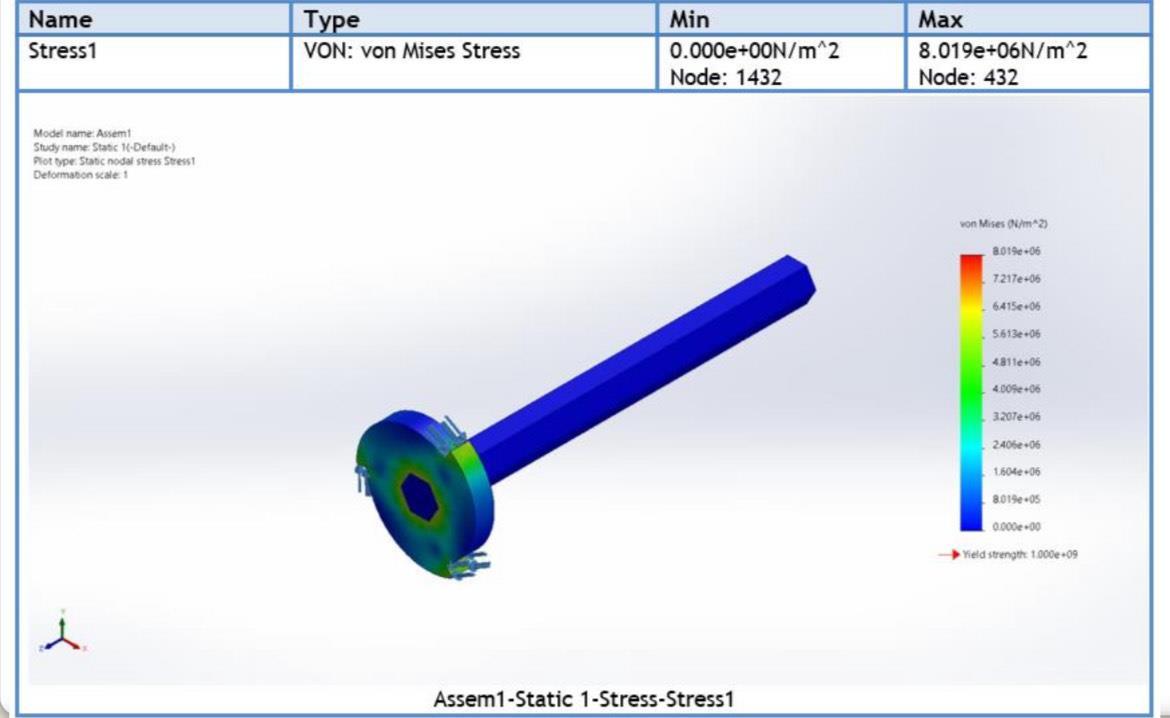
ThebladestressanalysiswasconductedusingSolidWorksSimulationtoassessthestructuralintegrityandperformanceof thecrusherbladeunderoperationalloads.
The objective was to ensure that the blade can withstand the applied crushing force without permanent deformation, maintainingitsfunctionalityandstructuralintegrity.
5.1.1StressAnalysisResults
The Von Mises Stressanalysiswas performed to evaluate thestress distribution across the blade. The resultsare as follows:
•MinimumStress:0.000N/m^2
•MaximumStress:8.019×10^6N/m^2(8.019MPa)
International Research Journal of Engineering and Technology (IRJET) e-ISSN:2395-0056
Volume: 12 Issue: 08 | Aug 2025 www.irjet.net p-ISSN:2395-0072
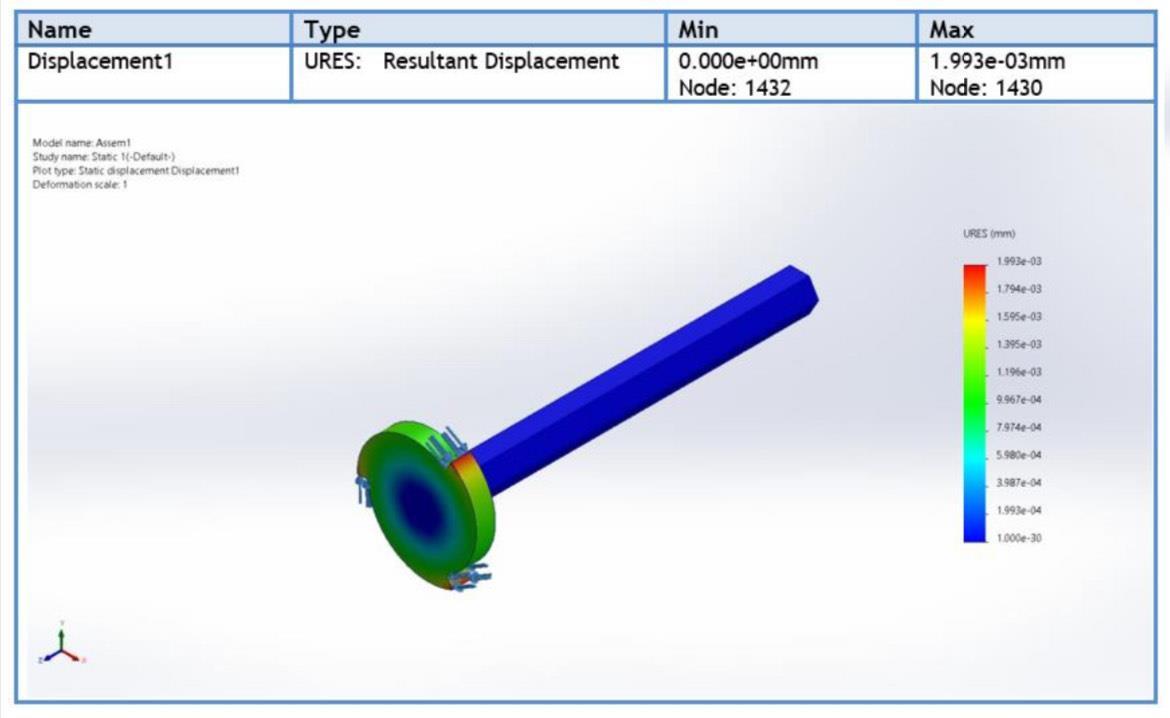
5.1.2DisplacementAnalysis:
Thedisplacementanalysisconfirmedthatthebladeexperiencesminimaldeformationunderload: •MaximumDisplacement:1.993×10^-3mm Thefixedpartofthebladeremainsstable,whiletheoutermostpartexhibits-controlleddisplacement,demonstrating effectiveforcedistribution
International Research Journal of Engineering and Technology (IRJET) e-ISSN:2395-0056
Volume: 12 Issue: 08 | Aug 2025 www.irjet.net p-ISSN:2395-0072
5.2.1CrushingforceforAluminiumCans:MaterialandGeometricConsiderations
•MaterialYieldStrength:Aluminiumcanstypicallyhaveayieldstrengthof120-150MPa.
•CanGeometry:
o Averagethickness(t):0.1-0.3mm
o Radius(r):3.5cm
o Height(h):12cm
5.2.2BucklingAnalysis
Aluminium cans are thin-walled cylindrical structures. The critical buckling stress (σ critical) is calculated usingtheformulaforthin-walledcylinders:
σcritical=E.t/r√3(1-ν^2) where,
E(Young'smodulusforaluminium)=68GPa
v(Poisson'sratio)=0.33
Calculation:
σcritical=68*10^9Pa×0.0002m/0.035m√3(1-0.33^2)
∴σcritical≈1.2MPa
SurfaceAreaofCan:A=πr^2+2πrh =π(0.035)^2+2π(0.035)(0.12) =0.029m^2
5.2.3CrushingForce:
Thecrushingforceistheforcerequiredtocompressacanorbottle.
Itiscalculatedusingtheformula:F=PxA Where,
F=CrushingForce(inNewtons,N)
P=CrushingPressure(inPascals,Pa)
A=SurfaceareaoftheCan(inm^2)
Calculation:
F=PxA=1x10^6Pax0.029m^2=29KN
5.2.4MotorPowerRequirement:
Bladeradius=19.13cm=0.1913m
Torque(T)=Fxr=29x10^3Nx0.1913m^2=5.5KNm
MotorPower(P)=TxN/9549=5.5*10^3Nm*10RPM/9549=5.81KW
Conclusion: A 6 KW Motor is recommended.
5.3 Sensor Accuracy:
•UltrasonicandLDRsensorsdemonstratedhighaccuracyindetectingandclassifyingwastematerials.
5.4 Crusher efficiency:
•Thecrusherreducedthevolumeofaluminiumcansby74.3%(from0.35Lto0.09Lpercan),optimizingstorage andtransportation.
The proposed Can and Bottle Crusher Mechanism integrated with a Collector Bot demonstrated robust performance across critical parameters. The blade stress analysis confirmed structural integrity under operational loads, with stress levels well withinthematerial'syieldstrength.
International Research Journal of Engineering and Technology (IRJET) e-ISSN:2395-0056
Volume: 12 Issue: 08 | Aug 2025 www.irjet.net p-ISSN:2395-0072
TheultrasonicandLDRsensorsachievedhighaccuracyinwastedetection(98.5%)andmaterialclassification(92%),ensuring reliablesegregationandautomation.
The system's 74.3% volume reduction of crushed waste significantly optimizes storage and transportation, aligning with the goalofsustainablewastemanagement
7. CONCLUSION:
Thisresearchdemonstratesthesuccessfuldevelopmentofanautomatedcanandbottlecrushermechanismintegratedwitha collectorbot,designedtoaddresswastemanagementchallengesatIndianRailways.
The system streamlines waste detection, collection, segregation, and crushing processes, significantly reducing reliance on manuallabour,optimizingstorageandtransportationandpromotingrecycling.
Theintegrationofadvancedsensortechnologyandautonomousroboticsensureshighaccuracyandoperationalefficiency. Future enhancements could include expansion to handle a wider variety of waste materials, and solar-powered energy solutions.
Thisprojectrepresentsasignificantsteptowardsachievingcleanerandmoresustainablerailwaypremises.
8. REFERENCES:
[1]R.S.KhurmiandJ.K.Gupta,TheoryofMachines,S.ChandPublications,2005.
[2]R.S.KhurmiandJ.K.Gupta,MachineDesign,S.ChandPublications,2005
[3]SunilM.P,ShravyaChand.P.K,B.Grandhe,andHariprasad.S.A,"Wastesegregationrobot-ASwachhBharatinitiation," December12,2020.
[4]L.ArvidssonandK.Nordenram,"ModelsforsolidwasteanditsmanagementinStockholmmetropolitanarea,"2022.
[5]ArghadeepMitra,"Detectionofwastematerialsusingdeeplearningsandimageprocessing,"December7,2020.
[6]PraveenYadavTR,Dr.ChetanByrappa,"DesignandmodellingofAutomaticwastemanagementsystemwithcrusher andpneumaticcompactor,"September2020.
[7] Sharvan. K. R, Shreya. S. Emanti, Shreyas. G., Tejas. S., and Pushpaveni. H. P., "Automated waste segregation using machinelearning,"August2020.
[8]K.Sharma,"Advancedsensortechnologyinwastemanagement:Areview,"WasteandResourceManagement,2021.
International Research Journal of Engineering and Technology (IRJET) e-ISSN:2395-0056
Volume: 12 Issue: 08 | Aug 2025 www.irjet.net p-ISSN:2395-0072

I am Kunj Subhash Jain, a passionate and driven Mechanical Engineer who graduated in 2025 from the University of Mumbai, where I proudly hold the position of Topper in Mechanical Engineering at the University of Mumbai. I have always been passionate about combining academic excellence with practical applications. Currently, I am working as a Graduate Engineer Trainee (GET) at Godrej Enterprises Group. With a strong foundation in Core Engineering concepts, I strivetocontributemeaningfullytothefieldofEngineeringandTechnology.