
International Research Journal of Engineering and Technology (IRJET) e-ISSN: 2395-0056
Volume: 12 Issue: 10 | Oct 2025 www.irjet.net p-ISSN: 2395-0072
International Research Journal of Engineering and Technology (IRJET) e-ISSN: 2395-0056
Volume: 12 Issue: 10 | Oct 2025 www.irjet.net p-ISSN: 2395-0072
Vamshi
Krishna Reddy Guttapadu1 , Sai Niyathi Padakanti2, Vaishnavi Mancherla3, Mrs. Ch. Indira
Priyadarsini4
1Graduate Student, Information System and Technology, University of North Texas, Denton, TX
2Graduate Student, Business Analytics, Northeastern University, Boston, MA
3Graduate Student, Industrial Engineering, Northeastern University, Boston, MA
4Assistant Professor, Dept. Of Mechanical Engineering, Chaitanya Bharathi Institute of Technology, Telangana, India
Abstract - This study examines the influence of product strategies and supply chain structure on inventory management within manufacturing industries. As global competition intensifies and customer demands become increasingly dynamic, effective inventory management has emerged as a critical factor for operational efficiency and profitability. The research explores how product design, lifecycle, and customization strategies interact with supply chain configurations - such as centralization, integration, and flexibility to affect inventory levels, turnover rates, and responsiveness. Using a combination of literature review, case studies, and empirical analysis, the study identifies key relationships and offers strategic insights for optimizing inventory performance. The findings highlight the importance of aligning product strategy with supply chain design to enhance responsiveness, reduce holding costs, and improve overallsupplychain agility.
In today's global landscape, Supply Chain Management (SCM) focuses not only on customer satisfaction but also on long-term strategic perspectives. Initially, SCM was primarily evaluated based on efficiency; however, over time, the benchmark has evolved to encompass both efficiency and effectiveness. While efficiency in SCM is closely linked to inventory management techniques, effectiveness is driven by a broader range of factors, particularly supply chain structure and product strategies. These components play a crucial role in enhancing the overall performance and adaptability of the supply chain. Customer satisfaction is closely tied to responsetime,whichplaysacriticalroleindetermininga business's success or failure in the marketplace. In today’scompetitiveenvironment,time-basedcompetition centersonfulfillingcustomerdemandswithminimallead times.Achievingthisrequiresawell-synchronizedsupply chain capable of adapting to demand fluctuations. Responsiveness refers to a supply chain's ability to handle unpredictable demand in terms of both volume andproductvariety.Asindustrialenvironmentscontinue
toevolve,responsivenesshasbecomecentral to boththe survivalandcompetitiveadvantageofcompanies.
A key objective of supply chain management is to efficiently manage the flow of inventory, materials, and services from raw materials to the final consumer. Strategies such as outsourcing and mass customization are increasingly used to accelerate response times in alignment with customer expectations. As a result, many industries are expanding their product lines to offer greater variety and ensure global distribution, aiming to meetdiversecustomerneedsmoreeffectively.
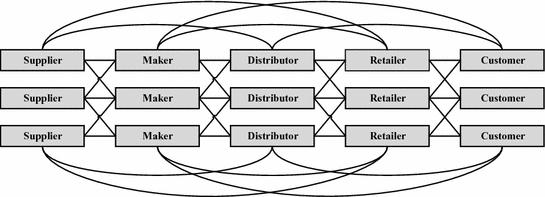
A typical supply chain comprises multiple stages, including customers, retailers, wholesalers/distributors, manufacturers,andcomponentorrawmaterialsuppliers. These stages are interconnected through the continuous flowofproducts,information,andfunds.Thedesignofan effective supply chain must align with customer needs andthespecificrolesofeachstage.
The long-term sustainability of any business increasingly depends on the efficiency of its supply chain. In the currentcompetitiveenvironment,Indiancompaniesmust prioritize strong coordination between suppliers and customers. This coordination enhances inventory managementandoverallsupplychainperformance.
Controlling costs, responding to market demand, and maintainingprofitabilityareallcriticalchallenges.Supply Chain Management (SCM) serves as a vital tool to
International Research Journal of Engineering and Technology (IRJET) e-ISSN: 2395-0056
Volume: 12 Issue: 10 | Oct 2025 www.irjet.net p-ISSN: 2395-0072
effectively balance demand and supply. As a result, companies are investing significant resources in SCM initiatives. Global competition further intensifies the pressuretoreducematerialandproductioncostswithout compromising quality.Atthesametime, inventorylevels mustbeoptimizedtoensureavailabilitywithoutexcess. Ultimately, the success of any supply chain hinges on seamless collaboration among its various stages and stakeholders, all working together to meet customer demandefficiently.
Globalization has significantly impacted manufacturing organizations. As markets expand and competition intensifies, customers are placing greater demands on quality, service, and flexibility, compelling companies to continuously adapt and improve their operations. In today’s global business environment, most supplychainsinvolvemultipleparticipants,includingraw material suppliers, manufacturers, distributors, wholesalers, retailers, and end consumers. Advances in information and communication technology have eliminatedtheneedforthesesupplychainmemberstobe geographically close, enabling seamless coordination and integrationacrossvastdistances.
The supply chain in India faces challenges on both the demand and supply sides. On the demand side, issues are primarily related to price sensitivity and productvariety.India’svastdiversityinculture,language, and consumer preferences even across short distances makesitdifficultfora singlemanufactureror group of manufacturers to meet the needs of all end consumers. To address this, manufacturers must collaborate closely with local agents, distributors, and retailers who have a deeper understanding of regional markets.
Additionally, a significant portion of India’s population resides at the bottom of the economic pyramid, creating further pressure to deliver affordable and accessible products. As a result, Indian manufacturers must adopt innovative and adaptable supply chain strategies to effectively serve diverse and economically varied consumersegments.
The objective of the research is to develop the relationships between strategy, structure and performance by utilizing the supply chain variables similar to product strategies, supply chain structure and supply chain inventory. This can be carried out by identifying the relationship between product strategies and supply chain structure, examine the relationship between supply chain structure and supply chain inventory, ascertain the relationship between product
strategies and supply chain inventory, evaluating the inter-relationshipamongproductstrategies,supplychain structure, and supply chain inventory on manufacturing industries.
YingGuo et.al. [1], presented a comprehensive literature review on inventory management strategies for enhancing supply chain resilience, such as stockpiling, multi-sourcing, capacity reservation, and flexible supply contracts. Muhammad Turki et.al. [2], discussed several ways that just-in-case inventory management can support expansion and profitability. They explained about "just-in-case" and pull-based strategies offer distinct advantages for the evolving field of supply chain management. In particular, the pull strategy emphasizes inventory management based on actual customer demand, making it especially effective for handling the unique requirements of customized or made-to-order products. Maheswaran et.al. [3], explored the key factors influencing the cost of inventory management in the automotive industry. This to clarify what can be called effective inventory management in this sector. Through this literature study, it emerged that effective inventory managementintheautomotiveindustryshouldtakeinto consideration three big aspects. Cost control tools were identified and the dependencies between these tools were discussed. V.H.Remko [4] talked on inventory during pandemic. As the world grows increasingly interconnected, global disruptions such as the Coronavirus (COVID-19) significantly and lastingly impact supply chain logistics, suppliers, and workforce. M.Christopheret.al.[5], explained supplychain resilience refers to the capability of a supply chain to recover from disruptions by either returning to its original state or adapting to a new, more favorable state. It encompasses the supply chain’s ability to anticipate, respond to, and recover from risks that lead to imbalances between supply and demand. A supply chain is considered more resilient when the likelihood of such mismatches is reduced, the recovery time is minimized, or the postrecovery performanceisimproved. Samuel Holloway [6], explored the critical role of supply chain management (SCM) in shaping marketing strategies in emerging markets, where rapid economic growth and dynamic consumer behavior present both challenges and opportunities.Hisfindingsrevealthatflexibilityinsupply chain operations is indispensable for adapting to the volatilemarketconditionstypicalofemergingeconomies, enabling companies to respond swiftly to changes in consumerdemandandmarkettrends.IreneOmariMbugi et.al.[7], his study was about the effect of inventory control management systems on organization performance in Tanzania manufacturing industry: a case study of food and beverage manufacturing company in
Volume: 12 Issue: 10 | Oct 2025 www.irjet.net
MwanzaCity.Thespecificobjectivesofthestudywereto: determine the types and purposes of inventory control managementpracticesfollowedascertaintheinfluenceof inventory control management practices on organizational performance and determine how technology adopted in operationalization of inventory control management practices affect organization performance. Kenneth Boro [8], explored inventory management practices, with the specific objectives as: to determinetheeffectofActivityBasedCostingpracticeon warehouse efficiency of tea processing companies in Kenya; to assess the effect of Just In Time practice on warehouses efficiency of tea processing companies in Kenya; to establish effects of Bin Card practice on warehouseefficiencyofTeaprocessingcompaniesandto determine the effect of vendor managed inventory practice on warehouse efficiency in tea processing firms. Aquick respondingbusinessisconsideredto begrowing and successful business in the competitive market. Justin-case (JIC) supply chain management has gained popularity recently, especially in the wake of the coronavirus epidemic [9], More interestingly, business successanddevelopmenthasgreatchargeonitseffective supplychainmanagement[10].
Tamil Nadu was chosen as the geographic focus of this study. Data were collected from key manufacturing hubs withinthestaterepresentingthetextile,leather,andsteel industries,respectively.
3.1 The selection of Tamil Nadu is based on its significance as India’s fourth-largest state and its diverse and well-established manufacturing sector. The state is a major center for industries such as automobiles, leather goods, textiles, garments, engineering, pharmaceuticals, components, plastics, and chemicals, making it an ideal settingforthisresearch.Thisresearchisprimarilybased on primary data, supplemented to a lesser extent by secondary data. The secondary data include information on India’s Gross Domestic Product (GDP) for relevant periods, Tamil Nadu’s State GDP, disaggregated data on the number of manufacturing industries, and production indices for both Tamil Nadu and India. These data were sourced from Indiastat, the Central Statistical Organization (CSO), the National Sample Survey Organization (NSSO), the Ministry of Industries, the Department of Economics and Statistics (Government of Tamil Nadu), and publications and working papers from theCentreforMonitoringIndianEconomy(CMIE).
The data collected for the study through personal interview using structured questionnaire with different executive levels in Tamil Nadu’s manufacturing industries.
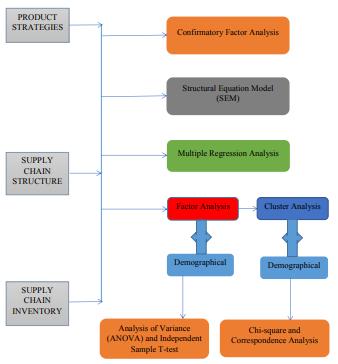
3.2 Impact of product strategies on supply chain
The nature and type of each enterprise, the number of employees, total capital investment, and annual turnover has been selected for analysis. Additionally, it covers the type of ownership, share listing status, the nature and process of manufacturing, and production patterns. The profilealsoincludesinformationonmarketcoverageand scope, business experience, software usage, and each unit’sroleandpositionwithinthesupplychain.
The well structure questionnaire was utilized to gather primary data, which was individually managed to the executives of Tamil Nadu’s Textile, Leather and Steel manufacturing companies. Method for Personal interviewing was applied in primary data collection. The questionnaire contains of both quantitative and qualitative characteristics related to the surveyed manufacturing units and their position related to the product strategies and supply chain structure and their expectedimpactonthemanufacturingcompanies’supply chaininventoryandperformance.
3.3ResearchDesign
The intention of this research is to analyse and portray thepresentfeaturesandsurroundingsofthesupplychain environment of the manufacturing industries. This research work also directs to investigative the causal analysis of the connection among strategy, structure and performance through utilizing the variables of supply chain like product strategies, supply chain structure and supply chain inventory. The suggested research is thereforedescriptiveinnature.
International Research Journal of Engineering and Technology (IRJET) e-ISSN: 2395-0056
Volume: 12 Issue: 10 | Oct 2025 www.irjet.net p-ISSN: 2395-0072
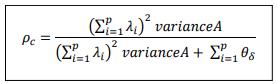
Convergent Validity: Convergent validity designates the scale to which constancy is undertaken by the measurement instrument through multiple operationalization. Only those variables with convergent validity must be involved in this research. Item with Average Variance extracted (AVE) of greater than 0.50 holdsconvergent validityandall othervariablesmust be removed.AVEiscalculatedwiththeformula.
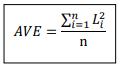
Discriminant Validity: Discriminant validity denotes the independence of the constructs utilized for this research. It designates the level to which the nine constructs examinedintheresearcharedifferentamongthemselves.
Constructs calculated must have discriminant validity if the variance explained (VE) value of any two constructs morethanthesquareof the correlation betweenthetwo constructs.
Reliability Test Reliability means the capability of a calculating instrument to provide exact and reliable outcomes. The problem of reliability arises only for the questions tested to assess insight which cannot be correctlycalculated.Inthis study,statementsareusedto evaluate supply chain management related variables of manufacturing enterprises. For every statements fivepointscaleisapplied.Beforethelaunchofcompletedata collection, a minor pilot study carries out to check necessary reliability of the constructs involved in the researchinstrument.Thisshallensurethattheconstructs involved in the questionnaire shall summarize the essentialdatarequiredforthestudy.Fromthepilotstudy results,thequestionnairewasfurthermodifiedtoensure that the questionnaire shall best serve the cause of capturingthedesiredinformationregardingsupplychain ofmanufacturingenterprises.Thisfinalquestionnairehas beenusedforthesamplesurvey.
Pilotstudy:
1.Productstrategies:0.5863
2.Supplychainstructure:0.8447
3.Supplychaininventory:0.6990
Sample Population
In this study, the unit of analysis is the product, as the research model and hypotheses are centred around
product-levelstrategiesandperformance.Althoughthere are various interpretations of product boundaries, this research defines a single product as a brand unit, recognizing that a brand represents the diversity and rangewithinaproductline.Thestudyspecificallytargets manufacturing industries with an emphasis on goods distribution. This focus reflects the expectation that manufacturing firms prioritize the distribution segment whendesigningtheirproduct-specificsupplychains.
The structure of the supply chain in manufacturing units was analyzed using several key variables. These include the persistence of the bullwhip effect, the absence of advanced information technology systems, a lack of trust among supply chain members, and limited capacity for inventory storage at various locations. These structural factors significantly influence the efficiency and responsivenessofsupplychaininventorymanagement.
15
Volume: 12 Issue: 10 | Oct 2025 www.irjet.net p-ISSN: 2395-0072
connections have been grouped under this factor, which is labelled “Interdependence of the Supply Chain Members.
Based on the above table, it can be concluded that manufacturingfirmsplacegreater emphasisonadjusting their supply chain structure in response to the bullwhip effect. This suggests that firms consider the bullwhip effect a key factor in configuring their supply chain. Conversely, maintaining continuous accuracy in demand forecastingappearstobealowerpriorityforthesefirms. It can be inferred from the above table that each of the fourfactorsiscomposedoffourvariables.Thefirstfactor is labelled “Number of Echelons,” the second as “InterdependenceofSupplyChainMembers,”thethirdas “Lead-Time of the Supply Chain,” and the fourth as “ResponsePointoftheSupplyChain.”
One of the most critical aspects in structuring a supply chain is determining the number of echelons. This refers to the number of distinct stages or levels within the supply chain, which can vary from enterprise to enterprise depending on whether they have a longer or shorter supply chain. The ability of a firm to manage its supply chain effectively particularly in mitigating the bullwhip effect and demand fluctuations depends largelyonthisfactor.Longersupplychainstendtocause information distortion and delays between members, negatively impacting overall efficiency. Therefore, the number of echelons plays a vital role in shaping the supplychainstructureofanyenterprise.Sinceallrelated statements pertain to this aspect, the factor is appropriatelylabelled“NumberofEchelons.
Manufacturers and distributors are key stakeholders in any business, with their relationship forming the foundation for the quantity of goods produced and distributed. The manufacturer often determines the volume to be distributed, making a strong, mutually dependent relationship essential. Business enterprises musthonortheircontractsbyensuringtimelydeliveryof therequiredproductquantitieswhileadheringstrictlyto quality standards. Interdependence among supply chain members is crucial, as no business can thrive without maintaining a good reputation within its supply chain network. Therefore, it is vital for manufacturing enterprises to foster strong, cooperative relationships with both manufacturersanddistributors.All statements concerning these interpersonal and professional
Ranking of Supply Chain Structure Factors By applying factor analysis, the sixteen variables are clustered into four factors of supply chain structure, labelled as “number of echelons”, “interdependence of the supply chain members”, “lead-time of the supply chain” and “responsepointofsupplychain”.Themeanvaluesoffour supplychainstructurefactorsareshowedinTable Supply Chain Structure
NumberofEchelons 3.30 I
Interdependenceofthe supplychainmembers 3.14 II
Lead-timeofthesupplychain 3.00 III
Responsepointofsupply chain 2.89 IV
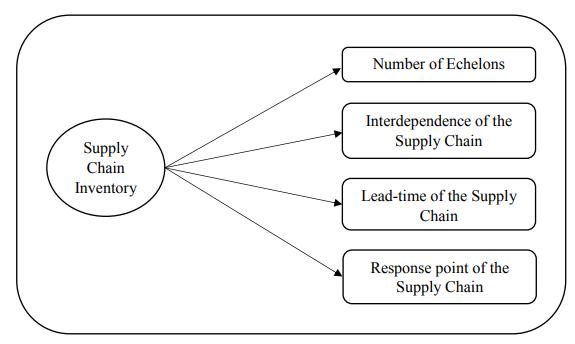
Fig –3: RegressionforSupplyChainInventorywith regardtoSupplyChainStructureFactors
5. ANALYSIS DISCUSSION
Table -1: LevelofIndustry
International Research Journal of Engineering and Technology (IRJET) e-ISSN: 2395-0056
Volume: 12 Issue: 10 | Oct 2025 www.irjet.net p-ISSN: 2395-0072
Most of the business units considered (45.1%) are operating in medium scale while above one-third of the units (36.9%) are operating in small scale and a shade underone-fifthoftheunits(18.0%)areoperatinginlarge scale.
Table -2: TypeofIndustry
Table2indicatesthatmanufacturingenterprisesinTamil Nadu are involved in the production of textiles, leather, and steel. The proportion of units engaged in each of these three industries is nearly equal, representing a significantshareoftherespondents.
Table -3: TypeofBusinessOrganization
Table
It can be noted from above table that the majority of the business units engaged in manufacturing in Tamil Nadu andothersouthernstatesarePrivatelimitedcompanies.
Table -4: OwnershipType
Thedatarevealsthatjustunderhalfofthebusinessunits studied (45.1%) are engaged in the manufacture of final products, while over one-third (34.0%) are involved in sub-product assembly. Table 4.10 further shows that nearly one-tenth of the units (9.5%) are involved in raw material production, whereas slightly more than onetenth(11.4%)areengagedinassemblinganddistribution activities.
Table -6: AnnualTurnover
Table 4 indicates that over three-fourths of the sample units (78.5%) operate in the private sector, while just over one-tenth (10.3%) are functioning in the public sector. Only a small fraction of the sampled units 6.4% and 4.8% operate as joint sector enterprises and foreign companies,respectively.
Table shows that Over one-fifth of the units (21.5%) reported an annual turnover ranging from more than 3 crores to 6 crores. further reveals that (16.2%) of the units could manage an annual turnover of 50 lakhs to 1 crore, whereas those units managing an annual turnover of more than 6 crores to 10 crores constitute only (13.3%), while those units managing an annual turnover of more than 10 crores to 50 crores and those managing more than 50 crores constitute 12.5% and 7.7% respectively.
International Research Journal of Engineering and Technology (IRJET)
Volume: 12 Issue: 10 | Oct 2025 www.irjet.net
Table -7: AreaofMarket
The market reach of business firms tends to grow in tandem with their size. As firms expand, they typically progress from operating at a regional level to targeting zonal markets, followed by national markets, and eventually aim to enter international and multinational markets. The market area of the sampled units has been categorized into five distinct groups, with the frequency distributionofeachcategorypresentedinTable7
Usage of SCM Software
Table –8: ERP/SCM/CRMSoftwareSystemApplication
Automation in Business
Automationhasmadeitswayintobusinessesofalltypes, regardless of their size or nature. The surveyed business units were asked whether they use ERP, SCM, or CRM software systems, and their responses are presented in Table8
Table –9: KMOandBarlett’sTest
Kaiser-Meyer-Olkin Measure of Sampling Adequacy
Barlett’s Test of Sphericity Approx.Chi-square 2625.462 df
Factor Analysis Validity
The KMO value of 0.627 indicates that the dataset is suitable for factor analysis. A significance level of less
than 0.01 confirms statistical significance at the 99% confidence level. The Chi-square value for Bartlett’s Test of Sphericity is 2625.462, which is relatively high and suggests that the variables are appropriately correlated forfactoranalysis.
Analysis of Variance test for significant difference among product strategies with supply chain supply chain structurefactors.
Table -10: VarianceExplainedbyFactorofProduct strategies
Eigen
Compon ent
The reduced three factors explain the total variance of 59.07 per cent which is reasonably significant. Amongst the three product strategies, differentiation strategy engages the key position, as this factor only explains29.93percentoftotalvariance.
Table –11: Chi-squareformanufacturingindustries profileandproductstrategies
12 Issue: 10 | Oct 2025 www.irjet.net
range of customers and business activities. Therefore, maintaining strong collaboration with supply chain partners emerges as a critical strategic priority for these manufacturing units. : ANOVA result indicates significant differenceamong productstrategiesandtype ofindustry in respect of textile, leather and steel, while there is a significant difference among such groups with respect to differentiation strategy and cost leadership strategy, while there is no significant difference in focus strategy. The chi-square test reveals significant association between supply chain structure segments and profile of manufacturing industries variables namely, type of industry, type of business organization, type of listing, number of employees, capital invested, annual turnover, areaofmarketandsoftwareusage.”
Supply Chain Management (SCM) is a complex and dynamic process that involves multiple entities and stakeholders,rangingfromsupplierstoendcustomersof manufacturing units. The composition of these entities variesacrossfirms.Intoday’scompetitiveenvironment,it is essential for firms to optimize the use of their limited resources to enhance overall performance and deliver greatervaluetostakeholders.
This study investigates the impact of key SCM strategies on product performance, supply chain structure, and inventory management within the Indian manufacturing context. It further explores how product strategies, supply chain structure, and inventory practices vary across different segments and characteristics of selected manufacturing units. Notably, the study fills a gap in existing literature by examining the interrelationships between firm characteristics and these strategic dimensions.
The variable related to product or service development strategy has been ranked as the most important among product strategy components. This suggests that executives of manufacturing units place a higher emphasis on product differentiation compared to other strategic variables. It indicates a strong intent among Tamil Nadu's manufacturing firms to build competitive supply chains within their respective markets. Conversely, there appears to be relatively low emphasis on focus strategy variables, such as the geographical
Manufacturingunitsinthisstudywerecategorizedbased on variables related to product strategies, supply chain structure, and inventory management, as well as their organizational characteristics. The product strategy variables include differentiation, cost leadership, and focus strategies. Supply chain structure variables consist of the number of echelons, interdependence within the supplychain,supplychainleadtime,andresponsepoints. Inventory-related variables cover demand stability and leadtimestability.
Data collected from manufacturing executives were analyzed using relevant statistical tools to assess the relationship between SCM strategies and firm characteristics. A conceptual model was developed and empirically tested using Structural Equation Modelling (SEM).
International Research Journal of Engineering and Technology (IRJET) e-ISSN: 2395-0056
Volume: 12 Issue: 10 | Oct 2025 www.irjet.net p-ISSN: 2395-0072
Key findings of the study reveal that supply chain structure significantly influences inventory performance, serving as a crucial performance indicator for manufacturing firms. Additionally, product strategies were found to have a strong influence on supply chain structure. This suggests that by adopting well-defined product strategies, firms can indirectly enhance their supply chain performance through improvements in structure.
The findings highlight the need for top management to focusonaligningproductstrategieswiththedesignofan effective supply chain structure. A properly configured supply chain structure acts as a control mechanism, influencing inventory stability and, in turn, enhancing overall organizational performance. However, the study foundnodirectsignificantimpactofproductstrategieson supply chain inventory. This underscores the role of supply chain structure as a mediating variable between productstrategiesandinventoryperformance.
In conclusion, manufacturing firms should prioritize strategic alignment between product development and supply chain design to boost operational efficiency and competitiveness.
[1]. YingGuo a,FangLiu b,JingShengSong c,ShumingWang,Supplychainresilience: A review from the inventory management perspective, Volume 5, Issue 2,March 2025, Pages 450-463, https://doi.org/10.1016/j.fmre.2024.08.002
[2]. Muhammad Turki Alshurideh , Barween Al Kurdi, Samer Hamadneh , the impact of pull supply chain strategy and just in case on supply chain performance, International Journal of Business Analytics and Security (IJBAS), Vol.1, Issue.1, 2022 HYPERLINK "https://www.sciencedirect.com/journal/fundament al-research/vol/5/issue/2"Maheswaran.N, Deepikatharani.G, Sivabharathy.R, Sowmiya.V, Mahavishnu.R, The Impact Of Effective Inventory Control Management In A Manufacturing Industry, Volume11,Issue03,2278-0181,IJERT,2023
[3]. V.H.Remko Research opportunities for a more resilientpost-COVID-19supplychain–closingthegap between research findings and industry practice, Int. J.Oper.Prod.Manage.,40(4)(2020),pp.341-355
[4]. M.Christopher,H.Peck Building the resilient supply chainInt.J.Logist.anage.,15(2)(2004),pp.1-14
[5]. Samuel Holloway, Influence of Supply Chain Management on Marketing Strategies in Emerging Markets27PagesPosted:13Feb2025
[6]. Irene Omari Mbugi , Deusdedita Lutego, Effects of Inventory Control Management Systems on Organization Performance in Tanzania Manufacturing Industry- A Case Study of Food and Beverage Manufacturing Company in Mwanza City, International Journal of Engineering, Business And Management(IJEBM), Vol-6,Issue-2, March - April 2022,Pages56-69,10.22161/ijebm.6.2.5
[7]. Kenneth Boro, Wallace Atambo, effect of inventory managementpracticesonwarehouseefficiencyoftea processing companies in kenya: a case study of tea processing companies in kisii county, International Journal of Economics, Commerce and Management United Kingdom ISSN 2348 0386 Vol. VII, Issue 11, November2019
[8]. M. El Khatib, S. Hamidi, I. Al Ameeri, H. Al Zaabi, and R. Al Marqab, “Digital Disruption and Big Data in Healthcare-Opportunities and Challenges,” Clin. Outcomes Res., vol. 14, pp. 563–574, 2022, doi: 10.2147/CEOR.S369553.
[9]. B. Al Kurdi, H. M. Alzoubi, I. Akour, and M. T. Alshurideh, “The effect of blockchain and smart inventory system on supply chain performance: Empirical evidence from retail industry,” Uncertain Supply Chain Manag., vol. 10, no. 4, pp. 1111–1116, 2022,doi:10.5267/j.uscm.2022.9.001.