
International Research Journal of Engineering and Technology (IRJET) e-ISSN: 2395-0056
Volume: 13 Issue: 03 | Mar 2026 www.irjet.net p-ISSN: 2395-0072
International Research Journal of Engineering and Technology (IRJET) e-ISSN: 2395-0056
Volume: 13 Issue: 03 | Mar 2026 www.irjet.net p-ISSN: 2395-0072
Muzammil Shaikh1, Nishant Katmore1, Vedant Ingole1 , Prof. Y.Y. Shaikh2 , Prof. N.G. Deshingkar3
1Diploma Students, Department of Civil Engineering, (MIT) Marathwada Institute of Technology Polytechnic, Chhatrapati Sambhajinagar, Maharashtra, India
2Professer, Department of Civil Engineering, (MIT) Marathwada Institute of Technology Polytechnic, Chhatrapati Sambhajinagar, Maharashtra, India
3Head of department, Department of Civil Engineering, (MIT) Marathwada Institute of Technology Polytechnic, Chhatrapati Sambhajinagar, Maharashtra, India
Abstract - Due to weak subgrade soils, steep slopes, high rainfallintensity,andfrequentslopefailuresroadconstruction inlandslide-pronehillyareasisamajorengineeringchallenge. Conventional or traditional road pavement system are often expensive, time consuming and very difficult to maintain in such areas. This review paper examines the influence of Geocells High-Density Polyethylene (HDPE) material reinforcedinroadpavementconstructionforlandslide-prone areas,emphasizingtheuseofecofriendlyandlocallyavailable material. Geocells road pavement system provides a threedimensionalconfinementtofillwithmaterialsuchaslocalsoil and aggregate, improves in load distribution, shear strength and erosion control while minimizing environmental impact and maintenance requirements. The methodology integrates geocell technology with eco-friendly materials to reduce construction costs by up to 10-80%, decrease construction time, and enable community-based maintenance. This study highlights construction methodology, advantages, cost effectiveness, ease of maintenance, and suitability for rural and remote areas. Geocells reinforced pavement system is a viable and low-cost solution for landslide regions.
Key Words: Geocell, HDPE Geocells, Landslide-Prone Areas, Road Pavement, Soil Reinforcement, Geosynthetics, Slope Stabilization, Weak Subgrade Soil, Erosion Control.
Road infrastructure in mountainous and hilly regions is highly vulnerable to landslides due to steep terrain, weak subgrade soils, and heavy rainfall. These conditions often leadtopavementdistress,slopefailures,trafficdisruption, and increased maintenance costs, severely affecting connectivityinrural andremoteareas.Conventional road constructionmethodsrequireheavymachinery,high-quality materials,andskilledlabour,makingthemexpensive,timeconsuming,andunsuitableforlandslide-pronelocations. In this context, geosynthetic-based solutions offer a sustainablealternativeforroadconstruction.Amongthem, geocell-reinforced systems made from High-Density Polyethylene (HDPE) provide an effectivee means of improvingpavementperformanceoverweaksoils.Geocells formathree-dimensionalhoneycombstructurethatconfines
infill material, enhances load distribution, reduces deformation, and improves slope stability. The us+e of locallyavailablematerials,reducedconstructiontime,and easeofmaintenancemakegeocell-reinforcedroadsacosteffective and eco-friendly solution for landslide-prone regions.
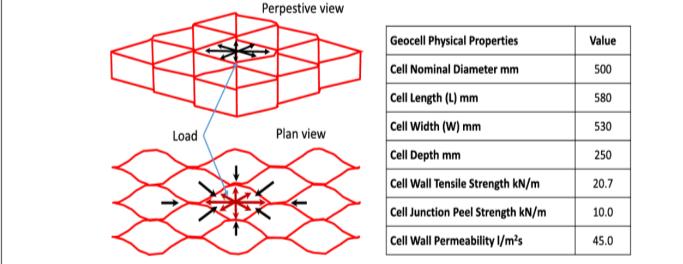
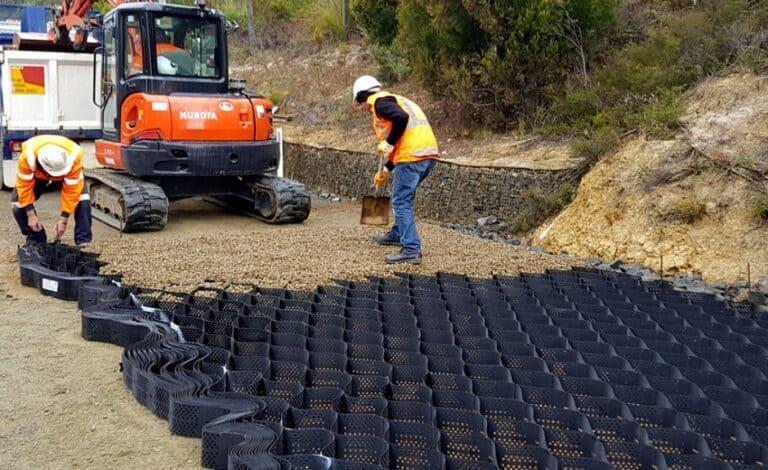
Geocells are three-dimensional honeycomb-like cellular confinementsystemsmadefrompolymericmaterials(mainly HDPE).
Whenexpandedandfilledwithsoil,sand,gravel,orconcrete, they create a strong composite structure that improves load-bearingcapacityandreducessoilmovement. Theyarewidelyusedin:
Roadconstruction
Slopeprotection
International Research Journal of Engineering and Technology (IRJET) e-ISSN: 2395-0056
Volume: 13 Issue: 03 | Mar 2026 www.irjet.net p-ISSN: 2395-0072
Erosioncontrol
Railwayfoundations
Retainingwalls
Embankments
Landslidemitigation
1. Toreviewthepropertiesandworkingmechanism ofHDPEgeocellreinforcementsystems.
2. Topromotetheuseofeco-friendlyandsustainable roadconstructionmethods
3. Tocompare geocell-reinforcedroadsystemswith conventionalroadconstructionmethodsintermsof cost,constructiontime,andmaintenance.
4. To examine the suitability of geocell systems for rural and remote areas using locally available materials.
5. To highlight the sustainability and environmental benefitsofgeocell-reinforcedpavements.
2. Literatures Review
K.Rajagopal(2012):Pavementfailuresoccurdueto weakmaterialsandsubgrade.Geocellconfinement
improves sub-base strength and stiffness, increasingpavementlife.
K. H. Mamatha (2017): Weak subgrades cause rutting. Geocells reduce rutting by 13–71% and increasepavementlifeby1.6–3.5times
Jain Sanjaya Kumar (2021): Combined use of geocells, geogrids, and micropiles improves slope stabilityandoverallperformance.
MainakMajumder(2022):Geocellsenhancebearing capacityandstiffnessofweak subgrades.Doublelayer geocells perform better and resist monsoon damage.
SayantiBanerjee(2024):Geocellsreducerutdepth (13–71%) and increase modulus (2.5–3.5 times), improvingpavementdurability.
Overall: Geocell reinforcement significantly improves strength,reducesdeformation,andincreasespavementlife, especiallyonweaksoils.
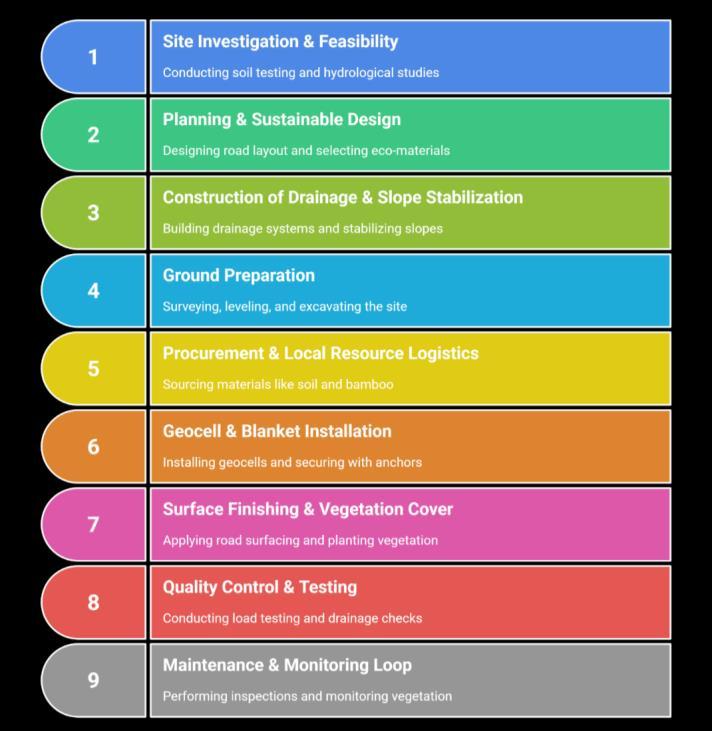
The study was carried out to evaluate the effectiveness of geocell reinforcement for stabilizing roads and slopes in landslide-prone areas. Initially, a literature review was conducted to understand weak subgrade behaviour and geocellreinforcementmechanisms.Basedonthis,suitable materialssuchasHDPEgeocellsandlocallyavailableinfill materialswereselected.Laboratorytestswereperformedto determinethepropertiesofthesubgradesoil.
Modelsectionswithandwithoutgeocellreinforcementwere prepared for comparison. Geocells were placed over the prepared subgrade, filled with soil or aggregate, and properly compacted. Drainage and surface protection measures were provided to simulate field conditions. Repeatedloadingtestswerethenapplied,andparameters suchassettlement,rutting,anddeformationwereobserved. Theperformanceofreinforcedsectionswascomparedwith unreinforcedsectionstoassessimprovementsinstrength, stability,anddurability.
Two road models will be prepared: a conventional (unreinforced) road and a geocell-reinforced road. Both modelswillbeconstructedusingthesamesubgradesoiland pavementlayersforuniformcomparison.Inthereinforced model,geocellswillbeplacedoverthesubgrade,filledwith locally available soil or aggregate, and compacted. NonDestructiveTesting(NDT)willbeconductedonbothmodels toevaluatestiffness,deformation,andloadresponse,andthe results will be compared to assess the effectiveness of geocellreinforcement.
International Research Journal of Engineering and Technology (IRJET) e-ISSN: 2395-0056
Volume: 13 Issue: 03 | Mar 2026 www.irjet.net p-ISSN: 2395-0072
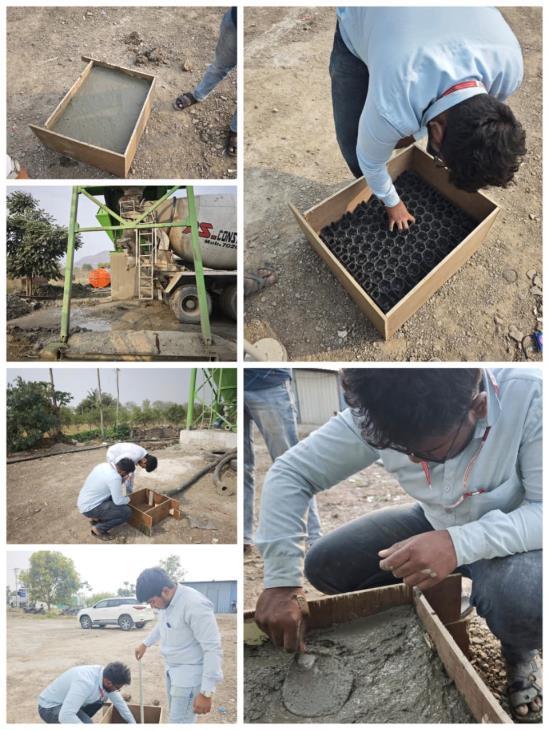
4: Model for comparing tradition and geocells road
Geocellreinforcementsignificantlyimproves loadbearing capacity ofweaksubgradesoils.
Three-dimensional confinement provided by geocellsreduces vertical settlement and rutting
Slopestabilityisenhancedbylimiting lateral soil movement and deformation
Proper drainage combined with geocells ensures effective performance during heavy rainfall
Geocell-stabilized sections show uniform load distribution andreducedstressconcentration.
Thesystemimproves durabilityandservicelife of pavementsandslopes.
Maintenancerequirementsareminimalcompared toconventionalconstructionmethods.
Geocell-based solutions are economical, ecofriendly, andsuitableforlandslide-proneareas
1. k. rajagopal “studies on geocell reinforced road pavementstructures”-(2012)
2. k.h. mamatha “performanceevaluationofgeocellreinforcedpavements”-(2017)
3. jain sanjaya kumar “effectivenessofgeocellwall, geogrid and micropile anchors for mitigation of unstableslopes”-(2021)
4. mainak majumder “performance evaluation of geocellreinforcedunpavedroads” -(2022)
5. sayanti banerjee “geocell as a promising reinforcementtechniqueforroadpavement:astate oftheart”–(2024)
6. pradhan mantri gram sadak yojana programme guidelines(pmgsyguidelines)
7. assessment of pmgsy improving its design and implementation
8. dpr template for pmgsy 3 (pradhan mantri gram sadakyojana)
9. engineering guidelines on landslide mitigation measuresforindianroadsbyindianroadcongress (irc-irc:sp:106-2015)
International Research Journal of Engineering and Technology (IRJET) e-ISSN: 2395-0056
Volume: 13 Issue: 03 | Mar 2026 www.irjet.net p-ISSN: 2395-0072




Muzammil Shaikh, Diploma Students, Department of Civil Engineering, (MIT) Marathwada InstituteofTechnologyPolytechnic, ChhatrapatiSambhajinagar, Maharashtra, India
Nishant Katmore, Diploma Students, Department of Civil Engineering, (MIT) Marathwada InstituteofTechnologyPolytechnic, ChhatrapatiSambhajinagar, Maharashtra, India
Vedant Ingole, Diploma Students, Department of Civil Engineering, (MIT) Marathwada Institute of TechnologyPolytechnic, ChhatrapatiSambhajinagar, Maharashtra, India
Prof. Y.Y. Shaikh Lecturer, Department of Civil Engineering, (MIT) Marathwada Institute of TechnologyPolytechnic, ChhatrapatiSambhajinagar, Maharashtra,India

Prof. N. G. Deshingkar, Head of Department, Department of Civil Engineering, (MIT) Marathwada InstituteofTechnologyPolytechnic, ChhatrapatiSambhajinagar, Maharashtra,India