
International Research Journal of Engineering and Technology (IRJET) e-ISSN: 2395-0056
Volume: 13 Issue: 05 | May 2026 www.irjet.net p-ISSN: 2395-0072
International Research Journal of Engineering and Technology (IRJET) e-ISSN: 2395-0056
Volume: 13 Issue: 05 | May 2026 www.irjet.net p-ISSN: 2395-0072
1Sikander Kumar , 2Md. Shariq , 3Karan Sahani, 4Kamil Ulla Khan, 5Ujjwal Mishra, 6Harshit dixit
1,2Assistant Professor, Dept. of Civil Engineering, Axis Institute of Technology and Management, Rooma Kanpur, India
3,4,5,6U.G. Student, Dept. of Civil Engineering, Axis Institute of Technology and Management, Rooma Kanpur, India
Abstract - In civil engineering, the foundation plays a vital role in ensuring the stability and safety of any structure,asitmustsafelytransferallimposedloadstothe ground without failure. However, in many regions, natural soils possess inadequate strength and require improvement through stabilization techniques. Soil stabilization becomes essential in such cases to enhance properties like strength, durability, and load-bearing capacity. Red soil, which covers approximately 10.6% of India’s geographical area, is characterized by its reddish color due to the high iron oxide content. In this study, red soil has been selected to evaluate its engineering behavior and improve its properties using additives. The soil sample was collected from Rath district in Uttar Pradesh and transported to the laboratory for testing. Polypropylene fibers were added in varying proportions of 1%, 1.5%, and 2%, along with a constant 5% gypsum content, to study their combined effect on soil properties. Various geotechnical tests such as compaction, California Bearing Ratio (CBR), and strength tests were conducted to assess improvements in performance. The study aims to evaluate the effectiveness of these additives in enhancing soil stability, reducing plasticity, and improving its suitability for construction applications such as subgrade and pavementlayers.
Key Words: Soil stabilization, red soil, polypropylene, Gypsum, CBR etc.
Soil stabilization is a process that alters and improves theengineeringpropertiesofthesoilinordertomakeit more suitable for building. Soil stabilization is a civil engineering technique for refining and improving soil engineering properties including mechanical strength, permeability, compressibility,hardness,andplasticity.The base soil serves as the foundation for any construction project,forahouse,aroad,oranairport.Furthermore,soil isanessentialbuildingmaterialtostandanystructure.As aresult,soilshouldhavepropertiesthatenableittoform a solid base.Soil stabilizationis a commonpractice in the construction of airfields, parking lots, landfills, embankments, highways and foundations, waterway maintenance,agriculture,andminingsites.
Soil stabilization is a critical component of various civil engineeringprojects.Withoutremovingtheentiresoil,the most effective technique is to use appropriate accessible. methods and materials to enhance the soil qualities. As a result,soilstabilizationisthoughttobethebeststrategyfor improvingsoilgeotechnicalparameters.Chemicaladditives, thermal energy, compaction, and plant-based or synthetic fiber reinforcing are all common stabilization approaches. Straw,coir,palm,sisal,andjuteareexamplesofplant-based fiberreinforcementmaterialsthatareinexpensive.Synthetic fiber reinforcing materials, such as polypropylene, nylon, rubber,orplastic,canalsohelpreducewaste.Researchinto the use of waste materials to stabilize soil is currently a globaltrend,assurpluswastematerialsposepublicsafety andlogisticalissuesintermsofdisposal
Inthisstudy,thefollowingmaterialswereused:
i)RedSoil
ii)Polypropylene
iii)Gypsum
Thesoilsampleforthisstudywastakeninthedistrict of Rath in Uttar Pradesh. The earth is a bright crimsoncolor. Redsoil is a type of soil that formsin warmtemperaturesandiscommonindampclimates withdeciduousormixedwoods.Theredsoil'stexture ranges from sandy to clay, with loam accounting for themajorityofit.
Table -1: Geotechnicalpropertiesofredsoil
International Research Journal of Engineering and Technology (IRJET) e-ISSN: 2395-0056
Volume: 13 Issue: 05 | May 2026 www.irjet.net p-ISSN: 2395-0072
2
(C)
Angle of internal friction (Φ) 14
Polypropylene's starting material is nonnumeric C3H6, a completelyhydrocarboncompound.Polypropylenefibers haveparticularlybeneficialqualitiesduetotheirformof polymerization,highmolecularweight,andthewaythey are processed into fibers. Polypropylene fiber is a single fiberwithadiameterof0.034mmandcomesinlengthsof 6mm,12mm,and20mm.
Table - 2: Characteristics of Polypropylene
Corridor (DFC) project site Bhestan near Surat. In this research. PPF has been mixed with soil in proportions of 0.75%,1.5%,2.0%,2.25%,and2.5%.
Tharini et.al (2020)
The laboratory conducted for study the performance on Black cotton soil reinforced with polypropylene fiber mixed at 0.2%, 0.3%, 0.4%, and 0.5%. The soil was gatherednearPSNACollegeofEngineeringandTechnology, Dindigul,TamilNaidu,IndiaPetry&Little(2002).
Thomas M. Petry and Dallas N. Little (2022)
Reviewed 60 years of research on expansive clay soils. These soils swell and shrink with moisture changes, causing structural damage. The paper summarizes key advances, current stabilization practices, and future researchdirections.
Amiri, Kalantari & Porhonar (2023): Mohammad Amiri, Behzad Kalantari, and Fatemeh Porhonar(2023)studiedhowheatingredsoil(100–900°C) changes its structure and strength. New minerals like mulliteandanorthiteformed,increasingstrengthupto20 times, showing thermal treatment improves soil propertiesforconstruction.
Singh & Kumar (2023)
Modulus of Elasticity (E) 3.5-6.8GN/m2
Thermal Conductivity 6(withairas1)
2.3 Gypsum
Gypsum powder is chemically known as calcium sulfate dihydrate (CaSO₄·2H₂O), meaning it contains calcium, sulfur, oxygen, and water molecules. Gypsum is a widely used building material that comprises 70% CaSO4 and can be utilized in the construction of buildings. In terms of chemistry, gypsum is a calcium sulphate that contains twomoleculesofwater,orCaSO4,2H20.Itisacrystalline material that dissolves in weak hydrochloric acid and waterwithverylittledifficulty,butnotinsulfuricacid.Itis madeupof20.9%waterand79.1%calciumsulphate.
3. Literature Review
T.N Dave et.al (2020)
Theuseofpolypropylenefires(PPF) for the stabilization of expansive soil obtained from Dedicated Freight
Gypsum-StabilizedLowPlasticitySoilsIntheir2023study, Singh & Kumar investigated the influence of gypsum stabilizationonlowplasticitysoils,includingredsoilswith similarproperties.Theyfoundthattheadditionofgypsum led to a reduction in Atterberg limits, indicating reduced plasticity and improved workability. The chemical interaction between calcium from gypsum and the soil particles resulted in enhanced aggregation and slightly increased strength values in Compaction and California Bearing Ratio (CBR) tests. While the effect was more pronounced in soils with higher clay content, the study demonstrated that gypsum is a promising stabilizer for soils exhibiting poor engineering behavior, particularly in regions where traditional stabilizers like lime or cement areexpensiveorunavailable.
Ahmed & Islam (2024)
Combined Effects of Fibers and Chemical Stabilizers Ahmed and Islam (2024) conducted a comparative study on the combined effects of polymeric fibers and chemical stabilizers(includinggypsumandlime)onexpansivesoils. They reported that when polymer fibers were used together with gypsum, there was a significant improvement in strength, stiffness, and resilience to moisturechangescomparedtousingeitheradditivealone. The fibers provided mechanical reinforcement, while gypsum improved particle bonding and reduced swelling
International Research Journal of Engineering and Technology (IRJET) e-ISSN: 2395-0056
Volume: 13 Issue: 05 | May 2026 www.irjet.net p-ISSN: 2395-0072
potential. The combined stabilization technique showed improved performance in swelling potential tests, suggesting that composite stabilization can effectively address both strength and volumetric instability problemsinproblematicsoilssimilartoredsoils.
Purohit et al. (2025)
Red Soil Stabilization Using Waste Plastic Additives
Purohitetal.(2025)investigatedtheuseofwasteplastic materials (including polypropylene waste strips) in the stabilization of red soils, with an emphasis on environmental sustainability. Their work demonstrated thatinclusionof wasteplasticimprovedtensilestrength andductilityandreducedtheformationofcracksduring drying and wetting cycles. In addition to benefits in mechanical behavior, the use of waste plastic helped reduce the environmental burden of plastic disposal. Coupled with gypsum treatment, the composite approach was found to enhance soil performance significantly more than either additive used alone. This study provides important evidence for environmentally conscious stabilization techniques suitable for regions withabundantredsoil.
4. METHODOLOGY AND EXPERIMENTAL INVESTIGATION
Therewassomeprocedurewhichwastakenintotheuse of the materials for the investigation is listed below. 1.Sieve Analysis. 2.Specific Gravity. 3.Free swell test. 4.OMC-MDD.5.CBRconsiderationduringtheundertaking oftheproject.Theprocess
Arepresentativeoven-dried soilsampleofsuitablemass was taken based on the maximum particle size, and all sieves along with the bottom pan were cleaned and weighed. The sieves were arranged in descending order, and the soil sample was placed in the top sieve and subjected to mechanical shaking for about 10 minutes. After shaking, each sieve with the retained soil was weighed,andthemassofsoilretainedoneachsievewas determined, ensuring the total mass was approximately equal to the initial sample. The percentage retained, cumulative percentage retained, and percentage finer were then calculated. Finally, the grain size distribution curve was plotted with sieve size on a logarithmic scale andpercentagefineronanormalscale.
Thepycnometer(densitybottle)wasfirstwashed,dried, andweighed.Approximately200gofdrysoilsamplewas then placed in the bottle and weighed. De-aired water
wasadded tocoverthesoil,andthebottle wasconnected to a vacuum pump to remove entrapped air. After removing air, the bottle was filled with water up to the calibration mark, cleaned externally, and weighed again. The bottle was then emptied, cleaned, refilled with distilled water up to the mark, and weighed. The entire procedurewasrepeatedthreetimestoensureaccuracy
Table–3:SPECIFICGRAVITY
EXPERIMENT NO VALUES (gm)
MASSOFDENSITYBOTTLE,W1 434
MASSOFDENSITY+DRYSOIL,W2 611
MASS OF DENSITY +SOIL+WATER, W3 1475
MASSOFDENSITY+WATER,W4 1360
SPECIFICGRAVITY=(W2-W1)/(W2-W1)-(W3-W4) =(611-434)/(1362-434)-(1475-611)
SpecificGravityofgivenSandis=2.76
4.3 COMPACTION TEST
Themaximumdrydensityandoptimummoisturecontent were determined by conducting standard proctor compactiontest.Inthistest,thesoilwascompactedusing a test mould and a rammer at different water contents until thewet density starteddecreasing.Moisturecontent of the soil at different water additions was obtained, and the dry density for each compaction level was graphed with its respective water content. The peak of the curve provided the maximum dry density that the soil can be compactedto,withtheoptimummoisturecontentthatcan yield the maximum compaction. how dry density can be calculated, where is dry density, wet density and water content.
Table–4:COMPACTIONVALUE
RESULTMDD=1.72g/ccOMC=16.35%
The test specimen was prepared as per IS 2720 (Part 10), and swelling was conducted if required before performing thepenetrationtest.Themouldwiththespecimenandbase plate was placed in the testing machine, and appropriate surchargeweightswereappliedtosimulatefieldconditions. Aseating loadof4 kgwasapplied to ensure propercontact
International Research Journal of Engineering and Technology (IRJET) e-ISSN: 2395-0056
Volume: 13 Issue: 05 | May 2026 www.irjet.net p-ISSN: 2395-0072
betweentheplungerandsoilsurface,andthegaugeswere set to zero. Load was then applied at a constant penetrationrateofabout1.25mm/min,andreadingswere recorded at specified penetration intervals. Moisture content was determined from the top layer of the specimen, and a load–penetration curve was plotted with corrections if necessary. Finally, the CBR value was calculatedandreportedtoonedecimalplace.
Table–5:CBRMEASURMENT
5. RESULTS AND DISCUSSIONS
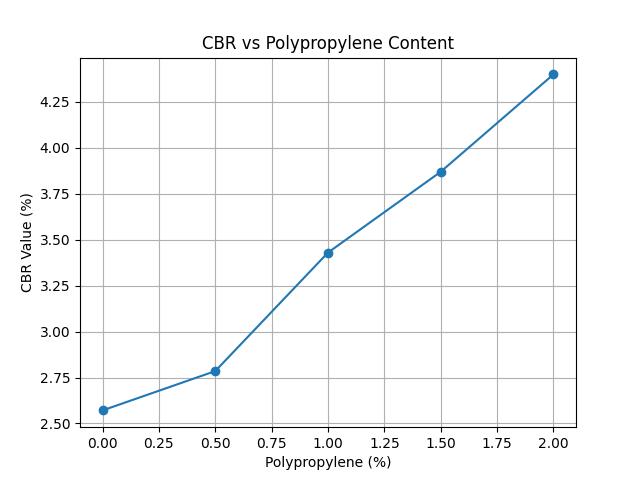
ForthesoilsampletheFreeswellvalueis73.6%Forthe soilsampletheSpecificGravityvalueis2.76Forthesoil sampletheOptimummoisturecontent(OMC)valueis 16.35%ForthesoilsampletheCBRvalueis4.3%.
6.
Theresultsofthestudyconcludedthatinsertionof plastic waste material in clayey soils would be productive for ground improvement and soil stabilizationingeotechnicalengineering.
In the present study, different content of plastic wastein%byweightvaryingfrom0%to2%were addedintothesoil.
The optimum moisture content (16.35%) and in the maximum dry density (1.72g/cc) results respectively.
Theswellingofthesoilwasreducedsignificantlyat high percentages of plastic content because of replacement in an equal mass of expansive soil by non-expansiveplastic
Reductioninswelling.
Properties of soil can be improved by using waste plasticasstabilizer:-CBRvalue(4.3%)andincrease the strength of soil. Reduction in consolidation settlement.
1. Kumar, R. & Gupta, A. (2021). Experimental investigation on improvement of red soil using polypropylene fiber reinforcement. International JournalofGeotechnicalEngineering,15(4),521–531.
2. Patel, D. S., Shah, M. P., & Joshi, H. B. (2020). Effect of gypsum as a stabilizing agent on engineering properties of clayey soils. Journal of Materials in Civil Engineering,32(7),04020109.
3. Reddy,K.R.&Rao,B.H.(2023).Durabilityresponseof fiber-reinforced soils subjected to cyclic moisture variations.SoilsandFoundations,63(1),87–95.
4. Zhao, Y., Li, J., & Zhang, X. (2022). Performance enhancement of expansive soils treated with polymeric fibers: A comprehensive review. Applied ClayScience,215,106339.
5. Lee, S. J. & Park, S. H. (2024). Synergistic effects of chemical stabilizers and fiber reinforcement in lowstrength soils. Construction and Building Materials, 391,131245.
6. Sangeetha, S. P. Stabilization of red soil using polypropylene fibers (experimental study). Available from ResearchGate (studies showing improvement in geotechnicalpropertieswithpolypropylene).
7. Anti-disintegration property of red soil treated with building gypsum powder, Construction and Building Materials, 2025. Reports increased resistance to moisture-induced disintegration in gypsum-treated redsoil.
8. Soil stabilization with gypsum: A review, Soils and Foundations / Digital Commons, (2024). A systematic review showing gypsum’s effects on UCS, CBR, swelling potential, and durability of soils including clayeytypes.
9. Improvement of geotechnical properties of red soil using waste plastic strips, International Journal of EmergingTechnologyandEngineering(IJETT)(2024).
International Research Journal of Engineering and Technology (IRJET) e-ISSN: 2395-0056
Volume: 13 Issue: 05 | May 2026 www.irjet.net p-ISSN: 2395-0072
Evaluates plastic waste inclusion in red soil stabilization
10. Performanceenhancementofredsoilsandexpansive soils with recycled polypropylene fibers, Sustainable Geotechnics (2025). Shows improved strength and ductilitywithrecycledpolypropylenereinforcement.
11. Enhancing clay soil’s geotechnical properties using sintered gypsum and cement, Applied Sciences (2022). Discusses gypsum’s role in strength and stiffness improvement when combined with binders (canbereferencedforgypsummechanisms).
12. Areviewonimprovingkeyengineeringpropertiesof lateritic/red soils with industrial by-products, ConstructionandBuildingMaterials(2025).Reviews stabilizationmethodsincludingindustrialwastesand by-products(goodforliteraturereviewbacking)