
International Research Journal of Engineering and Technology (IRJET) e-ISSN: 2395-0056
Volume: 13 Issue: 02 | Feb 2026 www.irjet.net p-ISSN: 2395-0072
International Research Journal of Engineering and Technology (IRJET) e-ISSN: 2395-0056
Volume: 13 Issue: 02 | Feb 2026 www.irjet.net p-ISSN: 2395-0072
Prabha Nishad 1 , David Kumar2 , Manisha3 , A.K. Jain4
1,2 U.G. Scholar Department of EEE Chouksey Engineering college Chouksey Engineering college Bilaspur Chhattisgarh, India
3 U.G. Scholar Department of EEE Chouksey Engineering college Bilaspur, Chhattisgarh, India
4 Professor Department of EEEChouksey Engineering Bilaspur, Chhattisgarh, India
Abstract - The Brushless Direct Current (BLDC) motor has emerged as a highly efficient and reliable alternative to conventional brushed DC and induction motors, owing to its superior performance characteristics and maintenance-free operation. This paper focuses on soft computing technique for BLDC motor speed control. The closed loop controller architecture employed PID control approaches to get around the maximum overshoot and extended settling times and performance analysis of BLDC motors. Advanced control techniques such as Pulse Width Modulation (PWM), FieldOriented Control (FOC), and Hall-effect orsensorlessfeedback mechanisms further enhance its operational efficiency and reliability. The speed control of BLDC Motor was simulated using MATLAB/SIMULINK and the results are obtained. The simulation results revealed that the proposed PID Controller provides better performancethanconventionalcontroller.The prototype model of BLDC motor is presented, and the speed response of BLDC motor is observed by LCD display.
Key Words: - Brushless DC Motor, PID Controller, DSP, Pulse Width Modulation.
In recent years the development of high-performance motordriveisveryimportantinindustrialaswellasother purpose applications such as automotive, computer, steel rollingmills,electrictrainsandrobotics,etc.
BLDCmotorshaveseveraladvantagesoverbrushedDC motorsuchashighefficiency,longlife,noiseimmunity,small size and less maintenance due to absence of brush and commutator arrangement. As the name implies, BLDC motors do not use brushes for commutation; instead, the BLDCmotoremployselectroniccommutationwhichmakes itavirtuallymaintenance-freemotor.Also,theyaremore efficient due to the permanent magnets which results in virtuallyzerorotorlosses
However, the BLDC motor constitutes a more difficult problemthanitsbrushedcounterpartintermsofmodelling andcontrolsystemdesignduetoitsmulti-inputnatureand couplednonlineardynamics.
The Brushless Direct Current (BLDC) motor has revolutionized the field of electric motors with its exceptionalefficiency,reliability,anddurability.Itssuperior performancecharacteristics,suchashightorque-to-weight ratio, high speed range, and maintenance-free operation, make it an ideal choice for a wide range of applications, including robotics, automotive, aerospace, and industrial automation. However, the control of BLDC motors is a complextaskduetotheirnonlineardynamicsandinherent instability.Inrecentyears,therehasbeenagrowingdemand for advanced control techniques to optimize the performance of BLDC motors. One such technique is the Proportional-Integral-Derivative (PID) control, which has beenwidelyusedinvariouscontrolapplicationsduetoits simplicityandeffectiveness.Thisprojectaimstodesignand implement a PID-based speed control system for BLDC motors, leveraging the capabilities of MATLAB/SIMULINK forsimulationandanalysis.
This report presents the findings and results of the project, including the design, simulation, and prototype developmentoftheBLDCmotorspeedcontrolsystem.The reportisorganizedasfollows:SectionIIprovidesadetailed overview of the BLDC motor and its control techniques, SectionIIIdescribesthedesignandsimulationofthePIDbasedspeedcontrolsystem,SectionIVpresentstheresults and discussion, and Section V concludes the report with futuredirections.
Thisprojectfocusesondesigningandsimulatingaspeed controlsystemforBrushlessDirectCurrent(BLDC)motors using a Proportional-Integral-Derivative (PID) controller. Thesimulationresultsdemonstratetheeffectivenessofthe PIDcontrollerintrackingthedesiredspeedwithimproved accuracyand stability. The project's findings highlight the potential of PID control for BLDC motor applications, offeringenhancedperformanceandreliability.
International Research Journal of Engineering and Technology (IRJET) e-ISSN: 2395-0056
Volume: 13 Issue: 02 | Feb 2026 www.irjet.net p-ISSN: 2395-0072
A) Construction of BLDC Motor
A brushless DC motor (BLDC) has permanent magnets on the rotor and electromagnets (stator windings)onthestator.Itworksbyusinganelectronic controller to power the stator windings in a specific sequence, creating a rotating magnetic field that interacts with the rotor's magnets.This interaction produces torque, causing the rotor to rotate and maintaincontinuous motion,eliminatingtheneedfor brushesandacommutatorfoundinbrushedDCmotors.
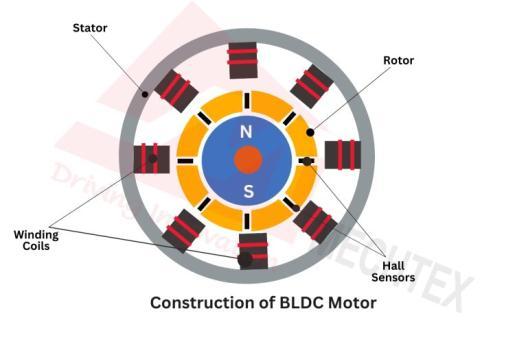
ConstructionofBLDCmotor.
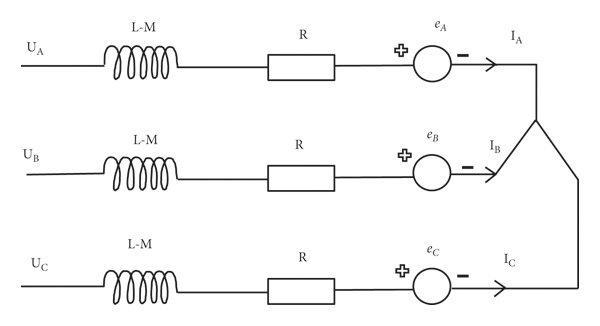
Fig.2 EquivalentcircuitofBLDCmotor
Themechanisms ofback-EMFandelectromagnetictorque are all the same with those of the traditional brushed DC motor;thus,similaranalysismethodscanbeadopted.
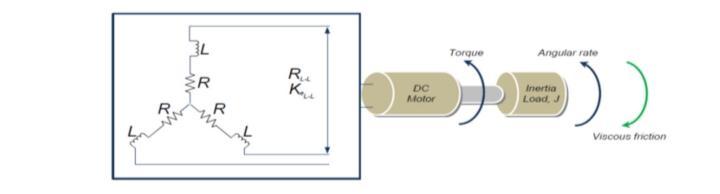
Fig.3 BrushlessDCMotorSchematicDiagram
Atanytime,thetwophasesareexcitedeitherABorBCor CA.ThesimplifiedequivalentcircuitwillbeasFig.4.
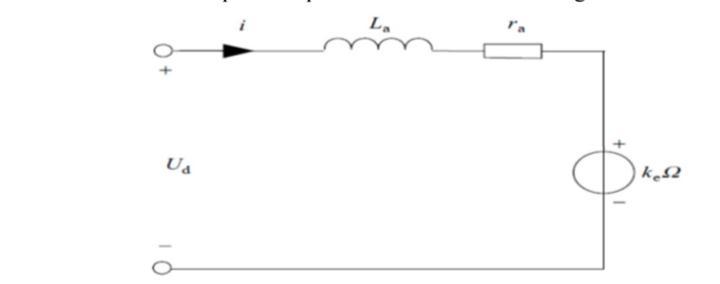
Fig.4 simplifiedequivalentcircuitoftheBLDCmotor
B) Transfer Function
The transfer function is one of the most important conceptsofcontroltheoryandthetransferfunctionbased mathematicalmodelsarewidelyusedinautomaticcontrol fields.TheTransferFunctionmodelofBLDCmotorisshown belowinFIG.5.
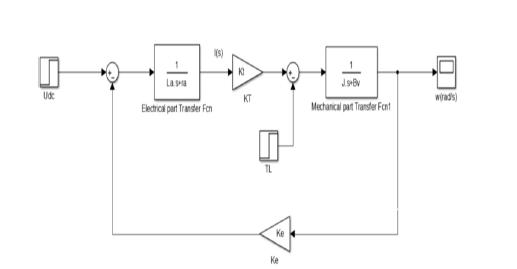
BlockDiagramofTransferFunctionModelofBLDC Motor
Table -1: SPECIFICATIONOFBLDCMOTOR
The speed response of BLDC Motor under open loop conditionisdiscussedbelow.TheparametersofBLDCMotor areshownintable1
DC resistance R 0.25 Ω
Inductance L 0.32 mH
Maximum Flux
Linkage Φm 65 mV/rad/sec
Number of Poles P 8
Peak Torque Tp 2.83 Nm Rated Voltage V 15 V
International Research Journal of Engineering and Technology (IRJET) e-ISSN: 2395-0056
Volume: 13 Issue: 02 | Feb 2026 www.irjet.net p-ISSN: 2395-0072
The transfer function model of PID (ProportionalIntegral-Derivative)controllerinitsstandard"parallel"form isK(s)=Kp +Ki/s+Kd.S
ThisequationisderivedbytakingtheLaplacetransform of the controller's time-domain equation, where KP is the proportional gain, Ki is the integral gain, and Kd is the derivative gain The peak overshoot is reduced using PID controllerandhencethesystemstabilitywasimproved.The values of the PID are tuned by Ziegler-Nichols’s methods The tuned PID values are Kp=0.135211, Ki=135.211 and Kd=3.38e-5.
A) Simulation of Speed Control of BLDC Motor using PID Converter
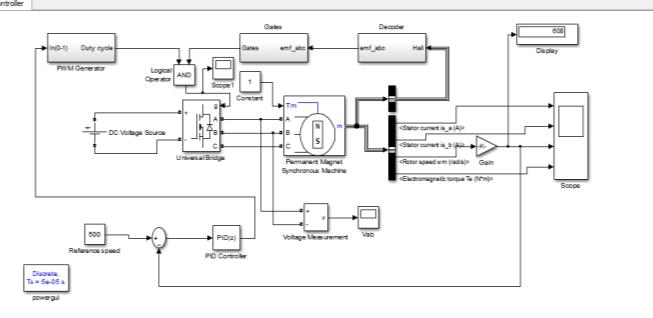
FIG.6SimulationdiagramofspeedcontrolofBLDCmotor usingPIDcontroller
The simulation model consists BLDC Motor, PID controller,andthreesubsystemswhichareDecoder,Gates, PWMGenerator.Therearetwobusselectors,oneofthemis connectedwithBLDCmotorandotheroneisconnectedwith decoder,aswecanseefromabovefigure.
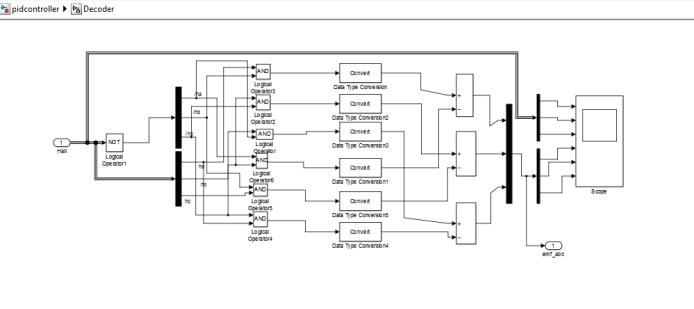
DecoderwithinputHallandoutputemf_abc
TheDecodersoutputisconnectedtothegatesinputand bothPWMgeneratorandgatesoutputisconnectedtoAND Gate.ThePIDcontrollerisconnectedtoPWMGenerator. Gates and PWM Generator subsystem diagram is shown belowinFIG.8andFIG.9.
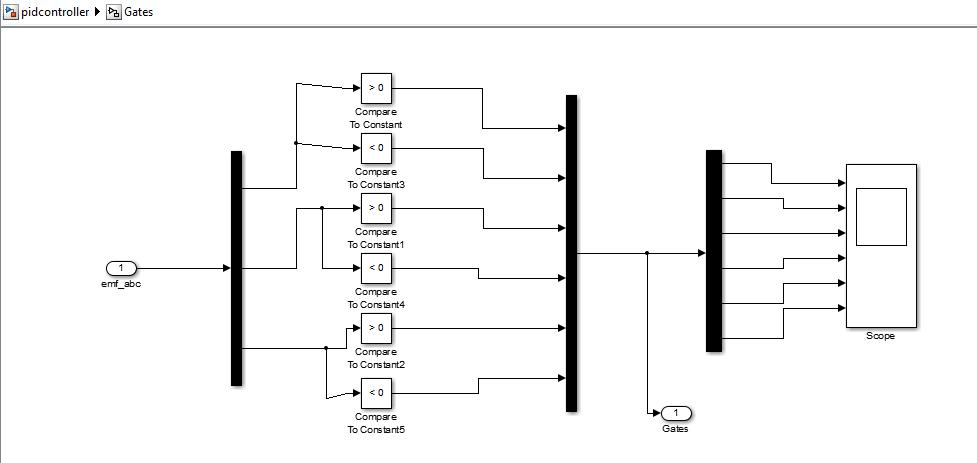
Gatessubsystem
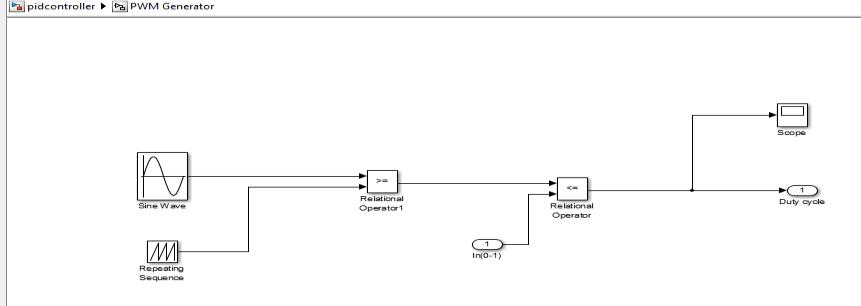
FIG.9 PWMGenerator
Theresultofthesimulationisshowedindisplayaswe can see at FIG.6. It shows the output of the simulation of speedcontrolofBLDCmotorusingPIDControllerandthe scopeshowstheoutputwaveforms.
A PID controller is an instrument used in industrial controlapplicationstoregulatetemperature,flow,pressure, speed and other process variables. PID (proportional integralderivative)controllersuseacontrolloopfeedback mechanism to control process variables and are the most accurateandstablecontroller.Itisacombinationofallthree typesofcontrolmethods.
PID-controlismostcommonlyusedbecauseitcombines the advantages of each type of control. This includes a quicker response once time because of the action of P control, the system will respond to a change very quickly. Due to the action of I control, the system is able to be returnedtothesetpointvalue.Finally,becauseitissocritical forthesystemtoremainataconstantsetpoint,Dcontrolwill measure the change in the error, and help to adjust the system accordingly. On the contrary, as mentioned previously,whenusedindividually,ithasaslowerresponse time compared to the quicker P-only control. So, the PID controllerseemstobethemostadequatecontrollerwhich providestheaccuracyandstability.
The output of the BLDC Motor speed control system demonstrates the effectiveness of the PID controller in achievingprecisespeedcontrol.Thesimulationresultsshow
International Research Journal of Engineering and Technology (IRJET) e-ISSN: 2395-0056
Volume: 13 Issue: 02 | Feb 2026 www.irjet.net p-ISSN: 2395-0072
thatthemotorspeedtracksthedesiredreferencespeedwith minimalovershootandsteady-stateerror.
Key Output Parameters
1. Speed Response: The motor speed follows the desiredreferencespeedaccurately.
2. Torque Output: Themotortorqueoutputisstable andmeetsloadrequirements.
3. Current Output: Themotor current is withinthe specifiedlimits,ensuringsafeoperation.
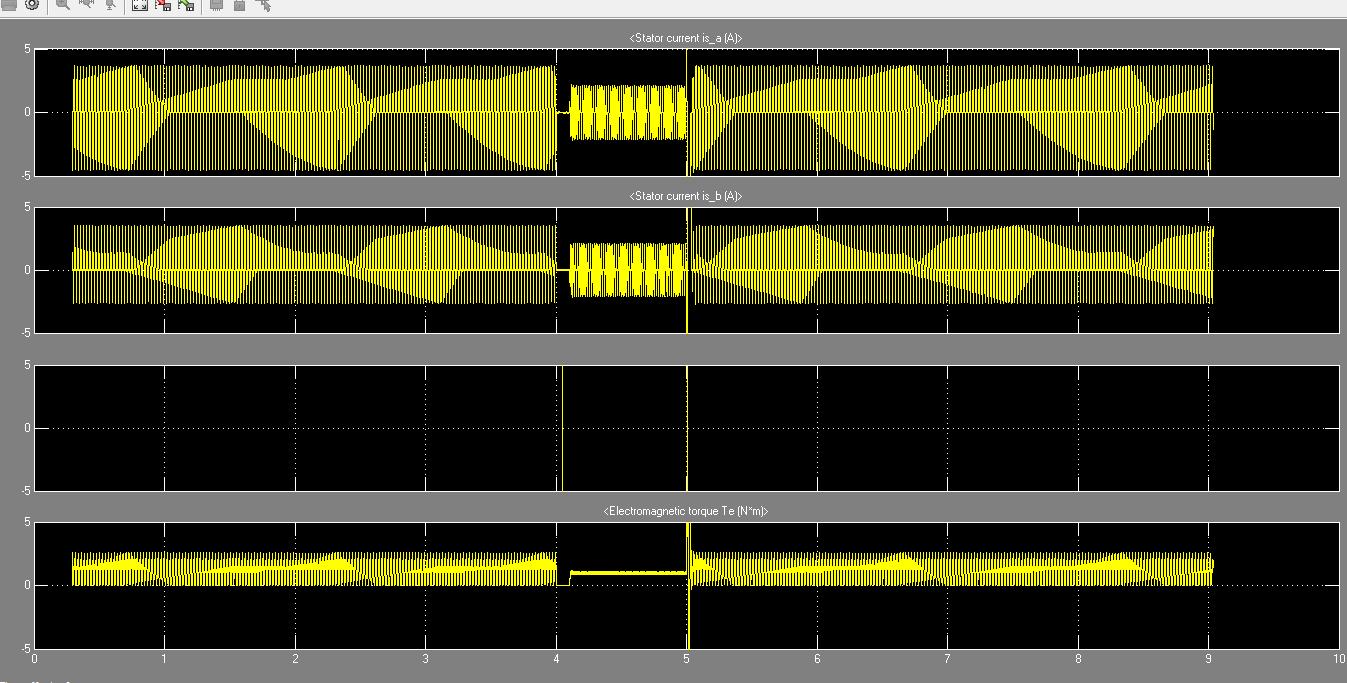
SpeedresponseofBLDCMotorusingPID Controller
Thesimulationofresultsispresentedintheformofplots andgraphs,showingthemotorspeed,torque,andcurrent output over time. These results demonstrate the performanceandstabilityofthePIDcontrollerincontrolling theBLDCmotorspeed.Theresultsareshowninthescopeas wecanseeontheFIG.6.
Thispaperdemonstratedthedesignandsimulationofa speed control system for BLDC motors using a PID controller. The simulation results show that the PID controller provides excellent speed tracking performance, reduced overshoot, and improved stability. The project's findings confirm the effectiveness of PID control in BLDC motorapplications,makingitaviablesolutionforindustrial and automation systems. Future work can focus on implementingthePIDcontrolleronahardwareplatformand exploringadvancedcontroltechniquestofurtheroptimize BLDCmotorperformance.
[1] Kumar,P.,&Kumar,P.(2019)."SpeedControlofBLDC Motor Using PID Controller." International Journal of EngineeringResearch&Technology(IJERT),8(3),1-6.
[2] Singh,S.,&Singh,S.(2020)."DesignandImplementation ofPIDControllerforBLDCMotor."JournalofElectrical EngineeringandTechnology,15(2),267-276.
[3] Ramesh, M. V., & Rao, G. S. (2018). "Speed Control of BLDC Motor Using PID Controller with MATLAB/SIMULINK." International Journal of Power ElectronicsandDriveSystems,9(2),839-848.
[4] Khan, M. A., & Rahman, M. A. (2017). "Design and Implementation of a PID Controller for BLDC Motor." JournalofIntelligentSystemsandApplications,9(2),19.
[5] Sathyan, A., & Krishnan, R. (2019). "Modeling and Simulation of BLDC Motor with PID Controller." International Journal of Electrical and Electronics EngineeringResearch,9(1),1-12.
[6] Jain, A., & Kumar, A. (2020). "Speed Control of BLDC MotorUsingPIDControllerwithFuzzyLogic."Journalof ElectricalEngineeringandElectronics,19(1),1-10.
[7] Kumar,R.,&Singh,B.(2018)."DesignandAnalysisof PIDControllerforBLDCMotor."InternationalJournalof EngineeringScienceandTechnology,10(2),1-8.
[8] Rao,P.S.,&Subramanyam,P.(2019)."Simulationand Analysis of BLDC Motor Speed Control Using PID Controller." Journal of Electrical and Electronics Engineering,14(2),1-9.
[9] Singh,R.,&Singh,J.(2020)."BLDCMotorSpeedControl UsingPIDControllerwithParticleSwarmOptimization." InternationalJournalofAdvancedResearchinElectrical, ElectronicsandInstrumentationEngineering,9(3),1-8.
[10] Patel, D., & Patel, R. (2019). "Design and ImplementationofPIDControllerforBLDCMotorUsing MATLAB/SIMULINK." International Journal of Innovative Research in Science, Engineering and Technology,8(4),1-8.