
International Research Journal of Engineering and Technology (IRJET) e-ISSN:2395-0056
Volume: 12 Issue: 01 | Jan 2025 www.irjet.net p-ISSN:2395-0072

International Research Journal of Engineering and Technology (IRJET) e-ISSN:2395-0056
Volume: 12 Issue: 01 | Jan 2025 www.irjet.net p-ISSN:2395-0072
D.J. Dahigaonkar
1,
Shivam Bhattad
2 ,
Ruhul Khan
3,
Sheefa Khan
4,
Pranav Agrawal
5
1Associate Professor, Dept of Electronics and communication, Ramdeobaba University Nagpur, Maharashtra, India
2Student, Ramdeobaba University Nagpur, Maharashtra, India
3Student, Ramdeobaba University Nagpur, Maharashtra, India
4Student, Ramdeobaba University Nagpur, Maharashtra, India
5Student, Ramdeobaba University Nagpur, Maharashtra, India
ABSTRACT:
This paper presents an IoT-based system designed to address the critical issue of load management in railway transportation by providing real-time weight monitoring for railway wagons. In modern logistics, recognizing the impact of improper load distribution and incorrect wagon loading is crucial. These issues contribute to operational inefficiencies,highermaintenanceexpenses,andincreased safetyhazards.
This study integrates approaches from multiple disciplines, such as sensor technology, wireless data transmission,andautomatedloadmonitoring,toprovidea practical, data-driven solution for managing load distribution.Theproposedsystememployscalibratedload cells installed in the railway wagons to collect precise weight data, which is wirelessly transmitted using ESP32 modules to a central monitoring hub. This comprehensive approachimprovessafety, ensures regulatorycompliance, and enhances resource allocation and operational efficiency, establishing a new benchmark in railway logistics.
Keywords: Internet of Things, Railway Transportation, Load Management, Real-Time Monitoring, Wireless Data Transmission.
1. Introduction:
In today’s logistics-centric economy, railway transport playsavitalroleinmovinglargequantitiesofgoodsdueto its high capacity and lower environmental impact. However, managing the load within railway wagons remains a significant challenge, affecting both operational efficiency and safety. Issues such as overloading, underloading, and uneven load distribution contribute to increased wear on wagons and infrastructure, leading to higher maintenance costs and safety risks. Current load management methods are often manual and inconsistent,
lacking the real-time monitoring needed to ensure proper load distribution and compliance [1]. Recent advancementsintheInternetofThings(IoT)
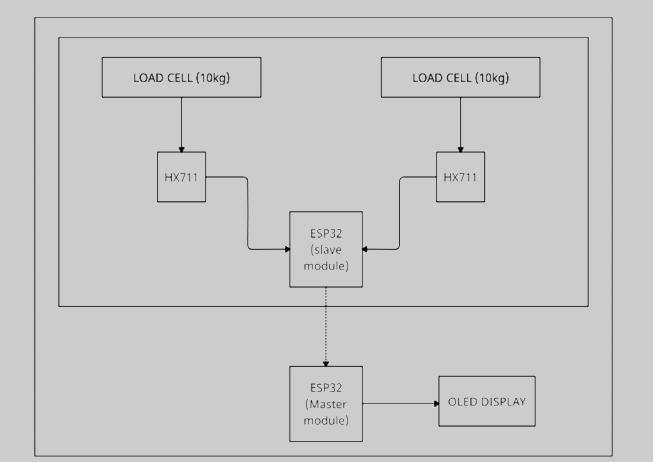
now enable real-time load tracking, presenting a transformative opportunity for railway logistics. This paper presents an innovative IoT-based solution for enhancing railway wagon load management. The system utilizescalibratedloadcellsandESP32modulestocapture weight data, which is wirelessly transmitted to an OLED display. By addressing the limitations of traditional load management practices, this system promotes safer and moreefficientrailwayoperations.
2. Experimental setup:
2.1 Load-cell:
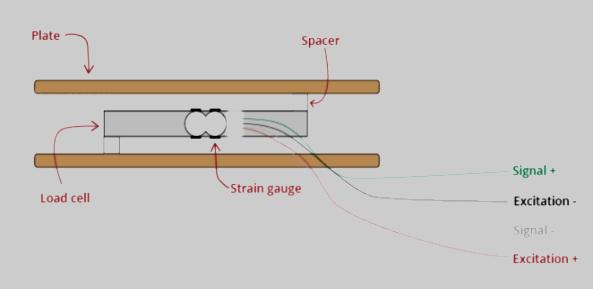
A load cell, a type of transducer, produces an electrical signal directly proportional to the force it senses. Several types of load cells are available, including hydraulic, pneumatic, and strain gauge models. The number of load cells required depends on the load configuration. For example,asingleloadcellcanmeasuresmallconcentrated forces,suchasthosefromcablesorpointloads.Forlonger beams,twoloadcellsareusuallyplacedattheends,while three load cells are typically used for vertical cylinders. Loadcellsareusedtomeasureforcesbyconvertingaforce intoanelectricalsignal.Formeasuringsmall,concentrated forces, a strain gauge-based load cell is commonly used. The relationship between the force applied and the electrical signal is governed by a mathematical formula derived from Hooke's Law and the Wheatstone bridge circuit,asdepictedbelow:
Strain (ε) is proportional to the applied force ‘F’ via Hooke'sLawas
ε= =
International Research Journal of Engineering and Technology (IRJET) e-ISSN:2395-0056
Volume: 12 Issue: 01 | Jan 2025 www.irjet.net
where σ is Stress, E is Young's modulus and A is Crosssectionalarea
The Wheatstone bridge produces an output voltage proportionaltothestrainas
ΔV=G.K.ε
Where K is a Gauge factor (relates strain to resistance change)andGisexcitationvoltage.
CombiningtheseequationsandisolatingF,weget
F= ,
whereSaccountsforthesensitivityoftheloadcellandits physical properties. The rectangular objects generally require four load cells for accurate measurements and for large platforms, containers, or extremely high loads, additional sensors are required. In symmetrical loading situations, pivots can replace some load cells to reduce cost, although this may reduce accuracy. Load cells can also be connected in parallel, where the corresponding signals (e.g., Ex+ to Ex+, S+ to S+) are connected. This setup generates an average output signal from all load cells,makingparallel configurationsideal fordevicessuch as personal scales and multipoint weight measurement systems. The most common colour coding for the wires is redforEx+,blackforEx-,greenforS+,andwhiteforS-,but other variations such as red for Ex+, white for Ex-, green for S+, and blue for S-, or red for Ex+, blue for Ex−, green forS+andyellowforS−,canalsobeused[2].
converter (ADC) designed specifically for use in load sensing and weighing applications. The HX711 converts the analog voltage (Vout) into a digital output value. The relationshipisgivenby
p-ISSN:2395-0072
Where,Vout=Outputvoltagefromtheloadcell(mV),Vref = Reference voltage of the HX711, G = Gain factor of the HX711 (default options: 32, 64, or 128) and 224 = Resolutionofthe24-bitADC.Itisparticularlyeffectivefor working with load cells or strain gauges, providing exceptional accuracy and minimal noise. The module has two channels: channel A, which provides selectable gain settings of 128 or 64, offering flexibility in handling differentsignalstrengths,andchannelB,whichisfixedata gainof 32. Thisversatilityallowsthe HX711to be used in various configurations, depending on the load cell manufacturer. With its simple 2-wire interface with DAT andCLKpins,theHX711iseasilyconnectedtowidelyused microcontrollerssuchasArduinoorESP32[3].Itsenergyefficient design makes it perfect for battery-powered systems.Themoduleconvertslow-millivoltanalogsignals fromaloadcellintodigitaldata,whichthemicrocontroller processes to provide accurate weight measurements in a varietyofapplications.TheHX711’sreliabilityandeaseof integration have made it a preferred choice for many industrial and consumer-level weight measurement solutions. Its wide compatibility with various sensors makesitadaptabletodiverseload-sensingrequirements.
The ESP32, developed by Espressif Systems, is a highperformance microcontroller with integrated Wi-Fi and Bluetooth, ideal for Internet of Things (IoT) applications thatrequirerobustwirelessconnectivityandefficientdata management.Poweredbyadual-coreprocessorclockedat up to 240 MHz, it can multitask and handle complex processesefficiently.TheESP32'slow-powermodesallow for extended battery life, making it suitable for portable andenergy-consciousdesigns.
Equipped with multiple GPIO pins, the ESP32 supports a widerangeofsensorsandperipherals,anditiscompatible withcommunicationprotocolssuchasSPI,I2C,UART,and PWM. It also has integrated analog-to-digital converters (ADC) and digital-to-analog converters (DAC), expanding itspotentialforsensingandcontrolapplications[4].
Dual connectivity via Wi-Fi and Bluetooth makes the ESP32 versatile when it comes to communication, supporting both remote network-based applications and short-range Bluetooth configurations. Its adaptability, accessibility, and support for open-source development maketheESP32popularin variousindustries,from home automationtoindustrialIoT,allowingdeveloperstocreate innovativeandconnectedsolutionsefficiently.
International Research Journal of Engineering and Technology (IRJET) e-ISSN:2395-0056
Volume: 12 Issue: 01 | Jan 2025 www.irjet.net
The I2C OLED display is a small, energy-efficient display thatusestheI2C(Inter-IntegratedCircuit)communication protocol to interface with microcontrollers such as the ESP32. I2C allows multiple devices to communicate with justtwowires:onefordata(SDA)andoneforclock(SCL), minimizing the number of connections required. OLED (Organic Light Emitting Diode) technology offers high contrast, deep blacks, and wide viewing angles, making it idealforcompact,low-powerapplications.THESEdisplays arecommonlyusedinIoTprojectstovisuallypresentdata such as sensor readings, status updates, or system informationinaclear,readableformat.
3.
The main objective of this research is to create a reliable andreal-timemonitoringsystemtoimprovethesafetyand efficiency of loading railway wagons. By avoiding issues such as under loading and overloading [1], the system aimstoimproveoperationalaccuracyandcompliancewith safety regulations. Accurate load monitoring helps reduce potential risks to the infrastructure and minimize safety risks, contributing to a more resilient rail logistics network.
This work offers an advantage by integrating IoT technology into a traditional manual and error-prone process. Real-time load weight data allows for immediate feedback and adjustments, optimizing load distribution and operational workflow. The wireless communication setup provides an efficient and automated solution that reduceshumanerrorandincreasesaccuracy.Alignedwith modern IoT standards, the research work lays the foundation for predictive maintenance, data-driven decision-making,andlong-termcostreduction,positioning therailsectortowardgreatersafetyandefficiency.
p-ISSN:2395-0072
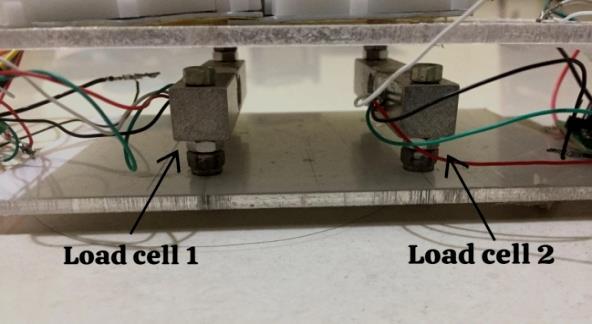
This system incorporates an array of two highly sensitive 10 kg load cells, carefully calibrated and positioned to measuretheweightdistributionofthemovingwagonwith a high degree of accuracy. Calibration of the load cells is crucial to ensure consistent and repeatable data, accounting for minor variances that can arise due to environmentalfactorsormechanicalshifts.Thedeliberate alignmentofthecellsallowsthemtodetecttheloadevenly across the entire setup, making the array capable of accurately tracking any variations in load distribution as the wagon moves across. This configuration reduces the risk of inaccurate readings and ensures the system captures reliable weight data, even under dynamic conditions like the passage of a large, moving object. By achieving precise load distribution measurement, the arrayalsoenhances theaccuracyanddependability ofthe weightdatacollected.
Load cells produce analog signals in response to weight, but these signals are often too weak to be processed directly.Tomakethesesignalsreadable,theHX711signal amplifier is used to amplify and convert them into a strongerdigitalformat.TheHX711 isspecificallydesigned for load cell applications, providing amplification and analog-to-digital conversion (ADC) functions. By amplifying the signal, the HX711 ensures that even small fluctuations in weight are recorded accurately, which is essential for detecting subtle changes in load. The amplified digital signal makes the data more accurate and stable because it maintains clarity and responsiveness even with slight weight changes [3]. This amplification step is essential for reliable data collection, especially in environments where temperature or other conditions can affect signal quality. With support for the HX711, the
International Research Journal of Engineering and Technology (IRJET) e-ISSN:2395-0056
Volume: 12 Issue: 01 | Jan 2025 www.irjet.net
system can continuously produce accurate weight data, readyforfurtherprocessingandanalysis.
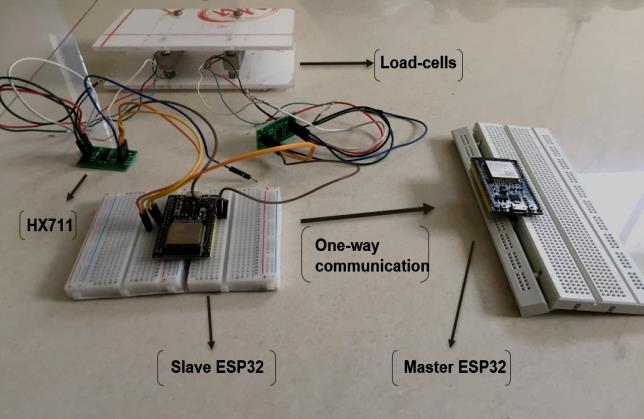
The ESP32 slave module is responsible for collecting and initially processing the load cell weight data. Located next to the load cells, this module handles the timing, synchronization, and data preprocessing before transmission to the master module. By handling these taskslocally,theESP32slavemoduleensuresthatthedata from each load cell is synchronized, which is essential for stableandreliabledatacollection.Themoduleoperatesin realtime,collectingamplifieddigitalsignalsandpreparing them for transmission. This localized data management reduces latency and allows accurate and synchronized data to be sent quickly to the master module. This initial processalsoallowstheslavemoduletoefficientlymanage and prepare data for smooth transfer, ensuring smooth operationoftheoverallsystem.Usingthismodule,weight data can be collected and processed in real time, contributingtoefficientandresponsivemonitoring.
The ESP32 master module is strategically positioned near the track, allowing it to be wirelessly connected to the ESP32 slave module on the moving railcar. As the railcar passes through the designated measurement area, the mastermoduleestablishesareal-timeconnectionwiththe slave module to receive the weight data captured by the load cells. The master module then collects this data and transmitsittoacentralmonitoringsystem,whereitcanbe analyzed or stored as needed. Its location is chosen to maximize the reliability of communication as the railcar movesthroughthearea,ensuringstabledatatransmission even at higher speeds. The instantaneous transmission of data from the master module to the monitoring system allows for rapid analysis and decision-making. The role of this module is crucial in maintaining a smooth and continuous flow of data, ensuring that no information is lostandthatthecentralsystemreceivesthedataquickly.
ESP32 modules use wireless protocols, such as Wi-Fi or Bluetooth, to enable transparent data transmission between slave and master modules. This eliminates the need for complex wiring and allows for real-time data transfer from the load cells on the wagon to the master module and then to the central monitoring system. Wireless communication also ensures that the system is flexible and scalable, as the modules can be placed in different configurations depending on the application
p-ISSN:2395-0072
environment. Wi-Fi is generally chosen for its robust connectivity and speed over short distances, making it suitable for real-time monitoring needs. Bluetooth provides a low-power alternative that can be useful for mobile configurations where battery conservation is important. Wireless communication between modules provides instant data transmission, allowing rapid access to weight measurements, and enabling responsive monitoring and analysis. This configuration offers flexibility in terms of deployment and maintenance while maintaining efficient and reliable data transmission in a busyrailwayenvironment[5].
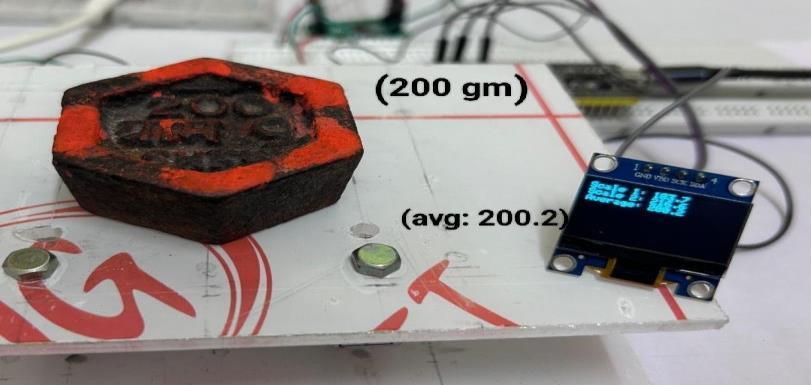
The future potential of this load cell-based weight measurement system presents many opportunities for improving functionality and adaptability. Expanding the load cell network would allow for accurate weighing of largerorheavierobjects,increasingtheadaptabilityofthe system for various industrial and transportation applications. The inclusion of automated calibration and self-diagnosticscansimplifymaintenanceandimprovethe
International Research Journal of Engineering and Technology (IRJET) e-ISSN:2395-0056
Volume: 12 Issue: 01 | Jan 2025 www.irjet.net
reliability of measurements, adapting to environmental changes over time. The integration of edge computing in the ESP32 slave module will allow for local data processing, reducing transmission requirements and improving system speed. In addition, by using advanced communication protocols such as LoRa or 5G, data can be transmitted over longer distances with greater stability, supporting applications that require faster movements or largercoverageareas.Predictivemaintenancefeaturescan be added to monitor system health and identify potential issues at an early stage, ensuring stable functionality. AIbased load distribution analysis can help optimize load distribution, which is essential for safety and operational efficiency. Cloud integration will enable centralized storage and remote monitoring of data, allowing for immediate analysis and insight generation, as well as tracking historical trends. IoT integration can improve logistics coordination, enabling interoperability with automated loading, tracking, and scheduling systems. Addingenvironmentaladaptabilitywithadditionalsensors can improve accuracy in different conditions. Finally, a real-time user interface can provide operators with immediatedatafeedback,allowingthemtomakeinformed decisions on the spot. These future enhancements will increasethesystem's versatility,reliability,andscalability forawiderangeofindustrialapplications.
6. Conclusion:
The IoT-based weight monitoring system developed for rail wagons represents a valuable advance in cargo management, improving the safety and efficiency of rail logistics. Integrating calibrated load cells, HX711 signal amplifier, ESP32 modules, and wireless communication, this system enables accurate real-time weight measurement that promotes best practices in load distribution. Unlike traditional methods, this automated, data-driven approach minimizes human error, reduces maintenance costs, and helps maintain safety standards. Real-time weight monitoring allows for immediate intervention in the event of load imbalance, helping to mitigate the risks associated with overloading, underloading,andunevenweightdistribution.Thissystem offers future potential for scalability and connectivity to largerIoTnetworks, enablingfunctionssuchaspredictive maintenance, long-term data analysis, and improved coordinationwithautomatedlogistics.
p-ISSN:2395-0072
Table6.1Comparisonwithtraditionalmethod
Criteria Traditional Methods Proposed Solution
Accuracy Low High
Real-Time Monitoring No Yes
Scalability Limited High
Cost-Effectiveness High (longterm) Low
As depicted in the table 6.1, the proposed solution offers advantages like low cost with minimum errors, scalability andrealtimemonitoring.Withrailtransportstillessential for the movement of large volumes of goods, the implementation of such a system could significantly contribute to a safer, more efficient, and technologically sophisticatedrailindustry.
7. References:
[1] N. Talwar, "Indian Railway Technical Bulletin," researchdesignandstandardsorganisation,2015,pp.1-5.
[2] MEGATRON Elektronik GmbH & Co. KG, "Load Cell Model Datasheet," MEGATRON, [Online] Available: https://www.megatron.de/fileadmin/user_upload/Datenb laetter/Kraftsensoren/DS_KM1403_en.pdf.[Accessed:Jun. 2,2024].
[3] SparkFun Electronics, "HX711 Load Cell Amplifier Datasheet,"[Online]. Available:https://cdn.sparkfun.com/datasheets /Sensors/ForceFlex/hx711_english.pdf. [Accessed: Jun. 2, 2024].
[4] E. Systems, "esp32_datasheet_en" [Online].Available: https://www.espressif.com/sites/default/files/document ation/esp32_datasheet_en.pdf.[AccessedJune2024].
[5] V. J. Hodge, S. O’Keefe, M. Weeks, and A. Moulds, "WirelessSensorNetworksforConditionMonitoringinthe Railway Industry: A Survey," IEEE Transactions on IntelligentTransportationSystems,vol.16,no.3,pp.45-60, Jun.2015.
[6]H.G.SinghandN.Z.Jahan,"In-MotionWagonWeighing System," International Journal of Computer Techniques (IJCT),vol.6,no.1,pp.23-29,Jan.-Feb.2019.
[7]G.Rao,T.M.Sai,S.P.Raj,C.V.Nikitha,P.M.Kumar,and A. Keerthi, "A System of IoT Devices to Prevent Underloading and Overloading of Railway Wagons," © 2025, IRJET | Impact Factor value: 8.315 | ISO 9001:2008 Certified Journal | Page294
International Research Journal of Engineering and Technology (IRJET) e-ISSN:2395-0056
Volume: 12 Issue: 01 | Jan 2025 www.irjet.net p-ISSN:2395-0072
International Journal of Innovative Research in Technology (IJIRT), vol. 10, no. 12, pp. 80-85, May 2024.
[8] A. Chawada, N. Bhosale, A. Patil, C. Chitte, M. Mali, and K. N. Kulkarni, "IoT Based Load Detection System for Goods," Alochana Journal, vol.13,no.5,pp.1-6,2024.
[9] A. Chawada, N. Bhosale, A. Patil, C. Chitte, M. Mali, and K. N. Kulkarni, "IoT Mechanisms Detecting Loading of Goods: A Review," International Research Journal of Engineering and Technology (IRJET), vol. 11, no. 03, pp. 1-7, Mar. 2024.