
International Research Journal of Engineering and Technology (IRJET) e-ISSN: 2395-0056
Volume: 12 Issue: 11 | Nov 2025 www.irjet.net p-ISSN: 2395-0072
International Research Journal of Engineering and Technology (IRJET) e-ISSN: 2395-0056
Volume: 12 Issue: 11 | Nov 2025 www.irjet.net p-ISSN: 2395-0072
Dhanushree ML1 , Keerthana Mohan2 , Vamshi KL3 , Prof. S S Vidya4
1,2,3Student, Department of Electronics and Instrumentation, BIT, Bengaluru, Karnataka, India.
4Assistant Professor, Department of Electronics and Instrumentation Engineering, BIT, Bengaluru, Karnataka, India.
Abstract - The ventilator system is essential for addressing the shortage of medical ventilators, especially during emergencies, such as the COVID-19 pandemic, or in lowresourceareas.Itoffersalow-cost,easilybuildablealternative usingArduinoandbasiccomponents,makingitaccessibleand deployable in areas where conventional ventilators are unavailable. Compared to existing methods, it stands out for itsaffordability,simplicity,portability,andreal-timecontrolof key breathing parameters. Its open-source nature also encourages innovation and educational use, making it a valuable tool for both emergency response and learning. Utilizing an Arduino microcontroller and ESP8266 Wi-Fi module, the system automates a manual Ambu bag to deliver controlled ventilation. Key features include an adjustable breathingrate,tidalvolume,andinspiration-expirationratio, with real-time monitoring via an LCD display.
Key Words: Ventilator, Arduino Microcontroller, ESP8266 Wi-FiModule,Real-TimeMonitoring,EmergencyAlerts,Ambu Bag, Controlled Ventilation.
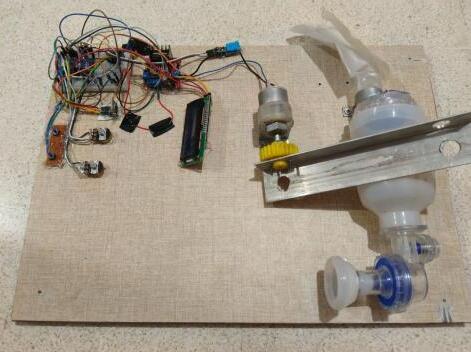
Thehumanrespiratorysystemfunctionsthroughnegative pressuregeneratedbythediaphragm’smovement,enabling inhalation and exhalation. During pandemics, the global shortageofventilatorsseverelystrainedhealthcaresystems, particularlyinunderprivilegedregionswithlimitedaccessto such critical equipment. In response to this crisis, some hospitals resorted to ventilator-sharing protocols, while temporarilyaddressingshortages,posedsignificantrisksof cross-infectionandimproperventilation.Tomitigatethese challenges,researchershavebeenactivelydevelopinglowcost, open-source ventilators to enhance accessibility and affordability.Inadditiontorespiratorysupport,continuous monitoringofvitalparameterssuchasheartrateremains essential for effective patient management, as it provides critical insights into a patient’s physiological condition. A heartbeatcanbemeasuredmanuallybydetectingthepulse at the wrist (radial pulse) or neck (carotid pulse) using fingertips. Thisventilatorsystemaimstodesignalow-cost andreliableventilatorsystemusingArduinomicrocontroller andESP8266Wi-Fimodule.TheventilatorusesaDCmotor withalineararmmechanismtoautomaticallycompressa silicon bag, providing breathing support for patients. To
monitor the patient’s condition, sensors such as the MAX30102areusedtomeasurebloodoxygenlevels(SpO₂) andheartrate,whiletheDHT11sensorrecordstemperature andhumidity.A16x2LCDdisplayandcontrolbuttonsallow users to start or stop the ventilator and choose suitable settings based on the patient’s age group. Additionally, potentiometersareincludedtoadjustthepressureandair volumedelivered,ensuringtheventilatorcanbetailoredto meetindividualpatientneeds.
TheimplementationofanArduino-basedventilatorsystem follows a structured methodology to ensure efficiency, reliability,andautomation.Thekeystepsinvolvedare:
Step 1: Problem Analysis and Objective Definition
Identifyingtheneedforanautomatedventilatorsystem.The keyobjectivesaredefined,focusingonmaintainingoptimal breathing cycles, pressure regulation, and adaptability to patient needs. Design constraints such as cost, power consumption,andcomponentavailabilityarealsoconsidered toensurefeasibility.
Step 2: System Design
Selectingappropriatehardwareandsoftwarecomponents. Hardware selection includes an Arduino microcontroller, ESP8266Wi-Fimodule,AmbuBag,DCmotor,LCDdisplay, and a power supply. Software logic is developedusing the ArduinoIDE,focusingonsensordataacquisition,real-time processing,andadaptivebreathingcyclecontrol.
All selected components are assembled into a functional system. The Arduino program is written and uploaded to controlairdeliverybasedonsensorinputsbasedonvarious agegroups.
Step 4: Software Development
Programmed Arduino with a breathing cycle control algorithm (inhale–hold–exhale–pause). Integrated sensor dataacquisitionandreal-timemonitoring.Usedanappcalled
International Research Journal of Engineering and Technology (IRJET) e-ISSN: 2395-0056
Volume: 12 Issue: 11 | Nov 2025 www.irjet.net p-ISSN: 2395-0072
ThingShowforreceivingrealtimedataonmobilephonesand pc.
Ensuringtheventilatoroperatesefficientlyandsafely.Initial testingisconductedusingacontrolledmodelortestlungto validate airflow rates, pressure regulation, and response time.Softwarealgorithmsareoptimizedtoenhanceefficiency andreducelatency.
The ventilator is deployed in real-world settings such as hospitals,emergencycare,orhomeuse.Systemperformance and reliability are continuously monitored to identify potential improvements. Data is collected for further refinements, and user guidelines are provided to ensure properoperation.
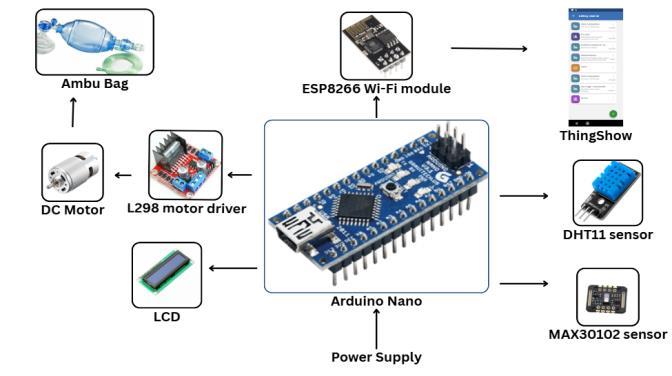
The block diagramoftheVentilatorSystem illustratesthe workingprincipleofanIoT-basedsmartventilatorsystem. ThecoreofthesystemistheArduinomicrocontroller,which serves as the central processing unit that coordinates all components.Itreceivesinputsignalsfromvarioussensors suchastheheartbeatsensor,temperaturesensor,andblood oxygen sensor (SpO₂ sensor) to continuously monitor the patient’s vital parameters. The microcontroller processes thisdataanddisplaysreal-timereadingsontheLCDdisplay and an app called ThingShow for easy observation. The ventilator unit, controlled via a driver circuit, provides automatedairflowtothepatient,withpurifiedairsupplied fromanAmbuBag.Thesystemispoweredbya regulated powersupplytoensurestableoperation.Forconnectivity, the IoT modem transmits the collected data to the cloud, enabling remote monitoring of patient health by medical personnel. This integrated setup makes the ventilator intelligent, efficient, and suitable for real-time patient monitoring in both hospitals and remote healthcare environments.
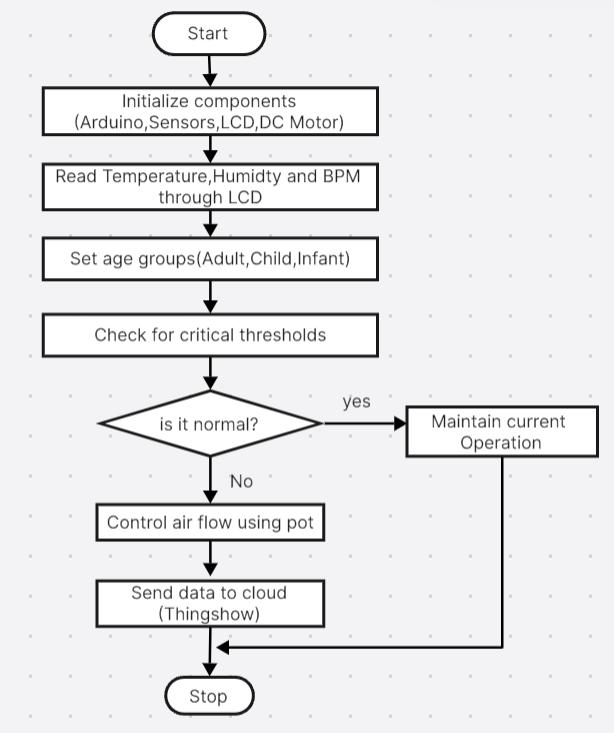
The System begins with the initialization of components, includingtheArduinomicrocontroller,sensorslikeDHT11 andMAX30102,LCDdisplay,andDCmotor.Onceinitialized, the system reads vital parameters such as temperature, humidity,andbeatsperminute(BPM)fromthesensorsand displaysthemontheLCD.Theuserthensetstheappropriate agegroup(Adult,Child,orInfant),toadjusttheventilator’s operationbasedonthepatient’sbreathingrequirements.The system continuously checks the measured parameters against critical thresholds to ensure patient safety. If the readingsarewithinnormallimits,theventilatormaintainsits currentoperation.However,ifabnormalvaluesaredetected, thesystemadjuststheairflowusingapotentiometer(pot)to stabilizethepatient’scondition.Finally,thesystemsendsall monitored data to the cloud platform (ThingSpeak or ThingShow)forremotemonitoringanddataanalysisbefore stoppingorloopingbackforcontinuousoperation.Thisflow ensures real-time monitoring, adaptive control, and IoT integrationforenhancedhealthcaresupport.
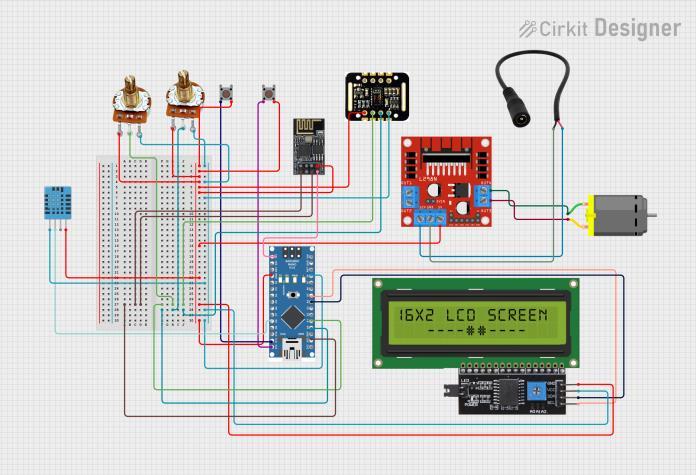
ThecircuitdiagramshowsanIoT-basedArduinoventilator systembuiltaroundanArduinoNano.ItconnectsaDHT11 sensor for temperature and humidity, and a MAX30102 sensorforbloodoxygenandheartratemonitoring.A16x2 LCD with I2C module displays real-time data. The L298N motordrivercontrolsaDCmotorthatoperatestheventilator mechanism,withpotentiometersusedtoadjustairflow.Push buttonsallowmanualinput,andanESP8266Wi-Fimodule sendsdatatothecloudforremotemonitoring.Thesetupis
International Research Journal of Engineering and Technology (IRJET) e-ISSN: 2395-0056
Volume: 12 Issue: 11 | Nov 2025 www.irjet.net p-ISSN: 2395-0072
poweredbyaregulatedsupply,enablingacompact,low-cost, andefficientventilatorcontrolsystem.
The implementation of the IoT-Based Smart Ventilator System has led to major improvements in affordable healthcare automation and patient monitoring. The key outcomesobservedinclude:
1. Automated VentilationControl: Thesystemefficiently operates a DC motor mechanism to compress the ventilatorbag,providingsmoothandconsistentairflow accordingtothepatient’sneeds.
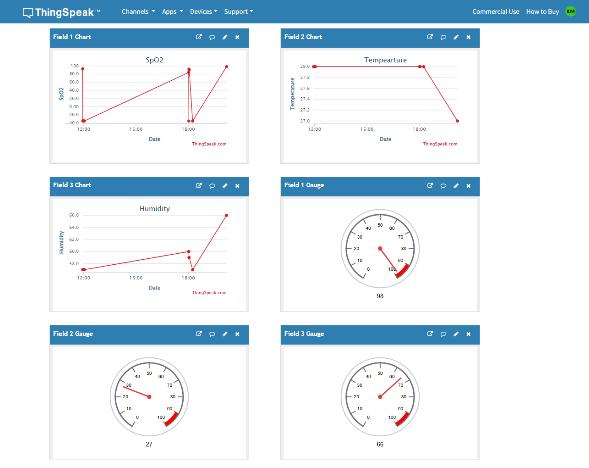
2. Real-TimeHealth Monitoring:Integratedsensorssuch as MAX30102 and DHT11 continuously monitor vital parameters like SpO₂, heart rate, temperature, and humidity,displayingaccuratereadingsontheLCD.
3. IoT-Based Data Transmission:UsingtheESP8266WiFi module, the ventilator successfully transmits realtime health data to cloud platforms like ThingSpeak, enablingremotemonitoringandrecord-keeping.
4. Automatic Alerts and Adjustments: The system detects abnormal readings and automatically adjusts airflowwhiletriggeringalerts,ensuringpatientsafety andtimelyintervention.
5. Enhanced Accessibility and Affordability: Thelowcost,portabledesignmakestheventilatorsuitablefor remote healthcare centers, emergency use, and resource-limitedareas,contributingtomoreaccessible life-supportsolutions.
7.
TheimplementationofanArduino-basedventilatorsystem demonstrates that affordable, efficient, and automated respiratory support can be achieved using embedded technology. The prototype successfully regulated airflow, monitored patient parameters, and reduced manual intervention, provingits potential asa reliablesolution in emergenciesandresource-limitedhealthcaresettings.This VentilatorSystemhighlightshowlow-costautomationand sensorintegrationcanaddresscriticalmedicalchallenges. Withfurtherimprovements inportability,IoTintegration, and compliance with medical standards, the system can evolveintoapractical,scalablesolutionforhospitals,rural healthcenters,anddisastermanagementscenarios.
[1] S. Rajalakshmi, S. Kavipriyabai, S. Vinodhini and S. Krithika,"VentilatorUsing ArduinowithBlood Oxygen Sensor," 2022 International Conference on Communication, Computing and Internet of Things (IC3IoT), Chennai, India, 2022, pp. 01-05, DOI: 10.1109/IC3IOT53935.2022.9767888.
[2] H.Gaur,S.Yadav, Shashikant,A.ShahinandM.Shahid, "Review On Design and Performance of the Medical Ventilators," 2023 International Conference on Power,
International Research Journal of Engineering and Technology (IRJET) e-ISSN: 2395-0056
Instrumentation,EnergyandControl(PIECON),Aligarh, India, 2023, pp. 1-5, DOI: 10.1109/PIECON56912.2023.10085815.
[3] R. B. Mohite, U. P. Waghmode, A. J. Chinchwade, S. D. Jadhav and V. E. Pawar, "E ventilator (Emergency ventilator) for Emergency Situations," 2023 IEEE 8th InternationalConferenceforConvergenceinTechnology (I2CT), Lonavla, India, 2023, pp. 1-6, DOI: 10.1109/I2CT57861.2023.10126249.
[4] https://www.researchgate.net/publication/37098981 1_E-ventilator_Emergency_ventilator_for_Emergency _Situations.
[5] https://www.researchgate.net/publication/392076594_ Patient_Monitoring_Low_-_Cost_Automated_ Ventilator.
[6] V. Krishna Prasath, R. Kiruthika Uma, R. Deekshita, T. Arun Prasath and M. Pallikonda Rajasekaran, "Smart AutomatedEmergencyVentilator(SAEVent):Designofa Low-Cost,InnovativeAndPortableVentilator," 20239th International Conference on Smart Computing and Communications (ICSCC),Kochi,Kerala,India,2023,pp. 606-609,doi:10.1109/ICSCC59169.2023.10335041.
[7] https://youtu.be/bS_2QTzhkDY.
[8] A. R. da Silva et al., “Low-Cost Open-Source Ventilator PrototypesforCOVID-19,”IEEEAccess,vol.9,pp.122–132,2021,doi:10.1109/ACCESS.2021.3050799.
[9] S.P.LalandP.S.Velmurugan,“DesignandDevelopment of an IoT-Based Smart Ventilator,” 2021 International Conference on Smart Electronics and Communication (ICOSEC), pp. 130–135, doi: 10.1109/ICOSEC51865.2021.9591715.
[10] A. Sharma et al., “Development of a Low-Cost Mechanical Ventilator Using Arduino,” 2020 IEEE InternationalConferenceonElectronics,Computingand CommunicationTechnologies(CONECCT),pp.1–6,doi: 10.1109/CONECCT50063.2020.9198535.
Volume: 12 Issue: 11 | Nov 2025 www.irjet.net p-ISSN: 2395-0072 © 2025, IRJET | Impact Factor value: 8.315 | ISO 9001:2008