
International Research Journal of Engineering and Technology (IRJET) e-ISSN: 2395-0056
Volume: 12 Issue: 10 | Oct 2025 www.irjet.net p-ISSN: 2395-0072
International Research Journal of Engineering and Technology (IRJET) e-ISSN: 2395-0056
Volume: 12 Issue: 10 | Oct 2025 www.irjet.net p-ISSN: 2395-0072
Prathmesh N. Suryawanshi1, Vaishnavi S. Pawar2, Darshan S. Jadhav3 , Soniya A. Borse4
1 Prathmesh Nitin Suryawanshi, Student, MCA, MET Institute of Management, Nashik, Maharashtra, India.
2 Vaishnavi Sunil Pawar, Student, MCA, MET Institute of Management, Nashik, Maharashtra, India.
3 Darshan Sudhakar Jadhav, Student, MCA, MET Institute of Management, Nashik, Maharashtra, India.
4 Soniya Abhijit Borse, Assistant Professor, Department, MCA, MET Institute of Management, Nashik, Maharashtra, India.
Abstract – The modern food supply chain is characterized by a critical and unsustainable paradox: the systematic wastage of over a billion tonnes of food annually while hundreds of millions of people face chronic hunger. The food service and hospitality sectors are significant contributors to this crisis, generating approximately 290 million tonnes of surplus food in 2022 alone. This inefficiency not only representsaprofoundeconomiclossbutalsoimposesasevere environmental burden, accounting for up to 10% of global greenhouse gas emissions. While numerous digital platforms haveemergedtoaddressthischallengebyredirectingsurplus food,theexistinglandscapeisfragmented.Manysolutionsare mobile-centric applications that rely on informal, volunteerbased logistics, which, despite fostering community engagement, often struggle with operational reliability and scalability key requirements for commercial food establishments. Other web-based systems provide more structure but often lack the comprehensive B2B framework needed to build long-term, dependable partnerships. This paper introduces NourishNow, a web-based digital platform architected specifically to bridge this gap by creating a formalized, reliable, and transparent food rescue ecosystem. The platform connects verified commercial donors, such as hotels and restaurants, with established non-governmental organizations (NGOs) through a structured workflow that includes real-time listings, formal request and approval mechanisms, and end-to-end donation tracking. Built on an enterprise-grade technology stack featuring Angular and Spring Boot, NourishNow is designed for high performance, security, and scalability. By providing a dependable and auditable solution, NourishNow offers a significant contribution toward integrating food rescue into standard businesspractices,aligningwithUNSustainableDevelopment Goals, and fostering a more equitable and sustainable urban food system.
NOMENCLATURE
ListofAbbreviations
API ApplicationProgrammingInterface
AWS AmazonWebServices
B2B Business-to-Business
CRUD Create,Read,Update,andDelete
CSR CorporateSocialResponsibility
ERP EnterpriseResourcePlanning
FLW FoodLossandWaste
GHz Gigahertz
HTTPS HypertextTransferProtocolSecure
ID IdentificationorIdentityDocument
INR IndianRupeeIoTInternetofThings
JSON JavaScriptObjectNotation
JWT JSONWebTokens
MERN MongoDB,Express,React,andNode.js
NGO Non-GovernmentalOrganization
ORM Object-RelationalMapping
PHP HypertextPreprocessor
PPP Public-PrivatePartnership
RAM Random-AccessMemory
RBAC Role-BasedAccessControl
REST RepresentationalStateTransfer
SDG SustainableDevelopmentGoals
SMS ShortMessageService
SPA Single-PageApplication
SQL StructuredQueryLanguage
UAT UserAcceptanceTesting
UN UnitedNations
UNEP UnitedNationsEnvironmentProgramme
USDA UnitedStatesDepartmentofAgriculture
XSS Cross-SiteScripting
The concurrent global crises of food wastage and hunger represent a profound and unsustainable paradox. An estimated1.05billiontonnesoffoodwerewastedin2022, amounting to 132 kg per capita annually, with the food servicesectorbeingaprimarycontributor[1].Thisimmense volumeofwastecarriessevereconsequences,contributing to 8-10% of global greenhouse gas emissions and representingasignificantlossofthewater,land,andenergy resourcesinvestedinitsproduction[2].InnationslikeIndia, thisissueisparticularlyacute,withsignificantfoodwaste occurringevenasthecountrygrappleswithahighrankon the Global Hunger Index [1]. A substantial portion of this surplus, particularly from the hospitality sector, remains
International Research Journal of Engineering and Technology (IRJET) e-ISSN: 2395-0056
Volume: 12 Issue: 10 | Oct 2025 www.irjet.net p-ISSN: 2395-0072
perfectly edible and nutritious at the point of disposal, highlighting a critical opportunity to redirect wholesome foodfromlandfillstothoseexperiencingfoodinsecurity.
Efforts to bridge this gap through food donation are wellestablished but are frequently undermined by systemic inefficiencies. Traditional, non-digital methods of coordination are often fragmented and suffer from significant communication delays, logistical complexities, and a lack of transparency [4], [5]. In response, a new generationoftechnology-drivensolutionshasemerged.The literature describes various approaches, including mobile applications built on frameworks like Flutter that rely on volunteer networks [3] and web-based platforms using stackssuchasDjango[6]ortheMERNstack[7].Whilethese systems demonstrate the potential of digital intervention, they often face challenges related to scalability and the reliabilityofinformallogistics[5].Apersistentgapexistsfor a structured and dependable platform tailored to the operationaldemandsofcommercialfoodestablishmentsand theformalneedsofregisteredNGOs.
This paper introduces NourishNow, a web-based digital platform specifically architected to address these shortcomings.ItestablishesaformalizedBusiness-to-NGO (B2B)ecosystemdesignedforreliabilityandscalability.The system moves beyond ad-hoc connections by providing a structured workflow for real-time surplus food listings, a formalrequestandapprovalmechanism,andtransparent, end-to-end tracking of all donations. By leveraging an enterprise-grade technology stack (Angular and Spring Boot),NourishNowoffersarobustandsecuresolutionthat commercial enterprises can integrate into their standard operating procedures as part of their Corporate Social Responsibility(CSR)activities[8].Thisresearchdetailsthe design, implementation, and performance of the platform, demonstratingitspotentialasascalabletooltoreducefood waste and create a sustainable, efficient channel for alleviatinghungerinurbancommunities.
The landscape of food redistribution is defined by a transition from informal, manual systems to technologyenabled platforms. Traditional approaches, relying on manual coordination between donors and charities, are consistentlyhamperedbysignificantlogisticaldelays,poor real-timecommunication,andalackofscalable,transparent processes. The absence of a centralized system makes it difficulttoefficientlymatchsupplywithdemand,resultingin aconsiderableportionofediblefoodbeingdiscardeddespite goodintentions.
In response to these inefficiencies, a variety of digital interventions have been developed, which can be broadly categorizedbytheiroperationalmodels.Themostcommon are mobile-centric applications that leverage a volunteer workforce. A prominent example is the "Food Share"
platform, a cross-platform mobile app connecting donors, volunteers,andrecipientsthroughcommunityengagement [3].Othersystemsfollowasimilarmobile-first,volunteercentricmodel,highlightingtheaccessibilityofthisapproach [4],[11].Whileeffectiveatfosteringlocalinvolvement,their operationalreliabilityandscalabilityareoftenconstrained byadependenceonthefluctuatingavailabilityofvolunteers [5].
Asecondcategoryincludesweb-basedplatformsthataimto establish more formal, B2B connections between organizations.Systemslike"FoodShala,"builtontheDjango framework [6], and other web applications using technologies like the MERN stack [7], focus on creating a directlinkbetweenfoodserviceestablishmentsandNGOs. Some introduce novel concepts like third-party logistics integration, while more advanced proposals outline ERPstyle systems with defined roles for all stakeholders to createafullymanagedsupplychain[4].
Despitethesetechnologicaladvancements,existingsystems exhibit persistent limitations. A primary challenge across nearly all models is the complexity of logistics, including efficientroutingandtimelypickups.Scalabilityalsoremains a significant hurdle, with many platforms struggling to expand their operational footprint effectively [5]. Furthermore, many systems lack robust mechanisms for data tracking and accountability, which are crucial for building long-term trust. A systematic review of the literature confirms that while digital platforms are a prevalent intervention, there is a need for solutions that offergreaterstructureandtraceability[2].
This technological landscape is further contextualized by broader academic research. Studies on urban food governance, for instance, reveal that the success of such platforms is deeply intertwined with municipal policies, highlighting the need for systems to foster public-private partnerships[9].Moreover,aforward-lookingthemeinthe literature is the shift from reactive redistribution to proactivesurplus preventionthroughtoolslikepredictive analytics,whichhavebeenshowntoaccuratelyforecastfood demand[10].
Insummary,theliteraturedemonstratesaclearpotentialfor technology to revolutionize food rescue but also reveals a consistent gap in providing a solution that combines scalability, operational reliability, and a formalized B2B framework.Theshortcomingsofcurrentinformalanddigital systems highlight the specific need for a platform like NourishNow,whichisarchitectedtoprovidethestructural integrity and professional-grade service required to integrate surplus food redistribution into the standard operationsofcommercialenterprises.
International Research Journal of Engineering and Technology (IRJET) e-ISSN: 2395-0056
Volume: 12 Issue: 10 | Oct 2025 www.irjet.net p-ISSN: 2395-0072
The concurrent challenges of systemic food wastage and persistent hunger represent a significant operational and ethical failure within global food supply chains. Despite sufficient global food production, vast quantities of edible food are discarded, particularly in urban centers by the hospitalityandfoodservicesectors[1].Thissurplusfood,if not efficiently redirected, contributes to severe environmentaldegradationthroughthereleaseofmethane inlandfills,squanderseconomicvalue,andrepresentsalost opportunitytoaddressfoodinsecurity[2],[7].Studiesreveal that a substantial portion of food served in institutional settings is wasted, indicating a consistent and predictable streamofrecoverablesurplus[13].
However,theeffectiveredistributionofthissurplusfoodis impededbyseveralcritical,recurringproblemsinherentin traditionalandexistingdonationsystems:
1. Lack of Real-Time Coordination and Information
Asymmetry: The primary obstacle is the absence of a dynamiccommunicationchannelbetweenfooddonorsand recipient organizations. Conventional methods rely on manual, asynchronous communication, resulting in significant delays that render perishable food unsafe for consumptionbeforeitcanbecollected[4],[5].
2. LogisticalInefficiencies:Theprocessoffooddonationis oftenburdenedbyuncoordinatedpickupschedulesand inefficientrouting.Thesecomplexitiescreateahigh operationalbarrierforfooddonors,suchasrestaurants andhotels,whorequireasimpleandreliablemethodto managetheirsurplus,therebydiscouragingconsistent participation[1],[7].
3. Scalability and Reliability Deficiencies: Many existing digitalplatformsdependonvolunteer-basedmodelsorare geographically constrained. This reliance on an informal workforcecanleadtounreliabilityandmakesitdifficultto scale operations sustainably, failing to provide the dependableservicerequiredbycommercialentities[3],[5].
4.AbsenceofTransparencyandAccountability:Traditional donationchannelsoftenlackmechanismsfortrackingand reporting.Thisopacitypreventsdonorsfromverifyingthe impact of their contributions and inhibits NGOs from effectively planning their distribution efforts based on predictablesupply.Alackoftransparentdataerodestrust andlong-termengagementamongstakeholders[2].
Therefore,thecentralproblemistheabsenceofastructured, scalable, and technologically robust digital framework specificallydesignedtoformalizetheBusiness-to-NGO(B2B) foodredistributionprocess.Adedicatedsystemisrequired to overcome the aforementioned inefficiencies by streamlining communication, standardizing logistics, and ensuring end-to-end transparency, thereby transforming
foodsurplusfromanoperationalwasteintoaconsistentand reliablecommunityresource.
The methodology for developing NourishNow focused on creatingareliableandscalabledigitalplatformforB2Bfood redistribution.Theapproachwasdesignedtoovercomethe logistical and procedural gaps in existing systems by implementingastructuredworkflowonarobust,multi-tier architecture.
Theplatform'sarchitecturewasdesignedinthreedistinct tiers to separate concerns and enhance performance. The frontend is a single-page application developed with Angular,offeringrole-baseddashboardsforallusertypes. The backend logic is managed by a Spring Boot (Java) applicationthatprovidesa suiteofRESTfulAPIs.Fordata storage,aMySQLrelationaldatabasewaschosentoensure the integrity of all transactional records. Authentication throughouttheplatformissecuredusingJSONWebTokens (JWT),whichprovidesthebasisforthesystem'srole-based accesscontrol.
Functionalitywasorganizedintodistinctmodulestailoredto the three primary stakeholders: Donors, NGOs, and Administrators.Theplatform’sworkflowproceedsthrougha transparentsequenceofevents:
1.Adonorinitiatestheprocessbylistingavailablesurplus food.
2.RegisteredNGOsinthevicinityarealertedandcansubmit aformalrequestforthedonation.
3.Thedonorreviewsandapprovesa request,after which contactdetailsaresharedtocoordinatethepickup.
Everystageofthisprocessislogged,creatingacompleteand auditable transaction history that can be used for operationalplanningandCSRreporting[2],[8].
Toensuresystemintegrity,amulti-facetedsecuritymodel wasimplemented.ThisincludesJWTforauthorization,RoleBasedAccessControl(RBAC)torestrictactionsbyusertype, server-sidevalidationagainstcommonexploits,andHTTPS encryption for all communications [12]. The architecture was built for scalability using stateless APIs and asynchronousoperationstomaintainresponsivenessunder heavy load. The platform was validated through a comprehensive testing strategy that included unit, functional, performance (JMeter), and User Acceptance Testing(UAT)toconfirmitmeetsallstakeholderneeds.
Volume: 12 Issue: 10 | Oct 2025 www.irjet.net p-ISSN: 2395-0072
Thefindingsofthisstudyaddressaproblemofsignificant nationalscale;inIndia,foodwastefromhouseholdsaloneis estimated at 78.2 million tonnes per year, with the commercial food sector also being a major source. To understandthisissueatalocallevel,thisresearchanalyzed surveydatafromkeystakeholdersintheNashikarea.The participantpoolincludedsixNGOswithdiverseoperational capacities from small, city-focused teams to extensive state-wide volunteer networks and five hospitality businesses,spanningfrom1-starto5-starestablishments.
To address the coordination barriers evident in this local context,theNourishNowplatformwasengineeredforhigh responsivenessandstability.Thesystemunderwentaseries offunctionalandstressteststoassessitsperformanceunder simulatedreal-worldconditions.Theaverageresponsetimes forcoreuserworkflowsweremeasuredtobeveryfast,and stress testing revealed robust performance as user load increased.Theplatform'sthroughputsuccessfullyhandleda high volume of requests per second, confirming that the architectureisbothefficientandscalable.
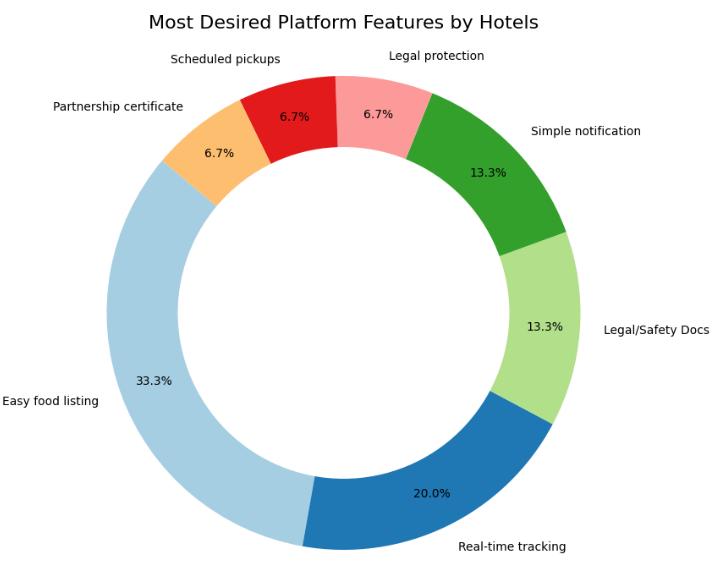
As illustrated in Fig. 2, the survey of hotel establishments revealedthateaseofuseistheirprimaryrequirementfora food donation platform. A third of respondents at 33.3% prioritizedan"Easyfoodlisting"feature, whilesignificant supportwasalsoshownfor"Real-timetracking"at20.0%to ensure transparency and "Legal/Safety Docs" at 13.3% to addresssecurityconcerns.Theseuserpreferencesvalidatea designapproachfortheplatformcenteredonsimplicityand trust.
These combined performance and projection results demonstratetheviabilityoftheplatform'sstructured,B2Bfocuseddigitalsolution.Acentralfindingisthesignificance of the B2B model, which provides the formality and accountability crucial for engaging commercial donors. While the implications of this work are significant for advancing urban sustainability, it is important to acknowledgethestudy'slimitations,includingthesimulated nature of the performance tests and the model's focus on redistribution rather than root-cause prevention. Despite these limitations, the NourishNow platform provides a robust and validated framework that contributes to the efforttobuildmoreresilient,efficient,andequitableurban foodsystems.
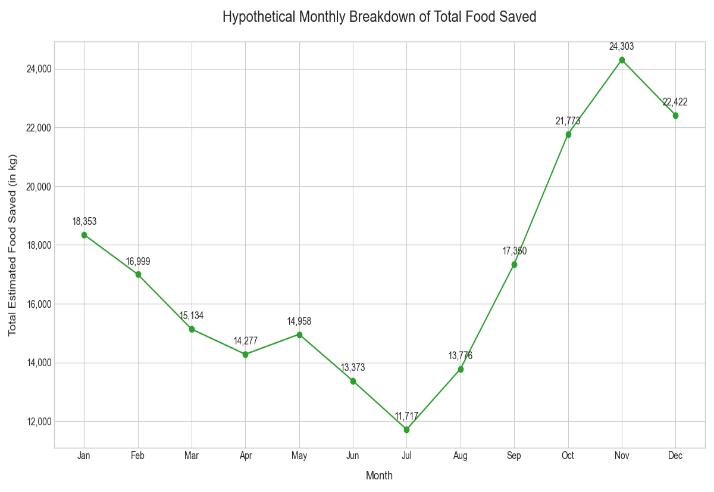
Apredictivemodeldevelopedfromthelocalsurveydatawas then used to forecast the potential impact of such a coordinatedsystem.Theprojectionindicatesasubstantial positivegrowthtrend,withthetotalvolumeofsavedfood expectedtoincreasefromapproximately118,524kgin2021 to over 205,432 kg by 2025. Furthermore, the analysis reveals a distinct seasonal variability withina singleyear, where donation volumes peak in the final quarter and declineduringmid-yearmonths.
International Research Journal of Engineering and Technology (IRJET) e-ISSN: 2395-0056
Volume: 12 Issue: 10 | Oct 2025 www.irjet.net p-ISSN: 2395-0072
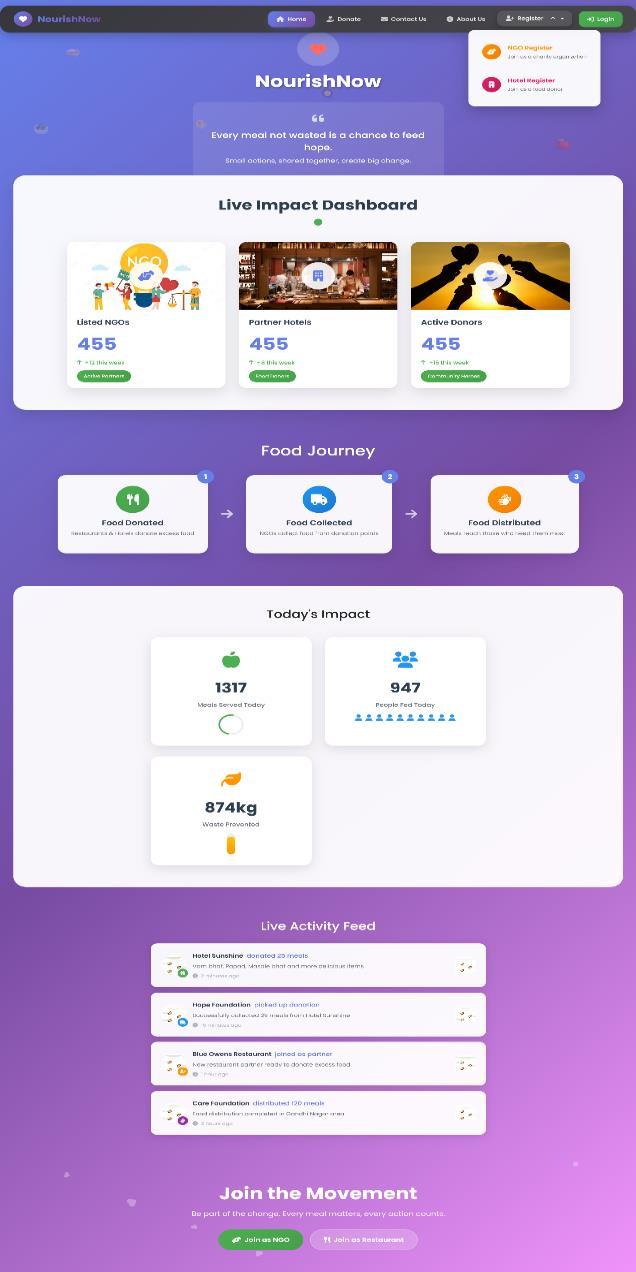
HomepageShowcasingReal-TimePlatformImpact andActivity.
Theplatform'spublic-facinghomepageisdesignedasa"Live Impact Dashboard" to foster community engagement and buildtrustthroughtransparency.Ithighlightskeyreal-time metrics, including the total number of partners, a visual "FoodJourney"oftheprocess,andasummaryofthedaily impact.Acentralfeatureisthe"LiveActivityFeed,"which displays recent donations to provide social proof and showcasethe collective, real-timesuccessoftheplatform, encouragingnewparticipation.
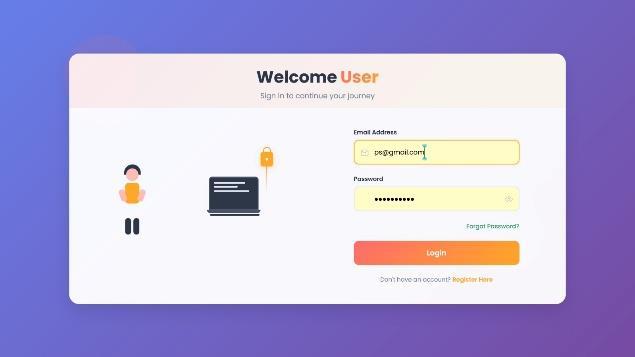
Theplatform'slogininterface,wasdesignedforsecurityand ease of use. It features standard email and password authentication,alongwithessentialfunctionsforpassword recoveryandnewuserregistration.Theclean,user-centric designaimstobuildtrustandencourageplatformadoption bybothdonorandNGOusers.
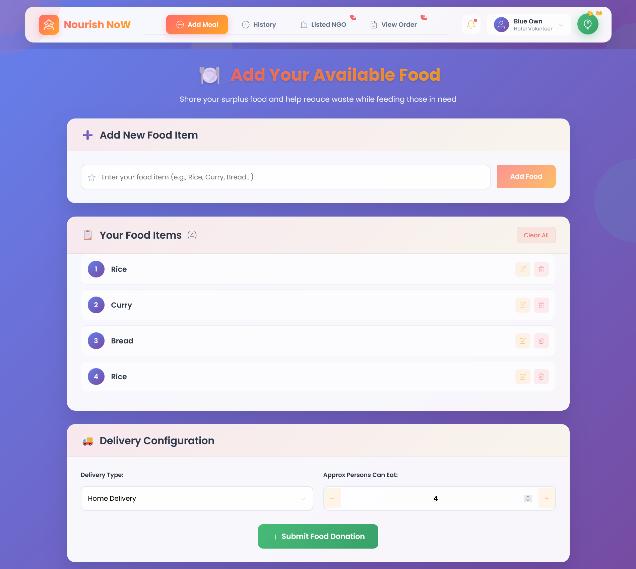
Thisstreamlinedworkflowallowsfooddonorstolistsurplus foodinafewintuitivesteps.Theuser-centricdesigndirectly addressesthetop feature requested in thehotel survey "Easyfoodlisting" makingtheprocessfastandefficientfor busycommercialkitchens
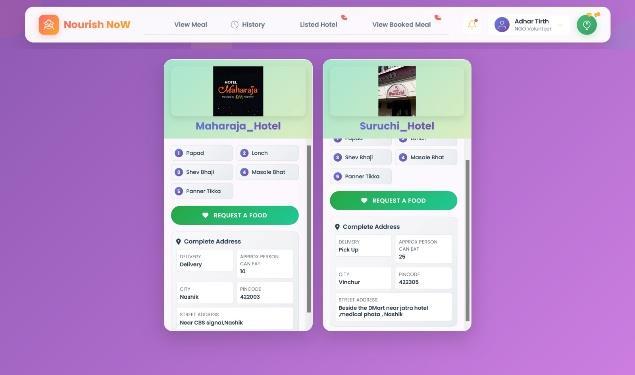
From the NGO's perspective, this "View Meal" dashboard displaysavailablefooddonationsusingaclear,card-based layout.Eachcardprovidesallcriticalinformationataglance: thedonor'sname,a listoffooditems,themeal'scapacity, and the location. This design allows NGO volunteers to efficientlybrowseandclaimsuitabledonationswithasingle click on the "Request a Food" button, streamlining the discoveryandacquisitionprocess.
International Research Journal of Engineering and Technology (IRJET) e-ISSN: 2395-0056
Volume: 12 Issue: 10 | Oct 2025 www.irjet.net p-ISSN: 2395-0072
[1] L. Devaraj and P. Balasubramanian, "Optimizing the RedistributionofSurplusFoodintheHospitalitySector...," Sustainability, vol. 17, no. 8, p. 3556, Apr. 2025, doi: 10.3390/su17083556.
[2]C.TrevisanandM.Formentini,"DigitalTechnologiesfor FoodLossandWastePreventionandReductioninAgri-Food SupplyChains:ASystematicLiteratureReviewandResearch Agenda," IEEE Transactions on Engineering Management, vol. 71, pp. 12327-12342, Dec. 2024, doi: 10.1109/TEM.2023.3273110.
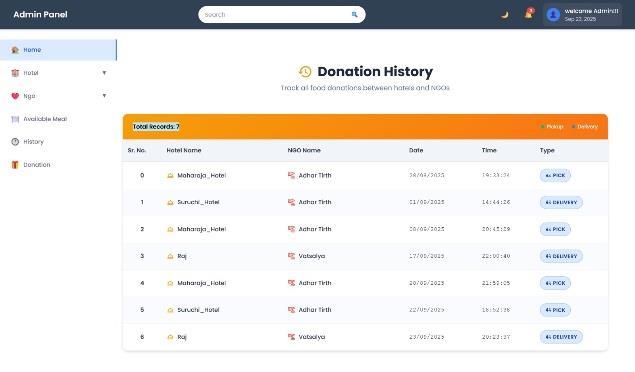
The platform's administrative backend provides comprehensive oversight of all platform activities. The centralfeatureisthe"DonationHistory"log,whichoffersa detailedandauditablerecordofeverytransactionbetween donorsandNGOs.Eachentrycapturescrucialdata,including theparticipatinghotelandNGO,theprecisedateandtime, and the transfer type. This centralized tracking system is vital for ensuring transparency, accountability, and the overallintegrityofthefoodrescueprocess.
This paper introduced NourishNow, a web-based digital platformarchitectedtoaddressthecriticalfailuresinurban foodredistribution.Itconfrontstheparadoxofconcurrent food surplus and hunger by specifically targeting the limitationsofexistingsystems,whichareoftenunstructured, reliant on inconsistent volunteer networks, and lack the scalability required by commercial enterprises. By establishing a formalized B2B ecosystem, NourishNow implements a transparent workflow for real-time listings, formalrequests,andcomprehensivedonationtracking.The platform's foundation on an enterprise-grade technology stack,featuringAngularandSpringBoot,anditssuccessful performancevalidationconfirmitasarobustandscalable solutionreadyforreal-worlddeployment.
Theprimarycontributionofthisworkisadependableand auditable framework that transforms food rescue from a seriesoffragmentedeffortsintoanorganized,sustainable movement. By providing a reliable tool for businesses to engage in corporate social responsibility, the platform directly supports the achievement of the United Nations Sustainable Development Goals of Zero Hunger and Responsible Consumption and Production. NourishNow offersasignificantstepforward,presentingascalablemodel toconvertfoodsurplusfromanoperationalwastestream intoaconsistentandvaluablecommunityresource,thereby fosteringamoreequitableandefficientfoodsystemforthe future.
[3]E.J.George,A.R.Khan,M.K,M.S.PT,andR.M,"Food Share: A Collaborative Platform for Food Donation and Distribution," International Journal of Research in EngineeringandScience(IJRES),vol.12,no.4,pp.317-326, Apr.2024.
[4]K.Pazhaniveletal.,"ASmartFoodDonationSystemusing Mobile Technology to Reduce Food Waste," International Journal of Advanced Research in Science, Communication andTechnology(IJARSCT),vol.4,no.7,Apr.2024.
[5] S. Singh, Kartik, Aryan, and S. Chauhan, "Waste Food Management and Donation App," International Research Journal of Modernization in Engineering Technology and Science,vol.6,no.11,Nov.2024.
[6]M.Moreetal.,"FoodShala–Awaytoreducefoodwaste anddonatingittothelessfortunate,"InternationalJournalof InnovativeResearchinTechnology(IJIRT),vol.10,no.1,pp. 927-930,June2023.
[7]R.Maske,R.Wagh,A.Verma,O.Thopate,andB.Bhagat, "A View on Surplus Food Donation App," International JournalforMultidisciplinaryResearch(IJFMR),vol.6,no.1, Jan-Feb.2024.
[8]P.Sirijuntrapun,P.Sukwong,andA.Marshall,"Theroleof food waste hierarchy as Thai hotels seek to fulfill their corporatesocialresponsibility,"Heliyon,vol.8,Nov.2022, Art.no.e11201,doi:10.1016/j.heliyon.2022.e11201.
[9]M.PixováandC.Plank,"Urbanfoodgovernancewithout localfood:missinglinksbetweenCzechpost-socialistcities andurbanfoodalternatives,"AgricultureandHumanValues, Aug.2024,doi:10.1007/s10460-024-10567-2.
[10]K.Lutoslawski etal.,"FoodDemand PredictionUsing theNonlinearAutoregressiveExogenousNeuralNetwork," IEEE Access, vol. 9, pp. 146123-146135, Oct. 2021, doi: 10.1109/ACCESS.2021.3123255.
[11]V.Panchal,K.Kuchekar,andS.Tambe,"Availabilityof foodforNGOthroughMobileApplication:FOODFORALL," International Research Journal of Engineering and Technology(IRJET),vol.7,no.5,May2020.
International Research Journal of Engineering and Technology (IRJET) e-ISSN: 2395-0056
Volume: 12 Issue: 10 | Oct 2025 www.irjet.net p-ISSN: 2395-0072
[12]S.Garciaetal.,"SecurityandPrivacyinFoodDonation Platforms,"IEEESecurity&Privacy,vol.19,no.5,pp.56-64, Sep./Oct.2021,doi:10.1109/MSP.2021.3075253.
[13]L.C.Hopkinsetal.,"PlateWasteinUSDASummerFood ServiceProgramOpenSites:ResultsfromtheProjectSWEAT Sub-Study,"Journal ofHunger&Environmental Nutrition, vol. 18, no. 5, pp. 699-712, Oct. 2023, doi: 10.1080/19320248.2023.2245783.
[14]A.Dhir,S.Talwar,P.Kaur,andA.Malibari,"Foodwaste in hospitality and food services: A systematic literature reviewandframeworkdevelopmentapproach,"Journalof CleanerProduction,vol.270,Oct.2020.
2025, IRJET | Impact Factor value: 8.315 | ISO 9001:2008