
International Research Journal of Engineering and Technology (IRJET) e-ISSN: 2395-0056
Volume: 12 Issue: 01 | Jan 2025 www.irjet.net p-ISSN: 2395-0072
International Research Journal of Engineering and Technology (IRJET) e-ISSN: 2395-0056
Volume: 12 Issue: 01 | Jan 2025 www.irjet.net p-ISSN: 2395-0072
Gaurav1 , Dr. V. K. Singh2 , Dr. Sakshi Chauhan3
1PhD scholar, Dept. of Mechanical Engineering, GBPUAT Pantnagar, Uttarakhand, India
2Professor, Dept. of Mechanical Engineering, GBPUAT Pantnagar, Uttarakhand, India
3Asst. Professor, Dept. of Mechanical Engineering, GBPUAT Pantnagar, Uttarakhand, India
Abstract - The study examines the effects of T6 heat treatment on the hardness of aluminumcomposites reinforced with boron carbide (B4C). Aluminum alloy 2024 (AA2024) served as the matrix material, with boron carbide particles incorporated to enhance its mechanical properties. A standard T6 heat treatment process comprising solutionizing, quenching, and aging was applied to the composite samples. Microstructural analysis revealed significant precipitation hardening and uniform dispersion of B4C particles as a result of the heat treatment. Comparedto as-cast composites, the T6treated samples exhibited a marked increase in hardness, attributed to the combinedeffects ofmatrixstrengtheningand reinforcement. The findings underscore the synergistic impact of heat treatment and B4C reinforcement on enhancing the mechanical performance of aluminum composites, pavingthe way for high-performance applications.
Key Words: Aluminium Matrix Material, Aluminium alloy, Rockwell Hardness, Stir casting, SEM
1.INTRODUCTION
Overthepasttwodecades,aluminiummatrixcomposites (AMCs)havemadesignificantadvancements,demonstrating improved performance characteristics [1]. Aluminium matrixcompositespossessadvancedpropertiessuchaslow density, excellent electrical and thermal conductivity, exceptionalresistancetooxidationandwear,highspecific strength and stiffness, and durability at elevated temperatures[2].Thesecompositesareidealforautomotive andaerospaceapplications,astheyaredesignedtoreduce weight while enhancing mechanical properties such as strength and stiffness [3]. Non-metallic ceramic particles suchassiliconcarbide,boroncarbide,andtitaniumcarbide are commonly used as reinforcements in aluminium matricestoproducealuminiummatrixcomposites(AMCs) [4].
Ceramic reinforcement composites have garnered significantattentionacrossvariousindustrialsectorsdueto their outstanding properties and versatility. These composites typically consist of a metal or ceramic matrix reinforcedwithceramicfibers,particles,orwhiskers,which significantly enhance their mechanical, thermal, and electrical performance. The addition of ceramic reinforcements improves the composite’s hardness, wear
resistance, thermal stability, and electrical conductivity, makingthemidealfordemandingapplicationsinaerospace, automotive, electronics, and energy sectors [5], [6], [7]. Titaniummatrixcomposites(TMCs)reinforcedwithboron carbide (B4C) exhibit excellent mechanical properties, including high strain rates and impressive compressive strengths [5]. Ceramic reinforcement composites offer a widerangeofpossibilitiesfortailoringmaterialproperties to meet specific application needs. The fabrication techniques, such as additive manufacturing, powder metallurgy, and stir casting, play a crucial role in determining the composite's microstructure and performancecharacteristics[8],[9],[10].
Stircastingisawidelyusedandcost-effectivemethodfor fabricating metal matrix composites (MMCs), particularly AMCs. This process involves mechanically stirring reinforcing particles into molten metal to ensure their uniformdistributionthroughoutthematrix[11],[12].The stir casting method is preferred for its simplicity, proven effectiveness, and suitability for large-scale production, making it an ideal choice for manufacturing aluminium matrixcomposites[11].Thequalityandpropertiesofstircast composites are influenced by several key factors, includingtheselectionofmatrixandreinforcingmaterials, alongwithparameterssuchasstirringtemperature,speed, andduration.Thesevariablesplayacrucialroleinensuring ahomogeneousdistributionofreinforcementandachieving thedesiredmechanicalandtribologicalproperties[12],[13]. Remarkably, when compared to traditional methods, the application of ultrasonic energy during stir casting has shownsignificantimprovementsinparticledispersionand theresultingmechanicalproperties.Theuseofultrasound helpsbreakdownparticleagglomerationsandenhancesthe uniformity of the reinforcement distribution within the matrix, leading to better overall performance of the composite[14].Nonetheless,challengessuchasachieving consistentparticledispersionandensuringproperwetting ofthereinforcementparticlesremainprevalent[15].
The composition and manufacturing methods of aluminiumcompositematerialssignificantlyinfluencetheir Rockwell hardness values. Typically, the addition of reinforcementssuchasceramicparticles,likeboroncarbide or silicon carbide, enhances the hardness of aluminium compositeswhencompared topurealuminium[16],[17],
International Research Journal of Engineering and Technology (IRJET) e-ISSN: 2395-0056
Volume: 12 Issue: 01 | Jan 2025 www.irjet.net p-ISSN: 2395-0072
[18].Aluminiumalloysreinforcedwithnano-TiO2 particles through friction stir processing (FSP) exhibit enhanced toughness[19].Similarly,theadditionofceramicparticles like titanium diboride (TiB2) to aluminium matrices significantlyenhancestheirhardnessandothermechanical properties.TiB2,beingahardceramicmaterial,contributes toincreasedwearresistanceandhardness[20].Incertain instances, it was discovered that the peak hardness of reinforced composites was either slightly higher than or equivalenttothatofunreinforcedalloys[21].
The AA2024 alloy was procured in block form from a supplierbasedinMumbai.Boroncarbidewasprocuredin powderformfromasupplierbasedinMumbai.Theaverage particlesizeofboroncarbidewas40-50microns.
The AA2024 block was carefully cleaned to remove impuritiesanddirtbeforemelting.Thisstepwascrucialto ensure the quality of the final alloy and minimize contaminants that could negatively affect the material's properties.ThecleanedAA2024blockwasplacedinacoalfired furnace. Coal furnaces were chosen for their accessibility and common usage, despite electric or gas furnaces being more prevalent due to their superior temperature control for melting. During the smelting process,slag,anon-metallicwaste,andotherimpuritiesthat hadaccumulatedatthesurfaceofthealuminiummeltwere removed.Thisprocesshelpedmaintainthealloy'spurityby eliminating oxides and other contaminants that could negativelyimpactitsmechanicalproperties
Boroncarbidewasaddedinweightpercentagesof8,10, 12, 14, and 16, and the molten mixture was vigorously stirred to ensure thorough mixing. Stirring is crucial in castingoperationsasitpreventstheformationoflocalized regions where alloying components could concentrate. Uniform mixing is essential to maintain a consistent microstructure throughout the material, which in turn ensures the uniformity of its mechanical properties. The moltenliquidwaspouredintopreheatedmoldstominimize thermalshockandensureasteadyflowofthemoltenmetal. Thisapproachreducestheformationofinternalstressesin the alloy, which could otherwise lead to cracking or deformation due to rapid cooling. The molds were specifically designed to produce circular samples, which were then further processed to create hardness test specimens.
Thecastingswereallowedtocoolnaturallyinambientair, rather than using forced cooling methods such as water quenching. This approach was chosen to prevent thermal stresses that could lead to cracking or warping of the
samples.Theslowcooling rateintheambientairenabled more controlled solidification of the aluminium alloy, ensuring a more uniform and stable microstructure. Once thecastingshadfullysolidified,theywerecarefullyremoved fromthemolds.
Aftercasting,thecircularsampleswerecutforhardness testing. The surfaces of these specimens were smoothed usingemerypaperandthencleanedwithacetonetoremove anycontaminants.
AspecificprocessknownasT6heattreatmentisapplied toaluminiumalloystoimprovetheirmechanicalproperties, such as strength and hardness. The composite samples underwent a standard T6 heat treatment process, which involvedsolutionizing,quenching,andaging.
Duringthesolutionizingprocess,thealuminiumalloyis heated to about 500°C, allowing the soluble alloying elements, such as copper in AA2024, to dissolve into the aluminiummatrixandformasolidsolution.
Afterthesolutionheattreatment,thealloyingelements aretrappedinthesolutionbyrapidlycoolingthematerial withwater.Thisquenchingprocesspreventstheformation ofprecipitatesatroomtemperature,keepingthematerialin asupersaturatedsolidsolution.
Followingthequenching,thematerialundergoesartificial aging at a lower temperature, typically around 180°C, for approximately24hours.Thisprocessallowstheprecipitates toformandenhancethematerial'sstrengthandhardness.
3.1
TheRockwellhardnesstestisacommonlyusedmethod toassessthehardnessofmaterials,includingalloys.Inthe Rockwellhardnesstest,ahardenedsteelballindenterisused to apply an initial force of 10 kgf to the specimen. The diameterofthehardenedsteelballindenterusedinthetest was1/16inch.Thisinitialforce,referredtoasthe"preload," ensuresthattheindentermakescontactwiththesurfaceof thespecimen.Subsequently,alargertestforce(majorload) of100kgfisapplied,causingtheindentertopenetratethe material.Afterapredeterminedduration,themajorloadis removed, and only the minor load remains applied to the specimen. The depth of the indentation created under the minorloadisthenmeasured.TheRockwellhardnessvalueis determinedbymeasuringthedepthoftheindentationand applyingEquation(1)correspondingtothescaleinuse.

International Research Journal of Engineering and Technology (IRJET) e-ISSN: 2395-0056
Volume: 12 Issue: 01 | Jan 2025 www.irjet.net p-ISSN: 2395-0072
Where HR is the Rockwell hardness number, N is a constantbasedonthescaleused(e.g.,N=130forRockwellB scale),histhetotaldepthoftheindentationafterapplying themajorload,anddisthedepthcausedbytheminorload
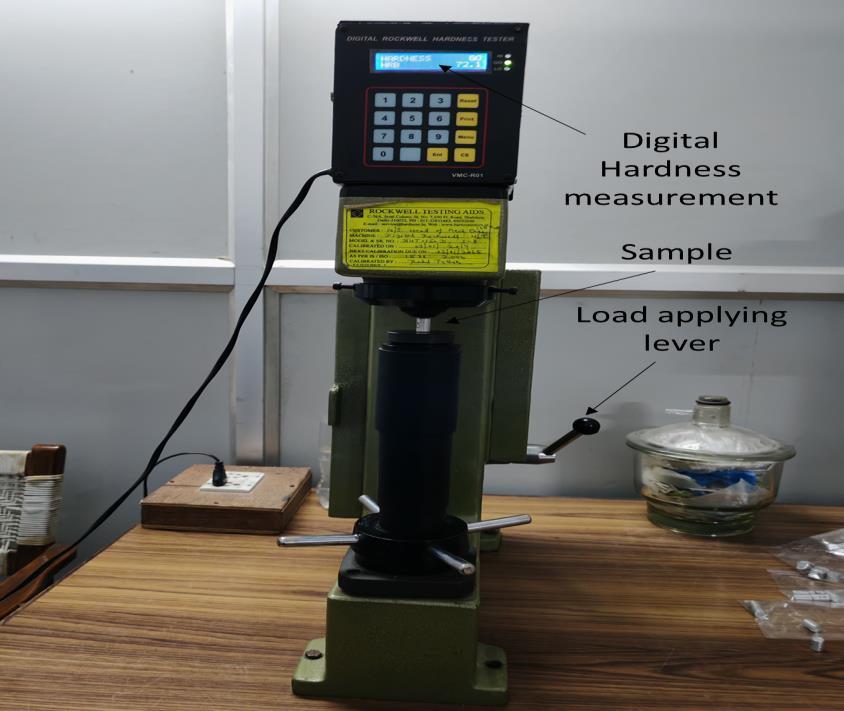
Inthepresentstudy,theBscaleoftheRockwellhardness test was used to evaluate the hardness of the prepared aluminiumcomposite.TheDigitalRockwelltestingmachine, asshownin Fig - 1,isusedtocalculatethehardnessofthe specimen.Inthissetup,thedepthcalculationsareperformed automatically by the machine itself. For each composite sample, around five hardness readings were taken on the surfacetoensureaccurateandconsistentresults.
Tofurtheranalysethedistributionofthereinforcement and matrix material in the composite, Scanning Electron Microscopy(SEM)wasutilizedtoobservethedispersionand distribution.Thisanalysishelpsusgaindeeperinsightsinto thephenomenadrivingtheobservedtrendsintheproperties of the composite. This serves as a valuable indicator for understanding the hardness pattern of the composite. Microstructure analysis also helps us establish the relationshipbetweenpropertiesandmaterialdistribution.By observingthedistributionofboroncarbideparticleswithin the aluminum matrix, we can gain insights into how uniformity or clustering of the reinforcement affects the mechanicalproperties,suchashardnessandoverallstrength ofthecomposite.
First,compositesS1,S2,S3,S4,andS5,reinforcedwith 8%, 10%, 12%, 14%, and 16% weight of boron carbide, respectively, were tested for hardness using the Rockwell hardnessmachine.Thehardnessvaluesofthesecomposites wererecordedandarepresentedin Table 1
Table -1: HardnessofB4Creinforcedcomposite
ThehardnessofT6heat-treatedcomposites,designated asT1,T2,T3,T4,andT5,with8%,10%,12%,14%,and16% weight reinforcement of boron carbide, respectively, was evaluated using the Rockwell hardness machine. The recordedhardnessvaluesarepresentedin Table 2.
Table -2: HardnessofB4Creinforcedcompositetreated withT6Heattreatment
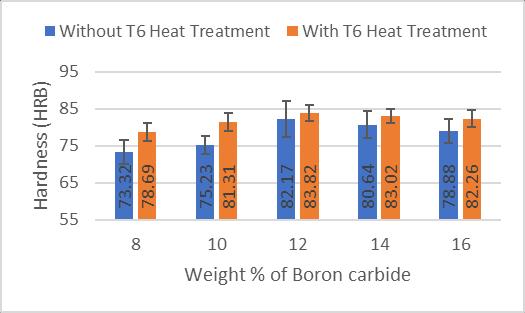
To clearly visualize the hardness pattern of the composites, a graph of these values was plotted and compared,asillustratedin Chart 1.
The chart clearly indicates that the hardness value increaseswithanincreaseintheweightpercentageofboron carbide. However, after reaching 14% weight of boron carbide,thereisaslightdecreaseinhardness.Thiscouldbe attributedtothenon-uniformdistributionofboroncarbide particlesathigherconcentrations.Thisdecreaseinhardness can be mitigated by further optimizing the stir casting parameters,suchasincreasingthestirringspeed,duration,
International Research Journal of Engineering and Technology (IRJET) e-ISSN: 2395-0056
Volume: 12 Issue: 01 | Jan 2025 www.irjet.net p-ISSN: 2395-0072
or temperature, to ensure a more uniform distribution of boroncarbideparticleswithinthematrix.
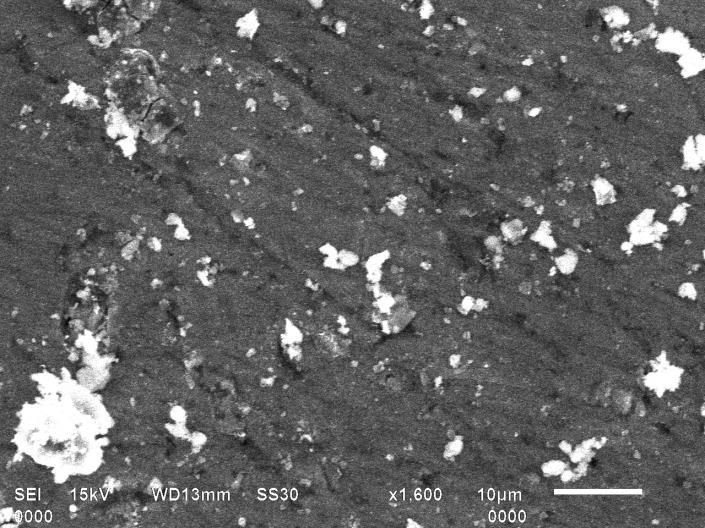
ToassessthedistributionofboroncarbideintheAA2024 composite,SEManalysiswasconducted.Forthispurpose,the specimensurfaceswerepreparedusingfineemerypaperand alumina particles In aluminum composites, boron carbide playsacrucialroleinenhancingthecomposite'sload-bearing capacity.Ifthedistributionofboroncarbideishomogeneous, this strengthening phenomenon will be more effectively realized. For this analysis, the composite with the highest boron carbide content was selected to examine the distributionasshownin Fig -2
TheSEMimageclearlyrevealsapredominantlyuniform distribution of boron carbide particles, with only minor clusteringobservedincertainareas.
According to this study, the T6 heat treatment substantiallyenhancesthemechanicalandmicrostructural propertiesofaluminumalloys.TheT6heattreatmentresults inamaximumincreaseof7.32%inhardness. Aconsistent improvementinhardnessisobservedforthesameweight percentofreinforcementaftertheT6heattreatment.These improvementsinhardnessenhancethecomposite'slifespan, making it suitable for long-term applications while also providingexcellentwearresistance.
Microstructuralanalysisfurtherconfirmsthesuccessful casting of aluminum composites with boron carbide reinforcement. The uniform distribution of boron carbide particlesobservedinthemicrostructuralanalysisvalidates the successful enhancement in hardness and indicates potentialimprovementsinothermechanicalpropertiesofthe composite.
The SEM image clearly reveals a predominantly uniform distribution of boron carbide particles, with only minor clusteringobservedincertainareas.
[1] W.B.Zhu,Z.G.Zhang,H.N.Chen,andT.Xiao,“Review and outlook of aluminum matrix composites,” in Materials Science Forum, Trans Tech Publ, 2020, pp. 119–124.
[2] D. Wanwu, Y. CHENG, C. Taili, Z. Xiaoyan, and L. I. U. Xiaoxiong,“Researchstatusandapplicationprospectof aluminummatrixcomposites,”ResearchandApplication ofMaterialsScience,vol.2,no.1,2020.
[3] S. Sura, B. N. Goud, A. G. Reddy, E. Veeraprathap, T. Jaikanth,andU.Yashwanth,“AnalysisandFabricationof AluminiumCompositewithSiCandGraphiteUsingStir Casting Method (MMC).,” in Journal of Physics: ConferenceSeries,IOPPublishing,2024,p.012067.
[4] P.O.Babalola,C.A.Bolu,A. O.Inegbenebor,andK. M. Odunfa,“Developmentofaluminiummatrixcomposites: a review,”OnlineInternational Journal ofEngineering andTechnologyResearch,vol.2,pp.1–11,2014.
[5] Z.Xiuetal.,“Microstructureandmechanicalproperties of core-shell B4C-reinforced Ti matrix composites,” Materials,vol.16,no.3,p.1166,2023.
[6] P. Satishkumar, G. Mahesh, R. Meenakshi, and S. N. Vijayan, “Tribological characteristics of powder metallurgy processed Cu-WC/SiC metal matrix composites,” Mater Today Proc, vol. 37, pp. 459–465, 2021.
International Research Journal of Engineering and Technology (IRJET) e-ISSN: 2395-0056
Volume: 12 Issue: 01 | Jan 2025 www.irjet.net p-ISSN: 2395-0072
[7] V.Khalili,A.Heidarzadeh,S.Moslemi,andL.Fathyunes, “Production of Al6061 matrix composites with ZrO2 ceramic reinforcement using a low-cost stir casting technique:Microstructure,mechanicalproperties,and electrochemicalbehavior,”JournalofMaterialsResearch andTechnology,vol.9,no.6,pp.15072–15086,2020.
[8] J. Sun et al., “A review on additive manufacturing of ceramic matrix composites,” J Mater Sci Technol, vol. 138,pp.1–16,2023.
[9] A. Parveen, N. R. Chauhan, and M. Suhaib, “Study of Si3N4 reinforcement on the morphological and tribomechanicalbehaviourofaluminiummatrixcomposites,” MaterResExpress,vol.6,no.4,p.042001,2019.
[10] D. K. Das, P. C. Mishra, S. Singh, and S. Pattanaik, “Fabricationandheattreatmentofceramic-reinforced aluminiummatrixcomposites-areview,”International JournalofMechanicalandMaterialsEngineering,vol.9, pp.1–15,2014.
[11] A. Ramanathan, P. K. Krishnan, and R. Muraliraja, “A review on the production of metal matrix composites through stir casting–Furnace design, properties, challenges, and research opportunities,” J Manuf Process,vol.42,pp.213–245,2019.
[12] B. C. Kandpal, J. Kumar, and H. Singh, “Manufacturing and technological challenges in Stir casting of metal matrixcomposites–AReview,”MaterTodayProc,vol.5, no.1,pp.5–10,2018.
[13] A.A.Adediran,A.A.Akinwande,O.A.Balogun,andB.J. Olorunfemi, “Optimization studies of stir casting parameters and mechanical properties of TiO2 reinforced Al 7075 composite using response surface methodology,”SciRep,vol.11,no.1,p.19860,2021.
[14] A. H. Idrisi and A.-H. I. Mourad, “Conventional stir castingversusultrasonicassistedstircastingprocess: Mechanical and physical characteristics of AMCs,” J AlloysCompd,vol.805,pp.502–508,2019.
[15] U. K. G. B. A. V. Kumar, “Method of stir casting of aluminum metal matrix composites: a review,” Mater TodayProc,vol.4,no.2,pp.1140–1146,2017.
[16] M.Tabandeh-Khorshid,E.Omrani,P.L.Menezes,andP. K.Rohatgi,“Tribologicalperformanceofself-lubricating aluminum matrix nanocomposites: role of graphene nanoplatelets,”Engineeringscienceandtechnology,an internationaljournal,vol.19,no.1,pp.463–469,2016.
[17] K. Park, J. Park, and H. Kwon, “Fabrication and characterization of Al-SUS316L composite materials manufacturedbythespark plasmasinteringprocess,” MaterialsScienceandEngineering:A,vol.691,pp.8–15, 2017.
[18] R.AlfattaniandM.Yunus,“Explorationsofmechanical and corrosion resistance properties of AA6063/TiB2/Cr2O3hybridcompositesproducedbystir casting,” Journal of Science: Advanced Materials and Devices,vol.9,no.4,p.100790,2024.
[19] S. P. Dwivedi et al., “Effect of nano-TiO2 particles addition on dissimilar AA2024 and AA2014 based compositedevelopedbyfrictionstirprocesstechnique,” JournalofMaterialsResearchandTechnology,vol.26, pp.1872–1881,2023.
[20] V.Mohanaveletal.,“Mechanicalpropertiesoftitanium diboride particles reinforced aluminum alloy matrix composites: a comprehensive review,” Advances in MaterialsScienceand Engineering,vol. 2021, no.1, p. 7602160,2021.
[21] N.E.Bekheet,R.M.Gadelrab,M.F.Salah,andA.N.Abd El-Azim, “The effects of aging on the hardness and fatiguebehaviorof2024Alalloy/SiCcomposites,”Mater Des,vol.23,no.2,pp.153–159,2002.
2025, IRJET | Impact Factor value: 8.315 | ISO 9001:2008