International Research Journal of Engineering and Technology (IRJET)
e-ISSN: 2395-0056
Volume: 12 Issue: 03 | Mar 2025
p-ISSN: 2395-0072
www.irjet.net
IMPACT OF P-DELTA EFFECTS ON THE SEISMIC PERFORMANCE OF HIGH-RISE RC BUILDINGS WITH VERTICAL GEOMETRIC IRREGULARITIES Dipesh D. Sambare1, Trupti Narkhede2, P. J. Salunke3 1PG Student, Dept. of Civil Engineering, Mahatma Gandhi Mission's College of Engineering and Technology
(MGMCET), Kamothe, Navi Mumbai, Maharashtra, India
2Assistant Professor, Dept. of Civil Engineering, Mahatma Gandhi Mission's College of Engineering and Technology
(MGMCET), Kamothe, Navi Mumbai, Maharashtra, India
3Head of Department, Dept. of Civil Engineering, Mahatma Gandhi Mission's College of Engineering and
Technology (MGMCET), Kamothe, Navi Mumbai, Maharashtra, India ---------------------------------------------------------------------***--------------------------------------------------------------------2. METHODOLOGY Abstract - The seismic performance of high-rise reinforced concrete (RC) buildings with vertical geometric irregularities is a critical aspect of structural engineering. This study evaluates the impact of P-Delta effects on a G+50 RC building with T-shape, L-shape, and Step-back irregularities under Nonlinear Time History Analysis (NLTHA) using Bhuj earthquake data. A model was analyzed in ETABS, considering variations in structural configuration and the presence or absence of P-Delta effects. The results indicate that displacement, story drift, and shear forces increase significantly when P-Delta effects are included, particularly in upper stories. Among the irregular configurations, L-shape structures exhibited the highest displacement and drift, indicating increased vulnerability. Step-back configurations demonstrated better stability, reducing excessive lateral deformations due to their inherent mass and stiffness distribution.
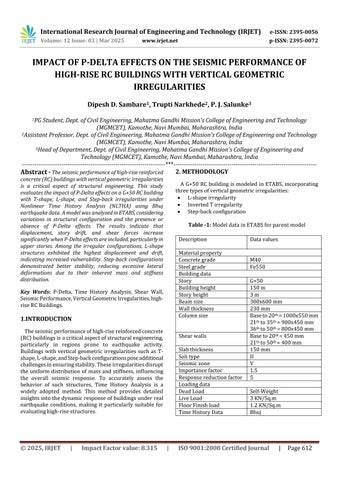
A G+50 RC building is modeled in ETABS, incorporating three types of vertical geometric irregularities: L-shape irregularity Inverted T irregularity Step-back configuration Table -1: Model data in ETABS for parent model Description Material property Concrete grade Steel grade Building data Story Building height Story height Beam size Wall thickness Column size
Key Words: P-Delta, Time History Analysis, Shear Wall, Seismic Performance, Vertical Geometric Irregularities, highrise RC Buildings.
1.INTRODUCTION The seismic performance of high-rise reinforced concrete (RC) buildings is a critical aspect of structural engineering, particularly in regions prone to earthquake activity. Buildings with vertical geometric irregularities such as Tshape, L-shape, and Step-back configurations pose additional challenges in ensuring stability. These irregularities disrupt the uniform distribution of mass and stiffness, influencing the overall seismic response. To accurately assess the behavior of such structures, Time History Analysis is a widely adopted method. This method provides detailed insights into the dynamic response of buildings under real earthquake conditions, making it particularly suitable for evaluating high-rise structures.
© 2025, IRJET
|
Impact Factor value: 8.315
Shear walls Slab thickness Soli type Seismic zone Importance factor Response reduction factor Loading data Dead Load Live Load Floor Finish load Time History Data
|
Data values M40 Fe550 G+50 150 m 3m 300x600 mm 230 mm Base to 20th = 1000x550 mm 21th to 35th = 900x450 mm 36th to 50th = 800x450 mm Base to 20th = 450 mm 21th to 50th = 400 mm 150 mm II V 1.5 5 Self-Weight 3 KN/Sq.m 1.2 KN/Sq.m Bhuj
ISO 9001:2008 Certified Journal
|
Page 612