
International Research Journal of Engineering and Technology (IRJET) e-ISSN: 2395-0056
Volume: 13 Issue: 04 | Apr 2026 www.irjet.net p-ISSN: 2395-0072

International Research Journal of Engineering and Technology (IRJET) e-ISSN: 2395-0056
Volume: 13 Issue: 04 | Apr 2026 www.irjet.net p-ISSN: 2395-0072
Pratibha Yadav1, Shashank Shekhar Jha1*
1Department of Physics, Nalanda College, Biharsharif Nalanda – 803101, Bihar, India
Abstract - Surface Acoustic Wave (SAW) devices are foundational components in modern telecommunications, precision sensing, and frequency control systems. While their compact size and high-frequency capabilities are highly advantageous, their overall performance is fundamentally constrained by inherent noise mechanisms. This review methodically examines the primary sources of noise in SAW devices,specificallythermal,flicker(1/f),andphasenoises.We evaluatehowthesenoisesourcesreducecriticaldevicemetrics suchas thelimit ofdetection(LOD)insensors and thequality factor (Q) in oscillators. Furthermore, this review article highlights contemporary mitigation strategies, including materialoptimization,advancedinterdigitaltransducer(IDT) design, and environmental compensation techniques.
Key Words: Surface Acoustic Wave Device, Phase Noise, FlickerNoise,QualityFactor,SAWSensors.
1. INTRODUCTION
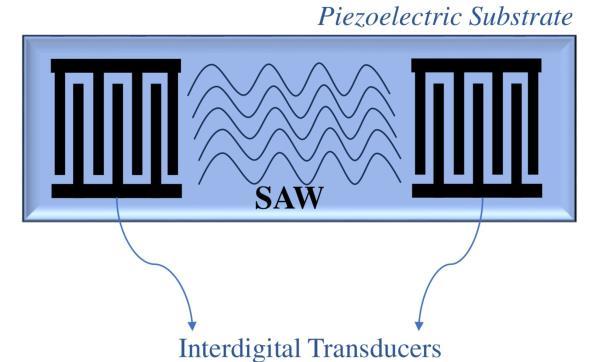
SurfaceAcousticWave(SAW)technologyhasfundamentally transformedthesceneryofmodernelectronics,establishing itself as a keystone in the fields of telecommunications, precision sensing, and frequency control. First mathematicallydescribedbyLordRayleighin1885,surface acousticwavesaremechanicalmodesthatpropagatealong the surface of a solid medium, with their energy decaying exponentially into the depth of the substrate [1]. In contemporarymicro-devices,thesewavesaregeneratedand detectedusingpreciselypatternedInterdigitalTransducers (IDTs)depositedonhigh-qualitysingle-crystalpiezoelectric substrates, such as quartz, lithium niobate, or lithium tantalate.The inverse piezoelectriceffectallowsthe input IDTtoconvertanalternatingelectromagneticsignalintoa mechanical acoustic wave, while the direct piezoelectric effect at the output IDT reverses this process, enabling highlyefficient,solid-statesignalprocessingcapabilities[2]. Thepassivenature,compactplanarfootprint,andabilityto operatereliablyathighfrequencies ranging fromtensofmegahertzuptoseveralgigahertz makeSAW deviceshighlyadvantageous.Overthepastfewdecades,they have become pervasive in radio frequency (RF) front-end modulesformobilecommunications,servingpredominantly as bandpass filters, delay lines, and resonators. With the adventof5Gandtheimpendingtransitionto6Gnetworks,
alongsidetheexponentialgrowthoftheInternetofThings (IoT),thedemandforultra-miniaturized,high-performance acoustic wave devices has never been greater [3]. Furthermore, their extreme sensitivity to surface perturbations has spurred extensive development in the realmofphysical,chemical,andbiologicalsensors.Inthese applications, SAW devices are utilized to detect miniscule changes in mass loading, fluid viscosity, temperature, or external magnetic fields [4]. Despite these profound advantages and widespread applications, the operational boundaries and ultimate performance of SAW devices are strictly governed by intrinsic and extrinsic noise mechanisms.Inanysignalprocessingorsensingsystem,the Signal-to-Noise Ratio (SNR) is the definitive metric of efficacy.Asdevicedimensionsscaledowntoaccommodate higher operational frequencies, and as the demand for precisionincreases,thedetrimentaleffectsofnoisebecome increasinglypronounced.Insensorapplications,theintrinsic noisefloordirectlydictatesthelimitofdetection(LOD)and the overall resolution limits. Thermal (Johnson-Nyquist) noise and flicker (1/f) noise can easily mask the minute phaseorfrequencyshiftsinducedbytracetargetanalytes, renderingthesensorcompletelyineffectiveincritical,lowconcentrationenvironments[5].Similarly,incommunication systems, SAW resonators are frequently employed as the highlystablefrequency-determiningelementsinfeedback oscillators. In this context, internal device noise is upconvertedintophasenoise,manifestingastimingjitterin the time domain. Excessive phase noise severely compromisessignalintegrity,increasesbit-errorrates(BER) in digital transceivers, and causes destructive adjacentchannelinterferenceindenselypopulatedRFspectralbands [6]. Therefore, a comprehensive understanding of the physical origins and the phenomenological behaviour of noiseinSAWstructuresisimperativefortheadvancement of next-generation acoustic technologies. This article systematically examines the primary sources of noise affecting SAW devices, with a specific focus on thermal fluctuations,flickernoisearisingfrommaterialandsurface defects, and the complex dynamics of phase noise in oscillator configurations. By bridging fundamental noise theorywithpracticaldeviceperformancemetrics,thispaper evaluateshownoisedegradescriticalparameterssuchasthe quality factor (Q) and the LOD. Finally, we highlight contemporary and emerging mitigation strategies, encompassingadvancedpiezoelectricmaterialoptimization,
International Research Journal of Engineering and Technology (IRJET) e-ISSN: 2395-0056
Volume: 13 Issue: 04 | Apr 2026 www.irjet.net p-ISSN: 2395-0072
innovative IDT architectures, and rigorous environmental compensationtechniques,providingaclearroadmapforthe developmentofultra-low-noiseSAWsystems.
AstandardSAWdeviceconsistsofapiezoelectricsubstrate (such as Quartz, Lithium Niobate, or Lithium Tantalate) patterned with metallic Interdigital Transducers (IDTs). Whenanalternatingcurrent(AC)voltage isappliedtothe inputIDT,itinducesmechanicalstrain,launchinganacoustic wave across the substrate surface. The synchronous frequencyofthegeneratedwaveisgovernedbythepitch(p) of the IDT fingers and the acoustic velocity (v) of the piezoelectricmaterial.Thecentralfrequency(f0)isexpressed as: where λ istheacousticwavelength.

3. SOURCES OF NOISE IN SAW DEVICES
Thermalnoiseisafundamentalandirreducibleelectrical noise source present in all Surface Acoustic Wave (SAW) devices. It is generated by the spontaneous thermal movement of electrons within conductive materials and resistive circuit paths, regardless of whether an external voltageisapplied.InSAWcomponents,thiseffectismainly linked to the metallic interdigital transducers (IDTs), electrode fingers,bus bars,contactpads,interconnections, andassociatedexternalcircuitry.Becausethermalagitation isanequilibriumphenomenon,itcannotbeentirelyremoved andthereforedefinestheminimumbackgroundnoiselevel achievableinpracticalSAWsystems[7].
Thisnoisemechanismisgenerallyconsideredfrequency independentoverthenormaloperatingrangeofSAWdevices and is therefore treated as white noise. The root-meansquare(RMS)noisevoltagecanbeexpressedas:

Where kB is the Boltzmann constant, T is the absolute temperature,RistheequivalentresistanceoftheIDT,and Δf isthemeasurementbandwidth.InSAWdevices,minimizing theseriesresistanceoftheIDTfingersistheprimarymethod forreducingthermalnoise.
Inhigh-frequencySAWdevices,thedimensionsoftheIDT electrodes are often reduced to achieve shorter acoustic wavelengths. However, narrower conductive paths can increaseresistanceandcurrentcrowding,therebyenhancing thermalnoisecontributions.Additionalnoisemayalsoarise from packaging losses, wire bonds, connectors, and impedance-matching circuits [8]. These effects become especially important in wireless communication modules, oscillators,andprecisionsensingsystemswherelow-noise operationisessential.
Severalpracticalmethodsareusedtolimitthermalnoise in SAW structures. One common approach is to lower the resistanceofIDTelectrodesbyincreasingmetalthicknessor selecting materials with superior conductivity. Electrode layoutscanalsobeoptimizedtoshortencurrentpathsand reduce resistive losses. Improved impedance matching between the SAW device and surrounding circuitry helps minimizeexcesslossandmaintainstrongeroutputsignals.In advancedsystems,thermalstabilizationtechniquesmaybe adoptedtosuppresstemperature-dependentfluctuations[8].
Therefore, although thermal noise cannot be eliminated, careful electrical design and material optimization can substantially reduce its influence. Effective control of this noisesourceisimportantforimprovingsensitivity,frequency stability,dynamicrange,andlong-termreliabilityinmodern SAW-basedfilters,resonators,andsensortechnologies.
Flicker noise, commonly referred to as 1/f noise, is a significant low-frequency noise mechanism observed in Surface Acoustic Wave (SAW) devices and is particularly criticalinquartz-basedSAWoscillators.Unlikethermalnoise, whichexhibitsaflatspectralresponse,flickernoiseincreases asthefrequencyoffsetfromthecarrierdecreases.Forthis reason,itoftendominatestheclose-inphasenoiseregionof high-stabilityoscillatorsandfrequencycontrolsystems.The powerspectraldensityofflickernoisecanberepresentedas:

Where h-1 is an empirical constant dependent on the material and device geometry. In SAW devices, 1/f noise primarilyoriginatesfromphononscattering,materialdefects within the piezoelectric substrate, and surface impurities. Studieshaveshownthatpropertreatmentandcleaningofthe quartz surface can significantly reduce 1/f noise contributions[4].
International Research Journal of Engineering and Technology (IRJET) e-ISSN: 2395-0056
Volume: 13 Issue: 04 | Apr 2026 www.irjet.net p-ISSN: 2395-0072
InSAWdevices,thephysicaloriginof1/fnoiseismore complexthanthatofthermalnoise.Itisgenerallyassociated withfluctuationsincarriermobility,trappinganddetrapping processes at interfaces, lattice imperfections, grain boundariesinmetallicelectrodes,anddefectstateswithinthe piezoelectric substrate. In quartz SAW resonators, microscopicsurfacecontamination,adsorbedparticles,and residualprocess-induceddamagecanfurtherintensifythese fluctuations[3].SinceacousticwavesinSAWstructuresare stronglyconfinedtothesurfaceregion,anydisturbanceator nearthesurfacecandirectlymodulatewavepropagationand contributetoexcesslow-frequencynoise.
Flickernoisehasadirectimpactonoscillatorphasenoise, short-term frequency stability, and sensor resolution. In communication systems,elevatedclose-in phase noise can degrade spectral purity and channel selectivity. In sensing applications,itmaylimitthedetectionofweakperturbations and small mass-loading effects. Therefore, minimizing 1/f noise is essential for advanced SAW resonators and oscillatorsusedinnavigationsystems,wirelesselectronics, andprecisioninstrumentation.
Severalmitigationstrategieshavebeenreported.Careful substratepolishing,rigoroussurfacecleaning,contaminationfree processing, and optimized electrode deposition can significantly reduce surface defect density and impurityrelatedfluctuations.High-qualityquartzsubstrateswithlow dislocationdensityarealsobeneficial.Inaddition,improved packagingmethodsthatisolatethedevicefrommoistureand airborne contaminants help preserve long-term low-noise performance[9,10].
Thus, flicker noise remains one of the principal factors limitingclose-to-carrierperformanceinSAWoscillators,and continuedprogressinmaterialsengineeringandfabrication technologyisessentialforitssuppression.
WhenaSurfaceAcousticWave(SAW)deviceisemployed asthefrequency-selectiveelementinafeedbackoscillator, the intrinsic electrical and material noise sources of the resonatorareconvertedinto phase noise,whichappearsas random short-term fluctuations in the phase of the generated output signal. In the frequency domain, phase noise is observed as spectral sidebands surrounding the carrierfrequencyandiscommonlyexpressedasthesinglesidebandnoisepowerdensity atanoffsetfrequency fromthecarrier.ForSAWoscillators,theoverallphase noisebehavioriswidelyinterpretedusing Leeson’s model, which relates oscillator noise performance to resonator qualityfactor,amplifiernoise,signalpower,andflicker-noise upconversionmechanisms[5].

Wherefmistheoffsetfrequencyfromthecarrier,Qisthe loadedqualityfactor,fcisthe1/fcornerfrequency,Fisthe noisefigureoftheamplifier,andPs isthesignalpower.
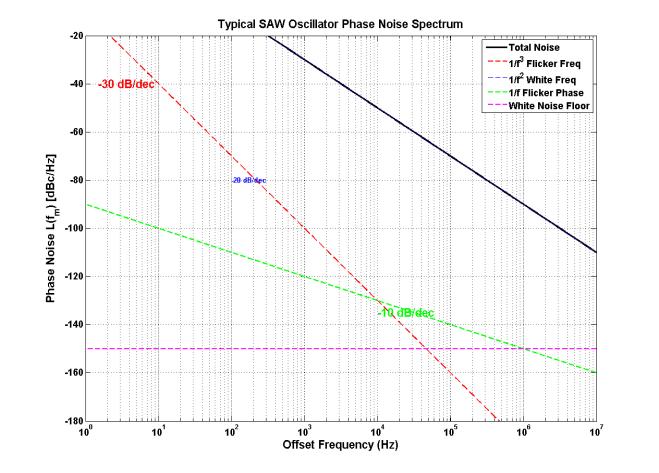
Fig -2:Atypicalphasenoisespectrum vs.offset frequency ofaSAWoscillator,illustratingthe1/f3 flickerfrequencynoise,1/f2 whitefrequencynoise,1/f flickerphasenoise,andtheflatwhitenoisefloor
InSAWoscillators,theloadedQ-factorplaysaparticularly important role because it determines how effectively the resonatorsuppressesphaseperturbationsnearthecarrier. Devices with higher Q values generally exhibit narrower resonance bandwidths and lower close-in phase noise. Quartz-based SAW resonators are often preferred for precision oscillators because of their excellent acoustic stabilityandrelativelyhigh-qualityfactors[11].
Theclose-to-carrierregionisusuallydominatedbyflicker noisetranslatedthroughactivedevices,whilethermalnoise becomes more influential at larger offset frequencies. Additionalcontributionsmayarisefromelectroderesistance, substrateimperfections,packagingstress,temperaturedrift, and power-supply fluctuations. These effects can degrade oscillator spectral purity, timing accuracy, and communicationperformance.
Toimprovephasenoisecharacteristics,designerstypically use low-noise amplifiers, maximize resonator Q, optimize loopgain,increaseoutputsignalpowerwithinsafelimits,and maintainstablethermalconditions.Carefullayout,shielding, and clean bias circuitry also help suppress external interference. Therefore, phase noise analysis remains a centralaspectinthedevelopmentofhigh-performanceSAW oscillators for wireless communication, navigation, and sensingapplications.
Noiseplaysadecisiveroleindeterminingthesensitivity, accuracy,andlong-termreliabilityofSurfaceAcousticWave (SAW)-basedsensors.Ingassensors,biosensors,humidity sensors, and magnetic field sensing platforms, the target
International Research Journal of Engineering and Technology (IRJET) e-ISSN: 2395-0056
Volume: 13 Issue: 04 | Apr 2026 www.irjet.net p-ISSN: 2395-0072
measurandmodifiesthepropagationcharacteristicsofthe acoustic wave, typically producing a measurable shift in phase,delay,amplitude,orresonantfrequency.Thesmallest detectable change is therefore strongly dependent on the backgroundnoiselevelofthedeviceandassociatedreadout electronics.
Phase noise and frequency fluctuations introduce uncertainty into the extracted sensing signal, especially when the induced frequency shift is very small. This limitation is commonly quantified through short-term frequencystabilitymetricssuchasAllandeviationorAllan variance, which are widely used for resonant sensing systems[12].Elevatedflickernoiseatlowoffsetfrequencies isparticularlyharmfulbecausemanysensingeventsoccur slowlyand must be detectedover longer averaging times. Similarly,thermalnoiseraisesthebroadbandnoisefloorand reduces signal-to-noise ratio. As a consequence, weak responses caused by trace gas concentrations, low biomolecularmassloading,orsmallmagneticperturbations maybecomeindistinguishablefromrandomfluctuations.
In biosensing applications, this may lead to poor detection limits and reduced selectivity, while in environmental monitoring it can hinder the detection of hazardousgasesatppmorppblevels.Therefore,minimizing noise is essential for achieving lower limits of detection (LOD), faster response times, and higher measurement confidenceinadvancedSAWsensorsystems[6,8].
In wireless communication systems, SAW devices are extensively used as RF filters, duplexers, resonators, and oscillator components because of their compact size and excellentfrequencyselectivity.However,excessivenoise particularly phase noise can significantly degrade communicationquality.Inoscillators,phasenoiseappearsas randomtimingfluctuationsorjitterinthetimedomain.This timing instability affects carrier synchronization, clock recovery,andmodulationaccuracyindigitaltransceivers.
Highjitterlevelsincreasebiterrorrate(BER),especially in high-speed data links employing advanced modulation formatssuchasQPSK,QAM,andOFDM.Inaddition,phasenoise sidebands spread energy into adjacent frequency channels, creating spectral regrowth and interference in crowdedcommunicationbands[4].Thisissueisespecially critical in modern cellular networks, satellite links, radar systems,andInternet-of-Things(IoT)deviceswherechannel spacingisnarrowandspectralefficiencyisimportant.
Noise in SAW filters may also reduce out-of-band rejection and dynamic range, limiting receiver sensitivity. Consequently,low-noiseSAWcomponentsareessentialfor reliablesignaltransmission,reducedinterference,andstable operationinnext-generationcommunicationplatforms.
5. MITIGATION STRATEGIES
Enhancing the Signal-to-Noise Ratio (SNR) in Surface Acoustic Wave (SAW) devices requires coordinated improvementsinmaterials,fabricationprocesses,structural design, and environmental stability. Since noise in SAW components originates from multiple mechanisms including thermal fluctuations, flicker noise, acoustic scattering,insertionloss,andtemperaturedrift nosingle solution is sufficient. Instead, a multi-parameter optimizationstrategyisnecessarytoobtainlow-noiseand high-performance devices for sensing, filtering, and oscillatorapplications.
Thechoiceofsubstratematerialhasadirectinfluenceon acousticpropagationloss,electromechanicalcoupling,and intrinsic noise behaviour. High-purity single-crystal piezoelectricmaterialssuchasST-cutquartz,lithiumniobate (LiNbO₃), lithium tantalate (LiTaO₃), and langasite are widely used because of their superior crystallographic uniformity and stable acoustic properties [1]. Reducing impurities, dislocations, and lattice defects minimizes phononscatteringandinternalenergydissipation,whichin turn improves resonator quality factor and lowers excess noise.
Advanced substrate engineering has further expanded performancepossibilities.Layeredacousticstructuressuch as aluminium nitride (AlN) on sapphire, AlN on silicon carbide,andthin-filmpiezoelectricstacksprovideenhanced acousticconfinementandreducedsubstrateleakage.These engineered platforms are especially attractive for highfrequencyandlow-lossSAWdevicesusedinnext-generation wirelesssystems[2].
Because SAW propagation is strongly confined to the near-surfaceregionofthesubstrate,surfacecleanlinessand defect control are critical. Even nanoscale contamination, adsorbedmoisture,organic residues,orpolishingdamage candisturbwavepropagationandincreaselow-frequency flicker noise. Proper surface preparation has therefore becomeanessentialstepindevicefabrication.
Processes such as UV-ozone cleaning, oxygen plasma treatment, wet chemical cleaning, and precision chemomechanical polishing are widely used to remove contaminants and reduce microscopic defects. Parker and related studies reported that careful surface conditioning can significantly suppress 1/f noise in quartz acoustic devices by reducing adsorption-related fluctuations and unstabledefectstates[13].Surfacepassivationcoatingsmay also help preserve long-term cleanliness and improve environmentaldurability.
International Research Journal of Engineering and Technology (IRJET) e-ISSN: 2395-0056
Volume: 13 Issue: 04 | Apr 2026 www.irjet.net p-ISSN: 2395-0072
BecauseInterdigitaltransducer(IDT)geometrystrongly affects insertion loss, acoustic reflections, impedance matching,andnoiseconversion.Poorlyoptimizedelectrodes can generate internal reflections, spurious bulk acoustic waves,andadditionalresistivelosses,allofwhichdegrade deviceperformance.
Modern electrode configurations such as split-finger, double-electrode, floating-electrode, and apodized IDT designs are commonly employed to improve acoustic responseandsuppressunwantedmodes[7,13].Split-finger IDTs are particularly effective in reducing electrode reflection effects and minimizing triple-transit echoes. Increasing metallization quality and optimizing finger thickness also reduce series resistance, thereby lowering thermal noise. Improved electrode symmetry and current distributionfurthercontributetohigherloadedQ-factorand betterphase-noiseperformanceinoscillatorcircuits.
Temperature variation is a major source of frequency instability in SAW devices because acoustic velocity and elasticconstantsdependstronglyonambienttemperature. Thermal drift not only shifts the operating frequency but may also amplify noise through fluctuating material parametersandstresseffects.
Toaddressthisissue,Temperature-CompensatedSAW (TC-SAW)deviceshavebeendevelopedusingoverlaylayers suchassilicondioxide(SiO₂),siliconnitride,orcomposite thinfilmsdeposited onpiezoelectricsubstrates[4].These layersareengineeredsothattheirtemperaturecoefficient counteracts that of the substrate, thereby reducing net frequency drift. In precision applications, hermetic packaging,thermalshielding,andactivetemperaturecontrol circuitsmayalsobeemployed.
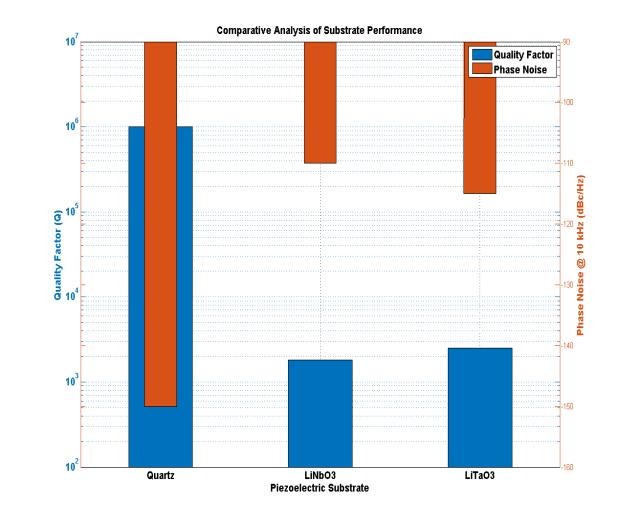
Fig -3:ComparativebarchartofQualityFactor(Q)and PhaseNoise(at10kHzoffset)acrossdifferentpiezoelectric substrates(Quartz,LiNbO3,LiTaO3).
The most effective noise reduction is achieved when materialquality,surfacetreatment,electrodegeometry,and thermalcompensationareoptimizedsimultaneously.Such integrated strategies enable SAW devices with lower insertionloss,improvedSNR,enhancedfrequencystability, andlongeroperationallifetime.Theseadvancesareessential forhigh-resolutionsensors,low-phase-noiseoscillators,and compact RF front-end modules used in modern communicationandindustrialsystems.
TheultimateperformancelimitsofSurfaceAcousticWave (SAW) devices are strongly governed by the presence of intrinsic and extrinsic noise sources. Thermal noise establishes a fundamental lower boundary that is determinedbyoperatingtemperature,electricalresistance, andmeasurementbandwidth,makingitunavoidableinall practicalsystems.Incontrast,phasenoiseandflicker(1/f) noisearehighlydependentonmaterialquality,fabrication precision,surfacecontamination,electrodeconductivity,and resonator geometry. These controllable factors provide significantopportunitiesforengineeringimprovement.
Theapplicationoftheoreticalmodels,particularlyLeeson’s phase-noiseframework,hasenabledadeeperunderstanding of how resonator quality factor, amplifier characteristics, andsignalpowercollectivelyinfluenceoscillatorstability.By optimizing interdigital transducer (IDT) dimensions, reducing electrode resistance, and enhancing acoustic confinement, researchers can substantially improve the loadedqualityfactorandsuppressclose-innoise.Likewise, advancedsurfacepreparationmethods,includingprecision polishing, plasma cleaning, and contamination-resistant passivation layers, have proven effective in minimizing defect-inducedlow-frequencyfluctuations.
FutureprogressinSAWtechnologyisexpectedtoarisefrom theincorporationofadvancedmaterialssuchasgraphene, diamond-like carbon coatings, low-loss piezoelectric thin films,andhigh-conductivity nanostructuredelectrodes. In parallel, innovative acoustic waveguide architectures, phononiccrystalstructures,andtemperature-compensated multilayersubstratesmayfurtherreducepropagationloss andenhancefrequencystability.
The authors are thankful to Principal, Nalanda College, Biharsharif for providing technical support and space for pursuingthiswork.
International Research Journal of Engineering and Technology (IRJET) e-ISSN: 2395-0056
Volume: 13 Issue: 04 | Apr 2026 www.irjet.net p-ISSN: 2395-0072
[1] A.Drafts,“AcousticWaveTechnologySensors,” IEEE TransactionsonMicrowaveTheoryandTechniques,vol. 49(4),2001,pp.795-802.
[2] J. Kosinski and A. Ballato, “Measurements of acceleration-induced phase noise in surface acoustic wave devices,” Proceedings of the 44th Annual SymposiumonFrequencyControl,1990,pp.415-420.
[3] E.RubiolaandV.Giordano,“Advancedphasenoiseand amplitudenoiseofRFoscillators,” ReviewofScientific Instruments,vol.78(3),2007,pp.034703.
[4] T.E.Parker,“1/fphasenoiseinquartzs.a.w.devices,” ElectronicsLetters,vol.15(10),1979,pp.296-298.
[5] D. B. Leeson, “A simple model of feedback oscillator noise spectrum,” Proceedings of the IEEE, vol. 54(2), 1966,pp.329–330.
[6] P. Durdaut et. al., “Phase Noise of SAW Delay Line Magnetic Field Sensors,” Sensors, vol.21(16),2021,pp. 5631
[7] D. Morgan, “Surface Acoustic Wave Filters: With Applications to Electronic Communications and Signal Processing, ”2nded.,AcademicPress,2007.
[8] H. Nyquist, “Thermal agitation of electric charge in conductors,” Physical Review,vol.32(1),1928,pp.110–113.
[9] C. Campbell, Surface Acoustic Wave Devices for Mobile and Wireless Communications,AcademicPress,1998.
[10] K. Hashimoto, Surface Acoustic Wave Devices in Telecommunications:ModellingandSimulation,Springer, 2000.
[11] E. Rubiola, “Phase Noise and Frequency Stability in Oscillators, ”CambridgeUniversityPress,2008
[12] D.W.Allan,“Statisticsofatomicfrequencystandards,” Proceedings of the IEEE,vol.54(2),1966,pp.221–230.
[13] T.E.Parker,“Surfaceeffectsandflickernoiseinquartz resonators,” IEEE Transactions on Ultrasonics, Ferroelectrics, and Frequency Control,vol.45(5),1998, pp.1233–1241.