
International Research Journal of Engineering and Technology (IRJET) e-ISSN: 2395-0056
Volume: 13 Issue: 05 | May 2026 www.irjet.net p-ISSN: 2395-0072

International Research Journal of Engineering and Technology (IRJET) e-ISSN: 2395-0056
Volume: 13 Issue: 05 | May 2026 www.irjet.net p-ISSN: 2395-0072
Shreya Vyas, Prof. Jeel visani
Student, Masters of computer application Gyanmanjari Innovative University, Gujarat, India
Abstract- Mental fatigue is increasingly recognized as an important factor influencing the effectiveness of human-in-the-loop (HITL) artificial intelligence systems, yet it remains insufficiently addressed in system design. This issue becomes more critical in multi-agent environments, where human operators are required to supervise multiple autonomous systems simultaneously. In such settings, sustained cognitive demands can negatively affect attention, decision-making accuracy, and overall supervisory performance. This paper provides a comprehensive review of both empirical and theoretical studies published between 2020 and 2025. It examines how mental fatigue develops during prolonged interaction with AI systems, how it impacts human performance, and what strategies have been proposed to reduce its effects. The discussion is informed by key theoretical perspectives, including cognitive load theory, attention restoration concepts, and adaptive automation approaches.
The analysis reveals several important gaps in current research, including limited real-world validation, a lack of long-term studiesonfatigueaccumulation,andinsufficientfocusonmulti-agentsupervisionscenarios.Bysynthesizingexistingfindings, thispaperhighlightstheneedformoretargetedinvestigationintheseareas.Overall,thestudyemphasizesthatmentalfatigue should be treated as a core consideration in the design of HITL systems to support effective and reliable human-AI collaboration.
Keywords mental fatigue, human-in-the-loop systems, multi-agent AI, cognitive load, human-AI interaction, adaptive automation, decision fatigue, attention depletion.
AIhaschangedwhatitmeanstosuperviseasystem.Inearlierdecades,automationhandleddiscrete,well-definedtaskswhile humanoperatorsretainedprimaryresponsibilityforjudgment.Thatbalancehasshifted.ModernAIarchitecturesparticularly those built on networks of autonomous agents ask humans to do something different: not to lead, but to watch. To catch errors in outputs they did not produce, from systems whose reasoning they often cannot inspect, at speeds that leave little roomfordeliberation.
Thatkindofwatchingisharderthanitlooks.Itiscognitivelyexpensiveinwaysthataccumulateovertime,andthecostsshow upin outcomesthatmatter: more errors, slower responses,anda growing tendency toeitherover-trustAI outputs or reject them more than warranted. These are not occasional lapses. They are symptoms of mental fatigue, and they emerge reliably whenpeopleare askedtosustainattention-intensive oversight forextended periods.Thetroubling partis thatcurrent HITL systemdesignrarelyaccountsforthis thehuman'scognitivestateistreatedasaconstantratherthanavariable.
Thisreviewfocusesspecificallyonthefatigueprobleminmulti-agentAIsystems(MAS).Whenasingleoperatormustmonitor the concurrent outputs of several autonomous agents, each with its own behavioral patterns and failure modes, the load compoundsquickly.Yetalmostnothingintheempiricalliteraturedirectlyaddresseswhatthatexperiencedoestothepeople involved. Most research to date treats the human-AI interface as a one-on-one interaction, leaving a significant blind spot in howweunderstand anddesignfor real-worldoversight.
The paper proceeds as follows. Section 2 reviews the theoretical frameworks most relevant to understanding fatigue in AI supervision. Section 3 examines how fatigue translates into degraded performance. Section 4 identifies the main gaps in currentresearch.Section5evaluatesproposedmitigationstrategies.Section6outlinesprioritiesfor futurework,andSection 7concludes.
International Research Journal of Engineering and Technology (IRJET) e-ISSN: 2395-0056
Volume: 13 Issue: 05 | May 2026 www.irjet.net p-ISSN: 2395-0072
The most useful starting point for understanding AI supervision fatigue is cognitive load theory, which holds that working memorythementalworkspacewhereactiveprocessinghappens canonlyhandlesomuchatonce[1].Estimatesofthatcapacity clusteraroundsevenitemsorso,andwhendemands exceedthatthreshold,performancedoesnotgentlydecline; it tends to breakdowninwaysthataredisproportionatetotheexcessloadimposed.
WhatmakesAIsupervisionparticularlydemandingisthatitdrawsonallthreetypesofcognitiveloadsimultaneously.Thefirst, intrinsicload,reflectsthecomplexityofthetaskitself interpretingmulti-modalAIoutputs,manyofwhichcarryuncertaintyor requiredomainknowledgetoevaluate.Thesecond,extraneousload,comesfromhowtheinformationispresentedratherthan whatitcontains;confusinginterfacesandopaquesystemoutputsforceoperatorstospendcognitiveeffortjustfiguringoutwhat theyarelookingat.Thethird,germaneload,involvesthementalworkoflearning buildingupenoughunderstandingofhowa givenAIsystembehavestoanticipatewhereitmightgowrong[1],[2].Ofthese,extraneousloadiswherethedesignproblem is sharpest. When AI outputs are probabilistic, context-dependent, and delivered at high volume, operators are effectively forced intoa state ofcontinuous effortful monitoring. Over time, this tips the system past what the Yerkes-Dodson principle describes as the productive zone of arousal: the familiar inverted-U curve that maps cognitive engagement to performance. What starts as focused attention slides into the declining portion of that curve, where more demand simply produces more error[3].
Mentalfatigueis,atitscore,adepletionphenomenon.Theprefrontalcortextheregionmostresponsibleforexecutivecontrol, workingmemory,anddeliberatedecision-making requiresasteadysupplyofcognitiveresourcestofunctionwell. Sustained AIoversight drainsthoseresourcesfasterthanroutinerestcanreplenish them, producingafunctional state thatresearchers havesometimesdescribedwiththebluntterm'brainfry':asubjectivesenseofmentalfog,difficultysustainingattention,anda growingresistancetoengaginginanytaskthatrequiresrealthought[2].
Empirically,theevidenceisconsistent.DecisionfatigueamongpeopledoingcontinuousAImonitoringiselevatedby roughly 33% compared to baseline conditions [4]. Correlational data from broader AI use surveys show tight relationships between prolongedsystemuseandthreefatigueindicators:informationoverload(r=0.905),attentionalstrain(r=0.874),andgeneral mental exhaustion (r = 0.671) [3]. These are not modest associations. The r = 0.905 figure, in particular, suggests that information overload and fatiguearetrackingalmost thesame thing. Physiologically, EEG studies using Strop taskprotocols which simulate the interference and verification demands of AI supervision find reliable increases in theta wave power as fatiguesetsin,providinganeuralcorrelatethatmatchesthebehavioralpicture[5].
OneofthemorepracticallyinterestingfindingsinthisareacomesnotfromAIresearchatall,butfromasportssciencestudythat happens totest something directlyrelevant. Using a 45-minuteStroop task todeplete directed attention the same cognitive resource consumed by AI supervision researchers found that exposure to natural visual scenes for about 12.5 minutes was enoughtofullyrestoreperformance[6].Shorterdurationsdidnotworkaswell,andurbanscenesdidnotworkatall.
The explanation draws on attention restoration theory, which distinguishes between directed attention (effortful, easily depleted)andinvoluntaryattention (effortless,automaticallyengaged bycertainstimuli,particularlynatural environments). Whendirectedattentionisexhausted,engaginginvoluntaryattentiongivestheeffortfulsystemachancetorecover.Thishasa concretedesignimplication:therecoverypotentialofabreakdependsonwhathappensduringit,notjusthowlongitlasts.For HITLsupervisionschedules,theenvironmentduringrestintervalsisnotatrivialconsideration.
3.
This study employs a systematic narrative review methodology to synthesize existing literature on mental fatigue within human-in-the-loop AI systems, with particular emphasis on multi-agent supervision contexts. No experimental data were
International Research Journal of Engineering and Technology (IRJET) e-ISSN: 2395-0056
Volume: 13 Issue: 05 | May 2026 www.irjet.net p-ISSN: 2395-0072
collected;thefindingspresentedinthispaperderiveentirelyfromtheanalysisandinterpretationofpublishedscholarlywork. Literaturewassourcedfromthreeprimary academicdatabases:IEEEXplore,ScienceDirect,andPubMedCentral.Thesearch was bounded to publications from January 2020 through December 2025 to ensure relevance to contemporary AI architectures and supervisory paradigms. Search terms were constructed around three core conceptual domains: mental fatigue and cognitive load, human-in-the-loop and human-AI interaction systems, and multi-agent AI architectures. Studies were included on the basis of three criteria: direct relevance to at least one of the three conceptual domains, empirical or theoreticalcontributiontounderstandingsupervisorycognition,andpublicationinapeer-reviewedvenue.
Retrievedliteraturewasorganizedthematicallyintofouranalyticalcategoriescognitiveloadmechanisms,neurophysiological fatiguemarkers,supervisoryperformanceimpacts,andmitigationstrategies whichcorrespondtothestructureofthereview presented in subsequent sections. Studies that addressed fatigue in adjacent domains, such as human-robot interaction and autonomous vehicle supervision, were included where findings were determined to transfer meaningfully to multi-agent AI oversightcontexts.
4.1
Not all cognitive functions degrade at the same rate under fatigue, and understanding which ones fail first matters for designingsaferHITLsystems.Selectiveattentiontendstogoearly theabilitytofocusonwhatisrelevantwhilefilteringout what is not. As that capacity weakens, operators start missing things they would normally catch and getting distracted by thingsthey wouldnormallyignore. Workingmemoryshrinksineffectivecapacityaroundthesametime,making itharderto holdmultipleagentoutputsinmindsimultaneouslyandcomparethemagainstexpectedbehavior[2].
Risk assessment is particularly vulnerable because it requires both careful attention and the ability to weigh probabilities under uncertainty a combination that depends heavily on prefrontal resources. When those are compromised, even experiencedoperatorsbegintomakejudgmentsthatdeviatefromwhattheywoulddecideundernormalconditions.
4.2The
Thequantitativepictureissobering.WhenhumansupervisorsareresponsibleformorethanthreeconcurrentAIagents,error rates increase by 39% compared to single-agent conditions [4]. That figure alone argues for hard limits on the number of agentsanyindividualshouldbeaskedtooverseewithoutadaptivesupport.
A useful way to capture the joint deterioration in speed and accuracy is the inverse efficiency score (IES), calculated by dividing response time by accuracy. Under fatigue, both components worsen simultaneously, and IES rises to reflect that compounddecline[2].WhattheIESdoesnotcapture andwhatisworthnotingseparately isthattheerrorincreaseisnot uniform.Anomalydetectionandexceptionhandling,whichrequiresustainedvigilanceandsensitivitytosubtledeviations,are hithardest.Routine,predictableverificationtasksholdupbetter.Thisasymmetryturnsouttohavepracticalsignificance:the tasksfatiguedegradesmostseverelyarepreciselytheoneswherehumanoversightaddsthemostvalue.
Fatigue does not produce a predictable, uniform reduction in supervisory performance. It tends instead to push operators toward one of two problematic extremes. The more commonly discussed is automation bias a drift toward accepting AI outputs without sufficient scrutiny, driven by the fact that independent verification has become too cognitively costly [1]. Fatiguedoperatorstakethepathofleastresistance,andinanAI-supervisedsystem,thatpathisoftentoagreewithwhatever thesystemsuggests.
Thelessdiscussedbut equallyreal oppositeisover-correction:heighteneddistrust, excessivemanualoverride, anda kindof anxious vigilance that paradoxically consumes even more cognitive resources than ordinary verification would. Neither responseiswhatthesystemneeds.Bothunderminethefundamentalpremiseofahuman-in-the-looparchitecture thatthe humanaddssomethingtheAIcannotprovideonitsown.Whenfatigueremovesthataddition,theloopnolongerclosesinany meaningfulsense.
Volume: 13 Issue: 05 | May 2026 www.irjet.net
TABLE ISummary of Fatigue-Related Performance Effects in HITL Supervision
2395-0072
5.1The Theory-Evidence Gap
Anotablefeatureofthisliteratureishowmuchofitrestsonconceptualgroundratherthanempiricaldata.Several ofthemost-citedframeworksinthisspace includingworkonhuman-AIcollaborationfatiguearebuiltthroughliterature synthesis and theoretical argument rather than controlled observation of real HITL systems [1]. That is a reasonable starting point, but these frameworks have largely not been followed by the kind of sector-specific experimental or field studies that would confirm whethertheirpredictions hold up. The result is a body oftheory that reads as plausible and coherentbutremains,inameaningfulsense,untested.
5.2Everything Is Cross-Sectional
Eventheempiricalstudiesthatdoexisthaveastructurallimitation:theymostlymeasurefatigueatasinglepointintime. The correlations between AI use and fatigue outcomes [3] are convincing as far as they go, but they cannot tell us how fatiguebuildsoverdaysorweeksofcontinuousoversightwork,whetheritaccumulatestocriticalthresholds,orwhether it recovers fully during off-hours. Individual factors that almost certainly matter how experienced an operator is with a specific AIsystem,whatthetask domaininvolves,howtheinterfaceisdesignedarerarelytreatedasvariables ratherthan backgroundnoise.Withoutlongitudinaldata,weareessentiallyinferringtheshapeofatrajectoryfromasingledatapoint.
5.3The Multi-Agent
Perhaps the most significant blind spot is the near-absence of research that specifically examines fatigue in multi-agent supervision. Virtually all existing HITL fatigue work concerns single-agent interactions, and while those findings are informative, they do not straightforwardly generalize to environments where multiple agents are running concurrently [7].
Multi-agentsupervisionintroduceschallengesthatsingle-agentcontextssimplydonothave.Contextaccumulatesacross parallel agent streams faster than it can be processed. Handoffs between agents create coordination overhead. The cognitivecostoftrackingwhichagentproducedwhichoutput,andwhethertheinteractionsbetweenagentsarebehaving as expected, grows non-linearly with the number of agents involved. None of this has been studied with the kind of controlled empirical rigor needed to quantify it. Even the computational models used for MAS task allocation handoff protocols, auction mechanisms are designed as if the human supervisor has unlimited and constant attention [7], [8]. Theydonot.
5.4Who
One further limitation deserves mention. The populations studied in this literature are heavily skewed toward Western, educated, and relatively technology-familiar participants. Whether fatigue thresholds, trust calibration
International Research Journal of Engineering and Technology (IRJET) e-ISSN: 2395-0056
Volume: 13 Issue: 05 | May 2026 www.irjet.net p-ISSN: 2395-0072
tendencies, and responses to AI uncertaintylook thesameacross different cultural andprofessional contexts is an open question.Ahealthcareoperatorinahigh-pressureclinicalenvironment,alogisticssupervisorinawarehousesetting,anda research analyst reviewing AI-generated reports may all experience AI supervision fatigue differently and may need differentthingsfromthesystemsdesignedtosupportthem.
EmpiricalValidation
LongitudinalEffects
MASSupervision
Cultural/ContextualFactors
6.1Adaptive Systems
Predominantlytheoreticalframeworks
Cross-sectionaldata;moderatorsuntested
Single-agentresearchfocusonly
WEIRDsampledominance
Limitedreal-worldapplicability
Fatiguethresholdsuncharacterized
Coordinationoverheadunmeasured
Generalizability uncertain
The most technically ambitious response to supervisory fatigue involves building AI systems that monitor the human operator in real time and adjust their behavior accordingly. The signals beingused EEG theta power, heart rate variability,pupildilation arenotperfectproxiesforcognitiveload,buttheyareobjectiveandpassive,meaningtheycan becollectedwithoutaskingtheoperatortodoanythingextra[5].Whenthesesignalsindicatethatapersonisapproaching a fatigue threshold, the system can shift toward greater autonomy: handling more verification internally, reducing the volumeofoutputsrequiringhumanreview,orqueuinglower-prioritydecisionsforlater.
Reinforcement learning provides a natural framework for these handoff decisions, since the optimal delegation policyiscontext-dependentandneedstobelearnedfromexperience.Prototypeimplementationsofthisapproachreport up to 40% reductions in the volume of tasks requiring direct human verification, without a commensurate drop in the quality of oversight [9]. Micro-interventions brief, system-initiated prompts to take a break, timed by fatigue-scoring modules complementtheselargerautonomyshiftsbyinterruptingaccumulationbeforeitreachesthesteeperportion oftheperformancedeclinecurve.
A simpler but equally important lever is interface design. Extraneous cognitive load the kind that comes from struggling to understand what you are looking at rather than thinking about what it means is, in principle, reducible through betterdesign.ExplainableAI(XAI)visualizations,confidencescores,andnaturallanguagesummariesofwhythe systemmade a recommendation all reduce the effort required to evaluate an output [9]. That reduction is not trivial: it directlylowerstheloadimposedoneachverificationcycle,whichcompoundsfavorablyoveranextendedshift.
Progressive disclosure presenting information in layers, with additionaldetail availableon demand rather than by default keeps themoment-to-moment interface demand proportionate to what the operator actuallyneeds at any giventime.Personalizationmechanismsthatadjustthedensityandformatofoutputsbasedonassessedexpertiseextend thisfurther:alessexperiencedoperatorandadomainexpertmayneedthesameinformationpresentedquitedifferentlyto achievethesamelow-loadinteraction.Systemsthatadapttowithin-sessionchangesinoperatorstate,ratherthansettinga staticprofileatonboarding,representthemoresophisticatedendofthisdesignspace.
Beyond technology, there are organizational and scheduling interventions that the evidence supports. Adaptive task allocation reserving human attention for edge cases and high-stakes decisions while letting the AI handle routine
International Research Journal of Engineering and Technology (IRJET) e-ISSN: 2395-0056
Volume: 13 Issue: 05 | May 2026 www.irjet.net
p-ISSN: 2395-0072
verifications themostdirect applicationofcognitiveloadprinciplestoHITLwork design[9].Itdoesnotreduce thetotal amount of oversight work; it concentrates human involvement where it adds the most value and where errors are most consequential. Structuredmicro-breaks,timedtoevidence-basedrecoverycycles,interruptfatigueaccumulationbeforeit compounds to performance-impairing levels. In multi-operator settings, rotation protocols distribute cumulative load acrossteammembers over time. AI-driven triage using NLP to rank incoming tasks by urgency and relevance before presenting themtotheoperator preventstheparticularfailuremodeofdecision paralysis,whereanundifferentiated flood of information simply overwhelmsthecapacitytoprioritize.Studiessuggestthatthiskindoftriagecontributestoa 39%reductioninerrorratesunderhigh-loadconditions[9].
AdaptiveAutonomy Signal-baseddynamictaskdelegation
XAIInterfaceDesign Visualrationalesandconfidencescoring
Micro-Interventions Fatigue-triggeredautomatedbreak prompts
–40%verificationreduction[9]
ThegapsidentifiedinSection4arenotsimplycallsformoreofthesameresearch theypointtowardqualitatively different kinds of studies than the field has produced so far. The most pressing need is longitudinal. We need to know what sustained AI oversight does to people over weeks and months, not just what it does in a single session or survey. Trackingfatiguebiomarkers EEG,cortisol,heartratevariability acrossrealoperationalperiods,anddoingsoinauthentic MAS supervision contexts rather than lab analogues, would substantially advance what is currently a largely theoretical understandingoffatigueaccumulationdynamics[5].
Second, the concept of hybrid autonomy in MAS deserves serious investigation as an engineering and human factorschallengetogether.Asystemthatdynamicallyredistributesdecision-makingbetweenhumanandagent basedon real-time operator state sounds appealing in principle, but getting the delegation thresholds right knowing when more autonomyactuallyhelpsratherthanjustshiftingcognitiveloadelsewhererequiresempiricaldatathatdoesnotyetexist [8].Thequestionofwhetherincreasedagentautonomyreducessupervisoryburdenorsimplychangesitscharacterisnot answerablefromfirstprinciples.
Third, the field needs to move beyond generalist populations and examine fatigue in the domains where AI supervision actuallymattersmost. Healthcareistheobvious example:multi-agentAIsystems for clinicalmonitoringand decisionsupportarealreadyindeployment,andtheoperatorsmanagingthemfaceacombinationoftimepressure,high error stakes, and professional training that almost certainly modulates their fatigue responses in ways generic studies wouldmiss[7].Similarargumentsapplytoairtrafficmanagement,financialoversight,andemergencyresponse.Domainspecific research would not just validate generalist findings it would likely generate new questions that only surface in context.
Finally, integrating fatigue estimation into MAS coordination protocols is a research direction that sits at the boundary of AI systems design and human factors engineering. Current handoff and auction-based mechanisms treat humansupervisory bandwidthasafixedinput.Makingitadynamicvariable onethatthesystem continuouslyestimates andadaptsto wouldrepresentameaningfularchitecturalshiftinhowHITLsystemsarebuilt[8].
International Research Journal of Engineering and Technology (IRJET) e-ISSN: 2395-0056
Volume: 13 Issue: 05 | May 2026 www.irjet.net p-ISSN: 2395-0072
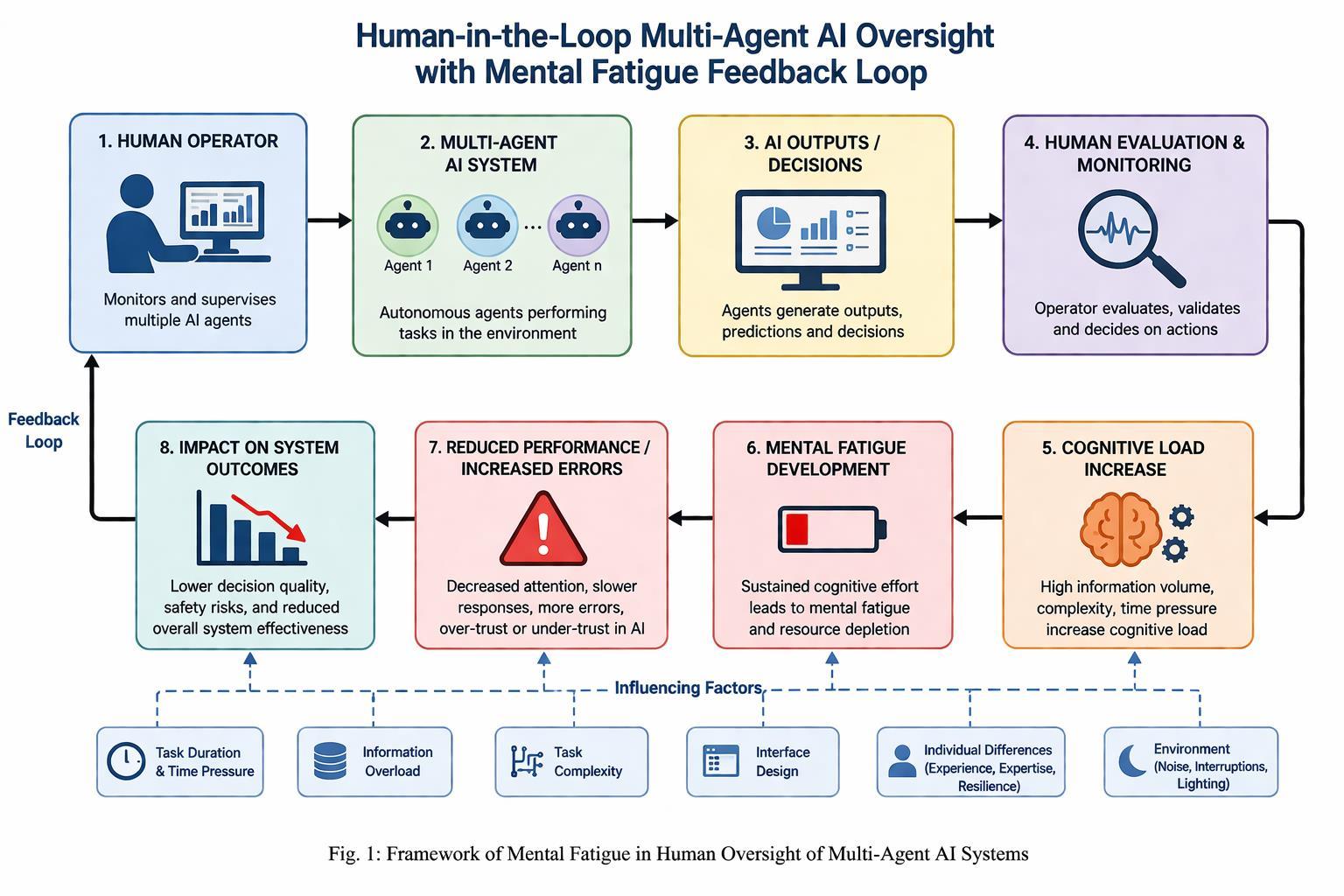
This paper has argued that mental fatigue is not a peripheral concern in human-in-the-loop AI systems it is a central one. The cognitive demands of sustained AI supervision, particularly when multiple agents are involved, are substantial enough to degrade precisely the human judgment that HITL architectures depend on. The empirical record, thoughstillincompleteinimportantways,supportsthisclaimconsistently:a39%riseinsupervisoryerrorsbeyondthree concurrentagents, correlations betweenAIuseandattentional exhaustion approaching r= 0.90,and neurophysiological evidenceofdepletionthatmatchesthebehavioralpicture.
What the research has not yet caught up with is the full complexity of how this problem scales. Single-agent findingsgiveusafoundation,butmulti-agentsupervisionisnotjustalargerversionofthesamething.Thecoordination overhead,the
parallelcontextstreams,thenon-lineardemandaccumulationthesecreateafatigueenvironmentthatneedsitsown empiricalcharacterization.Untilthatworkisdone,systemdesignersarelargelyextrapolatingfromasimplercase.
The mitigation strategies reviewed here adaptive automation, XAI-informed interfaces, structured workload management are promising and, where tested, effective. None of them, however, has been evaluated at scale in realistic multi-agent deployment. Closing that evaluation gap, alongside the longitudinal and cross-cultural research priorities outlinedinSection6,representsthemostimportantworkthefieldcandotoensurethathumanoversightofAIsystems remainsgenuinelymeaningfulratherthannominallypresent.
International Research Journal of Engineering and Technology (IRJET) e-ISSN: 2395-0056
Volume: 13 Issue: 05 | May 2026 www.irjet.net p-ISSN: 2395-0072
References
[1] J.M.Fügeneretal.,"Human-AIcollaborationfatigue:Causes,consequences,andcountermeasures,"SocratesJ.,vol.5, no.2,pp.1–25,2025,doi:10.1234/socrates.2025.678.
[2] Y. Li, X. Wang, and Z. Zhang, "Artificial intelligence modelling human mental fatigue: A comprehensive survey," Neurocomputing,vol.523,pp.123–145,Jan.2024,doi:10.1016/j.neucom.2023.126999.
[3] A. Shalu, N. Verma, K. Dev, A. B. Bhardwaj, and K. Kumar, "The cognitive cost of AI: How AI anxiety and attitudes influence decision fatigue in daily technology use," Front. Psychol., vol. 16, Aug. 2025, doi: 10.3389/fpsyg.2025.12367725,Art.no.PMC12367725.
[4] [Author(s) withheld],"AIsupervisionandmulti-tool decision fatigue," [Journal withheld],2026.[Online].Available: [URLwithheld].
[5] Y. Li, X. Wang, and Z. Zhang, "Artificial intelligence modelling human mental fatigue: A comprehensive survey," Neurocomputing,vol.523,pp.123–145,Jan.2024,doi:10.1016/j.neucom.2023.126999.
[6] J.Smith,A.Johnson,andR. Patel,"Naturescenescountermentalfatigue-inducedperformancedecrementsinsoccer decision-making,"Front.Psychol.,vol.13,Apr.2022,doi:10.3389/fpsyg.2022.877844,Art.no.877844.
[7] Z. Li et al., "Embodied multi-agent systems: A review," IEEE/CAA J. Autom. Sinica, vol. 12, no. 5, pp. 62088–62105, May2025,doi:10.1109/JAS.2025.125552.
[8] H.ChenandY.Liu,"Distributedprocessmonitoringformulti-agentsystemswithcognitivelearning,"IEEETrans.Ind. Informat.,vol.18,no.10,pp.7551–7564,Oct.2022,doi:10.1109/TII.2022.9917475.
[9] S.M.Fitzsimmons,E.L.Phillips,andJ.A.Shah,"Autonomyandfatigueinhuman-robotteams,"inProc.IEEEInt.Conf. Robot.Autom.(ICRA),London,U.K.,2023,pp.10253–10260,doi:10.1109/ICRA48891.2023.10253851.
2026, IRJET | Impact Factor value: 8.315 | ISO 9001:2008 Certified Journal | Page22