
International Research Journal of Engineering and Technology (IRJET) e-ISSN: 2395-0056
Volume: 12 Issue: 03 | Mar 2025 www.irjet.net p-ISSN: 2395-0072
International Research Journal of Engineering and Technology (IRJET) e-ISSN: 2395-0056
Volume: 12 Issue: 03 | Mar 2025 www.irjet.net p-ISSN: 2395-0072
Miss. Apeksha P. Ingle1 , Dr. C.N. Deshmukh2 , Dr. D.T. Ingole3
1(Mater of Engineering , Electronics & Telecommunication Engineering) Student, Prof .Ram Meghe Institute of Techonology & Research Badnera, 2Head of Department, Prof. Ram Meghe Institute of Techonology & Research Badnera, 3Principal, Takshashila Institute of Eengineering and Technology Darapur, Sant Gadge Baba Amravati University, Amravati, Maharashtra ***
Abstract - Digital image manipulation, specifically copymove forgery, poses a significant challenge given the easy access to editing software. This research examines blockoriented (including DCT, PCA, DWT) and key point-oriented (such as SIFT, SURF) detection techniques, evaluates their shortcomings, and introduces a combined methodology integratingbothapproaches.MATLAB-basedimplementation issuggestedtoaddresscomputationalcomplexity,localization accuracy, and robustness to geometric transformations A MATLAB-basedsolutionisrecommendedtotackleprocessing efficiency, detection precision, and resilience against geometric modifications.
Key Words: : Copy-moveforgery,Digitalcopyright,Feature Extraction, Detection.
Context: Theproliferationofsocialplatformsandimage manipulation tools has made forgery identification crucialforlegal,media,andinvestigativepurposes.
Challenge: Copy-move forgery, involving the duplicationofcontentwithinanimage,presentsunique difficulties due to its subtle nature and subsequent modifications(likescaling,rotation,noiseinsertion).
Objective: Createaneffective,comprehensivedetection system using MATLAB to address existing methodologicallimitations.
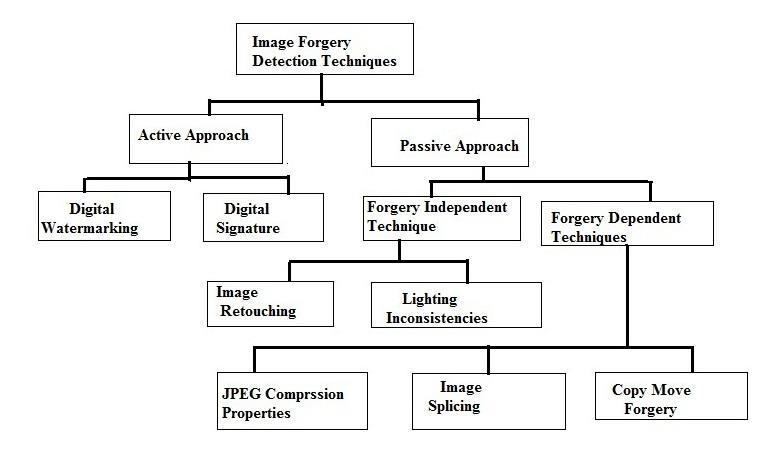
Authenticationverificationestablishesimagelegitimacy. Various approaches have been developed to validate authenticimages.Thesemethodscanbebroadlyclassified intotwomaingroups:
Activetechniques
Passivetechniques
Thisclassificationisbasedonwhetherthesourceimageis availableornot.Eachapproachcanbefurthersubdivided. Theclassificationhierarchyisillustratedinfigure1.
1.1.1
Active forgery detection methodology requires preembeddedorpre-extracteddata.DigitalWatermarkingand digital signature techniques are commonly employed methodsintheactivedetectionapproach.
1.1.2
Passivetechniques,alsoknownasblindmethods,utilize only the image itself for authentication and integrity verification. This approach operates on the premise that even when visual tampering signs are absent, the manipulationmaydisruptunderlyingstatisticalproperties through noise inconsistencies, image blur effects, enhancement artefacts, copy-move forgery, and image inpaintingoperations.
Forgerydependentmethodologiesaredesignedtoidentify specifictypesofmanipulations,suchassplicing,whichrely on the nature of alterations performed on the image. Forgeryindependentapproachesdetectmanipulationsthat are not tied to specific fraud types but instead focus on traces left by processes like sharpening, blurring, and irregularitiesinlightingandshadowpatterns.
International Research Journal of Engineering and Technology (IRJET) e-ISSN: 2395-0056
Volume: 12 Issue: 03 | Mar 2025 www.irjet.net p-ISSN: 2395-0072
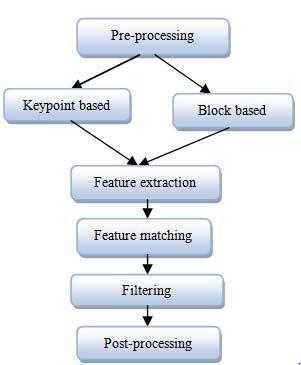
Forgeryidentificationinpicturesistwostepissue.The principletargetofblindforgerydetectiontechniquestaysto categorizeagivenpictureasrealoraltered.Awidelyused schema of image forgery identification procedure, that comprisesofthefollowingsteps:
1. Image Pre-processing:Thisinitialphaseinvolves various pre-processing operations on the target image,includingfiltering,enhancement,cropping, DCT coefficient modifications, and color space conversion from RGB to grayscale before proceedingwithfeatureextraction.Algorithmsmay ormaynotincorporatethisstepbasedonspecific computationalrequirements.
2. Feature Extraction: Feature selection for each classdifferentiatesimagesetsacrossvariousclasses while maintaining consistency within a specific chosenclass.Theselectedfeaturesetshouldideally be compact to reduce computational complexity while maintaining significant distinction between classes.
3. Selection of Classifier: Based on the extracted featuresetfromthepreviousstep,anappropriate classifier is either selected or designed. Larger training datasets typically result in enhanced classifierperformance.
4. Classification: The fundamental aim of classification is to determine image authenticity. Common classifiers employed include Neural Networks,LDA,andSVM.
5. Postprocessing: Certain forgeries may require additional processing steps, such as identifying copiedregions.
2. Literature Review
Copy-Move fabrication discovery strategies can be arrangedintotwoapproaches:
1. Keypointbasedmethodologies.
2. Blockbasedmethodologies
Key point based approaches utilize scale and rotation invariant feature detection and description algorithms, primarily Speeded-up Robust Features (SURF) and Scale InvariantFeatureTransform(SIFT).
Block based techniques employ various transformation methods including Discrete Wavelet Transform (DWT), Principal Component Analysis (PCA), Singular Value Decomposition(SVD),andDiscreteCosineTransform(DCT).
The following table outlines the methodologies, key contributions,andinherent limitations of eachreferenced study,alongwithproposedsolutionstoaddressidentified gaps:
International Research Journal of Engineering and Technology (IRJET) e-ISSN: 2395-0056
Volume: 12 Issue: 03 | Mar 2025 www.irjet.net p-ISSN: 2395-0072
Reference Method Contribution
Fridrich et al [4]
Popescu & Farid [5]
Block-based DCT+ lexicographi calsorting
PCA-based dimension reduction
Li et al. [6]
DWT+SVD
Introducedefficient blockmatchingvia DCTcoefficient sorting.
Reduced computationalcost usingPCAfor overlappingblocks
CombinedDWTfor dimensionality reductionandSVD forrobustfeature extraction.
Limitations
Failsforsmall duplicatedregions; sensitiveto geometric transformations.
Lowaccuracyfor smallblocksizes (eg.,32x32)
Limitedrobustness torotation/scaling; highmemory usage
Principal Component Analysis (PCA) to achieve dimensionality reduction during feature extraction. Subsequent methodologies incorporate DWT and SVD algorithmsforimagefeaturepointextraction.Thefieldhas also witnessed the introduction of key-point-based techniquesforforgeryregionidentification.ScaleInvariant Feature Transform (SIFT) enables key-point extraction, while Speeded Up Robust Features (SURF) focuses on identifying interest points rather than utilizing blocks for tampering detection. While these approaches successfully identify matching points, they fall short in precisely localizingforgedimageregions.Mostblock-baseddetection techniques, though utilizing identical algorithms, differ primarilyintheirfeatureextractionmethodologies.These approaches consistently demonstrate suboptimal recall rates.
Bayram et al. [8]
FourierMellin Transform (FMT)
Ryu et al [9] Zernike Moments
Bo et al. [10]
SURF-based keypoints
Invariantto translation/scaling; robusttonoise
Rotationandblur invariance; localizedtampered regions.
Efficientfeature detectionusing Hessianmatrix; robusttonoise
Amerini et al [11]
SIFT-based detection
Zhong & Xu [12]
Gaussian Pyramids
Thajeel & Sulong [13]
Block-based +Hu Moments
Detected geometrically transformed regionsusingSIFT
Usedmulti-scale decompositionfor low-frequency analysis.
Combinedfixedsizedblockswith Humomentsfor featureextraction.
Computationally expensive; struggleswith complex transformations.
High computational cost;failsforscaled regions.
Poorlocalization accuracy;cannot delineateexact forgedregions.
Highfalse positives; computationally intensiveforlarge images
Limitedtospecific forgerytypes;poor recallrates
Inefficientforhighresolutionimages; lacksrobustnessto post-processing.
Table -1: ContributionsandLimitations
3. Problem Synthesis
In copy-move forgery detection, block-based and keypoint-based algorithms emerge as the predominant methodological approaches. Fridrich et al. [4] presents a block-basedmethodologyutilizingdiscretecosinetransform (DCT), where feature extraction involves quantized DCT coefficients from overlapping blocks. However, this approachdemonstrateslimitedeffectivenessinidentifying small duplicated regions. Popescu et al. [5] implements
1. Computational Complexity: Block-based approaches (e.g., DCT, PCA) demand extensive comparisons,whilekeypoint-basedmethods(e.g., SIFT, SURF) demonstrate poor scaling with increasingimagedimensions.
2. Geometric Transformations: Existing methods struggle to detect duplicated regions modified throughrotation,scaling,orblurringoperations.
3. Localization Precision: Key point-based approaches identify matches but fail to delineate exacttamperedregionboundaries.
4. Threshold Dependency: The requirement for manual threshold adjustment (e.g., θ, R) restricts generalizationacrossdiversedatasets.
Thewidespreadaccessibilityofdigitalimagemanipulation tools has transformed copy-move forgery detection into a crucial challenge for validating image authenticity. This comprehensivereviewexaminedblock-basedmethodologies (incorporating DCT, PCA, DWT) and key point-based approaches (utilizing SIFT, SURF), evaluating their respective advantages and drawbacks. While block-based techniques demonstrate superior accuracy in identifying duplicated regions, their computational demands are substantial, and they exhibit vulnerability to geometric transformations. Conversely, key point-based approaches, though resilient to scaling and rotation manipulations, demonstratelimitationsinpreciseboundarydetectionand efficiencywithlargerimages. Analysisofcurrentresearch reveals several persistent challenges: substantial computational requirements, vulnerability to postprocessing modifications, and suboptimal localization precision. To overcome these limitations, this study proposes integrating block-based and key point-based
International Research Journal of Engineering and Technology (IRJET) e-ISSN: 2395-0056
Volume: 12 Issue: 03 | Mar 2025 www.irjet.net p-ISSN: 2395-0072
methodologies into a unified framework. This hybrid approachaimstocapitalizeonthecomplementarystrengths of both techniques, enhancing resilience to geometric transformations while maintaining precise localization capabilities.MATLABemergesastheoptimaldevelopment environment,providingcomprehensivetoolsforalgorithm implementation,performanceoptimization,andvalidation, particularly in addressing computational efficiency and scalabilityconcerns.
Subsequent research directions will concentrate on enhancing this hybrid framework, streamlining feature extraction and matching mechanisms, and conducting extensivevalidationacrossmultipledatasets.Prioritywillbe given to developing automated threshold selection processes, reducing manual calibration requirements and improvinguniversalapplicability.Successfullyimplementing these improvements could substantially advance forensic analysis,legalproceedings,andjournalisticverificationby deliveringanefficient,dependablesolutionforidentifying sophisticated forgeries. This research establishes groundwork for developing a robust, adaptable detection system,connectingtheoreticaladvancementswithpractical implementationrequirements.
[1] G.K.Birajdar and V.H.Mankar,”Digital image forgery detection using passive techniques:A survey”,Digital investigations,pp.226-245,2013.
[2] ”A Review Paper on Digital Image Forgery Detection Techniques”, Navpreet Kaur Gill, Ruhi Garg, Er.Amit Doegar,8thICCCNT2017
[3] “Image forgerydetectionforhighresolutionimagesusing SIFT and RANSAC algorithm”, Gonapalli Ramu, S.B.G. Thilak Babu, Proceedings of the 2nd International ConferenceonCommunicationandElectronicsSystems (ICCES2017)
[4] Fridrich,D.Soukal and J.Luka,”Detection of copy-move forgeryindigitalimages”,inDigitalForensicResearch Workshop,pp.6-8,2003..
[5] Popescu, A1in c., and Hany Farid, ”Exposing digital forgeries by detecting duplicated image regions”, Department of Computer Science, Dartmouth College, TechnicalReport.TR2004-515,August2004.
[6] G.Li,Q.Wu,D.Tu,andS.Sun,“ASortedNeighborhood ApproachforDetectingDuplicatedRegionsin Image Forgeries based on DWT and SVD,” in Proceedings of IEEEInternationalConferenceonMultimediaandExpo, BeijingChina,pp.1750-1753,July2-5,2007.
[7] J.Wang,G.Liu,Z.Zhang,Y.Dai,andZ.Wang,"FastAnd Robust Forensics for Image Region duplication
Forgery,"inProceedingsofActaAutomaticaSinica,Vol. 35,pp.1488-1495,2009
[8] S.Bayram,H.TahaSencarandN.Memon,"AnEfficient andRobustMethodforDetectingCopy-MoveForgery,"in IEEEInternationalConferenceonAcoustics,Speechand SignalProcessing,Taipei,pp.1053-1056,2009
[9] S. Ryu, M. Lee and H. Lee, “Detection of Copy-RotateMoveForgeryUsingZernikeMoments,”inProceedings of InformationHiding Springer Berlin Heidelberg, pp. 1053-1056,2009
[10]X. Bo, W. Junwen, L. Guangjie, and D. Yuewei, "Image Copy-Move Forgery Detection Based on Surf,"in ProceedingsofMultimediaInformationNetworkingand Security,InternationalConferenceOn,pp.889-892,2010
[11]I. Amerini, L. Ballan, R. Caldelli, A. Del Bimbo and G. Serra,"AnSIFT-BasedForensicMethodforCopy–Move Attack Detection and Transformation Recovery,"in Proceedings of IEEE Transactions onInformation ForensicsandSecurity,vol.6,no.3,pp.1099-1110Sept. 2011