
International Research Journal of Engineering and Technology (IRJET) e-ISSN: 2395-0056
Volume: 12 Issue: 04 | Apr 2025 www.irjet.net p-ISSN: 2395-0072
International Research Journal of Engineering and Technology (IRJET) e-ISSN: 2395-0056
Volume: 12 Issue: 04 | Apr 2025 www.irjet.net p-ISSN: 2395-0072
Agamoni Das 1 , Debasish Bandyopadhyay 2
1 PhD Scholar, Dept. of Construction Engineering, Jadavpur University, Kolkata, West Bengal-700098, India
2 Professor, Dept. of Construction Engineering, Jadavpur University, Kolkata, West Bengal-700098, India ***
Abstract - Seismic hazard refers to the probability or likelihood of certain levels of ground shaking (earthquake intensity) occurring in a specific region over a given period of time. Seismic hazard assessment is typically a map or model that shows areas with varying levels of earthquake hazard, basedonthepotential forgroundshaking,faulting,andother seismic phenomena. Seismic risk is typically assessed by combining seismic hazard data with information on the exposure and vulnerability of a region. It is a measure of the potential impact of earthquakes on people, buildings, infrastructure, and the environment. Seismic disaster mitigation techniques are being adopted which causes reduction in earthquake forces by different methods. The proposed paper investigates the ability of base isolation and energy absorption systems using rubber isolators and fluid viscousdamperstoprotectthestructurebycontrollingseismic response. Concretebuildingstructuresofregularandirregular typehavebeen modelledinSAP2000forvariousstoryheights of G+5 & G+15 building. Non-linear Time history has been performed for both conventional and isolated buildings. Seismicresponsese.g.baseshear, maxdrift/displacementetc. have been compared for the conventional and isolated structures for each of the building models with same seismic considerations. The optimum zone for selection of the ideal combination of isolation and damping system has been identified for all the building types from the parametric study of change in isolation and deformation ratio using various stiffness and damping properties.
Key Words: Base Shear; Non-linear; Energy absorption; Damping; Isolation ratio; Deformation ratio
Seismic disaster mitigation for structures is of paramount importance because it directly affects the safety, stability, andfunctionalityofbuildingsandinfrastructureduringan earthquake. It aims to anticipate and minimize the risks associatedwithearthquakes,leadingtosafercommunities, lesseconomicloss,andquickerrecoveryintheaftermath. Whendesigningstructuresforseismicconditions,engineers considertwomainearthquakescenarios:theDesignBasis Earthquake(DBE)andtheMaximumConsideredEarthquake (MCE).Thesescenarioshelpdeterminehowmuchseismic force a structure should be able to withstand during an earthquake, guiding the design of the structure's componentstoensuresafety,stability,andperformance.The
designstructureinDBEisdonetoensurethatthestructure can survive moderate earthquakes without significant damage and that it provides a safe environment for occupants.TheMCErepresentsamoresevereearthquake scenario,oftenassociatedwiththelargestearthquakethat couldreasonablybeexpectedinaregionoverthelifetimeof the structure. Under MCE conditions, the structure may experiencesignificantdamage,suchascracking,permanent deformation,orfailureofnon-essentialsystems.However, the key objective is for the building to not collapse. The structureshouldmaintainitsstabilityandnotposeadanger tooccupants,butrepairswilllikelybeneededafterward.
Seismic disaster mitigation involves a range of strategies designed to reduce the impact of earthquakes. There are several methods for making structures safe against earthquake;earthquakeresistantdesignusingBaseisolation and damping systems, retrofitting existing structures etc. Baseisolationisoneofthemosteffectiveseismicdisaster mitigation techniques used to protect buildings and infrastructure from earthquake damage ([4], [5], [12]) It involvesplacingabuildingorstructureonbearings(known asisolators)thatallowthebuildingtomoveindependently from the ground motion during an earthquake. This techniquereducestheamountofseismicenergytransmitted tothebuilding,helpingtominimizedamageandenhancethe safetyandresilienceofthestructure.Baseisolationcanbe applied to a wide range of structures, from residential buildingstolarge,complexinfrastructureprojectsforboth the conditions; retrofitting and new construction. Base isolationtechniqueincludessomeisolationdevicesbetween topandbottomstructureandusesthestiffnesstolengthen thetimeperiodoftheentirestructureandthusreducesthe seismicforcetoadesiredlevel.Seismicdampersaredevices that absorb and dissipate the energy generated by an earthquake,reducingtheamountofshakingexperiencedby abuildingorstructure.
Among the many supplemental base isolation and energy dissipation devices proposed and implemented for earthquakehazardmitigation,elastomericbearingsandfluid viscous dampers seem to be a popular solution in recent applications. Effectiveness of the isolator and damper behaviordependsonthenon-linearviscouscharacteristics ofisolators.Forelastomericisolators(EB)elasticstiffness helps in making structure flexible and base isolated with larger time period whereas fluid viscous dampers (FVD)
International Research Journal of Engineering and Technology (IRJET) e-ISSN: 2395-0056
Volume: 12 Issue: 04 | Apr 2025 www.irjet.net p-ISSN: 2395-0072
helpsinenergydissipationthroughthedampingpropertyof theviscousfluidandthecombinedeffectcanbesuitablefor anystructureinpurposeofreductionofearthquakeforces andsafedesign[13] Marquaet.alstudiedthebehaviourof low-rise, mid-rise and high-rise RC buildings with use of fluid viscous dampers [1]. Yenhul et. al [2] analysed the effectivenessofdamperswithinter-storyisolation.SimeS et. al. [5] analysed the performance of FVDs for SMRF RC buildingusingbothDBEandMCEearthquakeacceleration and compared the results. Mujeed et. al [8] studied the response of G+10 builidng with and without fluid viscous dampers.
Thedesignspectralacceleration(Sa/g)asperIS1893:2016 for equivalent static and Response spectrum method is showninFig1.1.
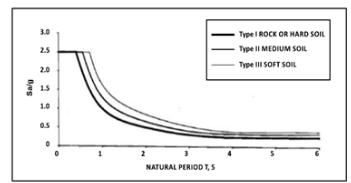
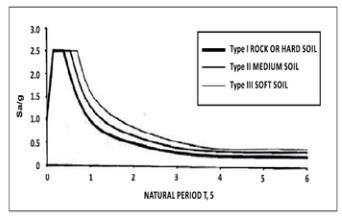
Fig-1.1:GeneralResponseSpectrumfromIS1893:2016
Thespectralaccelerationvaluegetsreducedifthestructure isflexiblewithanincreasedtimeperiodasshowninFig1.2.
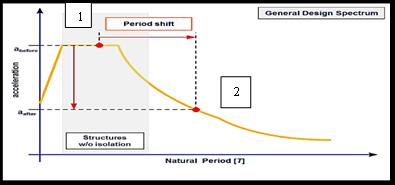
Fig-1.2:ReductionofSa/gduetoperiodshift
Point 1 denotes the initial time period of structure for conventional support. Adoption of base isolation method
lengthensthetimeperiodmakingsupportsflexible.Point2 definestheincreasedtimeperiodforisolatedsupport.
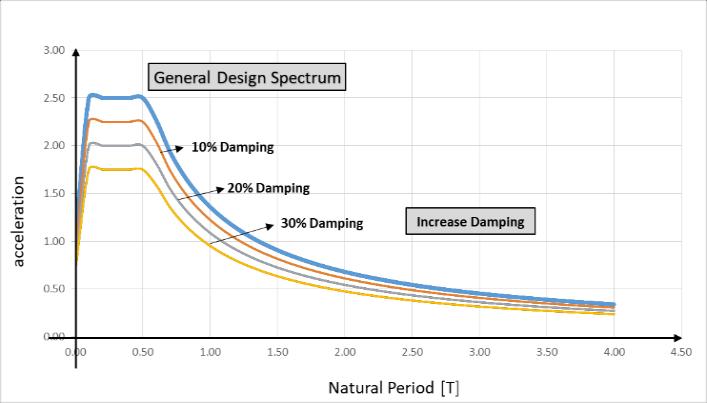
Fig-1.3:ReductionofSa/gduetoincreaseddamping
Point1definestheinitialtimeperiodfor5%dampingasper the standard response spectrum in accordance to IS 1893:2016. Further increase in damping helps in further reductionofSa/g.Point2,3,4areshowingthedecrementof Sa/g for a specific time period with increase in damping; 10%,20%.30%.
Thetimeperiodforregularstiffandconventionalbuilding structures is generally less than 1s for which spectral accelerationvaluemaximum.Thelevelofdampinginnormal structureisalsotypicallyverylowandtheamountofenergy dissipated during elastic behavior is very small. The supplementalisolationanddampingdevicesoperateonthe principleofincreasingtimeperiodwithadditionalflexibility andfurtherreducingaccelerationbydampingproperty.The devicesaredesignedtoisolatetopandbottomstructureand dissipateearthquake-inducedenergythroughinelasticaction.
Theobjectiveoftheproposedstudyistocheckthevariation of seismic forces and deformation values for different buildingstructureswithsameseismicinputsusingvarious propertiesforisolatorsanddampers.Therequirementisto find out the optimum zone from the interaction between isolationanddeformationratio,whichcanhelptodecidethe combinedisolationanddampersystemforeffectivecontrol ofstructuralresponse.Thebaseshearandmaxdeformation areaimedtobewithinthelimitwhichcanbecomfortable andserviceableforthestructure.
Thescopeincludesthenumericalparametricstudybasedon dynamic analysis (Non-linear Time history) of concrete buildingstructurewithfollowingvariation:
C: Structure without elastomeric bearings and fluid viscousdampers;conventionalsupportsystem
D: Structurewithelastomericbearingsandfluidviscous dampers between Superstructure and foundation at each columnsupport
R:Buildingsregularinelevation
International Research Journal of Engineering and Technology (IRJET) e-ISSN: 2395-0056
IR:Buildingsirregularinelevation
Comparisonstudieshavebeenmadeforimportantbuilding models with and without the use of EB and FVD for the followingdifferentparametersconsideredinSeismicanalysis Importance factor (1.5 for both conventional and isolated models)
• SeismiczoneV
• Response Reduction factor (1.0 for both conventionalandisolatedmodels)
• Soiltype-Medium
The type of conventional and isolated building structures consideredaredefinedinTable1.1.
Table-1.1:Differenttypeofstructuremodels
Storey Plan Support Designation
G+5 Regular Conventional CRM5
G+15 Regular Conventional CRM15
G+15 Irregular Conventional“L” CIRML15
G+15 Irregular Conventional“T” CIRMT15
G+15 Irregular Conventional “Opp T” CIRMT15’
G+5 Regular Isolated/damped DRM5
G+15 Regular Isolated/damped DRM15
G+15 Irregular Isolated/damped “L” DIRML15
G+15 Irregular Isolated/damped “T” DIRMT15
G+15 Irregular Isolated/damped “OppT” DIRMT15’
The study has been done for Non-linear Time history for Elcentro, Turkey and Sikkim earthquake acceleration matched to target response spectrum corresponding to differentseismiczonesandsoiltypes.
Numerical Models have been developed with and without isolatorsmadeofelastomericbearingsystemanddampersas Fluid viscous dampers. Study has been made of different kinds of structures for different seismic parameters with similarisolationanddampingsystem.
AnalysishasbeendoneinSAP:2000softwarebyNon-linear TimehistoryMethod.TheFEMbasedsoftwareseemstobe applicableforanalysisofdifferenttypesofstructuralsystem withrespecttostate-of-the-artpracticewithnon-linearand dynamicconsideration.
Volume: 12 Issue: 04 | Apr 2025 www.irjet.net p-ISSN: 2395-0072 © 2025, IRJET | Impact Factor value: 8.315 | ISO 9001:2008
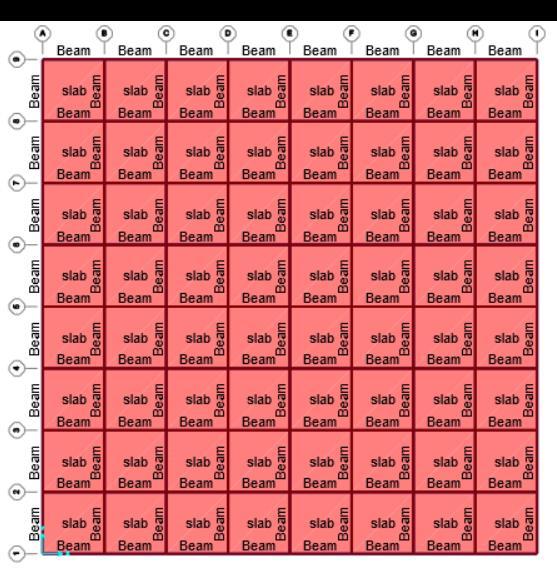
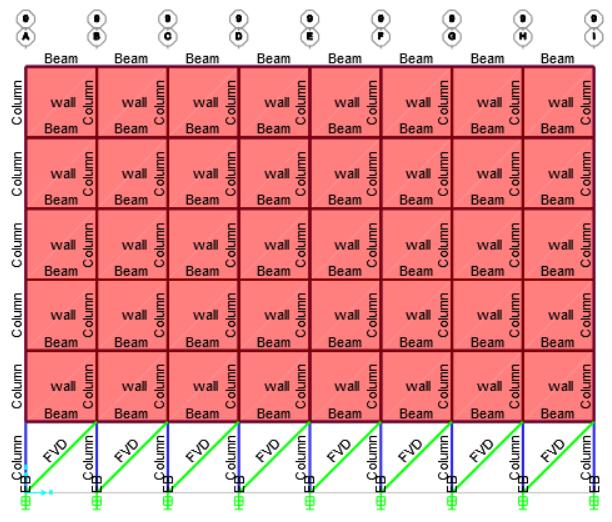
RCCregularbuildingmodelshavebeendevelopedforG+5& G+15storey.Allthebuildingmodelsareregularinplanwith 8x8grid.Eachpanelareais4mx4m.Theheightofeachstorey is4m.Thecolumnsareof300mmwidthand400mmdepth, beamsareassignedwith250mmwidthand300mmdepth. Slabs are 150mm depth and walls are 250mm thick. The grade of concrete is M30 for all the models. Supports are definedasconventionalforfixedandisolated/dampedusing EBandFVDs.EBandFVDareassignedaslinkelements.Link elementforEBhasbeendefinedwithnon-linearproperties, initial stiffness, yield force and post yield stiffness ratio. Though for regular elastomeric isolators the damping percentageisonly2-3%,henceyieldforcewillbeverylessin comparisontootherisolators,LeadrubberorHighdamping rubberbearings.
Theplanandelevationofeachregularbuildingareshownin Fig2.1toFig2.3.
International Research Journal of Engineering and Technology (IRJET) e-ISSN: 2395-0056
Volume: 12 Issue: 04 | Apr 2025 www.irjet.net p-ISSN: 2395-0072
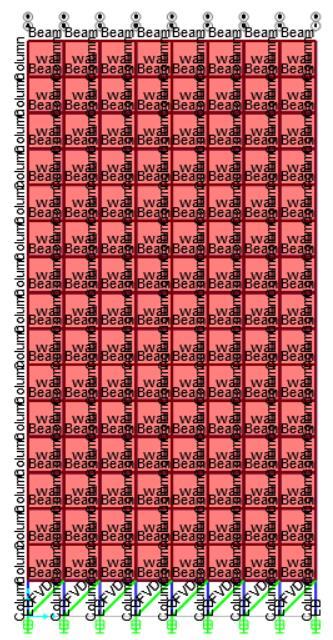
Fig-2.3:ElevationofCRM15/DRM15bldg
Theplanandelevationofeachirregularbuildingareshown inFig2.4toFig2.6.
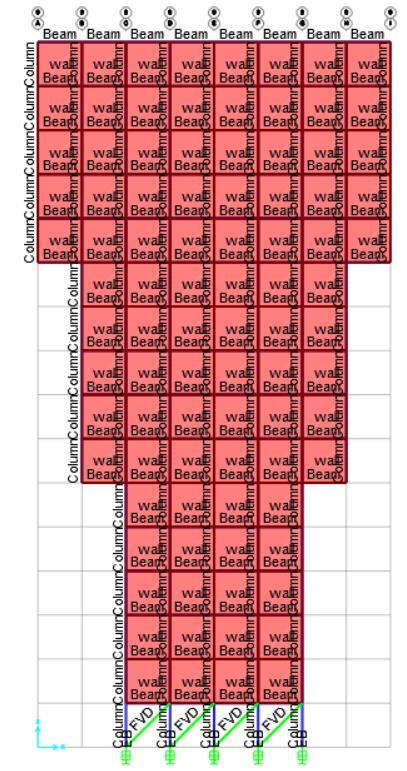
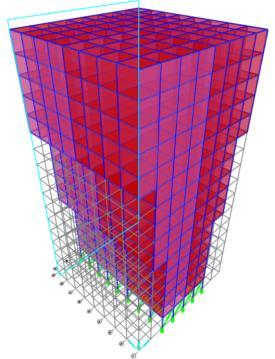
Fig-2.4:ElevationofDIRMT15bldg
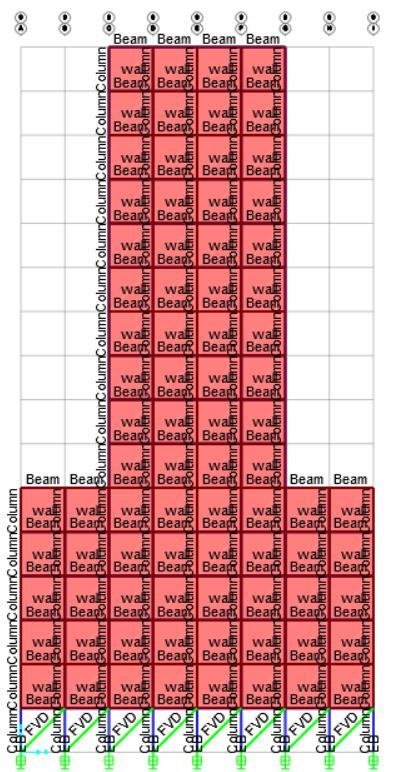
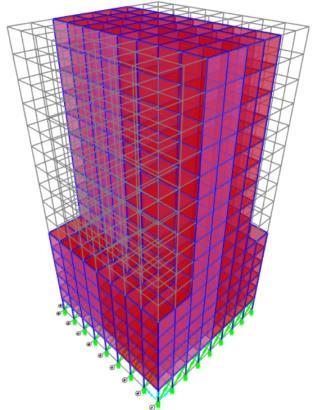
Fig-2.5:ElevationofDIRMT15’bldg
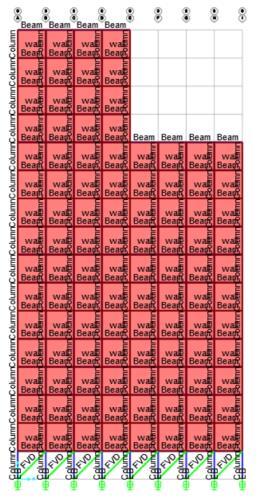
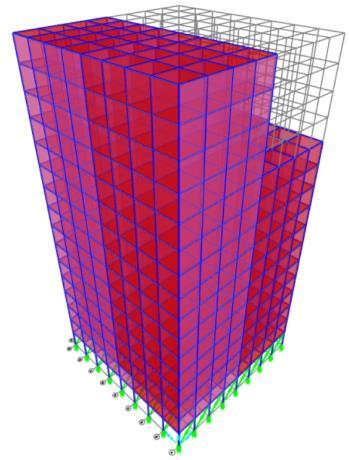
Fig-2.6:ElevationofDIRML15bldg
Differentmaterialproperties,loadcasesforvariouszones andsoiltypes,supportrestraints,non-linearpropertiesof linkshavebeenincorporatedinthemodels.Thetimehistory function has been derived by matching the accelerogram data from Elcentro, Sikkim and Turkey earthquake with targetresponsespectrumforvariouszonesandsoiltypes. Input function for non-linear dynamic analysis has been definedforloadpatternas acceleration in X& Y direction withscale/conversionfactoras9.81.Scaleconversionfactor is the value of “g” to match the unit of both input and matched accelerogram. Total duration of Time history accelerationfunctionis30s(timestepof0.02s)forElcentro and145s(timestepof0.005)forSikkimand105s(timestep of0.001)forTurkeyearthquake.
International Research
Volume: 12 Issue: 04 | Apr 2025 www.irjet.net
Thenon-linearpropertiesofLink/SupportforLeadrubber bearingsareconsideredasshowninTable2.1.
0.5to10ateach
Initialstiffnessisthecombinationofstiffnessofrubbertill theyieldpointanditcanbedefinedaselasticstiffness.Yield forceistheforcerequiredtoyieldandgobeyondtheelastic limit.Postyieldstiffnessratioistheratiobetweenpostyield stiffness and initial/elastic stiffness. The elastomeric isolatorsmainlyhelpstoreducetheseismicforcewiththe elasticproperty,notthedamping.
LinkpropertiesofFluidviscousdampersaredefinedusing constitutivelaw:
F=Cvn,where
F=ForceorcapacityofFVD C=dampingcomponentinkN/(m/s)n V=velocityinmm/s
n=dampingexponent,generallythevalueis0.1or0.2(here n=-0.1considered).
FVDsareplacedasdiagonalbracing.Inthisarrangement,the amplificationfactoroftherelativedisplacementbetweenthe twoendsofthedamperdependsontheangleofthebrace thatwillholdthedamper.Inthiscase,theaxialdisplacement devices are less than or equal than the story drift, thus loweringtheirefficiencyenergydissipation.IngeneralFluid viscousdampersareplacedasdiagonalbracinginbuildings toeffectivelydissipateenergyfromseismiceventsorstrong winds,reducingstructuralvibrationsanddeformationsby converting kinetic energy into heat. K V Sharma et. al. [6] showstheeffectofuseofFVDsatvariousplacesorlocations in G+20 building. Rinaldin et. al [7], and Agha et. al [9] studiedandinvestigatedthehystereticbehaviourofFVDs. Zoccoliniet.al[10]didresearchonsemi-activeandadaptive behaviour of FVDs and Prajapati et. al [13] studied performance of RCC structures using FVDs as energy dissipation devices. Waghmare et. al [11] investigated influence of FVDs on seismic response on reinforced concreteelevatedstoragetanks.
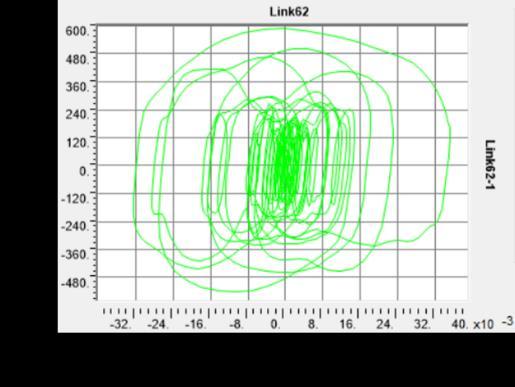
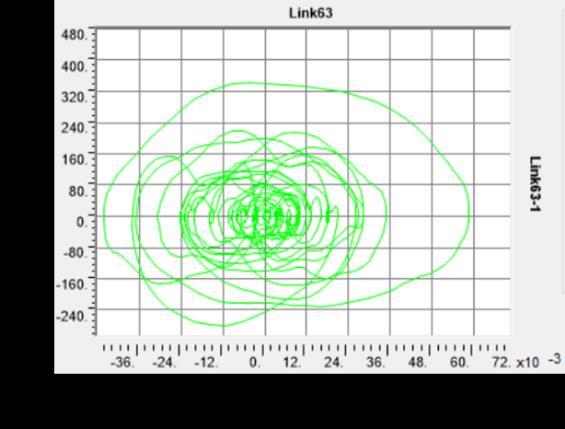
Fig 2.7 to 2.9 shows the hysteresis graph of link force vs deformationbehaviorofafluidviscousdamperasperthe analysisdoneinSAP.Theareaofhysteresisgraphdepends ondampingexponent,nandtheincreaseinthevaluefrom 0.1to1makesthehysteresisgraphmorecirculartype.
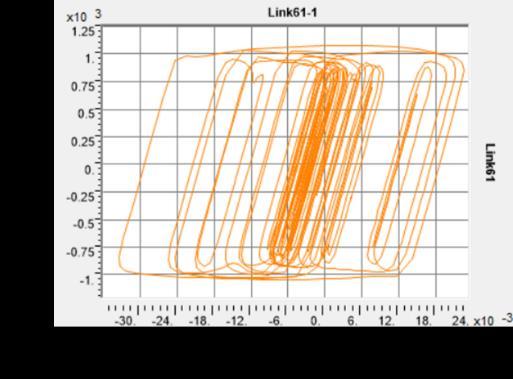
Thenon-linearpropertiesofLink/Supportforfluidviscous dampersareconsideredasfollowsinTable2.2.
Table-2.2:Non-linearpropertiesofdampers
International Research Journal of Engineering and Technology (IRJET) e-ISSN: 2395-0056
Volume: 12 Issue: 04 | Apr 2025 www.irjet.net p-ISSN: 2395-0072
3.1 Prob-1- Isolation and deformation comparison for G+5 and G+15 regular buildings
The Conventional regular building models have been developedwithoutisolatorsanddampersforfixedsupport conventional design. The non-linear analysis has been carried out for different time history functions and base shearanddeformationvalueshavebeenrecordedinTable 3.1.
Table -3.1:Baseshearforconventionalbuildings
Building Fixedbaseshear[kN]asper Non-linearTimehistory analysis Seismic weight[kN]
Elcentro Sikkim Turkey
CRM5 55653 51949 48863 107320
CRM15 65917 68658 64041 275690
The buildings have been analysed using only elastomeric bearings as isolators and the base shear got reduced considerably.
Table-3.2:Baseshearusingelastomericbearings [Stiffness=3.5kN/mm]
Building Baseshear[kN]using Elcentrotimehistory
CRM5 20814
CRM15 30672
onfixed baseshear
The displacement of isolated buildings using only EB is higherincomparisontofixedsupportbuildings.
InthenextsteptheRCCbuildingmodelswithisolatedand damped system have been analyzed using three different timehistoryfunctions.Theisolationratioanddeformation ratiohavebeenderivedfromthedataandplottedtoseethe variation.
Isolationratio=(Isolatedbaseshear)⁄(Fixedbaseshear)
Deformationratio=(isolateddeformation)⁄(Fixed deformation)
Theinteractionbetweenisolationanddeformationratiofor DRM5 building for elcentro time history analysis using is showninFig.3.1.
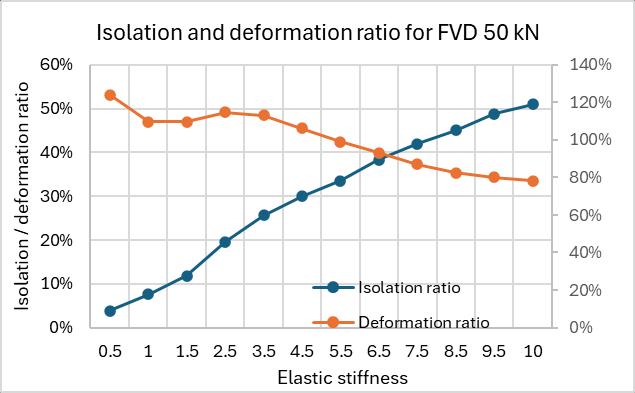
Fig-3.1:Isolation-deformationforDRM5building (Elcentro)
The base shear for isolated and damped buildings gets reducedupto49%anddeformationincreasesupto124% than the conventional fixed support buildings. The same non-linear time history analysis has been performed for DRM5 building with FVD of capacity 500 kN and the interactiongraphisshowninFig.3.2.
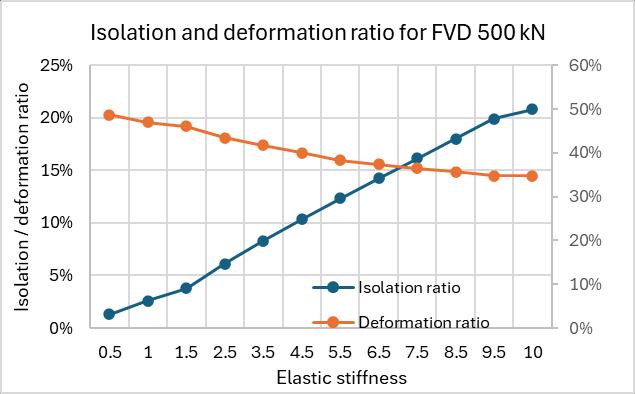
Fig-3.2:Isolation-deformationforDRM5building (Elcentro)
Thebaseshearforisolated/dampedbuildinggetsreduced to21%offixedsupportbaseshearanddeformationvalue also decreases to 50%. It has been observed that the combination of isolator and damper, i.e. EB and FVD is workingandeffectiveforreductionofbaseshearandtarget deformation.SimilaranalysishasbeenperformedforDRM5 buildingswithSikkimandTurkeyaccelerogramdataaswell andresulthasbeenshownhereinFig.3.3andFig.3.4.
International Research Journal of Engineering and Technology (IRJET) e-ISSN: 2395-0056
Volume: 12 Issue: 04 | Apr 2025 www.irjet.net p-ISSN: 2395-0072
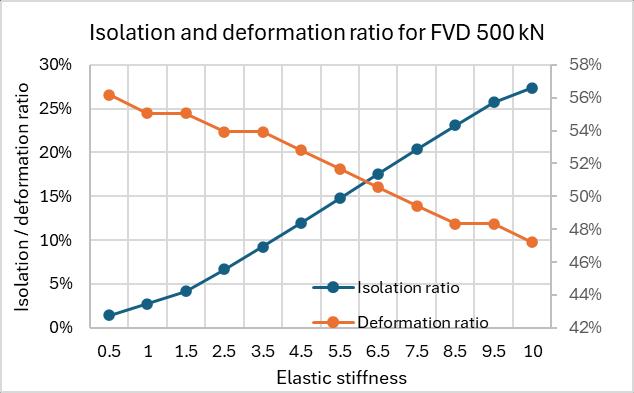
-3.3:Isolation-deformationforDRM5building (Sikkim)
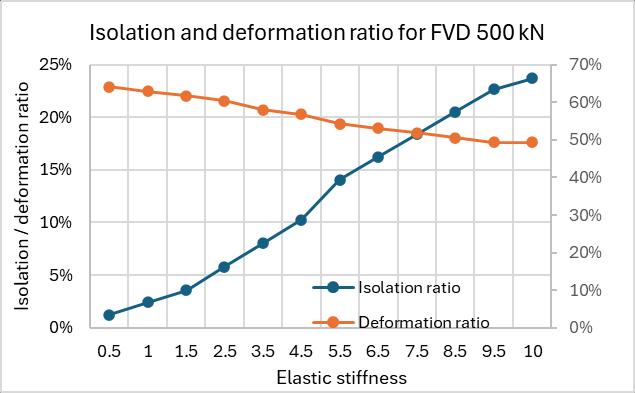
Fig -3.4:Isolation-deformationforIRM5building (Turkey)
Sincetheaccelerogramfunctionfortimehistoryanalysisare different,thereducedbaseshearanddeformationalsovary. Using Turkey earthquake function, the base shear can be reducedminimumof75%forFVDof500kNcapacityand stiffnessofEBas10kN/mm.
DRM15 building model has also been analysed using all different time history functions. The base shear and deformation values have been recorded for Sikkim earthquakedata.UsingFVDof300kNandelasticstiffnessof 0.5 kN/mm, base shear can be reduced to 47% and deformationupto94%(Fig.3.4).
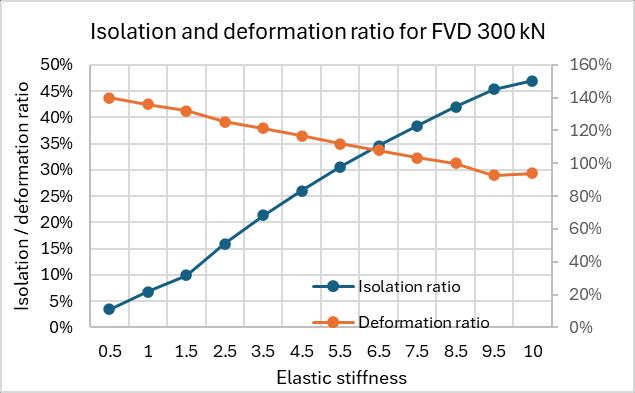
Fig-3.5:Isolation-deformationforDRM5building (Sikkim)
The deformation ration can go up to 65% for the analysis using elcentro time history data and it has been observed that the deformation ratio is maximum for Sikkim time historyforanycombinationofEBandFVD.
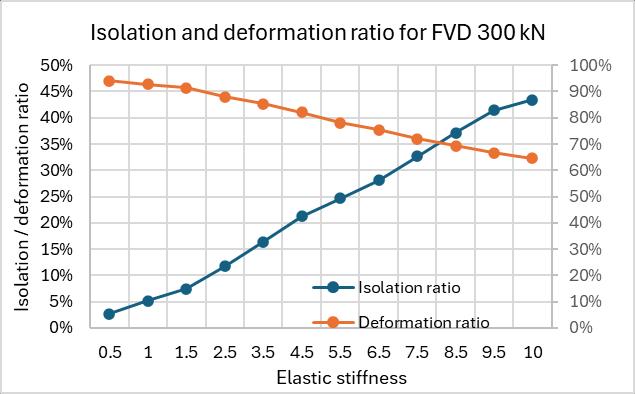
Fig-3.6:Isolation-deformationforDRM5building (Elcentro)
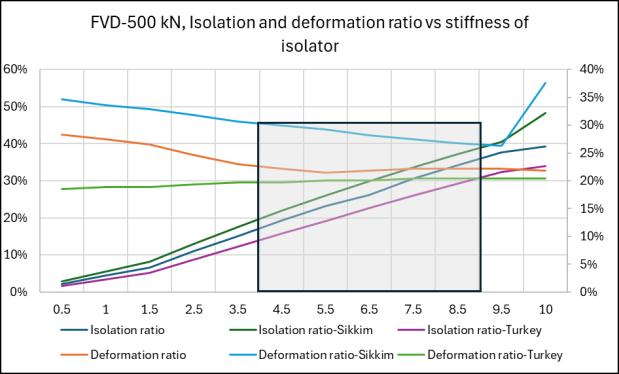
Theinteractionbetweenisolationanddeformationratiofor DRM5buildinghasbeenplottedforallthreedifferent time historyfunctions.TheisolationhasbeendoneusingEBwith stiffnessof0.5to10kN/mmanddampinghasbeenadded using FVD with capacity from 50 to 500 kN. Following graphsrepresenttheisolation-deformationinteractionand fromthisanoptimumzonecanbeselectedwheretherange ofstiffnessforEBandcapacityforFVDcanbedetermined.
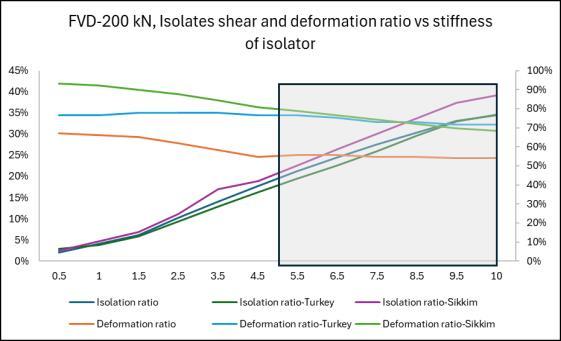
Fig -3.7:Isolation-deformationforCRM5building
InFig.3.7,theisolationratiohasbeenselectedfrom15%to 40%andaccordinglytherangeiselasticstiffnesshasbeen derived as 5 to 10 kN/mm for FVD capacity of 200 kN. Deformationratiovariesfrom45to85%whichiswithinthe acceptable range. However, the selection of isolation and deformationratioentirelydependsonthedesigner’schoice and other boundary conditions for which the structure is designed. Similarly, Fig. 3.8 and 3.9 present the optimum choiceofstiffnessofEBforFVDof300kNand500kNfora selectedrangeofisolationanddeformationratio.
International Research Journal of Engineering and Technology (IRJET) e-ISSN: 2395-0056
Volume: 12 Issue: 04 | Apr 2025 www.irjet.net p-ISSN: 2395-0072
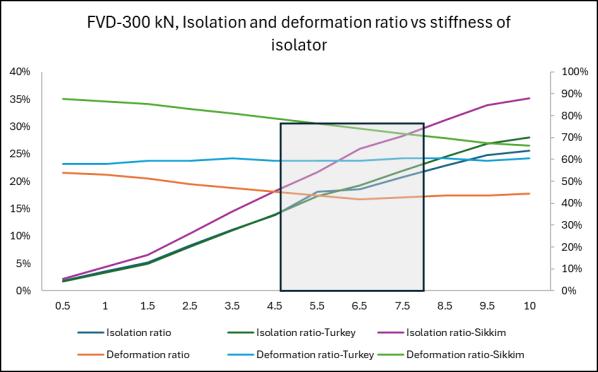
Fig -3.8:Isolation-deformationforDRM5building
Anotherexamplecanbetakenfromtheresultsduetothe analysisoftheDRM5buildingwithFVDof300kNinFig.3.8. If the isolation ratio is considered from 15% to 30%, the optimum range of elastic stiffness is 4.5-8 kN/mm. Deformationratiovariesfrom80%to40%.
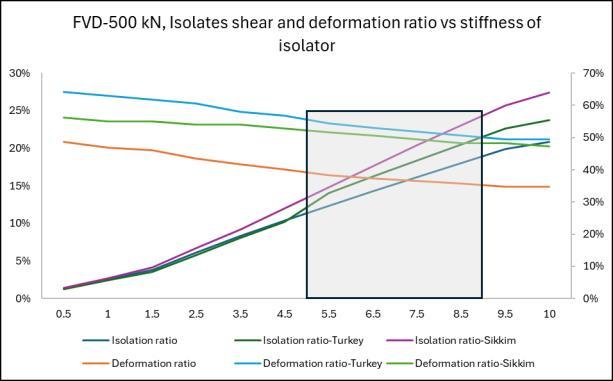
Fig -3.9:Isolation-deformationforDRM5building
Fig.3.9showstheisolation-deformationinteractionforFVD of500kNforaselectedzoneofisolationratiofrom10%to 25%anddeformationratiofrom60%to35%.
The stiffness of EB is in the range of 5 to 9 kN/mm. By changingtheFVDproperties,differentoptimumzonesfor isolator stiffness can be derived depending on structural designdemand.
Foranyspecificdesignseismicbaseshearseveraloptions can be defined from the analysis and results of isolationdeformationinteractions.Therecanbemultipleoptionsfor theisolationanddampingcombinationstoachieveatarget base shear. Fig. 3.10 shows the different EB-FVD combinations for a design isolation ratio of 10% Deformationratiovariesfrom51%to78%.Non-lineartime historyhasbeenperformedforElcentrofunction.
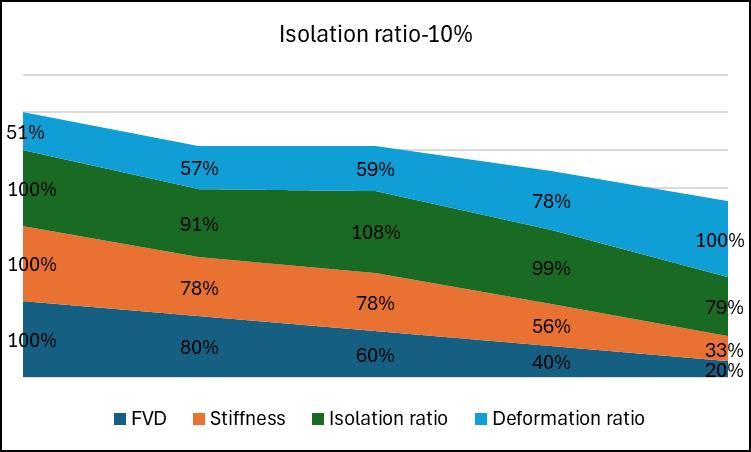
Fig-3.10:Isolation-deformationcombinationfor DRM5building(Elcentro)
For a target design isolation ratio of 20%, the several combinations of EB-FVD are shown in Fig. 3.11. The optimumsolutionsforeachEB-FVDcombinationhavebeen selectedandthecorrespondingdeformationratiohasbeen noted.Deformationratiovariesfrom36%to85%.Evenfor any range of design isolation ratio from 25-50%, the optimumEB-FVDinteractioncanbeselected(Fig.3.12).
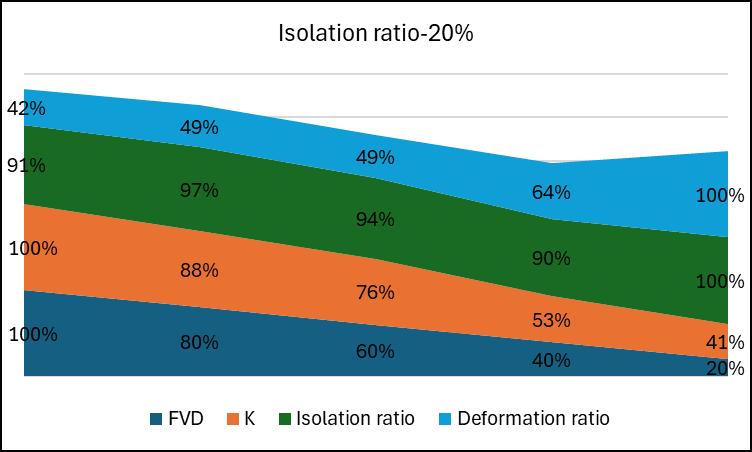
Fig-3.11:Isolation-deformationcombinationfor DRM5building(Elcentro)
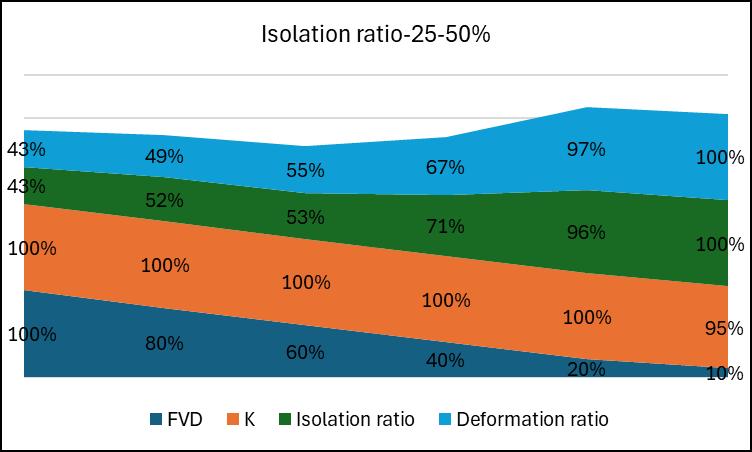
Fig-3.12:Isolation-deformationcombinationfor DRM5building(Elcentro)
TheabovefiguresFig.3.10toFig.3.12showthecontribution percentageforeachparameter;FVDcapacity,EBstiffness, isolationratioanddeformationratio.Hereinthegraphs,the
International Research Journal of Engineering and Technology (IRJET) e-ISSN: 2395-0056
Volume: 12 Issue: 04 | Apr 2025 www.irjet.net p-ISSN: 2395-0072
differentvaluesaredefinedasapercentageofthemaximum valueintherange.
Analysis has been carried out for DRM15 buildings and optimum zone for selection of EB and FVD for a desired seismicisolated/dampedbaseshearhasbeenderivedusing time history functions. Fig 3.13 shows the isolation and deformationinteractionfordifferentstiffnessofEBandFVD capacityof300kN.
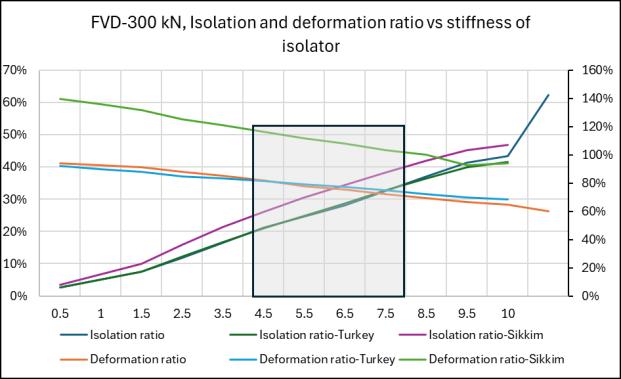
Fig -3.13:Isolation-deformationforDRM15building
Considering a design isolation ratio of 20-40% the combinationofEB-FVDhasbeenselectedfortheoptimum designandstiffnessofEBisintherangeof4.5to8kN/mm. Deformationratiovariesfrom120%to60%.Similaranalysis has been performed for FVD capacity of 500 kN, the optimumzoneisselected,andstiffnessrangeisfrom6-9.5 kN/mm. Fig 3.14 defines the interaction between EB-FVD usingFVDofcapacity500kNandthreetypesoftimehistory functions.Theisolationratioorreducedseismicbaseshear ismaximumusingSikkimtimehistoryfunctionmatchedto targetresponsespectrumforaspecificstiffnessofEBand FVDcapacity.
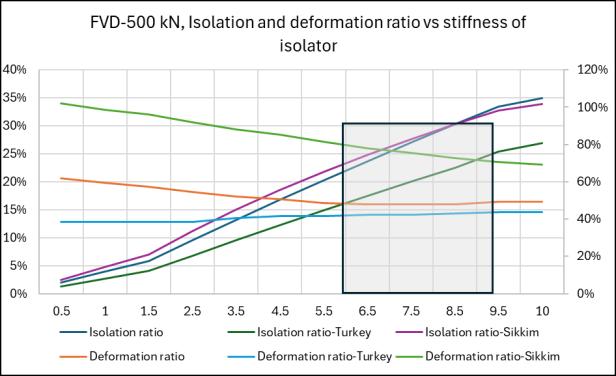
Fig- 3.14:Isolation-deformationforDRM15building
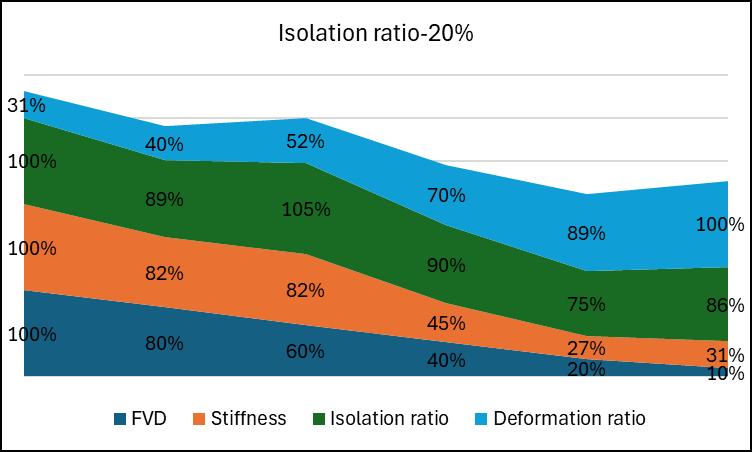
FromtheanalysisofDRM15buildingstheoptimumzonefor theidealcombinationofEB-FVDcanbedefined.Considering designisolationratioof20%,fortheanalysisusingElcentro time history function the different EB-FVD properties are definedinFig.3.15.Ithasbeenobservedthatwhenisolation ratio decreases FVD capacity, stiffness decreases but
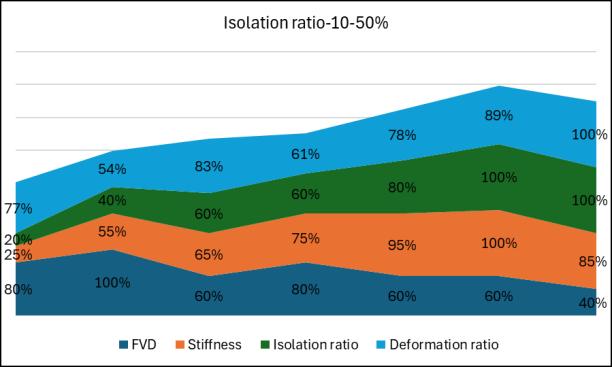
deformationratioincreases.Foradesignisolationratioof 10-50%range,thecombinationofEB-FVDhasbeenselected andshowninFig.3.16.InFig.3.16,ithasbeennoticedthat the FVD capacity decreases, stiffness value increases and with the increase in isolation ration from 10 to 50%, deformationratioincreases49to90%.
It has been noticed that using FVD of capacity 50 kN, the deformationratioisalwaysgreaterthan100%whichmeans the deformation for isolated / damped building DRM15, always gets increased due to the elastic stiffness and damping. The reason can be due to the use of very less capacity FVDs and also elastic stiffness, the stiffness of overall structure becomes less, and it leads to increase in deformation further. Fig. 3.17 shows the isolation and deformationbehaviourforthisanalysisusingElcentrotime historydata.
International Research Journal of Engineering and Technology (IRJET) e-ISSN: 2395-0056
Volume: 12 Issue: 04 | Apr 2025 www.irjet.net p-ISSN: 2395-0072
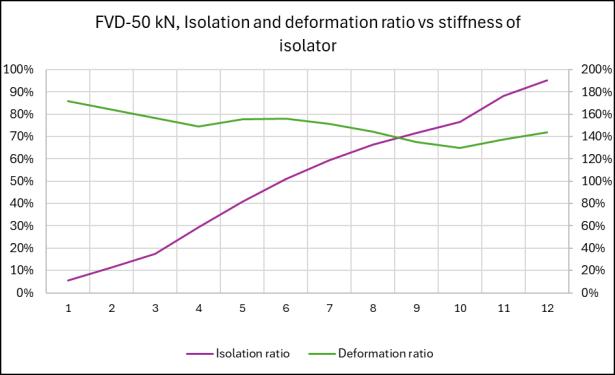
Fig-3.17:Isolation-deformationcombinationfor DRM15building(Elcentro)
For DRM5 building also, a similar analysis has been done using FVD of capacity 50 kN and the deformation ratio reducestomaximum78%usingmaximumstiffnessofEBin therange(Fig.3.18).
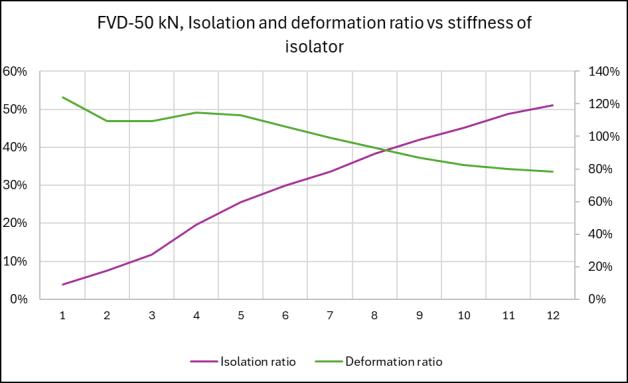
Fig-3.18:Isolation-deformationcombinationfor DRM5building(Elcentro)
3.2 Prob-2- Isolation and deformation comparison for G+15 irregular buildings
3.2.1 Irregular “L” shaped G+15 building
RCCbuildingsofG+5andG+15withverticalirregularityin geometryhavebeenanalysedforallthetimehistorydataas selectedandbaseshear,deformationvaluesarerecordedfor thechangeincapacityofFVDalongwithstiffnessofEB.The interaction between isolation and deformation ratio are plotted and optimum zones are identified. The base shear and deformation both for conventional fixed support are maximumforSikkimtimehistoryanalysis.Theresultsfrom theanalysisofirregularDIRML15buildingshowsthatthe isolationratioisnotmaximumforSikkimtimehistoryforall combinations of stiffness of EB. The isolation ratio is maximumforSikkimtimehistoryforcertainstiffnessofEB andthenwhenthestiffnessgraduallyincreases,theisolation ratioalsobecomeshigherthanthevalueresultingfromthe analysisusingothertimehistoryfunctions.
Theinteractionbetweenisolationanddeformationhasbeen noted for DIRML15 building and plotted to define the optimumrangeofstiffnessofEBandcapacityofFVD.The ideal combination of EB-FVD is shown in Fig. 3.19. Consideringisolationratiofrom10%to30%,theoptimum rangeofstiffnessforEBis4-8kN/mmandcapacityofFVDis 500kN.Theapprox.rangeofdeformationratiois75%-40%. AsimilaranalysishasbeencarriedoutforFVDcapacityof 200 kN and the optimum range of stiffness data has been recorded(Fig.3.20).Thedeformationratiohasbeennoted withintheoptimumzoneandfoundwithinthepermissible or serviceable limit for the design of structures. The optimumzoneforstiffnessofEBisfrom3-8kN/mmfora target isolation ratio of 20-50%. Deformation ratio varies from140%to80%.
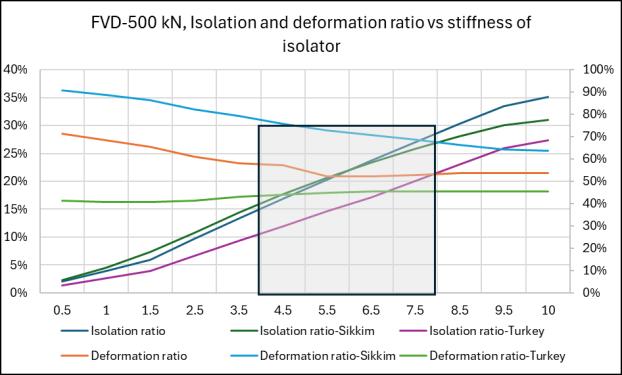
Fig-3.19:Isolation-deformationforDIRML15building
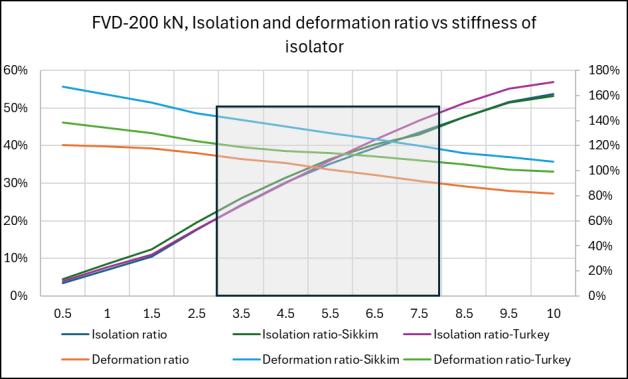
Fig- 3.20:Isolation-deformationforDIRML15building
The irregular G+15 building DIRMT15 has been analysed using all three time history functions and optimum combinationofEBstiffnessandFVDcapacityof500kNhave beenderivedinFig.3.21.
International Research Journal of Engineering and Technology (IRJET) e-ISSN: 2395-0056
Volume: 12 Issue: 04 | Apr 2025 www.irjet.net p-ISSN: 2395-0072
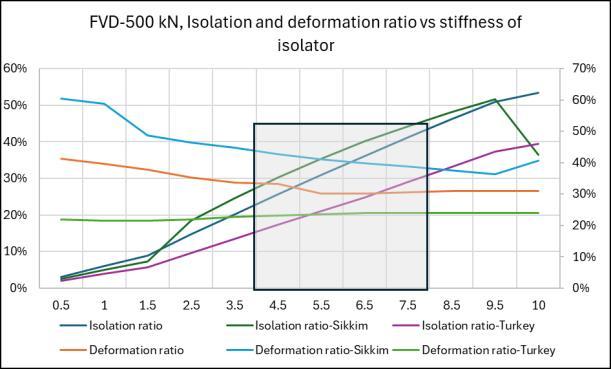
Fig-3.21:Isolation-deformationforDIRMT15building
For a design target of isolation ratio of 15-45%, range of stiffnessofEBis4-8kN/mm.Deformationratiovariesfrom 45% to 25%. The isolation ratio for Sikkim time history analysisismaximumandisminimumforElcentro.Fig.3.22 presentssimilaranalysisdataforFVDcapacityof200kN.
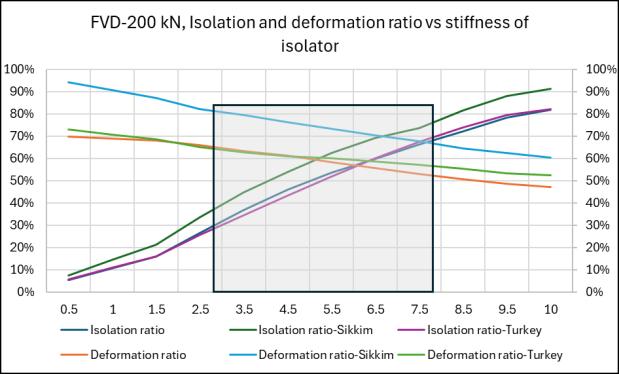
Fig-3.22:Isolation-deformationforDIRMT15building
StiffnessofEBrangesfrom3to8kN/mmanddeformation ratio varies between 95% to 50% for the target isolation ratio of 30% to 80%. Optimum range for selection of stiffnessofEBcanbedefinedforallothercapacityofFVD. Due to the irregular geometry in vertical direction the deformationforconventionalsupportisverylarge.Useof FVDwithadditionaldampingandEBforisolationhelpsto reducedeformationandhencedeformationratiogradually decreaseswiththeincreaseindampercapacityandstiffness ofisolators.
The DIRMT15’ building has been modelled with the same isolator stiffness and FVD capacity and the isolation and deformation ratio are noted. The interaction between isolation and deformation has been plotted to find the optimumuseofEBstiffnessforaparticularcapacityofFVD. Fig. 3.23 shows the graph for isolation-deformation behaviour for FVD of capacity 500 kN and the optimum range for stiffness of EB is 4 to 9 kN/mm considering an isolationratiozonefrom15to40%.Deformationratiofor theisolationratiorangechangesfrom30to20%.Ithasbeen
observed that for the vertical irregularity and shape as opposite “T” in the elevation, the fixed support seismic displacementisveryhighandexceedstheserviceablelimit. For the isolated / damped building, the deformation becomesmuchlessduetotheadditionofdampingfromFVD. Deformationforisolated/dampedbuildinggetsreducedto 60%ofthefixedsupportdeformation.
Fig 3.24 presents the result for isolation-deformation interactionusingFVDofcapacity200kNandtheoptimum zonehasbeenselectedwherestiffnessvariesbetween2.5-7 kN/mm for isolation ratio of 10-50%. The range of deformationratiofallswithin60-30%.
:Isolation-deformationforDIRMT15’building
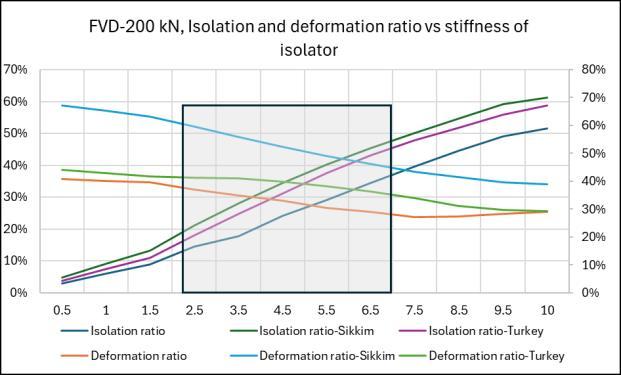
Fig-3.24:Isolation-deformationforDIRMT15’building
4 CONCLUSIONS
Based on the numerical and comparative study on elastomeric bearings isolation system and fluid viscous damperswithdifferentparameters,thefollowingconclusion maybemade:
1) Isolation system seems to be effective tool in mitigatingseismicforces(baseshear)withproper selection of non-linear properties. There is huge reductionofbaseshearwithreciprocateincreaseof driftandflexibilityduetoincorporationofstiffness.
2) Base isolation system using isolators which have only isolation property with minimum damping
International Research Journal of Engineering and Technology (IRJET) e-ISSN: 2395-0056
Volume: 12 Issue: 04 | Apr 2025 www.irjet.net p-ISSN: 2395-0072
effect,increasesthedisplacementofthestructure andhenceitmaynotbeserviceableinsomecases.
3) Usingthecombinationofisolatorsanddamperscan reducethebaseshearisseismicasperdesigntarget andparallellyreducethedisplacementsaswell.
4) Performing analysis for various combinations of stiffness of isolators and capacity of dampers can help to find the suitable option for any particular structureasperdesignrequirement.
5) Different time history accelerogram data may providedifferentresultsforbaseshearandtogofor thesuitablechoice,analysisusingmorethantwotimehistoryfunctionsisrecommended.
6) Theinteractionbetweenisolationanddeformation ratiohelpstoselectapossiblerangeofisolationand damping combination for a certain range of reductioninbaseshearanddisplacements.
7) WhenonlyelasticstiffnessofEBhelpstoreducethe force,additionaldampingalsohelpsinreductionof forceanddisplacementsboth.
8) Th combination using lower stiffness of EB and lower capacity of FVD result in an increase of displacements value even larger than the conventional support. Hence, stiffness as 0.5 kN/mm and FVD capacity as 50 kN may not be suitablechoiceforanyofbuildingmodelsshownin thispaper.
9) For any particular building type, considering the various options to select the isolation-damping combination,anyoptioncanbechosendepending ondesignrequirement.
10) Theirregularityinverticaldirectionmaynothave much impact in reduction of base shear but can have an influence on displacements as there is a tendency to get larger displacement at some locations.
11) UsingFVDatsomecolumnsupportlocationsresults in irregular deformation at the base support and may be larger for the locations where there is no FVDconsidered.Also,thedeformationdependson thestiffnessandFVDcapacityandmaynotbesame forallstructures.
12) The numerical analysis confirms elastomeric bearings and fluid viscous dampers effective in enhancingtheperformanceofstructureandthatits usemayreducetotalconstructioncostbyreduction of structural acceleration response in case of earthquakes.
13) It is observed that there is bandwidth of optimal design and Damping, stiffness in which the Structure can be equipped with dampers with reduced base shear but within stipulated drift as perserviceabilitycriteria.
14) Based on the study on Isolation and deformation ratio optimum design is possible by selecting the targetreducedbaseshearanddeformationforany structure.
15) ThelimitationsofpresentstudyincludeuseofEbas isolator and FVD as damper, damper layout as diagonalbracing,buildingmodelsforG+5andG+15, Elcentro,SikkimandTurkeytimehistorymatched totargetresponsespectrum.
16) Future research can be done with different FVD layout, different types of isolator, more different typesofstructuresandalsousingdifferenttypesof damperstocheckthebenefitsusingotherdevices aswell.Also,timehistoryanalysiscanbeperformed for various other ground motion data matched to designresponsespectrum.
17) Thepresentstudyhasbeenconductedforseismic zone V and medium soil. For further validation analysiscanbecarriedoutforotherseismiczones andsoiltypes
18) Thetargeteddesignbaseshearinseismicneedsto be targeted at a level where the design force including all load cases for a structure is same or lesserthanthereducedseismicforce.Inanycase,if dampedshearislesserthantheforcederivedfrom otherloadcases,thestructurehasto bedesigned forthelargerforce.
Iwouldliketotakethisopportunitytoexpressmydeepest gratitude to our reverent Professor Dr. Debashis Bandyopadhyay, for his resourceful guidance, active supervision,continuedsupportandconstantencouragement tohelpmebringthispapertoitspresentshape.Ioffermy sincereappreciationforthelearningopportunitiesprovided byCSIESPLduringmodeldevelopment.Iwouldalsoliketo takethisopportunitytothankallmycolleaguesandseniors inofficeanduniversitywhoencouragemecontinuously
[1] Maraqa Faroq, Eid Al-Sahawneh, Mahamied Ali, AssbeihatJamal,AlzubiYazan,2023;“ParametricStudy oftheEfficiencyofFluidViscousDamperinStructures with Different Heights”, International review of Civil Engineering, Vol 14, No 5., https://doi.org/10.15866/irece.v14i5.22496.
International Research Journal of Engineering and Technology (IRJET) e-ISSN: 2395-0056
Volume: 12 Issue: 04 | Apr 2025 www.irjet.net p-ISSN: 2395-0072
[2] YanhuiLiu,JinbiaoWu,MarcoDonà, 2018; “Effectiveness of fluid-viscous dampers for improved seismicperformanceofinter-storeyisolatedbuildings”, Vol 169, PP- 276-292, https://doi.org/10.1016/j.engstruct.2018.05.031
[3] SimaS.Ijmulwar,SanjayaKumarPatro,2024;“Seismic designofreinforcedconcretebuildingsequippedwith viscous dampers using simplified performance-based approach”, Vol 61, https://doi.org/10.1016/j.istruc.2024.106020
[4] Das Agamoni, Dr Bandyopadhyay Debashis, 2023; “Force-displacementtradeoffofRCCbuildinglocatedat variousseismiczonesandsiteconditionadoptingtime historyanalysis”,JournalofStructuralEngineeringand Management, Vol 10, No 1, https://doi.org/10.37591/josem.v10i1.7311
[5] Das Agamoni, Dr Bandyopadhyay Debashis, 2024; “A PARAMETRICSTUDYOFBASESHEAR-DEFORMATION FOR ISOLATED STRUCTURES USING LEAD RUBBER BEARINGS”,JournalofTransportationEngineeringand Information Technology, Vol 12, Issue 3, https://jtseit.com/volume-12-issue-3-2024/.
[6] Sharma Kul Vaibhab, Parmar Viral, Gautam Lilesh, ChaudharySumit,Gohil,2023;“Modellingefficiencyof fluid viscous dampers positioning for increasing tall buildings'Resiliencetoearthquakesinducedstructural vibration”,SoilDynamicsandEarthquakeEngineering, Vol. 173, 108108, https://doi.org/10.1016/j.soildyn.2023.108108
[7] Rinaldin, G., Amadio, C. and Fragiacomo, M., 2017; “Effects of Seismic Sequences on Structures with Hysteretic or Damped Dissipative Behaviour”, Soil Dynamics and Earthquake Engineering, Vol. 97, pp. 205–215, https://doi.org/10.1016/j.soildyn.2017.03.023.
[8] Mujeeb Md, Prasad J S R, Malagavelli Venu, 2019; “Performance of Fluid Viscous Dampers on Seismic Response of RCC Structures”, International Journal of InnovativeTechnologyandExploringEngineering,Vol. 8, pp. 3685-3691, http://dx.doi.org/10.35940/ijitee.L2555.1081219
[9] Agha M. E. Bouayad, Ras A. A., Hamdaoui K, 2023; “InvestigationofRheologicalandGeometricProperties Effect on Nonlinear Behaviour of Fluid Viscous Dampers”,JournalofAppliedFluidMechanics,Vol.16, pp. 2142-2157, https://doi.org/10.47176/jafm.16.11.1940
[10]Zoccolini Luca, Bruschi Eleonora, Cattaneo Sara, Quaglini Virginio, 2023; “Current Trends in Fluid Viscous Dampers with Semi-Active and Adaptive
Behavior”, Applied Sciences, Vol. 13, Issue 18, http://dx.doi.org/10.3390/app131810358.
[11]WaghmareManishaV,MadhekarSuhasiniN,Matsagar VasantA,2020;“InfluenceofNonlinearFluidViscous DampersonSeismicResponseofRCElevatedStorage Tanks”, Civil Engineering Journal, Vol. 6, https://doi.org/10.28991/cej-2020-SP(EMCE)-09
[12]Das Agamoni, Bandyopadhyay Debasish; “Study on seismic base shear and deformation of regular and irregular buildings using different properties of fluid viscous dampers”, Structures journal, Vol. 76, https://doi.org/10.1016/j.istruc.2025.108925
[13]Bessason,B.,andHaflidason,E,2004;“Recordedand numericalstrongmotionresponseofabase-isolated bridge”,EarthquakeSpectra,Vol.20,No.2,pp.309332,https://doi.org/10.1193/1.1705656.


Agamoni Das is a PhD scholar at Jadavpur University She has 10+ years’experienceinindustrywith seismicmitigationtopicsincluding isolationanddampingsystem.She iscurrentlyworkinginHiltiGroup asanEngineeringmanager.
Dr. Debasish Bandyopadhyay is a full-time professor in the dept of Construction Engineering at JadavpurUniversity.Hehasmade numerous contributions to the topic of structural engineering through various research journal publicationsonseveraltopics.