
International Research Journal of Engineering and Technology (IRJET) e-ISSN: 2395-0056
Volume: 13 Issue: 04 | Apr 2026 www.irjet.net p-ISSN: 2395-0072

International Research Journal of Engineering and Technology (IRJET) e-ISSN: 2395-0056
Volume: 13 Issue: 04 | Apr 2026 www.irjet.net p-ISSN: 2395-0072
Yash Lawand 1, Rutik Kale2, Aryan Salve³, Nikhil sawant⁴,Dhanawade K. B⁵
1-4
Student[Department of Mechanical Engineering KBP Polytechnic Satar, Maharashtra, India
5Professor, Dept. of Mechanical Engineering, Kbp Polytechnic Satara, Maharashtra, India
Abstract - This project work titled “ Hydraulic Jack ” has beenconceivedhavingstudiedthe difficulty inliftingthe any type of light vehicles. Our survey in the regard automobile garages, revealed the facts that mostly some difficult methods were adopted in lifting the vehicles for reconditioning.
Now the project has mainly concentrated on this difficulty, and hence a suitable device has been designed. Such that the vehicles can be lifted form the floor land without applications of any impact force. The fabrications part of it has been considered with almost case for its simplicityandeconomy,suchthatthiscanbeaccommodated asoneoftheessentialtoolsonautomobilegarage
hydraulicjack isa jack that usesa liquid topushagainsta piston. This is based on Pascal’s Principle The principle statesthatpressureinaclosedcontaineristhesameatall points.Iftherearetwocylindersconnected,applyingforce to the smaller cylinder will result in the same amount of pressure in the larger cylinder. However, since the larger cylinder has more area, the resulting force will be greater. Inother words, an increase inarea leads to an increase in force. The greater the difference in size between the two cylinders, the greater the increase in the force will be. A hydraulicjackoperatesbasedonthistwocylindersystem
Hydraulic systems play a vital role in modern mechanical engineering applications, particularly in load lifting, force transmission, and automation. The working principle of a hydraulic jack is based on Pascal’s Law, which states that pressure applied to a confined fluid is transmitted equally in all directions without loss. This principle enables force multiplication, allowing heavy loadstobeliftedwithrelativelysmallinputeffort.
AccordingtoTheoryofMachinesbyR.S.Khurmiand J. K. Gupta, hydraulic machines utilize incompressible fluidstotransmitpowerefficiently.Thesesystemstypically consist of cylinders, pistons, hydraulic fluid, and valves. When force is applied to a smaller piston, it generates pressure in the fluid, which is transmitted to a larger piston, resulting in an increased output force. This
relationship is governed by the equation , where pressure remainsconstantandforceincreaseswitharea[1].
Similarly,TheoryofMachinesbyS.S.Rattanexplains the concept of mechanical advantage and emphasizes that hydraulic systems provide smooth and controlled motion with high load-carrying capacity. These systems are preferred over conventional mechanical devices due to their efficiency, reliability, and reduced manual effort. Applications include lifting devices, presses, braking systems,andindustrialmachinery[3].
ThestudybyGearless TransmissionMechanismand its Applications discusses the importance of minimizing mechanical complexity and improving system efficiency [2]. Although focused on transmission mechanisms, the study highlights design principles such as reducing friction, simplifying mechanisms, and enhancing performance, which are equally applicable to hydraulic systems. Hydraulic systems inherently have fewer moving parts compared to mechanical systems, resulting in lower wearandmaintenance.
Furthermore, the performance of hydraulic systems depends on critical design parameters such as cylinder dimensions, fluid properties, sealing mechanisms, and material selection. Mild steel is commonly used for structural components due to its strength, durability, and ease of fabrication. Proper selection of hydraulic fluid is essential to ensure adequate lubrication, thermal stability, andefficientpowertransmission.
Hydraulic jacks are widely used in automotive and industrial applicationsforlifting vehiclesandheavyloads. However, conventional jacks often require significant manualeffortandtime.Thishasledtothedevelopmentof improved systems, such as motorized hydraulic jacks, which enhance convenience, reduce human effort, and improveoperationalsafety.
From the reviewed literature, it is evident that hydraulic systems offer advantages such as high load capacity, compact design, precise control, and reliability. These features support the development of an efficient hydraulic jack system that overcomes the limitations of traditional lifting methods while maintaining costeffectivenessandeaseofoperation
International Research Journal of Engineering and Technology (IRJET) e-ISSN: 2395-0056
Volume: 13 Issue: 04 | Apr 2026 www.irjet.net p-ISSN: 2395-0072
Forming a group:- First we form the group of capstone project.
Selection of project:- We searched for the topic of project onGoogle, you tubeandin books.Also we took project by consideringsomecriteria’ssuchastimeandcostrequired to make project. We also approved our project from our guide.
Design of components:- Then we figure out dimensions required for all components. Stress going to applied on each component, factor of safety of component and importantdesigns. Drawingoftheproject:-Themainneed of making any project is to make the production drawing withalldimensions,toleranceandotherrequiredvaluesof theproject.
Decided specification and quantity of components:- We then decided specification of components such as its capacity, dimensions. Also we decided how many componentsarerequired.
Buy or make components:- Then we figure out which components are required to buy and which we can make so that we could able to decide approximate costing requiredforourproject.
4. SYSTEM DESIGN AND COMPONENT DESCRIPTION
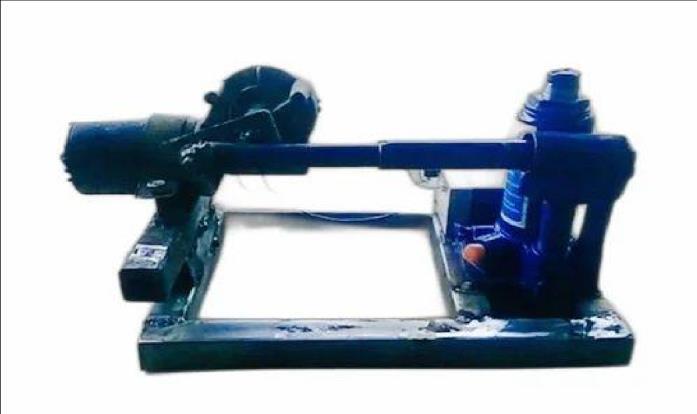
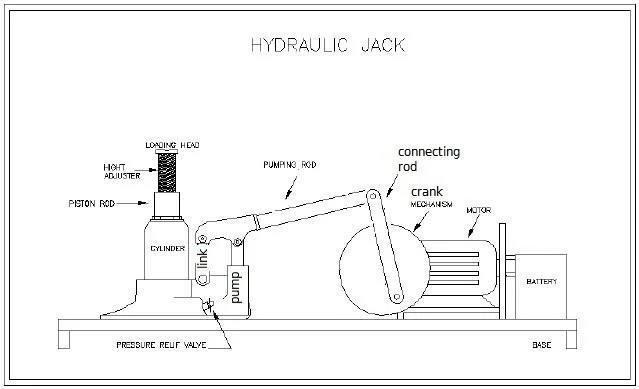
Hydraulic jacks and many other technological advancementssuchasautomobilebrakesanddentalchairs work on the basis of Pascal's Principle, named for Blaise Pascal,wholivedintheseventeenthcentury.Basically,the principle states that the pressure in a closed container is the same at all points. Pressure is described mathematically by a Force divided by Area. Therefore if you have two cylinders connected together, a small one and a large one, and apply a small Force to the small cylinder, this would result in a given pressure. By Pascal's Principle, this pressure would be the same in the larger cylinder, but since the larger cylinder has more area, the forceemittedbythesecondcylinderwouldbegreater.This is represented by rearranging the pressure formula P = F/A,toF=PA.Thepressurestayedthesameinthesecond cylinder, but Area was increased, resulting in a larger Force. The greater the differences in the areas of the cylinders, the greater the potential force output of the big cylinder. A hydraulic jack is simply two cylinders connectedasdescribedabove.
Good material selection was undertaken to reduce noise and wear, ease of maintenance, improve service life and reduce corrosion. Machine frame, shaft and dome-shaped top–(MildSteel).
The scope of the hydraulic jack project lies in the design and development of an efficient and userfriendly lifting systemforlighttomoderateloadapplications,particularly intheautomotivesector.Thesystemisintendedtoreduce manual effort and improve operational safety while lifting vehiclesformaintenanceandrepairwork.
This project focuses on utilizing hydraulic principles to achieve force multiplication, enabling heavy loads to be lifted with minimal input force. The developed hydraulic jack can be effectively used in automobile garages, workshops, and service stations where frequent lifting operations are required. Its compact design allows easy portabilityandconvenientusageinconfinedspaces. Furthermore, the project can be extended by integrating automation features such as motorized operation, remote control systems, or sensor-based safety mechanisms. This would enhance ease of use and reduce human intervention. The system can also be modified for higher load capacities by selecting appropriate materials, increasing cylinder dimensions, and optimizing hydraulic pressure. In industrial applications, the same concept can beadaptedforoperationssuchasmetalforming,pressing, bending, and assembly work. With further improvements in design and material selection, the hydraulic jack can be developed into a more robust and versatile lifting device suitableforheavy-dutyapplications.
International Research Journal of Engineering and Technology (IRJET) e-ISSN: 2395-0056
Volume: 13 Issue: 04 | Apr 2026 www.irjet.net p-ISSN: 2395-0072
Thus, the project has significant potential for future development in terms of automation, increased efficiency, enhancedsafety,andbroaderindustrialapplications.
6. ADVANTAGES AND APPLICATIONS
Advantages
I. ZeroManualEffort
II. HighLoadCapacity&Safety
III. Efficiency&Convenience
IV. CompactDesign
V. PreciseControl
Applications
I. MetalPressWork
II. Drawingandpushingrods
III. Bending and straightening any metal Packing Press
IV. Dismantlingofoldtanks
7. CONCLUSIONS
Hydraulic Jack can be used in many industries for the powertransmissionandloadliftingpurpose.Forliftingup the vehicle the motorized hydraulic jack is positioned is centre. The system operates on the hydraulic power. For lifting a car 300kg or a load of 3000N we have to apply a force of 49.5928N is applied which is quiet less than the weighttobelifted.
An inbuilt Motorized Hydraulic Jack system can be easily attached to all currently manufacture automobile chassis. There is a front suspension jack that is mounted externally to the front suspension of an automobile its front wheels. Quick lifting is possible and suitable for heavyloadforabout100kgor1000N.Withthehelpofthis systemthedrivingofvehicleswillbeeasy.
8. REFERENCES
[1] R. S. Khurmi and J. K. Gupta, Theory of Machines, S. ChandPublications,NewDelhi,2018.
[2]Gaikwad, J. (2017). Gearless Transmission Mechanism anditsApplications.
[3]S. S. Rattan, Theory of Machines, McGraw Hill Education,India,2017.
[4]N.Patil,J.Gaikwad,M.Patil,andC.Sonawane,“Gearless Transmission Mechanism and its Applications,” International Journal of Innovative Research in Science, EngineeringandTechnology,vol.6,no.3,2017.
© 2026, IRJET | Impact Factor value: 8.315 | ISO 9001:2008 Certified Journal | Page802