
International Research Journal of Engineering and Technology (IRJET) e-ISSN: 2395-0056
International Research Journal of Engineering and Technology (IRJET) e-ISSN: 2395-0056
Prof. S. V. Patil1 , Shubham Lanke2 , Shubham Mukhekar3 , Amol Marathe4 , Manav Chauhan5
*1Assistant Professor, Department Of Computer Engineering, Sinhgad College Of Engineering, Pune, India. *2,3,4,5Department Of Computer Engineering, Sinhgad College Of Engineering, Pune, India. DOI : https://www.doi.org/10.56726/IRJMETS48058 ***
Abstract - The conventional approaches to violence detection primarily focus on predicting body part or joint locations from images or videos. However, these methods face limitations, such as difficulty estimating human poses due to low-resolution andnoisy datafromdepthsensors,especiallyin real-time settingslikeCCTVfootage.Humanviolencedetection has been a key problem in computer vision for over last many years due to its numerous applications, such as video surveillance, human-computer interaction, and behavior analysis. This project aimstoaddressthesechallengesbyusing neural networks to detect violent human activity from realtime surveillance footage. The primary features of this system include: 1. Real-time Violence Detection 2. Violence Activity Monitoring 3. Automated Alerts 4. Categorization of Violence and Non-Violence Activities Our intelligent video surveillance system can be applied in public areas like airports, malls, schools, and parking lots to monitor human activities and prevent incidents such as theft, accidents, and vandalism. The system provides real-time monitoring and can automatically generate alerts when unusual or violent activities are detected, helping enhance public safety.
Key Words: Violence Detection, Real-time Monitoring, ViolenceActivityRecognition,NeuralNetworks,Intelligent Surveillance.
The project focuses on developing a real-time violence detection system for public places such as malls, airports, and railway stations, utilizing deep learning,neuralnetworks,and computer vision. To understand the entire project, familiarity with deep learning, neural networks, computer vision, video analysis, and desktop application development is essential. Deep learning is used to enable the model to learn from extensive datasets and recognize patterns in video frames, with neural networks helping to identify human body parts and detect violent movements. The project leverages these techniques to analyze real-time CCTV footage and trigger alerts upon detecting violent activities. The application has potential uses beyond security, such as monitoring patient movements in healthcare facilities to prevent injuries Computervisionplaysavitalroleindetectingandclassifying human poses within video data, introducing temporal complexity that requires advanced techniques to track movements over time. By analyzing video frames, the system can efficiently detect violent actions in real time, essential for its deployment in diverse public spaces. Furthermore,
unsupervised learning techniques are incorporated to handle violent behavior detection without the need for extensive labeled datasets. The system is designed as a cross-platform application, compatible with both mobileanddesktopdevices, allowing administrators to receive alerts and manage incidents remotely. Its adaptability also allows it to run on low-cost hardware, including embedded systems and mobile devices, making it user-friendly and accessible. In terms of motivation, violence detection has been a challenging area in computer vision, with applications in surveillance, behavior analysis, and human-computer interaction. The project aims to improve real-time surveillance by overcoming limitations related to low-cost sensors through the use of deep learning and CNNs, thereby enhancing public safety in high-risk environments. The main objectives of the project are to detect violent activities in real-time and provide an easy-to-use interface for administrators to receive timely alerts.
InthepaperReal-TimeViolenceDetectionandLocalizationin Crowded Scenes by Mohammad Sabokrou and Mahmood Fathy, a method is proposed for real-time detection and localization of violent activities in crowded areas. The approach segments each video into non-overlappingcubic patches,usingtwotypesofdescriptors localandglobal to capturevariousvideoproperties.Thesedescriptorsanalyze structural similarities between adjacent patches to differentiatenormalactivitiesfromanomalies.ByusingcosteffectiveGaussianclassifiersandlearningHUMANVIOLENT ACTIVITY RECOGNIZATION Shubham Lanke, Shubham Mukhekar,AmolMarathe,ManavChauhanPranaliD.Dahiwal B.E.ComputerEngineering,SinhgadCollegeofEngineering, Pune,Indiafeaturesinanunsupervisedmannerwithasparse autoencoder, the system can efficiently identify violent actions. Experimental results demonstrate the algorithm’s effectiveness and comparable accuracy to state-of-the-art methods, with improved time efficiency, especially on the UCSD ped2 and UMN benchmark datasets. However, a notable limitation is that scalability to larger real-world environments may affect performance [1]. In the paper Learning Temporal Regularity in Video Sequences by Mahmudul Hasan and Jonghyun Choi, the authors explore methodstoidentifymeaningfulactivitiesinlong,cluttered video sequences. This challenge is heightened by the subjectivenatureofwhatconstitutes‘meaningful’activity.To address this, they propose a generative model that learns regularmotionpatterns,or‘regularity,’usingmultipledata
Volume: 12 Issue: 04 | Apr 2025 www.irjet.net p-ISSN: 2395-0072 © 2025, IRJET | Impact Factor value: 8.315 | ISO 9001:2008 Certified Journal | Page258
International Research Journal of Engineering and Technology (IRJET) e-ISSN: 2395-0056
Volume: 12 Issue: 04 | Apr 2025 www.irjet.net p-ISSN: 2395-0072
sourceswithminimalsupervision.Twoautoencoder-based methods are introduced: the first uses traditional handcraftedspatio-temporallocalfeaturesandlearnsafully connectedautoencoderonthem,whilethesecondusesafully convolutional feed-forward autoencoder, allowing end-toendlearningofbothlocalfeaturesandclassifiers.Limitations includethathandcraftedspatio-temporalfeaturesmaynot captureallcomplexmotions,andthemodel'sperformance may vary depending on dataset size and quality [2]. The paper Violence Detection in Video Using Predictive Convolutional Long ShortTerm Memory Networks by JeffersonRyanMedelfocusesonautomatingthedetectionof anomalouseventsinlongvideosequences,achallengingtask due to the ambiguity of defining such events. The authors proposeanend-to-endtrainablemodelutilizingcomposite Convolutional Long Short-Term Memory (Conv-LSTM) networkstopredicttheprogressionofavideosequencefrom alimitedsetofinputframes.Themodelcalculatesregularity scores based on reconstruction errors, with abnormal sequences yielding lower scores as they deviate from expectedpredictions.Conv-LSTMnetworksinthisapproach leverage ‘conditioning’ to learn more meaningful representations, and the model selection is based on reconstruction and prediction accuracy. Evaluated both qualitatively and quantitatively, the Conv-LSTM model demonstratescompetitiveperformanceonviolencedetection datasets.However,alimitationisthatminimalsupervision may reduce accuracy for ambiguous events, and reconstructionerrorsmaynotalwayseffectivelydifferentiate regularfromabnormalsequences[3].InthepaperAbnormal EventDetectioninVideosusingSpatiotemporalAutoencoder byJeffeYongSheanChong,anefficientmethodforanomaly detection in videos is proposed, utilizing a spatiotemporal autoencoder architecture. Unlike traditional convolutional neuralnetworks(CNNs),whichexcelinobjectdetectionand recognition tasks but rely on labeled data for supervised learning, this spatiotemporal architecture is tailored for violencedetectioninvideos,includingcrowdedscenes.The model consists of two main components: one for spatial feature extraction and another for learning the temporal evolutionofthesefeatures.EvaluatedontheAvenue,Subway, and UCSD benchmarks, the model demonstrates accuracy comparable to state-of-the-art methods, with a high processing speed of up to 140 frames per second (fps). However,high-speeddetectionmaycompromiseaccuracyin complex scenes, and the model may not generalize well acrossdiverseenvironmentsandscenarios[4].Inthepaper UnrolledOptimizationwithDeepPriorsbyStevenDiamond and Vincent Sitzmann, the authors introduce a framework aimed at addressing inverse problems in computational imaging, sensing, and low-level computer vision. This "unrolledoptimizationwithdeeppriors"approachfocuses on extracting latent images from measurements using a knownphysicalimageformationmodel.Traditionally,such tasks have relied on handcrafted priors combined with iterativeoptimizationmethods.Incontrast,thisframework integrates the knowledge of image formation directly into
deep networks, inspired by classical iterative techniques, resulting in enhanced performance for imaging challenges likedenoising,deblurring,andcompressedsensingforMRI. Experimentalresultsshowthatthisapproachoutperforms state-of-the-art methods in these domains. However, the methodiscomputationallydemanding,whichcouldlimitits applicabilityinresource-constrainedenvironments,andits design is specific to imaging problems, restricting its generalizabilitytootherfields[5].
3.1
Expandingonthearchitecture,thesystembeginswiththe videoinput,whichistypicallyalivefeedfromCCTVcameras. Thepreprocessingstepincludesseveralessentialoperations, such as resizing the video frames, noise reduction, and possibly color correction, which collectively enhance the quality of data fed into the model. These adjustments are crucial as theyhelpin removing unnecessaryartifacts and ensuring that the deep learning model receives clearer images, improving its ability to detect details related to violent activities. Once preprocessing is complete, segmentationisappliedtotheframes.Segmentationisolates significantportionsoftheframe,suchashumanfiguresor objectsthatmightbeinvolvedinaviolentact.Thisfocused approach saves computational resources, as the model doesn’t have to process the entire frame but only specific regionswherehumanactivityisdetected.Byisolatingthese areas, the system can more effectively recognize patterns associatedwithviolentbehavior.Followingsegmentation,the featureextractionphasecomesintoplay.
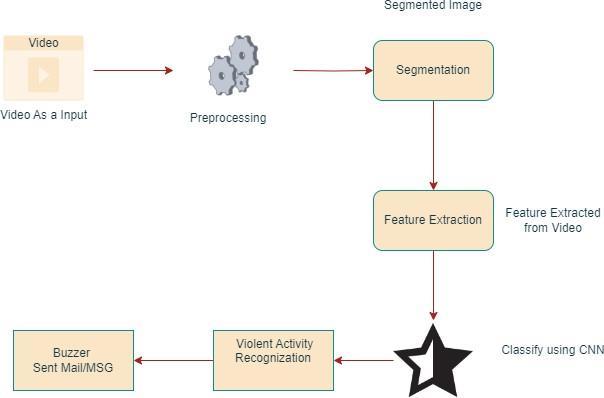
Thisstepinvolvesidentifyingspecificcharacteristicsor "features"fromthesegmentedregions,suchasthepostureof a person, movement speed, and joint orientation. These extracted features are fed into the CNN model, which has beentrainedonlargedatasetscontainingbothviolentand non-violentactivities.Throughthistraining,theCNNlearns to differentiate betweenaggressive actions (like punching,
International Research Journal of Engineering and Technology (IRJET) e-ISSN: 2395-0056
Volume: 12 Issue: 04 | Apr 2025 www.irjet.net p-ISSN: 2395-0072
kicking) and nonaggressive ones (like walking or talking). The CNN applies these learned patterns to classify the behavior observed in the video as either violent or nonviolent Upondetectingviolentbehavior,thesystemtriggers analertmechanism.Thisalertsystemcouldincludevarious methods, such as sounding a buzzer in the surveillance controlroom,sendingSMSoremailnotificationstosecurity personnel,orevenlogging theincidentwithatimestampfor later review. The alerts are intended to provide real-time feedback,enablingarapidresponsetopotentiallydangerous situations, which is crucial in preventing escalations and ensuring public safety. The system’s design allows it to operate across different environments and can be integrated into existing surveillance infrastructure, makingitversatileforuseincrowdedplaceslikemallsand airports,aswellasinquieter spaceslikehospitalwardsfor monitoringpatient activity.
3.1ProcessFlow:
1. Video as Input:Thesystembeginsbytakingvideo footageasinput,typicallyfromaCCTVfeedinpublic spaceslikemalls,airports,orrailwaystations.This videoinputservesastherawdataforthedetection pipeline.
2. Preprocessing: Before analysis, the video goes through a preprocessing stage. This step might include resizing frames, noise reduction, and adjusting lighting or contrast to ensure consistent quality and improve detection accuracy. Preprocessing prepares the frames for further analysisbynormalizingandenhancingthem.
3. Segmentation:Afterpreprocessing,theframesare passedthroughasegmentationstep.Segmentation involvesdividingtheframeintomeaningfulsections toisolateregionsofinterest,suchashumanfigures. Thisstepiscrucialasithelpsinfocusingonpartsof the image that are relevant for identifying violent activities, excluding irrelevant background information.
4. Feature Extraction: Once the frames are segmented,thesystemperformsfeatureextractionto capture essential characteristics of the movement within the frame. These features could include details about human poses, body movements, and spatialrelations,whichhelpindistinguishingviolent activities from normal ones. Feature extraction createsacompactrepresentationoftheframedata, makingiteasierforthemodeltoprocess.
5. Classification using CNN:Theextractedfeaturesare thenfedintoaConvolutionalNeuralNetwork(CNN) model. CNNs are particularly effective in analyzing spatialdatalikeimagesandvideoframes,allowing them to classify movements. The CNN model
examinesthefeaturesanddeterminesifthereisany violentactivity.Thisclassificationstepiswherethe system decides if the frame sequences indicate a violentornon-violentevent.
6. Violent Activity Recognition: If the CNN model detects violent activity, the system marks it as recognized violent behavior. This recognition step indicates that the system has identified patterns associatedwithviolentactions,suchaspunchingor aggressivemovements.
7. Buzzer/Alert Notification (Sent Mail/MSG):Once violent activity is detected, the system triggers an alert.Thisalertcanbeintheformofabuzzersound,a notification sent via email, or an SMS message to securitypersonnel.Thisreal-timenotificationallows authoritiestotakeimmediateactionandpotentially preventfurtherescalation.Insummary,thispipeline enablesreal-timeviolencedetectioninpublicspaces by segmentingvideoframes,extractingfeatures,and usingaCNNmodelforclassification.Thefinalstepis an alert system to notify relevant authorities instantly. This solution is highly relevant for enhancingsecurityinpublicenvironments.
3.2Implementation
3.2.1 Designing the Environment for Violent Activity Detection The primary objective of developing the violentactivitydetectionsystemistocreateareal-time surveillanceapplicationthatassistssecuritypersonnel in identifying potential violent threats. The system is designedtoacceptvideouploads,processthesevideos framebyframe,anddetectviolentactionslikefighting, aggression, or other criminal activities. The user interface is built using Tkinter, providing a clear and simplewaytouploadvideosandmanagetheprocess. The application's design emphasizes accessibility and ease of use, ensuring that it can be operated by users with minimal technical experience. In this phase, the focus was on creating a system that can easily handle videouploadsandprovidereal-timenotificationsupon detectingpotentialviolentactionsbasedontheanalysis of these frames. The system uses OpenCV for video processing,convertingthevideointoindividualframes for further analysis. The primary alert mechanism involves notifying the administrator when violent activities are detected based on the analysis of these frames.
3.3.2DevelopmentEnvironmentandSetup
TheprojectwasdevelopedusingPython,whichallowed easyintegrationoflibrarieslikeTkinterfortheGUIand OpenCV for video processing. Python’s flexibility was keyinensuringthatthesystemcouldprocessvideodata efficientlywhile maintaininga user-friendlyinterface.
International Research Journal of Engineering and Technology (IRJET) e-ISSN: 2395-0056
Volume: 12 Issue: 04 | Apr 2025 www.irjet.net p-ISSN: 2395-0072
The environment setup began by installing necessary dependenciessuchasOpenCV,Tkinter,andSQLitefor data storage.The user interface (UI) is created using Tkinter, and the core logic is separated into distinct functions to handle tasks like uploading videos, extracting frames from the video, and notifying users aboutsuccessfuluploads.Theapplication’sbackendis configured tostoredata in anSQLitedatabase, where detailsliketheuploadedvideo’sfilenameandextracted framesarerecorded.Thedatabaseensuresthatevery videoprocessedislogged,providingasystemthatcan track uploads and associated data, making it easy for userstomonitortheiractivity.Tohandlevideouploads, theaskopenfilename()methodisused,whichopensa filedialogallowingtheusertochoosethevideo.After the video is selected, OpenCV is used to extract each frame from the video and save it in a newly created directorycalled"data."Thisensuresthattheframescan laterbeanalyzedorstoredforfuturereference.
The detection mechanism is currently focused on extractingvideoframesandpreparingthemforfuture analysis. When the video is uploaded, each frame is saved as a JPEG file in the "data" directory. OpenCV’s VideoCapture() method is used to open the video file and read each frame. The frames are then saved sequentially, and the extraction continues until the entirevideohasbeenprocessed.Thesystemcurrently saveseachframeforfutureanalysis,andinthefuture, machine learning models can be integrated to detect violentactivitiesinreal-time.Onceframesareextracted, theapplicationprovidesanalerttotheuserthrougha message box(ms.showinfo())toinformthem thatthe video has been successfully uploaded and processed. This helps keep the user informed throughout the process. The next logical step would be to introduce activity recognition algorithms that could analyze the framesandidentifyviolentactivities,suchasfightingor aggression, based on a trained model. For now, the violent activity detection part of the system is in the preparation phase. Future work would involve integrating a deep learning model, such as a convolutional neural network (CNN), to classify the activities in the extracted frames and trigger alerts accordingly.
The user interface (UI) has been designed with simplicityinmind.Uponopeningtheapplication,users are presented with a clean interface featuring a prominentbuttontouploadvideos.Thisbuttonallows theusertochooseavideofilefromtheirlocalstorage, andonceselected,thesystemprocessesthevideoand extractsframes.Theprogressofthevideouploadand frame extraction is handled in the background, and
usersarenotifiedoncethetaskiscompleteviaapop-up message.Inadditionto the "UploadVideo"button,an "Exit" button is provided to allow users to close the application gracefully. This button ensures a smooth termination of the program, freeing up any resources that may have been allocated during the session. The system also ensures that the uploaded videos and extracted frames are stored in an organized manner, making it easier for users to track which videos have beenprocessed.Thefeedbacksystem,whilecurrently limited to popup messages, can be extended in the futuretoincludeaudioorvisualalertsontheUItonotify users about violent activities detected during video analysis.
ThesystemintegratesSQLitetomanagedataaboutthe videos uploaded by the user. Each uploaded video is recorded in the database, along with important metadata such as the video’s file name, the time of upload, and the status of the video processing. This ensuresthattheapplicationkeepsalogofallactivities, anduserscantracktheprogressoftheirvideouploads and frame extractions. In the current version, the database schema records the video file name, the timestamp of upload, and the number of frames extracted.Futureenhancementsmayincludeloggingthe results of violent activity detection, allowing users to view past detections and track patterns in violent actionsovertime.Theintegrationofthedatabaseallows for scalability, meaning that as the system grows and more features are added (such as real-time threat detection), user data will be stored and accessed efficiently, providing a seamless experience for users. Thisdatabasecanalsobeextendedtosupportfeatures likestoringalertsandresultsfromtheanalysis,creating a complete system for managing security footage and user interactions. This ensures that the application keeps a log of all activities, and users can track the progressoftheirvideouploadsandframeextractions.In the current version, the database schema records the videofilename,thetimestampofupload.
Inthisarchitecture,preprocessingisacrucialstepwherethe video quality is improved and unnecessary information is filtered out, ensuring that only relevant data is passed forward. This may involve resizing, noise reduction, and frame selection to make the system more efficient and accurate. The segmentation phase splits the video frames intosmallerregionstofocusonspecificpartsoftheframe, such as human figures or suspicious objects. By isolating these areas, the system can more accurately identify movements or actions that may indicate violent behavior. Feature extraction is performed to capture the essential characteristics of each segment, such as motion patterns,
International Research Journal of Engineering and Technology (IRJET) e-ISSN: 2395-0056
Volume: 12 Issue: 04 | Apr 2025 www.irjet.net p-ISSN: 2395-0072
shapes,andspatialrelationships.Thesefeaturesarevitalfor trainingtheCNNmodeltodistinguishbetweennormaland violent activities effectively. The CNN model, trained on a dataset of violent and non-violent actions, uses these featurestoclassifyactionswithhighprecision.Whenviolent activity is detected, the system's alert mechanism is activated.Thisincludessoundinganalarm,whichcanserve asanimmediatewarning,andsendingnotificationsviaemail orSMStosecuritypersonnel.Thismulti-layeredalertsystem ensuresthatauthoritiesarepromptlyinformed,allowingfor arapidresponsetopotentialthreats.
A system designed to process real-time CCTV footage for violence detection can revolutionize public safety by providingautomatedsurveillanceandreducingtheneedfor human monitoring. This technology leverages advanced deeplearningalgorithmstodetectviolenthumanbehavior, suchasaggressivemovements,fights,orpotentialthreats,in public spaces like malls, airports, and railway stations. In additiontoimprovingsecurity,violencedetectionsystems can be integrated with law enforcement to enable faster responsetimesincriticalsituations.Byidentifyingthreats early, the system can send real-time alerts to security personnel,ensuringimmediateaction.Moreover,thissystem can assist in preventing crime in highrisk areas, thereby enhancing overallpublicsafety.Researchinrelatedfields, such as human activity tracking and pose estimation, can further enhance the system’s effectiveness. For example, integrating activity tracking can help the system monitor specificindividualsovertime,flaggingviolentpatternsand behaviors before violence occurs. Combining this with predictiveanalyticscanalsoallowthesystemtoanticipate potentialthreatsbasedonpriorevents.Theapplicationof violencedetectionsystemsextendsbeyondpublicsecurity. In healthcare, it can be used to monitor patients with psychological conditions prone to aggressive behavior, improving care and safety in hospitals. In educational institutions,thesystemcanhelpidentifybullyingorother violentactivities,creatingsaferlearningenvironments.The growingadvancementsinArtificialIntelligence(AI),Internet ofThings(IoT),andNeuralNetworkswillcontinuetopush the boundaries of such systems. Future iterations may include enhanced accuracy in lowlight or crowded environments,reducedfalsepositives,andintegrationwith facial recognition for identifying individuals involved in violentincidents.Thiskindoftechnologycouldeventually serve as a cornerstone for smart cities, enabling a more secureandefficienturbanenvironmentwithminimalhuman interventions.
[1]Amrita1EraldaNishani,BetimCico:“ComputerVision ApproachesbasedonDeepLearningandNeuralNetworks” Deep Neural Networks for Video Analysis of Human Pose
Estimation-20176thMEDITERRANEANCONFERENCEON EMBEDDEDCOMPUTING(MECO),11-15JUNE2017,BAR, MONTENEGRO
[2]NaimatUllahKhan,WanggenWan:“AReviewofHuman Pose Estimation from Single Image”- 978-1-5386-51957/18/2018IEEE
[3] Qiuhui Chen, Chongyang Zhang, Weiwei Liu, and Dan Wang,”SurveillanceHumanPoseDatasetAndPerformance Evaluation For Coarse-Grained Pose Estimation”, Athens 2018.
[4] Baole Ai, Yu Zhou, Yao Yu : “Human Pose Estimation usingDeepStructureGuidedLearning”-978-1-5090-48229/172017IEEEDOI10.1109/WACV.2017.141
[5]ZheCao,TomasSimon, Shih-EnWei,YaserSheikhThe Robotics Institute, Carnegie Mellon University ”Real time Multiperson2DPoseEstimationusingpartaffinityfields”1063-6919/172017IEEEDOI10.1109/CVPR.2017.143
[6] F. Chollet, “Xception: Deep Learning with Depthwise Separable Convolutions,” 2017 IEEE Conference on ComputerVisionandPatternRecognition(CVPR),Honolulu, HI,2017,pp.1251-1258.
[7]W.Song,D.Zhang,X.Zhao,J.Yu,R.Zheng,andA.Wang, “ANovelViolentVideoDetectionSchemeBasedonModified 3DConvolutionalNeuralNetworks,”IEEEAccess,vol.7,pp. 39172–39179,2019.
[8]A.S.KeçeliandA.Kaya,“Violentactivitydetectionwith transferlearningmethod,”inElectronicsLetters,vol.53,no. 15,pp.1047–1048,2017.[9]A.Krizhevsky,I.Sutskever,and G. E. Hinton, “ImageNet Classification with Deep Convolutional Neural Networks,” Advances in neural informationprocessingsystems,pp.1–9,2012.
[10] LecunY., Bottou L., Bengio Y et al., “Gradient-based learningappliedtodocumentrecognition,”Proceedingsof theIEEE,vol.86,no.11,pp.2278–2324,1998.
[11] K. He, X. Zhang, S. Ren, and J. Sun, “Deep Residual LearningforImageRecognition,”2016IEEEConferenceon ComputerVisionandPatternRecognition(CVPR),2016,pp. 770–778.
[12]W.Sultani,C.Chen,andM.Shah,“Real-worldanomaly detectioninsurveillancevideos,”arXiv:1801.04264,2018.