
International Research Journal of Engineering and Technology (IRJET) e-ISSN: 2395-0056
Volume: 13 Issue: 03 | Mar 2026 www.irjet.net p-ISSN: 2395-0072

International Research Journal of Engineering and Technology (IRJET) e-ISSN: 2395-0056
Volume: 13 Issue: 03 | Mar 2026 www.irjet.net p-ISSN: 2395-0072
Mr. N Jagender1 , E.Keerthana2 , B.Sangeetha3 , D.Bhargavarama4 , B. Abhishek5
1 Assistant Professor, Department of Computer Science and Engineering 2,3,4,5 B.Tech Students, Department of Computer Science and Engineering
Teegala Krishna Reddy Engineering College , Telangana, India ***
Abstract - The placement process in academic institutions plays a vital role in connecting students with potential employers and providing career opportunities. However, traditional placement systems rely heavily on manual paperwork, offline communication, and scattered data management, which often lead to inefficiency, delays, and difficulties in handling large volumes of student information. To overcome these challenges, this research proposes a Human–Computer Interface based Placement Management System that digitizes and streamlines the entire placement process. The proposed system provides a centralized webbased platform where students can create and manage their profiles, companies can register and post job opportunities, and administrators can monitor and control placement activities effectively. By integrating Human–Computer Interaction principles with modern web technologies such as Django, the system ensures a user-friendly interface, secure datahandling,andefficientcommunicationbetweenstudents, companies, andplacementadministrators. Theplatformalso enables automated job application tracking, company approval management, and placement data monitoring. The proposed solution reduces manual effort, improves transparency, and enhances the overall efficiency of campus recruitment processes, making it easier for institutions to manage placements and for students to access employment opportunities.
Key Words: Placement Management System, Human–ComputerInterface,CampusRecruitment,WebApplication, DjangoFramework,Automation.
Inthemoderndigitalera,academicinstitutionsincreasingly relyontechnologytomanageadministrativeandacademic processes efficiently. One of the most critical activities in higher education is the campus placement process, which connects graduating students with potential employers. Traditionally, placement management has been handled manually through paperwork, spreadsheets, and offline communication,whichoftenresultsininefficiencies,delays, anddifficultiesinmaintaininglargevolumesofstudentand company data. As the number of students and recruiting organizationsgrowseachyear,theneedforastreamlined and automated placement management system becomes essential.
Recent studies emphasize the importance of web-based recruitmentplatformsinimprovingtheefficiencyofcampus placement processes. According to Kumar and Gupta [1], digitalplacementsystemshelpinstitutionsorganizestudent data, job opportunities, and recruitment activities in a centralized environment. Similarly, Sharma and Singh [2] highlighted that online campus recruitment systems significantly reduce administrative workload while improving communication between students, placement officers,andcompanies.
Human–ComputerInteraction(HCI)alsoplaysasignificant roleindesigninguser-friendlysystemsthatensureeffective interactionbetweenusersanddigitalplatforms.Nielsen[8] and Dix et al. [9] explain that well-designed interfaces improveusability,accessibility,andsystemperformanceby making applications easier to understand and navigate. IncorporatingHCIprinciplesinweb-basedsystemsensures that users can efficiently perform tasks such as profile management,jobapplications,andrecruitmentmonitoring.
To address these challenges, this research proposes a Human–ComputerInterfacebasedPlacementManagement Systemdevelopedusingmodernwebtechnologiessuchas Django.Thesystemprovidesacentralizedplatformwhere students can create profiles, companies can post job opportunities,andadministratorscanmanagerecruitment activities efficiently. By integrating automation, secure authentication,androle-basedaccess,theproposedsystem improves transparency, reduces manual workload, and enhancescommunicationbetweenstudents,companies,and placementadministrators.
The rapid advancement of information technology has transformed traditional administrative processes into automateddigitalsystems.Manyeducationalinstitutionsare adoptingweb-basedplatformstomanageacademicrecords, student services, and recruitment activities. Placement management systems provide a centralized solution for organizing student profiles, job postings, and recruitment processesefficiently.
Manualplacementmanagementprocessesoftenleadtodata redundancy,communicationgaps,anddelaysinrecruitment activities. Institutions require a digital solution that can
2395-0056
Volume: 13 Issue: 03 | Mar 2026 www.irjet.net p-ISSN: 2395-0072
manage large datasets, provide secure access to stakeholders, and simplify job application and monitoring processes. A web-based placement management system addresses these challenges by automating recruitment workflowsandimprovingdataaccessibility.
The primary objective of this research is to design and implementaHuman–ComputerInterfacebasedPlacement ManagementSystemthatsimplifiestherecruitmentprocess inacademicinstitutions.Thesystemaimstoprovideauserfriendly platform for students, companies, and administrators to manage placement activities efficiently while ensuring secure data management and improved communication.
TheproposedHuman–ComputerInterfacebasedPlacement ManagementSystemisdesignedtoautomateandsimplify the campus recruitment process in academic institutions. The system provides a centralized web-based platform wherestudents,companies,andadministratorscaninteract efficiently.Byintegratingmodernwebtechnologiessuchas Django with Human–Computer Interaction principles, the system ensures a user-friendly interface and smooth communicationbetweenstakeholders.
The system allows students to create profiles containing academicdetails,technicalskills,andresumes.Companies can register on the platform and post job opportunities according to their recruitment requirements. The administratorplaysanimportantroleinmanagingtheentire system by verifying company registrations, monitoring studentapplications,andmaintainingplacementrecords.
This automated platform reduces manual paperwork and improvestransparencyintherecruitmentprocess.Students caneasilyviewavailablejobopportunitiesandapplydirectly through the portal, while companies can review applicant profiles and shortlist candidates. The system also enables administrators to track placement statistics and manage recruitmentactivitiesefficiently.
Thestudentmoduleallowsstudentstoregisterandcreate personal profiles on the system. Students can update academic details, upload resumes, and view job opportunitiespostedbycompaniesoradministrators.The module also allows students to apply for jobs online and trackthestatusoftheirapplications.
Thecompanymoduleenablesorganizationstoregisteron theplatformandpostjobopeningsforstudents.Companies
can specify job requirements such as eligibility criteria, skills, and job descriptions. They can also view student applications, review resumes, and shortlist candidates for furtherrecruitmentprocesses.
Theadministratormoduleisresponsibleformanagingthe entire system. The administrator verifies company registrations, monitors student profiles, and manages job postings. Additionally, the administrator can track placementstatistics,maintainrecords,andensurethatthe recruitmentprocessrunssmoothly.
Thesystemprovidesanautomatedjobapplicationprocess where students can apply for jobs through the platform. Companies can review applications and select candidates basedontheirqualificationsandskills.Thisfeatureallows both students and recruiters to track the status of applicationsefficiently.
The system architecture of the proposed Placement Management System illustrates the interaction between usersandthewebapplication.Thearchitectureconsistsof threemainusers:students,companies,andadministrators. These users interact with the web interface, which communicates with the application server built using Django. The server processes user requests and stores or retrievesdatafromthedatabase.Thecentralizeddatabase maintains student profiles, company details, job postings, andapplicationrecords.
2395-0056
Volume: 13 Issue: 03 | Mar 2026 www.irjet.net p-ISSN: 2395-0072
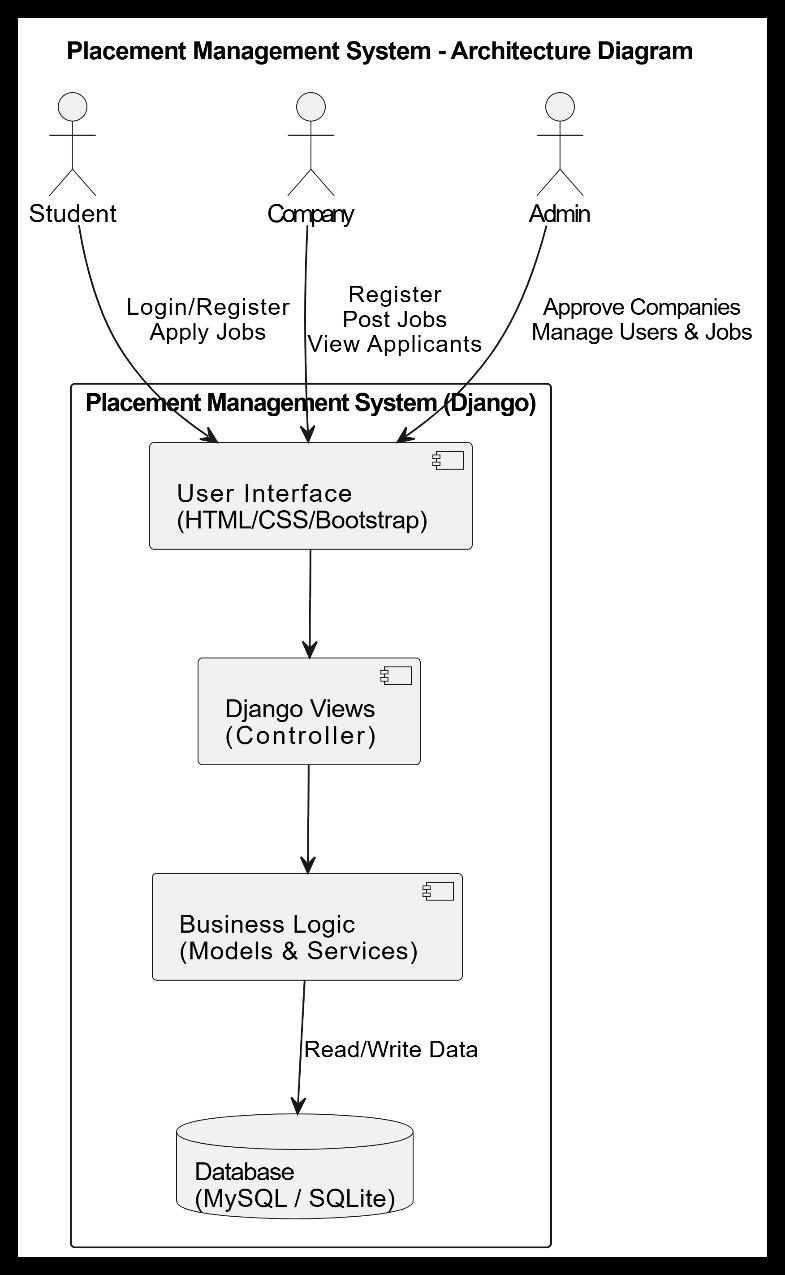
The implementation of the Human–Computer Interface basedPlacementManagementSystemfocusesondeveloping a web-based platform that automates the placement activitiesofacademicinstitutions.Thesystemisdeveloped usingtheDjangowebframework,whichfollowstheModel–View–Template (MVT) architecture. This architecture separatestheapplicationlogic,userinterface,anddatabase management,ensuringbettermaintainabilityandscalability ofthesystem.
The implementation process involves several stages including system design, database creation, user interface development, backend logic implementation, and system integration. The platformsupportsthreeprimary types of users:students,companies,andadministrators.Eachuser role is provided with specific functionalities to ensure a secureandorganizedrecruitmentprocess.
Thesystemisdeployedasawebapplication,allowingusers to access the platform through a standard web browser. Studentscanregisterandmanagetheirprofiles,companies canpostjobopportunities,andadministratorscanoversee theentireplacementprocess.
The development of the Placement Management System utilizesacombinationofmodernwebtechnologiestoensure efficiency and usability. The backend of the system is implemented using Python and the Django framework, whichprovidesbuilt-infeaturesforauthentication,database management, and security. The frontend interface is developed using HTML, CSS, Bootstrap, and JavaScript to createaresponsiveanduser-friendlyenvironment.
The system uses SQLite or MySQL as the database management system to store student records, company information,jobpostings,andapplicationdetails.Django’s Object Relational Mapping (ORM) simplifies database interactionandensuressecuredatahandling.
The database plays a crucial role in managing the large volumeofinformationassociatedwithplacementactivities. The database stores structured data related to students, companies, job postings, and applications. Each student record includes personal details, academic information, skills, and resume files. Company records contain organizationdetailsandjobrequirements.
Thejobtablestoresinformationsuchasjobtitle,description, salary,eligibilitycriteria,andapplicationdeadlines.When studentsapplyforajob,theapplicationdetailsarerecorded in a separate table that links the student and company information. This relational database design ensures efficientdataretrievalandmanagement.
Security is an important aspect of the placement management system. The platform uses Django’s built-in authentication system to manage user login and access control.Eachuserisrequiredtoregister andauthenticate beforeaccessingsystemfeatures.
Role-basedauthorizationensuresthatuserscanonlyaccess functionalitiesassignedtotheirrole.Studentscanviewjob postings and apply for jobs, companies can post job opportunitiesandreviewapplicants,andadministratorscan manageusersandmonitorsystemactivities.Thisapproach ensuresdataprivacyandpreventsunauthorizedaccess.
International Research Journal of Engineering and Technology (IRJET) e-ISSN: 2395-0056
Volume: 13 Issue: 03 | Mar 2026 www.irjet.net p-ISSN: 2395-0072
The student interface provides an interactive platform wherestudentscanregisterandcreateprofiles.Studentscan update personal information, academic records, technical skills,anduploadresumes.Thedashboardallowsstudents toviewavailablejobopportunitiespostedbycompaniesor administrators.
Studentscanapplyforjobsdirectlythroughthesystemand track the status of their applications. The system ensures that students can only apply for jobs within the specified application period, improving the efficiency of the recruitmentprocess.
The company interface allows recruiters to register and interact with the placement platform. After registration, companiescanpostjobopeningswithdetaileddescriptions, including job roles, required skills, salary packages, and eligibilitycriteria.
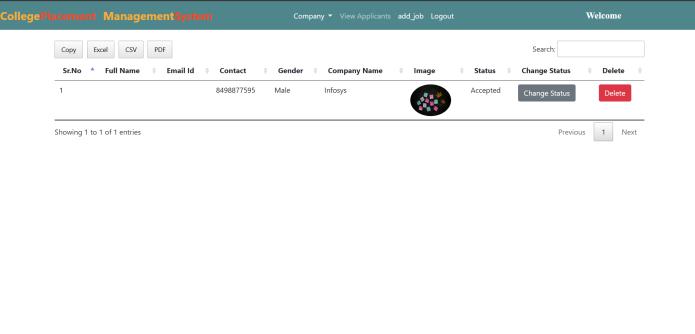
Recruiterscanviewapplicationssubmittedbystudentsand review candidate profiles. This interface simplifies the recruitment process by allowing companies to shortlist candidatesandorganizeinterviewschedulesefficiently.
Theadministratorinterfaceisresponsibleformanagingthe overallfunctioningofthesystem.Theadministratorverifies company registrations, manages student accounts, and monitors job postings. The administrator can also view applicationrecordsandmaintainplacementstatistics.
This module ensures that only authorized companies can access student information and post job opportunities. It also helps maintain system integrity by preventing unauthorizedactivities.
The job application process is automated to simplify recruitmentactivities.Whenastudentappliesforajob,the systemrecordstheapplicationdetailsinthedatabasealong with the submission date and resume file. Companies can access these applications through their dashboard and reviewthequalificationsofeachcandidate.
Thesystemalsocheckswhetherthejobapplicationperiodis openbeforeallowingstudentstoapply.Thispreventsinvalid applicationsandensuresastructuredrecruitmentprocess.
TheproposedHuman–ComputerInterfacebasedPlacement ManagementSystemwassuccessfullydevelopedandtested
using the Django web framework. The system integrates multiplemodulesincluding studentregistration,company registration,jobposting,jobapplication,andadministrative management.Thedevelopedplatformprovidesacentralized environment where all placement activities can be performedefficientlythroughawebinterface.
The primary objective of the system is to simplify the recruitmentprocessandreducethemanualeffortrequired byplacementofficers.Thesystemwastestedunderdifferent userrolessuchasstudents,companies,andadministrators toensurethateachmoduleperformsitsintendedfunctions correctly. The evaluation process involved verifying user authentication, job posting functionality, application submission,anddatabasestorageoperations.
The results show that the system effectively handles placement-related data and provides a smooth user experience. Students can easily register on the platform, create profiles, upload resumes, and browse available job opportunities.Companiescanregisterandpostjobopenings withdetailedinformationsuchasjobtitle,salary,experience requirements, and required skills. The administrator is responsible for managing company registrations and monitoringplacementactivitieswithinthesystem.
The developed system significantly improves the transparency and accessibility of the placement process. Students receive timely access to job postings, while companies can review candidate profiles and applications through the system dashboard. This automation reduces dependency on manual communication methods such as emails and spreadsheets, which are commonly used in traditionalplacementmanagementsystems.

Thehomepageofthesystemprovidesthemainentrypoint forallusers.Itcontainsnavigationlinksthatallowusersto access different sections of the platform such as Student Login, Admin Login, and Company Login. The interface is designedwithaclearlayoutthathighlightsthesystemtitle andprovidesquickaccesstothemainfunctionalitiesofthe platform.
The home page also includes an introduction to the PlacementManagementSystemandexplainsthepurposeof
2395-0056
Volume: 13 Issue: 03 | Mar 2026 www.irjet.net p-ISSN: 2395-0072
theplatform.Thisdesignensuresthatnewuserscaneasily understandthesystemandnavigatetotheappropriatelogin section.Theresponsivedesignofthepageensuresthatthe interfacecanbeaccessedthroughvariousdevicesincluding desktopsandmobilebrowsers.
The job posting interface enables companies or administratorstoaddnewjobopportunitiestothesystem. Theformincludesmultiplefieldssuchasjobtitle,startdate, end date, required experience, salary information, skills required, company location, and job description. Once the formissubmitted,thejobdetailsarestoredinthesystem database and become visible to students through the job listingpage.
Thisinterfacesimplifiestherecruitmentprocessbyallowing companies to publish job openings directly through the system. Students can view these job postings and apply onlinebysubmittingtheirresumes.Thesystemalsoverifies thejobapplicationperiodtoensurethatstudentscanonly apply within the specified timeframe. The performance evaluationofthesystemindicatesthattheapplicationcan efficientlyhandlemultipleuserinteractionssimultaneously. Thedatabaseoperationsforstoringandretrievingstudent profiles, company details, and job applications were executed successfully without data inconsistencies. The system also ensures secure authentication using Django’s built-insecurityfeatures,preventingunauthorizedaccessto sensitiveinformation.
Furthermore, the centralized database structure allows placement administrators to monitor placement activities and maintain records of student applications and recruitmentoutcomes.Thiscapabilityenablesinstitutionsto generateplacementstatisticsandreportsthatcanbeused for academic analysis and decision-making. Overall, the experimental results demonstrate that the proposed PlacementManagementSystemsuccessfullyautomatesthe campusrecruitmentprocessandimprovestheefficiencyof placementmanagementinacademicinstitutions.
The Human–Computer Interface based Placement Management System provides an efficient solution for
managing campus recruitment activities in academic institutions.Thesystemsuccessfullydigitizesthetraditional placement process by providing a centralized web-based platform for students, companies, and administrators. Throughthisplatform,studentscanmaintaintheirprofiles, companies can post job opportunities, and administrators can manage placement activities in an organized manner. The implementation of this system reduces manual paperwork, minimizes administrative workload, and improvescommunicationbetweenallstakeholdersinvolved intherecruitmentprocess.Theintegrationofuser-friendly interfaces and secure authentication mechanisms ensures that the system remains reliable and accessible to users. Additionally,thecentralizeddatabaseenablesinstitutionsto store and manage large volumes of placement-related information effectively .Overall, the proposed system enhances transparency, efficiency, and accessibility in the campus recruitment process. By leveraging modern web technologiesandHuman–ComputerInteractionprinciples, thePlacementManagementSystemprovidesascalableand practicalsolutionforimprovingplacementmanagementin educationalinstitutions.
TheproposedPlacementManagementSystemcanbefurther enhancedbyincorporatingadditionalfeaturestoimproveits functionality and efficiency. In future developments, the system can be integrated with email and SMS notification services to automatically inform students about new job postings, application deadlines, and interview schedules. This will help students stay updated with placement activitiesinrealtime.Anotherpossibleimprovementisthe integrationofmachinelearningtechniquestorecommend suitablejobopportunitiestostudentsbasedontheirskills, academicperformance,andinterests.Thiswouldmakethe recruitmentprocessmoreefficientandpersonalized.
The system can also be extended to include online assessment modules, allowing companies to conduct aptitudetestsortechnicalevaluationsdirectlythroughthe platform. Additionally, mobile application support can be developed to make the system accessible through smartphones, enablinguserstointeractwiththeplatform anytime and anywhere . By incorporating these advanced features,thePlacementManagementSystemcanevolveinto amoreintelligent,scalable,andcomprehensiverecruitment managementplatformforacademicinstitutions.
[1] A. Kumar and S. Gupta, “Web-Based Placement Management System for Academic Institutions,” InternationalJournalofComputerApplications,vol.178,no. 12,pp.15–20,2020.
[2]P.SharmaandR.Singh,“DesignandImplementationof an Online Campus Recruitment System,” International
International Research Journal of Engineering and Technology (IRJET) e-ISSN: 2395-0056
JournalofEngineeringResearchandTechnology(IJERT),vol. 9,no.5,pp.210–215,2020.
[3] M. Verma and A. Patel, “Automated Placement Portal Using Web Technologies,” International Journal of InnovativeTechnologyandExploringEngineering,vol.8,no. 7,pp.345–349,2019.
[4] S. Reddy and K. Rao, “Development of a Web-Based RecruitmentManagementSystem,”InternationalJournalof AdvancedResearchinComputerScience,vol.10,no.4,pp. 112–118,2019.
[5] T. Anderson, “Human–Computer Interaction in WebBased Information Systems,” IEEE Computer Society, pp. 125–130,2018.
[6]R.S.PressmanandB.R.Maxim, Software Engineering: A Practitioner’s Approach, 8th ed., New York, NY, USA: McGraw-HillEducation,2015.
[7]I.Sommerville, Software Engineering,10thed.,Boston, MA,USA:PearsonEducation,2016.
[8]J.Nielsen, Usability Engineering,SanFrancisco,CA,USA: MorganKaufmann,2012.
[9]A.Dix,J.Finlay,G.Abowd,andR.Beale, Human–Computer Interaction,3rded.,Harlow,U.K.:PearsonEducation,2004.
[10]K.C.LaudonandJ.P.Laudon, ManagementInformation Systems: Managing the Digital Firm,15thed.,NewYork,NY, USA:PearsonEducation,2018.
[11]M.Fowler, UML Distilled: A Brief Guide to the Standard Object Modeling Language, 3rd ed., Boston, MA, USA: Addison-Wesley,2014.
[12] D. Gourley and B. Totty, HTTP: The Definitive Guide, Sebastopol,CA,USA:O’ReillyMedia,2015.
[13]A.HolovatyandJ.Kaplan-Moss, The Definitive Guide to Django: Web Development Done Right, Berkeley, CA, USA: Apress,2009.
[14] S. Krug, Don’t Make Me Think: A Common Sense Approach to Web Usability,3rded.,Berkeley,CA,USA:New RidersPublishing,2014.
[15] R. Fielding and R. Taylor, “Principled Design of the ModernWebArchitecture,” ACMTransactionsonInternet Technology,vol.2,no.2,pp.115–150,2002.
Volume: 13 Issue: 03 | Mar 2026 www.irjet.net p-ISSN: 2395-0072 © 2026, IRJET | Impact Factor value: 8.315 | ISO 9001:2008