
International Research Journal of Engineering and Technology (IRJET) e-ISSN: 2395-0056
Volume: 13 Issue: 01 | Jan 2026 www.irjet.net p-ISSN: 2395-0072
International Research Journal of Engineering and Technology (IRJET) e-ISSN: 2395-0056
Volume: 13 Issue: 01 | Jan 2026 www.irjet.net p-ISSN: 2395-0072
Mahmudov Dalerjon1 , Yoqubjoni Saivali2
1,2 College of Environmental Science and Engineering, Institute of Environment and Sustainable Development (IESD), Tongji University, 1234 Siping Road, Shanghai 200092, China ***
Abstract - A robust interdependence exists between economic growth and human capital development, with the latter acting as a core driver for advancing national knowledge, health, and welfare, profoundly shaping economic paths. Human capital-encompassing acquired skills, education, health, and innate abilities-transforms individual potential into societal progress, posing universal challenges in fostering socio-economic advancement, especially in health, education, and living standards. This study explores the interplay between Tajikistan's economic expansion and human capital cultivation, amid its shift from traditional roots to modernization under President Emomali Rahmon's reforms. Grounded in foundational theories from Theodore Schultz and Gary Becker, it positions human capital as the engine of industrial and post-industrial economies, dominating national wealth in advanced nations. Employing the World Bank's Human Capital Index and UNDP's Human Development Index, the analysis reveals Tajikistan's medium development status and consistent gains in longevity, schooling, and income. Findings affirm strong links between human capital investments and growth, per studies like Boztosun et al. and Azam et al., while highlighting hurdles such as underqualified workforces limiting technology adoption (Sacerdoti et al.). Targeted recommendations for Tajikistan include bolstering education funding (top global rank by UNESCO), tackling noncommunicable diseases (a leading mortality cause), and leveraging foreign investment for global integration. Ultimately, human capital enhancement is essential for Tajikistan's sustainable progress, regional convergence, and improved livelihoods, via education reforms, demographic strategies, and resource optimization.
Keywords: human capital development, economic growth, Tajikistan, Human Development Index (HDI), Human Capital Index (HCI), education investment, health capital, socio-economic progress, foreign direct investment, sustainable development
Introduction
Inthe framework ofa market economy,itis widelyrecognizedthattheearningsof economicactorsarenotassuredand arenotuniformlyallocatedacrossdifferentsegmentsofthepopulation.Thisisbecauseanotableadvantageofthemarket systemistheincreaseinreturnsfrompropertyandentrepreneurialventures,evenwhenthesebenefitsareconcentrated amongaminority.Disparitiesinincomeperpersonsignifyeconomicinequality.
Recent decades have marked a period of profound change for the Republic of Tajikistan, situated in the heart of Central Asia. Guided by the reform-oriented leadership of President Emomali Rahmon, the nation is moving beyond a history rootedintraditionandadvancingtowardmodernizationandenhancedengagementontheglobalstage.Itis increasingly apparent that unlocking Tajikistan's potential to become a focal point for regional economic activity hinges on the development ofitsmostvaluableresource:itshumancapital (HC).Humancapital isformallyintegrated intoTajikistan’s strategicplanningandisconsistentlydefinedinthenationalpolicydiscourse.Initscomprehensivearticulationwithinthe country’sscientificandeconomictheory,HCisunderstoodasthe aggregate ofan individual’sknowledge, skills,abilities, and health. This conceptualization views HC not as a mere social input, but as an essential, investable asset. The paramountimportanceofHCisreflectedinthehighestlevelsofpoliticalleadership.
PresidentEmomaliRahmonhasrepeatedlyemphasizedthatthedevelopmentoftheeconomyandthestrengtheningofits competitivenessarefundamentally«Impossiblewithoutthecontributionofhumancapital».ThePresident’sAddressesto theMajlisiOlihavepositionedHCdevelopmentasoneofthemainfactorsnecessaryforthecountry'sprogress,specifically requiringincreasedscientificknowledgethroughthetrainingandretrainingofpersonnel.HCdevelopmentistreatedasa keyfactorinraisingthequalityandeffectivenessofsocialsectors,includingeducation,healthcare,science,andinnovation (https://www.president.tj).
ThiselevationofHCisgroundedincompellingeconomicanalysis.Studiesconductedbyinternationalfinancialinstitutions, such as the World Bank, have demonstrated that in countries undergoing economic transition-a group that includes Tajikistan-the majority of economic growth, specifically up to 64%, is derived from human capital. This contribution substantially outweighs the roles played by physical capital (such as infrastructure and equipment, contributing approximately16%)ornaturalcapital(landandnaturalresources,contributingaround20%).Thisanalysisunderscores
International Research Journal of Engineering and Technology (IRJET) e-ISSN: 2395-0056
Volume: 13 Issue: 01 | Jan 2026 www.irjet.net p-ISSN: 2395-0072
that HC is the most significant independent variable influencing Tajikistan's potential for future economic expansion (WORLD BANK. The Human Capital Project 2018) Recent strategic documents reinforce this, with the National Development Strategy (NDS) to 2030 dedicating сhapter four to HC objectives, linking it to food security, productive employment,andthethirdphaseofeconomicdevelopmentfocusedonscience,technology,andinnovation(NDS2030)
The most significant asset and precious resource of any society is its human capital, which also acts as the principal benchmarkforsocio-economicprogress.Theexaminationofhumandevelopment,theaccumulationofhumancapital,the amalgamationofinventivecharacteristicsandcompetencies,andtheallocationofresourcesintohumancapitalrepresent a major area of inquiry in global science. Consequently, the study of human capital and its advancement remains highly relevantinthe21stcentury.
Over the last half-century, human capital has played an indispensable role in socio-economic development. Its rapid accumulationis,infact,surpassingthegrowthofotherfactorsandprogressivelyaccountingforalargershareoftheGross National Product structure. In developed nations, it now constitutes approximately 80% of the national wealth. This compositionstoodat48%in2020,withnatural resourcesat20%andphysicalcapitalat32%.AccordingtoWorldBank estimates, the total global value of human capital at the close of the 20th century reached 550 trillion USD, a figure that exceeds eight times the world's GDP at the time (https://www.worldbank.org/). As of 2024, Tajikistan's Human Capital Index(HCI)underscorestheurgencyforaction,withongoinginvestmentsinhealthandeducationpositionedasstrategic imperativesforfutureprosperity.
AUnitedNationsanalysisfrom1978inthefieldofinternationalstatisticsidentified12principalindicatorsforevaluating population living standards, one of which is population income. Concurrently, metrics such as per capita gross domestic product, gross national product, the human development index, along with coefficients measuring stratification across specific populationgroups(quintile,decilegroups)are alsoroutinelyappliedinpractice.The2025HumanDevelopment Report (HDR), launched in Dushanbe, emphasizes expanding choices through responsible AI governance to enhance HC outcomes.
Theprospectivesocio-economicdevelopmenttrajectoryofTajikistanisintrinsicallylinkedtothequalitativeenhancement of human creative capacities, which is evolving into the central element of economic progress. A nation's human capital represents one of the core constituents of its societal wealth. Therefore, a pressing necessity exists to investigate the challenges associated with human capital development, to broaden the avenues for its further growth, and to formulate scientifically-grounded recommendations for its formation and more complete realization, which underscores the significance of this research. Republic of Tajikistan’s overarching strategic documents, which formally establish the necessarynexus betweenhuman capitalinvestmentandsustainabledevelopmentgoals.Humancapitaldevelopmentisa formalizedandnon-negotiablepillaroftheNDS2030.ThecontinuingstrategicpriorityofHCisconfirmedbythedirective that the draft Medium-Term Development Program for 2026-2030 must give «primary attention» to the issue of human capitaldevelopment(NDS2030).
The term «Human Capital» was first introduced in 1961 by Theodore Schultz, with Gary Becker further developing the concept from 1965 onward, demonstrating the efficacy of investing in human capital and articulating an economic perspectiveonhuman behavior.Schultzplayeda monumental roleinestablishingthetheoryofhumancapital duringits formativeyears,securingitsrecognitionwithintheacademiccommunity,andpromotingitswidespreadadoption.Hewas amongthepioneerstoconceptualizehumancapitalasafactorofproduction.Moreover,hemadesubstantialcontributions to comprehending the role of human capital as the primary engine and cornerstone of industrial and post-industrial economies.From Schultz'sviewpoint,the principal outcomes ofinvesting inan individual arethepreservation ofhealth, the capacity for productive labor, and the ability to contribute effectively to society as a creative force. He believed that humancapitalinherentlypossessesproductivequalitiesandhasthepotentialforaccumulationandself-regeneration.The theoryofhumancapitalisbuiltuponcontributionsfrominstitutionaltheory,neoclassical theory,Neo-Keynesianism,and other specialized economic theories. It emerged as the response of economics and related disciplines to the demands of the real economy and everyday life. A significant challenge was to achieve a comprehensive understanding of the individual'sroleandtheaggregateimpactoftheirintellectualendeavorsonthepaceandqualityofsocietalandeconomic advancement.
Initially, Adam Smith in «The Wealth of Nations» (A. Smith, 1776) laid the groundwork for the study of human capital. Whilehedidnotemploythespecificterm,heidentifiedtheacquiredandusefulcapabilitiesofallcitizensasafundamental source of a country's prosperity and economic development. Writing more than a century later, Alfred Marshall notes in
International Research Journal of Engineering and Technology (IRJET) e-ISSN: 2395-0056
Volume: 13 Issue: 01 | Jan 2026 www.irjet.net p-ISSN: 2395-0072
his«PrinciplesofEconomics»(Marshall,1920)thelong-termnatureofinvestmentsinhumancapitalandthefamily’srole inundertakingthem.However,Marshallisalsocreditedwithdelayingthestudyofhumancapitalduetohisreluctanceto putitonthesamefootingasphysicalcapital.
Contemporary research on human capital aligns with two parallel developments within economics. The first was a renewed interest in identifying the drivers of economic growth. Researchers observed that the growth rate of national output significantly outpaced the combined growth rates of traditional inputs-land, labor, and physical capital (Denison, 1962).Theseconddevelopmentcomplementedthefirst-theemergenceofextensivedatasetsthatenabledtheexploration ofworkerproductivityandearnings,andtheircorrelationwithattributessuchaseducationalattainmentandage.
Amid a surge of theoretical and empirical work in the late 1950s and early 1960s, three authors are particularly noteworthy. Jacob Mincer (1958) catalyzed a vast body of literature dedicated to measuring the returns on education. Utilizingcensusdata,hedocumentedthenow-classicfindingthattherelationshipbetweenyearsofeducationandtherate ofearningsgrowthfollowsaninvertedU-shape.TheodoreSchultzconcentratedonthefunctionofeducationandgeneral human capital investments in explaining the rising productivity of labor. His monograph «The Economic Value of Education»positionededucationasasubjectwarrantingconcentratedstudybyeconomists,therebyfoundingthefieldof theeconomicsofeducation.GaryBecker(1964)synthesizedtheemergingstrandsofempiricalandtheoreticalworkintoa coherent framework that provided a guidebook for future research (E.R. Eide, M.H. Showalter, «Human Capital» InternationalEncyclopediaofEducation(ThirdEdition),2010).
The primary objectivesare toleveragehumancapital (HC)to influence economicgrowth and elevate livingstandards in Tajikistan, while refining HC to attain high levels and sustain regional economic development. Elena Pelinescu (2015) argues that human capital-encompassing skills, knowledge, and values-is a pivotal growth factor, emphasizing that slow investmentsinHCdirectlyimpedesustainabledevelopment,particularlyinthecontextoftheEU'ssmart,inclusivegrowth strategies. Her panel data analysis underscores HC's superior role over traditional inputs in fostering long-term productivity and innovation (Elena Pelinescu, «The Impact of Human Capital on Economic Growth», Procedia Economics andFinance23(2015):584-589).Similarly,SabihaOltulular(2025)highlightsthevitaldynamicsofHCasthecornerstone of future economic value, demonstrating through vector autoregressive (VAR) models that education-driven HC accumulation complements physical capital, drives innovation, and exhibits a stable long-run relationship with GDP per capita growth (Sabiha Oltulular, «Human Capital Dynamics Are the Key to Economic Growth: Source of Value of the Future»,Economies13,no.8(2025):235).
However, contextual challenges can diminish HC's efficacy. Mulugeta Bekele et al. (2024) examined Sub-Saharan African economies and found that HC development-proxied by schooling years and education returns-exerts a negative and significant impact on economic sustainability, attributing this to pervasive issues like brain drain, skills mismatches, graduate unemployment, and a disproportionate focus on educational access over quality. Their augmented mean group (AMG)estimationacross30countriesrevealsthatwithouttargetedreformsinteachertrainingandvocationalalignment, HC fails to outperform physical investments in promoting growth (Mulugeta Bekele, Maria Sassi, Kedir Jemal, and Beyan Ahmed, «Human capital development and economic sustainability linkage in Sub-Saharan African countries: Novel evidencefromaugmentedmeangroupapproach»,Heliyon10,no.3(2024):e25123).
Furthermore, the composition of HC emerges as a critical determinant of growth trajectories. Mario F. Carillo (2024) analyzescross-countrydatatoshowthatbalancinghighereducation(forinnovation)andbasiceducation (fortechnology adoption) resolves trade-offs that otherwise perpetuate stagnation and income disparities. Adopting a unified growth framework, the study employs empirical techniques to confirm that optimized HC structures accelerate the transition to sustainedgrowth,withtechnologyadoptionamplifyinginnovationeffectsinmoderneconomies(MarioF.Carillo, «Human capital composition and long-run economic growth», Economic Modelling 137 (2024): 106–120). These insights suggest that less developed nations, like Tajikistan, can converge toward affluent economies by prioritizing qualitative HC enhancementsrelativetopercapitaGDPlevels
Theimpetus forthedevelopmentofhumancapital theoryoriginatedfromstatistical data showingthatthe economiesof developed countries were growing faster than predictions based on classical growth factors would suggest. Through an analysisofactualdevelopmentandgrowthprocessesundercontemporaryconditions,humancapitalhasbeenrecognized as the primary productive and social factor in the evolution of a modern economy and society. The concept of human capital represents a natural extension of the ideassurrounding the human factor andhuman resources,culminating in a morecomprehensiveeconomiccategory.Theinitialboundariesoftheeconomiccategoryknownas«humancapital»were defined by an individual's knowledge and capacity for work, and this understanding developed progressively. Furthermore, from the standpoint of economic theory, human capital was for a long time perceived merely as a social development factor, essentially a cost component. Expenditures on education and upbringing were once considered
International Research Journal of Engineering and Technology (IRJET) e-ISSN: 2395-0056
Volume: 13 Issue: 01 | Jan 2026 www.irjet.net p-ISSN: 2395-0072
unproductive and burdensome. Throughout the latter half of the 20th century, perspectives on education and human capital underwent a steady transformation. An individual's potential to generate income is quantified by their human capital.Humancapitalencompassesnotonlyeducationandacquiredqualificationsbutalsoinnatetalentsandaptitudes.
The extent of humancapital development is increasinglycritical for determining boththelevel and the rate of economic developmentineverycountryworldwide.Asa result,enhancingthequantityandqualityofhumancapitalhasbecomea priority in the economic policies of numerous nations. The modern conception of human capital is founded on specific historical preconditionsaswell asunique,distinct,and universal patternsof emergence.Takingtheaforementionedinto account,wepositthathumancapitalcompriseslabor,education,health,andtheoverallqualityoflife.
TheprincipalstrategicaimforTajikistanistointegrateintotheglobalcommunityofdevelopednationsandensureahigh standard of living for its populace. The country is executing a clear, meticulously conceived plan of action, where the institutional, legal, practical, consistent, and systemic measures adopted robustly support the implementation of democratic,political,andeconomic reforms,alongsidesocial transformations designed tocreateampleopportunitiesfor thefullrealizationoftheprofessional,intellectual,andspiritualpotentialofeverycitizenandsocietycollectively.
The Human Capital Index (HCI) is a composite index that describes the level of human capital development in countries and regions around the world. It is published by the World Bank Group and used as a component of the Human Capital Project. The project was initially led by a group of economists who proposed measuring human capital using Global Learning Data surveys. The index is intended for use by countries to diagnose complex issues in their socio-economic policies and to assess their readiness to transition to a sustainable development model. The index quantifies the level of humancapitaldevelopmentexpectedforthenextgenerationandincludesthefollowingthreecomponents.(Figure1):
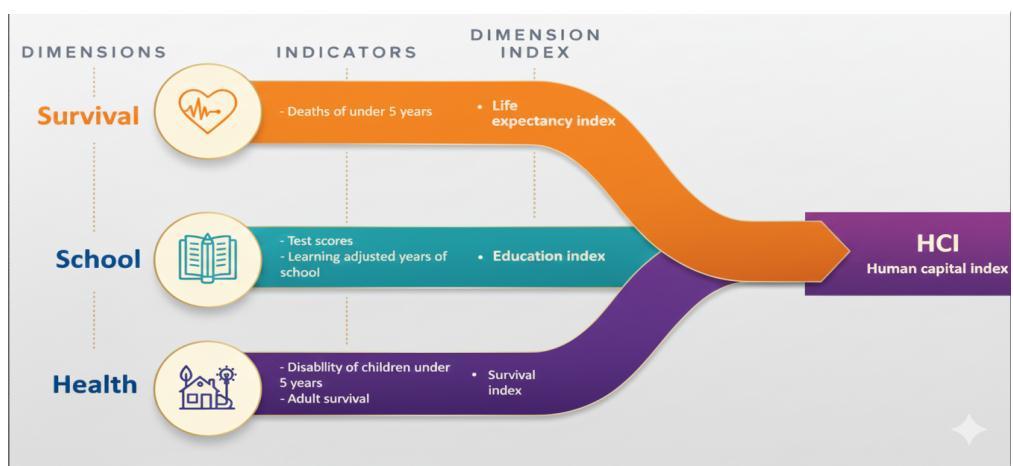
1 Survival. This dimension is measured by the under-5 mortality rate. It serves as an indicator of the quality of the country'shealthcaresystem,particularlymaternalandchildhealthservices.
2. School. Thiscomponentintegratesdataonthequantityofeducationachildislikelytoreceivebyage18withmetrics on the quality of learning. Quality is assessed by the successful performance of students on standardized tests that align withinternationalbenchmarks.Aggregatingthisinformationyieldstheexpectedyearsofeducation,adjustedforlearning quality. This adjustment reveals that children in some countries effectively receive fewer years of learning than those in othercountries,evenwithidenticalnominalyearsofschooling.
International Research Journal of Engineering and Technology (IRJET) e-ISSN: 2395-0056
Volume: 13 Issue: 01 | Jan 2026 www.irjet.net p-ISSN: 2395-0072
3. Health. Thisaspectemploystwoindicatorstoevaluatetheoverallhealthstatusofthepopulation:
1) Therateofstuntingamongchildrenunderfiveyearsofage,reflectingearlychildhoodhealthandnutrition;and 2). Theadultsurvivalrate,definedastheproportionof15-year-oldswhoareexpectedtosurviveuntilage60,indicating thelongevityandhealthoftheworking-agepopulation.
ThemethodologyforaggregatingtheHumanCapitalIndexisbasedonthefollowingcalculation: ThecomponentsoftheHCIarecombinedintoasingleindexbyfirstconvertingeachintoameasure ofitscontributionto productivity relative to a benchmark of complete education and full health. Multiplying these productivity contributions togetheryieldstheoverallHCIscore:
According to the 2020 report produced by the United Nations Development Program (UNDP), the Human Development Index features a classification termed «High level of human development», which includes countries that can be considered developed, where populations enjoy a high standard of living. According to this report, the nations with the highest human development index scores are Norway (0.957), Ireland (0.955), and Switzerland (0.955). Tajikistan was positioned125thinthisrankingwithanindexvalueof 0.668in2019,reflectingastatusofmediumhumandevelopment. Key indicators for the country include a population of over 10 million, a literacy rate nearing universal, and strategic prioritizationofeducationfunding,withUNESCOrankingit21stamong 183countriesfortheshareofpublicexpenditure allocatedtoeducation.
In the contemporary global context, the Human Development Index evaluates three fundamental dimensions to gauge a country's achievements in human development. The first is longevity and health, assessed by life expectancy at birth, indicating whether a country possesses adequate health services to ensure a long and healthy life for its citizens. The second dimension measuredisknowledgeand education.Thisis evaluatedthroughindicatorsofadultliteracyratesand the expected years of schooling for children. The third dimension is the standard of living, reflecting the material wellbeingofthepopulation.ThisismeasuredbyGrossNationalIncome(GNI)percapita,adjustedforpurchasingpowerparity (PPP)inconstantinternationaldollars.
Tajikistan’s HDI value for 2019 is 0.668, which placed the country in the medium human development category, positioning itat125out of 189countriesandterritories.Between2000and2019, Tajikistan’sHDIvalueincreasedfrom 0.569 to 0.668, an increase of 17.4 percent. Table 1 reviews Tajikistan’s progress in each of the HDI indicators. Between 1990and2019,Tajikistan’slifeexpectancyatbirthincreasedby8.2years,meanyearsofschoolingincreasedby3.5years and expected years of schooling increased by 4.9 years. Tajikistan’s GNI per capita increased by about 119.3 percent between1990and2019.
Table 1: Key socioeconomic indicators for Tajikistan
Indicators
Population
Source: World Bank, UNDP, Agency on statistics under the President of the Republic of Tajikistan (2022–2024)
However, attracting foreign capital offers several potential advantages for Tajikistan's economy. Research on developing economiessuggests thatforeigndirectinvestment can bring technology transferand enhance productivity. Over thelast decade, Tajikistan has seen considerable economic improvements. Key elements of the national development strategy
International Research Journal of Engineering and Technology (IRJET) e-ISSN: 2395-0056
Volume: 13 Issue: 01 | Jan 2026 www.irjet.net p-ISSN: 2395-0072
haveincludedimportingmodernequipmentandexportingnaturalresourcessuchasmineralsandhydropower.However, becausethenation'seconomyisnotyetfullyintegratedintoglobalvaluechains,ithasbeensomewhatshieldedfromthe immediateimpactsofrecentinternationalfinancialcrises.
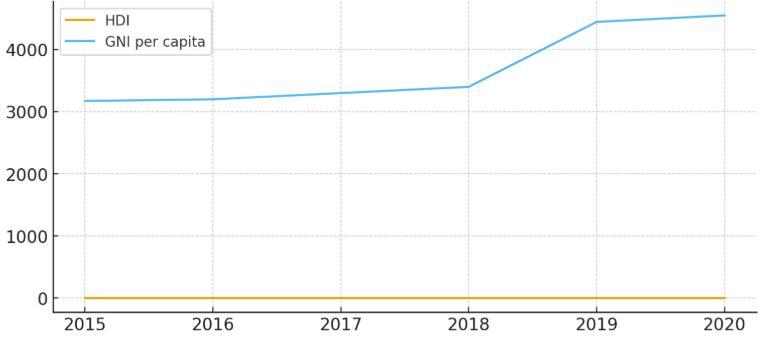
Figure 2. HID and GHI per capital (2015-2020)
Figure 2 shows the trends of Tajikistan’s Human Development Index (HDI) and Gross National Income (GNI) per capita from2015to2020.HDIdemonstratesasteadybutgradualincrease,risingfrom0.624to0.669,reflectingimprovements in education, health, and living standards. In contrast, GNI per capita shows stronger growth, especially after 2018, increasing from USD 3,173 to USD 4,550. This indicates accelerated economic expansion. However, the faster rise in income compared to HDI suggests that economic gains are not yet fully transforming into proportional human developmentoutcomes.Overall,thefigurehighlightsmoderateprogressinhumandevelopmentalongsidenotableincome growth.
Table 2. Rating of Countries of the World According to the Human Development Index
Health capital and Demographic policy. Health capital is an indispensable element of human capital, representing investmentsmadetomaintainworkforceefficiencybyreducingillnessandextendingtheproductivelifespan.Thecaliber ofhealthservicesanindividualaccessesfrombirththrougholdageprofoundlyimpactstheirhealthstatus.Morbidityand disabilitiesaremanifestationsofdeterioratinghealth.Naturally,apopulationwithalowerincidenceofdiseaseishealthier andyieldsahigherreturnonhealthcareinvestments.Nonetheless,contemporarysocietiesfacesignificantchallengesthat impedethedevelopmentofhealthcapital.
Non-communicablediseases(NCDs),suchaschronicrespiratoryconditions,diabetes,cancer,andcardiovascularailments, representamajorburden.InTajikistan,diseasesincludingdiabetesmellitus,malignantneoplasms,stroke,cardiovascular disease,andchronicrespiratorydisordersareleadingcontributorstodisabilityandmortality.Thesearelargelyassociated withriskfactorslikehypertension,highbloodcholesterol,tobaccoandalcoholconsumption,obesity,insufficientintakeof fruitsandvegetables,andphysicalinactivity.
In2016alone,NCDswereresponsiblefor40milliondeathsglobally,accountingfor70percentofalldeathsworldwide.It is known that in Tajikistan, NCDs cause a significant majority of all deaths annually. Experts note that a substantial proportion of premature mortality from NCDs can be prevented or delayed by mitigating risk factors and enhancing the
International Research Journal of Engineering and Technology (IRJET) e-ISSN: 2395-0056
Volume: 13 Issue: 01 | Jan 2026 www.irjet.net p-ISSN: 2395-0072
organization and delivery of medical care for patients with these conditions. The government of Tajikistan has been implementingconsistentmeasurestoprevent,treat,andcontrolthiscategoryofdiseases,theirriskfactors,andtoreduce prematuremortalityandmorbidityrates.[6]
Humancapital,constituting a complex of knowledge, competencies, health,andsocial attributes, isintrinsicallylinked to the structure and development stage of a society. Its evolution is directly influenced by an individual's consciousness, ethicalframework,worldview,andtheprevailingsocio-economicandpoliticalrelations,aswellasthenatureofthesocial system.Asarationalbeing,apersoncomprehendseventsinthetangibleworldandmanagesitthroughscientificthought, labor, and inherent potential. The growth of human capital is consequently shaped by the overarching events and conditionswithinthesurroundingsocialenvironment. Therefore, to generate innovative human capital, it is imperative that every family and the children born within them are guided from an early age to acquire knowledge, to haveadesireforscienceandaloveforworkinstilledintheirhearts,andtobeeducatedutilizingthelatesttechnologies, world-classtextbooks,andteachingaids.Knowledgeenablestheutilizationofallopportunitieswithinsociety,whileskills drive social development and economic expansion. This reality necessitates continuous and sustained funding for the education sector. To achieve the established target parameters, a comprehensive enhancement of the entire education systemisrequired,focusingonbothquantitativeandqualitativeindicators.Despitethearrayofinstrumentsavailableto the state, the effectiveness of governmental oversight and quality assurance in education remains an area for improvement.Thepersistentissueofeducationqualityisyettobefullyresolved. This situation calls for a systemic reform and a fundamental enhancement of the country's education system, elevating the process of training highly qualified personnel who possess contemporary knowledge and high moral and ethical qualities to a new level. Investing financialresourcesineducationisdirectlycorrelatedwiththeaccumulationofeducationalcapital.Itisestimatedthata 1 percent increase in investment in education can lead to a more than proportionate increase in the stock of educational capitalandsubsequenteconomicoutput
References
1. Becker, G. S. (1964). Human capital: A theoretical and empirical analysis, with special reference to education Chicago:UniversityofChicagoPress.
2. Boztosun, D., Aksoylu, S., & Ulucak, Z. Ş. (2016). The role of human capital in economic growth. Economics, 4(3),1–10.
3. Denison, E. F. (1962). The sources of economic growth in the United States and the alternatives before us. Committee for Economic Development,NewYork.
4. Eide, E. R., & Showalter, M. H. (2010). Human capital. In International Encyclopedia of Education (3rd ed.). Elsevier.
5. GovernmentoftheRepublicofTajikistan.(2016). National Development Strategy of the Republic of Tajikistan for the Period up to 2030
6. Marshall,A.(1920). Principles of economics (8thed.).London:Macmillan.
7. Mincer,J.(1958).Investmentinhumancapitalandpersonalincomedistribution. Journal of Political Economy, 66(4),281–302.
8. Pelinescu,E.(2015).Theimpactofhumancapital oneconomicgrowth. Procedia Economics and Finance,23, 184–190.https://doi.org/10.1016/S2212-5671(15)00358-0
9. Sacerdoti, E., Brunschwig, S., & Tang, J. (1998). The impact of human capital on growth: Evidence from West Africa.IMFWorkingPaperNo.98/162.InternationalMonetaryFund.
10. Schultz,T.W.(1961).Investmentinhumancapital. The American Economic Review,51(1),1–17.
11. Smith,A.(1776). An inquiry into the nature and causes of the wealth of nations.London:W.Strahan.
12. United Nations Development Programme (UNDP). (2020). Human Development Report 2020: The next frontier-Human development and the Anthropocene.NewYork:UNDP.
International Research Journal of Engineering and Technology (IRJET) e-ISSN: 2395-0056
Volume: 13 Issue: 01 | Jan 2026 www.irjet.net p-ISSN: 2395-0072
13. United Nations Development Programme (UNDP). (2024). Human Development Report 2024. New York: UNDP.
14. WorldBank.(2018). The Human Capital Project.Washington,DC:WorldBank.
15. World Bank. (2018). The Changing Wealth of Nations 2018: Building a sustainable future. Washington, DC: WorldBank.
16. WorldBank.(2024). Human Capital Index.Washington,DC:WorldBank. https://databank.worldbank.org/source/human-capital-index
17. WorldBank.(2024). World Development Indicators.Washington,DC:WorldBank. https://databank.worldbank.org/source/world-development-indicators
18. Agency on Statistics under the President of the Republic of Tajikistan. (2022–2024). Socio-economic indicators of the Republic of Tajikistan.Dushanbe.https://www.stat.tj
19. President of the Republic of Tajikistan. (2024). Address of the President of the Republic of Tajikistan to the Majlisi Oli.Dushanbe. https://www.president.tj