
International Research Journal of Engineering and Technology (IRJET) e-ISSN: 2395-0056
Volume: 12 Issue: 12 | Dec 2025 www.irjet.net p-ISSN: 2395-0072
International Research Journal of Engineering and Technology (IRJET) e-ISSN: 2395-0056
Volume: 12 Issue: 12 | Dec 2025 www.irjet.net p-ISSN: 2395-0072
1 Guide and Lecturer, Department of mechanical Engineering, Annai JKK Sampoorani Ammal Polytechnic College, Tamil nadu, India
2Lecturer Department of mechanical Engineering, Annai JKK Sampoorani Ammal Polytechnic College, Tamil nadu, India
3Head of the department Department of mechanical Engineering, Annai JKK Sampoorani Ammal Polytechnic College, Tamil nadu, India
4-6Student, Department of mechanical Engineering, Annai JKK Sampoorani Ammal Polytechnic College, Tamil nadu, India ***
Abstract - Thispaperpresentsthedesignanddevelopment of a solar-powered pesticide spraying robot intended for efficient and safe agricultural operations. The system comprisesasolarpanel,rechargeablebattery,controlunit,DC motor pump, pesticide tank, height-adjustable sprinkler sprayer, and a rocker–bogie-based motorized wheel mechanism. Solar energy is harnessed to charge the battery, which supplies power to the DC motors, pump, and remotecontrolreceivercircuit.Therocker–bogiemechanismenables smooth and stable movement over uneven farmland, while remote control operation allows precise navigation without direct human exposure to harmful chemicals. The DC motor pumpdeliverspesticidefromthestoragetanktoanadjustable sprinkler sprayer, ensuring uniform and controlled spraying suitable for different crop heights. The proposed robot operates independently of conventional power sources, reduces manual labor, minimizes pesticide wastage, and enhances farmer safety. Overall, this system offers an ecofriendly, cost-effective, and practical solution for modern agricultural pesticide application.
Key Words: Solar-powered robot, Pesticide spraying system,Agriculturalautomation,Rocker–bogiemechanism, Remote-controlled vehicle, DC motor pump, Sustainable farming,Precisionagriculture
1.
Agricultureplaysavitalroleintheeconomicdevelopmentof manycountries,yetitcontinuestorelyheavilyonmanual labor for essential operations such as pesticide spraying. Conventional spraying methods require farmers to carry heavy equipment and work in close contact with harmful chemicals, which can lead to serious health issues and unevenapplicationofpesticides.Inaddition,theincreasing costoflaborandlimitedaccesstoreliableelectricalpowerin rural areas create further challenges for efficient crop management.
Automation and renewable energy technologies offer promising solutions to theseproblems. Theuseof robotic systemsinagriculturecansignificantlyreducehumaneffort while improving accuracy and consistency in field operations.Atthesametime,solarenergyprovidesaclean, renewable, and widely available power source that is particularly suitable for agricultural environments. Integratingsolarpowerwithautomatedsprayingsystems can reduce dependence on fossil fuels and external electricity,makingfarmingpracticesmoresustainableand cost-effective.
Inthiscontext,thesolar-poweredpesticidesprayingrobot presentedinthisworkisdesignedtoautomatethespraying process while ensuring farmer safety and environmental sustainability. The system incorporates a solar panel, rechargeablebattery,controlunit,DCmotor-drivenpump, andaheight-adjustablesprinklersprayertoenableuniform pesticide application for different crops. A rocker–bogie mechanismwithmotorizedwheelsallowsstablemovement over uneven farmland, while remote control operation ensuressafeandconvenientnavigation.Thisprojectaimsto provideanefficient,eco-friendly,andpracticalsolutionfor modernagriculturalpesticideapplication.
Theincreasingdemandforprecisionagricultureandlaborsavingtechnologieshasstimulatedextensiveresearchinto automated spraying systems. Early studies focused on mechanized boom sprayers and tractor-mounted systems that improved application uniformity over large fields but remaineddependentonfuelandhumanoperation.Assmallscaleandfragmentedfarmsbecamemorecommon,research shifted toward compact, mobile platforms capable of operating in tight spaces and reducing direct human exposuretochemicals.
International Research Journal of Engineering and Technology (IRJET) e-ISSN: 2395-0056
Volume: 12 Issue: 12 | Dec 2025 www.irjet.net p-ISSN: 2395-0072
Asignificantbranchofresearchaddressesroboticpesticide applicators.Severalprototypesandexperimentalplatforms have been developed that integrate wheels or tracks with liquiddeliverysystemstoprovidetargetedspraying.These systems commonly employ pumps, nozzles, and simple controlelectronicstoregulateflowandcoverage.Research showedimprovementsinsprayingaccuracyandreductions in chemical use when robots followedpredefined pathsor usedsensor-drivenactuationtosprayonlywhereneeded.
Renewableenergyintegration,particularlysolarpower,has been explored as a means to make field robotics selfsufficientinoff-gridenvironments.Studiesdemonstratethat photovoltaic panels combined with battery storage can reliablypowerlow-to-moderateloadcomponentssuchasDC motors,controlelectronics,andsmallpumpsduringdaylight operations.Hybriddesignsthatcombinesolarchargingwith battery buffers enable operations during periods of low insolationandextendoperationaltimewithoutfossilfuels, makingthemattractiveforruralandremotefarms.
Mobilityandterrainnegotiationhavebeencriticaltopicsin literature.Conventionalwheeledrobotsperformadequately on flat fields but struggle on uneven or rough terrain. To address this, investigators have evaluated alternative suspension and locomotion mechanisms such as tracked systems, articulated wheel assemblies, and rocker–bogie linkages that improve stability, obstacle negotiation, and wheel-groundcontact.Therocker–bogiearchitecture,while more commonly reportedinplanetary rover research,has been adapted in some agricultural prototypes to maintain chassisstabilityanddistributeloadsacrossmultiplewheels onunevensoil.
Spraying mechanisms and fluid dynamics also receive considerableattention.Researchcomparesdifferentnozzle types,dropletsizes,andpressurestooptimizecoveragewhile minimizingdriftandrunoff.Electrostaticspraying,ultrasonic atomization,and variable-rate nozzles havebeen testedto increase deposition efficiency and reduce pesticide consumption. Integration of flow sensors and closed-loop pump control is shown to maintain consistent application ratesdespitevaryingpumporterrainconditions.
Controlstrategiesandautonomyrangefromsimpleremotecontrolledunitstosemi-autonomousandfullyautonomous systems.Remote-controlsolutionsprioritizeoperatorsafety andsimplicity,allowingmanualguidancewhilekeepingthe operator at a distance from chemicals. Semi-autonomous approaches use GPS waypoint navigation and obstacle avoidance to follow preplanned paths. More advanced research integrates camera vision, LiDAR, and machine learning for crop-row detection, weed identification, and selective spot treatment demonstrating substantial potentialforprecisionapplicationsbutwithincreasedsystem complexityandcost.
Severalstudiesemphasizesystem-levelchallenges:payloadversus-energy trade-offs, the need for robust sealing and chemical-resistant materials, maintenance of pumps and nozzles,andtheimpactoffieldconditions(mud,vegetation, slopes)onmobilityandreliability.Batteryweightandsolar panelsizingarerecurringdesignconstraints;designersmust balance operational range, spraying capacity, and solar rechargingcapabilitytomeetpracticalfieldrequirements.
From a socio-economic perspective, literature highlights farmer acceptance, cost–benefit analyses, and training requirements.Adoptionisinfluencedbycapitalcost,easeof maintenance,perceivedreliability,anddemonstrablesavings inlaborandchemicaluse.Pilotstudiesandfieldtrialsoften recommend modular, repairable designs and provision of local technical support to increase uptake in rural communities.
Gapsandfuturedirectionsidentifiedacrosssurveysinclude the need for standardized field trials to compare systems objectively, improved energy management strategies (including energy-aware path planning), enhanced sensor fusion for reliable autonomous operation under variable lighting and dust conditions, and cost reduction through component standardization. Researchers also point to environmental monitoring integration (soil moisture, weather)toenablecontext-awaresprayingdecisionsandto regulatory and safety frameworks that guide autonomous chemicalapplication.
In summary, the body of literature suggests that solarpowered, remote-controlled or autonomous pesticidespraying robots are a promising direction for sustainable agriculture.Existingworkdemonstratestechnicalfeasibility across core subsystems power, mobility, spraying, and control while also pointing to practical design trade-offs and real-world challenges that future research and developmentmustaddress.
Thesolar-poweredpesticidesprayingrobotisconstructed usingreadilyavailablemechanical,electrical,andelectronic components to ensure reliability, low cost, and ease of maintenance.Thematerialsselectedaresuitableforoutdoor agriculturalconditionsandprovideefficientperformanceof thesystem
Mechanical Components: The chassis is fabricated from mildsteeloraluminumtoprovidesufficientstrengthwhile keeping the structure lightweight. Motorized wheels are usedalongwitharocker–bogiemechanismtoensurestable movementonunevenfarmland.Aheight-adjustablevertical frameisprovidedtosupportthesprinklersprayer,allowing easyadjustmentbasedoncropheight.Apesticidetankmade of chemical-resistant plastic is mounted securely on the chassistostorethepesticidesolution.
International Research Journal of Engineering and Technology (IRJET) e-ISSN: 2395-0056
Volume: 12 Issue: 12 | Dec 2025 www.irjet.net p-ISSN: 2395-0072
Electrical and Power Components : Aphotovoltaicsolar panelisusedastheprimaryenergysourcetoconvertsolar energyintoelectricalpower.Achargecontrollerregulates the charging process and protects the battery from overcharging and deep discharge. A rechargeable battery suppliespowertotheDCmotors,controlunit,andDCmotor pump. Wiring, connectors, and protective casing are used toensuresafeandreliablepowerdistribution
Electronic and Control Components: The control unit consistsofamicrocontrollerorrelay-basedcontrolcircuitto manage motor driving, pump operation, and power distribution. A remote-control transmitter and receiver module enables wireless operation of the robot for movementandspraying.Relaysormotordrivermodulesare used to control the direction and speed of the DC motors. Switchesandindicatorsareincludedformanualcontroland systemstatusmonitoring.
Spraying System Components: Thesprayingmechanism includes a DC motor-driven pump, flexible hoses, and a sprinkler-typespraynozzle.Thepumpdrawspesticidefrom thetankanddeliversitunderpressuretothenozzle,which atomizestheliquidintofinedropletsforuniformspraying. Flow control valves may be used to regulate the spraying rateandreducepesticidewastage.
Overall, the materials used in this project are economical, durable, and suitable for field applications, making the systempracticalforagriculturaluse.
The methodology of the solar-powered pesticide spraying robot involves a systematic approach that integrates mechanicaldesign,powergeneration,controlsystems,and spraying mechanisms to achieve efficient and safe agriculturaloperation.
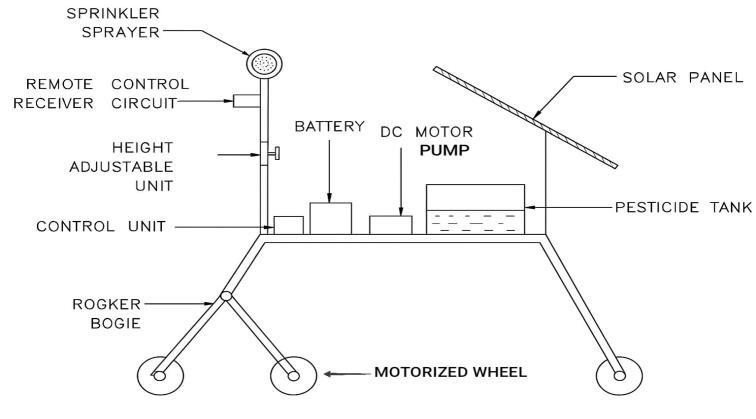
Initially,themechanicalstructureoftherobotisdesignedto supportallcomponentswhileensuringstabilityonuneven farmland.Arigidchassismadeofmildsteeloraluminumis fabricated,anda rocker–bogie mechanism with motorized wheels is incorporated to enhance traction and smooth movementacrossroughterrain.Averticalheight-adjustable frame is mounted on the chassis to hold the sprinkler sprayer, allowing the spraying height to be modified accordingtocroprequirements.
Next, the power system is developed using a photovoltaic solar panel as the primary energy source. The solar panel convertssunlightintoelectricalenergy,whichisregulatedby achargecontrollerandstoredinarechargeablebattery.This batterysuppliespowertotheDCmotors,controlunit,remote receiver circuit, and DC motor pump. Proper power distribution and protection are ensured through suitable wiringandelectricalsafeguards.
The control system is then implemented to manage movementandsprayingoperations.Acontrolunitconsisting ofamicrocontrollerorrelay-basedcircuitinterfaceswitha remote-controlreceiver.Basedoncommandsreceivedfrom the transmitter, relays or motor drivers are activated to controlthedirectionandmotionoftheDCmotors,enabling forward,backward,left,andrightmovements.Thisremote operationallowsthefarmertocontroltherobotfromasafe distance.
The spraying mechanism isintegrated by connecting a DC motor-driven pump to a pesticide storage tank through flexiblehoses.Whenthepumpisactivated,pesticidesolution isdrawnfromthetankanddeliveredunderpressuretothe sprinkler sprayer. The nozzle atomizes the liquid into fine dropletstoensureuniformsprayingandminimalwastage. Theheight-adjustableunitallowseffectivesprayingforcrops ofvaryingheightsandgrowthstages.
Finally, the testing and validation phase is carried out to evaluatetheperformanceoftherobot.Thesystemistested forsmoothmobility,reliablesolarcharging,effectivebattery backup, remote-control responsiveness, and uniform spraying coverage. Adjustments are made to improve stability, spraying efficiency, and power management. Throughthismethodology,theproposedsystemachievesan eco-friendly, cost-effective, and efficient solution for automatedpesticidesprayinginagriculture
International Research Journal of Engineering and Technology (IRJET) e-ISSN: 2395-0056
Volume: 12 Issue: 12 | Dec 2025 www.irjet.net p-ISSN: 2395-0072
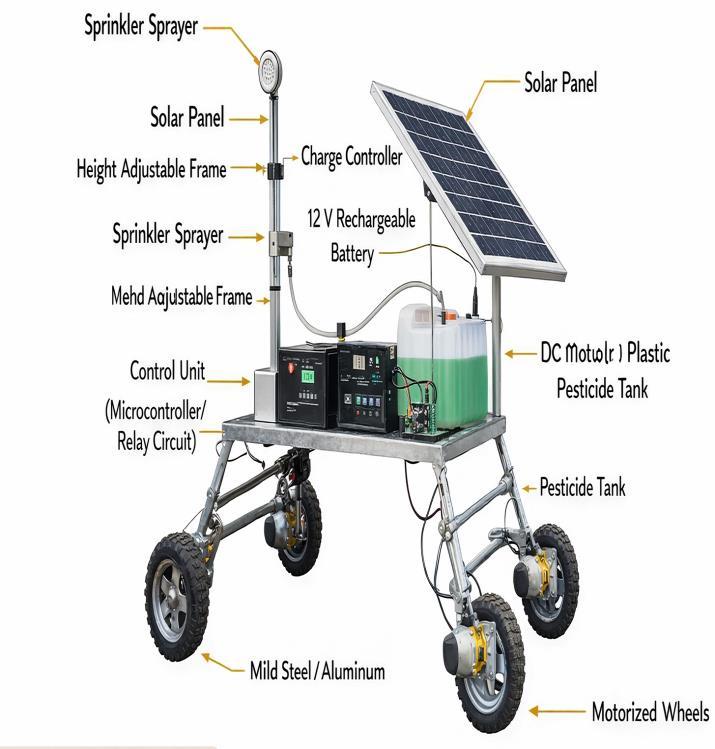
Fig-2 Design And Model Idea
The working principle of the solar-powered pesticide spraying robot is based on the efficient utilization of solar energy, remote-controlled mobility, and a pressurized spraying mechanism to automate pesticide application in agricultural fields. The solar panel mounted on the robot convertssunlightintoelectricalenergy,whichisregulatedby achargecontrollerandstoredinarechargeablebattery.This stored energy serves as the primary power source for the controlunit,DCmotors,remotereceivercircuit,andtheDC motor-drivenpump,enablingcontinuousoperationwithout dependenceonexternalelectricity.
Themovementoftherobotisachievedthroughmotorized wheels integrated with a rocker–bogie mechanism. This mechanismensuresstableandsmoothmotionoveruneven androughfarmlandbymaintainingcontinuouswheelcontact with the ground. The robot’s navigation is controlled remotely using a transmitter–receiver system. Commands fromthetransmitterarereceivedbythecontrolunit,which activatestheappropriaterelaysormotordriverstocontrol forward,backward,left,andrightmovements.
Thesprayingoperationiscarriedoutusingapesticidetank connectedtoaDCmotorpumpviaflexiblehoses.Whenthe spraying command is given, the control unit powers the pump,whichdrawsthepesticidesolutionfromthetankand delivers it under pressure to the sprinkler sprayer. The sprayer nozzle atomizes the liquid into fine droplets, ensuringuniformdistributionofpesticidesacrossthecrop surfaceandminimizingchemicalwastage.
Animportantfeatureofthesystemistheheight-adjustable sprayerunit,whichallowsthenozzlepositiontobemodified accordingtocropheightandgrowthstage.Thisadaptability improvessprayingeffectivenessfordifferentcrops.Overall, thecoordinatedoperationofthesolarpowersystem,control unit, mobility mechanism, and spraying system enables efficient, safe, and eco-friendly pesticide application in agriculturalfields.
Thesolar-poweredpesticidesprayingrobotdevelopedinthis work provides an effective and sustainable solution for automatingpesticideapplicationinagriculture.Byutilizing solar energy as the primary power source, the system reduces dependence on conventional electricity and fossil fuels,makingitsuitableforruralandoff-gridfarmingareas. Theintegrationofarocker–bogiemechanismwithmotorized wheels ensures stable movement over uneven farmland, while remote-control operation enhances ease of use and protectsfarmersfromdirectexposuretoharmfulchemicals.
Theheight-adjustablesprinklersprayerandDCmotor-driven pumpenableuniformandcontrolledsprayingfordifferent croptypesandgrowthstages,reducingpesticidewastageand improving application efficiency. Overall, the proposed system demonstrates a practical, eco-friendly, and costeffective approach to modern agricultural practices. With furtherenhancementssuchasautonomousnavigationand sensor-basedspraying,therobotcanbeextendedtosupport precisionagricultureandimprovedcropmanagementinthe future.
With profound respect, I remember our beloved Founder Chairman, (Late) Thavathiru Dr. J.K.K. Munirajahh, M.Tech.,D.Litt.,whosevisionaryleadershipandunwavering dedicationlaidthefoundationof Annai J.K.K. Sampoorani Ammal Charitable Trust and our institution. His remarkablelegacycontinuestoinspireandguideus in all ourendeavors.
Iamsincerelygratefultoour Honorable Chairperson and Correspondent, Mrs. Vasanthakumari Munirajahh, of AnnaiJ.K.K.SampooraniAmmalCharitableTrustand Annai J.K.K. Sampoorani Ammal Polytechnic College, for her constant encouragement, invaluable guidance, and for providing excellent facilities that made the successful completionofmyinternshippossible.
Iwouldliketoexpressmyheartfeltthankstoour respected Secretary, Mrs. KasthuripriyaKirubakarMurali,ofAnnai J.K.K. Sampoorani Ammal Polytechnic College, for her continuous motivation and for extending the necessary facilitiesthatsupportedmethroughoutmyinternship.
International Research Journal of Engineering and Technology (IRJET) e-ISSN: 2395-0056
Volume: 12 Issue: 12 | Dec 2025 www.irjet.net p-ISSN: 2395-0072
Iamprofoundlygratefultoour esteemed Principal, Prof. Dr. P. Ramesh, M.Tech., Ph.D., for his guidance, moral support, and encouragement, which greatly helped me duringthecourseofmyinternship.
I extend my sincere thanks to my Project Guide, Mr. S. Sandeepgandhi, B.E., for his valuable guidance, constant support,andtimelysuggestionsthroughouttheinternship period.
Ialsoexpressmydeepsenseofgratitudetothe Head of the Department,Mr.P.Ravichandran,B.E., forencouragement andsupport.
I am thankful to Mr. A. Ramesh, M.E., and all the faculty membersandstaffofthedepartmentfortheircooperation, guidance,andsupportduringtheinternship.
Finally,Iwouldliketothankmyparentsandfriendsfortheir encouragement and support, which motivated me to completemyinternshipsuccessfully
[1] R. K. Mittal, K. P. Singh, and S. Kumar, “Automation in agriculture: A review of robotic pesticide spraying systems,” International Journal of Agricultural Engineering,vol.10,no.2,pp.245–252,2017.
[2] A.K.GuptaandR.Sharma,“Solarpoweredagricultural machines:Asustainableapproach,” Renewable Energy ApplicationsinAgriculture,vol.5,no.1,pp.12–18,2018.
[3] J.Zhang,L.Wang,andY.Zhao,“Designanddevelopment of an autonomous spraying robot for precision agriculture,” JournalofIntelligent&RoboticSystems,vol. 84,no.1–4,pp.353–367,2016.
[4] S.BecharandY.Edan,“Human–robotcollaborationfor improved agricultural spraying,” Biosystems Engineering,vol.146,pp.135–149,2016.
[5] M. A. Khan, S. Ahmed, and N. Ali, “Remote-controlled pesticide spraying robot using renewable energy,” InternationalJournalofAdvancedResearchinElectrical, ElectronicsandInstrumentationEngineering,vol.6,no.4, pp.2345–2351,2017.
[6] P. Corke, R. Paul, and W. Churchill, “Rocker–bogie mechanism for rough terrain mobility,” IEEE Robotics and Automation Magazine, vol. 20, no. 4, pp. 65–75, 2013.
[7] V.SubramanianandR.Mahendran,“Designandanalysis of solar-powered mobile robots for agricultural applications,” International Journal of Engineering Research and Technology (IJERT),vol.8,no.6,pp.421–425,2019.
[8] FAO, GuidelinesonPesticideApplicationEquipment,Food and Agriculture Organization of the United Nations, Rome,2015.



Mr.P.Ravichandran, B.E., is currently working as the Head of the Department of Mechanical EngineeringatAnnaiJKKSampoorani Ammal Polytechnic College, Tamil Nadu, IndiaHe possesses extensive teaching and administrative experience and plays a vital role in curriculum development, faculty coordination,andstudentmentoring. His areas of interest include mechanical systems, manufacturing processes,andengineeringeducation.
Mr.A.Ramesh M.E., is currently working as a Lecturer at Annai JKK Sampoorani Ammal Polytechnic College, Tamil Nadu, India. He has completedaMasterofEngineeringin Thermal Engineering. His academic and project interests include renewableenergyapplications,solarpowered systems, agricultural automation, and energy-efficient engineering solutions. He actively guides student projects focused on sustainabletechnologiesandpractical engineering applications for realworldproblems.
Mr.Sandeepgandhi.s currently working as a Lecturer Annai J.K.K. Sampoorani Ammal Polytechnic College, Tamil Nadu, India. He has strong expertise in guiding student projects and internships, with academic interests in automation, renewable energy systems, and applied engineeringtechnologies.He actively contributes to student development through technical mentoring and practical-oriented teaching.
International Research Journal of Engineering and Technology (IRJET) e-ISSN: 2395-0056
Volume: 12 Issue: 12 | Dec 2025 www.irjet.net p-ISSN: 2395-0072
Dhanush.N is a Diploma student in MechanicalEngineeringatAnnaiJKK
Sampoorani Ammal Polytechnic College,, T.N. Palayam, Tamil Nadu. The student has a strong interest in engineering applications related to automation, renewable energy, and agricultural technologies. As part of academic learning, the student has successfullycompletedaninternship andprojectworkfocusingonpractical problem-solving and sustainable engineering solutions. The student aimstoapplytechnicalknowledgeto real-world challenges and continue developing skills in emerging technologies..
Karthikeyan.PisaDiplomastudentin MechanicalEngineeringatAnnaiJKK
Sampoorani Ammal Polytechnic College,, T.N. Palayam, Tamil Nadu. The student has a strong interest in engineering applications related to automation, renewable energy, and agricultural technologies. As part of academic learning, the student has successfullycompletedaninternship andprojectworkfocusingonpractical problem-solving and sustainable engineering solutions. The student aimstoapplytechnicalknowledgeto real-world challenges and continue developing skills in emerging technologies.
Kiruthik.D is a Diploma student in MechanicalEngineeringatAnnaiJKK
Sampoorani Ammal Polytechnic College,, T.N. Palayam, Tamil Nadu. The student has a strong interest in engineering applications related to automation, renewable energy, and agricultural technologies. As part of academic learning, the student has successfullycompletedaninternship andprojectworkfocusingonpractical problem-solving and sustainable engineering solutions. The student aimstoapplytechnicalknowledgeto real-world challenges and continue developing skills in emerging technologies.