
International Research Journal of Engineering and Technology (IRJET) e-ISSN: 2395-0056
Volume: 13 Issue: 06 | Jun 2026 www.irjet.net p-ISSN: 2395-0072
International Research Journal of Engineering and Technology (IRJET) e-ISSN: 2395-0056
Volume: 13 Issue: 06 | Jun 2026 www.irjet.net p-ISSN: 2395-0072
Saurabh Kedar1 , Kunal Bora2 , Yash Landage3 , Hrishikesh R. Shirke4
1,2,3 Student, Dept. Of Electrical Engineering, PES’s Modern College Of Engineering, Maharashtra, India 4Professor, Dept. of Electrical Engineering, PES’s Modern College Of Engineering, Maharashtra, India
Abstract - Traffic congestion in urban areas is increasing rapidly due to the growing number of vehicles and inefficient traditional signal systems. Fixed-time traffic signals fail to respond to real-time road conditions, leading to delays, fuel wastage, and environmental pollution. This project presents a smart and adaptive traffic signal control system that adjusts signal timings based on actual vehicle density at intersections. The system uses a camera to capture live traffic footage, which is processed on a laptop acting as the main operating system using an object detection model (YOLO) to identify and count vehicles. Basedonthisanalysis,optimizedsignaltiming decisionsare generated. A Raspberry Pi is used to receive these decisions and actuate the traffic lights through relay modules. In addition to traffic density control, the system includes features such as emergency vehicle detection and a pedestrian crossing mechanism. These features improve both traffic flow and road safety. Overall, the proposed system provides an intelligent, automated, and efficient solution for traffic management. It helps reduce congestion, saves fuel, improves travel time, and supports the development of smart and sustainable cities by combining AI,IoT,andreal-timedecision-making.
Key Words: YOLO, Raspberry Pi, Smart Traffic Signal System, Real Time, IoT
This project focuses on developing a smart traffic signal system that can control traffic lights based on real-time vehicle detection. In many places, traffic signals work on fixed timing, which does not change according to traffic conditions. This leads to longer waiting times and traffic congestion. To solve this problem, a camera is used to capture live traffic at the junction. The video is processed usingaYOLO-basedobjectdetectionmodeltoidentifyand count the number of vehicles in each lane. In this system, the laptop is used as the main processing unit, where the AI model runs and analyses the traffic data. Based on the number of vehicles detected, the system decides which laneshouldgetmoresignaltime.TheRaspberryPiisused tocontrolthetrafficlights.Itreceivescommandsfromthe laptop and operates a relay module to switch the signal lights (red, green) ON and OFF. This combination makes the system more efficient, as it adjusts signal timing accordingtoactualtrafficconditionsinsteadofusingfixed
timers.Italsohelpsinreducingcongestionandimproving trafficflow.
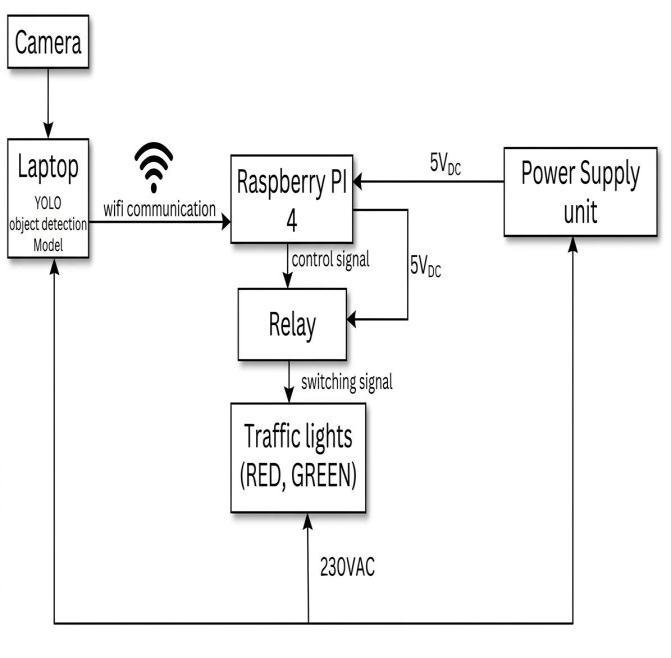
The proposed system is an AI-based smart traffic signal control system that uses real-time traffic analysis to improvetheefficiencyofroadintersections.Inthissystem, a camera is installed at the junction to continuously capturelivevideoofvehiclesmovingacrossdifferentlanes. Insteadofrelyingsolelyonalow-powerembeddeddevice, a laptop is used as the main processing unit, providing a more Powerful operating system platform capable of handlingcomplexcomputations. Thelaptop runssoftware tools such as Python, OpenCV, and the YOLO (You Only Look Once) algorithm, which together perform image processingandobjectdetectiontasks.
The captured video frames are processed by the YOLO model to accurately detect and classify various types of vehicles, including cars, bikes, buses, and trucks, and then count them in each lane. Based on this data, the system calculates the traffic density dynamically for every lane. Using this information, the laptop determines optimal signaltimings,allocatinglongergreensignalstolaneswith heavier traffic and shorter durations to those with lower trafficdensity,therebyimprovingoveralltrafficflow.
For hardware execution, a Raspberry Pi is used as a controller that receives commands from the laptop and operates a 4-channel relay module. This relay module is connectedtothetrafficsignallightsred,yellow,andgreen and switches themaccording to the instructions provided. The entire system functions automatically without requiring manual intervention, ensuring efficient and intelligenttrafficmanagement.
Byleveragingthehigherprocessingcapabilityofthelaptop forAIcomputationandusingtheRaspberryPiforphysical control, the system achieves better accuracy and speed. Ultimately, this smart approach helps reduce traffic congestion, minimizes waiting time, saves fuel, and enhances the overall efficiency of traffic movement at intersections.
International Research Journal of Engineering and Technology (IRJET) e-ISSN: 2395-0056
Volume: 13 Issue: 06 | Jun 2026 www.irjet.net p-ISSN: 2395-0072
ProblemIdentification:
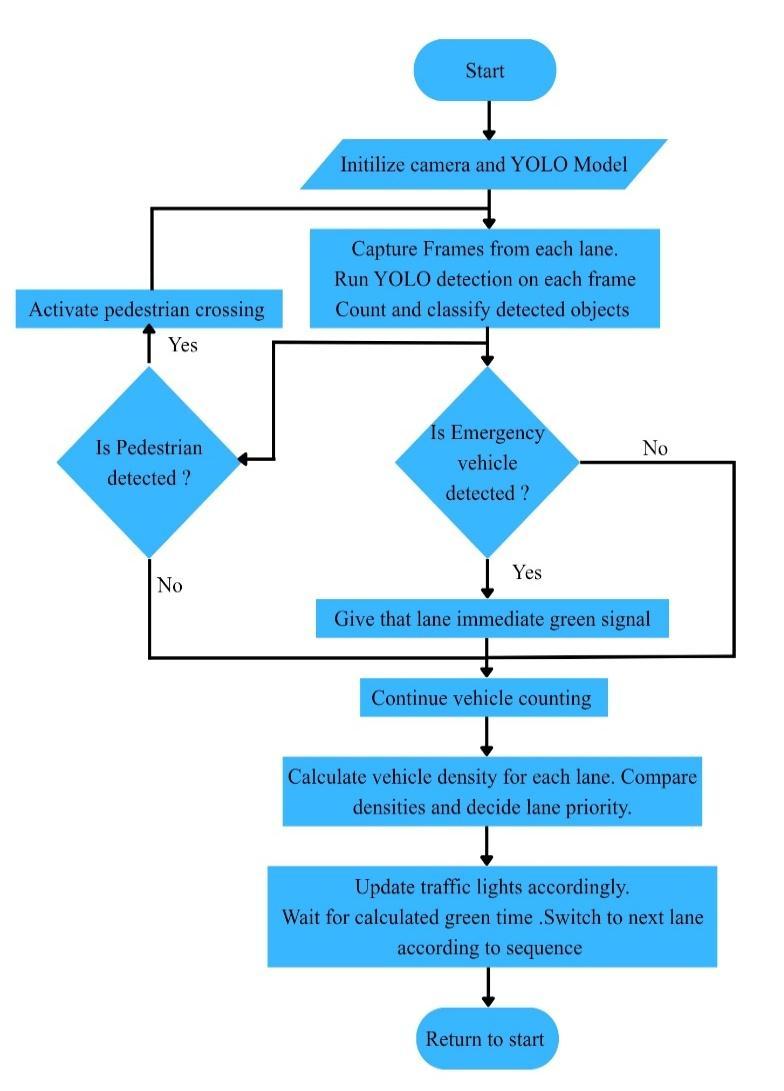
Analyse issues with fixed-time traffic signals (e.g., delays, inefficiency). Identify the need for adaptive control based onreal-timetraffic.
SystemDesignandPlanning:
Selecthardware:RaspberryPi,PiCamera,relays,etc.Plan features like AI vehicle classification, emergency vehicle detection,andpedestrianIntegration.
DataCollection&DatasetPreparation:
Capture or source images of various traffic scenarios. Collect images of emergency vehicles, different vehicle types (car, truck, bike), and Pedestrian movement. Label andannotateimagesfortraining
HardwareSetup:
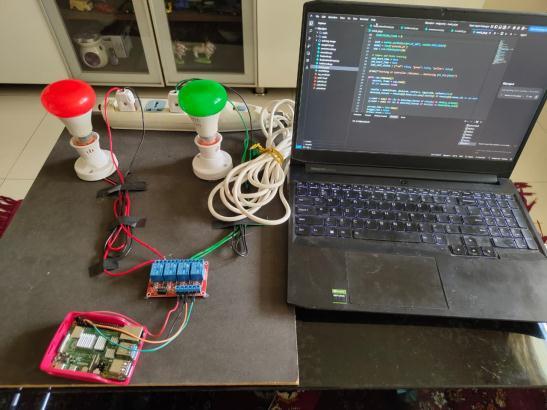
Install Pi camera to monitor traffic lanes. Set up traffic lightsviarelaymodule.
SoftwareandAIDevelopment: TraintheAImodelswithcollecteddata.
IntegrationandTesting:
Combine all modules (camera, sensors, relays) into a working system. Test signal switching under different traffic and pedestrian conditions. Simulate emergency scenariosforpriorityswitching.
Deployment(PrototypeStage):
Implement the system on a scaled down 2-lane intersectionmodel.
Volume: 13 Issue: 06 | Jun 2026 www.irjet.net p-ISSN: 2395-0072
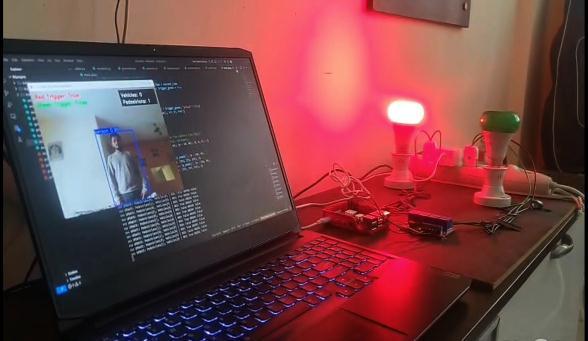
Fig -4 illustrates pedestrian detection using the proposed AI-based system. When a pedestrian is detected for more than 5 seconds, the traffic signal switches to red and remains in that state until the pedestrian leaves the crossingarea.
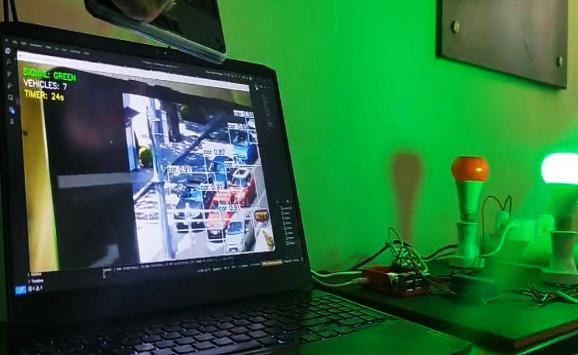
Fig -5:Highvehicledensitybasedgreensignaladjustment
Fig -5 Adaptive green signal control based on real-time vehicledensity.Thegreensignaldurationisautomatically increased whena largernumberofvehiclesisdetected in thelane.
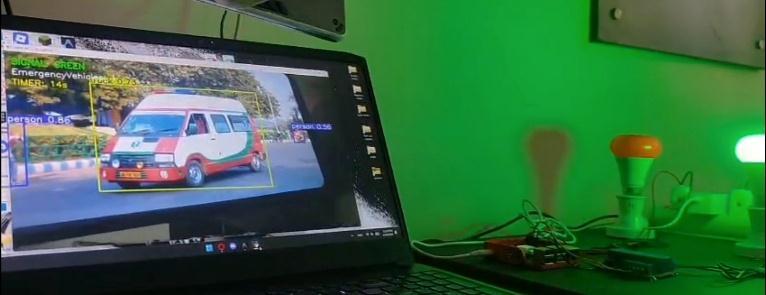
Fig -6: Emergencyvehiclebasedgreensignaladjustment
Fig-6 Emergency vehicle priority control. When an ambulanceisdetected,thetrafficsignalimmediatelyturns greentoprovideprioritypassagethroughtheintersection.
Fig-7Adaptivegreensignalcontrolforlowtrafficdensity. The green signal duration is automatically reduced when fewervehiclesaredetectedinthelane.
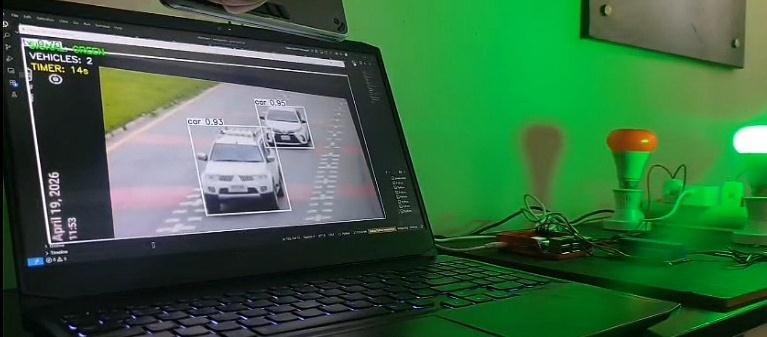
Reduces waiting time during low traffic conditions.
Dynamically adjusts signal timing based on vehicledensity.
Providesprioritytoemergencyvehicles.
Enhances pedestrian safety through real-time detection.
Utilizeslow-costhardware(RaspberryPi).
Suitableforsmartcitytransportationsystems.
Future enhancementstothe proposed system caninclude theintegrationofmultipleinterconnectedtrafficjunctions for city-wide traffic optimization. The system can be extendedusingcloud-basedmonitoringanddataanalytics to provide real-time traffic insights to traffic authorities. Advanced AI models can be incorporated for improved vehicle classification and traffic prediction. Additionally, the proposed system can be integrated with smart city infrastructure and Vehicle-to-Infrastructure (V2I) communication technologies to further enhance traffic efficiency, road safety, and emergency response management.
The AI-based smart traffic signal system improves traditional fixed-time traffic control by introducing realtime, intelligent decision-making using the YOLO (You Only Look Once) object detection algorithm. It continuously analyzes live video input to detect vehicles, estimate traffic density, and dynamically adjust signal timings to reduce congestion and waiting time. A key feature of the system is its ability to prioritize emergency vehicles such as ambulances, fire trucks, and police vehiclesbyimmediatelyprovidingagreensignalforfaster movementduringcriticalsituations.Italsoenhancesroad safety by detecting pedestrian presence and allocating appropriate crossing time to prevent accidents. Overall, this project demonstrates an effective AI-driven approach
International Research Journal of Engineering and Technology (IRJET) e-ISSN: 2395-0056
Volume: 13 Issue: 06 | Jun 2026 www.irjet.net p-ISSN: 2395-0072
to traffic management that improves efficiency, reduces delays, and increases safety for both vehicles and pedestrians,makingitsuitableforsmartcityapplications.
[1] Akash A., Chetan A. B., O. M. Hegde, R. Hosamani, and VisheshJ.,“Smartcontroloftrafficlightsystemusing artificial intelligence,” Journal of Emerging TechnologiesandInnovativeResearch(JETIR),vol.11, no.12,pp.c586–c588,Dec.2024.
[2]S.Mahato,“Smarttrafficsignals:ComparingMARLand fixed-time strategies,” arXiv preprint arXiv:2505.14544v2,Jun.2025.
[3] A. N. A. Yusuf, A. S. Arifin, and F. Y. Zulkifli, “Recent development of smart traffic lights,” IAES International Journal of Artificial Intelligence (IJ-AI), vol. 10, no. 1, pp. 224–233, Mar. 2021. Doi: 10.11591/ijai.v10.i1.pp224-233
[4] B. Zhou, Q. Song, Z. Zhao, and X. Liu, “Deep reinforcementlearningforsmarttrafficsignalcontrol: A review,” IEEE Transactions on Intelligent TransportationSystems,vol.24,no.8,pp.7842–7861, Aug.2023.Doi:10.1109/TITS.2023.3264578
[5] W.-H. Lee and C.-Y.Chiu,“DesignandImplementation ofaSmartTrafficSignalControlSystemforSmartCity Applications,”Sensors,vol.20,no.2,p.508,Jan.2020, doi:10.3390/s20020508.
[6]R.SalamaandJ.B.Idoko,“DesignandImplementation of Smart Traffic Light System Using Renewable Energy, Fail-Safe Systems, and Intelligent Sensors,” Research Square, Dec. 2024, doi: 10.21203/rs.3.rs5542376/v1.
[7] B. Ghazal, K. ElKhatib, K. Chahine, and M. Kherfan, “Smart Traffic Light Control System,” in Proceedings of the IEEE International Conference on Electrical, Electronics, Computer Engineering and their Applications (EECEA), 2016, pp. 161–166, doi: 10.1109/EECEA.2016.7470780.
[8] K. Dharani, D. Sunnyhitha, K. Shirisha, and B. D. Mathews, “Smart Control of Traffic Lights Using Artificial Intelligence,” International Journal of Research and Analytical Reviews (IJRAR), vol. 10, no. 2,pp.356–357,Jun.2023.