
International Research Journal of Engineering and Technology (IRJET) e-ISSN: 2395-0056
Volume: 13 Issue: 02 | Feb 2026 www.irjet.net p-ISSN: 2395-0072
International Research Journal of Engineering and Technology (IRJET) e-ISSN: 2395-0056
Volume: 13 Issue: 02 | Feb 2026 www.irjet.net p-ISSN: 2395-0072
Ms. T.P Kamatchi ¹, Sri Vishnu A M ², Siddharth M ³, Gokul Nanda M⁴ , Mukilan M⁵
¹ Head of Department, Department of Computer Engineering, PSG Polytechnic College, Coimbatore, Tamil Nadu, India
2,3,4,5 Final Year Diploma Student, Department of Computer Engineering, PSG Polytechnic College, Coimbatore, Tamil Nadu, India ***
Abstract - Recruitment is a complex and time-consuming processduetoitshighapplicationcount,unstructuredresume format, and imprecise assessment methods [1],[18]. The traditional approach toward resume screening may result in inept candidate evaluation and undervalued talent discovery [5],[14]. Talent Lens is an AI-driven resume and job description matching tool designed to fully automate and optimize the recruitment process [3],[6]. This tool uses NaturalLanguageProcessingandmachinelearningtoextract important information such as skills, education, work experience, and certifications from resumes and job descriptions [4],[15].Thistoolcalculatessemanticsimilarities forobjectiverankingandmatchingofapt talentforrespective job roles [1], [9], [20]. Talent Lens will act like an intelligent decision aid for HR analysts by allowing ranked candidate listing, skill gap analysis, and data visualization that may assist in informed recruitment decisions. This automated resume analysis and candidate ranking tool reduces manual processing efforts and promotes bias-free and efficient recruitment [14], [21]. The proposed model drastically accelerates and aims to achieve better accuracy of hiring speedandresultsindiscoveringapttalentinshorttimespans.
Contemporaryrecruitmentpracticesentailthesubmissionof manyresumesinresponsetoeachjobadvertisement.Such manual evaluation takes time. Un-structurally arranged resumes, unstructured content, and subjective resume evaluation contribute to the ineffectiveness of resume screening[18].
Inordertosolvetheabove-mentionedchallenges,the"Talen t Lens – AI Based Resume & Job Description Matching SystemforHRAutomation"isproposed.TalentLensisanAIbased system that uses Natural Language Processing techniques to analyze the resume and job description [3]. This system is capable of extracting data such as skills, education, and work experience from the resume and job description [4]. Based on this data, similarity metrics are calculatedtorankthecandidateasperthesimilaritytothe jobrequirement[1].Insteadofreplacingtherecruiter,the Talent Lens system is used as an assistant tool that can enhancetheaccuracyofthisprocessandspeeditup[19].
The received resumes are automatically processed for extracting key features such as skills, education, and experienceusingNLPtechniques.Eachreceivedresumeis thenmatchedwiththejobdescriptionand,ifavailable,the modelCV,whichisanidealrepresentationofthecandidate profile[5].Semanticsimilaritymeasurementsarecalculated, andarankedlistofcandidatesisobtainedbasedonwhich the recruiter can easily shortlist candidates and view the gaps in skills, thus shortlisting candidates quickly and accurately[13].
Thismoduleenablestheuploadingoftheresumeinany formortheuseofpre-settemplates.Allthenecessarydetails such as personal details, educational background, skills, projects,certifications,andwork experienceareextracted and formatted in a standardized manner [15]. Hence, the data is formatted in a manner that enables the accurate matching process by AI algorithms and also helps in reportinginthelaterstageintheTalentLensSystem[17].
In order to automatically screen and shortlist resumesforrecruiters
Toconverttheunstructuredformatofresumesinto astructuredonetoextract
For comparing candidate profiles and job descriptionsbasedonAIanalysis
To rank candidates on the basis of their semantic similarityandskillsrelevance[20]
To offer analysis and recommendations on improvementintheskillgap[13]
Forfacilitatingteamcollaborationthroughshared shortlists[24]
Tominimizetheroutinescreeningprocessaswell asthechancesofjudgmentbiasinthe ForfacilitatinganAI-drivenrecruitmentassistant service[14],[12]
International Research Journal of Engineering and Technology (IRJET) e-ISSN: 2395-0056
Volume: 13 Issue: 02 | Feb 2026 www.irjet.net p-ISSN: 2395-0072
Thetransformationofrecruitmenttechnologyhasevolved frombasickeywordmatchingtocontext-awareAIsystems [18].Earlymodelsutilizedelementarymachinelearningto measuresuitabilitybetweenresumesandjobdescriptions [1]. Existing platforms such as LinkedIn Recruiter, Naukri RMS, and basic Applicant Tracking Systems (ATS) have traditionally relied on manual keyword searches and rudimentary filtering [24]. As application volumes scaled, the industry transitioned to Natural Language Processing (NLP) to automate the parsing of unstructured data [25]. Recentbreakthroughshaveintroducedsemanticsimilarity measurements and high-dimensional vector embeddings, enabling a conceptual understanding of candidate experiencebeyondexactwordmatches[20].
Research indicates that Large Language Models (LLMs), particularlyGemini-basedarchitectures,excelinzero-shot data extraction for complex fields like education and experience [10]. Transitioning from the keyword-centric searches used in traditional portals to AI-driven semantic analysis can reduce manual screening effort by approximately75%to85%. Modernarchitecturesnowfavor modular, service-oriented approaches to handle massive datasetswhileensuringreal-timeprocessinganddecisionmaking[17].
Challenges in traditional recruitment:
Laborious Manual Screening: Recruiters spend excessive time manually scanning resumes for highvolumeroles,leadingtofatigueandslowhiringcycles.
Keyword Rigidity: Traditional systems often reject qualified candidates who lack specific "buzzwords," despitepossessingtherelevantexpertise.
Subjectivity and Bias:Manual evaluationfrequently resultsininconsistentshortlistingbasedonsubjective humanjudgment[14]
Lack of Actionable Insights:Legacytoolstypicallyfail toprovideskill-gapanalysis,leavingmanagerswithout aclearunderstandingofcandidaterankings[13]
Unstructured Data Handling: Existing systems struggle to parse diverse formats effectively, such as multi-columnPDFsorimage-basedresumes
TalentLensisanautomatedsystemforresumeprocessing andcandidate-jobmatchingthatreplacesmanualeffortwith AI-drivenprecision[3].Theplatformutilizesawebinterface developedinReact.jsforrecruiterstouploadresumesand jobdescriptions.ThebackendissupportedbyanNLPserver built with Fast API, leveraging Gemini 2.5 Flash for highaccuracy extraction and analysis. The AI matching engine assessesthesimilaritybetweenprofilesandrequirements
through semantic embedding’s, enabling context-aware ranking.
Recruitersinteractwiththesystemviaamodernthreepagelayout:candidatelists(left),anAI-assistedchatbotfor natural language commands like "show top 3 candidates" (middle),andcandidateprofiles(right).Thisconsolidated approach offers significant advantages over traditional systems:
Increased Efficiency: Automated resume parsing reducesinitialscreeningtimebyapproximately 85%
Enhanced Accuracy:Semanticmatchingensuresmore precise candidate identification than basic keyword filtering..
Interactive Guidance: The integrated AI assistant provides real-time search refinement and ranking justifications[12].
Visual Insights: Tools like skill-gap maps and heatmaps help identify training needs and candidate deficiencies[13].
Format Versatility: The system seamlessly handles multipleformats,includingPDF,DOCX,andimages.
Objective Ranking: Automated scoring eliminates subjective human bias, supported by a scalable architecture[14]forlargerecruitmentvolumes.
The Talent Lens architecture follows a Modular DualBackend design, separating standard business logic from intensive artificial intelligence processing [17]. This "blueprint"ensuresthatheavyLargeLanguageModel(LLM) operations,suchasresumeparsingandsemanticscoring,do notinterferewithcoreuserfunctionslikeauthenticationor jobmanagement[7],[17].
The architecture is built on a Sync Bridge strategy that connectsthreeprimarylayers:
Frontend Layer (React.js):Asingle-pageapplication (SPA) that manages the user experience, role-based navigation,andreal-timeUIstatethroughacustomCSS variablesystem[25].
Business Backend (Node.js & Express):Operateson Port5000andhandles MongoDB operationsforuser authentication (JWT), job postings, and application records[16],[22].
Intelligence Backend (Python & FastAPI):Operates on Port 8000 and interfaces with Google Gemini 2.5 Flash for resume parsing and semantic scoring [10], [16].
International Research Journal of Engineering and Technology (IRJET) e-ISSN: 2395-0056
Volume: 13 Issue: 02 | Feb 2026 www.irjet.net p-ISSN: 2395-0072
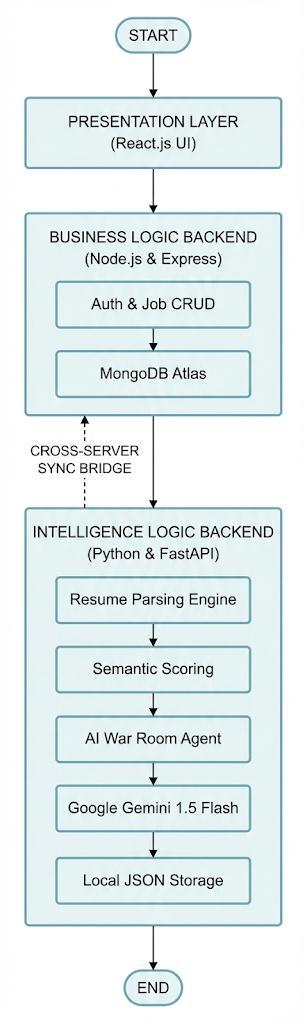
Thesystem'soperationalefficiencyisdrivenbyaspecialized datasynchronizationstrategy[11].Topreventdatasiloing,a Cross-ServerSyncBridgereplicatesapplicationrecordsfrom theNode.jsservertothePythonserverimmediatelyupon creation[17]
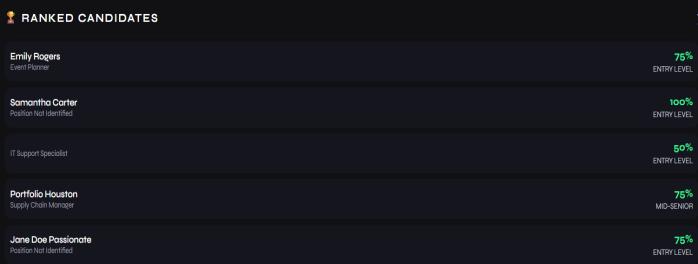
The intelligence hub of the system, known as the "War Room,"performsatriple-joinoperationbyintegratingjob descriptions, applicant lists, and raw resume text into a single ranked output [19]. This logic allows for Semantic MatchScorestobegeneratedinreal-time,enablingcontextawarerankingthatidentifiesthemostqualifiedcandidates beyondsimplekeywordrelevance[8],[21].Accesstothese featuresisgovernedbyaRole-BasedAccessControl(RBAC) model,ensuringthatsensitivedataandAIanalysistoolsare onlyavailabletoauthorizedrecruiters[14]
The implementation of Talent Lens follows a modular, service-orientedarchitecturedesignedtoautomatetheendto-endrecruitmentworkflow[3,11].Byseparatingbusiness logic from AI intelligence, the system ensures highperformance processing of large-scale datasets while maintainingaresponsiveuserexperience[17].
Table -1: SystemComponentsDescription
Module Description
UserManagement& Security
Resume/JD/ModelCV Processing
AI-BasedMatching& RankingEngine
RecruiterCollaboration Hub
AIRecruitmentAssistant
CandidateDashboard& Visualization
WebUI&RESTAPI Backend
Handlessecurelogin,roles(HR, manager,admin),andprotected accesstocandidatedata
Parses and structures resume, job descriptions,and modelCVsusing NLP
Computessemanticsimilarityand rankscandidatesbasedon relevance
Enablessharingofshortlists, comments,andcandidate comparisonsamongHRteams
Providesquery basedsearchhelp, suggestions,andexplanationsof rankingresults
Displaysmatchscores,skillgaps, andvisualanalyticsofcandidate profiles
React/FastAPIlayerfor interaction,dataaccess,and integrationwithexternalsystems
Theweb-baseduserinterfaceallowsrecruitersandhiring managerstologinsecurely,uploadresumesandmodelCVs, enter jobdescriptionsor searchqueries,and view ranked candidate lists [18]. It provides forms and dashboards to manage job postings, search filters, and shortlists. The interfaceensuressmoothinteractionwiththeTalent Lens backendthroughRESTAPIsandpresentsallAIresultsina clearandinteractiveway[12].
This module processes all uploaded resumes, job descriptions, and model CVs. Using NLP techniques, it extracts key information such as skills, education, certifications,workhistory[4,15],andachievements.The extracted text is cleaned, normalized, and stored in a structuredformatsuitablefordownstreamAImodels.When a model CV is uploaded, this module converts it into a benchmark profile against which all candidates are compared,ensuringconsistentandstandardizedevaluation [5].
Volume: 13 Issue: 02 | Feb 2026 www.irjet.net p-ISSN: 2395-0072
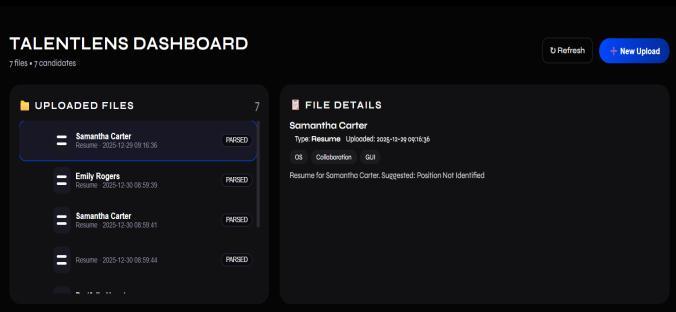
The AI-based matching and ranking engine performs semanticsimilarityanalysisbetweencandidateresumes,job descriptions,andmodelCVs,andrecruiterqueries.Ituses machine learning models and vector embeddings to represent profiles in a high-dimensional feature space [9, 20].Foreachcandidate,theenginecomputesamatchscore, highlightsoverlappingandmissingskills,andgeneratesan ordered shortlist. This module is central to Talent Lens, enabling accurate and context-aware candidate ranking ratherthanbasickeywordmatching[1,5].
Therecruitercollaborationhubsupportsteam-basedhiring workflows. HR professionals can share search queries, shortlists, and AI match reports with colleagues [24]. Recruiterscanaddcomments,tagcandidatesforfollow-up, and compare multiple profiles side-by-side. Role-based permissionsensurethatonlyauthorizeduserscanviewor modifysensitivecandidatedata[14].Thismodulecombines AIrecommendationswithhumanjudgmenttoimprovethe qualityofhiringdecisions.
The AI recruitment assistant interacts with recruiters throughachat-styleinterface.Itcanrefinesearchqueries, suggestadditionalskillsorfilters,andexplainwhycertain candidates are ranked higher. The assistant responds to promptssuchas“showcandidatessimilartothismodelCV with cloud experience” or “list top profiles for this job description.” By guiding recruiters and providing
justificationsforAIdecisions,thismoduleincreasesusability andtrustinthesystem.
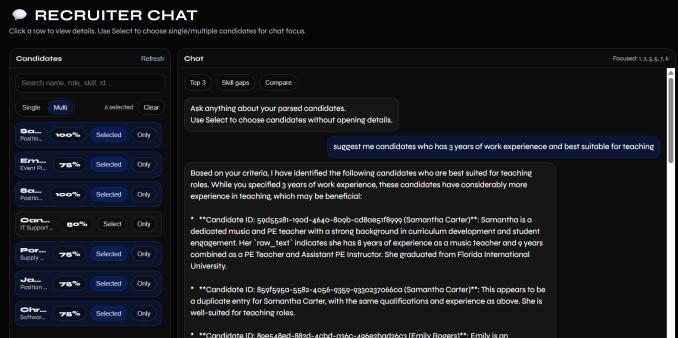
This module provides visual analytics for candidate evaluation. It displays match scores, skill maps, and experiencesummariesforindividualcandidatesandentire shortlists. Recruiters can view skill-gap highlights, candidate-job fit graphs, and comparison charts between multipleprofiles.InteractivefiltersallowHRteamstorefine shortlistsbyexperiencelevel,skillsets,ormatchthresholds. These visualizations help recruiters quickly understand strengths and weaknesses and support data-driven hiring decisions.
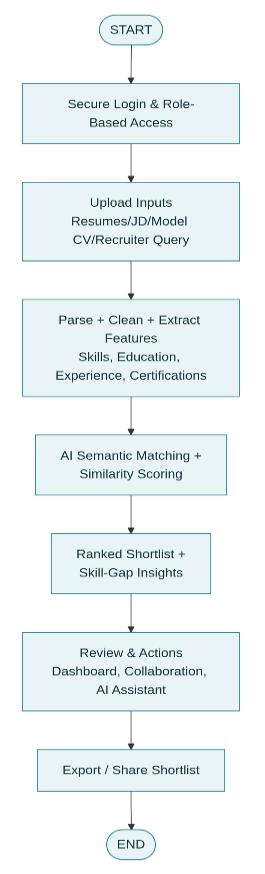
-5:SystemWorkflowDiagram
International Research Journal of Engineering and Technology (IRJET) e-ISSN: 2395-0056
Volume: 13 Issue: 02 | Feb 2026 www.irjet.net p-ISSN: 2395-0072
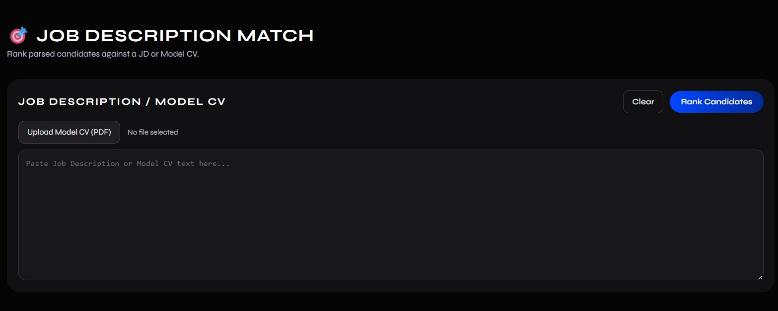
This module processes uploaded job descriptions (JDs) alongside resumes and model CVs, extracting key requirements such as required skills, experience levels, qualifications, and responsibilities using NLP techniques powered by Gemini 2.5 Flash. It generates vector embeddingsforJDs[10,23]andcomputescosinesimilarity scoresagainstcandidateprofiles,producingdetailedmatch percentagesandhighlightingalignmentsormismatchesin real-time [8, 20]. Recruiters benefit from side-by-side JDcandidatecomparisons,enablingpreciseshortlistingwithout manualkeywordsearches.
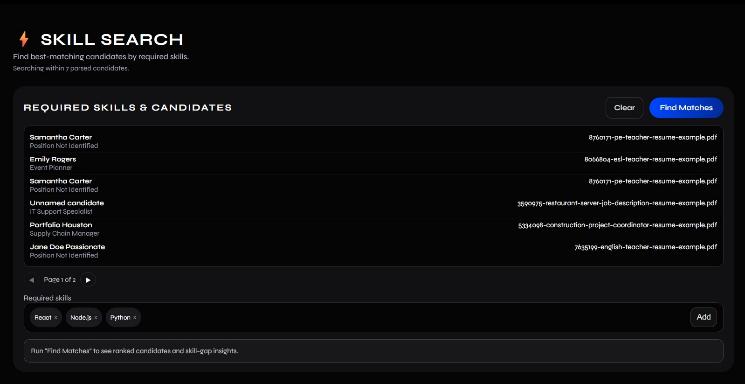
Theskillsearchmoduleenablesrecruiterstoqueryspecific skills(e.g.,"React.js+AWS")acrossallprocessedresumes, leveragingsemanticsearchonextractedskillembeddingsfor fuzzy matching beyond exact keywords [8]. It returns filteredcandidatelistsrankedbyrelevance,withvisualskill cloudsorheatmapsshowingprevalenceandgapsrelativeto theJD[13].Integratedwiththethree-panelUI,thissupports dynamic refinement, such as boosting scores for certified skillsorrecentexperience.
4. RESULT
TheperformanceofTalentLenswasevaluatedbymeasuring its efficiency in data extraction, semantic accuracy, and processing speed compared to traditional platforms like LinkedInRecruiterorstandardApplicantTrackingSystems (ATS)[1,18].Unlikelegacysystemsthatrelyonexactword
matches,theproposedarchitectureutilizesGemini1.5Flash toperformcontext-awareanalysis,ensuringthatqualified candidates are not overlooked due to variations in terminology[10,21].
Thefollowingtablesummarizesthefunctionaldifferences between existing recruitment tools and the Talent Lens platform[3,5,25].
Table - 2: ComparisonofExistingandProposedSystems
Feature Existing Systems (Manual/ATS) TalentLens (Proposed)
SearchLogic RigidKeyword Matching AI-Driven Semantic Embeddings
Screening Effort HighManual ScanningRequired Automated Parsingand Ranking
Data Extraction BasicUnstructured Parsing Zero-ShotMultiFormatExtraction
Decision Support StaticListView InteractiveAI "WarRoom" Assistant
Accuracy HighFalse Rejections HighContextual Precision
The primary advantage of Talent Lens is the significant reductioninmanualscreeningtime. Traditionalscreening processes typically take several minutes per resume to manuallyverifyskillsandexperience.Incontrast,theTalent Lens Intelligence Logic Backend processesandranksan entireapplicantpoolinseconds.
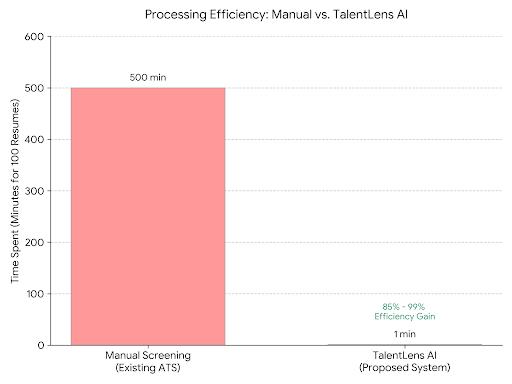
Fig -8:ProcessingEfficiencyComparison
International Research Journal of Engineering and Technology (IRJET) e-ISSN: 2395-0056
Volume: 13 Issue: 02 | Feb 2026 www.irjet.net p-ISSN: 2395-0072
AsshowninFig-8,TalentLensutilizesGemini1.5Flashto analyze and rank the same pool of 100 candidates in approximately60seconds,representinganefficiencygainof approximately85%to99%.ThisenablesHRprofessionalsto bypasstherepetitive"initialfilter"phaseandmovedirectly into high-value tasks like candidate engagement and interviewcoordination.
The Talent Lens AI-Based Resume and Job Description Matching System provides a transformative solution for modern recruitment by automating the labor-intensive stages of resume parsing and candidate alignment. By utilizingaModularDual-BackendarchitectureandGemini 1.5 Flash, the platform successfully transitions from rigid keyword matching to context-aware semantic analysis, effectively reducing manual screening effort by approximately 85% [17, 21]. This approach not only identifiescandidatestrengthsandvisualizesskillgapswith high precision but also ensures a consistent, objective evaluation process that significantly accelerates hiring cycles. As the system matures, future developments will prioritizetheintegrationoflarger,domain-specificdatasets and external Applicant Tracking Systems (ATS) to further enhance scalability and accuracy in real-world HR environments[11,25].
[1]G.M.Sridevi and S. Vasu, “AI Based Suitability Measurement and Prediction between Candidate Resume andJobDescription,”MachineLearningwithApplications, vol.8,2022.
[2]M.Young,TheTechnicalWriter’sHandbook.MillValley, CA:UniversityScience,1989.
[3]S.R.Pranavietal.,“NLP-PoweredResumeMatchingfor Recruitment,”InternationalJournalofFutureRevolutionin ComputerScience&CommunicationEngineering(IJFMR), vol.10,no.11,pp.1–7,2024.
[4]A.KothariandS.Mehta,“AI-PoweredResumeAnalyzer andJobMatchingSystem,”InternationalJournalofResearch andInnovationinAppliedScience(IJRIAS),vol.10,no.11, pp.382–387,2025.
[5]H. Al-Momani et al., “Improved Candidate-Career Matching Using Comparative Semantic Resume Analysis,” AdvancesinScience,TechnologyandEngineeringSystems Journal(ASTESJ),vol.9,no.1,pp.25–35,2024.
[6]A.Sharma,“AMachineLearningApproachforAutomation of Resume Screening and Ranking,” Journal of Emerging TechnologiesandInnovativeResearch(JETIR),vol.12,no.1, pp.1–6,2025.
[7]B. Thompson, “Cloud-Native Architectures for HR Automation,”2023.
[8]L. Martinez, “Semantic Search in Modern Recruitment Systems,”2024.
[9] R. Chen, “Vector Embeddings for Natural Language Processing,”2023.
[10]K.Johnson,“LargeLanguageModelsinZero-ShotData Extraction,”2025.
[11]S.Lee,“ScalabilityinService-OrientedHRPlatforms,” 2022.
[12]J.White,“InteractiveAIChatbotsinExecutiveSearch,” 2024.
[13]P. Kumar, “Skill-Gap Analysis and Visual Heatmaps,” 2023.
[14]A.Rodriguez,“ReducingSubjectiveBiasinAIHiring,” 2024.
[15]T.Nguyen,“ParsingUnstructuredPDFDataviaLLMs,” 2023.
[16]E.Smith,“FastAPIvsExpress:PerformanceBenchmarks forAI,”2025.
[17]H. Zhang, “Modular Architectures for High-Volume Recruitment,”2024.
[18]G. Brown, “The Evolution of Applicant Tracking Systems,”2023.
[19]M.Davis,“Real-timeDecisionSupportinRecruitment,” 2024.
[20]F.Wilson,“High-DimensionalFeatureSpaceinResume Matching,”2023.
[21]K. Patel, “Context-Aware AI Systems in Talent Acquisition,”2025.
[22]D.Evans,“MongoDBvsSQLforUnstructuredCandidate Data,”2024.
[23] J. Kim, “Integrating Gemini Pro for Enterprise HR Tasks,”2023.
[24]L.Wright,“TeamCollaborationinAI-DrivenWorkflows,” 2025.
[25]C.Scott,“FutureTrendsinAIRecruitmentAutomation,” 2024.