
International Research Journal of Engineering and Technology (IRJET) e-ISSN: 2395-0056
Volume:12 Issue:01| Jan 2025 www.irjet.net p-ISSN: 2395-0072

International Research Journal of Engineering and Technology (IRJET) e-ISSN: 2395-0056
Volume:12 Issue:01| Jan 2025 www.irjet.net p-ISSN: 2395-0072
Venkata Nagarjun Devarapalli
KBR Inc, Sustainable Technology Solutions, Houston, Texas, USA
Abstract - Chemical manufacturing, together with the otherindustriesintheprocessarea,haswitnessedincreased globalization and the application of digital solutions to achieve operational optimization and improved profitability. An idea of how virtual assistants based on Large Language Models (LLM) can be incorporated into plant asset operations has the potential to provide effective solutions to certain issues like efficiency improvement, predictive maintenance, and decision-making in real time. In this paper, I discuss the opportunity to use LLM-based virtual assistants in chemical manufacturing plants with an outline of their impact on the optimization of asset management, safety standards, and workforce effectiveness. By using the enhanced opportunities of ANLU and Contextual Reasoning, LLMs foster fluent interactions, information processing and knowledge-forwarding. The paper also includes descriptions of methodologies and illustrations based on the cases and experimental results. Suggestions concerning deployment and implementation difficulties are also made. Lastly, this paper finds that the integration of LLM-based virtual assistants provides a way towardthedigitalizationagendaoftheprocessindustry.
Key Words: LLM-based virtual assistants, Chemical manufacturing, Predictive maintenance, Plant, Digitalization.
The process industry, including refineries and petrochemicals, pharmaceuticals, and chemicals, is complexinstructure,withlargecapitalinvestment,andis bound by heavily regulated safety standards. Thus, digitalization has been established as a crucial source to overcomeoperationconcernsandpromoteinnovation.[13] However, the adequate usage of the developed solutions presupposes the availability of the skills for navigating various digital technologies and it is in this aspect that LLM-based virtual assistants can reach impressiveresults.
Complex Asset Operations: Chemistry plants have many systems and apparatus working simultaneously to produce chemicals; thus, their proper operation is vital. They comprise reactors, heat exchangers, distillation
columns, and miscellaneous equipment used and necessary for water and electrical power supplies. Even a minor issue or a suboptimal performance by a particular component will have an impact on the operations of the entire system, so it is vital to have sophisticated instruments for the automatic evaluation of performance. A key advantage of implementing LLM-based virtual assistants is its capability to enable operators to understandthemutualdependenciesintheirorganization byofferingknowledge-basedrecommendations.
DataOverload:Digitalflowsincurrentchemicalplantsare enormous and are derived from sensors, control systems, andlaboratoryanalysis.Whilethisamountofinformation is useful in making decisions, it causes real-time operations challenges to operators as they try to manage complexinformationsets.Thisinformationcanbefedinto an LLM-based virtual assistant who will analyze the data to highlight trends, alert operators to anomalies, and manage priorities so that while plant performance data can be provided in as nearly real-time as possible, operators are not overloaded with information and thus do not lose sight of the most critical aspects of plant performance.
Skill Gaps: In many plants, experienced workers retire, leaving the employer with few operators who have adequate knowledge of the peculiarities of their plant. Such inadequate information may hinder operational efficiency, and the chances of error are high. Virtual assistants developed through LLM provide real-time consultative and training functionalities for relatively junior personnel. They allow the operators to view past data,identify problems,and make suitable decisions,thus eradicatingtheskillgapasrequired.
Safety and Compliance: Concerning safety and environmental standards, compliance with environmental and safety is very important in the process industry. Noncompliancecancostalargeamountofmoney,prompt legal action, or damage the environment or individuals, patients, and clients. Indeed, based on LLM, LMV can anticipate such needs and help maintain compliance by constantly tracking precise parameters, calculating checklists, and warning operators of possible transgressions. Also, they can deliver quick decisions and recommended actions, thus enhancing the overall plant safety.
International Research Journal of Engineering and Technology (IRJET) e-ISSN: 2395-0056
Volume:12 Issue:01| Jan 2025 www.irjet.net p-ISSN: 2395-0072
Today,LargeLanguageModelsliketheGPT-basedsystems comewithhighlydevelopedNLPenvironmentscapableof changing how humans and machines interact. These modelscan:
Process and Analyze Unstructured Data: Today's manufacturing sites and factories produce massive amounts of textual information; these texts lack clear patterns, such as maintenance reports, operator comments, manuals, user instructions, etc. Virtual assistantsdevelopedonLLMsareparticularlyproficientat this activity since they allow sorting through and evaluating such data and finding the most important patterns that other methods fail to consider. Due to such solutions, the operators are thus in a better position to tackle the organization's problems by using unstructured dataandconvertingitintousefulinformation.
Provide Contextual Responses to Queries: Some queries are toocomplex,requiring operatorsand managersto get immediate and accurate information. LLMs can comprehend them through such queries, grasp their content and provide suitable answers. For instance, if the user wants to know about a particular equipment abnormality, the assistant can support the specifics with information from the database history, controlling conditions, and maintenance schedule. This makes responses accurate and, at the same time, practically implementable in the real world by coming up with them withcontext.
Assist in Decision-Making by Synthesizing Complex Information:Decision-makingprocessesinchemical plant activities are complex because of numerous activities and their interactions. Virtual assistants of the LLM type can integrate complex data from various sources, including sensors, regulating guidelines, and operating regulations. Such systems bring operators a unified vision of the circumstances and practical plans to let them make the bestdecisionstoimproveproductivityandsecuritylevels. Its use is especially efficient in emergency conditions when the time for decision-making is limited, and the informationpossesseshighaccuracy.
Provide Information: Virtual assistants based on LLM can provide a user with specific and precise information in real time when processing a query. It can answer questions that are general or are within a specific area of interest, such as health or business finance, normally better than traditional Information Retrieval Systems because of their Natural Language Processing and huge trainingdatasets.
Facilitate Conversations: These virtual assistants are supposed to engage in context-aware natural language interactions with people. It improves user interactions by recognizing the tone of communication, reflecting the user's emotions, and keeping track of numerous dialogue turns, making them synergistic with customer service, education,andentertainmentapplications.
Enhance Accessibility: In return, LLMs help reduce language diversities by having the ability to handle multiple languages and dialects for disabled and poor foreignspeakers.Theycantranslateonetotheother,help with voice-activated devices and ensure those with impaired vision and hearing or motor skills are not left behindinthedigitalage.

Automate Customer Support: As for addressing customer queries on their own, LLM-based assistants can eliminate repetitive tasks in the sphere of customer relations. They can also answer frequently asked questions, solve problems, and even transfer difficult issues to humans, whichwillsavetimeforbusinesses.
Perform Tasks: In addition to dialogue, virtual assistants developed using LLMs can interact with other tools and applications to call a reminder, schedule an appointment or even perform particular processes in complicated automated systems. That way, they can learn to follow commandsandbeversatileandefficient.
As stated earlier, the key driver to digitalization in the process industry is the need for more efficient, safe, environmentally friendly operations. Computer-based systems like the IIoT, analytics and automation have enabled monitoring and managing intricate systems. [5-9] The influence of digital technology has promoted better production flow, safer equipment maintenance, and improved decisions. Therefore, there has been growing
International Research Journal of Engineering and Technology (IRJET) e-ISSN: 2395-0056
Volume:12 Issue:01| Jan 2025 www.irjet.net p-ISSN: 2395-0072
attention to gaining innovative approaches to implementing digitalization, such as Large Language Models (LLMs), in improving the efficiency of diffused sectors of the process industry, especially the chemical productionindustry.
Industrial IoT (IIoT): The process industry has been revolutionized by IIoT by using sensors installed in machinesandstructurestomonitordatainreal-time.This trend has also enabled the monitoring of equipment conditions and identifying problematic conditions as appropriate to the operators. IIoT is glorified as the solution to predictive maintenance, process enhancement, and comparative performance analysis regardless of the industry keeper Chemical Industry 13 Virtual assistants designedusingLLMcanminedatafromIIoTappliancesto help the operators identify issues, possible solutions and increaseproductivity.
AdvancedAnalytics:Thereisagrowingapplicabilityofthe processofusingtechnologyintheprocessindustry,where intelligent automation is currently taking root with a greaterfocusontheaspectsofpredictive maintenance.By using past data and present sensor measurements, analytical models predict equipment failures before their occurrence and decrease overall time andexpenses. Using conceptual and analytical models built on LLMs enhances thiscapabilitybysheddinglightondifficultnumericaldata andinculcatingactionableknowledgewithintheoperators tomakebetterdecisionsfaster.
Automation: Technological advancement, especially in the field of automation, has since been used to enhance operations, reduce human intervention and enhance efficiency.Robots,automatedcontrolsystems,andartificial intelligence algorithms are used to automate such activities, control different processes in real time, and optimizetheoperationsofassets.Itisthereforefoundthat LLM-basedvirtualassistantscanenhancecooperationwith robotsbyprovidingoperatorswithreal-timeguidanceand assistance for problem–solving, thus providing optimal meansforalleviatinghuman-robotoperationalcontests.
Inadequate Human-Machine Interfaces (HMIs): Although simple models of HMIs have been used in the process industry for many years, they do not possess the depth required to meet the requirements of present-day process plantenvironments.Theseinterfacescanbefixedtoquitea degree and might not supply the operator with the right, situatedunderstanding.Theselimitationscanbeovercome by using LLM-based virtual assistants, which present operators with natural language interfaces to the system that will improve the user's overall experience and decision-makingability.
LackofReal-TimeInsightsfromUnstructuredData:Oneof the main problems within the process industry is a large amount of semi-structured and unstructured data left unanalyzed most of the time, including maintenance logs, operator notes and reports. These provide basic information regarding the performance of the plant, and from this data, meaningful information is quite hard to deduce.Throughnaturallanguageprocessing,LLMscango through written content, prepare reports to help the operatorsmakebetterdecisionssupportedbythecollected evidence,andspotproblemsbeforetheyworsen.
Need for Scalable Solutions: Large numbers of people, many different processes, a complex overall picture: The process industry cannot do without scalable digital solutions.Withthegrowthanddevelopmentofplants,new issues and needs arise for which those tools must be developed to address. Realized virtual assistants for LLMbased capital asset pricing thus add flexibility, and these systems can expand and interface with new systems, sensors,anddata.Thatwouldmakethemverysuitablefor meeting the requirements of the flexible environment of today'schemicalproductionfacilities.
Natural Language Interfaces: More LLMs are being employedtodevelopconversational interfacesindifferent verticals, such as the process sector. Such NLI offers the operators a natural way of manipulating large systems from a set of questions and answers in natural language. This application eases the problems of diagnosing, document searching and even some decision-making functions because these functions convert the data into simpler formats that non-technical users can easily understand.
Technical Documentation Retrieval: Applications powered by LLM have been very successful in the field, assisting operators and engineers in gaining precise, expeditious access to required technical documents. This may be extremely useful in chemical manufacturing, leading to regulatory compliance, process descriptions, and equipment instructions. Making documentation easy and fasttosearchforfacts,answeringqueries,andfindingyour way around it may help to minimize losses of operating time.
Conversational Interfaces for Troubleshooting: Diagnosing problems in chemical plants can be a slow affair and may need technical expertise. Virtual assistants realized that, basedonthe LLM,theyoffera goodsolutionbecause they can only perform context-aware troubleshooting help. As withallothersystems,byreviewingpastrecords,noteson maintenance, and results, the virtual assistants can assist the operator in the diagnostic stage, suggesting the
International Research Journal of Engineering and Technology (IRJET) e-ISSN: 2395-0056
Volume:12 Issue:01| Jan 2025 www.irjet.net p-ISSN: 2395-0072
possiblecause ofthe problemandreducingthechancesof makingthewrongdecisions.
2.4.1.
An example given in an oil refinery was how virtual assistants on the base of LLMs were used to define the necessary changes in production parameters. It used data collected from sensors and control systems to look for areas of poor performance. It provided recommendations for increasing the raw material flow through the facility safely and within specifications. This application reveals how LLMs can improve decision-making in operation withincomplexindustrialcontexts.
In the case of LLMs, they have been used to enhance the speed of research and development in the pharmaceutical industry. LLMs can contribute to formulation science and process enhancement with reference to a great volume of literatureandexperimentalinformation.Thesamefeatures may be used in chemical manufacturing to make production processes more efficient, reactions more effective,andthefinalproductbetter.
3.1.
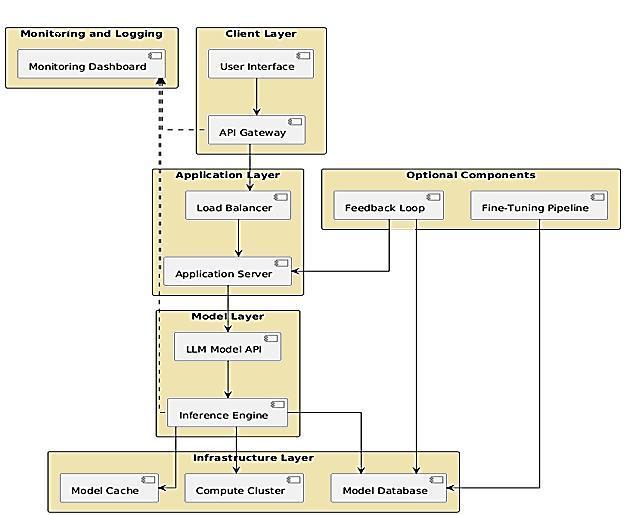
Totheinputlayer,real-timedataisexpectedtobefedfrom the IIoT devices and SCADA systems to facilitate efficient control. Instrumentation systems are a crucial element contributing to the plant's needed sensor information, control instructions and event Reporting. The smooth integration of these data streams guarantees that the LLM has all the data necessary for analysis and improved insight.[10-15]ProcessingLayerHowever,atthestrategic level, the one that most stands out is the LLM-based reasoning engine. This layer analyses the received data with the help of such technologies as natural language processing and machine learning. The engine translates unstructured data and proactively responds to queries using context determination and identification of insights. This makes it an ideal tool because of its flexibility, which allows it to improve itself from time to time and give out datathatspecificallysuitstheplant'soperation.Theoutput layer provides decision-making data to the users through dynamic graphical interfaces and expressive voice or text. These tools enable natural and easy manipulation so the operator can easily recover information. The snapshots and suggestions provided by the LLM include a visual aid that is more effective than deducing; decision-making is
improved, and the existing risk in plant operations is reduced.
DatasetPreparation:BeforeattemptingtotrainanLLMfor digitalizing chemical manufacturing plant operations, creating the dataset is equally important. The other information and documents that may be used involve collectingtechnical data onthe plant practices,equipment data of the plant, safety instructions, and standard operating procedures data, among others. Furthermore, thedetailsoftheincidentsthatoccurred,therecordsofthe maintenance activities or Repair and overhaul activities carried out, and the real-time data collected by sensors of the different systems in the plant involving reactors, pumps, heat exchangers, etc. Such datasets help the LLM frame the context for comprehending the chemical manufacturing industry's technical terms, operations, and issues, on which the LLM should now be capable of producingaccurateinsightsandrecommendations.
LLMTrainingFine-Tuning:Afterthat,gettingtheLLMmust be fine-tuned properly to correspond to the specific vocabulary and inflexion of the chemical manufacturing industry. It was seen that standard LLMs could have preexisting knowledge of various industry-related terms, equipment operations, and chemical processes. Here, the model was retrained on a selected subset of the domain data to pick formsand operational concepts related to the plant.ThiscustomizationhelpstheLLMgeneratetheright response for the user, which is useful for the plant operators,engineers,orotherrelatedstakeholders.
International Research Journal of Engineering and Technology (IRJET) e-ISSN: 2395-0056
Volume:12 Issue:01| Jan 2025 www.irjet.net p-ISSN: 2395-0072
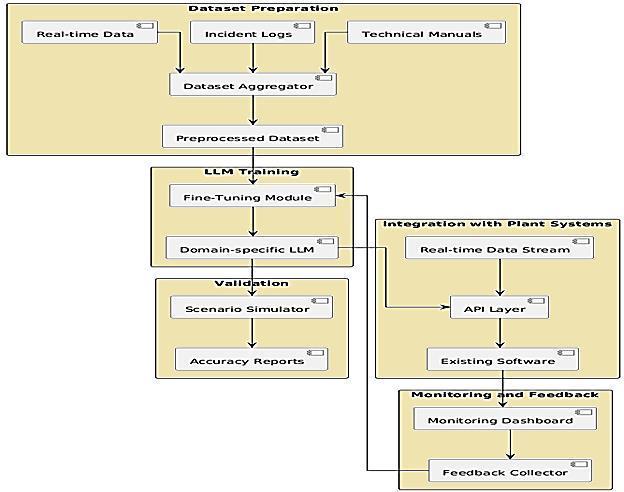
Validation: After fine-tuning, the LLM must be checked before being used in a real-world plant environment to verify its effectiveness. This is done by exploring all the possible operational scenarios and then comparing the results provided by the model with the expected/anticipated results. Therefore, validation examples may involve regular service usage questions, working troubleshooting questions, and emergencies wherefastresponseisdeemednecessary.Evaluatingbased on logical problem-solving, analyzing effectiveness and safety compliance will give an overall view of the model's efficiency. Moreover, the questions and answers provided by the operator during validation will reveal any missing areas of the model's comprehension or reaction that still require improvementbeforethe model isappliedina real environment.
IntegrationwithPlantSystems:FortheLLMtobeofvalue in a plant environment, it must integrate easily with the othersystemsemployedbytheplant.Thisnormallyentails establishing communications via APIs where the LLM can interact with others, such as real-time sensors, plant control and ERP. In this mode, the LLM can extract realtime process data and interact with as-built plant models aswellastheoperatorinterfaces.Further,integrationwith alarm management systems means that the LLM provides operators with information about certain problems and recommended actions, thereby optimizing processes and safety.ThisintegrationguaranteesthattheLLMstaysvery active and has functional continuity in the plant's operations.
Monitoring and Feedback: In an actual plant, having deployed the LLMs, monitoring its performance and providing consistent feedback on its efficiency is important. The system should monitor the engagement of theLLMwithoperators,whatkindofsolutionsthesystem offers, how it interprets questions and how helpful it is in decision-making.Sitefeedbackisessentialtodiscovergaps in the LLM's performance and avoid areas needing additional improvements. In addition to this, several
measures that the system provides, which include response accuracy rate, response time, and level of satisfaction of the operators, can be employed to measure the system's effectiveness. This means that the LLM stays freshanduseful,relevanttothechangingoperationsofthe plant, and fed by new plant data, changed and emerging plantlanguage,andfeedback.
Predictive Maintenance: One of the most pertinent use cases of LLM-based smart virtual assistants in chemical manufacturingplantsisrelatedtopredictive maintenance. Beingareal-timedatamonitoringsystemimplementedfor the existing equipment and tools like pumps, motors reactors, etc., the LLM can uncover strategies that show characteristic signs of failure or inefficiency. For instance, the vibration levels from a pump can be an abnormality, which the LLM can alert a technician as symptoms of a mechanical fault. When an anomaly is identified, the LLM can notify the operators with precise advice based on the detected context to avoid further deterioration involving recommending that maintenance be performed or that certain operations settings be modified. It also enables its users to predict their equipment's possible outages and failures, thus minimizing unscheduled downtimes and increasingequipmentlifeandmaintenanceefficiency.
Safety Management: It is for this reason that safety management in chemical plants is of utmost importance because the plants contain dangerous goods and risky procedures. Such LLM-based virtual assistants could help in meeting compliance with safety regulations by generating a safety checklist honoring all the safety regulations and standards applicable within an industry andaspecificplant.Thesechecklistsmaycontainmeasures forthecorrecthandlingoftheequipment,regulationofthe environment, and response to emergencies. Depending on the given situation, the LLM can offer concrete operating procedures to the emergency operators within a short time. For instance, in case of a spillage of a hazardous chemical,theassistantwouldprovidedirectionsonhowto manage the spill, safety measures to put in place and communicationmeasurestofollowtoavoidorcounterthe spillageeffects.
WorkforceEnablement:On-demandtraininganddecisionmakingsupportofLLM-basedvirtualassistantsareindeed critical in enabling human workforces. As these skilled employees get sick, old or change employers, finding such expertise to coordinate complicated activities becomes difficult. Virtual assistants can provide an opportunity to covertheemployeeswithseparatecourseswheretheycan master crucial information, rules of safety, and working procedures at any time. In addition to training, LLMs can help employees in relation to decision-making across contextualized data by generating options based on realtime information. For example, suppose the operators are
International Research Journal of Engineering and Technology (IRJET) e-ISSN: 2395-0056
Volume:12 Issue:01| Jan 2025 www.irjet.net p-ISSN: 2395-0072
inadilemmaaboutthechangestobemadeintheprocess. Inthatcase,theassistantgivesthemdirectionsfoundedon data gathered in the past and the most effective practices toaidtheoperatorseveniftheyarenewonthejob.
Performance Metrics: Thus, as a way of measuring the impactofLLM-basedvirtualassistantsinplantoperations, performance indicators should be tracked. Response accuracy examines how well the assistant comprehends theoperator'srequiredinputanddeliversappropriateand useful results. Downtime reduction monitors the system's effectiveness based on equipment reliability and operational performance since predictive maintenance solutions shouldresultinless equipmentfailure.Last,and probablymostimportantly,operatorsatisfactionmeasures whether the virtual assistant advances daily work tasks, optimizes existing work processes, facilitates decisionmaking, and whether using it is simple and integrating it into existing structures. To track these metrics is to improvethesystemandbecertainofitsimpactintheplant setting.
A postsecondary chemical plant was emulated to evaluate the performance of incorporating an LLM-based virtual assistantintotheplant.Theobjectivesaimedtoassesshow theLLMcanbeusedtoprovidereal-timedecisionsupport, perform predictive maintenance, and optimize performance. Several important steps were originally takentoestablishtheplantandmakeitasrealaspossible duringitsenablingprocess.
Integration with IIoT-enabled equipment: The plant's equipment was fitted with Industrial Internet of Things (IIoT) sensors, allowing simultaneous monitoring of important pieces of equipment like reactors, pumps, pressure vessels, andheatexchangers. These sensors help to measure temperature, pressure, flow rates and even vibration levels, creating a huge volume of data. This data was fed into the plant's monitoring system, and the LLM was used to analyze it in an effort to detect patterns commonly associated with failure or poor performance. From the loads of information collected by the installed sensors, the LLM could anticipate equipment failures and suggest maintenance activities, improving preventive maintenance planning and minimizing unexpected downtime.
Simulated Plant Operations: To assess the LLM's performance,amockversionoftheplantwascreated,and typicaldailyfunctioningwasincluded.Thissimulationwas a close representation of the actual production process, including the continuity of feedstock, different reactions takingplaceinthereactors,andcontrolofutilities,suchas
power and water. Also, emergencies were modelled, including equipment breakdown, safety issues, and any occasion that was a drift from the norm. The LLM was utilizedtoprovidecontextinformationforoperatorsabout the ongoing signals and request operators for potential troubleshooting steps and possible solutions grounded in previousoccurrences.Due tothelarge numberofpossible scenarios that the LLM had to face during BOP and plant simulating, it became possible to test this system's ability to operate normally and to use it in emergency situations, whichanoperatorcanfaceinacomplexplantsetting.
Downtime (Hours/Month): Integrating an LLM-based virtual assistant had a combative effect on the downtime incurredinthevirtualchemicalplantasitreducedfrom15 hourswithinamonthto8hours.Suchenhancementcanbe attributed to the positive impact of the LLM in detecting possible equipment failures and performance variations thatmayleadtoseveretrouble.Withthehelpofsuchrealtime analysis of the sensor data, the LLM offered suggestions for the maintenance of the equipment to the operators in order to prevent problems. These recommendationscoveredsuchstepsaswhentoschedule an inspection or replacement of a certain component that detracted from ad hoc outages. Such a forward-looking strategyalsohelpednotonlytorationalizethescheduleof maintenance operations but also to guarantee that interruptions in production work would be minimal, thus increasingtheoverallefficiencyofproductionactivities.
Safety Incidents: After implementing LLM, the frequency per month of safety incidents recorded in the simulated environment decreased from 5 to 2. This reduction underlines the functions of LLM in improving the safety managementsystem.Forinstance,byconstantlyobserving safety-sensitive parameters and checking them with existing standards set by the regulating bodies, the LLM could notify the operators of likely risks. Moreover, in emergency situations, the virtual assistant provided the operators with the script for actions, whichhelped reduce the risks and improve the response time. It also produced automated safety checklists to eliminate the common errors expected when implementing normal and routine safetychecks.Allthesecapabilitiesworkedhandinhandto help create a safer working environment and reduce workingaccidents.
International Research Journal of Engineering and Technology (IRJET) e-ISSN: 2395-0056
Volume:12 Issue:01| Jan 2025 www.irjet.net p-ISSN: 2395-0072
Scalability: One aspect the LLM showed was its suitability for scaling up new inputs and different operational conditions. When new data accrued from the IIoT sensors or when new pieces of plant equipment were purchased, theLLMremainedrelevant.Anothersystemrequirementis scalability, which is needed for permanent usage because the evolution of the plant might include changes, enlargements, or improvements, and the virtual assistant stillhastoretainitsfunctionality.
Operator Queries Resolved (%): The LLM integration provedtheefficiencyoftheoperatorsupportbyraisingthe rate of queries resolved from 70% to 95%. This results from improved natural language understanding and contextualreasoningoftheLLM.TheLLMwasveryhelpful because it could answer operators' complicated questions about certain equipment performance, maintenance time, or any abnormal process. The LLM made it possible to provide the operators with the relevant data based on historical records, live sensors, and operations guidelines. This amplified query resolution increased the problemsolving effectiveness and offered the operators immediate assistancewhereknowledgedeficiencieswerepresentand raisedtheoverallstaffoutput.
Enhanced Decision-Making: Another major advantage of incorporating LLMs into plant operations was the enhancedabilitytomakegooddecisions.Thisalsoletsthe operatorshavecertainkindsofinformationrelatingtodata that the plant is capturing at that moment. For instance, when operators ask about a problem using a pump, in addition to knowing from the sensor data that the pump hasaproblem,theLLMcansuggestprobablesolutionsthat can be obtained from the maintenance records on similar equipment. It enabled the operators to make timely databased decisions and minimize their time spent problemsolving.
Operational Efficiency: Less frequency and safety-related issues indicate that LLM-based virtual assistants can enhance efficiency in operations. What the LLM was capable of was the proactive identification of problems before they resulted in equipment malfunction; this was known as predictive maintenance, which helped plant managersRun the plantmostefficiently without incurring muchlossduetomalfunctioningofsomeoftheequipment. Further,the improvedsafetyperformance isevidence that the LLM helped create a safer workplace by correcting procedure errors and keeping operators and other staff informedofsafetyhazards.
The use of LLM-based virtual assistants in the process industry, particularly in chemical manufacturing, can help revolutionize the improvement of operation efficiency, safety, and productivity in the workforce. Based on the sophisticated NLP characteristics, LLMs allow human operatorstointeractefficientlywithextensivelyintegrated industrial processes. This integration solves problems like dataoverload,lackofskillsincertainareas,andveryoften the necessity to make fast decisions with the help of a better understanding of the picture which takes place at the moment. For instance, the LLMs applied to predictive maintenancecanspottherequiredequipment'sanomalies using sensor data and enable the operator to address the problem before top failure is witnessed, minimizing the downtime in the plant and overall reliability. Additionally, LLM-based virtual assistants contribute to safety managementbygeneratingsafetychecklistsandproviding emergencyprotocolstoadheretoregulations,suchassafe production of chemicals and prevention of occurrence of accidentsinhazardouscorporations.
The features also include its on-demand training and decision-aidcapabilities,whichareevenmoreimportantas the industry struggles to fill skill gaps due to retirements. Operatorscanobtaincontext-aware advice,gainhelpwith problem-solving, and generally receive support when making decisions at the moment. This also redeems the preexistent employees but also relieves the knowledge frombeingcentralizedandbureaucratic,thusguaranteeing that even new or less prepared operators can perform these tasks adequately. Therefore, LLMs improve workforce output through ongoing training and developmentandfunctionasadailyworkresource.
However, there is still room for improvement, and the current issues for discussion are the shortcomings connected to computational effectiveness and the ethical issues. The availability of the LLMs poses a problem of availability of computational resources, which is a decreasing factor given the current use of LLMs. Further studies should target the enhancement of design characteristicsofLLMstructurestoenhancethespeedand thereby minimize the requirements in terms of infrastructure support that are likely to come with these architectures. Also, the ethical issues in the application of
International Research Journal of Engineering and Technology (IRJET) e-ISSN: 2395-0056
Volume:12 Issue:01| Jan 2025 www.irjet.net p-ISSN: 2395-0072
new technology, especially in the industrial process, are generic and include data privacy, transparency, and accountability. However, proper regulation and the establishment of controls for these technologies will be essentialintheprocessindustryinthefuture.Intotality,it would translate to further advancement of the LLM-based virtual assistants as a key driver to the digital transformationoftheProcessIndustrytowardssafer,more efficientandsustainable.
[1] Lee, J., Bagheri, B., & Kao, H. A. (2015). A cyberphysical systems architecture for industry 4.0-based manufacturing systems. Manufacturing letters, 3, 1823.
[2] Guan,Y.,Wang,D.,Chu,Z.,Wang,S.,Ni,F.,Song,R.,...& Zhuang, C. (2023). Intelligent virtual assistants with llm-based process automation. arXiv preprint arXiv:2312.06677.
[3] Urlana, A., Kumar, C. V., Singh, A. K., Garlapati, B. M., Chalamala, S. R., & Mishra, R. (2024). LLMs with Industrial Lens: Deciphering the Challenges and Prospects A Survey. arXiv preprint arXiv:2402.14558.
[4] Top 10 Real-Life Applications of Large Language Models, Pixelplex, 2024. online. https://pixelplex.io/blog/llm-applications/-Image
[5] Myöhänen, J. (2023). Improving industrial performance with language models: a review of predictivemaintenanceandprocessoptimization.
[6] Tejani, A. (2021). Integrating Energy-Efficient HVAC Systems into Historical Buildings: Challenges and Solutions for Balancing Preservation and Modernization. ESP Journal of Engineering & TechnologyAdvancements(ESP-JETA),1(1),83-97.
[7] Tamanampudi, V. M. (2024). Development of RealTime Evaluation Frameworks for Large Language Models (LLMs): Simulating Production Environments to Assess Performance Stability Under Variable System Loads and Usage Scenarios. Distributed Learning and Broad Applications in Scientific Research,10,326-359.
[8] Lin, X., Wang, W., Li, Y., Yang, S., Feng, F., Wei, Y., & Chua, T. S. (2024, July). Data-efficient Fine-tuning for LLM-based Recommendation. In Proceedings of the 47thInternationalACMSIGIRConferenceonResearch and Development in Information Retrieval (pp. 365374).
[9] Why Large Language Models are the future of manufacturing, World Economic Forum, 2024. online. https://www.weforum.org/stories/2024/04/whylarge-language-models-are-so-important-for-thefuture-of-the-manufacturing-industry/
[10] Pentyala,S.K.,Wang,Z.,Bi,B.,Ramnath,K.,Mao,X.B., Radhakrishnan,R.,&Asur, S.(2024).PAFT:AParallel Training Paradigm for Effective LLM Fine-Tuning. arXivpreprintarXiv:2406.17923.
[11] Xia, Y., Kim, J., Chen, Y., Ye, H., Kundu, S., Hao, C. C., & Talati, N. (2024, September). Understanding the performance and estimating the cost of LLM finetuning. In 2024 IEEE International Symposium on
Workload Characterization (IISWC) (pp. 210-223). IEEE.
[12] jayanna Hallur, "From monitoring to observability: Enhancing System Reliability and team productivity," International Journal of Science and Research (IJSR). Volume 13, Issue 10, October 2024, pp, 602-606, https://www.ijsr.net/getabstract.php?paperid=SR241 004083612
[13] Li,Y.,Zhao,H.,Jiang,H.,Pan,Y.,Liu,Z.,Wu,Z.,...&Liu, T. (2024). Large language models for manufacturing. arXivpreprintarXiv:2410.21418.
[14] van der Burg, S., & Dolstra, E. (2011, May). A selfadaptive deployment framework for service-oriented systems. In Proceedings of the 6th International SymposiumonSoftwareEngineeringforAdaptiveand Self-ManagingSystems(pp.208-217).
[15] Liao,Q.V.,Geyer,W.,Muller,M.,&Khazaen,Y.(2020). Conversational interfaces for information search. Understanding and Improving Information Search: A CognitiveApproach,267-287.
[16] Celik, T., Koksal, O., & Tekinerdogan, B. (2014, August).Deploy-DDS:ToolFrameworkforSupporting Deployment Architecture of Data Distribution Service based Systems. In Proceedings of the 2014 European Conference on Software Architecture Workshops (pp. 1-5).
[17] RevolutionizingHeavyAssetMaintenance:The Power of LLM-based Virtual Assistants, Arundo, online. https://www.arundo.com/articles/llm-based-virtualassistants
[18] Tejani, A., & Toshniwal, V. (2023). Enhancing Urban Sustainability: Effective Strategies for Combining Renewable Energy with HVAC Systems. ESP International Journal of Advancements in Science & Technology(ESP-IJAST)Volume,1,47-60.
[19] Yao, Y., Duan, J., Xu, K., Cai, Y., Sun, Z., & Zhang, Y. (2024). A survey on large language model (llm) securityand privacy:The good, the bad,and the ugly. High-ConfidenceComputing,100211.
[20] Judd, G., & Steenkiste, P. (2003, March). Providing contextual information to pervasive computing applications. In Proceedings of the First IEEE InternationalConferenceonPervasiveComputingand Communications,2003.(PerCom2003).(pp.133-142). IEEE.
BIOGRAPHIES (Optional not mandatory)

Venkata Nagarjun Devarapalli lead Sustainable Energy Tech Solutions at KBR using Data, AI to solve critical problems for greater outcomes.
2025, IRJET | Impact Factor value: 8.315 | ISO 9001:2008 Certified