
International Research Journal of Engineering and Technology (IRJET) e-ISSN: 2395-0056
Volume: 13 Issue: 04 | Apr 2026 www.irjet.net p-ISSN: 2395-0072

International Research Journal of Engineering and Technology (IRJET) e-ISSN: 2395-0056
Volume: 13 Issue: 04 | Apr 2026 www.irjet.net p-ISSN: 2395-0072
Shiwangi Pandey1 , Netra Singh2 , Aayush Mohan3 ,Nandini Jagtap4,Smita Dandge5
1Department of Computer Engineering, Thakur Shyamnarayan Engineering College, Mumbai, Maharashtra
2Department of Computer Engineering, Thakur Shyamnarayan Engineering College, Mumbai, Maharashtra
3Department of Computer Engineering, Thakur Shyamnarayan Engineering College, Mumbai, Maharashtra
4Department of Computer Engineering, Thakur Shyamnarayan Engineering College, Mumbai, Maharashtra
5Professor, Department of Computer Engineering, Thakur Shyamnarayan Engineering College, Mumbai, Maharashtra ***
Abstract - Rural areas face significant challenges in accessing basic health advice due to limited healthcare facilities and a shortage of doctors. Many existing digital health tools require typing skills, which can be difficult for people who are not familiar with technology.This paper presentsHealthSathi,anAI-basedvoiceassistantdesigned to providebasichealthcare support.Userscaninteract withthe system by speaking, typing, or selecting symptoms, and the assistantrespondsinbothvoiceandtext formats.Thismakes the system easy to use, especially for individuals who are not tech-savvy. HealthSathi utilizes speech recognition, natural language processing, and text-to-speech technologies to understand user input and generate appropriate responses. The system also supports multiple languages, helping to overcome communication barriers. HealthSathi provides guidance for common health problems and promotes awareness through simple and clear suggestions. It is designed to be user-friendly, cost-effective, and suitable for useinareaswithlimitedresources.ThismakesHealthSathia valuable tool for improving access to basic health information in underserved communities.
Key Words: Voice Assistant, Rural Healthcare, Natural Language Processing ,Speech Recognition, Text-toSpeech, Artificial Intelligence.
Access to basic healthcare support remains a significant challenge in rural areas due to the shortage of medical facilitiesandhealthcareprofessionals.Peopleoftenneedto travel long distances to seek medical assistance, even for minorhealthissuessuchasfever,cold,orheadaches.Asa result, many individuals delay seeking timely help, which can lead to worsening health conditions and increased healthcare risks. In addition to limited access to medical services,thereisalackofawarenessregardingpreventive healthcarepractices.Manyindividualsarenot
fullyinformed about how to manage common illnessesor maintaingoodhealth,whichcontributestofrequenthealth problemsandplacesadditionalpressureonthehealthcare system.
Inrecentyears,variousdigitalhealthcaresolutionssuchas mobileapplicationsandtelemedicineplatformshavebeen developed to improve accessibility. However, these systemsoftenrequireuserstonavigatecomplexinterfaces, readinstructions,andtypeinputs,makingthemdifficultto use for individuals who are not familiar with technology, particularlyelderlyusers.Toaddressthesechallenges,This isproposedasanAI-basedhealthcareassistantdesignedto simplify user interaction. The system allows users to communicate by speaking, typing, or selecting symptoms throughasimpleinterface.Thisflexibleinteractionmodel ensureseaseofuseforawiderangeofusers. HealthSathi utilizes speech recognition, natural language processing, and text-to-speech technologies to understand user input and generate meaningful responses. The system provides responses in both voice and text formats, making it more accessible and user-friendly. Additionally, it supports multiple languages, enabling users to interact in their preferredlanguage.
There have been a lot of developments in Artificial Intelligence and Natural Language Processing. These developments have helped to create healthcare support systems. This is especially true for people who live in areas.Several studies have looked at creating Artificial Intelligence based assistants. These assistants can give people medical advice and help them communicate with healthcare providers. They can also reduce the need for healthcaresystems.
Umesh R and Praveen Kumar [1] made an Artificial Intelligencevoiceassistantin2025.Thisassistantismeant for people who live in areas and it can work without the
International Research Journal of Engineering and Technology (IRJET) e-ISSN: 2395-0056
Volume: 13 Issue: 04 | Apr 2026 www.irjet.net p-ISSN: 2395-0072
internet. It uses speech recognition and simple language models.Thesystemisprettyaccurate.Canrespondquickly. ItshowsthatArtificial Intelligence systemscanwork well on devices that do not have a lot of power. They can also keepuserinformationprivate.
Nagesh Algondi [2] made a multilingual voice Artificial Intelligence assistant in 2025. This assistant can help peoplewhospeaklanguagescommunicatewithhealthcare providers. It can translate what people say in time. Howeveritdoesnotworkwellinplacesanditneedsgood audioqualitytofunctionproperly.
Sumaiya Tasnia Khan and Shyamasree Saha [3] made a voice health application called AmarDoctor in 2021. This applicationcananalyzesymptoms.Givepeopleadvice.Itis verygoodatdiagnosingillnesses.Itiseasytouse.However, it only supports a languages, which means it is not useful for everyone. Dr. Seedha Devi [4] and others made an Artificial Intelligence assisted healthcare portal in 2024. This portal uses machine learning to predict illnesses. It also lets people consult with doctors online. However it needsthe internetto work,whichmeansitisnotsuitable for areas with internet connectivity.P.Jhansi Lakshmi [5] andothersmadeanoffline virtualvoiceassistantin2025. This assistant uses Artificial Intelligence and Natural LanguageProcessing.Itisfastandprivate.Itworkswellin areaswithpoorinternetconnectivity.Howeveritdoesnot have a lotofknowledge whichmeansit is notveryuseful forcomplicatedhealthissues.SathiyaseelanBalasundaram [6]lookedathowArtificialIntelligencecanhelphealthcare workers in areas in 2025. Artificial Intelligence can help withhealthchecksanddecisionmaking.Howeveritisnot a replacement for medical diagnosis. G.Shobana [7] and othersmadeamultilingualhealthcarechatbotin2025.This chatbotcanbeusedwithvoiceortext.Ithasalotoffeatures. Howeversomeofthesefeaturesneedtheinternettowork, which means it is not very useful in areas with internet connectivity. Juliet Johny and Abhishek Singh Tomar [8] did a survey on Artificial Intelligence based chatbots in 2025. They found that Natural Language Processing and machine learning are very important for these systems. Howevertherearestillalotofchallengessuchaskeeping userinformationprivateandmakingsurethesystemsare reliable.Arulmangainayaki [9]andothersmadeachatbot forruralareasin2020.Thischatbotcangivepeopleadvice andconnectthemwithhealthcareproviders.Howeveritis not very useful for health issues, which means it has limitations. Seethu Kurian [10] looked at how Artificial IntelligencedrivenhealthchatbotsreusedinruralIndiain 2025.Thesechatbotscangivepeopleadviceonsymptoms
and health education. They can also support government healthcare systems. However they need the internet to work.Theydonotsupportalotoflanguages.
From these studies it is clear that Artificial Intelligence systems have improved healthcare for people in areas. Howevertherearestillalotofproblems,suchastheneed, for internet connectivity and limited language support. Theseproblemsmeanthatweneedtocreateaofflinevoicebased health support system that is easy to use and supportsmanylanguages.Thissystemshouldbedesigned forruralareas.ArtificialIntelligenceandNaturalLanguage Processing can help to create this system. The system should be able to work without the internet. It should be able to support many languages. It should also be easy to use.Itshouldbeabletoprovidepeoplewiththehelpthey need.
TheHealthSathisystemisanAI-basedhealthcareassistant designed to provide basic health guidance through an interactiveanduser-friendlyinterface.Itisavoice-enabled applicationthatallowsuserstocommunicateusingspeech, typing,orbyselectingsymptoms,makingitaccessibletoa widerangeofusers.Thesystemarchitectureisdividedinto two main components: hardware and software. The hardware componentincludesa smartphone or computer equipped with a microphone and speaker. These components enable users to interact with the system through voice input and receive responses in audio form, ensuring a smooth and natural user experience. The software component is developed using the Python programminglanguage,whichprovidesflexibilityandease ofimplementation.ThesystemusestheFlaskframeworkto manage application flow and handle user requests efficiently. For speech processing, the system utilizes the Vosk speech recognition engine to convert spoken input intotext.Additionally,thepyttsx3libraryisusedtoconvert generatedtextresponsesintospeechoutput.
To understand user queries, the system incorporates NaturalLanguageProcessing(NLP)techniquessuchastext normalization,keywordextraction,andintentrecognition. These processes help in accurately identifying user symptoms and requests.The system is supported by a structured database that stores information related to common symptoms, health conditions, precautions, and basic remedies. When a user provides input, the system processestherequest,matchesitwithrelevantdatainthe database,andgeneratesanappropriateresponse.Thefinal output is delivered to the user in both text and voice
International Research Journal of Engineering and Technology (IRJET) e-ISSN: 2395-0056
Volume: 13 Issue: 04 | Apr 2026 www.irjet.net p-ISSN: 2395-0072
formats, ensuring better accessibility and ease of understanding. This modular design enables efficient interaction and reliable performance while maintaining simplicityandusability.
3.1.Materials: HealthSathi system is made to work with basiccomputerpartssoitiseasytouseanddoesnotcosta lot of money. It can work on a smartphone or a personal computer that has a microphone and speaker or headphones.Themicrophoneisusedtolistentowhat the user says and the speaker is used to play the HealthSathi systemsresponsessotheuserandtheHealthSathisystem cantalktoeachothersmoothly.Thepeoplewhomadethe HealthSathi system used the Python programming languagetobuilditbecausePythoniseasytouseandhasa lotoftoolsthatcanhelp.TheyusedtheFlaskframeworkto managethebehindthescenesworkandtohandlewhatthe usersaskfor.TheHealthSathisystemcanunderstandwhat people say because it uses the Vosk engine, which turns voice into text and it uses the pyttsx3 library to turn text intospeechthatpeoplecanhear.
WhenpeopletalktotheHealthSathisystemituseswaysto understand what they mean like making the text normal finding important words figuring out what is wrong with them and knowing what they want. These things help the HealthSathisystemunderstandwhatpeoplesaycorrectly. TheHealthSathisystemalsohasadatabasethatwasmade using SQLite, which stores information about common problems people have basic health issues things people shouldbecarefulaboutwaystofeelbetterandgeneraltips, for being healthy. This database helps the HealthSathi system find the information quickly and answer peoples questions efficiently. The whole HealthSathi system is designed to be simple not expensive and easy to use on devices.
3.2.Methods:Thesystemwearetalkingaboutismadeup ofpartsthatworktogether.Eachpartofthesystemdoesa jobtohelpthesystemunderstandwhattheuserissaying and to give a good response. The system can take input from the user in ways like when the user talks to it types something or picks a symptom from a list. This makes it easyfortheusertousethesystem.Whentheusertalksto thesystemthesystemusesamicrophonetohearwhatthe userissaying. Aspecial tool calledVosk to turn the users voiceintotext.Iftheusertypessomethingthesystemcan understandthattoo.Thesystemalsoletstheuserpickfrom alistofsymptoms,whichmakesiteasyfortheusertotell thesystemwhatiswrong.Allofthesewaysofgivinginput
are then sent to a part of the system called the Natural LanguageProcessingmodule.
In the Natural Language Processing module the system looks at the input. Tries to understand what the user is saying.Itdoesthisbylookingforwordsfiguringoutwhat theuserssymptomsareandtryingtounderstandwhatthe user wants. This helps the system give a response to the user.ThesystemthenusesaframeworkcalledFlasktohelp allthepartsofthesystemworktogether.Thesystemtalks toadatabasecalledSQLite,whereitlooksforinformation about the users symptoms and finds out what might be wrongandwhattheusercandotofeelbetter.Thesystem is designed to be flexible and easy to use. It uses many differenttoolsandpartstomakesuretheusergetsagood response.TheNaturalLanguageProcessingmoduleandthe databasearepartsofthesystemandtheyhelpthesystem give the user a response that is accurate and helpful. The system uses the Flask framework and the pyttsx3 tool to makesureeverythingworkstogethersmoothly.
3.3 SystemFlow: TheHealthSathisystemisreallyeasy touse.Ithelpsusersgetbasichealthguidance.Itdoesthis through an interface that users can interact with. The HealthSathi system starts working when a user gives it someinformation.Thiscanbedoneinaways:theusercan talk to it type something or pick from a list of symptoms. This way the HealthSathi system is flexible and easy for different kinds of users to use. When a user talks to the HealthSathisystemitusesamicrophonetohearwhatthey are saying. Then it turns that into text. If the user types somethingtheHealthSathisystemjustusesthattext.Ifthe user picks symptoms from a list the HealthSathi system usesthosesymptoms.TheHealthSathisystemthenputsall of this information into text and sends it to the next step.The HealthSathi system then looks at the text using techniques to understand what the user means. This includes making sure the text is correct finding words figuring out what symptoms the user has and understandingwhattheuserwantstoknow.Thishelpsthe HealthSathisystemgivetheuserananswer.
After the HealthSathi system understands what the user wants it talks to the part of the system. The backend part was made using the Flask framework. The backend part manages everything and talks to a database to get the information.TheHealthSathisystemlooksatthesymptoms the user has. Tries to figure out what might be wrong. It then gets information about what the user can do to feel better like what precautions to take or what remedies to try.OncetheHealthSathisystemhasalltheinformationit
International Research Journal of Engineering and Technology (IRJET) e-ISSN: 2395-0056
Volume: 13 Issue: 04 | Apr 2026 www.irjet.net p-ISSN: 2395-0072
needs it makes a response that's easy to understand. The HealthSathi system then turns this response into speech using an engine. Finally, the HealthSathi system gives the user the response in both text and audio so the user can choosehowtheywanttogetthe info
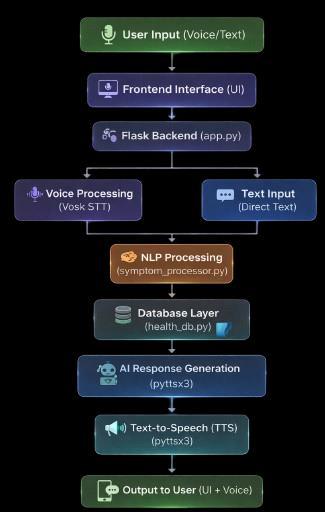
ArchitectureofHealthsathi
4. TECHNOLOGY USED
TheHealthSathisystemisdevelopedusingacombinationof modern technologies and tools that help in building an efficient, user-friendly, and interactive healthcare application. Each technology plays an important role in enablingsmoothcommunicationbetweentheuserandthe system, as well as in processing and generating accurate responses.
1. Python:
Python is the main programming language used for developing the HealthSathi system. It is chosen because of its simple syntax, flexibility, and strong supportforartificialintelligenceandnaturallanguage processing.
2. FlaskFramework:
Flaskisalightweightwebframeworkusedtobuildthe backend of the application. It is responsible for handlinguserrequestsandmanagingtheflowofdata betweendifferentpartsofthesystem.
3. VoskSpeechRecognition:
Vosk is used as the speech recognition engine in the system. It converts the user’s spoken input into text, allowing users to interact with the system through
voice commands. This makes the application more accessible, especially for users who are not comfortablewithtyping.
4. pyttsx3(Text-to-Speech):
The pyttsx3library isused toconvert text responses generated by the system into speech output. This allows the system to “speak” to the user, creating a moreinteractiveanduser-friendlyexperience.
5. NaturalLanguageProcessing(NLP):
Natural Language Processing is used to understand and interpret user input. It helps the system analyze thetext,identifyimportantkeywords,anddetermine theuser’sintent.
6. SQLiteDatabase:
SQLiteisusedasthedatabaseforstoringhealthcarerelated information such as symptoms, diseases, precautions, and remedies. It is a lightweight and efficientdatabasethatallowsquickdataretrieval.
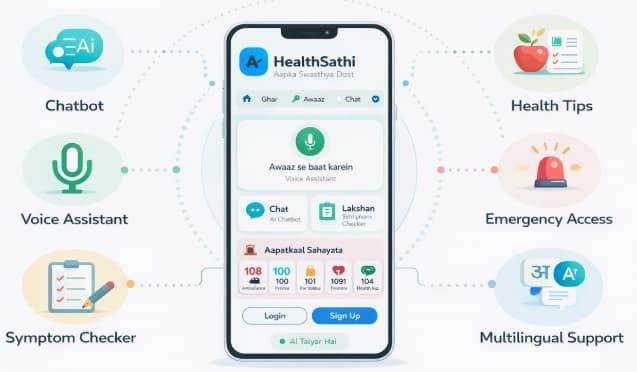
5.1User-FriendlyInterface:TheHealthSathihomepage ismadetobesimpleandeasytouse.Ithasalayoutwhere you can see all the options and they make sense. The HealthSathi home page does not have a lot of words on it whichmakesiteasytolookat.TheHealthSathihomepage alsohasiconsthat'reeasytounderstand.Thismakesiteasy forpeopletousetheHealthSathihomepageeveniftheydo not know a lot about technology. The HealthSathi home page only has the healthcare things on it so it is not too complicated. This makes the HealthSathi home page a better experience, for people who use it. The HealthSathi homepageisdesignedforpeoplewhousetheHealthSathi homepage.
5.2 Voice Assistant: The HealthSathi system has a voice assistantthatletsuserstalktoitinaway.Thismeansusers
International Research Journal of Engineering and Technology (IRJET) e-ISSN: 2395-0056
Volume: 13 Issue: 04 | Apr 2026 www.irjet.net p-ISSN: 2395-0072
donothavetotypeanything.Itisveryeasyforpeoplewho have trouble reading or writing. The HealthSathi system usesthemicrophonetohearwhattheuserissaying.Ittries to understand what the user wants. Users can simply tell the HealthSathi system how they are feeling. The HealthSathi system will give them a helpful answer. The HealthSathisystemisveryuseful,forpeoplebecausethey can just talk to it and it is easy to use. This makes the HealthSathisystemfeelliketalkingtoarealperson.
5.3Chatbot:Thechatbotfeatureisforpeoplewholiketo type.Itletsuserstypeinwhat'swrong,withthemandget answers right away. The chatbot uses Natural Language Processingtofigureoutwhatusersaretryingtosayabout their health. The chatbot feature can tell what users want whentheytypeintheirsymptoms.Thenthechatbotfeature gives users some advice and tells them what might be causingtheirsymptoms.Thismakesiteasyforuserstotalk to the chatbot feature if they like typing. The chatbot featureisawayforpeopletogetsomehelpwhentheyneed it.
5.4 Symptom Identification Module: The symptom identificationpartisimportantbecauseitlooksatwhatthe usersaysandtriestofigureoutwhatmightbewrongwith their health. It takes the symptoms that the user gives whether they talk, type or pick them from a list and finds theinformationinthem.Thesystemlooksforhealthwords and matches what the user says with the information it already has so it can give good ideas about what the problem might be. This part of the system helps it understandwhattheuserisworriedaboutandgivesthem health advice, about their symptoms and possible health conditions.
5.5 Emergency Assistance: The emergency assistance featureprovidesquickaccesstoessentialhelplineservices during critical situations. The home page includes important contact options such as ambulance, police, and fireservices,allowinguserstoaccesshelpinstantlywithout external searching. This feature is particularly useful in urgent health conditions where immediate response is required. By integrating emergency support within the system,HealthSathiextendsbeyondadvisoryfunctionsand offerspractical,real-worldassistancetousers.
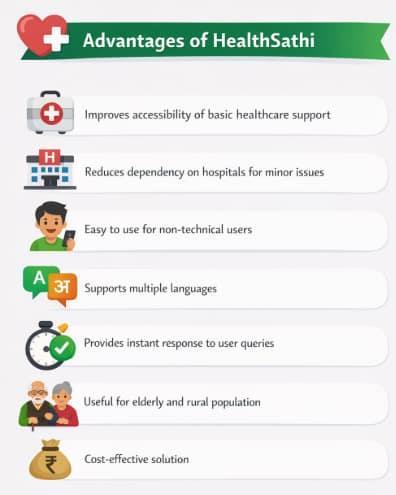
Fig-3:KeyComponentsofHealthsathi
7.LIMITATIONS OF HEALTHSATHI
1. NotaReplacementforDoctors: The system provides only basic health guidance and cannot replace professional medical diagnosis. Users shouldconsultadoctorforseriousconditions.
2. LimitedtoBasicSymptoms: It mainly handles common symptoms like fever, cough,andheadache,andmaynotaccuratelysupport complexmedicalcases.
3. AccuracyDependsonUserInput: Theresponsequalitydependsonhowclearlytheuser describessymptoms.Incorrectinputmayleadtoless accurateresults.
International Research Journal of Engineering and Technology (IRJET) e-ISSN: 2395-0056
Volume: 13 Issue: 04 | Apr 2026 www.irjet.net p-ISSN: 2395-0072
HealthSathi is an AI-powered health assistant that allo s userstodescribetheirsymptomsthroughvoiceorchat.As shown in the interface, users can speak e.g., “sir dard ho rahahai” andthesystemlistens,processestheinput,and providessimplehealthadviceinstantly
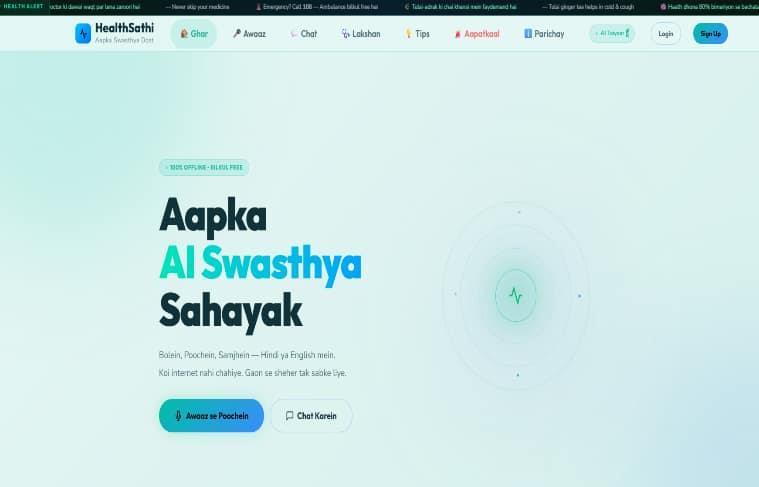
Fig-4:LandingpageofHealthsathi
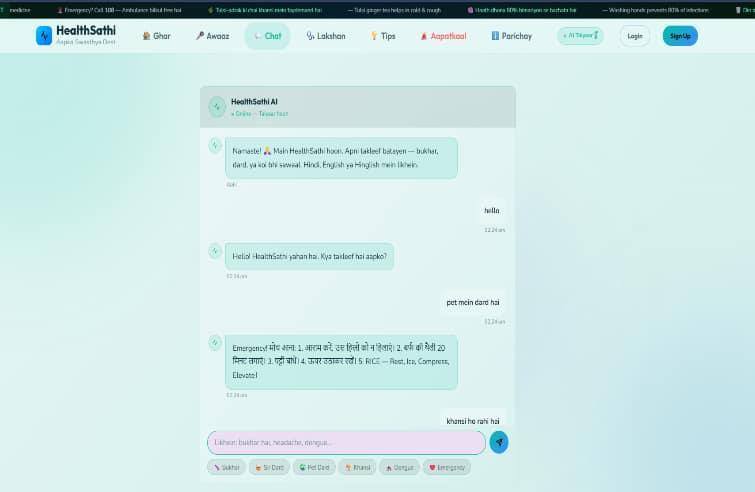
:Chatbot Interface
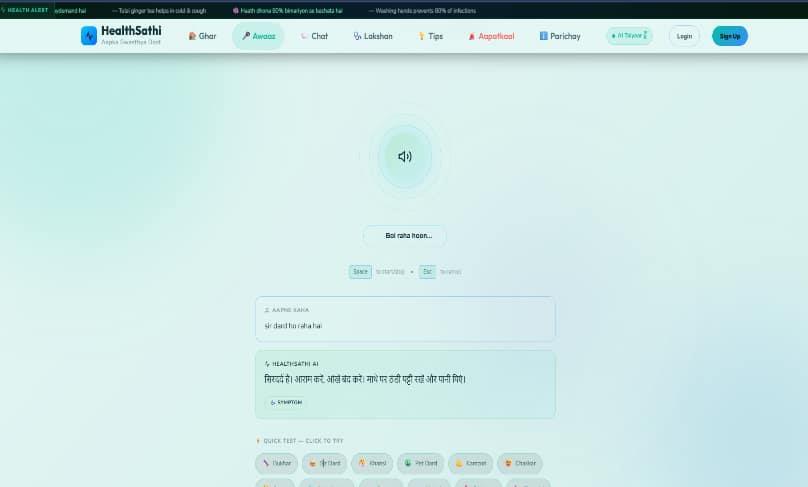
:VoiceAssistantofSathi
The HealthSathi system was. It worked really well. It was tested to see how well it performed. If it was easy to use. The HealthSathi system had parts that worked smoothly together.Thesepartsincludedtalkingtothesystemusing text to chat with the system and figuring out what was wrongwiththeuser.Whenthesystemwastestedthepart that listened to the users voice worked well. It could understandwhattheuserwassayingandturnitintotext. TheHealthSathisystemwasgoodatunderstandinghealth questionsandgivinggoodanswers.Thepartthatusedtext tochatwiththeuseralsoworkedwell.Userscouldtellthe systemwhatwaswrongwiththemandgetanansweraway.
The part of the HealthSathi system that figured out what waswrongwiththeuserwasreliable.Itcouldlookatwhat theusersaidandmatchitwithinformationinthedatabase. Thenitcouldsaywhatmightbewrongandgivesomeideas about what to do. The system could give answers quickly andinawaythatwaseasytounderstand.Userscouldget these answers by listening or by reading. Overall the HealthSathisystemdidwhatitwassupposedtodo.Itwas anefficientwayforuserstogethealthcarehelp.Thesystem used different technologies, like speech recognition and database management. These technologies helped make the HealthSathi system work well and be reliable. The HealthSathi system was a way for users to get the healthcarehelptheyneeded.
TheHealthSathisystemprovidesaneasyandeffectiveway for users to access basic healthcare guidance. By using voice, text, and symptom-based interaction, the system ensures accessibility for users with different levels of technical knowledge. It successfully combines modern technologieslikespeechrecognitionand naturallanguage processingtodeliverquickandunderstandableresponses. Overall, HealthSathi is a practical solution that improves access to basic health information and enhances user experience.The system successfully uses technologies like speech recognition and natural language processing to understanduserinputandprovideclearresponsesinboth textandvoiceformats.
1.IntegrationwithHospitalsandDoctors: In the future, the system can be connected with hospitals and healthcare professionals so that users can directly consultdoctorswhenneeded.
International Research Journal of Engineering and Technology (IRJET) e-ISSN: 2395-0056
Volume: 13 Issue: 04 | Apr 2026 www.irjet.net p-ISSN: 2395-0072
2.UseofAdvancedArtificialIntelligence:
The system can be improved by using advanced AI and machine learning models to better understand user symptoms and provide more accurate and personalized healthsuggestions.
3. MultilingualSupportExpansion:
The system can be extended to support more regional languages,makingitaccessible toa larger populationand removinglanguagebarriers.
4.Image-BasedDiagnosis:
Futureversionscanallowuserstouploadimages(suchas skinissuesorinjuries)forpreliminaryanalysis,enhancing diagnosticcapabilities.
5. HealthMonitoringIntegration:
The system can be connected with wearable devices to track vital signs like heart rate, temperature, and activity levelsforcontinuoushealthmonitoring.
Whenyoutalktothesystemyoushouldsaythingsinaway so the system can understand what is wrong with you. Whenyouusethevoicefeatureyoushouldtalkslowlyand clearly.Trytobeinaquietplacesothesystemcanhearyou better.Togetresultsyoushouldchoosetherightsymptoms whenyouarepickingthemfromthelistofsymptoms.You should.Listentowhatthesystemsaysallthewaytotheend before you do anything. The system is made to give you advice about your health and some general ideas. If you haveahealthproblemoranemergencyyoushouldgosee adoctorrightaway.
Also,youshouldmakesurethemicrophoneonyourdevice and the speaker are working properly so the system can hearyouandyoucanhearthesystem.Youshouldusethe system to get some help with your health and the system willtrytogiveyousomeideas,likethesymptomselection optiontohelpyoufigureoutwhatiswrong,withyou,the symptoms.
1. U R. and P. Kumar, “Offline AI-Based Voice Assistant for Rural Healthcare,” International Journal of AdvancedResearchinComputerScience,2025.
2. N. Algondi, “Multilingual Voice AI Assistant for Healthcare Communication,” International Journal of Innovative Technology and Exploring Engineering, 2025
3. S. T. Khan and S. Saha, “AmarDoctor: A Voice-Based Healthcare Application,” Journal of Healthcare InformaticsResearch,2021.
4. S. Devi et al., “AI-Assisted Healthcare Portal Using Machine Learning Algorithms,” International Journal ofEngineeringResearch&Technology,2024.
5. P. J. Lakshmi et al., “Offline Virtual Voice Assistant Using AI and NLP,” International Journal of Scientific ResearchinComputerScience,2025.
6. S. Balasundaram, “AI for Rural Healthcare Support Systems,” Journal of Emerging Technologies in Healthcare,2025.
7. G. Shobana et al., “Multilingual Healthcare Chatbot withVoiceandTextSupport,”InternationalJournalof ComputerApplications,2025.
8. J.JohnyandA.S.Tomar,“SurveyonAI-BasedMedical Chatbots,” International Journal of Computer Science TrendsandTechnology,2025.
9. V.Arulmangainayakietal.,“MedicalChatbotforRural Healthcare Assistance,” International Journal of AdvancedComputerScienceandApplications,2020.
10. S. Kurian, “AI Chatbots in Rural Healthcare in India,” JournalofDigitalHealth,2025.