
International Research Journal of Engineering and Technology (IRJET) e-ISSN: 2395-0056
Volume: 09 Issue: 04 | Apr 2026 www.irjet.net p-ISSN: 2395-0072

International Research Journal of Engineering and Technology (IRJET) e-ISSN: 2395-0056
Volume: 09 Issue: 04 | Apr 2026 www.irjet.net p-ISSN: 2395-0072
Sneha.I.K1, Kavitha M.R.2, Alphiya A3
1PG Scholar Communication and networking, Ponjesly college of engineering, Kanyakumari, Tamil Nadu, India.
2ProfessorECE Department, Ponjesly college of engineering, Kanyakumari, Tamil Nadu, India.
3Assistant Professor ECE Department, Ponjesly college of engineering, Kanyakumari, Tamil Nadu, India
Abstract - Integrated Sensing and Communication (ISAC) systems are becoming an important part of future wireless networks. These systems can send data and sense the environment at the same time. However, it's tough to classify the signals accurately because of things like noise, interference, and changing channel conditions. This project suggests a new way to classify signals using a neural network with a method called Hankelization, and it's built using MATLAB. The method takes the received time-based signals and turns them into structured Hankel matrices. These matrices help capture the time-based patterns and relationships in the signals better than normal feature extraction methods. Once these matrices are created, they are used to get important features that are then sent to a neural network to classify the signals. The model uses deep learning to tell apart different types of signals, even when the signal quality is not very good. MATLAB is used for running simulations, preparing the data, training the model, and checking how well it works. The system is tested with different signal datasets that represent various ways of sending signals and different communication situations. The model's performance is measured using things like accuracy, precision, recall, and confusion matrix analysis. The results show that using this Hankelization method greatly improves signal classification accuracy compared to older methods. It also makes the system more resistant to noise and signal problems.
Key Words: ISAC, Signal Classification, Hankelization, Deep Learning, Neural Networks, MATLAB, Interference Handling.
Integrated Sensing and Communication (ISAC) has become a key technology for next-generation wireless systems. It allows both data transmission and environmental sensing to happen at the same time within a single system. This ability improves how efficiently the system uses the radio spectrum and reduces the complexity of the hardware, which makes ISAC suitable for uses like self-driving cars, smart cities,
and IoT networks [1], [3]. However, accurately classifying signals in ISAC environments is still difficult because of noise, interference, and constantly changing channel conditions. As artificial intelligence has advanced,deeplearningmethodshavebeenwidelyused for signal processing tasks. Neural networks, especially deep ones, are good at learning complex patterns directly from raw signal data, and they perform better than traditional methods in signal classification [4], [5]. These models can automatically find important features without needing manual feature engineering, making them effective in dynamic wireless settings. Even with thesebenefits,traditionaldeeplearningmodelsoftenfail to capture the time-based connections and patterns found in time-series signals. To address this, structured signaltransformationtechniqueslikeHankelizationhave been introduced. By turning time-domain signals into Hankel matrices, this method captures time-based relationships and underlying signal behavior, which improves feature representation for classification tasks [1],[2].Inadditiontothechallengeoffeatureextraction, ISAC systems must work reliably in tough conditions such as low signal-to-noise ratios and multi-user interference. Recent studies have explored advanced signal processing and learning-based methods to improve robustness and adaptability in these situations [6], [7]. These methods aim to make models better at handling different communication environments. An importantpartofthisworkistheintegrationoflearning frameworks that can optimize both sensing and communicationtaskstogether.Modernresearchfocuses on combining signal transformation techniques with deep neural networks to build end-to-end systems that can manage complex signal changes [3], [6]. These hybrid approaches use both domain knowledge and data-driven learning to achieve better performance. Evaluatingtheperformanceofthesemodelsisimportant totesttheireffectiveness.Commonmetricsusedinclude accuracy,precision,recall,andconfusionmatrixanalysis. Recent studies show that using structured representations like Hankel matrices greatly improves classification accuracy and robustness compared to
International Research Journal of Engineering and Technology (IRJET) e-ISSN: 2395-0056
Volume: 09 Issue: 04 | Apr 2026 www.irjet.net p-ISSN: 2395-0072
traditional approaches [1], [7].The availability of highquality datasets and strong computational tools like MATLAB has helped speed up research in this area. Simulation environments allow for efficient data creation, preprocessing, model training, and validation, speedingupdevelopmentandtestingofnewalgorithms [6], [8].Despite progress, challenges still exist. Differences in signal characteristics, changing environmental conditions,andhardwarelimitationscan affect model performance. Also, ensuring that deep learning models scale well and work in real-time for practicalISACsystemsisstillanopenresearchquestion [3],[9].Currentresearchtrendsfocusoncreatingunified frameworksthatcombinesignal transformation, feature extraction, and classification into one process. These methods aim to improve efficiency and accuracy while keeping modelsrobust under tough conditions[1], [10]. Theseadvancementsarecrucialforenablingreliableand smart wireless communication systems. Overall, using Hankelization-based feature extraction with deep learning offers a promising way to improve signal classification in ISAC systems. By effectively capturing time-based structures and boosting model learning, this approach helps in the development of next-generation intelligentcommunicationtechnologies.
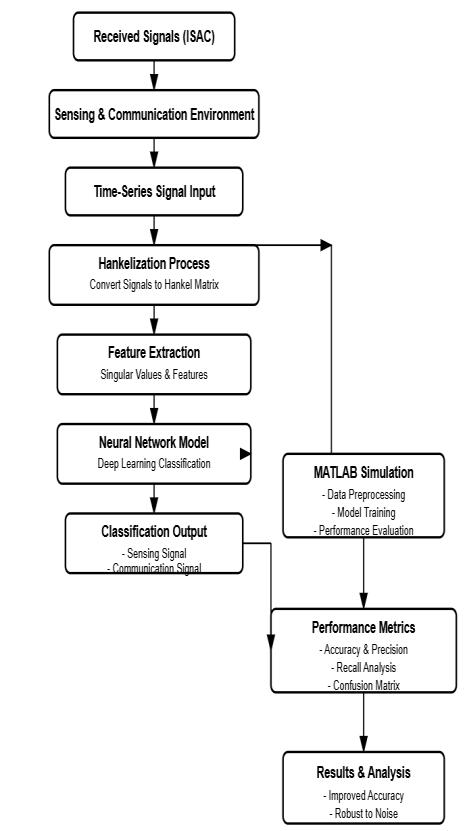
Fig-1:BlockDiagram
The fig.1 shows the full process of the proposed signal classification system that uses a neural network along with Hankelization for Integrated Sensing and Communication (ISAC). The system starts by receiving signals from a place where sensing and communication happen together. These signals can come from radar systems, wireless devices, or mixed ISAC transmitters. Since sensing and communication use the same spectrum,it'shardtotellthemapart.Thisarchitectureis built to process these signals well and accurately. It mixes signal processing and machine learning to make classification better. Each part of the diagram shows a specificstepintheprocessingchain.Theorganizedflow allows the system to manage complex and noisy signal environments. The first big step is time-series signal input. The received ISAC signals are treated as timedomain signals that have useful information and noise. These signals are collected and ready for more processing. Preprocessing includes things like normalizing and filtering to remove unwanted noise. MATLAB is used to handle getting and preparing the signals efficiently. This step makes the input data clean and ready for transformation. The quality of the input signals directly affects the performance of the classification model. So, careful preprocessing is important. This stage is the base for the whole system. The next step is the Hankelization process, which is a keypartofthesystem.Inthisstep,thetime-seriessignal turns into a structured Hankel matrix. This transformation captures the time-based patterns and hidden features in the signal. By arranging overlapping partsofthe signal into a matrix, thesystem getsa more detailed view of the signal's features. This structured view helps distinguish between sensing and communication signals. Unlike traditional methods, Hankelization doesn’t need manual feature extraction. MATLAB's matrix operations are used to do this transformation efficiently. This stage improves the featurerepresentationa lot.AfterHankelization,feature extraction is done using Singular Value Decomposition (SVD).The Hankel matrix is broken down into singular values, which show the major parts of the signal. These values become feature vectors for the classification model. This step reduces the data size while keeping important information. It also helps remove noise by focusingonthemainsignalparts.Theextractedfeatures arenormalizedbeforegoingtotheneuralnetwork.This ensuresconsistencyand better model performance. The featureextractionstageiskeytoimprovingclassification accuracy.The neural network model is the main part of the classification system. It takes the extracted features
International Research Journal of Engineering and Technology (IRJET) e-ISSN: 2395-0056
Volume: 09 Issue: 04 | Apr 2026 www.irjet.net p-ISSN: 2395-0072
as input and goes through several layers to learn complexpatterns.Themodelistrainedwithlabeleddata to tell sensing and communication signals apart. MATLAB'sNeural Network Toolboxisusedtobuildand train the model. The output is a classification result, usually in a one-hot encoded vector. The model can adapt to different signal conditions and environments. Its ability to learn nonlinear patterns enhances classification performance. This stage ensures accurate and reliable signal identification. The last part of the architecture is performance evaluation and result analysis. The system's performance is measured with metrics like accuracy, precision, recall, and confusion matrix. MATLAB has tools to calculate and show these metrics. The results show improved classification accuracy and better resistance to noise. The system works well under different Signal-to-Noise Ratio (SNR) conditions and in changing environments. This stage confirms the effectiveness of the proposed approach. It also gives insights for further improvement and optimization. Overall, the architecture provides a complete solution for efficient signal classification in ISACsystems.
TheTime-SeriesSignalInputModuleisthefirstpartofthe system that takes in and prepares signals received in Integrated Sensing and Communication (ISAC) environments. These signalscan include both sensing and communication data collected under different channel conditions. The module makes sure the raw signals are properly arranged and adjusted before they go through moreprocessing.Sincereal-worldsignalsoftenhavenoise, interference, and distortions, this step is important for keepingthedataconsistent.Byorganizingtheinputintoa structured time-series format, the system sets up a solid base for the next steps. This helps make the signal classificationprocessmorereliableandeffective.
The Hankelization-BasedSignal Transformation Moduleis animportant part of the system that helps turn raw timeseries signals into a more organized format, making it easier to extract features and classify signals. In ISAC systems,signalsoftenhavecomplicatedpatternsovertime thatarehardtodetectwithregularmethods.Thismodule solves that problem by changing the input signal into a Hankel matrix. The process works by breaking the timeseries signal into overlapping parts, creating a structured matrix where each row is a slightly shifted version of the original. This Hankel structure helps the system better understandthetime-basedconnectionsandhowthesignal behaves. By keeping the order of the data, the model can
get a better grasp of how the signal changes, which is key foraccurateclassification.Thismodulealsoimproveshow wellthesystemcanrepresentthesignalbymakingvisible important patterns like repeating cycles, trends, and connectionsthatmightnotbeobviousintheoriginaldata. Becauseofthis,thesystemcantellapartdifferenttypesof signals more clearly, even when there is noise or interference.Theorganizedoutputfromthisstepisuseful forthenextpartoffeatureextractin.
TheFeatureExtractionModuleisimportantforfindingthe keyfeaturesfromthetransformedHankelmatrix.Oncethe signal is organized into a structured format, this module identifies useful features like singular values and other statistical measures. These features help in distinguishing between different types of signals by capturing the essential details. By concentrating on the most relevant features, this module lowers the amount of data while keeping the important information. This makes the processmoreefficientand helpstheneural network learn better. The features extracted offer a clear and detailed understanding of the signal, which improves the model's ability to classify signals accurately, even in tough situations.
TheNeuralNetworkClassificationModuleisthemainpart of the system that makes decisions. It uses the features that were extracted to sort signals into different groups. This part of the system uses deep learning methods to understandcomplex patternsandconnectionsinthedata. The neural network learns from datasets that have labels, so it can tell the difference between signals that are used for sensing and those used for communication.The model canadjust to changes in signal featuresandhandles noise and interference well. Using deep learning helps this module achieve high accuracy and strong performance. The result from this step gives the final prediction, which isimportantformakingsmartdecisionsinISACsystems.
TheMATLABSimulationModuleisusedtobuildandcheck the proposed system in a controlled setting. MATLAB has strong tools for handling signals, showing data visually, and training models, which makes it a good choice for creating and testing the system. This part of the work includestaskslikepreparingdata,trainingthemodel,and checking if it works well.Simulating the system lets researchers try it out with different types of signals and situations without needing to use real-world equipment. It also helps in adjusting the model's settings and making
International Research Journal of Engineering and Technology (IRJET) e-ISSN: 2395-0056
Volume: 09 Issue: 04 | Apr 2026 www.irjet.net p-ISSN: 2395-0072
the system perform better. Using MATLAB makes the wholedevelopmentprocessfasterandeasiertoadapt.
2.5Performance Evaluation
The Performance Evaluation Module checks how well the proposed system works by using standard ways to measure its performance. These include accuracy, precision, recall, and looking at a confusion matrix. These methods show how good the model is at recognizing differentkindsofsignals.Thispartoftheprocesshelpsfind out what the model does well and where it needs improvement.
By looking at the results, researchers can make sure the system meets the needed standards and is ready to be usedinrealsituations
RESULT & DISCUSSION
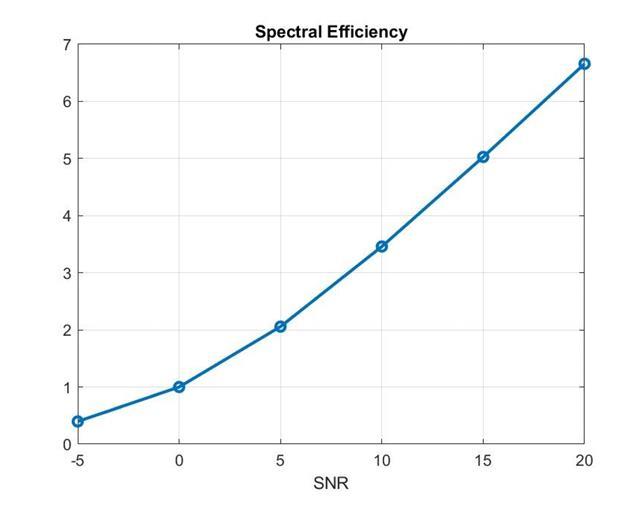
Fig.-2: SpectralEfficiencyVsSNR
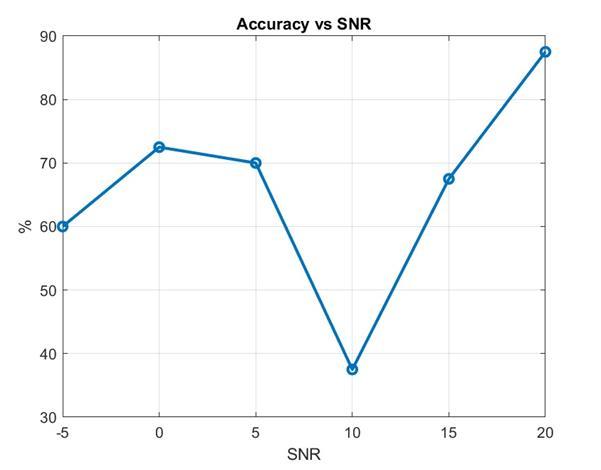
Fig-3: AccuracyVsSNR
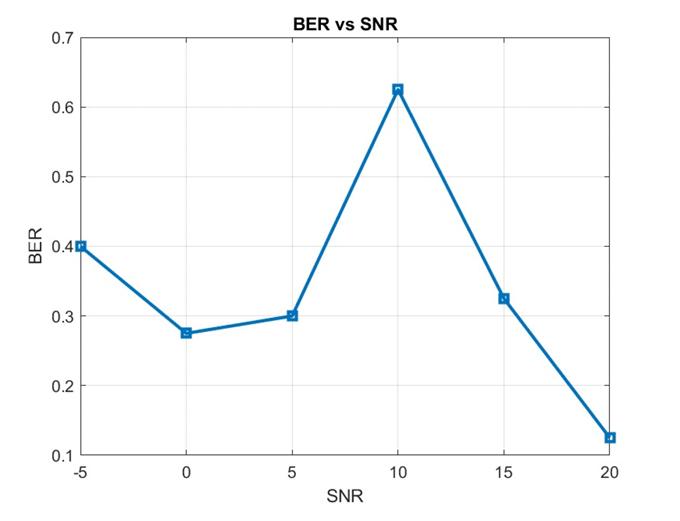
Fig-4: BERVsSNR
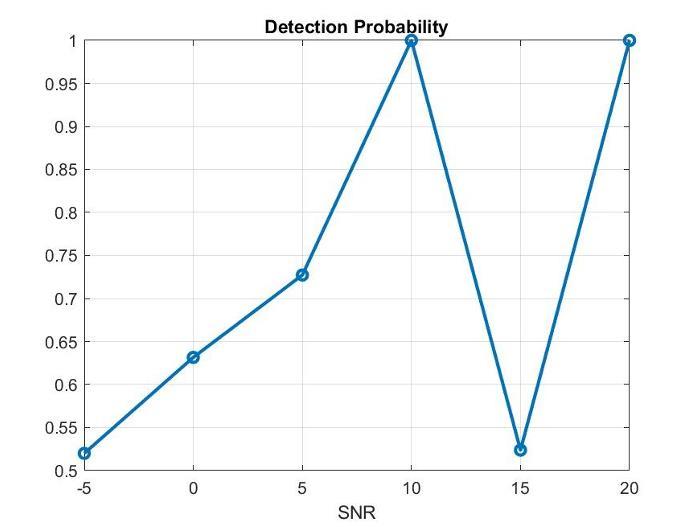
Fig-5: DetectionProbabilityVsSNR
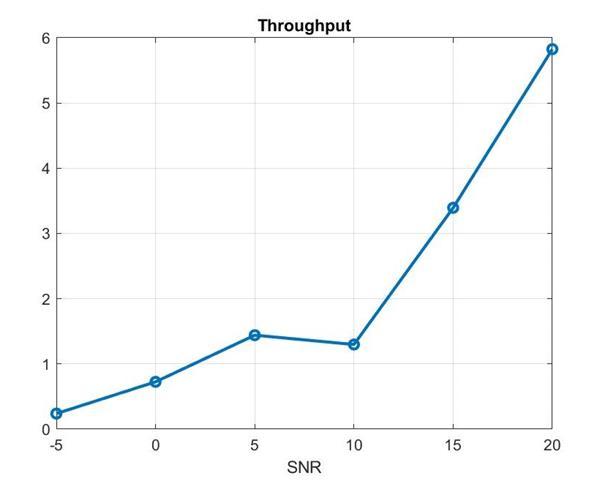
Fig-6: ThroughputvsSNR
The experimental results show that the Hankelizationbased deep learning model works well for signal classification in Integrated Sensing and Communication (ISAC) systems.Fig.2 (Spectral Efficiency vs SNR) shows thatspectralefficiencygoesupastheSignal-to-NoiseRatio
© 2026, IRJET | Impact Factor value: 7.529 | ISO 9001:2008 Certified Journal | Page1278
International Research Journal of Engineering and Technology (IRJET) e-ISSN: 2395-0056
Volume: 09 Issue: 04 | Apr 2026 www.irjet.net p-ISSN: 2395-0072
(SNR) increases.When the SNR is low, efficiency is low because of a lot of noise. But as the SNR gets better, the system uses the bandwidth more efficiently, reaching its highest efficiency at higher SNR levels. This shows the model helps improve communication performance when the channel conditions are good. Fig. 3 (Accuracy vs SNR) shows that classification accuracy improves as SNR increases. There is a small drop in accuracy at mid-level SNR (around 10 dB), but the model quickly bounces back andreachesmaximumaccuracyathigherSNRvalues.This means the model is strong and can deal with changes in noiseinreal-lifesituations.Fig.4(BERvsSNR)showshow theBitErrorRatechangeswithSNR.AsSNRincreases,the BERdropsalot,whichisgoodforcommunicationsystems. At low SNR, the error rate is high because of noise, but as SNR increases, the BER becomes very low, showing that signals are transmitted reliably and accurately. Fig.5 (DetectionProbabilityvsSNR)showsthesensingabilityof the proposed ISAC system. As SNR goes up, the detection probability also increases and reaches a peak at higher SNR levels. This means the system can detect signals well under better conditions. There are some small ups and downs, but the overall trend shows strong sensing performance. Fig. 6 (Throughput vs SNR) shows that throughput increases a lot as SNR improves. AtlowSNR,throughputislimitedbecausethesignalisnot strong. But as SNR rises, the system sends data faster, achieving maximum throughput at high SNR levels. This shows the system uses communication resources efficiently. Overall, the results show that the proposed system improves both sensing and communication performance. By combining Hankelization with deep learning, the system can better represent features, resulting in higher classification accuracy, fewer errors, andstrongerresistancetonoise.Thesefindingsprovethat theapproachissuitableforadvancedISACapplications.
This work introduces a new neural network framework that uses Hankelization for signal classification in ISAC systems. It changes time-based signals into structured Hankel matrices and uses SVD to extract important features. This helps the model better understand timebased patterns and remove noise. Using deep learning makesthemodelmoreaccurate,evenwhenconditionsare toughlikelowsignalqualityor interference.Testsdonein MATLAB show that this method is more accurate, dependable, and strong compared to traditional approaches.Thesystemalsoworkswellwithlesstraining data, making it more flexible. Overall, this framework offers a good solution for future wireless communication
systems and can be used in real-time setups and more complexdesignsinfutureresearch.
[1] L. Zhang, M. Ozger, and W.-H. Lee, “A Hankelization-Based Neural Network-Assisted Signal Classification in Integrated Sensing and CommunicationSystems,”IEEEAccess,vol.13,pp. 94648–94657,May2025.
[2] J.-H. Kim, J.-H. Lee, O.-S. Shin, and W.-H. Lee, “A Novel Neural Network Framework for Automatic Modulation Classificationvia Hankelization-Based Signal Transformation,” Applied Sciences, vol. 15, no.14,p.7861,Jul.2025.
[3] V. Koivunen, M. F. Keskin, H. Wymeersch, M. Valkama, and N. González-Prelcic, “Multicarrier ISAC: Advances in waveform design, signal processing, and learning under nonidealities,” IEEESignalProcessingMagazine,Sep.2024.
[4] X. Zhang, G. Peng, Y. Tan, Z. Zhang, and X. Bai, “A transformeracousticsignalanalysismethodbased onmatrixpencilandhybriddeepneuralnetwork,” FrontiersinEnergyResearch,vol.12,2024.
[5] D. K. Jayaraman Rajendiran, C. Ganesh Babu, and K. Priyadharsini, “Hybrid neural network method for classification of ECG signals,” Scientific Reports,vol.14,p.15087,Jul.2024.
[6] Y. Wang et al., “Deep-learning methods for integrated sensing and communication in vehicular networks,” Vehicular Communications, vol.40,p.100574,Apr.2023.
[7] S. K. et al., “An intelligent deep learning-based hyperspectral signal classification scheme,” Measurement,vol.188,p.110540,Jan.2022.
[8] L. Chen, K. Liu, Q. Gao, X. Wang, and Z. Zhang, “Enhancing integrated sensing and communication performance for radarcommunication systems with multi-dimensional data,”RemoteSensing,vol.16,no.17,p.3242,Sep. 2024.
[9] T. Nie, W. Zheng, C. Ding, et al., “Deep learning aided intelligent signal recognition for backscatter-based passive IoT systems,” Complex &IntelligentSystems,Mar.2026.
International Research Journal of Engineering and Technology (IRJET) e-ISSN: 2395-0056
Volume: 09 Issue: 04 | Apr 2026 www.irjet.net p-ISSN: 2395-0072
[10] Y. Wang, et al., “Deep-learning assisted beam selection for millimeter wave integrated sensing and communication,” Digital Signal Processing, vol.175,p.106000,May2026.
© 2026, IRJET | Impact Factor value: 7.529 | ISO 9001:2008 Certified Journal | Page1280