
International Research Journal of Engineering and Technology (IRJET) e-ISSN: 2395-0056
Volume: 12 Issue: 05 | May 2025 www.irjet.net p-ISSN: 2395-0072
International Research Journal of Engineering and Technology (IRJET) e-ISSN: 2395-0056
Volume: 12 Issue: 05 | May 2025 www.irjet.net p-ISSN: 2395-0072
Mr. Faizan Ahmad1, Syed Falah Jamal2, Sachin Yadav3, Gulam Mudassir Zafar4 and Faiza5
1Assistant Professor, Department of Computer Science & Engineering, Lucknow India
2Student, Department of Computer Science & Engineering, Integral University, Lucknow India
3Student, Department of Computer Science & Engineering, Integral University, Lucknow India
4Student, Department of Computer Science & Engineering, Integral University, Lucknow India
5Student, Department of Computer Science & Engineering, Integral University, Lucknow India
Handwrittendigitrecognitionremainsacomplextaskduetothewiderangeofvariationsinindividualhandwritingstyles.This research aims to provide a foundation for future developments in the field by identifying and addressing the challenges associatedwithdigitrecognition.Adetailedreviewofexistingmachinelearningtechniqueswasconductedtodeterminethe mostaccurateandefficientmethodsforclassification.ThestudyusedtheMNISTdataset,consistingof60,000grayscaleimages of handwritten digits, each sized 28x28 pixels. These images were employed to train various models and evaluate their performanceagainsttestdata.Amongalltheapproachesanalyzed,theclassifierensemblemethodachievedthebestresults, with an impressively low error rate of 0.32%. The paper offers a comparative analysis of several techniques including ConvolutionalNeuralNetworks(CNN)andSupportVectorMachines(SVM),highlightingtheirstrengthsandlimitations.The findingsaimtoguideresearcherstowardmoreaccurateandreliabledigitrecognitionsystems.Keywords CNN,MNIST, HandwrittenDigitRecognition,SVM.
The recognition of handwritten characters has been an area of interest since the early 1980s. As defined by the Collins dictionary,adigitisa numericsymbol rangingfrom0to9.Thesedigitsplayacrucialroleinvariousaspectsofdailylife. Industriessuchasbanking,healthcare,andinsuranceareheavilyreliantonaccuratedigitinterpretation. Forexample,in bankingoperations whetheropeninganaccountorprocessinga withdrawal digitslikeaccountnumbersandcontact detailsareoftenhandwrittenbycustomers.Thesehandwrittenentriesareeithermanuallyverifiedbystafforscannedand interpretedbymachines.
Similarly,inthehealthcaredomain,medicalformsincludehandwrittendetailssuchaspatientIDs,prescriptions,anddosage instructions allofwhichmustbeaccuratelyunderstood.Taxdocuments,postalcodesformailsorting,andhandwritinginput ondigitaldevicesareadditionalreal-worldapplicationswheredigitrecognitioniscritical.
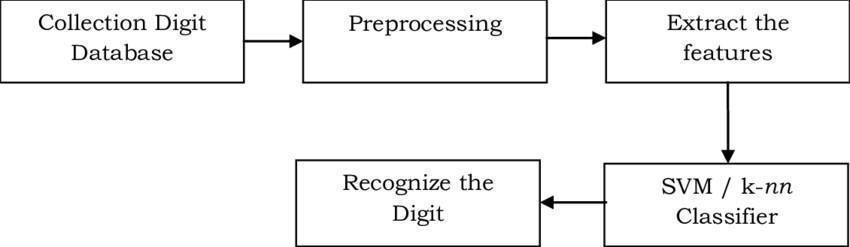
Fig 1: Process of Handwritten digit recognition
Handwrittendigitrecognitionhasthusemergedasasignificantresearchfocus,especiallywithinthefieldsofmachinelearning andartificialintelligence.Thissystemaimstoconverthuman-writtennumeralsintomachinereadableformwithhighaccuracy andreliability.Variousmachinelearningalgorithmsareemployedtoprocessandclassifythesedigits,butchallengesremain due to the vast diversity in individual handwriting styles and the presence of different numeral representations across languages.
International Research Journal of Engineering and Technology (IRJET) e-ISSN: 2395-0056
Volume: 12 Issue: 05 | May 2025 www.irjet.net p-ISSN: 2395-0072
Oneofthemajorobstaclesisidentifyinganoptimalalgorithmthatcanreliablyrecognizepoorlywrittenorstylizeddigits, especiallywhen compared toclearlytyped or printed ones.Even minormisclassificationscanleadto serious errors.For instance,digitslike0,8,and9canappearsimilarinpoorlywrittenscripts, makingitdifficultformachinestodistinguish betweenthemaccurately.
Incriticalsectorssuchashealthcareandfinance,amisinterpreteddigitcanleadtocostlymistakesorevenlife-threatening outcomes.Thus,theneedforanintelligent,robust,andhighlyaccuratedigitrecognitionsystemisevident.Whilesignificant researchhasbeendoneinthisfield,achievingperfectaccuracyremainselusive.Thispaperaimstoexplore,evaluate,and comparedifferentmachinelearning-basedapproachestodevelopanefficientanddependablehandwrittendigitrecognition system.
A wide array of algorithms has been applied to the MNIST dataset for handwritten digit recognition. Among traditional techniques,thek-NearestNeighbors(k-NN)algorithmstandsoutforitssimplicity.Itclassifiesinputsamplesbasedonthe majority label among its nearest neighbors in the feature space, relying on direct pixel comparison. Despite its ease of implementation,k-NNfaceslimitationsintermsofscalabilityandefficiency,especiallywhenworkingwithlargedatasetslike MNISTduetohighcomputationalcostsduringprediction.SupportVectorMachines(SVM),ontheotherhand,haveproven effectiveforhigh-dimensionaldata.SVMsaimtofindanoptimalhyperplanethatmaximallyseparatesdifferentdigitclasses. Whileaccurate,theyarecomputationallyintensiveduringthetrainingphase.Recentdevelopmentsindeeplearninghave shiftedfocustowardsConvolutionalNeuralNetworks(CNNs),whichautomaticallyextracthierarchicalfeaturesfromimages, enhancingclassificationperformance.DanCiresanetal.successfullyapplieddeepneuralnetworksforthispurpose,achieving notableaccuracy.Moreover,thehybridCNN-SVMmodelsintroducedbyXiao-XiaoNiuandChingY.standoutduetotheir innovativeapproachandeffectivenessinenhancingclassificationperformance.SuencombineCNNfeatureextractionwithSVM classification,enhancingrecognitionreliability.
TheModifiedNationalInstituteofStandardsandTechnology(MNIST)databaseisawidelyrecognizedbenchmarkdatasetused forhandwrittendigitclassification.Itisfreelyavailableandservesasastandardforevaluatingmachinelearningalgorithms. WhileitsharessimilaritieswiththeTIDigitdatabase developedbyTexasInstrumentsforspeechrecognitiontasks MNIST focusessolelyonimage-baseddigitrecognition.
TheMNISTdatasetisderivedfromamodifiedversionoftheoriginalNISTdataset.Thedatasetcomprises60,000grayscale imagesfortrainingand10,000fortesting,eachdepictingadigitfrom0to9witharesolutionof28by28pixels.andcentered withinauniformblack-and-whiteformat,resultingina784-dimensionalinputvector.Thisdatasetsimplifiestheclassification taskforresearchers,eliminatingtheneedforextensivepreprocessing.ConvolutionalNeuralNetworks(CNNs)haveshown exceptionalperformanceonMNIST,achievingerrorratesaslowas0.27%usingensemblemethodsandaround0.35%witha singlelargenetwork.Techniqueslikeelasticdistortionsduringtraininghelpfurtherreduceerrorrates,whereasomittingthem increases errors to approximately 0.53%. Many experiments also employ artificially augmented training data through transformationslikeshifting,skewing,andsmudgingtoenhancemodelrobustness.
Handwrittendigitrecognitionreliesheavilyonthequalityandtypeoffeaturesextractedfrominputimages.Researchershave explorednumerousfeatureextractionmethodsovertheyears,eachofferinguniqueadvantages.Sincedifferentalgorithms produce different types of errors that rarely overlap, combining multiple feature extraction methods has been proven to significantlyenhancerecognitionaccuracy.Thisstrategyallowsthemodeltomakemorerobustpredictionsandbetterreject ambiguousinputsthataredifficulttoclassifyevenforhumans.Thecomprehensiveintegrationoffeaturesenablessystemsto recognizedigitswithhigherprecision,especiallythosecommonlymisclassifiedduetotheirsimilarstructures.Belowisa summaryofkeyfeatureextractiontechniquesdocumentedinexistingliterature:
1. Structural Features: This method involves resizing the digit image to a standard size, often 32×32 pixels, and computing histogram profiles. Radial histograms are calculated by counting the number of black pixels in 72 directionsspacedevery5degreesfromthecenteroftheimage.Thesedirectionalcountshelpcapturetheshapeand
International Research Journal of Engineering and Technology (IRJET) e-ISSN: 2395-0056
Volume: 12 Issue: 05 | May 2025 www.irjet.net p-ISSN: 2395-0072
orientationofthedigitandaremergedtoformasingle,informativefeaturevector.Thistechniquehelpscapturethe outlineandstrokedirectionalityofhandwrittencharacters.
2. Modified Edge Maps:Inthisapproach,thedigitimageisfirstdividedinto25×25pixelsections.Edgedetectionisthen performedusingSobeloperatorstogeneratefourtypesofedgemaps:horizontal,vertical,andtwodiagonals.These edgemapsareeachsplitinto25sub-regionsof5×5pixels,resultinginatotalof100smallerpatches.Featuresfromall fouredgetypesarethencombinedintoasingle125dimensionalvector.Thismethodallowsthesystemtocapture strokepatternsandedgeintensitiesthatarecharacteristicofdifferentdigits.
3. Image Projections:Imageprojectiontechniquesfocusoncapturingpixelintensitydistributionsalongdiagonaland radialdirections.Theimageisdividedintofourquadrants top,bottom,left,andright tominimizetheeffectsof unwantedrotationalinvariance.Radialprojectionsareobtainedbygroupingpixelsbasedontheirradialdistance fromthecenterofthedigit.Thesenormalizedfeaturesarethencompiledintoa128-dimensionalfeaturevector.This methodisparticularlyusefulforidentifyingthespatialsymmetryanddistributionofpixels.
4. Multi-Zoning Technique:Thismethodisbasedonmeasuringtheconcentrationofblackpixelsinvarioussub-regions oftheimage.Multiplezoningconfigurationsareused,suchas3×1,1×3,2×3,3×2,3×3,1×4,4×1,4×4,6×1,1×6,6×2, 2×6,and6×6,resultingin13differentfeaturesets.Eachconfigurationhelpsthesystemfocusonauniquespatial arrangement,improvingitsabilitytogeneralizeacrossdifferenthandwritingstyles.Thepixeldensitiesfromallzones arecollectedandcombinedintoacompositefeaturevector.
5. Concavity Measurements:Here,theinputimageisresizedtoan18×15pixelgridanddividedintosixseparatezones. Withineachzone,thesystemcheckseverywhitepixelandsearchesforsurroundingblackpixelsinalldirections. Theseconcavity-basedfeaturesreflectthedepthandcurvestructuresofthedigits.Thefeaturevectorforeachzoneis 13-dimensional,andallsixvectorsareconcatenatedtoforma78dimensionalfeaturevector.Thismethodiseffective forcapturingindentationsandholeswithindigitssuchas8,6,and9.
6. Gradient-Based Features:Gradientfeaturesareextractedfromgrayscaleimages,whichretainmoredetailthan binaryimages.First,theimageisconvertedintoapseudo-grayscaleformatusingMedialAxialTransformation(MAT). Then,Sobeloperatorsareappliedtocalculatethegradientamplitudeanddirection(phase).Theimageissplitinto16 sub-images,andforeachsegment,thesystemcountsthenumberofpixelsineightdirections.Thesecountsareused asdirectional gradientfeatures,resultingina final vectorof128 features. Thisapproachenhancessensitivityto strokesanddirectionality,whicharevitalindistinguishingsimilardigitslike3and8.
By combining these diverse extraction techniques, the system leverages the strengths of each to significantly improve recognitionaccuracywhileminimizingerrorsfromindividualmethods.Thishybridapproachservesas thefoundationfor manystate-of-the-arthandwrittendigitrecognitionsystems.
4.2DataVisualization
International Research Journal of Engineering and Technology (IRJET) e-ISSN: 2395-0056
Volume: 12 Issue: 05 | May 2025 www.irjet.net p-ISSN: 2395-0072
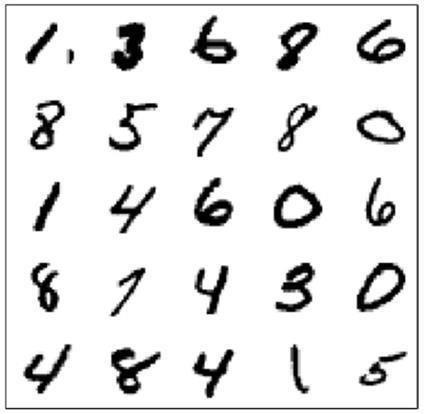
Figure1showcasesthevariationinhandwritingpatternsforeachindividualdigit.Forinstance,thedigit'8'appearsinatleast fivedistinctformswithinthissamplealone,andit'slikelythatevenmorevariationsexistthroughoutthedatasetandinreallifescenarios.
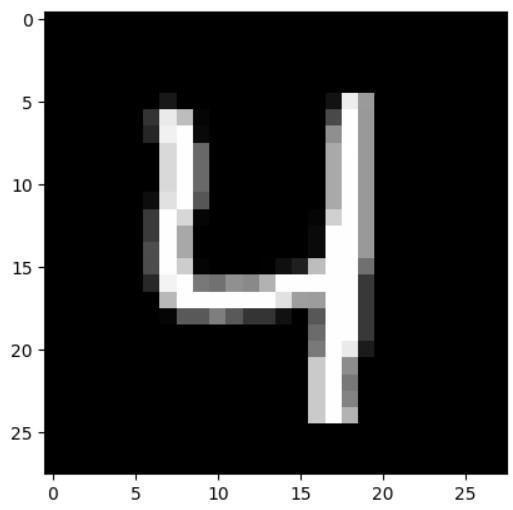
Fig 4: An image from the training set is selected and reshaped into (28x28) pixels for visualization.
4.3 Data Preparation
The'label'column,representingthedigits,istransformedintoone-hotencodedvectorscorrespondingto10uniqueclasses (rangingfrom0to9).Thedatasetispartitionedintotwosegments:onefor modeltrainingandtheotherforassessingits performanceandprecision.Thetrainingsetisutilizedtofitthemodel,whilethevalidationsetplaysacrucialroleincrossverifyingthemodel’saccuracyandassessingitsabilitytogeneralizetodataithasn’tencounteredduringtraining.
4.4 Modelling & Analysis
Themodellingphaseinvolvesselectingasuitablemachinelearningarchitecture,trainingitwithprepareddata,andevaluating itsperformance.Adeeplearningapproach,particularlyusingConvolutionalNeuralNetworks,isappliedduetoitsproven effectivenessinimagerecognitiontasks.Themodelistrainedusingthetrainingdataset,learningtoidentifypatternsand structuresspecifictoeachdigitclass.Duringthisprocess,variousparameterssuchaslearningrate,batchsize,andthenumber ofepochsisfine-tunedforoptimalperformance.Aftertraining,themodel’saccuracyismeasuredusingthevalidationdataset to ensure that it can correctly classify digits beyond the training data. Performance metrics such as accuracy, loss, and confusionmatrixareanalyzedtoassessthemodel’sgeneralizationcapabilities.Thisphasehelpsinidentifyinganysignsof overfittingorunderfittingandisessentialindeterminingwhetherthemodelisrobustenoughforreal-worldhandwrittendigit recognitiontasks.
4.7 Model used
Logistic Regression:
Multi-classclassificationcanbeachievedbyextendinglogisticregression,astatisticalappbinaryclassification,withmethods suchasoneinput(x)belongstoacertainclass(k).
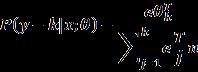
istheoutcomeofthelogisticregressionmodel,inwhichkisthetotalnumberofclassesandθ_kwillbetheparametervector forclassk'.Wheretheindicatorfunction,is1ifandonlyifexampleI'struelabelisk.Optimizationtechniqueslikegradient descentareusedtochangeθinordertominimizethisloss,whichincreasesthemodel'saccuracy.
International Research Journal of Engineering and Technology (IRJET) e-ISSN: 2395-0056
Volume: 12 Issue: 05 | May 2025 www.irjet.net p-ISSN: 2395-0072
1. The Handwritten Digit Recognition project uses the logistic regression approach, which entails several crucial processes,toguaranteethedevelopmentofadependableandeffectivemodel.Datagathering,preprocessing,model installation,training,assessment,andanalysisareafewoftheseprocesses.Thisisanextensiveapproach: 1.Data Collection: The MNIST dataset is a massive collection of handwritten digit pictures that have been classified. Ten thousandtestphotosandsixtythousandtrainingimagesmakeupthedataset.Toaidinmodeltrainingandperformance assessment,makesurethedatasetissuitablysplitintotrainingandtestingsets.
2. Datapreprocessing:Create1Dvectorswith784characteristicseachfromthe2Dpicturematrices,whicharemadeup of28by28pixels.Toinputthedataintothelogisticregressionmodel,thisadjustmentisnecessary.Normalizethepixel valuesbydividingeachby255,scalingthemtoastandardrange,typicallybetween0and1.Themodelperformsbetter duringtrainingbecauseofthequickerconvergenceduringthisperiod.
3. LogisticRegressionandModelImplementation:Utilizethelogisticregressionapproachandconfigureitformulticlass categorization in order to handle the ten digits (0–9). Select the required parameters, such as the learning rate, regularizationstrength,andthemaximumnumberofiterations.Thesesettingsarenecessarytocontrolthetraining processandavoidoverfitting.
4. Model Training: The logistic regression algorithm learns patterns by processing data from the training set. Utilize optimizationstrategiessuchasgradientdescenttolowerthecostfunction.Assessthemodel'sperformanceonunused datausingcross-validation,andadjusthyperparameterstoensuregeneralizationanddurability.
5. Testing and Evaluation: To assess the model's performance on the testing set, use crucial metrics including recall, accuracy,precision,andF1score.Thesemetricsofferathoroughevaluationofthemodel'scategorizationperformance. Makeaconfusionmatrixtoevaluatehowwellthemodel distinguishesbetweenvariousdigitclassesandidentifies misclassificationhotspots.
6. ResultsAnalysis:Tocomprehendtheadvantagesanddisadvantagesofthemodel,analyzeandinterpretthedata.Analyze themetricstodetermineoverallperformanceandspotanymisclassificationtrends.Lookforphotosthathavebeen incorrectlyclassifiedandinvestigatepossiblereasonssuchaserratichandwritingornoisydata.Thisstudycontributes toourunderstandingofthelogisticregressionmodel'slimitations.
7. Visualization:Viewtheacquiredweightsandbiasestoobservehowthelogisticregressionmodeldifferentiatesbetween differentdigitclasses.Showimagesthathavebeenincorrectlyidentifiednexttotheirpredictedandcorrectlabelsin order to better understand the model's capabilities and possible areas for improvement. Some of the tools and technologiesutilizedaretheScikit-LearnandNumPylibraries,theMatplotliborSeaborndatasetfordatavisualization, theMNISTdataset,andcomputerresourceswithenoughprocessingcapacityforbothmodeltrainingandevaluation. Thedetailedstrategymentionedaboveguaranteesamethodicalapproachtobuildingahandwrittendigitizingsystem basedonlogisticregression.Byfollowingtheseprocedures,thestudyhopestoprovideareliableandaccuratemodelin additiontoinsightfulinformationabouttheuseoflogisticregressioninmachinelearningandpatternrecognition.
Anaccuracyof90%inhandwrittendigitrecognitionindicatesthatthemodelisabletocorrectlyclassify9outofevery10 digits.Whilethislevelofaccuracyisconsidereddecent,especiallyintraditionalmachinelearningmodels,itstillleavesroom forimprovementincriticalapplicationswhereprecisionisessential.Suchascoresuggeststhatthemodelhascapturedthe generalpatternsofmostdigitsbutmaystrugglewithambiguousorpoorlywrittensamples.Toimproveuponthis,deeper modelslikeConvolutionalNeuralNetworks(CNNs),alongwithenhancedpreprocessinganddataaugmentationtechniques, canbeemployedtominimizemisclassificationandpushtheperformanceclosertoexpert-levelaccuracy.
Aconfusionmatrixwasgeneratedtoassessthemodel'sperformance.Thismatrixprovidesadetailedbreakdownofcorrect andincorrectpredictionsacrossallclasses.
International Research Journal of Engineering and Technology (IRJET) e-ISSN: 2395-0056
Volume: 12 Issue: 05 | May 2025 www.irjet.net p-ISSN: 2395-0072
Theconfusionmatrixforthedigitrecognitionmodelispresentedbelow:

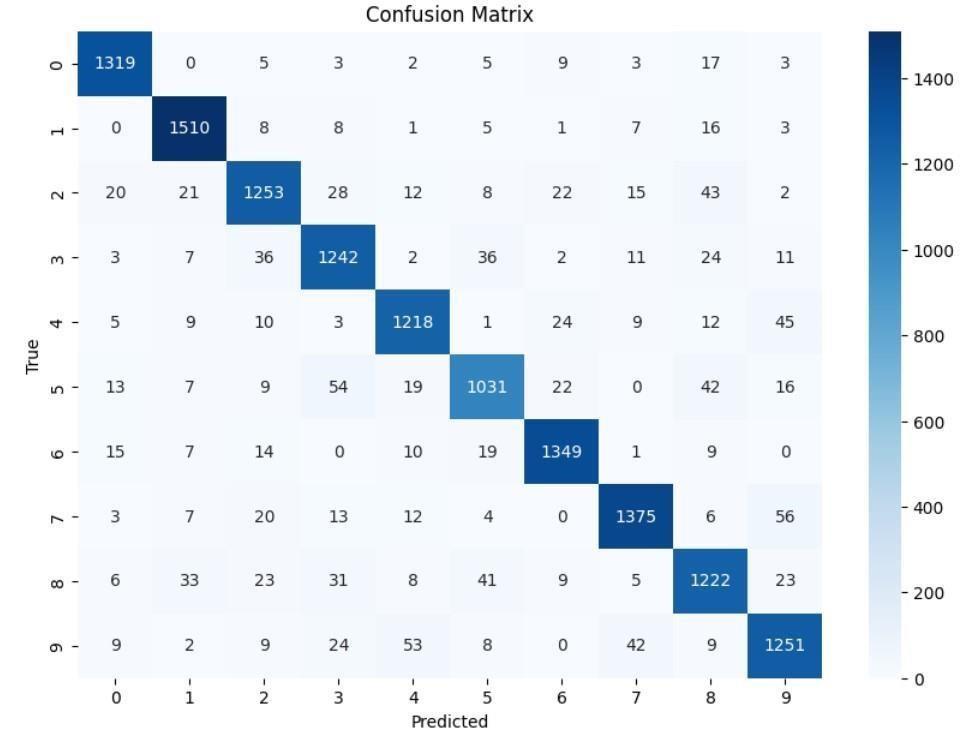
performance.
5. Conclusion
Thisresearchfocusedondevelopinganefficientsystemforrecognizinghandwrittendigitsusingmachinelearninganddeep learningtechniques.Withnumerouswritingvariationsinhumanhandwriting,achievinghighaccuracyrequiresrobustmodels andcarefullyprepareddatasets.TheMNISTdatasetservedasareliablefoundationfortrainingandevaluatingthesystem. Techniques like feature extraction and data preprocessing helped improve the performance of the recognition model. ConvolutionalNeuralNetworks(CNNs)provedespeciallyeffectiveduetotheirabilitytodetectcomplexpatternsinimagedata.
Throughmodeltraining,validation,andtesting,itwasdemonstratedthatthesystemcouldaccuratelyclassifydigitsacross multiplestyles.However,somelimitationsremain,particularlywithambiguousordistortedinputs.Futureworkcanexplore moreadvancedarchitectures,largerandmorediversedatasets,andbetterhandlingofedgecases.Overall,theprojectshows promisingresultsandcontributestothedevelopmentofintelligentsystemscapableofinterpretinghandwrittennumerical information.
[1].Han,X.,&Li,Y.(2015).Theapplicationofconvolutionneuralnetworksinhandwrittennumeralrecognition. International Journal of Database Theory and Application, 8(3),367-376.
[2].Shima,Y.,Nakashima,Y.,&Yasuda,M.(2017,September).Patternaugmentationforhandwrittendigitclassificationbased oncombinationofpre-trainedCNNandSVM.In 2017 6th International Conference on Informatics, Electronics and Vision & 2017 7th International Symposium in Computational Medical and Health Technology (ICIEV-ISCMHT) (pp.1-6).IEEE.
International Research Journal of Engineering and Technology (IRJET) e-ISSN: 2395-0056
Volume: 12 Issue: 05 | May 2025 www.irjet.net p-ISSN: 2395-0072
[3]. Niu, X. X., & Suen, C. Y. (2012). A novel hybrid CNN–SVM classifier for recognizing handwritten digits. Pattern recognition, 45(4),1318-1325.
[4].Ma,C.,&Zhang,H.(2015,August).Effectivehandwrittendigitrecognitionbasedonmulti-featureextractionanddeep analysis.In 2015 12th international conference on fuzzy systems and knowledge discovery (FSKD) (pp.297-301).IEEE.
[5].Teow,M.Y.(2017,October).Understandingconvolutionalneuralnetworksusingaminimalmodelforhandwrittendigit recognition.In 2017 IEEE 2nd International Conference on Automatic Control and Intelligent Systems (I2CACIS) (pp.167-172). IEEE.
[6].Cireşan,D.C.,Meier,U.,Gambardella,L.M.,&Schmidhuber,J.(2010).Deep,big,simpleneuralnetsforhandwrittendigit recognition. Neural computation, 22(12),3207-3220.
[7].LeCun,Y.,Jackel,L.D.,Boser,B.,Denker,J.S.,Graf,H.P.,Guyon,I.,...&Hubbard,W.(1990).Handwrittendigitrecognition: Applicationsofneuralnetchipsandautomaticlearning.In Neurocomputing: Algorithms, Architectures and Applications (pp. 303-318).SpringerBerlinHeidelberg.
[8].TSIVA,A.J.A.Y.(2017).HandwrittenDigitRecognitionUsingConvolutionalNeuralNetworks.
[9].Deng,L.(2012).Themnistdatabaseofhandwrittendigitimagesformachinelearningresearch[bestoftheweb]. IEEE signal processing magazine, 29(6),141-142.
[10].Cruz,R.M.,Cavalcanti,G.D.,&Ren,T.I.(2010,June).Handwrittendigitrecognitionusingmultiplefeatureextraction techniquesandclassifierensemble.In 17th International conference on systems, signals and image processing (pp.215-218).
[11].Bishop,C.M., &Nasrabadi,N.M. (2006). Pattern recognition and machine learning (Vol.4, No.4, p.738). New York: springer.
[12].Hastie,T.,Tibshirani,R.,Friedman,J.,&Franklin,J.(2005).Theelementsofstatisticallearning:datamining,inferenceand prediction. The Mathematical Intelligencer, 27(2),83-85.
[13.]Goodfellow,I.,Bengio,Y.,Courville,A.,&Bengio,Y.(2016). Deep learning (Vol.1,No.2).Cambridge:MITpress.
[14].LeCun,Y.(1998).TheMNISTdatabaseofhandwrittendigits. http://yann. lecun. com/exdb/mnist/.
[15].Ng,A.(2018).Machinelearningyearning:TechnicalstrategyforAIengineers,intheeraofdeeplearning.
[16].James,G.,Witten,D.,Hastie,T.,&Tibshirani,R.(2013). An introduction to statistical learning (Vol.112,No.1).NewYork: springer.
[17].Cortes,C.,&Vapnik,V.(1995).Support-vectornetworks. Machine learning, 20,273-297.
[18].Friedman,J.H.(2001).Greedyfunctionapproximation:agradientboostingmachine. Annals of statistics,1189-1232.
[19].Kelleher,J.D.,&Tierney,B.(2018).DataScience:APracticalIntroductiontoDataScience.
[20].Zhang,H.(2004).TheoptimalityofnaiveBayes. Aa, 1(2),3