
International Research Journal of Engineering and Technology (IRJET) e-ISSN: 2395-0056
Volume: 13 Issue: 03 | Mar 2026 www.irjet.net p-ISSN: 2395-0072

International Research Journal of Engineering and Technology (IRJET) e-ISSN: 2395-0056
Volume: 13 Issue: 03 | Mar 2026 www.irjet.net p-ISSN: 2395-0072
1-3Student,AjeenkyaDYPatilUniversity,Pune,Maharashtra,India, 4AssistantProfessor,DepartmentofComputerScience,AjeenkyaDYPatilUniversity, Pune,Maharashtra,India
Abstract- The communication gap between the Deaf community and the hearing community has created a need for accessible assistive technologies. This paper introduces a sign language recognition and illustration system based on static hand gesture detection to form sentences. The proposed system differs from other hardware-based techniques in its use of a contactless approachbasedoncomputervisionwithOpenCV/CV2and MediaPipeHandstodetecta3Dskeletalmodelofthehand with 21 points. The system uses a 63-element feature vector, which is invariant to environmental noise, with a detection threshold set at 0.3 to acquire the landmarks. A dataset was created in real-time with 1,300–1,400 samples to train a Random Forest classifier, which was serialized using Joblib The vocabulary of this system includes 26 ASLalphabets, 10 numeric signs rangingfrom 1 to 10, and 8–10 basic communication words that are frequently used. A new temporal stability buffer logic is used for moving from isolated gestures to sentence construction. This also includes "Space" and "Delete" gestures for text editing. In addition to this, this system also uses gTTS (Google Text-to-Speech) and Pygame for providing audio feedback. TextBlob is used for text processing. During experimental evaluation using a dataset of276 samples, exceptionalresults were obtained. This is because this system has obtained a perfect accuracy, precision, recall, and F1-score of 1.00. This stability filter has successfully minimized flickering. However, this performance may be influenced by controlled dataset conditions and requires further validationinreal-worldenvironments.
Keywords: Sign Language Recognition, MediaPipe, Hand Skeleton Tracking, Machine Learning, RealTime Translation, Random Forest, gTTS, TextBlob, OpenCV.
Signlanguageisahighlyevolvedformofcommunication that uses a combination of manual gestures, facial expressions, and body language to convey meaning. Unlike spoken languages, sign languages are usually spatial gestural languages that may not be governed by thesamegrammaticalrulesorword/sentencestructures as the spoken counterparts. Additionally, they may not
be organized in a set format as in the case of written or spokenlanguages[1].
In the past, people with hearing impairment have faced major barriers in society. The term "deaf and dumb" represents the misunderstanding of the past where peoplewhowereunabletohearwerealsounabletotalk [2]. Children who suffer hearing impairment in early stages of development due to illness or accident often lose the power of speaking in no time because they are unable to learn the language by imitating others [3, 4]. Astherearevariousdistinctsignlanguagesintheworld, such as British Sign Language (BSL), Spanish Sign Language (LSE), Arabic Sign Language (ArSL), and AmericanSignLanguage(ASL),communicationbetween the Deaf community and the hearing community is a majorchallenge[5].Foreffectivecommunicationtotake place, hearing individuals need professional translators, which is not only costly but also compromises the privacyofthehearing-impairedindividual[6].
The magnitude of this problem is enormous. According totheWorldHealthOrganization(WHO),over5%ofthe world's population, which translates to 430 million people, needs to be rehabilitated for "disabling" hearing loss [8]. The figure is projected to reach almost 700 millionbytheyear2050fordebilitatinghearingloss[9]. Despite the need for assistive technology for hearingimpaired individuals, sign language has not received as muchacademicattentionasnaturallanguageprocessing because of its complexity and the advanced computer visionrequiredforinterpretingsignlanguage[10].
Sign Language Recognition (SLR) is a significant subdomain of the field of machine translation and human-computer interaction (HCI), with research in the field tracing back to the 1940s [11]. In the development of such systems, there are two major phases involved: feature extraction and classification [12, 13]. Feature extraction is particularly challenging in the case of dynamic signs, where the sequences of signs in various frames of the video have to be extracted. This is then processedbytheclassifiertoarriveattheprobabilityof the signs representing the intended meaning [14]. However, the existing research is mostly limited to manual features, and there is a significant absence of
International Research Journal of Engineering and Technology (IRJET) e-ISSN: 2395-0056
Volume: 13 Issue: 03 | Mar 2026 www.irjet.net p-ISSN: 2395-0072
systemsthatcanbepracticallyappliedinthereal world [15,16].
To address these limitations, this research aims to develop a real-time system capable of not only recognizing individual sign language alphabets but also forming meaningful, editable sentences from sequential inputs. By leveraging a lightweight, camera-based approach, this study assesses the viability of an interpretation solution that is accessible to the general publicwithouttheneedforspecializedhardware.
Themaingoalsofthisresearchworkare:
1. To develop a real-time system for recognizing sign language alphabet gestures using the MediaPipe Hand Skeleton.
2.Toimplementatemporallogicforformingmeaningful sentencesfromsequentialgestureinputs.
3. To evaluate the effectiveness of incorporating control gestures(SpaceandDelete)forreal-timetextediting.
The field of Sign Language Recognition (SLR) has evolved significantly, driven by the need to bridge the communication gap between the hearing-impaired and the hearing world. This review categorizes previous research into hardware-based methods, vision-based approaches,andtherecentshifttowardlandmark-based real-timesystems.
2.1.1
Early SLR systems relied heavily on wearable technology, such as data gloves and motion sensors, to track finger articulation and hand orientation. While these methods provided high accuracy by directly capturing physical movements, they were inherently limited. As noted in recent reviews, such systems are costly, invasive, and impractical for daily use [17, 18]. The requirement for specialized hardware prevents these systems from being scaled for general public use, leadingresearcherstowardcontactlesssolutions[21].
To overcome the invasive issue of wearables, visionbased systems were developed, employing conventional cameras for image acquisition and image processing techniques [19, 20]. Initially, skin color detection, edge detection, and shape features were employed. However, these techniques were associated with considerable challenges:
Sensitivity to Environment: These systems were very sensitive to changes in illumination conditions and cameraorientation.
Complex Background: Overlapping skin areas or presence of background objects similar to a hand in the sceneweremajorissues.
Computational Overhead: Real-time processing of raw pixel values or high-resolution video streams was computationally expensive, requiring high-end hardware.
Recent research has moved toward Skeleton-Based Recognition, which defines model parameters based on geometric properties rather than raw pixels [17, 21]. This method utilizes a skeletal hand model to define constraints,trajectories,andcorrelationsbetweenjoints. The most prominent features applied in this paradigm include:
Joint Orientation and Space: Measuring the relative distanceandanglebetweenskeletaljoints.
Skeletal Joint Position: Using $(x, y, z)$ coordinates to createa3Drepresentationofthehand.
Trajectories: Tracking the movement paths of specific jointsovertime.
This skeletonization approach, primarily enabled by frameworks like MediaPipe, offers superior robustness against background noise and environmental variations comparedtotraditionalimage-basedtechniques[21].
International Research Journal of Engineering and Technology (IRJET) e-ISSN: 2395-0056
Volume: 13 Issue: 03 | Mar 2026 www.irjet.net p-ISSN: 2395-0072
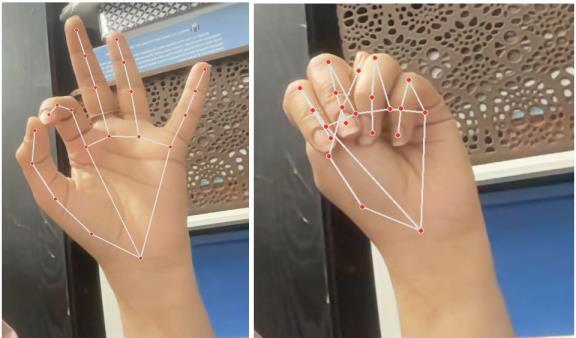
MediaPipe has emerged as the industry standard for real-time hand detection. It offers a lightweight and efficient platform capable of detecting 21 landmarks on the hand with high accuracy [5, 7]. By providing a "contactless communication" bridge, MediaPipe allows researchers to build systems that are invariant to scale androtation[21].
While machine learning algorithms (SVM, Random Forest, etc.) are effective at classifying static hand gestures, their application in real-time sentence formationislessexplored.Mostexistingworkfocuseson isolated alphabets or gestures [13, 15]. Forming completesentencesinvolvestemporalcomplexities,such as handling repeated gestures and providing a robust mechanismforwordsegmentation[16].
Despite the progress detailed in the literature, several criticallimitationspersistincurrentSLRresearch:
1. Focus on Isolated Gestures: A significant portion of research remains restricted to recognizing single characters, failing to addressfluidsentenceformation[12,16].
2. Hardware Constraints: Many high-accuracy systems still require specific camera configurations (e.g., TOF or IR cameras) [18, 22].
3. DatasetGaps:Pre-existingdatasetsoftenlack the real-world noise encountered in live environments.
4. Lack of User Control Logic and Multi-Modal Output: Many systems do not include intuitive "control gestures" (like Space and Delete)ortext-to-speech(TTS)conversion.A
notable gap in the researched subject is that no previous research paper has successfully integrated real-time text-to-speech conversion in a lightweight, skeleton-based framework.Thisresearchsolvesthisproblem by providing immediate auditory feedback, closing the communication loop for both the senderandthereceiver.
Thecurrentprojectaddressesthesegapsbyproposinga lightweight, Python-based system that utilizes the MediaPipe Hand Skeleton as its core feature extractor. By incorporating real-time data collection and specific logic for sentence formation, this system provides a practicalandscalablesolution.
This section describes the systematic approach to the development of the sign language illustration system, including real-time data acquisition, skeleton-based landmark detection, feature extraction, model training, andsentenceformationlogic.
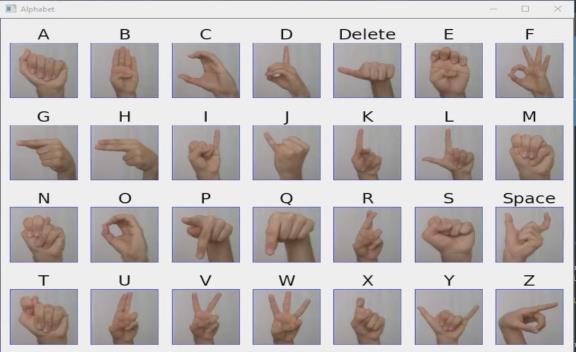
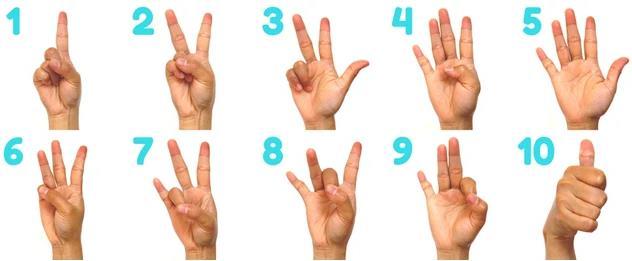
A new dataset was created to accommodate the intricaciesofstatichandgesturesforall26alphabets(AZ),numbersrangingfrom1to10,andalistof8-10basic words used in communication, along with "Space" and "Delete"commands.Unlikeusingpre-existingdatasetsof static images, this dataset was created using a live feed fromawebcam.
Interactive Capture: A new interface was created that allowed the user to input each gesture in front of a live webcam feed. For each symbol or word, a total of 30 different instances were captured. This figure was specifically chosen since many sign language gestures are similar in nature (the distinction between 'M', 'N', and 'T' is very minor). It is believed that this will allow the model to be able to detect these gestures by capturingsufficientvariance.
Direct Landmark Recording: Using the MediaPipe library, the $(x, y, z)$ coordinates of the hand's landmarks were directly recorded and saved in a structured format (such as CSV) directly from the live feed. This ensured that the data that was captured matched perfectly with the environmental conditions and sensor characteristics that will be present at the timeofactualdeployment.
Data Diversity: There were several samples for each class,takenwithdifferenthandpositions,distances,and small rotations, in order to increase the generalization
International Research Journal of Engineering and Technology (IRJET) e-ISSN: 2395-0056
Volume: 13 Issue: 03 | Mar 2026 www.irjet.net p-ISSN: 2395-0072
capability of the model, where there are a total of about 1,300to1,400samples.
3.2 Skeleton Tracking and Hand Landmark Model (The Core Component)
The core of the gesture recognition system is the MediaPipe Hands skeletonization model. This component is the primary engine that transforms raw videoframesintoastructuredgeometricrepresentation ofthehand.
3.2.1 MediaPipe Skeleton Architecture
MediaPipe employs a machine learning pipeline to achieve high-fidelity hand tracking. In each video frame, it locates a total of 21 hand landmarks (key points), which represent the "skeleton" of the hand. The hand landmarksarenumberedasfollows:
Wrist(0):Thebaseofthehand.
Thumb(1-4):FourlandmarksfortheCMC,MCP,IP,and tipofthethumb.
Index Finger (5-8): Four landmarks for the MCP, PIP, DIP,andtipoftheindexfinger.
Middle Finger (9-12): Four landmarks for the MCP, PIP, DIP,andtip.
Ring Finger (13-16): Four landmarks for the MCP, PIP, DIP,andtip.
Pinky Finger (17-20): Four landmarks for the MCP, PIP, DIP,andtip.
3.2.2
In each of the landmarks, the coordinates $(x, y, z)$ are obtained. Here, the coordinates $(x, y)$ represent the landmark position in the image space and are normalized in the range $[0.0, 1.0]$ based on the image width and height. In the same way, the $z$ coordinate represents the landmark depth with the wrist as the reference point. This 3D skeletal model makes the system robust with the changes in the size of the hand (depth) and rotation using a threshold of 0.3 for precision.
The extracted 21 landmarks were converted into a 1D featurevectorfortheinputofthemodel:
Normalization: Normalization was performed by normalizingthecoordinatesrelativetoareferencepoint (such as the wrist landmark) to ensure scale and translationinvariance.
Flattening: The 21 landmarks were flattened into a 63dimensional feature vector, where each landmark has 3 coordinates.
Serializationwith Joblib:Joblibwasusedtoserializethe trainedmachinelearningmodelforefficientdeployment in real-time inference without the need for re-training themodel.
The supervised learning Random Forest classifier was trainedontheself-collectedreal-timedataset.
Training Process: The labeled feature vectors were split intoa setfortraininganda setfortesting.Theclassifier wastrainedtomatchthe63-dimensionalfeaturevectors tothecorrespondingalphabet,number,orword.
Optimization:Thetrainingwasoptimizedtoensurethat the classifier minimizes the classification error for visually similar signs, such as 'A', 'S', and 'M', by
International Research Journal of Engineering and Technology (IRJET) e-ISSN: 2395-0056
Volume: 13 Issue: 03 | Mar 2026 www.irjet.net p-ISSN: 2395-0072
analyzing the distributions of the features collected in the real-time phase. It was observed that the classifier has a perfect accuracy and F1-score of 1.00 on the test set.
The system uses a temporal logic to make the predictions on individual gestures into a coherent sentence. In the Character Recognition section, the system predicts the character in each frame with high confidence,stabilitybuffertoavoidflickeringandwrong key entries, where a character is "appended" to the sentence only if it is stable for a certain number of frames (e.g., 20-30 frames), and the alphabets are concatenatedinreal-timeanddisplayedasasentenceon
3.6 Text-to-Speech (TTS) Conversion
In order to bridge the gap between visual recognition and auditory communication, a Text-to-Speech module was incorporated. Once the sentence is finalized or a specific "Speak" command is invoked, the system uses the gTTS library to transform the text string into an audio stream. The audio stream is then played in realtime using the Pygame library. This dual form of output enables the system not only to assist the hearingimpaired but also to facilitate the communication needs ofindividualswithspeechdisabilitiesthroughvocalizing thegesturestheymake.
The proposed system will employ a variety of sophisticated technologies to ensure the efficiency of signlanguagerecognitionandinterpretationinrealtime. TheproposedsystemwillbedevelopedusingthePython programming language, which can be easily adapted to accommodate different programming libraries. The proposed system will employ OpenCV to ensure the visualization of sign language. This ensures efficiency of thesignlanguageintheproposedsystem.Theproposed system will employ MediaPipe to ensure the accurate detection of the hand, which plays a critical role in recognizingthe patternsin signlanguage. The proposed systemwillemployaclassifiertorecognizethealphabet in sign language. Joblib will be used to serialize the model, whichensuresthe model canbesavedforfuture
use without having to train the model. The proposed system will also employ a sentence formation mechanism to ensure the interpretation of the alphabet toformmeaningfulwordsorsentences.
The explanation of the sign language illustration system also shows the practicality of using static hand gestures for interpretation. This is because the system can recognize all 26 alphabets and also include space and delete commands. This is important because it ensures that there is no interruption in communication. This is usuallyaprobleminsuchsystems.
The use of Mediapipe for hand landmark detection is also important because it ensures that there is precise detectionof handgestures. ThisisalsobecauseJoblibis used for model management. This shows that it is importanttoensurethatthereispropermanagementof modelstoensurethattheyareefficient.
The accuracy of the model in distinguishing between static gestures also shows that it can recognize slight variations in hand shapes. This is important because it ensures that there is no error in recognizing alphabets. However, the limitations that were experienced in distinguishingbetweengesturesalsoshowthatthereisa problem with static hand gestures. These problems indicate that, even though the system has a firm base in static recognition, the addition of dynamic gesture analysis could enhance the robustness of the system in real-worldapplications.
Moreover, the addition of the space and delete commands not only improves the sentence construction but also demonstrates a user-centric design philosophy by addressing the needs that a user may have in a system. This addition improves the usability and practicality of the system, making it more accessible to the end user, who may be in need of the sign language forcommunication.
When comparing the proposed system to existing sign languagerecognitiontechnology,itdemonstratesamuch simpler solution that could be scaled up for greater functionality.Theemphasisonstaticgesturesmakesthe system easier to deploy, which would be advantageous inawiderscopeofapplications.
International Research Journal of Engineering and Technology (IRJET) e-ISSN: 2395-0056
Volume: 13 Issue: 03 | Mar 2026 www.irjet.net p-ISSN: 2395-0072
Some of the possible improvements that could be made in the future to this sign language illustration system include the addition of two-hand gesture recognition, thus enabling the system to interpret more complex signs. Further, the addition of dynamic gesture recognition would be beneficial, thus enabling the system to interpret hand movements. This would be instrumental in addressing one of the challenges associated with rapid change in gestures. Yet another possibleenhancementthatcouldbemadetothissystem istheadditionoftext-to-audiooutput,thusenablingthe user to hear what is being said, thus enhancing its accessibility.
Thesignlanguageillustrationsystemshowsa comprehensiveandeffectiveapproachtorecognizeand translatestatichandgesturestotheircorresponding alphabetsandcreatemeaningfulsentences.Byusing PythonlibrarieslikeMediaPipeforprecisedetectionof handlandmarksandJoblibforefficientserializationand loadingofmodels,thesystemhasshownasuccessful recognitionofall26alphabetsfromAtoZ,numbers from1to10,somecommunicationwords,andtwo criticalcontrolwords:spaceanddelete.Thesecontrol wordsareveryhelpfulinstructuringsentencesand correctingerrors,respectively.
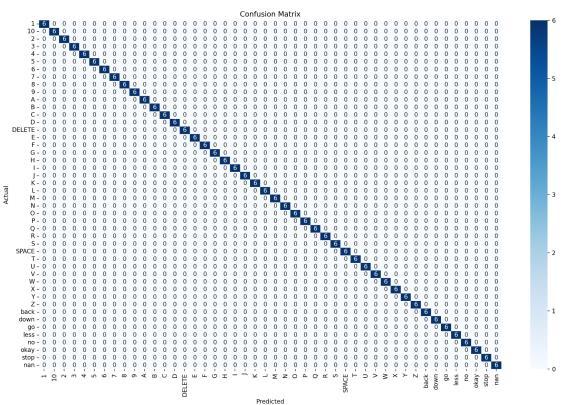
This matrix represents the performance of your sign language recognition model over various classes of objects (alphabets, numbers, and special signs such as space,delete,stop,etc.).Thediagonallinewiththevalue 6indicatesthatthemodelhascorrectlyclassifiedallthe test cases for each class of objects. In other words, the predictedlabelsoftheobjectsarethesameastheactual labels.Alltheothercellsofthematrix arefilledwiththe value 0, indicating that the model is not confusing any two objects. This is a clear indication of the excellent performance of the model with almost 100% accuracy andprecisionintheclassificationoftheobjects.Inother words,yourmodelisworkingcorrectlyinthesensethat itisrecognizingallthesignswithoutanyerrors.
The accuracy and precision of the gesture recognition model indifferentiatingbetweenthevariousstatichand positions were remarkable. This accuracy of the model played a vital role in the correct identification of the alphabets, as the identification of alphabets is the base forthecorrectformationofsentences.
Moreover, the performance evaluation of the system indicatesthatthesystemisfunctioningwithlowlatency andishencehighlysuitableforthedevelopmentofrealtime systems, particularly as a communication aid for the hearing-impaired community. Moreover, the model hasshownoutstandingresultsintheevaluation process with an accuracy of 1.00 for 276 samples overall and perfect precision, recall, and F1 score of 1.0 each. Additionally, the macro and weighted averages of the model's performance indicate the overall consistency of the model in the classification of all the classes, indicating that the system is highly reliable and can accurately identify the sign language gestures without anyerrors
In the development of the system, various classes of differentlibrarieshavebeenutilizedincombinationwith thedevelopment ofa customclassinordertodevelop a complete real-time system. A custom VideoProcessor class has been developed by extending the VideoTransformerBase class of the streamlit-webrtc library in order to process the video in real-time. In the development of the machine learning module of the system, the RandomForestClassifier class of the scikitlearn library has been utilized in order to classify the hand gestures of the users. To ensure stability in predictions, data structures like 'deque' and 'Counter' from'collections'wereusedforsmoothingandselecting the most frequent prediction. Also, 'Hands' class from MediaPipe was used for detecting hand landmarks and obtaining significant features. These components were used for efficient gesture recognition, prediction, and interactionintheapplication.
International Research Journal of Engineering and Technology (IRJET) e-ISSN: 2395-0056
Volume: 13 Issue: 03 | Mar 2026 www.irjet.net p-ISSN: 2395-0072
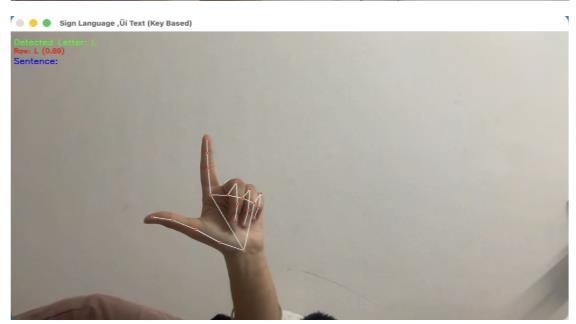
Fig -7: Letter Detection
Therefore, the project has successfully established a framework for the automation of sign language interpretation using static gesture recognition. The addition of the space command as well as the delete command has made the interface more natural, hence making it more effective in the communication process. This is a stepping stone towards further improvements inthesamearea,whichcouldleadtotheenhancementof accessibilityforthehearing-impaired.
The sign language illustration system developed in this project has successfully demonstrated its capability to recognize and translate static hand gestures into the corresponding alphabets, as well as form meaningful sentences. This has been achieved through the effective
[1] M. A. Abdel-Fattah, "Arabic sign language: A perspective,"JournalofDeafStudiesandDeafEducation, vol.10,no.2,pp.212–221,Apr.2005.
[2] L. Lee, "The Importance of Learning Deaf Culture through a Black Deaf Perspective in the Field of Communication Sciences and Disorders," Research Report,2022.
[3] S. Colibaba, I. Gheorghiu, A. Colibaba, O. Ursa, C. Antonic, and R. Cirmari, "The Voice Project: Habilitating Hearing-ImpairedChildrentoRecoverHearingandLead a Normal Life," in 2022 E-Health and Bioengineering Conference(EHB),IEEE,2022,pp.1–4.
[4] Y. Xusnora and A. Yulduz, "Ways to develop vocabulary in children with hearing impairment," in E ConferenceZone,2022,pp.229–230.
[5] Y. Farhan, A. A. Madi, A. Ryahi, and F. Derwich, "AmericanSignLanguage:DetectionandAutomaticText Generation," in 2022 2nd International Conference on InnovativeResearchinAppliedScience,Engineeringand Technology(IRASET),IEEE,2022,pp.1–6.
[6] S. H. Hamerdinger and C. J. Crump, "Sign language interpreters and clinicians working together in mental
utilization of Python programming libraries like Mediapipe to ensure accurate hand landmark detection and Joblib to efficiently handle model management. Through these developments, the system has been able torecognizeall the26alphabets,aswell asvital control commands like space and delete. This has significantly enhanced the naturalness of the sign language illustration system, making it a very effective tool for communication.
The high accuracy and low latency observed in the performance of the sign language illustration system have significantly demonstrated its potential for use in real-world applications, especially in helping the hearing-impaired community. Although there are still a few challenges to be addressed, especially in dealing with ambiguous hand gestures, the foundation establishedinthisworkhaslaidaveryeffectiveplatform forfuturedevelopments.
On the whole, this project makes a significant contribution to the development of automated sign language interpretation, which will go a long way in enhancing accessibility as well as effective communicationforindividualswhousesignlanguageas ameansofcommunication.
health settings," Routledge Handbook of Sign Language TranslationandInterpretation,2022.
[7] A. S. Dhanjal and W. Singh, "An optimized machine translation technique for multi-lingual speech to sign language notation," Multimedia Tools and Applications, vol.81,no.17,pp.24099–24117,2022.
[8] S. A. Khan, "Importance of hearing and hearing loss treatment & recovery," IJSA, vol. 3, no. 1, pp. 14–16, 2022.
[9] K. Aashritha and V. M. Manikandan, "Assistive Technology for Blind and Deaf People: A Case Study," in Machine Vision and Augmented Intelligence: Select ProceedingsofMAI2022,Springer,2023,pp.539–551.
[10] J. M. Power, G. W. Grimm, and J.-M. List, "Evolutionary dynamics in the dispersal of sign languages,"RoyalSocietyOpenScience,vol.7,no.1,Jan. 2020,Art.no.191100.
[11] U. Farooq, M. S. M. Rahim, N. Sabir, A. Hussain, and A. Abid, "Advances in machine translation for sign language: Approaches, limitations, and challenges," Neural Computing and Applications, vol. 33, no. 21, pp. 14357–14399,Nov.2021.
International Research Journal of Engineering and Technology (IRJET) e-ISSN: 2395-0056
Volume: 13 Issue: 03 | Mar 2026 www.irjet.net p-ISSN: 2395-0072
[12] M. Raja’a, M. Mohammed, and S. M. Kadhem, "Automatic translation from Iraqi sign language to Arabic text or speech using CNN," Iraqi Journal of Computers, Communications, Control and Systems Engineering,vol.23,pp.112–124,Jun.2023.
[13]M.Mukushev,A.Sabyrov,A.Imashev,K.Koishybay, V. Kimmelman, and A. Sandygulova, "Evaluation of manual and non-manual components for sign language recognition," in Proceedings of the International Conference on Language Resources and Evaluation, 2020,pp.6073–6078.
[14]K.Wong,R.Dornberger,andT.Hanne,"Ananalysis of weight initialization methods in connection with different activation functions for feedforward neural networks," Evolutionary Intelligence, vol. 17, no. 3, pp. 2081–2089,Jun.2024.
[15] H. Luqman and E.-S.-M. El-Alfy, "Towards hybrid multimodal manual and non-manual Arabic sign language recognition: MArSL database and pilot study," Electronics,vol.10,no.14,p.1739,Jul.2021.
[16] B. Fang, J. Co, and M. Zhang, "DeepASL: Enabling ubiquitous and nonintrusive word and sentence-level sign language translation," in Proceedings of the 15th ACM Conference on Embedded Networked Sensor Systems,Nov.2017,pp.1–13.
[17] H. Kaur and J. Rani, "A review: Study of various techniques of Hand gesture recognition," in Proceedings ofthe2016IEEE1stInternationalConferenceonPower Electronics, Intelligent Control and Energy Systems (ICPEICES),Delhi,India,Jul.4–6,2016,pp.1–5.
[18]J.S.Sonkusare,N.B.Chopade,R.Sor,andS.L.Tade, "A review on hand gesture recognition system," in Proceedings of the 2015 International Conference on Computing Communication Control and Automation, Pune,India,Feb.26–27,2015,pp.790–794.
[19] G. R. S. Murthy and R. S. Jadon, "A review of vision based hand gestures recognition," International Journal ofInformationTechnologyandKnowledgeManagement, vol.2,pp.405–410,2009.
[20] P. Garg, N. Aggarwal, and S. Sofat, "Vision based hand gesture recognition," World Academy of Science, EngineeringandTechnology,vol.49,pp.972–977,2009.
[21] M. Oudah, A. Al-Naji, and J. Chahl, "Hand Gesture Recognition Based on Computer Vision: A Review of Techniques,"JournalofImaging,vol.6,no.8,p.73,2020.
[22]A.OsmanHashi,S.ZaitonMohd Hashim,and A.Bte Asamah, "A Systematic Review of Hand Gesture
Recognition: An Update From 2018 to 2024," IEEE Access,vol.12,pp.143599–143626,2024.
2026, IRJET | Impact Factor value: 8.315 | ISO 9001:2008