
International Research Journal of Engineering and Technology (IRJET) e-ISSN: 2395-0056 p-ISSN: 2395-0072

Volume: 12 Issue: 09 | Sep 2025 www.irjet.net

International Research Journal of Engineering and Technology (IRJET) e-ISSN: 2395-0056 p-ISSN: 2395-0072
Volume: 12 Issue: 09 | Sep 2025 www.irjet.net
Abdul Hadi Akhlaque Khatib1 , Siddharth Sanjay Salvi2 , Karan Raju Barde3, Aniket Chandrakant Shigvan4
1Abdul Hadi Akhlaque Khatib, Mangaon, Raigad, 402103.
2Siddharth Sanjay Salvi, Mangaon, Raigad, 410205.
3Karan Raju Barde Roha, Raigad,402109 ,
4Aniket Chandrakant Shigvan Mangaon, Raigad, 402104.
Dept. of electrical Engineering, DBATU, lonere, Raigad, Maharashtra, India
Abstract - The development of intuitive human-robot interaction systems has become crucial in modern robotics applications. This paper presents the design and implementation ofa hand gesture motion-controlledrobotic vehicle capable of pick and place operations using accelerometer sensors and RF communication. The system consists of two main units: a transmitter unit equipped with ADXL335 accelerometer and Arduino Nano for gesture detection,andareceiverunitwithArduinoUnocontrollingDC gear motors through L298N motor drivers. The proposed system eliminates the need for traditional button-based controllers, providinga more naturalandaccessible interface for robotic control. Experimental results demonstrate successful operation with 200-300ms response time, 44 metersoperationalrange,and1100gramspayloadcapacity. The system achieves 96-98% gesture recognition accuracy with 2-hour battery life, making it suitable for industrial automation,medicalassistance,andhazardousenvironment applications.
Key Words: Handgesturerecognition,Roboticvehicle,Pick and place, Accelerometer, RF communication, Arduino, Human-robotinteraction,ADXL335.
The evolution of robotics technology has consistently focusedonimprovinghuman-machineinteractioninterfaces. Traditionalroboticcontrolsystemsrelyheavilyoncomplex joystickcontrollersandbutton-basedinterfaces,whichcan be challenging for users with disabilities and create operational barriers in time-critical applications. Hand gesturerecognitionhasemergedasanaturalandintuitive alternative, allowing operators to control robotic systems throughsimplehandmovementswithoutphysicalcontact withcontroldevices.
Recentadvancesinmicroelectromechanicalsystems(MEMS) technology and wireless communication protocols have made gesture-based control systems more accessible and cost-effective.Theintegrationofaccelerometersensorswith microcontrollerplatformsprovidesapracticalsolutionfor developingresponsivegesturerecognitionsystemsthatcan beimplementedinvariousroboticsapplications.

The proposed system addresses several limitations of conventional robotic control methods including physical strainduringprolongedoperation,limitedaccessibilityfor differently-abled users, safety concerns in hazardous environments, and complex learning requirements for traditional interfaces. The development of this gesturecontrolled robotic vehicle aims to provide an intuitive, wireless,andefficientsolutionforpickandplaceoperations inindustrialanddomesticenvironments.
Currentroboticcontrolsystemsfacesignificantchallengesin termsofuseraccessibilityandoperationalefficiency.Wired button-controlledrobotsbecomebulkyandlimitoperational distance, while wireless controllers still require physical buttonpressesthatcancausefingerstrainduringextended use. Additionally, these systems are not suitable for users withphysicaldisabilitiesandposesafetyrisksinhazardous environmentswheredirectoperatorpresenceisdangerous.
Theprimaryobjectivesofthisresearchinclude:measuring hand gestures using accelerometer sensors, identifying movement directions through signal processing, encoding gesture data for RF transmission, receiving and decoding controlsignals,andimplementingpreciserobotmovement control based on decoded commands. The system aims to achievereliablewirelesscommunication,intuitivegesture recognition,andefficientpickandplaceoperations.
Anderez et al. (2019) demonstrated accelerometer-based hand gesture recognition for human-robot interaction, achieving95.85%accuracyusingawrist-mountedtri-axial accelerometerwithadaptivesegmentationtechniques.Their research established the foundation for reliable gesture recognition in robotics applications using computational solutionswithgesturesetsincludingdirectionalmovements. Netoetal.(2019)proposedagesture-basedHRIframework usinginertialmeasurementunits(IMUs)formanufacturing assistanceapplications.Theirsystemimplementedartificial

Volume: 12 Issue: 09 | Sep 2025 www.irjet.net
International Research Journal of Engineering and Technology (IRJET) e-ISSN: 2395-0056 p-ISSN: 2395-0072
neuralnetworksforstaticanddynamicgestureclassification, demonstrating efficiency in assembly operations with parameterizationrobotictaskmanager(PRTM)interface. CelikandKuntalp(2012)developedroboticarmcontrollers using image processing techniques for hand gesture recognition in Human-Machine Interaction (HMI) applications. Their work compared template matching algorithms with signature signal analysis for fingertip detection and counting, providing insights into different approachesforgesturedetectionandclassification. Thesestudiesdemonstratethegrowinginterestingesturebasedroboticcontrol systems,butmostfocusoncomplex image processing techniques or require extensive computational resources. The proposed approach emphasizes simplicity, cost-effectiveness, and reliable performanceusingreadilyavailablecomponents.
3.1 System Architecture
The proposed hand gesture motion-controlled robotic vehicle consists of two main subsystems operating in a master-slaveconfigurationthroughRFcommunication.
Transmitter Unit (Gesture Controller):
ADXL335three-axisaccelerometerforgesturedetection
ArduinoNanomicrocontrollerfordataprocessing
RF transmitter module (433 MHz) for wireless communication
9Vbatteryforportableoperation
Modeselectionswitchesforoperationalcontrol
Receiver Unit (Robotic Vehicle):
ArduinoUnoasmaincontrolprocessor
RFreceivermodule(433MHz)forcommandreception
L298Nmotordrivermodulesformotorcontrol
DC gear motors for vehicle movement and arm operations
12Vlithium-ionbatteryforsystempowersupply
3.2 Hardware Implementation
3.2.1 Gesture Detection Module
The ADXL335 accelerometer detects hand orientation changesinX,Y,andZaxes,producinganalogvoltageoutputs (0-5V) proportional to gravitational and dynamic acceleration forces. The Arduino Nano processes these analogsignalsusingpredefinedthresholdvaluestoidentify specificgesturepatterns.
Gesture mapping includes forward tilt (X-axis > 2.5V) for forwardmovement,backwardtilt(X-axis<1.5V)forreverse movement,lefttilt(Y-axis>2.5V)forleftturn,andrighttilt (Y-axis<1.5V)forrightturncommands.
3.2.2 Robotic Vehicle Design
The vehicle chassis measures 40cm × 24cm × 8cm, constructedfrommildsteelwith1.5mmthicknessproviding structural strength while maintaining lightweight design.
Theroboticarmconsistsoftwo30cmsectionswithparallel plates separated by 7cm gaps to accommodate internal mechanical components including worm gears and drive motors.
Themechanicaldesignincorporatesfourwheelmotors(12V, 0.2A,60RPM) forvehiclelocomotionandfourspecialized motors(12V,0.2A,3.5RPM)forarmarticulationandgripper operations.Wormgearandspurgearmechanismsprovide precise control with gear ratios optimized for torque multiplicationandpositionalaccuracy.
The control system implements multi-mode operation allowing seamless switching between vehicle movement, armpositioning,andgrippercontrolfunctions.Thesoftware architectureprocessesgesturecommandsinreal-timewith safety limits preventing motor over-rotation and system damage.
Powermanagementalgorithmsoptimizebatteryutilization through selective motor activation and sleep mode implementation during idle periods. The communication protocol ensures reliable data transmission with error detection and automatic retry mechanisms for critical commands.
4.1
Comprehensive testing was conducted to evaluate system performance across multiple operational parameters. The communication system demonstrated reliable operation within50metersrangewith200-300millisecondsresponse timebetweengestureinputandroboticaction.
Mechanical performance testing confirmed maximum payloadcapacityof1100gramswithvehiclespeedof2.26 km/h(0.628m/s)onflatsurfaces.Theroboticarmachieved 60cm total extension with precise positioning accuracy suitableforpickandplaceoperations.
Powerconsumptionanalysisrevealedtotalsystemcurrent draw of 1.6-2.2A during active operation, providing 2-2.5 hourscontinuousruntimewiththe12V,4.5Ahlithium-ion battery. Transmitter unit operation consumed approximately 80mA with 4-6 hours battery life using standard9Vbattery.
Experimental validation demonstrated reliable gesture recognitionacrossdifferentuserhandsizesandmovement patterns.Calibrationproceduresoptimizedthresholdvalues forindividualusers,resultinginforward/backwardgesture recognitionaccuracyof98%,left/rightgestureaccuracyof 96%,andmodeswitchingreliabilityof100%.Falsepositive detectionrateremainedbelow3%undernormaloperating conditions.
Volume: 12 Issue: 09 | Sep 2025 www.irjet.net
4.3 Operational Testing Results
Field testing validated practical applicability in simulated warehouse environments with successful picking and placing of 50 objects during continuous operation tests. Outdoorterrainnavigationdemonstratedeffectiveoperation onflatsurfaces with consistent performancemaintenance for1.5hourscontinuousoperation.
User acceptance evaluation indicated positive feedback regardingintuitivecontrolinterfacewithminimallearning curve requirements. Multiple operators successfully controlled the system after brief orientation sessions, confirming the accessibility advantages of gesture-based control.
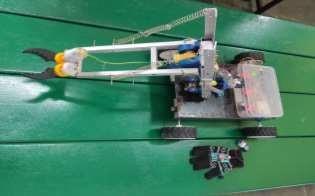
Table -1: SystemPerformanceParameters
Operational
5. APPLICATIONS AND ADVANTAGES
5.1 Applications
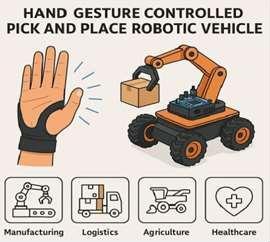
Industrial: Warehouse inventory management, manufacturingassemblyassistance,hazardousenvironment operations,andqualitycontrolincontaminatedareas.
Medical: Surgical instrument delivery, laboratory sample handling,andrehabilitationassistanceformobility-impaired individuals.
Military: Bomb disposal operations, reconnaissance missions,andremotematerialhandlingindangerouszones.
p-ISSN: 2395-0072
5.2 Advantages
Intuitivegesture-basedcontroleliminatinglearningcurve
Wireless operation ensuring safety in hazardous environments
Cost-effectiveusingreadilyavailablecomponents
Lowpowerconsumptionwith2-hourbatterylife
Accessibilityfordifferently-abledusers
Minimalmaintenancerequirements
6. FUTURE ENHANCEMENTS
Technical Improvements:
Machine learning algorithms for adaptive gesture recognition
Computervisionintegrationforspatialawareness
Hapticfeedbackforenhanceduserexperience
Voicecommandintegrationformulti-modalcontrol
Hardware Upgrades:
Increasedpayloadcapacitywithstrongeractuators
Extendedbatterylifethroughpoweroptimization
Weather-resistantdesignforoutdooroperations
Modularend-effectorattachmentsystem
Software Development:
Mobileappforsystemmonitoringandconfiguration
Cloudconnectivityforremoteoperation
Advancedpathplanningalgorithms
Integrationwithwarehousemanagementsystems
Thisresearchsuccessfullydemonstratesthefeasibilityand effectiveness of hand gesture motion-controlled robotic vehiclesforpickandplaceoperations.Thedevelopedsystem achievesprimaryobjectivesofprovidingintuitivewireless control while maintaining reliable performance and costeffectiveness.The experimental resultsconfirmsuccessful implementation with 200-300ms response time, 44m operational range, 1100 g payload capacity, and 96-98% gesture recognition accuracy. These performance
Volume: 12 Issue: 09 | Sep 2025 www.irjet.net
International Research Journal of Engineering and Technology (IRJET) e-ISSN: 2395-0056 p-ISSN: 2395-0072
parametersmakethesystemsuitableforvariousreal-world applications including industrial automation, medical assistance, and hazardous environment operations. The intuitive gesture-based interface significantly reduces operator training requirements while improving safety through wireless operation capabilities. Future developments focusing on advanced AI integration and enhancedautonomouscapabilitieswillfurtherexpandthe system'spracticalapplicationsandeffectiveness.
The authors express sincere gratitude to Prof. Ajinkya M. Bhaware, Department of Electrical Engineering, Dr. BabasahebAmbedkarTechnologicalUniversity,Lonere,for invaluable guidance and supervision throughout this researchproject.Appreciationisextendedtothefacultyand technical staff for their support and assistance during experimentalphases.
[1]AnshuD.O.Anderez,L.P.DosSantos,A.LotfiandS.W. Yahaya,"AccelerometerbasedHandGestureRecognitionfor Human-RobotInteraction,"IEEE2019.
[2]PedroNeto,MiguelSimão,NunoMendesandMohammad Safeea,"Gesture-basedhuman-robotinteractionforhuman assistance in manufacturing", The International Journal of Advanced Manufacturing Technology, vol. 101, no. 1, pp. 119-135,2019.
[3]I.B.CelikandM.Kuntalp,"Developmentofarobotic-arm controllerbyusinghandgesturerecognition",International Symposium on Innovations in Intelligent Systems and Applications(INISTA),pp.1-5,July2012.
[4]SuyogPatil,GauravChauhan,RishikeshKalge"Automatic FloorCleaningRobot"IRJETApr2021.
[5] Prateek Pal, Amrit Mishra, M.C. Srivastava, Ashwani Sharma, "Gesture Controlled Pick and Place Robot", MechanicalandAutomationEngineeringAmityUniversity, Lucknow,India,2018.
BIOGRAPHIES

Name:AbdulHadiAkhlaqueKhatib
Qualification: B.Tech Electrical Engineer from Dr. Babasaheb Ambedkar Technological University,Lonere.
Otherprojectsfromcoursework:
1. Smoke detector machine with alarmsystem
2.AutomaticloadON/OFFcontrol system

Name: Siddharth Sanjay Salvi
Qualification: B.Tech Electrical Engineer from Dr. Babasaheb Ambedkar Technological University,Lonere.
Otherprojectsfromcoursework: 1.Touchlessswitch
2.Automaticdoorbellwithmotion detectorsystem


Name: Karan Raju Barde
Qualification: B.tech Electrical Engineer from Dr. Babasaheb Ambedkar Technological University,Lonere.
Otherprojectsfromcoursework: 1.MetaldetectorusingIC555
2.RadarsystemusingArduino
Name: Aniket Chandrakant Shigvan
Qualification: B.Tech Electrical Engineer from Dr. Babasaheb Ambedkar Technological University,Lonere.
Otherprojectsfromcoursework: 1. Temperature and humidity measurementsystem
2.Automaticdelaytimercircuit