
International Research Journal of Engineering and Technology (IRJET) e-ISSN: 2395-0056
Volume: 11 Issue: 12 | Dec 2024 www.irjet.net p-ISSN: 2395-0072

International Research Journal of Engineering and Technology (IRJET) e-ISSN: 2395-0056
Volume: 11 Issue: 12 | Dec 2024 www.irjet.net p-ISSN: 2395-0072
Dr. Sanjay M. Malode1 , Ms. Achal S. Tidke2 , Ms. Prachi S. Gedam3 , Mr. Harshad R. Choudhari4 , Mr. Harshal S. Raut5
1Professor and HOD, Artificial Intelligence and Data Science, K.D.K College Of Engineering Nagpur, Maharashtra, India. 2345Student, Computer Science and Engineering, K.D.K College Of Engineering Nagpur, Maharashtra, India.
Abstract - The digital era continually reshapes how democratic processes are conducted. Traditional and electronic voting systems, though pivotal in shaping democratic outcomes, often grapple with concerns about security, transparency, and accessibility. This research paper introducesanovelblockchain-basedvotingsystemdesignedto addressthesecriticalvulnerabilities.UtilizingtheMERNstack (MongoDB, Express.js, React.js, Node.js), Ganache for simulating a local blockchain environment, and Web3.js for interactions with the blockchain, this system leverages the inherent security, immutability, and transparency properties of blockchain technology. Our proposed system promises to revolutionize the voting process by ensuring that every vote cast is not only secure but also verifiable and transparent. It eliminates reliance on central authorities, reducing risks of tampering and fraud, and facilitates a user-friendly platform that is accessible to a broad user base. The development approach is detailed, involving rigorous testing phases that ensure the system's reliability and security before full-scale deployment. By enabling a tamper-proof and transparent ledger of recorded votes, the system enhances voter trust and engagement, potentially increasing turnout andthe integrity ofelectoralprocessesglobally.Thispaperaimstocontributeto the discourse on technology's role in enhancing democratic processes by offering a scalable, secure, and transparent methodofvoting,pavingthewayforfutureinnovationsinthe domain of digital democracy
Key Words: Digital era , Democratic processes, Traditional voting systems, Electronic voting systems, Security concerns, Transparency concerns.
Votingisafoundationalelementofdemocraticgovernance, enablingtheexpressionofthepopularwillandtheselection ofleadership.However,associetiesandtechnologiesevolve, thesystemsusedtocaptureandreflectthewillofthepeople mustalsoprogress.Thispaperpresentsablockchain-based voting system designed to enhance the security, transparency, and accessibility of voting processes, addressingtheinherentdeficienciesfoundintraditionaland electronicvotingsystems(EVMs).
A voting system encompasses the methods and processes usedtocollect,count,andvalidatevotesduringanelection. Ideally, a voting system must be accessible, transparent, secure,andcapableofaccuratelyreflectingtheintentionsof voters.Itshouldensureconfidentiality,provideaverifiable audittrail,and prevent unauthorized actions such as vote tamperingorduplication.
Traditional voting systems typically involve paper ballots or mechanical devices that voters use torecord their votes. These votes are then manually countedand verifiedbyelectionofficials.Whilethismethodhas been the standard for centuries, it is fraught with challenges. Paper-based systems are vulnerable to human error during the countingprocessandlogisticalissuessuchasthe distribution,storage,anddisposalofballots.Theyarealso susceptibletotamperingandfraud,includingballotstuffing andthedestructionofballots.Moreover,manualprocesses aretime-consumingandcostly,requiringsignificanthuman resourcesandlogisticalplanning.
ElectronicVotingMachines(EVMs)wereintroducedasa solutiontotheinefficienciesandvulnerabilitiesoftraditional systems.EVMsautomatethevotingprocess,allowingvotesto be cast and tallied electronically. However, these systems have introduced new complexities and vulnerabilities. Cybersecurityisamajorconcern,asEVMscanbesusceptible tohacking,programmingerrors,andotherelectronicfailures. Instancesofmalfunctioningmachinesanddiscrepanciesin thevotecountshaveunderminedpublictrustintheintegrity ofelections.Furthermore,EVMs donottypicallyprovidea means for voters to verify that their vote was recorded as intended, leading to concerns over transparency and accountability.
Blockchain technology offers a transformative solution to the problems faced by both traditional and electronic voting systems. At its core,blockchain is a
International Research Journal of Engineering and Technology (IRJET) e-ISSN: 2395-0056
Volume: 11 Issue: 12 | Dec 2024 www.irjet.net p-ISSN: 2395-0072
decentralized digital ledger thatrecords all transactions across a network of computers. This ledger is secure and transparent; transactions can be verified by all participants and cannot be altered once recorded. A blockchain-based voting system utilizes this technologyto createanimmutableandtransparentrecordofvotes. Each vote is recorded as a transaction on the blockchain, which provides a verifiable audit trailthatenhancesvoter confidenceandsystemintegrity.
Ourproposedblockchain-basedvotingsystemleverages the MERN stack for application development, Ganache for creating a local blockchain environment, and Web3.js for interactingwiththeblockchain.Thissystemaddresseskey issuessuchasvoteranonymity,security,andtransparency. Thedecentralizednatureof blockchain reduces the risk of tamperingandfraudbyeliminatinganysinglepointoffailure. Oursystemincludessmartcontractsformanagingthevoting process, from voter registration to vote tallying, ensuring that all operations are performedaccordingtopredefined rules that cannot be altered post-deployment. The use of blockchainalsofacilitatesgreateraccessibility,allowingvotes to be cast securely from any location, thereby potentially increasingvoterturnoutandengagement.
A. Building Scalable Web Applications with the MERN Stack
Intherealmofmodernwebdevelopment,creatingrobust andscalableapplicationsrequiresa potentcombinationof technologies.OnesuchpowerfulensembleistheMERNstack, whichcomprisesMongoDB,Express.js,React.js,andNode.js. Thisstackprovidesdeveloperswithacomprehensivetoolkit tobuildsophisticatedwebapplicationscapableofhandling largevolumesofdataanduserinteractions.
B. MongoDB
AttheheartoftheMERNstackliesMongoDB,aleading NoSQL database. Unlike traditional relational databases, MongoDB adopts a document- oriented approach, storing datainflexibleJSON-likedocuments.Thisflexibilityallows developerstoevolvetheirdatamodelovertimewithoutthe constraintsofapredefinedschema.MongoDB'sscalabilityis renowned, making it suitable for applications with rapidly growingdatarequirements.
C. Express.js
Express.js serves as the backbone of server-side development in the MERN stack. Built on top of Node.js, Express.js is a minimalist web application framework designed for building APIs and web applications. Its lightweightnatureandrobustfeaturesempowerdevelopers
to create scalable and efficient server-side solutions. With Express.js,developerscaneasilydefineroutes,handleHTTP requests, and integrate middleware to streamline developmentprocesses.
On the client side, React.js revolutionizes the way user interfaces are built. As a JavaScript library developed by Facebook,React.jsenablesdeveloperstocreatedynamicand interactivesingle-pageapplications(SPAs).Itscomponentbased architecture promotes code reusability and maintainability, allowing developers to efficiently manage complexUIs.React'svirtualDOMenhancesperformanceby minimizingunnecessaryre-renders,resultinginaresponsive userexperienceevenfordata-intensiveapplications.
E. Node.js
Completing the MERN stack is Node.js, a runtime environmentforexecutingJavaScriptcodeoutsideofaweb browser.PoweredbyChrome'sV8JavaScriptengine,Node.js employsanevent-driven,non-blockingI/Omodel,makingit idealforbuildingreal-timeanddata-intensiveapplications. WithNode.js,developerscanleverageJavaScriptonboththe client and server sides, enabling seamless communication and code sharing between the two environments. Its lightweight architecture ensures scalability and efficiency, making ita preferred choicefor building web applications thatcatertoadiverserangeofusersanddevices.
F. Ganache
Intherealmofblockchaindevelopment,Ganacheemerges as a pivotal tool for Ethereum development. Serving as a personal blockchain, Ganache provides developers with a simulated Ethereum network environment for deploying contracts, developing applications, and running tests. Whether as a desktop application or a command-line tool, Ganache simplifies the development process by offering a hassle-freesetupandconfigurationexperience.Aspartofthe Truffle suite of Ethereum development tools, Ganache seamlesslyintegrateswithothertoolstostreamlinetheentire developmentlifecycle.
G. Web3.js
TointeractwiththeEthereumblockchain,developersrely on Web3.js, a comprehensive library that facilitates communication with local or remote Ethereum nodes. SupportingvariouscommunicationprotocolssuchasHTTP, IPC, and WebSocket, Web3.js empowers developers to interact with smart contracts, send Ether, and access blockchain data effortlessly. With its rich set of functionalities, Web3.js serves as the bridge between decentralized applications (DApps) and the Ethereum blockchain,enablingdeveloperstounlockthefullpotentialof blockchaintechnologyintheirapplications.
International Research Journal of Engineering and Technology (IRJET) e-ISSN: 2395-0056
Volume: 11 Issue: 12 | Dec 2024 www.irjet.net p-ISSN: 2395-0072
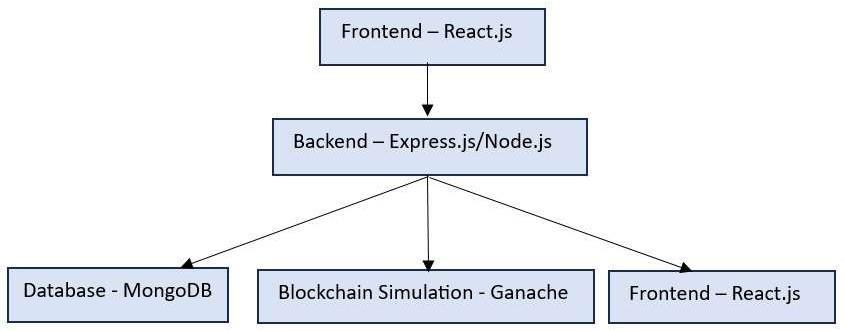
Fig-1:ArchitectureoftheBlockchain-basedVotingSystem
Thearchitectureoftheblockchain-basedvotingsystem integratestheMERNstackalongsideGanacheandWeb3.jsto createarobust,secure,andtransparentelectoralprocess.The systemiscomposedofseveralkeycomponents:
Frontend: The visual interface, built using React.js, is where users both voters and candidates interact with the application. This frontend facilitates an intuitive user experience tailoredtotheneedsoftheelectoralprocess.
Backend: Powered by Express.js running on Node.js, the backend acts as the central logic controller of the application. It handles business logic, database operations, and API services, ensuringthatallcomponentsfunctioncohesively.
Database: MongoDB, a NoSQL database, is utilized to store all persistent data, such as user details, voting records, and election results. Its schema-less nature allows for flexibility and scalabilityinmanagingdata.
Blockchain Simulation: Ganacheisemployedto simulateanEthereumblockchainenvironment.This tool is crucial for developing and testing smart contractsbeforetheyaredeployedinalivesetting.
Blockchain Interaction: Web3.js provides the necessary tools to interact with the blockchain. It facilitatescriticaloperationssuchascastingvotes, registering voters and candidates, and retrieving election results, ensuring that all blockchain interactionsareseamlessandsecure.
The system's workflow is streamlined to ensureuserfriendlinessandsecurity:
User Registration and Authentication: Users begin by registering through the React.js frontend,submittingpersonalinformationlike name, date of birth, Aadhaar number, and photos, along with their Ganache-generated privateandpublickeys.Thisdataisprocessed andstoredsecurelyinMongoDBbythebackend. Web3.js utilizes the Ganache keys for all transactions on the blockchain, linking user identitiestotheirblockchaintransactions.
DashboardAccess: Post-registration,userslogin to access dashboards specific to their roles voter or candidate. Voters input additional demographic details, while candidates enter campaign-related information. This not only enrichestheuser profilebutalso enhances the electoraldata'sintegrity,whichmayberecorded on the blockchain for added transparency and immutability.
Voting Process: During elections, voters select theirpreferredcandidatesthroughthefrontend interface. Votes are processed as transactions viaWeb3.js,callingsmartcontractmethodsthat record each vote on the blockchain to prevent tamperingandensuresecurity.Theblockchain environmentmanagedbyGanacheconfirmsand logseachtransaction.
Result Compilation: Smart contracts on the blockchainincludefunctionsfortallyingvotes. The backend retrieves these results using Web3.js and displays them on the frontend, ensuring that all electoral outcomes are transparent, verifiable, and accepted as legitimatebyallpartiesinvolved
Theblockchain-basedvotingsystem,utilizingtheMERN stack, Ganache, and Web3.js, represents a significant technological advancement in electoral processes. By integratingthesemoderntechnologies,thesystemaddresses critical issues traditionally associated with voting, such as security,transparency,andaccessibility.Thedecentralized nature of blockchain ensures that all votes are recorded securelyandimmutably,makingthesystemhighlyresistant to tampering and fraud. This setup not only boosts voter confidencebutalsoenhancesthelegitimacyoftheelectoral outcomes.
International Research Journal of Engineering and Technology (IRJET) e-ISSN: 2395-0056
Volume: 11 Issue: 12 | Dec 2024 www.irjet.net p-ISSN: 2395-0072
The application's architecture, combining MongoDB, Express.js, React.js, and Node.js, provides a robust and scalableplatformthatefficientlymanagesdataflowanduser interactions. This approach ensures that the system can handle large volumes of data and user traffic, which are common during elections. Ganache plays a crucial role in simulating blockchain environments for development and testing,therebyallowingdeveloperstocreateandrefinethe systeminacontrolledandcost-effectivemanner.
Moreover, the use of Web3.js for blockchain interactions facilitatesaseamlessconnectionbetweentheuserinterface and the underlying blockchain infrastructure, enabling straightforwardandsecurevotingoperations.Thesystem's capacity to allow voters to participate remotely from any location not only increases voter turnout but also makes votingmoreinclusive.
Thisblockchain-basedvotingsystemsetsanewstandardfor electoral integrity and efficiency. Its implementation could significantly impact the future of democratic processes, potentiallyleadingtowideadoptioninvariousgovernmental andorganizationalcontexts.
[1] D.Khude,"OnlineVotingSystemUsingBlockchain Technology,"InternationalJournalforResearchin AppliedScienceandEngineeringTechnology,2023.
[2] Prof.SantoshKumarBiradar,etal.,"SecureDigital VotingSystemonBlockchain,"InternationalJournal of Advanced Research in Science, Communication andTechnology,2023.
[3] D.Kumar, etal.,"SecureElectronicVotingSystem usingBlockchainTechnology,"InternationalJournal ofSmartHome,2018.
[4] Cosmas Krisna Adiputra, et al., "A Proposal of Blockchain-BasedElectronicVotingSystem,"2018 Second World Conference on Smart Trends in Systems, Security and Sustainability (WorldS4), 2018.
[5] Jiayang Yao, et al., "Blockchain Based Voting System,"InternationalJournalofAdvancedTrends inComputerScienceandEngineering,2020.
[6] Ashwathy Menon, Vijayalakshmi Bhagat, "BLOCKCHAINBASEDE-VOTINGSYSTEM,"Indian journalofappliedresearch,2020.
[7] Tushar Ganotra, Sachin Garg, "Voting Application usingBlockchainTechnology,"InternationalJournal for Research in Applied Science and Engineering Technology,2023.
[8] AbhishekSharma,etal.,"BlockchainBasedE-Voting System," International Journal for Research in AppliedScienceandEngineeringTechnology,2022.
[9] S.R,etal.,"Blockchain-BasedOnlineVotingSystem," ECSTransactions,2022
[10] T.Vairam,etal.,"BlockchainbasedVoting systeminLocal Network,"20217thInternational Conference on Advanced Computing and communicationsystem(ICACCS),2021.
[11] Yashpal Soni, et al., "Blockchain Based VotingSystems,"Proceedingsofthe19thEuropean ConferenceonCyberWarfare,2020.
[12] SatyajeetPrakash,etal.,"BlockchainBased E-Voting System," 2022 4th International Conference on Advances in Computing, CommunicationControlandNetworking(ICAC3N), 2022.
[13] Akhil Shah, et al., "Blockchain Enabled Online-Voting System," ITM Web of Conferences, 2020.
[14] Tushar Ganotra, Sachin Garg, "Voting Application using Blockchain Technology," International Journal for Research in Applied ScienceandEngineeringTechnology,2023.
[15] A.Thakur,A.Singh,"BlockchainTechnology forSecureElectronicVoting,"InternationalJournal ofComputerApplications,2020.