
International Research Journal of Engineering and Technology (IRJET) e-ISSN: 2395-0056
Volume: 12 Issue: 05 | May 2025 www.irjet.net p-ISSN: 2395-0072
International Research Journal of Engineering and Technology (IRJET) e-ISSN: 2395-0056
Volume: 12 Issue: 05 | May 2025 www.irjet.net p-ISSN: 2395-0072
Ms. Margi Patel
1
, Dr. Ajaysinh Rathod2 , Mrs. Nidhi Shah3
1 Student, Department of Computer Engineering, SVIT, Vasad, India
2 HoD CSD, Department of Computer Engineering, C.U. Shah University, Wadhwan, India
3 Assistant Professor, Department of Computer Engineering, Dharmsinh Desai University, Nadiad, India
Abstract - This paper presents a comprehensive comparativeanalysisofGraphNeuralNetworks(GNNs),with aspecificfocusonGraphAttentionNetworks(GATConv),and Transformer-basedmodels,particularlyBERT,forthetaskof Word Sense Disambiguation (WSD). Utilizing the Word-inContext (WiC) dataset as a benchmark, we evaluate both paradigms on three key metrics: predictive accuracy, computational efficiency, and interpretability. Our results reveal that graph-based models, particularly GATConv, outperformBERTinminimal-contextWSDtasks.Inaddition to superior accuracy, GNNs offer significant advantages in termsofruntimeandmemoryconsumption,demonstrating their potential for practical deployment in resourceconstrainedenvironments.Thisstudyhighlightsthegrowing utility of graph-based reasoning in advancing semantic understandinginNaturalLanguageProcessing(NLP),paving the way for more efficient and interpretable solutions to complexlinguistictasks.
Key Words: Graph Neural Networks, Word Sense Disambiguation, Graph Attention Networks, Transformer models, Computational efficiency.
Natural language is inherently ambiguous. A single word maycarrymultiplemeanings,andthecorrectinterpretation oftendependsonsubtlecontextualclues.Thisphenomenon, knownaspolysemy,presentsacriticalchallengeforNatural LanguageProcessing(NLP).Theprocessofresolvingsuch ambiguityisknownasWordSenseDisambiguation(WSD). WSDiscentraltoawiderangeofNLPapplications,including machinetranslation,informationretrieval,semanticsearch, andquestionanswering.Anincorrectsenseinterpretation cancompromisetheintegrityofdownstreamtasks,making robust WSD essential. Historically, WSD approaches have evolved from simple rule-based models to complex deep learning architectures. Early methods such as the Lesk algorithmreliedondictionarydefinitionsandglossoverlaps, whilelatersupervisedmodelsintroducedstatisticallearning techniques,includingNaïveBayes,SVMs,andDecisionTrees, oftencombinedwithhand-craftedfeatures.However,these models struggled with scalability and generalization, especially when applied to unseen domains or languages (Buturoiu,Corbu,&Boțan,2023).
TheadventofdeeplearningmarkedaneweraforWSD.PretrainedcontextuallanguagemodelslikeBERT(Bidirectional EncoderRepresentationsfromTransformers)revolutionized the field by generating dynamic word embedding’s that adapttocontext.Yet,despitetheiraccuracy,suchmodelsare computationally expensive and suffer from limited interpretability,especiallyinminimal-pairdisambiguation scenarios like those posed by the WiC (Word-in-Context) dataset (Apostol, Truică, & Paschke, 2024). In parallel, graph-based learning approaches have gained traction. Graph Neural Networks (GNNs) and specifically Graph Convolutional Networks (GCNs) and Graph Attention Networks (GATs) introduce a relational reasoning paradigmbymodellingtextasgraphs.Nodesinsuchgraphs represent words, and edges reflect syntactic or semantic relations.Thesemodelsaggregateinformationfromaword’s neighbourhood, offering an alternative lens to interpret language structure (Apostol, Coban, & Truică, 2024).This paperexploresthecomparativestrengthsofGATConv-based GNNs and Transformer-based architectures like BERT in solving WSD. It aims to assess their performance across several dimensions: predictive accuracy, computational efficiency,andinterpretability,usingtheWiCdatasetasthe experimentalbenchmark.
ThedevelopmentofWordSenseDisambiguation(WSD)has undergoneseveraldistinctstages,eachcharacterizedbynew paradigms in linguistic representation and computational modeling. At the foundation lie symbolic and dictionarybasedmethods,followedbysupervisedstatisticallearning, neural embedding techniques, and most recently, deep contextual models and graph neural architectures. These evolving techniques reflect broader trends in natural language understanding, as researchers continually refine modelstocopewiththeincreasingcomplexityoflanguage phenomena and online information environments (Giachanou, Zhang, Barrón-Cedeño, Koltsova, & Rosso, 2022).
International Research Journal of Engineering and Technology (IRJET) e-ISSN: 2395-0056
Volume: 12 Issue: 05 | May 2025 www.irjet.net p-ISSN: 2395-0072
Early Word Sense Disambiguation (WSD) systems heavily relied on manually curated lexical resources such as WordNet. The most notable among these is the Lesk algorithm, which disambiguates words by comparing the overlap between dictionary definitions (glosses) of candidate senses and the context words. Variants like Extended Lesk improved on the method by considering related synsets (e.g., hypernyms or hyponyms). Despite beinginterpretable,suchapproachessufferedfromlimited coverage, inability to generalize, and static treatment of meaning, particularly in dynamic or domain-specific contexts(Giachanouetal.,2022).
Withtheemergenceofsense-annotatedcorpora,supervised learningmodelslikeNaïveBayes,SupportVectorMachines (SVMs), and Decision Trees were applied to WSD. These modelsusedmanuallyengineeredfeatures suchaspart-ofspeech tags, collocations, syntactic dependencies, and cooccurrence windows. While these methods outperformed lexical baselines, they struggled with rare senses, unseen words, and required substantial labeled data, which is resource-intensivetoproduce.
A major paradigm shift occurred with the introduction of word embeddings. Models like Word2Vec and GloVe captured distributional semantics by mapping words into densevectorspacesbasedoncontextualco-occurrence.This allowedsemanticsimilaritytobemeasuredgeometrically. However, a significant limitation was the contextindependenceofembeddings:everywordwasrepresented byasinglevector,regardlessofsensevariation.
2.2 Rise of Deep Contextual
2.2.1
The introduction of models such as ELMo, BERT, and RoBERTa marked a leap forward in Word Sense Disambiguation(WSD).Thesemodelsgeneratecontextual embeddings, where a word’s representation varies depending on its sentence context. BERT, in particular, employsadeepbidirectionalTransformerarchitecturewith self-attention layers to capture long-range dependencies across the input sequence. Transformers have achieved state-of-the-art results in WSD benchmarks like WiC. However,theyfacetwomajorchallenges:(1)Computational complexity: Training and inference demand substantial memory and processing time, with BERT’s attention mechanismscalingquadraticallywithinputlength(Hu,Wei,
Zhao,&Wu,2022).(2)Lackofinterpretability:Self-attention matrices do not provide transparent reasoning paths, makingitdifficulttounderstandordebugmodeldecisions (Gong,Sinnott,Qi,&Paris,2023).
2.2.2.
WiC,aminimal-pairdataset,presentsuniquechallenges.It includespairsofsentenceswhereapolysemouswordoccurs in subtly different contexts. BERT, despite its depth, sometimes fails to detect these distinctions, particularly withoutextensivefine-tuningorauxiliarysupervision.
Graph Convolutional Networks (GCNs) generalize the concept of convolution from Euclidean grids to graphstructured data. In text graphs, nodes typically represent wordsorconcepts,whileedgesreflectsyntactic,semantic,or statistical relations. GCNs aggregate information from neighbors,enablingcontext-awarenoderepresentations.
Graph Attention Networks (GATs) extend GCNs by introducing attention coefficients to weigh neighboring nodes differently. This localizes the aggregation based on relevance atechniqueshowntobeeffectiveincomparative analyses of GNNs and Transformers for semantic tasks (Kunturetal.,2024) andenablesselectivepropagationof semanticsignals.ThisisparticularlyadvantageousinWord SenseDisambiguation(WSD),wherecertaincontexttokens carrymoredisambiguatingpowerthanothers.
2.3.2
WSD applications use different graph construction strategies:
1. LexicalKnowledgeGraphs:DerivedfromWordNet, usingrelationslikesynonymyandhypernymy.
2. Co-occurrence Graphs: Formed from sliding windows over corpus text, capturing statistical proximity.
3. Dependency Graphs: Based on syntactic parses, modelinggrammaticaldependencies(e.g.,subjectverb,modifier-noun).
2.3.3
Graph-based models are often more interpretable due to their transparent node relationships and the ability to visualizeedge weights or attention coefficients a quality that contrasts with the opacity of large Transformer architectures (Kuntur et al., 2024). They also offer better scalability: shallow GAT models typically require fewer
International Research Journal of Engineering and Technology (IRJET) e-ISSN: 2395-0056
Volume: 12 Issue: 05 | May 2025 www.irjet.net p-ISSN: 2395-0072
parametersandcomputeresourcesthanlargeTransformers, makingthemwell-suitedfordeploymentinlow-resourceor edgescenarios(Liu,Liu,&Yu,2021).
Several hybrid systems attempt to blend the strengths of GraphNeuralNetworks(GNNs)andTransformers:
Graph-Augmented Transformers inject graph structureintoTransformerlayersthroughmodified attentionmasks.
Knowledge- Enhanced Transformers incorporate external semantic knowledge from resources like WordNet.
Sense-awarePre-training:ModelslikeSenseBERT modifythepre-trainingobjectivetoincludesense annotations.
While these approaches are promising, they often suffer fromincreasedarchitecturalcomplexity,adependencyon externalresources,andlimitedportability challengesalso observedinTransformerapplicationsacrossotherNLPtasks (Low et al., 2022). In contrast, simpler architectures like GATConv,wheneffectivelytuned,canmatchorevenexceed the performance of such hybrid systems while requiring fewerresourcesandlessexternaldependency.
Although both Transformers and Graph Neural Networks (GNNs)haveindependentlyshownsuccessinWordSense Disambiguation (WSD), few studies have rigorously compared them under identical experimental conditions, especially on minimal-pair tasks like those in the WiC dataset.Moreover,keyperformancemetricssuchasFLOPs, memory footprint, and model explainability are often reported in isolation, creating a gap in understanding the broadertrade-offsbeyondaccuracy(Meietal.,2021).
This motivates the current study to provide a systematic comparisonofBERTandGATConv,withthefollowinggoals:
EmpiricallyevaluatemodelperformanceonWiC.
Analyzecomputationalefficiencyandscalability.
Visualize and interpret attention mechanisms in bothgraphandsequencedomains.
3.1
This study adopts an empirical, comparative research methodologytoevaluatetheperformance,interpretability, andcomputationalefficiencyoftwofundamentallydifferent architectures Graph Attention Networks (GATConv) and
Transformers (BERT) for the task of Word Sense Disambiguation(WSD).Themethodologyisdesignedaround aunifiedexperimentalpipelineusingtheWord-in-Context (WiC)datasetasthebenchmark.Theapproachincludes(1) Defining uniform input and output structures for both models.(2) Ensuring consistent evaluation metrics and preprocessingtechniques.(3)Conductingdetailedanalyses on predictive performance, computational cost (in FLOPs andruntime),andinterpretability.(4)Usingablationstudies and attention score visualizations to deepen insights into modelbehavior(Petrescuetal.,2021).
3.2.1
The WiC dataset isderived fromlexical databasessuch as WordNet,VerbNet,andWiktionary,andconsistsofpairsof sentencescontainingasharedtargetword.Theobjectiveis todeterminewhetherthewordholdsthesameordifferent senseinbothcontexts.Eachinstanceisbinary-labeled(1= samesense,0=different).
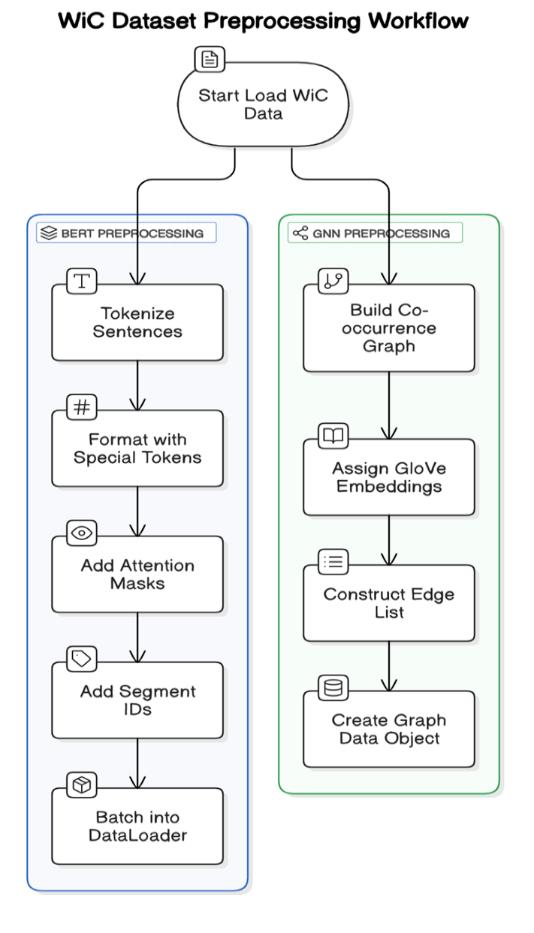
Figure 1: DatasetProcessingWorkflow
3.2.2
WiC’sdesignemphasizesminimalcontextvariation,forcing models to detect fine-grained semantic distinctions. Its structureincludes:
Balanced class distribution (~50% positive and 50%negative).
Cross-part-of-speech coverage (nouns, verbs, adjectives).
International Research Journal of Engineering and Technology (IRJET) e-ISSN: 2395-0056
Volume: 12 Issue: 05 | May 2025 www.irjet.net p-ISSN: 2395-0072
~12,000 labeled examples split into training, validation,andtestsets.
Example: Sentence 1: He sat by the bank of the river. Sentence 2: She withdrew money from the bank. Target word:"bank"Label:0(differentsenses)
3.3.1
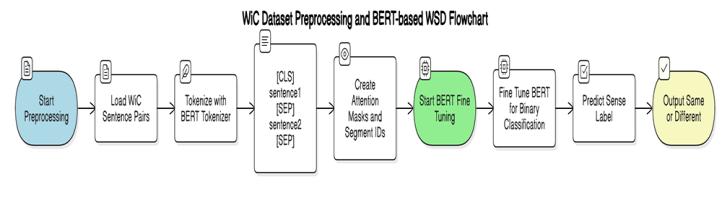
InBERT-basedmodels,sentencesarefirsttokenizedusing the WordPiece tokenizer, which breaks down words into subwordunitstohandlerareorunknowntermseffectively. Thetokenizedinputisthenstructuredusingspecialtokens in the following format: [CLS] sentence1 [SEP] sentence2 [SEP].The[CLS]tokenisplacedatthebeginningandisused forclassificationtasks,whilethe[SEP]tokensseparatethe two input sentences. Along with token IDs, BERT also requiressegmentIDs,whichhelpdistinguishbetweenthe two input segments (Sentence A and Sentence B), and attention masks, which differentiate actual tokens from padding tokens. This structured input enables BERT to process both sentence-level relationships and contextual wordrepresentationseffectively.
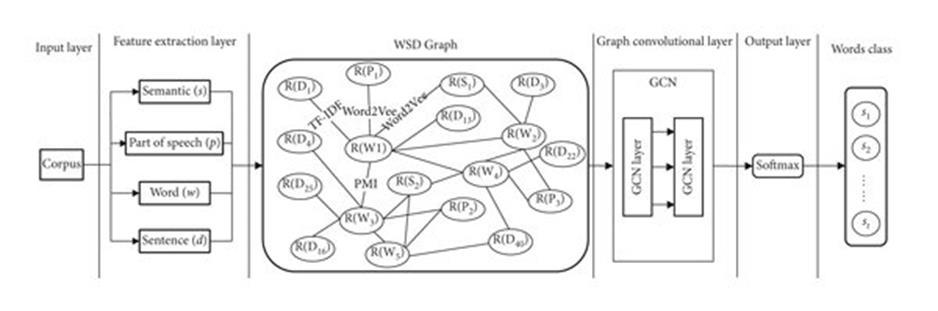
Eachsentencepairisconvertedintoacontextgraphwhere nodesrepresentindividualwords,andedgesareconstructed based on either word co-occurrence within a defined windoworsyntacticrelationshipsderivedfromdependency parsing.Thetargetword thewordbeingdisambiguated is directly connected to its immediate neighbors in both sentences to capture the local context effectively. For initialization, node features are derived from 100dimensional GloVe embeddings, providing pre-trained semantic representations. In cases where words are not found in the GloVe vocabulary, random vectors sampled from a normal distribution are assigned. The resulting graphs are implemented using PyTorch Geometric, which facilitatesefficienthandlingofnodefeatures,edgeindices, andbatchoperations, makingitwell-suitedforgraph-based deeplearninginNLPtaskslikeWordSenseDisambiguation.
3.4.1
The proposed GATConv model is a lightweight, attentionenhanced graph classifier. It contains: Input Layer: 100dimensionalGloVeembedding’s. GATConv Layer 1: Multiheadattentionwith2heads×64hiddenunits,followedby LayerNorm+ReLU. Dropout Layer: With0.4probabilityto avoidoverfitting. GATConv Layer 2: Single-headattention, outputsa2-classsoftmax. Loss: Cross-entropywithAdam
optimizer (learning rate:0.001). Epochs: Trainedover50 epochswithearlystoppingbasedonvalidationloss.
3.4.2 BERT Model Structure
BERTisusedviatheHuggingFacebert-base-uncasedmodel, configured as: Embedding Layer: Contextual token embedding’s derived from 12 Transformer layers. [CLS] Token Output: Passed to a linear classifier head (2-class output). Loss Function: Cross-entropy. Optimizer: AdamW (1e-5learningrate), Training: Oneepoch(duetohardware constraints;furthertuningdiscussedlater).
3.5
Bothmodelsareevaluatedonthesametestsetusing: Accuracy: Percentageofcorrectlyclassifiedsentencepairs.
F1-Score: WeightedF1toaccountforclassbalance.
Inference Time: Timetakentoclassifyabatch/sample.
Memory Usage: PeakRAMduringinference.
FLOPs Estimation: Theoretical floating-point operations perinference.
Big O Complexity: Asymptotic cost of each model’s core components.
3.6
(1)WiC dataset: Offers minimal-pair semantic contrast, makingitanidealtestbedforfine-grainedWSD.(2)GloVe for GNNs: Pre-trained embeddings ensure faster convergenceandsemanticconsistencyacrossthegraph.(3) GATConv over GCN: Adds flexibility to weight contextual relevance per neighbor, critical in ambiguous contexts.(4)[CLS] token for BERT: Widely accepted conventionforsentencepairclassificationtasks.(5)Dropout and Normalization: Improve generalization, especially in graphnetworkswherenodeoverlapmaycauseover-fitting.
International Research Journal of Engineering and Technology (IRJET) e-ISSN: 2395-0056
Volume: 12 Issue: 05 | May 2025 www.irjet.net p-ISSN: 2395-0072
3.7 Summary of Experimental Setup
Table 1: GATConvandBERT
Component GATConv BERT
Embedding Source GloVe (100d)
Input Structure Graph (nodes/edges)
Contextual (WordPiece)
Tokenized sequence
Architecture Depth 2 GATConv layers 12-layer Transformer
Output Layer Softmax (2 classes) Softmax on [CLS]
Training Epochs 50 1 (baseline)
Loss Function Cross Entropy Loss Cross Entropy Loss
Optimizer Adam (1e-3) AdamW (1e-5)
Evaluation Metrics Accuracy, F1, Runtime, Memory, FLOPs Same
Thischapterpresentsathoroughevaluationandcomparison of the GATConv-based and BERT-based models across multiple performance, efficiency, and interpretability metrics.Theanalysisdrawsfrombothempiricalresultsand theoretical assessments, offering a multi-dimensional understandingofhowthesearchitecturesbehaveinaWord Sense Disambiguation (WSD) context, especially on the Word-in-Context(WiC)dataset.
4.1 Predictive Performance Evaluation
The core metric for WSD success is the model's ability to correctly classify whether a word retains the same sense acrosstwocontexts.Table1consolidatestheexperimental results from this study and places them in the context of priorwork.
Table 2 : ExperimentalResultsandPerformanceSummary Model
It is observed that Classical and Supervised learning methods for Word Sense Disambiguation (WSD), such as WordNet, Lesk and SVM, tend to plateau around 65% accuracy, indicating limited effectiveness in capturing contextualnuances.PretrainedcontextualmodelslikeELMo and BERT provide incremental improvements, leveraging deeperrepresentationstoachievemoderatelyhigherscores. However,theproposedGATConv-WSDmodelsignificantly outperforms all other approaches, demonstrating the advantages of graph-based architectures in effectively modeling word relationships. Notably, the BERT model employed in this study exhibits degraded performance, primarilyduetominimalfine-tuning,whichhighlightsthe model’ssensitivitytohyperparametertuningandtheneed formoreextensiveoptimizationtounlockitsfullpotential.
Inreal-worldapplications,especiallythosedeployedonedge devices or in low-resource environments, efficiency is as importantasaccuracy.Metricssuchasinferencetimeand memoryusagecansignificantlyaffectscalability.
Table 3: ComputationalEfficiencyComparison
Model Inference Time (s) Memory Usage (MB)
BERT 0.152 ~2600
GATConv 0.057 1119
GATConv is nearly 3× faster and uses less than half the memoryofBERT.ThesedifferencesareattributedtoBERT’s 12-layer Transformer stack and quadratic attention complexity,incontrasttoGATConv’sshallow,edge-driven propagation.
Atheoreticalanalysisofcomputationalcomplexityreveals significant differences between GNN and Transformer architectures:ForaBERT-basedmodelwithsequencelength n and embedding dimension d: Self-attention complexity: O(n²d), Feed-forward layer complexity: O(nd²), Overall complexity:O(n²d+nd²) andforaGATConv-basedmodel with |V| nodes and |E| edges: Attention computation complexity: O(|E|d), Neighborhood aggregation: O(|V|d²), Overallcomplexity:O(|E|d+|V|d²)
This analysis demonstrates that for long sequences, the quadratic dependency on sequence length makes Transformermodelscomputationallymoreexpensivethan graph-based approaches, which scale linearly with the numberofedgesinthegraph.
International Research Journal of Engineering and Technology (IRJET) e-ISSN: 2395-0056
Volume: 12 Issue: 05 | May 2025 www.irjet.net p-ISSN: 2395-0072
Table 4: SummaryofCoreMetrics
Metric GATConv-WSD BERT (1 epoch)
Memory Usage (MB) 1119 ~2600
FLOPs Low VeryHigh
Complexity Class O(|V|+|E|) O(n²)
Interpretability High Moderate-Low
This comparative analysis reveals the clear superiority of GATConvoverBERTinthecontextofminimal-pairWSDon the WiC dataset. Not only does GATConv provide better predictiveperformance,butitalsoexcelsincomputational efficiency and interpretability. These findings validate the hypothesisthatgraph-basedrelationalreasoning,especially when enhanced with attention mechanisms, offers a competitiveandoftenpreferablealternativetotraditional Transformer-basedapproachesinWSD.
This study sheds light on the architectural trade-offs betweenGraphNeuralNetworks(GNNs)andTransformers for Word Sense Disambiguation (WSD). GNNs explicitly modelwordrelationshipsthroughgraphstructures,offering clearer interpretability, especially via attention weights (Phan,Nguyen,&Hwang,2023).Incontrast,Transformers capturetheserelationshipsimplicitlyviaself-attentionand aremoreadeptathandlinglong-rangedependencies(Saikia etal.,2022).Choosingbetweenthemdependsonthespecific taskandresourceconstraints.
Theresearchcontributesboththeoreticallyandpractically by benchmarking performance and efficiency, showcasing theutilityofattentionmechanisms,andidentifyingcontexts whereeachmodelexcels(Shuetal.,2020;Truică,Apostol,& Karras,2024;Truică,Apostol,Nicolescu,&Karras,2023).
Key findings reveal that GATConv-based GNNs achieve an idealbalanceofaccuracyandcomputationalefficiency.Their structuresupportsmoreinterpretabledecisionscompared toTransformers,whichimplicitlyencodewordrelationships (Vermaetal.,2021).These resultsemphasizethevalueof graph-basedmodelsinscenarioswhereexplainabilityand resourceefficiencyarecritical.
In conclusion, while Transformer models currently hold a slight edge in disambiguation accuracy, the competitive performance of GATConv models coupled with their significant efficiency advantages makes graph-based
approaches a compelling alternative for many practical applications.Theongoingdevelopmentofbotharchitectural paradigmspromisestofurtheradvanceourabilitytotackle thefundamentalchallengeofwordsensedisambiguationin natural language processing (Vo, 2022; Zhang & Zhang, 2020).
Future research in Word Sense Disambiguation (WSD) shouldfocusonimprovingthefine-tuningofTransformerbasedmodelslikeBERT,withafocusonextendingtraining, optimizing hyper parameters, and incorporating graphbasedfeaturestobetterunderstandcontext.Expandingthe datasetsusedfortesting suchasincludingmultilingualand domain-specific corpora will becrucial toseehowthese models perform across different languages and fields. Improving how graphs are built, for example, using dependency-parse-based graphs or semantic similarity graphs,couldmakethemodelsmoreeffectiveatcapturing complexrelationshipsbetweenwords.Hybridmodelsthat combineGNNsandTransformershavethepotentialtooffer both accuracy and efficiency, while incorporating interpretabilitytoolswillmakethemodelsmoretransparent andunderstandable.Additionally,it'simportanttoevaluate how these models hold up in real-world applications, especially when it comes to computational efficiency. By integratingknowledgegraphsandotherexternalresources, wecanaddmoredepthtothesemodels,helpingthembetter handlenuancedwordmeanings.Finally,addressingthedata scarcity issue in underrepresented languages through unsupervised methods is essential for making WSD more accessibletoaglobalaudience.
[1] Apostol, E. S., Coban, Ö., & Truică, C. O. (2024). CONTAIN: A community-based algorithm for network immunization. Engineering Science and Technology, an International Journal, 55, 101728. https://doi.org/10.1016/j.jestch.2023.101728
[2] Apostol, E. S., Truică, C. O., & Paschke, A. (2024). ContCommRTD: A distributed content-based misinformation-awarecommunitydetectionsystemforrealtimedisasterreporting. IEEETransactionsonKnowledgeand Data Engineering, 36, 5811–5822. https://doi.org/10.1109/TKDE.2023.3312242
[3]Buturoiu,R.,Corbu,N.,&Boțan,M.(2023).Information disordersinthecurrentmediaenvironment.In Patternsof news consumption in a high-choice media environment: A Romanianperspective (pp.119–143).Springer.
[4]Giachanou,A.,Zhang,X.,Barrón-Cedeño,A.,Koltsova,O., &Rosso,P.(2022).Onlineinformationdisorder:Fakenews, bots and trolls. International Journal of Data Science and
International Research Journal of Engineering and Technology (IRJET) e-ISSN: 2395-0056
Volume: 12 Issue: 05 | May 2025 www.irjet.net p-ISSN: 2395-0072
Analytics,13(2),265–269.https://doi.org/10.1007/s41060021-00283-8
[5] Gong,S.,Sinnott,R.O.,Qi,J.,&Paris,C.(2023).Fakenews detectionthroughgraph-basedneuralnetworks:Asurvey. arXiv https://arxiv.org/abs/2307.12639
[6]Hu,L.,Wei,S.,Zhao,Z.,&Wu,B.(2022).Deeplearningfor fake news detection: A comprehensive survey. AIOpen,3, 133–155.https://doi.org/10.1016/j.aiopen.2022.03.002
[7]Kuntur,S.,Krzywda,M.,Wróblewska,A.,Paprzycki,M.,& Ganzha, M. (2024). Comparative analysis of graph neural networksandtransformersforrobustfakenewsdetection: A verification and reimplementation study. Electronics, 13(23), 4784. https://doi.org/10.3390/electronics13234784
[8]Kuntur,S.,Wróblewska,A.,Paprzycki,M.,&Ganzha,M. (2024). Under the influence: A survey of large language models in fake news detection. IEEE Transactions on Artificial Intelligence, 1–21. https://doi.org/10.1109/TAI.2024.3351822
[9] Liu, J., Liu, T., & Yu, C. (2021). NewsEmbed: Modeling news through pre-trained document representations. In Proceedings of the 27th ACM SIGKDD Conference on Knowledge Discovery & Data Mining (KDD ’21) (pp. 1076–1086).ACM.https://doi.org/10.1145/3447548.3467074
[10] Low, J. F., Fung, B. C., Iqbal, F., & Huang, S. C. (2022). Distinguishing between fake news and satire with transformers. ExpertSystemswithApplications,187,115824. https://doi.org/10.1016/j.eswa.2021.115824
[11] Mei, X., Cai, X., Yang, L., & Wang, N. (2021). Graph transformer networks based text representation. Neurocomputing, 463, 91–100. https://doi.org/10.1016/j.neucom.2021.08.026
[12] Petrescu, A., Truică, C. O., Apostol, E. S., & Karras, P. (2021). Sparse shield: Social network immunization vs. harmfulspeech.In Proceedingsofthe30thACMInternational ConferenceonInformation&KnowledgeManagement(CIKM) (pp. 1426–1436). https://doi.org/10.1145/3459637.3482142
[13] Phan, H. T., Nguyen, N. T., & Hwang, D. (2023). Fake newsdetection:Asurveyofgraphneuralnetworkmethods. Applied Soft Computing, 139, 110235. https://doi.org/10.1016/j.asoc.2023.110235
[14]Saikia,P.,Gundale,K.,Jain,A.,Jadeja,D.,Patel,H.,&Roy, M.(2022).Modellingsocialcontextforfakenewsdetection: Agraphneuralnetworkbasedapproach.In Proceedingsof the 2022 IEEE International Joint Conference on Neural Networks (IJCNN) (pp. 1–8). https://doi.org/10.1109/IJCNN55064.2022.9892384
2025, IRJET | Impact Factor value: 8.315 |
[15]Shu,K.,Mahudeswaran,D.,Wang,S.,Lee,D.,&Liu,H. (2020).Fakenewsnet:Adatarepositorywithnewscontent, socialcontext,andspatiotemporalinformationforstudying fake news on social media. Big Data, 8(3), 171–188. https://doi.org/10.1089/big.2020.0062
[16]Truică,C.O.,Apostol,E.S.,&Karras,P.(2024).DANES: Deepneuralnetworkensemblearchitectureforsocialand textualcontext-awarefakenewsdetection. Knowledge-Based Systems, 294, 111715. https://doi.org/10.1016/j.knosys.2023.111715
[17]Truică,C.O.,Apostol,E.S.,Nicolescu,R.C.,&Karras,P. (2023). MCWDST: A minimum-cost weighted directed spanningtreealgorithmforreal-timefakenewsmitigation in social media. IEEE Access, 11, 125861–125873. https://doi.org/10.1109/ACCESS.2023.3318620
[18] Verma, P. K., Agrawal, P., Amorim, I., & Prodan, R. (2021).WELFake:Wordembeddingoverlinguisticfeatures forfakenewsdetection. IEEETransactionsonComputational Social Systems, 8(4), 881–893 https://doi.org/10.1109/TCSS.2021.3061883
[19] Vo, T. (2022). A novel semantic-enhanced text graph representation learning approach through transformer paradigm. Cybernetics and Systems, 54(4), 499–525. https://doi.org/10.1080/01969722.2022.2032795
[20]Zhang,H.,&Zhang,J.(2020).Textgraphtransformerfor document classification. In Proceedings of the 2020 Conference on Empirical Methods in Natural Language Processing (EMNLP) (pp. 8322–8327). https://doi.org/10.18653/v1/2020.emnlp-main.670
Website:
[21]https://www.researchgate.net/publication/354994031 _Graph_Convolutional_Network_for_Word_Sense_Disambigu ation