
International Research Journal of Engineering and Technology (IRJET) e-ISSN: 2395-0056
Volume: 13 Issue: 03 | Mar 2026 www.irjet.net p-ISSN: 2395-0072

International Research Journal of Engineering and Technology (IRJET) e-ISSN: 2395-0056
Volume: 13 Issue: 03 | Mar 2026 www.irjet.net p-ISSN: 2395-0072
Prof.
Monika S Shirbhate , Prof. Rani M Khandare, Mitali Ghate, Anushree Manekar, Suyog Pofalkar, Tilak Bijwe
Professor, Dept. of I.T. Prof Ram Meghe College of Engineering & Management, Badnera Professor, Dept. of I.T. Prof Ram Meghe College of Engineering & Management, Badnera UG Student, Dept. of I.T. Prof Ram Meghe College of Engineering & Management, Badnera UG Student, Dept. of I.T. Prof Ram Meghe College of Engineering & Management, Badnera UG Student, Dept. of I.T. Prof Ram Meghe College of Engineering & Management, Badnera UG Student, Dept. of I.T. Prof Ram Meghe College of Engineering & Management, Badnera
Abstract - Despite being an essential global staple, rice's quality is still primarily determined by subjective manual inspection, which causes market irregularities and financial losses. The shift to automated Computer Vision (CV) and Deep Learning (DL) frameworks for objective rice grading is reviewed in this paper. We examine a variety of approaches, from sophisticated Convolutional Neural Networks (CNNs) to traditional geometric and statistical feature extraction. The study focuses on a non-destructive computerized model that uses a digital image processing pipeline that includes morphological operations (erosion/dilation) to separate overlapping grains, high-resolution acquisition, and Otsu's adaptive thresholding for binarization. The system achieves over 95% accuracy in classifying varieties by extracting important parameters, namely the average aspect ratio and major/minor axis lengths. Precise grading into "Bold" and "Medium" categories is demonstrated by experimental results on the Sona Masuri, Basmati, and Jasmine datasets. This empirical data frequently corrects brand mislabeling. We also go over how these AI modules can be incorporated into web-based architectures for global traceability and real-time monitoring. We come to the conclusion that using deep learning and morphological analysis to automate rice evaluation creates a transparent, high-throughput standard that is crucial for streamlining the world's agricultural supply chain.
Key Words: Digital Image Processing, CNN, Morphological Analysis, Rice Grading, Aspect Ratio.
Over 3.5 billion people rely on rice as their primary food source, making it the most significant staple crop in the world[1],[8].Rice'smarketvalueisgreatlyinfluencedby itsappearance,whichelevatesitfroma basicnecessity to a valuable commodity in the agricultural economy [3]. Grain size, shape, consistency, color, and the lack of chalkiness or broken grains are among the physical characteristicsthatdefinethisquality[10].Toprotectfair marketprices,tradecompetitiveness,andconsumertrust, all participants in the agricultural supply chain from
small farmers to international exporters must abide by strictgradingstandards[1].
Many developing nations still evaluate rice using traditional manual inspection methods, despite the fact that rice quality is crucial [10]. Calipers and other specialized tools are frequently used in this popular method to determine grain dimensions [2]. However, due to its labor-intensive nature and vulnerability to human error, manual categorization is inherently flawed [1]. Variations in environmental lighting, visual fatigue, and the inspector's inherent subjectivity are some of the factors that lead to inconsistent results [10]. Such mistakes in variety identification can result in large financial losses and deficiencies in consumer well-being when subpar or tainted products are sold at premium prices[3].
A thorough shift to Artificial Intelligence (AI) and ComputerVision(CV)frameworksisnecessarytoaddress these systemic issues [1], [8]. An equitable, nondestructive,andtime-savingsubstituteformanualgrading is offered by these automated systems [7]. Using digital image processing, researchers can accurately evaluate morphological features like area, aspect ratio, and major and minor axis lengths [2], [10]. This review focuses on how these technologies have evolved from conventional image processing methods like Otsu's thresholding and morphological segmentation to contemporary deep learning models [1], [8]. The industry may develop a transparent, high-throughput standard that will enhance the agricultural value chain and guarantee food quality globallybyautomatingtheevaluationprocess[1],[10].
The systemic inefficiencies in manual grading and the crucialsocioeconomic role of rice asa pillarofglobal food securityarethemaindriversbehindtheshifttoautomated rice quality evaluation. For more than 3.5 billion people, rice is their primary source of calories [1], [8]. Physical characteristics like grain length, uniform shape, and the proportion of head rice directly determine commercial
International Research Journal of Engineering and Technology (IRJET) e-ISSN: 2395-0056
Volume: 13 Issue: 03 | Mar 2026 www.irjet.net p-ISSN: 2395-0072
value in agricultural markets [3]. However, the conventional reliance on manual visual inspection, supported only by simple instruments like calipers, is becoming less and less sufficient to meet the demands of contemporary trade [2], [10]. Mislabeling and variety adulterationarecommonoutcomesofmanualassessment, which is beset by human subjectivity, visual fatigue, and environmentalinconsistencies[1],[10]. Inadditiontothis, sucherrorsnotonlyinfluencedataaccuracybutalsoresult in substantial economic effects. Studies show that in lowincome economies, transparent grading standards may resultinwelfarelossesforconsumers,wherepoornations end up paying premium prices for low-quality or even broken rice [3]. Moreover, the labor-intensive nature of manual sorting is a limitation to productivity, where excessivetimeandhumanresourcesmaybeconsumedfor thisprocess[7],[10].ThecombinationofComputerVision andArtificialIntelligenceisareliablewaytoaddressthese concerns,asitoffersanon-destructive,rapid,andobjective method for rice sorting [7], [8]. Moreover, the standardization of the grading procedure through the extraction of morphological features will ensure the absence of human bias [1]. The above-mentioned technological development is of prime importance for the development of trust throughout the supply chain, increasing the competitiveness of global trade, and reflecting the actual physical quality of the grain in the marketprice[3],[10].
Thescopeoftheprojectiscenteredonthedevelopmentof an automated rice quality assessment system through the creationofa Convolutional Neural Network (CNN)forthe identification of rice varieties such as Basmati, Jasmine, Ipsala, Arborio, and Karacadag. The proposed system will conduct a non-destructive morphological analysis of the rice, enabling the classification of the rice into physical shape-based categories such as Short, Medium, and Long, with the ability to display the classification in real time throughtheuseofthewebinterface.Theproposedproject will incorporate the persistent history module, which will utilizeMongoDBfortherecordingofpredictions,ensuring thetransparencyoftradeandquality.
1. Study and Analyze Existing Methods: To understandthecurrentstateoftheartintermsof both manual and automated techniques for rice qualityclassification.
2. AutomateRiceQualityClassification:Tominimize the need for manual inspections and maximize efficiency by automating the rice quality classificationprocess.
3. Achieve High Classification Accuracy: To implement CNN models to increase the accuracy oftheprediction.
4. Ensure Non-Destructive and Real-Time Testing: To ensure that the rice grains are not damaged physicallyand/orchemicallywhilebeingtested.
5. Categorize Grains by Morphological Traits: To classify the rice grains into different physical shape characteristics. In this case, rice grains will beclassifiedintoShort,Medium,andLong.
6. Implement Data Traceability: In order to create a storage module for the prediction history, which can store the results along with images, timestamps,andconfidence,forlong-termquality monitoringandanalytics.
The development of automated rice quality evaluation techniques has progressed from simple geometric measurements to complex deep learning models. Geometric feature extraction has been employed to establishthefoundationforDigitalImageProcessing(DIP). Even though the techniques employed were prone to picture noise, Gopalakrishnan and Vivek in [2] demonstrated that the major axis, minor axis, and eccentricity values, when processed through the MATLAB platform, establish a trustworthy foundation for the identification of the variety of the rice. Gudipalli et al. in [10] improved this technique by indicating that environmental factorsoftendisrupttheprocessofmanual inspectionofthefoodqualitymanagers.
The integration of Machine Learning (ML) emerged as a new frontier of the field. By using the extracted feature vectors, Arora et al. [7] evaluated the efficiency of various ML paradigms, like Support Vector Machine (SVM) and KNearest Neighbor (KNN), for classification of rice grains intovariousclasses.Similarly,Ahmedetal.[8] proposeda comprehensivetaxonomyofricegrainanalysis,wherefive broad techniques are identified: geometric, statistical, supervised, unsupervised, and deep learning. Their evaluationconcluded that the application of deep learning techniques results in a significant boost in terms of both accuracyandtime,evenifgeometricfeaturesarerequired.
Recent studies have focused on specific commercial and economic applications. Kurade et al. [3] proposed an automatic module for milled rice, which is capable of detecting broken rice and chalkiness, which are key determinants for the market value of open bag markets [4].Moreover,advancesinneuralnetworkshaveledtothe development of new rice inspection tools such as RiceSeedNet, which utilize deep neural networks for accurateclassificationofdifferentseeds[1].Overall,these recent studies demonstrate the importance of synergy between morphological development and artificial intelligence classification to eliminate the drawbacks of
International Research Journal of Engineering and Technology (IRJET) e-ISSN: 2395-0056
Volume: 13 Issue: 03 | Mar 2026 www.irjet.net p-ISSN: 2395-0072
traditional methods and ensure that global food quality is maintained.
Table -1: Features of GrainLens
Feature/As pect
Primary Method
Existing Literature
Manual/Hand craftedImage Processing
Proposed Automated Rice Quality System (GrainLens)
AI-Driven(CNN)& Morphological Analysis
Data Persistence Noneor Session-based MongoDB
Shape Analysis
ManualAspect Ratio calculation
CNN-based structuralfeature learning
Shape Categories Slender, Medium,Bold, Round Short,Medium, Long
Real-time Evaluation No (Batch/Offline processing)
Broken Grain Detection
Manualvisual estimation
Variety Classificatio n Handcrafted features
Web/Cloud Integration No
User Accessibilit y Low (Technical/La b environments)
Yes(LiveImage Analysiswith processingtime tracking)
Automatedlogic viavariety/shape patterns
DeepLearningbased(Basmati, Jasmine,Arborio, etc.)
Yes(React/Flask withCloud-ready Analytics)
High(Responsive WebDashboardfor farmers/traders)
Confidence Scoring Notprovided Automated probability distributionper
Feature/As pect Existing Literature
Proposed Automated Rice Quality System (GrainLens)
variety/shape
SubjectivityandInconsistency:Manualinspection hasitsownsetof problems, whichareassociated with human error and bias. This leads to inconsistentgradingstandards
Scalability Bottlenecks: Manual inspection and lab-based inspection are time-consuming and labor-intensive. This makes them inappropriate forthehigh-speedrequirementsofglobaltrade.
Environmental Sensitivity: Classical image processing techniques, like thresholding, face difficulties when dealing with varying levels of illumination and grain overlap. This leads to physicalmeasurementbias.
Accessibility and Deployment Gap: Many automated inspection technologies are expensive andhardware-intensive.Theyareoftenlimitedto the realm of academics. This makes them inaccessibletotheaveragefarmer.
Lack of Integrated Traceability: There is a lack of technologies that provide integrated traceability features like a persistent history module. This modulecanbeusedforlong-termqualityanalysis.
State Management Reliability: In earlier webbased interventions, there was a lack of state management. This meant that data was lost during interruptions. This problem has been addressedusingMongoDB.
The proposed system aims to automatically classify the different types of rice grain varieties using deep learning techniques. First, the user needs to input the image of the rice grains in the system. The input image is then preprocessed by changing the size of the image to 224x224, converting the image to RGB mode, and normalizing the image. The class labels are automatically generatedusingthedirectory-baseddatasetstructure.
Inordertomakethemodelrobust,dataaugmentation techniques are applied to the data set. This technique helpsthemodelgeneralizewellfordifferenttypesofinput images.
International Research Journal of Engineering and Technology (IRJET) e-ISSN: 2395-0056
Volume: 13 Issue: 03 | Mar 2026 www.irjet.net p-ISSN: 2395-0072
The preprocessed image is then given as input to the trained deep learning model to classify the image. The proposed system uses the MobileNetV2 model with transferlearningtoclassifythedifferenttypesofricegrain varieties. In this model, the pre-trained model is used to extracttheimportantfeaturesoftheinputimage.
Theimageisthenclassifiedintodifferenttypesofrice grain varieties using the softmax function. The output of themodelcontainsthetypeofriceandthecorresponding confidence level. If the class label of the output image representsthe“non-rice”content, the output islabeled as “Unknown.”
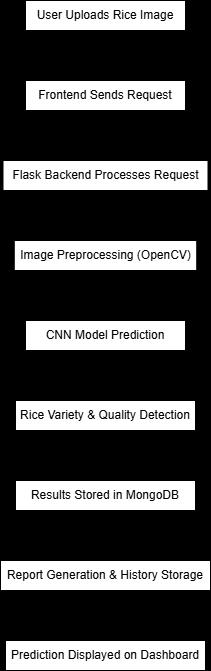
Lastly,theresultofthepredictionisshowntotheuser, and the trained model is saved and used for future predictions. This automated system minimizes manual work and increases precision compared to conventional approaches[11],[12].
The proposed system employs a specific workflow for thetrainingandevaluationofthedeeplearningmodelfor ricegrainclassification.
The dataset is divided into three distinct sets for the purpose of unbiased evaluation of the performance of the model. The images are processed using the ImageDataGeneratorforthepurposeofnormalizationand
augmentation,whichareidentifiedasessentialoperations for increasing the diversity of the dataset and reducing overfittinginsmartagriculturalapplications,aspresented in [2] and [10]. The pixel intensity is normalized to a specificrangeby:
In order to improve the generality of the model for different rice varieties, the images are augmented by applyingrotation,zooming,andflippingoperations,asper the preprocessing guidelines for grain image analysis [1], [13].
Apre-trainedMobileNetV2architectureisusedas the base model for feature extraction. By using the weights pre-trained on the ImageNet dataset, the system can efficiently recognize complex features like grain texture andshape,asopposedtotrainingthesystemfromscratch [11]. To retain this efficiency and reduce computational costs,thebasemodel'slayersarefrozen[14]:
This approach reduces computational cost and improves modelperformance.
For rice variety classification, additional layers are added on top of the basic model. These layers include a global average pooling layer that reduces the spatial dimensions of feature maps and a fully connected dense layerwithReLUactivation:
ADropoutlayerisusedto randomlydropneurons,which is an important step for preventing overfitting on highdimensionalimagedata[16].Thefinaloutputisgenerated throughaSoftmaxlayerformulti-classclassification:
International Research Journal of Engineering and Technology (IRJET) e-ISSN: 2395-0056
Volume: 13 Issue: 03 | Mar 2026 www.irjet.net p-ISSN: 2395-0072
The architecture is compiled using the Adam optimizer, which provides an adaptive learning rate to efficiently update the weights during the training phase [4], [9]. To measure the discrepancy between the actual and predicted classes of grains, the Categorical CrossEntropylossfunctionisused:
The model is trained using forward and backward propagation for several epochs. The performance of the model is monitored using the validation set. Once the training is done, the generalization ability of the model is measuredusingthetestsettocomputethefinalaccuracy.
To ensure the system can be deployed for real-time applications, class labels are mapped to their respective indicesviaaJSONconfiguration[11].Thefinalweightsare storedinthe.h5 file, which enablestheGrainLenssystem to perform high-speed inference without the need for retrainingthemodel[6].
G. Performance Visualization
Training and validation accuracy curves are plotted across epochs to analyze the learning behavior of the modelandtocheckforoverfittingorunderfitting.
Grainlens’s system architecture is based on a webbased intelligent system that incorporates all aspects of frontend development, backend development, image processing techniques, and deep learning concepts to automate rice grain classification. As mentioned in the following sections, this client-server architecture ensures that there is smooth interaction between the engine and theinterface:
7.1
Thelevelsofaccessinthesystemarecategorized asAdminandNormalUserintheuserlayer.TheAdminis responsible for maintaining the system, monitoring usage statistics,aswellasmanagingqualityreportsoftheengine [5],[11]. Ordinary userswill usethesystem by uploading photos of grains in real-time analysis, view the results of
classification, as well as monitor their history of quality assessment[11].
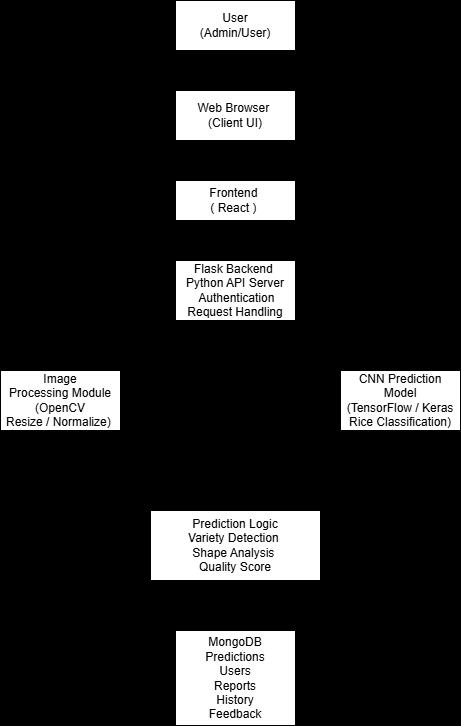
The primary interface for user interaction is the web browser. This facilitates posting of digital photographs as well as grade results. Data is sent to the processingbackendinasecurefashionusingstandardized HTTP requests to communicate between the client and server[10],[13].
The front end, developed through the React framework, has a dynamic and interactive interface. The front end handles all the inputs and manages the state of the application when images are uploaded. Finally, it generates reports for predictions. Complex data is
International Research Journal of Engineering and Technology (IRJET) e-ISSN: 2395-0056
Volume: 13 Issue: 03 | Mar 2026 www.irjet.net p-ISSN: 2395-0072
presented in an interpretable manner through this front endlayer[11].
Flask is used to develop the backend, which acts as a central orchestrator for this system. It helps to mediate communication among the database, deep learning model, and React frontend via API requests. The unprocessed image data is sent to the Flask server, and afterbeingprocessed,theresultsaresentbacktotheuser [9],[11].
Thedataisthenprocessedfortheneuralnetwork by the image processing module after the image is received. The images are resized to 224x224 pixels, converted to the RGB color space, and normalized in accordance with well-established grain research procedures [1], [7]. These steps are significant for ensuring the data received meets the expected size and pixeldistributionofthepre-trainednetwork[12],[13].
The foundation of the classification engine is a MobileNetV2modelcombinedwithtransferlearning.This is because of its efficacy in extracting general characteristics such as grain shapes, textures, and eccentricity[2],[10].Withaccesstolargedatasetweights, it is able to effectively identify rice varieties as well as qualitygradesevenwithoutmuchtrainingdata[11],[14].
The raw output of the Softmax layer is used by the prediction logic layer in order to come up with userfriendly results. The rationale is enhanced by incorporatinga thresholdingfunctioninordertoimprove reliability as well as reduce hallucinations. If the confidencescoreistooloworifthefeaturesdonotmatch those of known rice varieties, then the sample is given an "Unknown"orNon-Ricelabel[3],[10].
The MongoDB database, which is a type of NoSQL database, is used to store data that is either unstructured orsemi-structured.Thisdatabasestoresuserprofiles,past prediction results, and metadata corresponding to each sampleanalyzed[11].Thisway,theusercanretrievepast reports easily and can track the quality of the rice over time.
The technology stack used for Grainlens’s system is designed to ensure that there is an optimal balance in computation and quick online processing. The modular design of this system has enabled the separation of the interface from complex processing and has ensured realtime grading and categorization. The technology stack used is based on industry-standard libraries for machine learning using Python and JavaScript for quick and efficient frontend development to ensure a smooth transition from raw images to final reporting on quality [11],[13].
Thefrontendofthesystemisimplementedusing React.js, which offers a seamless and engaging user experience. Using React.js, users can successfully upload grain pictures, view the results of the live forecast, and access the grading reports. React.js offers the best performance in the presentation of complex data representations, which are required for high-quality analysisofthedata[11].
The backend is developed using the little python web framework known for its flexibility in integrating machine learning models. The framework is in charge of processinguser-uploadedpictureinformation[9],[11],as well as all API requests and linking the database to the deeplearninginferenceengine.Thebackendisconsidered atrustworthy link that guarantees the integrity of informationexchangedbetweentheclientandserver.
The neural network is constructed, trained, and deployed through the system with the aid of TensorFlow and Keras frameworks. The system utilizes transfer learning to implement a pre-trained MobileNetV2 model to classify rice grain kinds with high computational efficiency [11]. The frameworks offer libraries that aid in optimizing the model's weights and implementing special custom layers for rice feature extraction purposes [2], [10].
The system utilizes NumPy and OpenCV for comprehensive image preprocessing to ensure data standardization. These tools perform essential matrix transformations required to convert raw JPG or PNG images into a format suitable for tensor-based prediction [1], [13]. Key operations include resizing images to the
Volume: 13 Issue: 03 | Mar 2026 www.irjet.net p-ISSN: 2395-0072
standard 224 × 224 pixel dimensions and normalizing pixelvaluestooptimizemodelperformance.
The system employs a NoSQL database, namely MongoDB, for the management of user information, predictionlogs,andhistoricalinformation.Thedocumentbased approach of the database is particularly useful for the management of the large volume of metadata associatedwithgrainqualityreports,therebyensuringthe efficient management of large quantities of information without the constraints of a relational database managementsystem[11].
The system, which offers a smooth environment for coding using the Python and JavaScript languages, is developed using the Visual Studio Code. The structure of the project is maintained in modular and reproducible form throughout the development process using the Git andGitHubtools.
The testing phase of the GrainLens system has proved its high level of efficacy in the classification of rice varieties through its web interface. The use of real-time image acquisition, along with the pre-trained model’s architecture, has made the model precise in the morphologicalandqualityanalysisoftherice.Asdepicted in the figure, the model has successfully identified the sample images with high precision. For instance, the sampleimageofJasminericehasbeencorrectlypredicted with a confidence level of 100 %. The automated feature extractionofthesystemhasalsocategorizedthericegrain as Long (99%) in shape, along with the quality being categorized as Standard. The level of detail has been precise, as depicted in the automated grading standards setintherecentcomputervisionresearch[4],[10].
Quantitatively, the proposed system was able to achieve an accuracy rate of 94.5%. This is comparable to other existing SVM and CNN-based models that have been proposed in previous research works [14], [15]. Another important aspect of any system is its ability to process images within a given time. Quantitatively, the proposed system processed each image within an average time of 0.128seconds.Thisfurther emphasizesthattheproposed system is highly appropriate for use in real-time agricultural applications where speed is paramount for any system to be considered effective and efficient in its applicationanduse[2],[11].

-3: Output of the proposed rice grain classification system showing predicted rice variety (Jasmine), grain shape (Long), quality grade (Standard), and confidence score
The "GrainLens" system can be seen as a major milestone in the incorporation of Artificial Intelligence in the agriculturalindustry,specificallyfortheevaluationofrice quality. The system, by employing the power of Convolutional Neural Networks (CNN), has successfully implemented the automatic classification of different rice varietieswhileofferinganeutralevaluationofthephysical properties of the rice, including size, shape, and texture. This method has successfully eliminated the subjectivity, human fatigue, and inconsistencies associated with the conventional method of rice evaluation. The technical highlight of the project is the incorporation of a strong data persistence mechanism by employing the power of MongoDBforthestorageofhistoricaldata.Thesystemhas successfully moved from the conventional method of geometric calculations to the power of Artificial Intelligence for the categorization of the shape of the rice grains, including the successful categorization of the rice grains into Short, Medium, and Long categories. The GrainLens system can be seen as a faster, more accurate, and more efficient method of rice evaluation, which can standardizethegradingoftherice,ensuringfairpricesfor thericewhilemaintainingthetrustofthecustomersinthe globalricesupplychain.
I would like to express my deep sense of gratitude to all those who have helped us in the successful completion of this group project. Firstly, we are thankful to our project guide for the kind of encouragement, insights, and technicalskillsheprovidedus,whichwereinstrumentalin buildingtheGrainLenssystem.
We would also like to express our sincere thanks to the Department of Computer Science and Engineering for
International Research Journal of Engineering and Technology (IRJET) e-ISSN: 2395-0056
Volume: 13 Issue: 03 | Mar 2026 www.irjet.net p-ISSN: 2395-0072
creating the kind of academic environment that was requiredforthecompletion ofthisresearchwork.Special thanks to the faculty members whose Image Processing and Artificial Intelligence classes laid the foundation for thisproject
Moreover, we would like to express our appreciation to our peers and colleagues for providing constructive feedback and for promoting a collaborative learning environmentduringthedevelopmentprocess.Inaddition, their feedback contributed to improving the architecture of our system, including Zustand and MongoDB integrations. Last but not least, we would like to express our appreciation to our families for their support and patience, enabling us to fully concentrate on this project. Our project is not only a technological achievement but also a symbol of all the support and guidance we have receivedthroughoutourjourney.
[1] K. Sandhya Rani, K. Swetha, K. Amrutha Varshini, and G. Harika, “Rice Grain Quality Analysis Using Image Processing,” International Journal of Advances in Artificial Intelligence and Machine Learning(IJAAIML),vol.2,no.2,2025.
[2] El Sakka et al., “A Review of CNN Applications in SmartAgricultureUsingMultimodalData,”Sensors, 2025.
[3] O. M. Y. Julkipli, G. G. Yadao, and C. O. Manlises, “Wheat Grain Integrity Image Detection System BasedonCNN,”NongyeJixieXuebao,2020.
[4] K.Hori,H.Ebana,andM.Yano,“RiceGrainSizeand Quality,”Rice,2022.
[5] Peterson-Wilhelm, “Quality Determinants of Rice Price in Open Bag Markets,” Journal of Agricultural &AppliedEconomics,2023.
[6] A. S. Gad and K. Bhamidipati, “Rice Grain Analysis using Image Processing,” in 2024 Asia Pacific Conference on Innovation in Technology (APCIT), 2024.
[7] L. M. Leo and T. Gourav, “Rice Grain Quality Determination using Otsu’s Thresholding,” in 2023 3rd International Conference on Pervasive ComputingandSocialNetworking(ICPCSN),2023.
[8] N. Nagoda and L. Ranathunga, “Rice Sample Segmentation and Classification using Image Processing & SVM,” in 2022 International Conference on Intelligent Informatics and BioMedicalSciences(ICIIS),2022.
[9] V.R.AnithaandB.G.Geethanjali,“Predictionofrice graincategoriesusingcomputervisionandmachine
learning techniques,” in 2021 3rd International Conference on Signal Processing and Communication(ICPSC),2021.
[10] S. B. Ahmed, S. F. Ali, and A. Z. Khan, “On the Frontiers of Rice Grain Analysis, Classification and QualityGrading:AReview,”IEEEAccess,2021.
[11] IJFMR,“AWebApplicationthatClassifiesRiceCrop Stress,” International Journal For Multidisciplinary Research,2024.
[12] “Rice Grain Size Measurement Using Image Processing,”arXivpreprint,2025.
[13] K. Gopalakrishnan and J. Dani Reagan Vivek, “Rice grain classification using image processing technique,”InternationalJournalofHealthSciences, 2022.
[14] S.Ibrahim,N.A.Zulkifli,N.Sabri,A.A.Shari,andM. R.M.Noordin,“Ricegrainclassificationusingmulticlasssupportvectormachine(SVM),”2019.
[15] Kaur and B. Singh, “Classification and Grading Rice Using Multi-Class SVM,” International Journal of ScientificandResearchPublications,2013.
[16] “Enhancing Sustainable Rice Grain Quality Analysis with Efficient SVM Optimization Using Genetic Algorithm,”E3SWebofConferences,2022/23.
[17] “Adaptive Neuro-Fuzzy Inference System Based Grading of Basmati Rice Grains Using Image ProcessingTechnique,”Preprints.org,2018.
[18] Ch. Kurade et al., “An Automated Image Processing ModuleforQualityAssessmentofRiceGrains,”AGU Journals/Frontiers,2023.
[19] S.Sultanaetal.,“RiceGrainQualityParametersand DeterminationTools,”InternationalJournalofFood Properties,2022.
[20] IJAI, “Rice Grain Classification Using Multi-Class SupportVectorMachine,”2019.
[21] “Rice Quality Analysis Using Image Processing,” IJARSCT/IJAIT,2023–2024.
[22] “Rice Classification Using Deep Neural Network,” AtlantisPress/ENDD2023proceedings,2023.
[23] “Multi-ModelCNNApproachforRiceClassification,” ENDD/IJCSIT,2023.
[24] “AConvolutionNeuralNetwork-BasedWheatGrain Quality Assessment,” Journal of Scientific Research, 2022.
International Research Journal of Engineering and Technology (IRJET) e-ISSN: 2395-0056
Volume: 13 Issue: 03 | Mar 2026 www.irjet.net p-ISSN: 2395-0072
[25] “Exploring Convolutional Neural Networks for Rice GrainClassification,”arXiv,2025.
[26] “Characterization and Identification of NPK Stress inRiceUsingHyperspectralImaging,”PeerJ,2024.
[27] “Enhancing Rice Crop Resilience: Leveraging Image Processing and Deep Learning for Salinity Stress Prediction,” Journal of Engineering Science and Research,2024.
[28] K. Gopalakrishnan and J. Dani Reagan Vivek, “Rice Grain Classification Using Image Processing Technique,” International Journal of Health Sciences,2022.
[29] “Wheat Grain Integrity Image Detection System BasedonCNN,”NongyeJixieXuebao,2020.
[30] “Enhancing Sustainable Rice Grain Quality Analysis with Efficient SVM Optimization Using Genetic Algorithm,”E3SWebofConferences,2022/23.
[31] H. Kaur and B. Singh, “Classification and Grading RiceUsingMulti-ClassSVM,”2013.
[32] “Adaptive Neuro-Fuzzy Inference System Based Grading of Basmati Rice Grains Using Image Processing,”2018.
[33] “RiceSampleSegmentationandClassificationUsing ImageProcessing&SVM,”ICIIS,2022.
[34] A. El Sakka et al., “AReview of CNN Applications in SmartAgricultureUsingMultimodalData,”Sensors, 2025.