
International Research Journal of Engineering and Technology (IRJET) e-ISSN:2395-0056
Volume: 11 Issue: 12 | Dec 2024 www.irjet.net
p-ISSN:2395-0072

International Research Journal of Engineering and Technology (IRJET) e-ISSN:2395-0056
Volume: 11 Issue: 12 | Dec 2024 www.irjet.net
p-ISSN:2395-0072
Renjith Ramachandran1 , Gaurav Sharma2
1Independent Researcher and Solutions Architect, Hudson, MA, USA
2Independent Researcher and Associate Director Quality Engineering, Atlanta, GA, USA
Abstract - Artificial intelligence (AI) is becoming an essential component for enterprises. Many organizations are either in the process of digital transformation or have already completed it. The rise of AI provides enterprises with numerous tools and technologies that can boost the productivity of individual teams and enhance overall organizational efficiency. Since AI systems are data-driven and constantly seek additional data, the quality and quantity of this data are crucial to making AI applications more effective. As enterprises increasingly adopt AI tools and practices, embedding responsible AI practices is essential to ensure that AI applications are ethical, transparent, and aligned with organizational values. These practices help enterprises comply with standards while leveraging the full potential of AI.This paper examines governance strategies for integrating responsible AI into digital transformation initiatives across industries. It provides enterprises with frameworks to manage the ethical, legal, and operational challenges posed by AI. By implementing these governance strategies, organizations can effectively navigate the complexities of AI, build trust, and maximize AI’s contribution to digital transformation.
Key Words: Digital Transformation, Artificial Intelligence, AI Governance
1.INTRODUCTION
Artificial intelligence (AI) is reshaping enterprise digital transformation, driving revolutionary advancements with innovative, AI-powered capabilities. The surge of AI technology in software development has resulted in significant breakthroughs in machine learning, deep learning,neural networks,andfoundationmodelssuchas BERT (Bidirectional Encoder Representations from Transformers), LLMs (Large Language Models), and NLP (NaturalLanguageProcessing).Theseadvancementshave exponentiallyenhanced capabilities, transitioning AI from instruction-based systems to self-learning and predictive models.
Modern AI models can process and generate outputs across multiple modalities, including text, images, audio, video, and vision, showcasing their Generative AI capabilities. However, with the ability to generate almost
anything,theseadvancementscomewithsignificantrisks. AI risks are multifaceted, encompassing both preimplementation challenges and post-deployment consequences.
This paper explores how effective AI governance strategies should be developed and applied when embedding AI into enterprise digital transformation solutions. Additionally, it examines research findings on the challenges of designing and implementing these governance strategies, emphasizing their importance in mitigating AI risks. The paper highlights the global implications of these risks for technology, business, and humanity.
All the sectors are undergoing or in the process of Digital Transformation. Post Covid Era, there has been increased demandforDigitaltransformation. Digitaltransformation is about using technologies to create value, enhance productivity and bring in social welfare [14]. It is also aboutthetransformationofOrganizationalActivitiesboth internalandexternaltoleveragetheadvantagesofDigital Technologies [16]. For example, patients are able to book doctors’ appointments online using websites or apps. Patients can even schedule virtual consultation with the doctoravoidingtravel[15].Anotherusecaseisthegrowth in the use of online platforms for education and learning. The concept of face to face learning has moved to more online or hybrid modes of learning. These types of innovationshavecreatedenhancedvaluestocustomers.
AI is built upon a foundation of diverse technological subsets, including Machine Learning (ML), Deep Learning (DL), Natural Language Processing (NLP), Foundation Models (FM), Large Language Models (LLMs), Small Language Models (SMLs), Neural Networks (NN), and Computer Vision driven by Convolutional Neural Networks (CNNs). As a comprehensive superset of these advanced technologies, AI utilizes a variety of algorithms to facilitate the creation of sophisticated models, such as LLMs, Text-to-Speech systems, Generative AI (GenAI) models,andImageProcessingsolutions.[11]
International Research Journal of Engineering and Technology (IRJET) e-ISSN:2395-0056
Volume: 11 Issue: 12 | Dec 2024 www.irjet.net p-ISSN:2395-0072
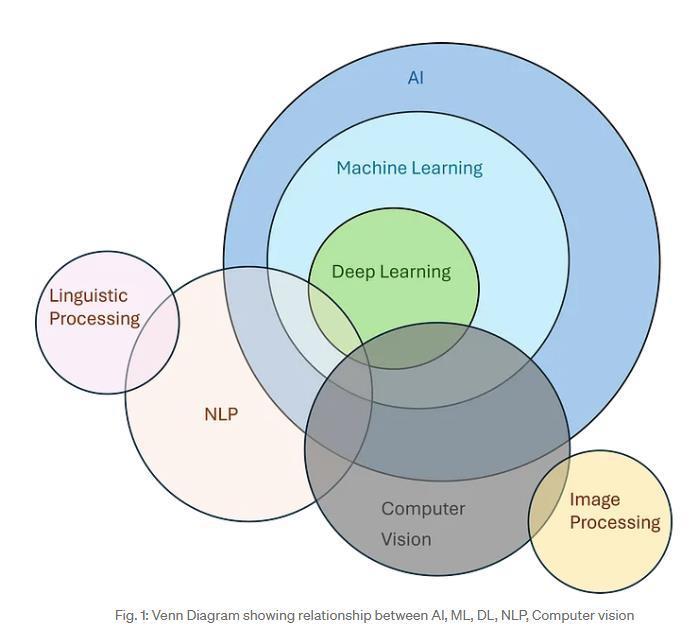
Fig -1:VennDiagramshowingrelationship[11]
ArtificialIntelligence(AI)empowersmachinestosimulate human intelligence, enabling them to perform tasks such as reasoning, learning, decision-making, and problemsolving. It forms the foundation for various technologies, includingmachinelearning,robotics,andnaturallanguage processing, and acts as the overarching "superset" of intelligentsystems.
Machine Learning (ML) is a subset of AI that enables systems to learn and improve from data without explicit programming.Itisclassifiedintothreemaintypes:
● Supervised Learning: Uses labeled data to make predictions.
● Unsupervised Learning: Identifies patterns and structuresinunlabeleddata.
● Reinforcement Learning: Adapts through feedbackbasedonrewardsorpenalties.
ML powers flexible and adaptive solutions, such as recommendationsystemsandfrauddetectionmodels.
Deep Learning (DL) utilizes neural networks modeled after the human brain to detect patterns in raw data. It automates the process of feature extraction, excelling in tasks such as image recognition, speech processing, and text analysis. Although DL demands significant computational resources, it drives groundbreaking innovations like virtual assistants and autonomous vehicles.
Natural Language Processing (NLP) bridges the gap between human communication and machine understanding. It enables systems to process, interpret, andgeneratehumanlanguage,poweringapplicationssuch aschatbots,textsummarization,andlanguagetranslation. Techniqueslike deep learningand GenerativeAdversarial Networks (GANs) enhance NLP capabilities. GANs, in particular,areadeptatcreatingrealisticoutputs,including images,text,andaudio.
Computer Vision (CV) allows machines to analyze and interpret visual data, such as images or videos, using advanced models like Convolutional Neural Networks (CNNs). CNNs extract information at the pixel level, enabling applications such as facial recognition, object detection, and autonomous navigation. CV equips AI systems to make real-world decisions, from detecting obstacles in self-driving cars to identifying faces in securitysystems
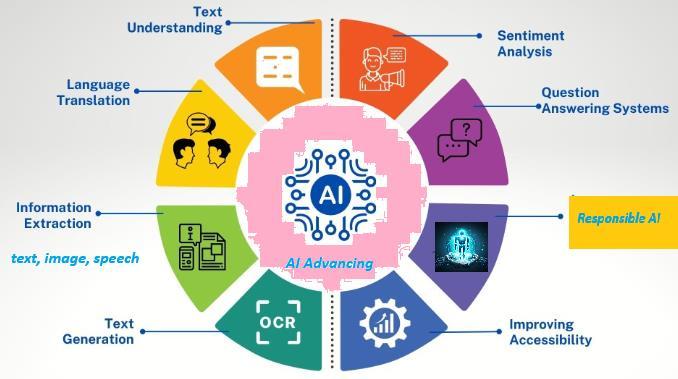
Artificial Intelligence (AI) derives its name from the concept of intelligence, which inherently implies progress and innovation. The remarkable potential of AI lies in its continuous advancement. Over time, AI has evolved from interpreting code at the binary level to processing assembly language and ultimately understanding and responding to human inputs in natural language through technologieslikeNaturalLanguageProcessing(NLP).
AI is transforming the technological landscape by mimicking human reasoning and decision-making in realworld scenarios. Its ability to learn autonomously, powered by neural network-based technologies, has significantly accelerated its growth and capabilities, achievingexponentialadvancementsinrecentyears.
Volume: 11 Issue: 12 | Dec 2024 www.irjet.net p-ISSN:2395-0072
AI has evolved to process multiple input types, including text, images, and speech, and generate outputs across various formats. Modern AI models are designed not only to interpret instructions but also to analyze sentiments and emotions embedded in the inputs, delivering responses that feel more human-like and empathetic. TheseevolutionsarepropellingAIintomoresophisticated domains, including generative, predictive, analytical, and self-learning models. These advancements are applied across a broad spectrum, from interactive chatbots to autonomous vehicles like robo-taxis. AI's influence spans industries such as technology, education, fintech, and healthcare.
To further optimize performance, AI models have progressed into systems like RAG (Retrieval-Augmented Generation),whichimproveresponsespeedandaccuracy. ThisinnovationcontinuestopositionAIasacriticaldriver ofprogressacrossdiversefields.
Retrieval-Augmented Generation(RAG) models enhance response accuracy and relevance by retrieving input or prompts, augmenting them with data from vector databases, and then generating responses more quickly andeffectively.
Table -1: Comparisonofmodels
Comparison of Models
ModelType Capability Key Techniques Usecase examples
Generative Generatenew contentanddata basedonthe interaction/ instruction.
Predictive Future predictionbased onhistorydata.
Analytical Insight extractionfrom data(text,image, audio)for intelligent analysis.
GANs,VAEs, Diffusion Models
Image generation,textto-speech
Regression, Neural Networks, Trees
Salesforecast, customer behavior prediction,fraud detection
Clustering, PCA, Association Rules Customer segmentation, anomaly detection
Self-learning Correctiveand continuous improvement. Reinforceme ntLearning, neural network Learning
AI is no longer a futuristic concept it is a technology embedded in our everyday lives. The computers we use, the phones we carry, the digital applications we rely on, the music players we enjoy, the cars we drive, and the software powering enterprises all incorporate AI or are enhanced by AI-driven capabilities.AI has been proved to improve the lives of human beings in different ways. AdoptionofAIhasspreadacrossalltheindustries. Ithas impactedbothindustriesandgovernmentfunctionsatthe same time. It has helped to tackle labor shortages, boost productivity in software development, build autonomous vehicles, strengthen national defense; to name a few [3]. Productivity and cost savings have increased with the adoptionofAI.
However, along with these capabilities come significant risks.AImodelsusevastamountsofdatatotrainandtest. They use historical data to make predictions about the futuretypicallybyassigningweightstofeaturesidentified during the feature engineering phase [2]. AI applications face challenges due to the lack of generalizability to different contexts [3]. In these situations, they face unexpected outcomes. System may not be trained for these so-called corner cases. As these models are trained on features that can range to hundreds to millions, it's usually challenging for AI and ML engineers to identify why a particular output was produced by the model. In addition, based on the data these models are trained and from the data these models learn, there can be bias and discrimination which can result in behaviors which are difficulttotrace[4].
Historical events and statistics highlight that AI-related riskshavealreadyemerged,impactingbusinessesandthe real world in various ways. AI models, such as Large Language Models (LLMs) and Small Machine Learning (SML)models,generateoutputsbasedonpre-traineddata and continuous learning, adapting to feedback provided during their use. This raises critical risks at both the predeployment and post-deployment stages of generative AI, necessitating a thorough understanding and management ofthesechallenges.
Table -2: AIRisks
Self-drivingcars, adaptive robotics
International Research Journal of Engineering and Technology (IRJET) e-ISSN:2395-0056
Volume: 11 Issue: 12 | Dec 2024 www.irjet.net p-ISSN:2395-0072
Transparency
Jobdisplacement
Misinformation/disinformation
Intellectualpropertyinfringement
Before deploying generative AI models, extensive pretraining is conducted using vast amounts of data, along with use cases and historical events. However, if the training data, shared decisions, feedback, or use cases contain inherent biases such as those based on gender, skin color, or age the model will absorb these biases. Consequently, it will generate outputs and decisions that perpetuatethosesamebiases,asitsfoundationisbuilton skeweddata.
In addition to bias, other significant risks at the preimplementation stage include concerns about privacy, transparency, and the potential for job displacement. Thesechallengesunderscoretheimportanceofaddressing such issues early in the AI lifecycle to mitigate their longtermimpact.
When implementing a Generative AI model, there are inherent risks, such as the creation of deep fake content, especially if the model is not trained on accurate data, lacks fine-tuning with robust algorithms, or is misused to generate manipulated outputs. Deep fake technology, which involves swapping faces or altering images, has emergedasasignificantAI risk,posingthreatsto privacy, security,andidentity,asevidencedbyrecentincidentson theinternet.
There are concerns on data privacy with the usage of AI. Systems collect vast amounts of data from different sources to train the models. This data goes through multiple iterations of transformation. Data can be public dataavailableontheinternetordatasharedbythirdparty systems. Validating authenticity of the data is a major challenge for AI applications. In addition to that these systems process vast amounts of personal data[5] which canrangefromsocialmediaprofileinformationtomedical information. Usage of these data without proper privacy laws can result in improper use of the technology. On top ofthat,usingdatafromunverifiedsourcescanresultinAI models which are biased or make wrong decisions. No proper framework to validate the authenticity of the data is also a major concern. Another concern is related to the effect on employment opportunities. Automation can impacthighlyroutineandcognitivetasks[7].
AI governance encompasses the frameworks and measures established to manage these risks and ensure the ethical and responsible use of AI technologies. Key challenges addressed by AI governance include bias, privacy violations, lack of transparency, and the potential for job displacement. To mitigate such risks effectively, a well-structured AIgovernancestrategy is essential before integrating AI into enterprise digital transformation. This approach involves setting up ethics boards, embedding ethical considerations into AI design, and adopting organizational strategies that promote innovation while proactivelymanagingassociatedrisks.
DesigningandimplementinganAIgovernanceframework is a complex task, as there is no universally accepted definition that encompasses all aspects of AI governance. It requires a deep understanding of AI's capabilities, potential benefits, and associated risks. Transparency throughout the entire AI lifecycle from data usage and algorithm development during the software design phase to the generation of AI-driven content is essential. Additionally, adherence to both local and international regulations is critical to ensure compliance and establish ethicalguardrailsforAIsystems.
An effective AI governance framework strives to balance regulatory oversight with a culture that promotes transparency, trust, and accountability. It safeguards fundamental rights while fostering innovation and encouraging the responsible development of AI technologies for societal benefit. An AI governance framework can be developed in phases, incorporating local, global, future, and technological considerations during its design. Each phase should establish key pillars toensuretheframeworkiscomprehensiveandadaptable.
Governance of Artificial Intelligence (AI) operates on two levels: local (within individual countries) and global (across multiple nations). Both levels present unique challenges and opportunities that must be addressed collaboratively to create a cohesive and effective governance structure. The interaction between these levels ensures a balanced approach to AI oversight and regulation.
An effective AI governance strategy must incorporate globallyimplementedAI-relatedlaws.Forexample,theEU AI Act, the first internationally published framework, has set a precedent by redefining and categorizing AI risks. Following this initiative, other countries are also working
International Research Journal of Engineering and Technology (IRJET) e-ISSN:2395-0056
Volume: 11 Issue: 12 | Dec 2024 www.irjet.net
towards developing their own AI regulatory frameworks to address emerging challenges and opportunities in AI governance.
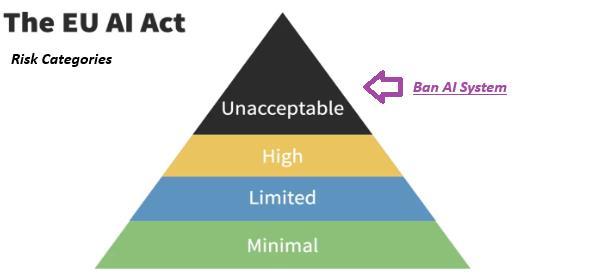
The EU AI Act categorizes risks based on their criticality, asoutlined in theAct's criteria. Thisclassification aims to address and mitigate risks of varying levels of severity, particularly those with significant global or life-altering impacts.
Unacceptable Risks are those deemed highly critical according to the defined criteria in the AI governance framework. Applications falling under this category are flagged as high-priority concerns, halting further development until the identified risks are effectively mitigated.
At the local level, countries create their own rules and policies to tackle issues specific to their needs and priorities.Thisinvolvesgovernments,industries,andlocal organizations working together to make sure AI benefits their communities. However, this approach can lead to fragmented regulations and differences between regions, makingcoordinationtricky.
Table -3: AIGovernancePillars
AIGovernance FrameworkPillar Description RiskMitigated
Transparency Transparency fromAIsystem designphase,AI modeltraining dataselection,and decisionmaking algorithms AvoidsriskofBias andunfairrisks. Reduceunknown factorsofAI systems.Fake trainingdatacan beavoided.
AIRisk categorisationand DefiningAIriskin high,medium,low
AIvitalriskon livesandbusiness
p-ISSN:2395-0072
lawenforcement categoriesand enforcingrulesto avoidtheserisks.
DataPrivacy Protectdata privacytoavoid threatofmisuse. Nationalsecurity andhealthcare dataisthemost sensitivedatato beprotected undertheseAI systems.
Accountabilityand Responsibility AIsystemsmust have accountabilityand responsibility definedandtested. Guardrails implementedon allAIsystems.
HumanOversight AIsystemsmust havehuman oversighton decisionmaking andcontrolto controltheAI systemsactions anddecision making algorithms.
AIActcompliance (localandglobal)
Continuous Monitoringand Enhancement
AIgovernance mustcomplywith localandglobalAI Acts.Lawofthe landand technologymust beenforcedonall AIsystems.
AIsystemsmust havecontinuous monitoringand enhancement basedonthe feedbackfrom theirhistory decisionsandacts. Advancingwith newinnovationin futuremustbe incorporated.
willbecontrolled withsupporttoAI technology innovation.Impact ofAIriskson businesscanbe controlled.
Nationalsecurity datathreat, Healthcare informationleak, Businessesdata andtechnology securityriskcan bemitigated.
Hallucinationand Nonaccountability ofAIsystemscan bemitigated. Wrongandunfair decisionscanbe controlled.
Mitigate unstoppableAI systems.AI systemscanbe controlled, corrected and stoppedby humansincase theygowrongin decisionmaking.
LocalandGlobal AIActbanscanbe mitigated.National securitythreats mitigated.
Unexpandableand UnattendedAI systemscanbea threattosociety. Correctionsand Improvements basedonfeedback canmitigatethe risks.
International Research Journal of Engineering and Technology (IRJET) e-ISSN:2395-0056
Volume: 11 Issue: 12 | Dec 2024 www.irjet.net
AI is a Digital Technology whose adoption as part of the Digital Transformation requires transformation in the organizational culture from resourcing, staffing, decision making and most importantly culture [18]. AI can have a disruptive impact on the organization if done correctly. The study conducted by Holmström et al [18] at an Insurance Organization wanted to apply AI readiness framework to the four dimensions of the Digital Transformation namely technologies, activities, boundaries and goals. As part of the Digital Transformation attributes, we will embed AI Governance pillarsintothese4dimensions.
Table -3: FourdimensionsoftheDigitalTransformation [18]
Dimension Description
Technology
Newtechnologiesarebeingintegratedaspart ofdigitaltransformation,resultingina significantimpactonorganizationsatalarge scale[21]
Activties Organizationshavebeenabletoperform activitiesmoreefficientlyfollowingthe adoptionofdigitaltransformationpractices [18][21].
Boundaries
Theimplementationofdigitaltransformation hasledtotheexpansionoreveneliminationof traditionalenterprisearchitectureboundaries formanyorganizations[18].
Goals Digital transformation can profoundly influence the goals and objectives of organizations, reshaping their strategic direction[22].
Table -4: ApplyingAIGovernancePillarstothefour dimensionsofDigitalTransformation
Dimension AIGovernance Pillar Description
Technology Transparency Aspartofdigital transformation,companiesoftenadoptnewtoolsand technologiesthatleverageAImodels.Enterprisesmust maintaintransparencyregardingthedatausedtotrain
AIRisk categorisation andlaw enforcement
p-ISSN:2395-0072
Device governance rules to enforce AI risk assessment on the tools andtechnologiesthatuse AI these models and implement governance rules to enforce AI risk assessmentsfortoolsand technologies employing AI.
Data Privacy Digital transformation involvestheenhanceduse of data for decisionmaking. Organizations should establish practices thatpromotetheeffective use and reuse of data, lay the foundation for integrated data systems, ensure robust data protection mechanisms, and provide equitable access to the benefits generatedbydata[19].
Accountability and Responsibility
AI governance, incorporated into digital transformation, should emphasize the accountability and responsibility of AI models. This includes considerations for authority recognition, interrogation, and the limitationsofpower[20].
Human Oversight
Continuous Monitoringand Enhancement
Tools developed using AI technologies as part of digital transformation initiativesmustadhereto compliance standards, generatedetailedreports, and undergo oversight to evaluate their performanceandconduct [20].
Monitoring practices should be in place to conductregularauditsof tools developed using AI technologies as part of Digital Transformation initiatives.
International Research Journal of Engineering and Technology (IRJET) e-ISSN:2395-0056
Volume: 11 Issue: 12 | Dec 2024 www.irjet.net p-ISSN:2395-0072
Activities Accountability and Responsibility Human Oversight
With Digital Transformation, enterprises can perform activitiesmoreefficiently. Mechanisms should be established to ensure the accountability and responsibility of AI models in terms of authorityrecognitionand interrogation
Mechanisms should also be implemented to monitor activities concerningthedatabeing exchanged and the responses of the models for accuracy and correctness
AIAct compliance (localand global) Continuous Monitoringand Enhancement
Boundaries AIRisk categorisation andlaw enforcement
Systems should be establishedtoensurethat new and enhanced enterprise activities comply with local and nationalregulations
Monitoring practices should be in place to conductregularauditsof activities to ensure they do not violate societal norms
As enterprises extend beyondtheboundariesof their architecture, they often integrate with multiple third-party systems for new AI capabilities. Governance practices should be implemented to ensure proper AI risks are identified during these integrations.
AIAct compliance (localand global)
These integrations should alsocomplywithlocaland national AI laws and practices.
Goals Transparency Whendefiningnewgoals, enterprisesshouldensure transparency in the data used to train models to achievetheseobjectives.
AIAct compliance (localand global)
Proper audits and governance strategies should be in place to ensure these goals are achievedinaccordance with local andnational compliancelaws.
AIand ML systems rely on data and complex models. The complexity of these algorithms remains a barrier because of the challenges in explainability, accountability and transparency of these algorithms. Even experts cannot explain with confidence why certain outputs were generated [8]. In certain industries, the algorithms are intentionally kept opaque because of security concerns and intellectual proprietary issues. Moreover, these algorithmsdependonthedata.Qualityofthedataplaysan important role in the output of these algorithms. The governance framework should address the issue of the technicality of these complexalgorithms at the same time introducemethodologiestobringinthegovernanceofthe data. Technical advancements in these areas is another challenge. New AI models and versions of the existing models are getting released so frequently that bringing them under the scrutiny of the guidelines is more challenging unless there is a governance body who can manageit[10].
AIissteadilyadvancingand drivingsignificantchanges in boththeinternalandexternaloperationsofenterprises.It isalsosimplifyingdailylifeforindividualsinvariousways. As a digital technology, AI relies heavily on data collected from multiple sources. Therefore, it is crucial to establish governance practices to ensure the authenticity of results and that decisions made by AI models comply with local and national laws. With the rise of digital transformation, embedding these governance practices into the transformation process has become imperative. This approach enables enterprises to integrate responsible AI practices seamlessly, ensuring compliance while avoiding potential fines or legal complications. In conclusion, the success of AI-driven digital transformation depends not only on technological advancements but also on the strength of the governance strategies implemented. By embedding responsible AI practices into their transformation processes, enterprises can ensure ethical, transparent, and sustainable operations, positioning themselvesforlong-termsuccessinthedigitalera.
International Research Journal of Engineering and Technology (IRJET) e-ISSN:2395-0056
[1] Vinothkumar, J., & Karunamurthy, A. (2022). Recent advancements in artificial intelligence technology: trends and implications. Quing: International Journal of Multidisciplinary Scientific Research and Development,2(1),1-11.
[2] Lim, H. S. M., & Taeihagh, A. (2019). Algorithmic decision-making in AVs: Understanding ethical and technical concerns for smart cities. Sustainability, 11(20),5791.
[3] Taeihagh, A. (2021). Governance of artificial intelligence.Policyandsociety,40(2),137-157.
[4] Osoba, O. A., Welser IV, W., & Welser, W. (2017). An intelligenceinourimage:Therisksofbiasanderrors inartificialintelligence.RandCorporation.
[5] Lu,Q.,Zhu, L.,Xu, X., Whittle, J.,Zowghi, D., & Jacquet, A. (2024). Responsible AI pattern catalogue: A collection of best practices for AI governance and engineering.ACMComputingSurveys,56(7),1-35.
[6] Janssen, M., Brous, P., Estevez, E., Barbosa, L. S., & Janowski,T.(2020).Datagovernance:Organizingdata for trustworthy Artificial Intelligence. Government informationquarterly,37(3),101493.
[7] Frey, C. B., & Osborne, M. A. (2017). The future of employment: How susceptible are jobs to computerisation?. Technological forecasting and socialchange,114,254-280.
[8] Felzmann, H., Villaronga, E. F., Lutz, C., & TamòLarrieux, A. (2019). Transparency you can trust: Transparency requirements for artificial intelligence between legal norms and contextual concerns. Big Data&Society,6(1),2053951719860542..
[9] Larsson, S. (2020). On the governance of artificial intelligencethroughethicsguidelines.AsianJournalof LawandSociety,7(3),437-451.
[10] Kroll, J. A. (2015). Accountable algorithms (Doctoral dissertation,PrincetonUniversity).
[11] https://medium.com/@jainpalak9509/breakdownsimplify-ai-ml-nlp-deep-learning-computer-visionc76cd982f1e4
[12] Zi, B., Chang, M., Chen, J., Ma, X., & Jiang, Y. G. (2020, October). Wilddeepfake: A challenging real-world dataset for deepfake detection. In Proceedings of the 28thACMinternationalconferenceonmultimedia(pp. 2382-2390).
Volume: 11 Issue: 12 | Dec 2024 www.irjet.net p-ISSN:2395-0072 © 2024, IRJET | Impact Factor value: 8.315 | ISO 9001:2008 Certified Journal | Page602
[13] Madiega, T. (2021). Artificial intelligence act. European Parliament: European Parliamentary ResearchService.
[14] Ebert, C., & Duarte, C. H. C. (2018). Digital transformation.IEEESoftw.,35(4),16-21.
[15] Osborne,S.P.,Cucciniello,M.,Nasi,G.,&Zhu,E.(2022). Digital transformation, artificial intelligence and effectivepublicservices:challengesandopportunities. GlobalPublicPolicyandGovernance,2(4),377-380.
[16] Matt, C., Hess, T., & Benlian, A. (2015). Digital transformation strategies. Business & information systemsengineering,57,339-343.
[17] Holmström, J. (2022). From AI to digital transformation: The AI readiness framework. BusinessHorizons,65(3),329-339.
[18] Davenport, T. H. (2018). The AI advantage: How to put the artificial intelligence revolution to work. mit Press.
[19] Yukhno, A. (2024). Digital transformation: Exploring big data governance in public administration. Public OrganizationReview,24(1),335-349.
[20] Novelli, C., Taddeo, M., & Floridi, L. (2024). Accountability in artificial intelligence: what it is and howitworks.Ai&Society,39(4),1871-1882.
[21] Huang,J.,Henfridsson,O.,Liu,M.J.,&Newell,S.(2017). Growingonsteroids.MISquarterly,41(1),301-314.
[22] Wessel, L., Baiyere, A., Ologeanu-Taddei, R., Cha, J., & Blegind-Jensen, T. (2021). Unpacking the difference between digital transformation and IT-enabled organizational transformation. Journal of the Associationforinformationsystems,22(1),102-129.
International Research Journal of Engineering and Technology (IRJET) e-ISSN:2395-0056
Volume: 11 Issue: 12 | Dec 2024 www.irjet.net

Gaurav Sharma, holding a Master's degree in Computer Science from Kurukshetra University(2005),isanAssociate Director at LTIMindtree with 20 years of experience in software engineering and quality leadership. He has driven transformative AI-driven solutions across industries such as Aviation, Telecom, Financial Services,Retail,andERPsystems. Gaurav specializes in designing AI-powered automation frameworks integrated into CI/CD pipelines, enhancing software development efficiency and time-to-market. An AI enthusiast and advocate for ResponsibleAI,heactivelyshares hisinsightsasathoughtleaderon platforms like Medium and LinkedIn.

Renjith Ramachandran received his Bachelor's Degree in Electronics and Communications Technology from India and his Master's Degree in Computer Science from the US. He spent 12 years as a consultant, taking on various roles from Software Engineer to Architect, and workingwithclientsinindustries such as Telecom, Banking, and Insurance. He currently serves as a Solutions Architect, with research interests that focus on software architectures, emerging technologies, and the development of innovative tools andframeworks.
p-ISSN:2395-0072